Map: GSI Japan Rozan-ji and the grave area near Horikawa-Kitaōji preserve two different kinds of memory attached to Murasaki Shikibu. Rozan-ji occupies ground identified in modern research with the Tsutsumi residence of her family, but the temple moved there only in the late sixteenth century and its present halls are later. Its Genji Garden is a modern literary interpretation, not a Heian garden. Several kilometres to the northwest, the mound called Murasaki Shikibu's grave stands beside the mound of Ono no Takamura and is documented as a paired location in medieval writing. The grave attribution is historically significant tradition rather than archaeologically demonstrated identification. The value of this focused Place lies in keeping residence site, later temple, interpretive garden, and memorial grave separate.
Rozan-ji's own moving history
廬山寺
Attraction
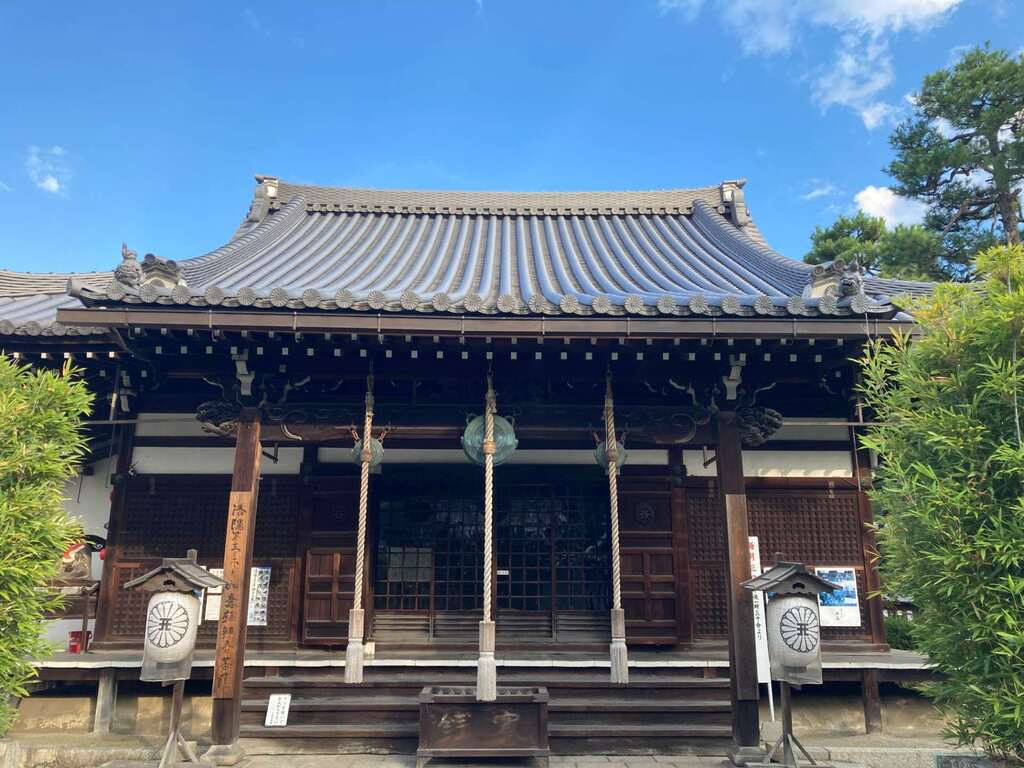
Rozan-ji began near Funaokayama under the monk Ryōgen in the tenth century, was rebuilt and renamed in the medieval period, burned during the Ōnin War, and moved to its present site in the late sixteenth century. The current Main Hall and related court-connected buildings date chiefly from rebuilding after the 1788 fire. This chronology prevents a basic mistake: the temple did not stand here when Murasaki Shikibu lived. What connects temple and author is the ground beneath and around the later institution, not an original room in which The Tale of Genji can be viewed.
Current visibility
The current temple buildings are visible under normal temple access, but they postdate Murasaki by many centuries.
The Tsutsumi residence site and Murasaki Shikibu
紫式部邸宅址
Attraction
Kyoto City's historical marker database identifies this ground with the Tsutsumi residence of Murasaki's great-grandfather Fujiwara no Kanesuke and records the tradition that she also lived here. Modern historical work strengthened the association; it is not an uninterrupted local label reaching back to the Heian period. A marker erected in 1965 materializes that interpretation. No excavated house plan is presented as Murasaki's room, and the marker itself has limited close access. The site's importance is therefore biographical geography: a credible family residence area linked to her life and writing, expressed through modern commemoration rather than surviving domestic architecture.
Current visibility
The residence association is marked within the later temple; no identified Heian house survives above ground, and the marker is not fully approachable from every side.
The Genji Garden as modern literary interpretation
源氏庭
Attraction
The Genji Garden uses white gravel, moss islands, stones, and seasonal bellflowers to evoke an imagined literary world associated with Murasaki Shikibu. Kyoto City describes it as a newly created dry landscape garden, not a recovered Heian plan. That modernity is the point: the garden shows how twentieth-century commemoration translated textual memory into a visual place after the residence-site identification gained prominence. It should not be used as evidence for what Murasaki's household garden looked like. Garden access follows temple hours, fees, closures, ceremonies, and conservation conditions published by Rozan-ji.
Current visibility
The modern garden is normally viewable during controlled temple hours; closures and access conditions require a current official check.
The grave mounds of Murasaki Shikibu and Ono no Takamura
紫式部墓所・小野篁墓
Attraction
Near Horikawa-Kitaōji, two planted mounds and stone markers are identified as the graves of Murasaki Shikibu and Ono no Takamura. Kyoto City's account notes that medieval writing already described the two graves together, giving the location a long documentary afterlife. The popular explanation that Takamura rescued Murasaki from judgment in the underworld is later legend, not proof of burial. Nor does the present enclosure expose excavated remains that verify either identity. The site matters as a durable medieval and modern memorial pairing, separate from Murasaki's probable residence ground at Rozan-ji.
Current visibility
The mounds and markers are visible in a small enclosure; the personal attributions are traditional and not presented as archaeologically verified burials.