Read the article below. Interactive reading tools are available when scripts load.
Quick
Kūkai was born in 774 in Sanuki Province on Shikoku. His secular family is usually placed within the Saeki local elite, a setting that could provide education and connections beyond an ordinary farming household.
Later biographies supplied a personal name, precise parentage, visions, unusual intelligence, and signs of future sanctity. Some details became central to Zentsūji and regional identity, but they do not all have equal early evidence.
The secure beginning is institutional rather than miraculous. Kin, household workers, provincial teachers, writing materials, and command of literary Chinese helped prepare a boy for study and possible government service.
The historical person emerged through later choices and opportunities; saintly childhood belongs to the history of devotion.
As a young man Kūkai studied the literary and classical knowledge associated with official advancement. He acquired a level of Chinese writing that later enabled diplomacy, religious argument, catalogue making, and court communication.
Around 797 he completed the work now known as Sangō Shiiki, a literary dialogue comparing Confucian, Daoist, and Buddhist paths. It expresses a Buddhist conclusion through invented speakers.
The text is not a transcript of Kūkai defeating representatives of three traditions in public. Nor is every speech a transparent diary entry.
It does show a consequential change of direction: an educated provincial with access to bureaucratic learning was presenting Buddhist practice as a more adequate life project, while using the literary tools that secular education had given him.
Before traveling to Tang China, Kūkai became associated with mountain, cave, and coastal practice, including a memory discipline connected with the bodhisattva Kokūzō.
Shikoku landscapes later preserved many claims about where he meditated, found water, carved images, subdued danger, or founded temples. These traditions made his early search visible in place.
They do not prove that Kūkai personally walked today's fixed circuit of eighty-eight temples. Pilgrimage across Shikoku formed over later centuries; documentary and material evidence becomes much clearer from the sixteenth century and especially the Edo period.
Early practice and later pilgrimage belong in the same relationship, but not the same event. Ascetics, guides, temple communities, villagers, mapmakers, road builders, hosts, and pilgrims constructed the route through time.
In 804 Kūkai crossed to Tang China as a long-term student monk attached to an official embassy. Saichō traveled on the same embassy system but with a different assignment and on a different ship.
The voyage depended on Kammu's government, embassy leaders, shipbuilders, sailors, navigators, interpreters, provisions, ports, and Tang officials. Storm and separation could destroy years of planning.
Kūkai's Chinese writing and ability to communicate purpose became valuable after landfall. Access to the interior was not automatic simply because a Japanese monk had survived the sea.
The event reveals a productive tension: personal intellectual urgency needed state authorization and collective maritime labor. No divine rescue scene or solitary-genius crossing replaces the people and institutions that carried him.
Chang'an exposed Kūkai to a scale of religious, linguistic, artistic, and administrative knowledge unavailable in Japan. Its monasteries connected Chinese traditions to learning and objects that had traveled from India, Central Asia, and maritime Asia.
Texts alone were not the whole transmission. Pronunciation, initiation, gesture, diagrams, images, ritual tools, pigments, copying practice, and teacher-student authorization all mattered.
Kūkai had to select among many possibilities under severe time pressure. Translators, scribes, artisans, patrons, foreign monks, and local institutions shaped what he could find and preserve.
Calling Chang'an a warehouse for one Japanese genius misses the network. His achievement lay in recognizing a powerful configuration, entering it, learning intensively, and preparing knowledge and material to cross into another institutional world.
At Qinglong Temple Kūkai studied with Huiguo, a leading esoteric Buddhist teacher. In a short period he received major initiations and instruction, while images, texts, implements, and copying were prepared for return.
Huiguo died in 805. The compressed timetable became central to later Shingon legitimacy: Kūkai presented himself as carrying an integrated transmission across the sea.
The evidence supports a major teacher-student relation and unusually concentrated transfer. It does not require that every practitioner in Chang'an accepted Kūkai as the only possible heir or that short instruction produced effortless total mastery.
Fellow monks, translators, painters, scribes, craftsmen, and patrons made the transfer material. Huiguo's authority mattered; so did the network that enabled teaching to survive his death.
Kūkai returned in 806, earlier than the long study period originally attached to his status. He brought texts, images, ritual objects, and a catalogue explaining the collection.
Emperor Kammu had already died. The return therefore did not culminate in a meeting with the ruler who authorized the 804 embassy. Heizei and then Saga governed Kūkai's opportunities.
Knowledge did not become authority at the harbor. Officials had to receive explanations, objects required transport and preservation, and a foreign-trained monk needed recognized places to teach and perform.
The period before full central prominence is not an embarrassing delay. It shows how innovation passes through review, regime change, existing temple interests, and the difficult conversion of private expertise into public institution.
From the Saga period Kūkai gained stronger central access. At Takaosan-ji he taught, initiated monks, wrote, and developed a network able to reproduce the transmission.
Saichō sought instruction and received major initiations in 812. Surviving registers and letters show cooperation, requests for texts, respect, different expectations about study, and later strain.
This relationship was not a simple duel between founders. Saichō had his own Tendai institution and disciples; some studied with Kūkai, and decisions about texts and training affected both communities.
Shingon formed through repeated acts: initiation, curriculum, manuscripts, images, ritual performance, discipleship, patronage, and boundary making. No single declaration transformed Kūkai's knowledge into a finished denomination.
In 823 Emperor Saga entrusted Tō-ji, an existing state temple at Heian-kyō's southern entrance, to Kūkai and his esoteric community.
The grant gave Shingon a durable urban and governmental base. Kūkai began reorganizing space, teaching, ritual, and building around an esoteric program.
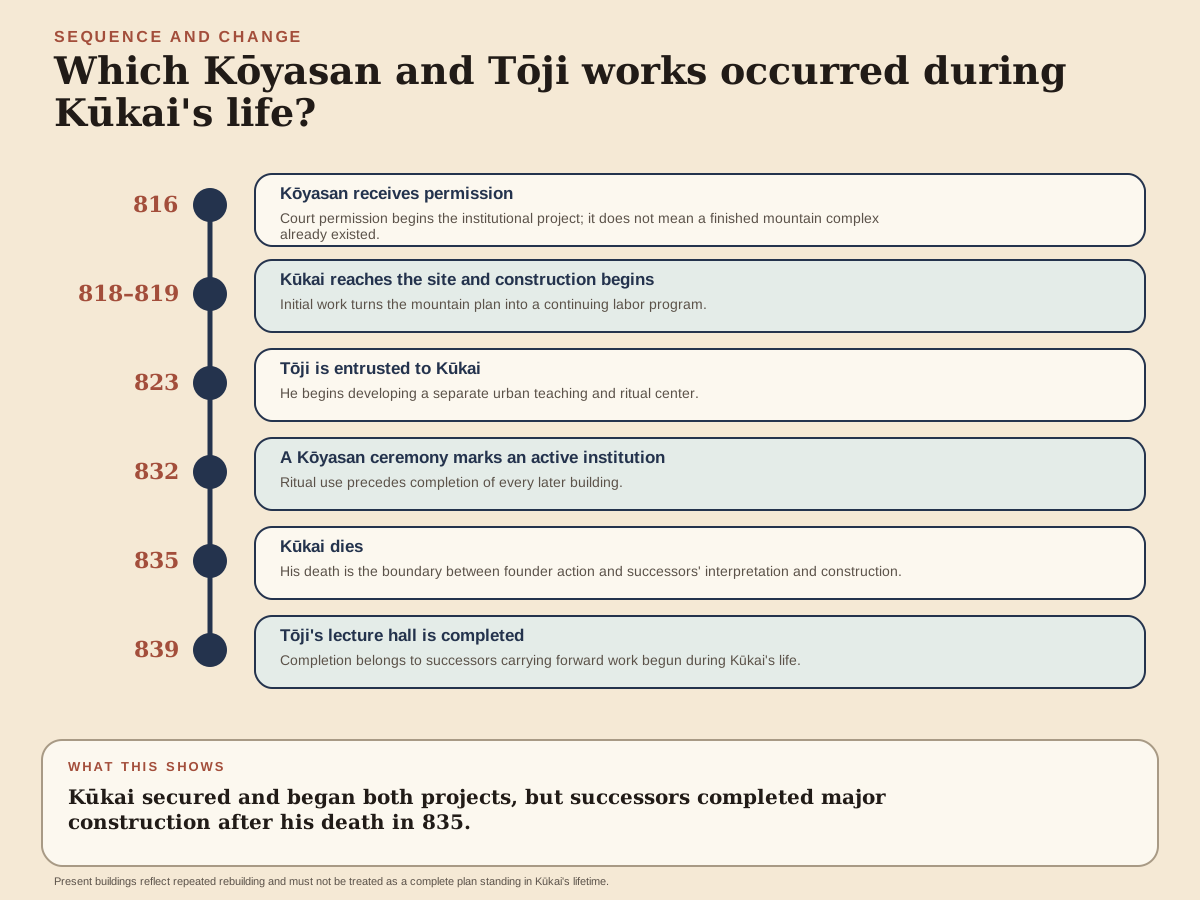
He did not produce the complex alone or finish it in one lifetime. The lecture hall begun in 823 was completed in 839, after his death. Sculptors, painters, monks, builders, timber workers, suppliers, patrons, and successors gave the plan material form.
Present Tō-ji preserves institutional and spatial continuity through repeated fires and reconstruction, not every ninth-century timber. The Place relation joins Kūkai's planning to centuries of custodianship.
In 816 Kūkai requested and received permission to establish a mountain practice center at Kōyasan in Kii. Temple chronology places his first ascent after permission in 818 and the start of major construction in 819.
The site offered distance from capital routine, but it was not outside politics. Rights to land, relations with provincial and local communities, access routes, timber, food, labor, and patronage all required negotiation.
Later sacred narratives describe hunters, deities, animals, and divinely selected terrain. These traditions express a religious understanding of place; they do not function automatically as survey records.
Kūkai established direction and ritual meaning. Disciples and workers continued the complex across generations. Kōyasan was a long project, not a finished gift created by one imperial authorization.
Danjō Garan became the ritual center of Kōyasan. Kūkai's plan used buildings, images, movement, and mountain setting to make an esoteric cosmos inhabitable.
Work began during his life, and a major ceremony was held in 832. But important structures, including the great pagoda project, extended beyond his death and depended on disciples and later patrons.
Fires repeatedly altered the complex. Present buildings express reconstructed continuity rather than an untouched ninth-century fabric.
This difference matters for both history and visitor interpretation. Kūkai's agency lies in selecting and organizing a sacred building program; carpenters, artists, donors, monks, and successive rebuilding communities made the program endure.
In 821 Kūkai was appointed to help repair Mannō Pond in Sanuki after earlier reconstruction efforts had failed. The reservoir existed long before him and continued to be rebuilt long after him.
His regional reputation, administrative access, and technical authority may have helped mobilize workers and complete a major phase. Farmers, officials, planners, earth workers, tool makers, and food suppliers made the repair real.
In 828 Kūkai founded Shugei Shuchi-in in Kyoto on property associated with Fujiwara no Mimori. It offered Buddhist and non-Buddhist learning to people excluded from the state university and provincial-school routes.
The school was neither a modern public university nor a permanent mass institution; it ended after Kūkai's death. Together, pond and school show a monk applying networks to public capacity, with collective execution and institutional limits intact.
Kūkai's writing joined religious thought, official communication, poetry, catalogue, pedagogy, calligraphy, and interest in sound and script. Surviving manuscripts show fluent brushwork and, in some cases, visible revision rather than miraculous effortlessness.
Later memory grouped him with Emperor Saga and Tachibana no Hayanari among the Three Brushes. It also attached famous sayings, exemplary anecdotes, abundant calligraphy, kana invention, and the Iroha poem to his name.
These claims do not share one evidentiary level. Authenticated letters, registers, catalogues, and doctrinal manuscripts can be studied object by object; attribution based only on saintly fame cannot.
Writing mattered because Shingon joined sound, character, image, body, and meaning. Kūkai was not merely a beautiful hand. He used scripts to move knowledge between languages and institutions.
Kūkai died at Kōyasan in 835. Historical narration stops his agency there: no final speech, diagnosis, inner review, or conscious observation of later institutions is invented.
Shingon tradition describes the event as nyūjō, entry into continuing meditation. Okunoin practice treats Kōbō Daishi as still present and receives offerings accordingly.
These statements answer different questions. Death belongs to the biographical event layer. Continuing presence belongs to belief, ritual, community, and Place history.
The distinction neither mocks faith nor converts it into biology. Disciples, attendants, court and temple institutions, memorial workers, donors, and believers carried Kūkai's transmission after the person could no longer act historically.
Kūkai did not use the name Kōbō Daishi during his life. Emperor Daigo granted that posthumous title in 921, after requests associated with Kangen and growing institutional devotion.
Kōyasan and Tō-ji preserved different but connected modes of presence. Memorial rites, images, manuscripts, buildings, offerings, teaching lineages, and pilgrimage expanded the founder beyond his 774–835 biography.
The Shikoku circuit became a major popular form through later route selection, guides, maps, markers, lodging, hospitality, and local support. Countless springs, carvings, schools, temples, inventions, and sayings were also attached to Kōbō Daishi.
Through 1912 the result was a national sacred figure made by practitioners and places. Canonical history preserves this reception without making every attribution a lifetime fact or allowing the dead founder to narrate it.
Classic
Founder biographies often begin at the end. Once a religious community regards an adult as exceptional, childhood is rewritten as the first visible proof.
Kūkai's birth in 774 and association with Sanuki are firm chronological anchors. A connection to the Saeki family and provincial elite is also more credible than an origin outside every institution.
That background matters because education was expensive. Literary Chinese required teachers, texts, paper, brushes, time away from subsistence work, and people who expected study to produce advancement.
Family position could connect a student to provincial schooling and eventually the capital. It did not guarantee success or decide which intellectual path he would choose.
Later accounts identify parents, a childhood name, sacred dreams, and prodigious behavior in vivid detail. Local communities have preserved these claims as religious and place memory.
The correct response is not contempt. A birth tradition can shape pilgrimage, temple identity, family genealogy, festivals, images, and the way residents locate universal sanctity in a familiar landscape.
It is still not contemporary observation merely because it is old. The time between childhood and surviving elaborated biography created room for theological pattern and institutional claim.
A destined infant solves several later problems. It makes departure from official study appear inevitable, makes rapid learning in Tang China seem prefigured, and makes future authority independent of political contingency.
Historical explanation works differently. It asks what capacities existed before the religious outcome: local status, education, language, kin support, travel opportunity, and access to Buddhist practice.
It also restores invisible contributors. Household women managed care and resources. Servants and producers sustained elite study. Teachers transmitted characters, texts, and disciplined habits.
The Saeki label should not become a complete personality theory. A lineage category does not tell us whether the child was devout, ambitious, anxious, rebellious, or intellectually restless.
Nor should provincial origin be turned into outsider romance. Sanuki was connected to ritsuryō administration, temples, roads, ports, and the Inland Sea. It was not beyond the state.
Later Kūkai could use provincial relationships powerfully, most famously in the Mannō Pond appointment and the dense memory of his Shikoku presence. Those developments cannot be installed in infancy.
Even a reported birth place may hold two truths at once: a site can be a real centuries-old focus of devotion while the precise room and circumstances remain historically unverified.
This boundary protects Kūkai from a flattering reduction. If every achievement flowed automatically from divine childhood, his adult decisions, study, institutional negotiation, and dependence on others would cease to matter.
It also protects readers from circular proof. Later fame cannot be used to authenticate every story created to explain that fame.
The strongest opening is therefore modest but substantial. A boy born in 774 entered a locally prominent, literate world capable of sending him toward central learning.
What he would do with that access remained open. The saintly child is a later devotional object; the historical child is present through conditions, not recoverable mature speech.
The young Kūkai did not abandon learning when he moved away from ordinary official ambition. He redirected skills acquired for one institutional future toward another.
Classical study trained memory, composition, allusion, argument, brushwork, and sensitivity to audience. These capacities later made religious claims legible to emperors, monks, officials, and educated patrons.
The work associated with 797 is structured through speakers representing different teachings. Literary personae allow an author to arrange positions, objections, hierarchy, humor, and conversion.
That form does not report three historical advocates meeting before an audience. A fictional speaker can combine common arguments, social types, and rhetorical exaggeration.
Calling the text a victory in debate changes genre into event. It gives the author an opponent who can be defeated once and makes intellectual history look like a tournament.
The actual achievement is more durable. Kūkai had learned competing ethical and religious vocabularies well enough to stage their differences and guide readers toward his preferred conclusion.
The Buddhist choice should also not be reduced to rejection of everything learned before it. His later career depended continuously on Chinese prose, official forms, court rank, diplomacy, and institutional negotiation.
Confucian learning was not merely an enemy. It remained part of the language through which educated government evaluated a monk's usefulness, discipline, and claims.
Daoist material in a literary comparison likewise does not prove a stable organized Japanese rival identical to later religious categories. The work uses inherited concepts for an argumentative purpose.
The autobiographical element is strongest at the level of direction. Kūkai presents ordinary status and scholarship as insufficient beside a Buddhist path that promised transformation and universal scope.
It is weaker at the level of scene. We cannot hear his exact conversation with a relative, identify one decisive lecture, or recover a moment when official ambition vanished completely.
Family expectations deserve attention because withdrawal from a bureaucratic route redistributed investment. Kin who supported education may have expected office, income, marriage alliance, and prestige.
Religious departure could therefore be both intellectual and social. A new vocation required teachers, ordination, recognized discipline, texts, travel, food, robes, and communities willing to support practice.
The composition itself is material evidence of continued connection. Someone supplied paper and copying; readers understood the script and references; a text circulated beyond solitary mountain experience.
Later denominational history can make the outcome too neat. In 797 there was no completed Japanese Shingon institution, no Tō-ji center, and no Kōyasan complex awaiting its founder.
Kūkai's questions exceeded the system available to him. The subsequent Tang mission mattered precisely because writing a Buddhist preference did not yet supply the ritual, texts, images, teachers, and authorizing transmission he sought.
The work therefore stands between careers. It records neither a government student who simply failed nor a fully established patriarch speaking from certainty.
It shows an author using elite learning to justify a risky reorientation. The literary victory belongs inside the book; the historical decision unfolded through years of study, practice, and institutional search.
Mountains and remote coasts offered conditions different from classroom or capital temple. Isolation, hunger, weather, repetition, fear, and bodily endurance made religious practice concrete.
Tradition links Kūkai to a discipline invoking Kokūzō and intended to transform memory and understanding. The exact sequence of instruction and every claimed site remain unevenly documented.
That unevenness is expected. Ascetic movement produces fewer bureaucratic records than court office, and later sacred geography preserves significance through story rather than contemporary itinerary.
Local knowledge made solitary practice possible. Guides knew paths and water; households supplied food or shelter; temple and shrine communities interpreted dangerous terrain; boat people connected coasts.
Calling an ascetic completely alone erases those relationships. Remoteness is a degree of distance from institutions, not the absence of all human support.
Later followers attached Kūkai to caves, peaks, springs, stones, temples, and miraculous interventions. Each attachment increased the density of a landscape in which the founder seemed continually present.
The modern eighty-eight-site circuit is a different historical object. It requires a selected list, route order, naming conventions, lodging, guides, devotional practices, and communities prepared to receive travelers.
Evidence confirms pilgrimage activity by the sixteenth century. Edo-period diaries, printed guides, maps, markers, charity, and travel facilities show a mature long-distance circuit.
A detailed 1763 printed map, for example, documents an already organized regional system. It cannot be used as a map of Kūkai's own movements nine centuries earlier.
The number eighty-eight also should not function as automatic proof. Once a circuit becomes authoritative, older sites can be interpreted through the finished total and alternative routes become less visible.
Women, poor pilgrims, people with disabilities, the sick, professional religious travelers, local residents, and elites did not experience access in the same way. Restrictions and substitute worship sites reveal unequal pilgrimage geography.
Villagers maintained paths, offered or sold food, carried information, buried travelers, and negotiated the burdens and benefits of sacred traffic. Their work made devotion mobile.
Kūkai's historical role remains important without sole authorship. His remembered Sanuki origin, ascetic reputation, temple relations, posthumous title, and continuing-presence belief gave later pilgrims a powerful companion figure.
The phrase often translated as two traveling together expresses that devotional relation, but the mature practice belongs to communities after his death. It should not be placed in his early first-person voice.
Separating periods also protects local claims. A temple tradition need not prove a precisely dated visit to be studied as evidence of when and how a community joined Kūkai's sacred geography.
The same site can therefore hold layered records: possible early ascetic association, medieval foundation narrative, Edo route infrastructure, Meiji markers, and current ritual.
Biography benefits from that architecture. Kūkai's early practice shows dissatisfaction with purely literary learning and growing demand for embodied method; later pilgrimage shows how societies expanded that search into a shared route.
The responsible conclusion is neither that he founded all eighty-eight sites nor that Shikoku memory is fiction without value. His life supplied an origin relation; generations built the circuit.
Crossing the East China Sea in the early ninth century was not independent educational travel. Ships, diplomatic status, seasonal timing, provisions, documents, and permission determined who could attempt it.
Kammu's court sponsored the embassy for state relations and knowledge acquisition. Individual monks entered a larger project whose aims also included diplomacy, information, texts, and prestige.
Kūkai traveled with long-term study status. Saichō's assignment was shorter. Their distinct positions shaped expectations about duration, training, and the legitimacy of early return.
They also did not share one ship. Treating them as two famous passengers in a single cabin erases the fleet's distributed risks and their separate travel experiences.
Embassy leadership mattered. Fujiwara no Kadonomaro and other officials carried authority that monks alone did not possess in dealings with foreign administration.
Shipwrights converted timber, cordage, sail, and accumulated experience into vessels capable of departure, not guaranteed arrival. Maintenance continued under stress at sea.
Sailors and navigators read wind, current, cloud, stars, damage, and limited coastal knowledge. A learned monk could not substitute calligraphy for their skill.
Provisioners calculated water and food for uncertain duration. Illness, spoilage, fear, crowding, and separation made the ship a social as well as mechanical system.
Accounts of sacred protection later gave the crossing religious meaning. Such belief can be retained as Tradition, but it cannot replace weather, labor, decisions, and chance as objective explanation.
Landfall did not end the problem. Coastal officials had to identify the travelers and decide whether their documents and explanation justified movement farther inland.
Kūkai's literary Chinese is traditionally credited with helping communicate the embassy's position. The broader point is secure: language functioned as infrastructure between foreign bodies and administrative categories.
Interpreters, scribes, messengers, local transport, inns, guards, and provincial offices then enabled the route toward Chang'an. Arrival at the capital was another institutional achievement.
The mission also demonstrates unequal access. Countless Japanese monks could desire foreign learning; very few could obtain a place, endure the journey, and enter elite Tang networks.
Family education and court recognition thus returned to the story. The same literary training Kūkai had redirected away from ordinary office now helped him navigate a state diplomatic channel.
Outcome bias makes the voyage look designed for Shingon. In 804 neither Japanese officials nor Kūkai could know the exact teacher he would meet, how quickly training would proceed, or whether he would return alive.
Saichō's presence provides a shared event without collapsing biographies. His mission, texts, companions, return, and institutional priorities belong to him; Kūkai's later transmission belongs to another path.
The fleet carried people with different aims, and not all careers became famous. Crew injury, death, or unrecorded service should remain part of the event even when biography follows one passenger.
Kūkai's courage is not diminished by dependence. Choosing the voyage meant accepting extreme risk inside a system he did not control.
The strongest account therefore joins agency to infrastructure. He pursued a rare opening with formidable skill, while government, maritime workers, foreign officials, and contingent survival made pursuit possible.
A manuscript records words, but many religious systems depend on performance, correction, lineage, material arrangement, and controlled access. Esoteric practice intensified that dependence.
Pronunciation matters when syllable and sound carry ritual function. A page cannot always tell a foreign reader how a teacher articulates or times a formula.
Gesture matters when bodily action organizes a rite. Images and diagrams matter when the relation among figures expresses a structured cosmos rather than simple decoration.
Objects matter because ritual is performed with crafted implements, textiles, color, incense, altars, and prepared spaces. Artisans are therefore participants in knowledge transmission.
Authorization also matters. Initiation defines who may perform, teach, or claim a lineage. It makes religious learning simultaneously intellectual, embodied, and institutional.
Chang'an concentrated monasteries, court patronage, translation histories, foreign visitors, merchants, and diplomatic communities. No single institution contained the whole city.
The Buddhism Kūkai encountered already had a long transregional history. Indian texts and concepts had been translated, reorganized, interpreted, and materially represented by generations in Central Asian and Chinese settings.
To call the result simply Chinese hides those paths. To call it unchanged Indian purity hides the creative labor of translation and adaptation.
Kūkai's own position added another transformation. He needed to understand what could operate within Japanese court, temple, language, and training systems.
Learning Sanskrit or Siddham-related forms was important because it gave access to sounds and scripts that Chinese translation did not exhaust. Mastery, however, should not be imagined as instantaneous fluency in every source language.
Teachers determined sequence; translators bridged gaps; scribes copied; image makers reproduced mandalas; suppliers located ritual objects; patrons made intensive instruction materially possible.
Kūkai brought unusual preparation. His Chinese composition enabled communication at a high level, and his earlier practice gave him questions more focused than general sightseeing.
Even so, selection was risky. A short stay could produce distorted priorities, incomplete notes, or dependence on one network's claim to authority.
The later success of Japanese Shingon can make his choice seem self-evidently correct. In Chang'an, he encountered a plural field in which future Japanese reception was unknowable.
Qinglong Temple became decisive because of Huiguo, but the path to that teacher ran through the larger urban environment. Other monks and contacts helped make recognition possible.
Material evidence strengthens the story. Catalogues and surviving objects connect transmission to particular images, implements, and texts, while provenance claims still require object-by-object criticism.
The city also imposed political conditions. Tang authorities controlled foreigners, travel, residence, and access; internationalism did not mean free movement without administration.
Selection also implied exclusion. Materials unavailable, misunderstood, too expensive to copy, or outside Huiguo's immediate program would not cross with equal strength. Japanese Shingon emerged from a powerful transmission, but not from possession of everything Chang'an Buddhist life contained.
Kūkai's accomplishment was therefore neither passive reception nor solitary invention. He entered a mature, diverse system and reorganized selected elements for another crossing.
Chang'an mattered because it joined people, languages, bodies, objects, and authority in one reachable field. Books were essential, but the living network taught what books alone could not.
Rapid learning is plausible when preparation is deep, instruction is concentrated, and the teacher organizes a curriculum around what the student must carry forward.
Kūkai arrived with advanced Chinese literacy, Buddhist study, ascetic experience, and a defined search. He was not beginning from complete ignorance.
Huiguo possessed recognized authority within an esoteric network and could identify a foreign monk capable of extending that network into another court and language environment.
Initiation did more than certify knowledge. It placed a learner within a relation of permission, obligation, ritual identity, and succession.
Two major mandalic systems required rites, images, bodily actions, sounds, and explanations. A student could receive an authorized framework before mastering every application across a lifetime.
This distinction prevents two opposite errors. Skepticism should not dismiss all rapid transmission as impossible; devotion should not turn initiation into instant omniscience.
Huiguo's approaching death intensified the schedule. Limited time made selection, copying, image production, and delegation urgent.
Scribes and painters therefore belonged to the transmission. A teacher's spoken correction would disappear unless people produced durable texts, diagrams, and mandalas.
Craft workers made implements whose form embodied ritual sequence and authority. Patrons paid for materials. Fellow disciples shared or contested access and preserved their own lineages.
Kūkai's later Catalogue of Newly Imported Items made the return cargo intelligible to the Japanese court. A list was simultaneously inventory, evidence of study, and argument for value.
Surviving objects and early copies can corroborate portions of that material history. They do not authenticate every later item associated with the founder.
Lineage narratives often move backward from institutional need. A community seeking legitimacy emphasizes a chain without gaps and a founder who received the complete core from the correct master.
That does not make the chain merely fictional. It means that factual instruction and later claims about uniqueness must be evaluated separately.
Huiguo had other students and inherited multiple prior traditions. The religious world did not empty into one Japanese traveler when the teacher died.
Kūkai nevertheless occupied an unusual position. He could transport a coordinated package of doctrine, initiation, image, script, object, and court-facing explanation to a setting where that combination was new.
The teacher's agency must remain visible. Kūkai did not discover the system by decoding objects alone; Huiguo chose, ordered, corrected, and authorized.
The student's agency also remains. He learned under pressure, commissioned or gathered materials, recorded what he brought, and later spent decades translating transmission into Japanese institutions.
The relation was also asymmetrical without being mechanical. Huiguo could authorize and teach, yet Kūkai would determine how the received architecture was described to another court. Transmission preserves authority through adaptation, not through a perfect duplicate of one master's environment.
No private deathbed dialogue is required. The chronology and material corpus already establish urgency without a dramatic final scene.
The strongest account therefore accepts the extraordinary scale of the transfer while rejecting effortless totality. Huiguo gave Kūkai an authorized architecture; practice, writing, disciples, and institutions would determine whether it lived.
Return closed one risk and opened another. The cargo had to be described, evaluated, stored, copied, translated into use, and assigned institutional meaning.
Kūkai's long-term student status made early return a procedural question. Intensive success under Huiguo explained the decision religiously, but government still had to assess departure from the original expectation.
The catalogue served that assessment. It showed not merely quantity but an organized claim that the cargo formed a significant transmission rather than miscellaneous acquisition.
An inventory is never the objects themselves. Cases had to survive unloading, salt, moisture, handling, inland transport, and the vulnerabilities of paper, pigment, wood, metal, and textile.
Carriers, storekeepers, scribes, conservators, monks, and officials became part of the knowledge system. Without them, even a unique manuscript could disappear before teaching began.
Kammu's death is a decisive boundary. The sovereign who sponsored the mission could not receive Kūkai after return, hear a report, or adopt mature Shingon policy.
The same event seed contains death and return because their chronology intersects. It must not fabricate personal contact from adjacency.
Heizei inherited government amid broader succession and court pressures. Kūkai's opportunity therefore entered a changing political field rather than a stable patronage plan.
Saga later became an especially important patron and cultural interlocutor. That relationship belonged to Saga's living reign and agency, not to Kammu acting through a prewritten future.
Existing Buddhist institutions also mattered. Nara temples, Saichō's developing Tendai community, court ritual specialists, and administrative offices already occupied religious space.
A new transmission had to prove usefulness, orthodoxy, teachability, and compatibility with state regulation of monks. Novelty alone could provoke uncertainty.
The waiting period should not be romanticized as persecution without evidence. Institutional review, communication delay, residence, and regime transition can constrain access without a simple hostile ban.
Nor should it be erased by a triumphal biography. If Kūkai immediately possessed recognized supremacy, later teaching, ritual service, relationships, and temple grants would have no explanatory role.
Kyushu and Dazaifu were not merely a threshold to leave behind. They were central nodes of foreign contact, document handling, lodging, religious exchange, and transport.
Local people encountered the return before the capital did. Their labor made the imported corpus movable and preserved the monk while his status was clarified.
Kūkai's own skill lay in interpretation. He had to explain why images, sounds, initiations, and objects belonged together and why the court should invest in their reproduction.
This task required the secular literacy of chapter 2 as much as the initiation of chapter 6. Religious authority had to be communicated through administrative form.
The strongest narrative therefore treats 806 as a beginning of Japanese institutional work, not the completed foundation of a sect.
Kūkai returned with rare resources and authorization from a Tang master. Japanese authority emerged only when living rulers, monks, students, and material systems gave that transmission durable places.
An institution exists when knowledge can outlast one person's presence. It needs trained successors, recognized procedures, places, resources, records, and relationships with authorities.
Kūkai's move into stronger central activity under Saga supplied opportunity but not automatic permanence. Court invitation could make him visible without creating a complete school.
Takaosan-ji became a critical teaching site. There, ritual practice, writing, images, and instruction could be organized for Japanese participants.
Initiation registers from 812–813 provide unusually material evidence. Names record that specific people entered ceremonies rather than leaving transmission as a founder's later claim.
Saichō appears prominently because he requested and received initiation. The older and already established Tendai leader did not behave as though Kūkai's learning were irrelevant.
Respect did not erase institutional difference. Saichō had responsibilities on Hiei, a distinct curriculum, court recognition, students, and an urgent project for ordination reform.
Kūkai emphasized direct training and stages of esoteric qualification. A request to borrow an advanced text could therefore raise a question about whether reading could substitute for supervised practice.
Surviving correspondence shows exchange and disagreement without authorizing invented conversations. The documents are actions shaped by genre, courtesy, hierarchy, and practical need.
The relation also involved disciples. Taihan and others could move between networks, form loyalties, and make choices that founders could not wholly control.
Describing students as stolen property repeats a founder-centered conflict. Monks had ambitions, convictions, offices, and interpersonal relations of their own.
Copyists and artisans again mattered. A teaching system needed reproducible texts and images, but restricted transmission required control over who copied what and under whose authorization.
Court ritual offered another route to permanence. Demonstrated capacity in protection, healing, rain, memorial, or state rites could earn patronage while also narrowing public understanding to practical efficacy.
Kūkai had to prevent esoteric practice from becoming only a temporary service supplied on demand. Disciples and doctrine made the ritual intelligible as part of a larger path.
The word Shingon is useful for the emerging tradition, but it should not imply a modern centralized denomination with all later ranks, temples, and boundaries already complete.
Competition likewise should not erase exchange. Early Heian Buddhism developed through monks borrowing, debating, translating, seeking initiation, and appealing to the same court under different programs.
Saga's patronage was powerful but not solitary authorship. Other officials, temple administrators, donors, monks, and workshops created the social field in which recognition became material.
Institutional names also arrived later than many constitutive practices. A historian should trace when people, offices, temples, and rules became linked rather than asking only for the first use of a denominational label.
Kūkai's agency lay in integration. He treated script, image, ritual, philosophy, space, and lineage as mutually supporting rather than isolated accomplishments.
The institutional threshold was crossed gradually as others could teach, perform, copy, build, and argue in the tradition's name.
Shingon therefore formed through cooperation and boundary. Saichō's requests reveal attraction; disagreement reveals that access had rules; disciples reveal that succession could never be merely personal possession.
Tō-ji already existed before 823. It belonged to the planned religious protection of Heian-kyō and occupied a strategic location near the capital's southern gate.
Saga's grant therefore transferred an institution, not empty land. Buildings, rights, duties, personnel, unfinished work, and state expectations accompanied the site.
For Kūkai, the temple solved several problems at once. It offered classrooms, ritual space, housing, visibility, court access, and a base for authorized succession.
Mountain practice could cultivate concentration and distance. A capital temple could train monks who had to interact with administration, patrons, other schools, and public rites.
The two spaces were complementary rather than evidence of hypocrisy. Religious withdrawal and political relationship were designed for different functions.
Kūkai's spatial program made doctrine visible. The arrangement of figures in the lecture hall could express relations that prose alone would present sequentially.
Sculpture is not a frozen diagram. Scale, placement, gesture, color, ritual use, light, and movement shape how a community experiences an organized sacred world.
That experience required artists with distinct expertise. Sculptors, assistants, painters, wood suppliers, metalworkers, textile producers, and transport crews converted patronage into form.
Builders also confronted foundations, roofs, drainage, fire, weather, and the logistics of moving timber into a dense capital. Religious vision did not suspend engineering.
Official records of requests for materials show dependence rather than solitary creation. A famous monk still needed permission, labor, and supply.
The lecture hall chronology is an essential check on founder myth. Work began in 823, while completion in 839 belonged to disciples and successors after Kūkai's death.
The pagoda and other structures likewise developed through long building histories. The present pagoda dates to a seventeenth-century reconstruction, not Kūkai's untouched workshop.
Continuity should therefore be described accurately. Location, institutional identity, ritual, object lineages, design memory, and repeated rebuilding can persist when material fabric changes.
Fire is part of the Place biography. Destruction redistributed agency to later abbots, donors, artisans, governments, and communities who chose what to restore.
Saga's role remains distinct. Entrusting Tō-ji was a sovereign allocation of religious space; Kūkai did not seize a capital base through spiritual fame alone.
Monks who entered the temple made the tradition reproducible. Their study, discipline, ritual schedules, disputes, copying, and succession mattered more to durability than one ceremonial grant.
The city's residents also encountered Tō-ji through labor, markets, processions, protection rites, sound, landscape, and eventually recurring devotional practices. The institution was never sealed from urban life.
Objects within the halls also had biographies. Images could be repaired, moved, replaced, ritually reclassified, or reinterpreted as later communities changed the arrangement while claiming fidelity to its logic.
Calling Kūkai sole architect obscures all these participants. Calling him merely a recipient obscures his integrative planning and ability to make an imported system spatially persuasive.
Tō-ji became decisive because court authority, an existing Place, founder design, collective production, and successor maintenance met there. Its history is precisely the opposite of an instant finished monument.
Religious distance is produced materially. A community cannot practice on a mountain without rights of access, food, shelter, paths, water, tools, and protection.
Kūkai petitioned the court in 816 and received permission. The act defined his project within imperial land and administrative authority rather than beyond government.
Permission did not build a hall. It created a legal and political opening that provincial officials, local relationships, donors, disciples, and labor could convert into occupation.
The gap between 816 authorization, the 818 ascent in institutional chronology, and the 819 start of construction makes process visible.
Surveying mountain terrain required attention to water, drainage, slopes, timber, approach, winter, fire, cultivation, and the movement of supplies.
Woodcutters, carpenters, earth workers, roofers, carriers, cooks, and tool makers were as necessary to sacred space as doctrinal design.
These workers did not all share the founder's religious purpose or social status. Corvée, paid labor, donation, devotion, and local obligation could overlap.
Local communities had prior relationships with the landscape. A foundation narrative that begins only when a famous monk arrives can erase use, worship, travel, and authority already present.
Traditions involving Niutsuhime, a hunter figure, guiding animals, or revealed terrain address this problem religiously by describing negotiated sacred welcome.
Those narratives deserve a Tradition layer. Their details cannot simply be converted into the minutes of an 816 land transaction.
Kūkai's choice of an elevated basin enabled a mandalic interpretation of surrounding peaks and central ritual space. Geography became part of instruction.
Yet a mountain center remained linked to the capital. Court patrons, Tō-ji administration, visiting monks, messengers, and supply routes kept the two environments mutually dependent.
The idea of escape can therefore mislead. Kōyasan created institutional alternation: periods of intensive practice away from daily court demand, supported by relationships that reached back to court and province.
Construction exceeded Kūkai's remaining life. Disciples inherited plans, unfinished halls, resource problems, succession tensions, and the obligation to preserve a founder's spatial intention.
Later fire and decline would require further foundations in practice. Repair, rebuilding, pilgrimage, donation, and administration repeatedly recreated the mountain center.
Outcome bias makes the present complex appear contained in the 816 request. The petition could not guarantee that work would begin, survive, attract practitioners, or become a national sacred center.
Naming the mountain as a founder's center also redistributed future value. Temple rights, donations, pilgrimage, forestry, and settlement would affect local economies; sacred withdrawal never meant that the land ceased to have material consequences.
Kūkai's achievement was making the proposal credible enough to obtain authority and compelling enough that others invested labor after him.
The mountain also constrained his agency. Weather and distance determined schedules; material shortage limited design; age and competing Tō-ji duties restricted personal oversight.
Kōyasan was thus neither an untouched wilderness sanctified by individual will nor a mere state project. It emerged from founder vision, court permission, local landscape, collective labor, and generational persistence.
Architecture can preserve several kinds of continuity at once. Material, location, plan, function, ritual, name, object, and memory do not always survive together.
Kūkai's Danjō Garan project began with a spatial argument. Central structures and surrounding topography were intended to organize practice, teaching, and cosmological relation.
A plan is real historical action even before completion. It directs resources, places foundations, assigns priority, and gives successors a framework against which to judge change.
It is not the same as a finished building. Timber must be cut and seasoned, foundations prepared, roofs maintained, images made, and specialists supported over years.
The 832 observance demonstrates active ritual life during Kūkai's final period. It does not prove that every structure visible in later representations already stood complete.
Founder-centered description often treats successor work as mere execution. In reality, disciples faced new resource conditions and made choices about sequence, design, repair, and compromise.
Their names and institutions therefore belong to the Place history. Without later leadership, the founder's intention would have remained partial earthwork and memory.
Donors also shaped completion. Court households, aristocrats, provincial supporters, monks, pilgrims, and local producers supplied wealth and materials under changing political conditions.
Carpenters and sculptors interpreted design rather than mechanically obeying an abstract diagram. Craft knowledge determined proportions, joints, surfaces, image presence, and structural survival.
Fire reveals architecture's dependence most clearly. Lightning, accident, war, or dry timber could erase years of labor in hours.
Rebuilding was not exact time travel. Later materials, techniques, patron preferences, available craftsmen, and ritual priorities entered every reconstruction.
The present Konpon Daitō and neighboring buildings therefore should not be described as the untouched structures Kūkai saw. The site's continuity is more complex and historically richer.
Location persisted. Ritual functions returned. Plans and narratives guided reconstruction. Communities continued to identify the space through Kūkai's intended mandalic order.
Some objects and documentary traditions preserved older layers, while replacement itself became a repeated religious act. Material rupture did not necessarily end sacred identity.
This framework avoids two errors in visitor storytelling. Authenticity does not require pretending every beam is ninth-century; reconstruction does not make the Place historically empty.
Kūkai's foresight should also be bounded. He understood that successors were necessary, but no living person could predict each fire, patronage crisis, rebuilding style, or later pilgrimage economy.
Documentation helped successors distinguish an inherited program from improvisation, but records never removed judgment. They still had to decide which unfinished intention deserved scarce labor first and which change remained compatible with the place's sacred identity.
The incomplete complex reveals institutional success more clearly than a miracle of instant construction would. Other people accepted enough of the project to continue investing after the founder could no longer direct them.
It also keeps labor visible. Sacred geometry reached the ground through bodies carrying earth, wood, stone, pigment, food, and tools.
Danjō Garan endures as a relationship among plan, place, practice, loss, and renewal. Kūkai initiated that relationship; generations rather than one biography made it durable.
Mannō Pond was not Kūkai's invention. Official regional history places its origins more than a century before the 821 repair.
The reservoir had failed and earlier appointed efforts struggled with technical difficulty and labor shortage. Kūkai entered an existing public problem, not empty terrain.
His appointment as a responsible leader joined religious prestige, local Sanuki connection, court confidence, and practical organization. Reputation could attract cooperation that an unknown official could not command.
That does not mean he moved the earth personally or supplied every design. Large hydraulic work required assessment of water pressure, soil, drainage, embankment form, spillway, weather, tools, and workforce coordination.
Tradition credits ingenious techniques and remarkably rapid completion. The appointment and repair are strong; exact attribution of each technical feature should remain source-bounded.
Farmers had the greatest material stake because irrigation shaped harvest and survival. Their labor was not merely the founder's following; it was expertise and obligation rooted in the landscape.
Officials organized resources and authority. Earth workers, supervisors, carriers, food providers, tool makers, and surrounding households sustained the work.
Later failures and reconstructions matter. A successful 821 phase did not make the reservoir permanently immune to flood, erosion, neglect, or changing agricultural demand.
Calling Kūkai builder of the pond erases both its prehistory and its long maintenance. Calling him irrelevant erases the documented importance of his appointment.
Shugei Shuchi-in likewise joined innovation to constraint. Founded in 828, it used a donated or made-available urban property rather than appearing through educational principle alone.
Its curriculum included Buddhist and secular or classical learning. The attempt challenged channels in which family status and official eligibility structured access.
Broader access was meaningful in an aristocratic society. It did not create universal compulsory schooling, gender equality, standardized degrees, or a modern public budget.
Teachers needed support, students needed time and materials, and the institution required an endowment capable of surviving its founder.
Its short duration after Kūkai's death exposes that weakness. Later disposal of assets supported other religious purposes rather than preserving the school unchanged.
They also addressed different publics. Irrigation redistributed water through an agricultural landscape; the school redistributed access to learned traditions in the capital. Neither public was universal, but both extended Kūkai's activity beyond monastic initiation.
The two projects share a pattern. Kūkai could use fame, writing, patrons, office relations, and regional trust to open collective action.
They also share a limit. Infrastructure survives only when maintenance institutions outlast charismatic mobilization.
The label social reformer can therefore clarify or distort. Kūkai pursued access and material welfare through early Heian religious-administrative forms, not through modern citizenship or secular public policy.
His religious purpose was not separate from usefulness. Knowledge, irrigation, ritual, and moral cultivation could belong to one account of beneficial action.
The strongest judgment credits Kūkai as organizer, advocate, and institutional entrepreneur while restoring every worker, learner, teacher, official, donor, farmer, and successor whose participation determined results.
Exceptional reputation acts like a magnet. Anonymous excellence is assigned to the most famous plausible name, increasing fame and making later attribution feel still more plausible.
Kūkai genuinely possessed extraordinary Chinese literary and calligraphic skill. His mission role, catalogue, correspondence, teaching, and surviving manuscripts provide independent reasons for that judgment.
Some manuscripts preserve corrections and additions. Revision is important because it reveals composition as work rather than effortless saintly emission.
Brush, ink, paper, posture, speed, model, and genre all affect the written object. A letter, initiation register, formal petition, poem, and doctrinal draft demand different decisions.
Scribes and copyists expanded Kūkai's reach. Their copies could preserve lost originals, introduce errors, normalize unusual forms, or acquire the founder's name through transmission.
Collectors and temples had incentives to associate treasured writing with Kōbō Daishi. Attribution increased devotional, institutional, and material value.
The later Three Brushes grouping located Kūkai beside Saga and Tachibana no Hayanari as an emblem of early Heian calligraphy. It is reception, not a contest result recorded in their lives.
Kūkai's study of Sanskrit-related script and sound gave writing a doctrinal dimension. Esoteric Buddhism treated syllable, visual form, and voiced practice as active components of understanding.
That emphasis does not prove he invented Japanese kana. Writing systems develop through distributed use, adaptation, abbreviation, teaching, and scribal convention.
Attributing kana to one genius supplies a memorable founder but erases generations of writers whose practices changed script.
The Iroha poem was likewise attached to Kūkai without adequate chronological and textual support. Its fame should be studied as attribution history, not inserted into his authored corpus.
Maxims pose a similar problem. A concise saying can circulate orally, change wording, be translated repeatedly, and acquire a famous speaker because the pairing feels appropriate.
HO therefore avoids quoting even genuine Kūkai writing in publication prose. Copyright is not the only reason; quotation can allow one translated sentence to dominate a complex intellectual life.
Doctrinal terminology also requires restraint. Modern English equivalents can falsely stabilize concepts whose meaning depends on Chinese, Sanskrit, ritual, and commentary contexts.
The stronger method describes what writing did: petitioned rulers, inventoried objects, taught students, negotiated with Saichō, organized doctrine, marked initiation, and shaped visual culture.
Object history then asks material questions. Who preserved the sheet, where did it travel, when was it mounted, and which hand or copy is actually present?
Authentication therefore strengthens rather than diminishes admiration. It lets a smaller secure body reveal actual technique and use, while unverified objects remain evidence of how strongly later owners desired contact with his hand.
Kūkai's fame does not need inflated authorship. His verified corpus already demonstrates rare integration of religious argument, linguistic attention, administrative communication, and aesthetic control.
Separating work from attribution also restores later agency. Calligraphers, teachers, publishers, collectors, temples, and schoolchildren made Kūkai a continuing standard.
The result is a richer cultural history: an accomplished historical writer generated a field of imitation and attachment so powerful that society kept placing new writing inside his name.
The first obligation is not to force unlike claims into one evidentiary category. Biological death and religious presence are not competing measurements made by the same method.
Kūkai's death in 835 is the secure end of his life. Surviving chronology places it at Kōyasan on the twenty-first day of the third month.
Exact conversion and age statements require calendar care. A contemporary Japanese date is not automatically the same numbered day in the modern Gregorian calendar.
Sources and later biographies elaborate preparation, fasting, final instruction, burial, and the body's condition. Each detail requires its own source history rather than automatic promotion from tradition.
No diagnosis should be supplied from narrative clues. Modern medicine cannot responsibly examine a body through selective medieval description.
No first-person farewell is used. A dying person cannot summarize how Tō-ji, Kōyasan, Shikoku pilgrimage, 921 title, or later legends will define him.
The historical transition belongs to living people. Disciples had to redistribute teaching, offices, manuscripts, objects, building supervision, property, and ritual responsibility.
Attendants and possible medical caregivers experienced the bodily event without becoming visible enough for a recreated room. Funeral and memorial labor gave the death material form.
Nyūjō belief developed a different continuity. Kūkai was understood not as absent but as remaining in profound meditation and awaiting the future Buddha Maitreya.
At Okunoin, ritual action makes this presence social. Offerings, clothing traditions, recitation, lamps, pilgrimage, and daily service organize behavior around a living relation.
Such behavior is historical evidence. People allocate food, time, wealth, space, and emotion because they understand Kōbō Daishi as present.
The supernatural or biological proposition is not thereby verified as objective event fact. Material consequences establish belief's historical force, not its mechanism.
Conversely, saying death occurred does not make later practice fraudulent. Religious communities often distinguish ordinary biological description from a sacred mode of presence.
The vocabulary should therefore remain layered. Kūkai died in 835; Shingon communities remember the founder's nyūjō and continue to serve him at Okunoin.
The Place itself developed after death. Paths, mausoleum precinct, lamps, graves, monuments, kitchens, donor networks, and offices made continuing presence perceptible.
Later patrons chose proximity to the founder, filling the approach with memorials across class and period. Their motives were diverse and cannot be reduced to one doctrine.
Kūkai's earlier promise or aspiration, where transmitted in religious texts, should not become a quoted factual guarantee in publication prose. It belongs to doctrinal and devotional source analysis.
The event boundary protects those successors from being treated as instruments of a dead will. They could preserve, alter, dispute, neglect, and revive the inheritance, and responsibility for those choices belonged to them.
Death also exposes the limits of founder authorship. Major construction and organizational work continued because other people interpreted incomplete plans.
The rigorous account thus preserves both loss and presence. The person ceased to act in 835; a community created durable forms through which relationship with him did not cease.
Names can reorganize memory. The 921 title gave imperial form to a reputation that temples, disciples, texts, rites, and sacred sites had already been cultivating.
Emperor Daigo's grant was a political and ritual act. Kangen and institutional advocates helped present the case; the dead monk did not request or receive the title as a living office.
The title encouraged retrospective unity. Early uncertainty, delayed recognition, disagreement with Saichō, unfinished buildings, and fragile institutions could be read as stages in an inevitable sacred career.
Kōyasan anchored continuing presence at Okunoin. Tō-ji anchored urban ritual, teaching, manuscripts, images, and memorial observance.
The two Places did not simply preserve identical copies. Their offices, patrons, rebuilding histories, ceremonies, and relations to visitors produced different material expressions of one founder.
Shikoku widened access further. Pilgrims could trace a sacred geography associated with Kūkai without entering the elite initiation structures of esoteric monastic training.
The circuit was not fully made in the ninth century. Sixteenth-century evidence, Edo-period route guides, diaries, maps, markers, and facilities show later system formation.
A 1763 printed map visualized eighty-eight sites and connecting roads for travelers. Printers, sellers, readers, guides, and local hosts made the founder mobile through reproducible information.
Hospitality traditions distributed sacred action beyond temples. Residents offered food, shelter, directions, medical help, and burial, while also living with the costs and commerce of pilgrimage traffic.
Women encountered restrictions at some sacred spaces and developed alternative forms and places of worship. A universal founder did not automatically produce equal physical access.
Local legends multiplied because Kōbō Daishi could authorize water, fertility, healing, craft, script, temple origins, dangerous landscapes, and moral exchange.
These attributions are valuable reception evidence. They reveal what communities needed a sacred visitor to explain, protect, or connect to national religious history.
They are not cumulative proof that Kūkai personally visited every village or created every object. Fame increases the probability of attachment as well as preservation.
Calligraphers and collectors made another Kōbō Daishi: the effortless master to whom superb anonymous writing and memorable maxims could be assigned.
Temple rebuilding repeatedly renewed material authority. Each reconstruction selected which founder design, image, object, or legend should appear ancient and continuous.
Meiji government and society altered the institutional environment through separation policies, classification, preservation, education, transport, and new national historical culture. Devotion survived by adaptation rather than unchanged isolation.
By the 1912 boundary, Kōbō Daishi joined several addressable identities: historical monk, Tang-trained transmitter, ritual expert, writer, institutional founder, mountain presence, pilgrimage companion, engineer, educator, miracle worker, and calligraphic ideal.
Not all identities have equal factual relation to 774–835. A canonical system must attach each to Fact, Tradition, Belief, Reception, Place, or Event rather than flattening them.
The whole-person judgment can then remain strong. Kūkai integrated language, image, ritual, institution, court access, mountain practice, and teaching with exceptional effectiveness. Later society magnified that achievement into continuing sacred presence.
Kōbō Daishi is therefore not a false shell to discard. He is a major posthumous historical object created by emperors, monks, pilgrims, workers, donors, artists, local communities, and believers around a remarkable but mortal life.