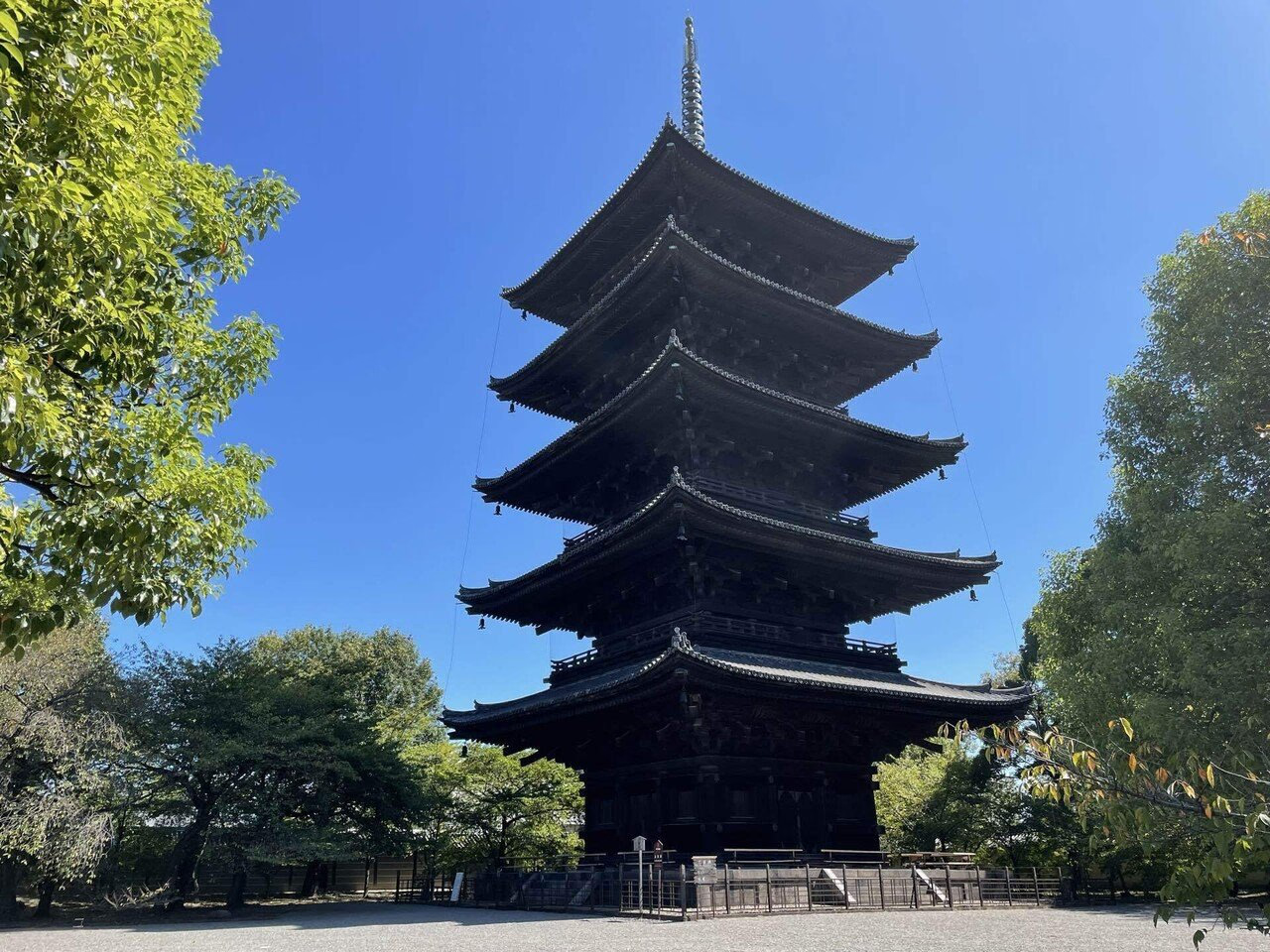
The East Temple at Heian-kyo's Southern Gate
Attraction
To-ji was established as one of two state temples flanking the southern entrance of the new capital founded in 794. Sai-ji, its western counterpart, disappeared; To-ji survived through repeated fires, rebuilding and institutional change. Its location near Rashomon made Buddhist protection part of the city's planned threshold. The modern streetscape no longer preserves the full gate complex or symmetrical capital, but To-ji's position still allows the grid of Kyoto to be read against the earlier Heian plan. This identity precedes Kukai. Recognizing that sequence prevents the temple from becoming only his biographical monument: first a state temple in a designed capital, then a principal base through which esoteric Buddhism gained a lasting institutional form.
Current visibility
Tō-ji's temple precinct, position near the former Rashōmon, and relation to Kyoto's street grid preserve its role at Heian-kyō's southern threshold; no physical biographical memorial is claimed.
823: Kukai Receives To-ji
Attraction
In 823 Emperor Saga entrusted To-ji to Kukai and his esoteric Buddhist community. The grant gave Kukai a state-supported base inside the capital, complementing the mountain training center he had begun at Koyasan. Teaching, initiation, ritual, images and texts could now be organized close to the court. This was not the instantaneous creation of a finished Shingon sect, but a decisive institutional step. Read To-ji and Koyasan as different parts of one project: the former tied esoteric practice to capital and government, while the latter offered a mountain setting for sustained religious discipline. The surviving temple embodies centuries of development after Kukai, so later buildings should not all be attributed directly to his hand. His importance lies in the system he established here.
Current visibility
Tō-ji's capital precinct and continuing ritual institution anchor Kūkai's 823 grant; Kōyasan's mountain setting is an off-site comparison, not a feature visible here.
The Lecture Hall's Sculptural Mandala
Attraction
The Lecture Hall arranges twenty-one Buddhist images as a three-dimensional mandala associated with Kukai's esoteric program. The grouping matters more than a checklist of statues. Buddhas, bodhisattvas, wisdom kings and guardians occupy a spatial hierarchy that translates a ritual cosmos into bodies positioned within architecture. Several images date to the ninth century, while the hall itself has been rebuilt after fire. This combination must be stated clearly: ancient sculpture survives inside later architectural fabric. Move visually from the central Dainichi Nyorai outward and compare posture, expression and directional role. The arrangement demonstrates how doctrine was taught through image and controlled space, making To-ji a place where imported knowledge was not merely stored but reorganized into a Japanese institutional practice.
Current visibility
The object or display associated with “The Lecture Hall's Sculptural Mandala” is not guaranteed on every visit to Tō-ji; check current gallery or special-opening notices, while reading the sculpture group, the ritual setting, and the reconstructed building as the stable context.
Miedo, Pagoda and the Temple's Continuing Memory
Attraction
Miedo preserves the devotional memory of Kukai in a residential-style hall, while the five-storied pagoda gives To-ji its most visible urban profile. They represent different continuities. Miedo focuses regular worship and the belief surrounding Kobo Daishi; the pagoda, repeatedly lost and rebuilt, demonstrates how a landmark can remain institutionally continuous without retaining one original structure. Treasure Hall exhibitions add a third layer because manuscripts, paintings and ritual objects are shown selectively rather than permanently. Visitors should therefore distinguish a living memorial hall, a seventeenth-century reconstruction of an older pagoda tradition and rotating historic objects. Together they show how To-ji survived: not by freezing Kukai's ninth century, but by renewing buildings, rites and collections while preserving an identifiable religious center.
Current visibility
The place-specific feature discussed as “Miedo, Pagoda and the Temple's Continuing Memory” is anchored by the pagoda, the ritual setting, and the reconstructed building, but today's access or operating condition at Tō-ji requires a current official check.