Read the article below. Interactive reading tools are available when scripts load.
Quick
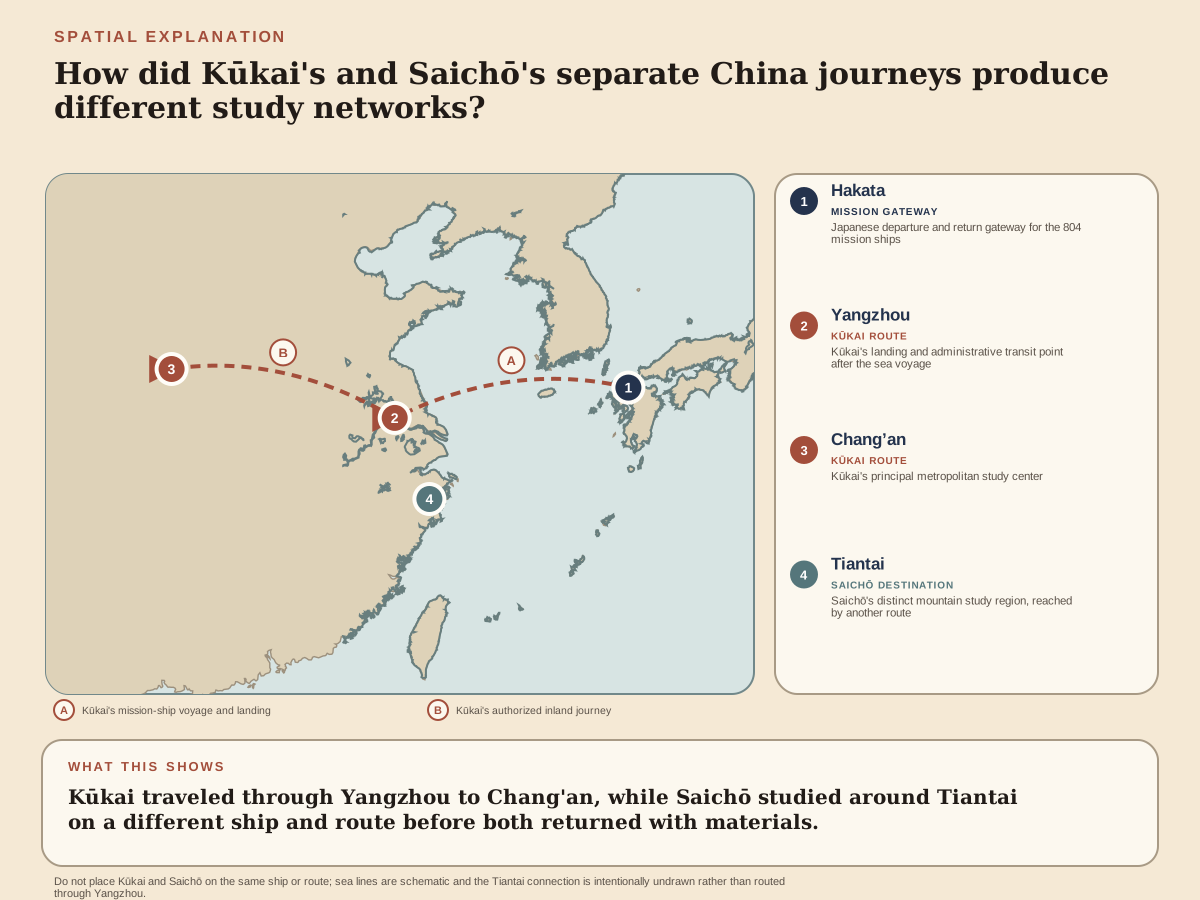
Kūkai sailed with the embassy sent to Tang China by Emperor Kanmu in 804. He traveled as a monk assigned to extended study, on a different ship from Saichō, whose shorter assignment focused on obtaining Buddhist teaching and texts. The vessels separated during the crossing, so the two monks did not follow one shared journey through China.
Kūkai reached Chang'an and studied at Qinglong Temple with Huiguo, a leading teacher of esoteric Buddhism. His training included initiations, texts, ritual implements, and mandalas: diagrams and images organizing a Buddhist sacred world. Those materials and the transmission of teaching gave him resources he could take back to Japan.
He returned in 806 and submitted a catalogue of the works and objects he had brought. Kanmu had died earlier that year, so the later development of Kūkai's institutions cannot be treated as a program already received and implemented by Kanmu. Support under Emperor Saga, the grant of Kōyasan, and the use of Tō-ji followed in separate stages.
Question: How can Kūkai's genuine connection to Shikoku practice be preserved without crediting him with a pilgrimage system formed centuries after his death?
Saichō departed for Tang China in 804 under Kanmu’s patronage. He traveled through an imperial embassy, accompanied by Gishin, his disciple and interpreter. Kūkai sailed in the same embassy on a different ship, with a longer study assignment. Their separate routes matter: Saichō’s work centered on the Tiantai region, while Kūkai’s esoteric training developed in Chang’an. The embassy carried several projects rather than one shared course of learning.
Classic
Kūkai sailed with the embassy sent to Tang China by Emperor Kanmu in 804. He traveled as a monk assigned to extended study, on a different ship from Saichō, whose shorter assignment focused on obtaining Buddhist teaching and texts. The vessels separated during the crossing, so the two monks did not follow one shared journey through China.
Question: What does a composed debate prove about Kūkai's intellectual turn, and what does it not prove about an event that never occurred as written?
The young Kūkai did not abandon learning when he moved away from ordinary official ambition. He redirected skills acquired for one institutional future toward another.
Classical study trained memory, composition, allusion, argument, brushwork, and sensitivity to audience. These capacities later made religious claims legible to emperors, monks, officials, and educated patrons.
The work associated with 797 is structured through speakers representing different teachings. Literary personae allow an author to arrange positions, objections, hierarchy, humor, and conversion.
That form does not report three historical advocates meeting before an audience. A fictional speaker can combine common arguments, social types, and rhetorical exaggeration.
In 785 Saichō received full ordination at Tōdai-ji, the great temple in Nara. The ceremony recognized him as a monk under the disciplinary rules used by Japan’s authorized clergy. He had trained with Gyōhyō in Ōmi, the province beside Lake Biwa, where he had been born in either 766 or 767. The later traditional biography supports the familiar 767 date; an institutional historical note points to official ordination documents as evidence for 766. Neither estimate changes the sequence of his documented adult career.
Kūkai reached Chang'an and studied at Qinglong Temple with Huiguo, a leading teacher of esoteric Buddhism. His training included initiations, texts, ritual implements, and mandalas: diagrams and images organizing a Buddhist sacred world. Those materials and the transmission of teaching gave him resources he could take back to Japan.
He returned in 806 and submitted a catalogue of the works and objects he had brought. Kanmu had died earlier that year, so the later development of Kūkai's institutions cannot be treated as a program already received and implemented by Kanmu. Support under Emperor Saga, the grant of Kōyasan, and the use of Tō-ji followed in separate stages.
Question: How can Kūkai's genuine connection to Shikoku practice be preserved without crediting him with a pilgrimage system formed centuries after his death?
Mountains and remote coasts offered conditions different from classroom or capital temple. Isolation, hunger, weather, repetition, fear, and bodily endurance made religious practice concrete.
Tradition links Kūkai to a discipline invoking Kokūzō and intended to transform memory and understanding. The exact sequence of instruction and every claimed site remain unevenly documented.
That unevenness is expected. Ascetic movement produces fewer bureaucratic records than court office, and later sacred geography preserves significance through story rather than contemporary itinerary.
Local knowledge made solitary practice possible. Guides knew paths and water; households supplied food or shelter; temple and shrine communities interpreted dangerous terrain; boat people connected coasts.
Question: Why did one of Japan's most celebrated religious innovators require an imperial embassy, and what does the voyage reveal about knowledge movement?
Crossing the East China Sea in the early ninth century was not independent educational travel. Ships, diplomatic status, seasonal timing, provisions, documents, and permission determined who could attempt it.
Kammu's court sponsored the embassy for state relations and knowledge acquisition. Individual monks entered a larger project whose aims also included diplomacy, information, texts, and prestige.
Kūkai traveled with long-term study status. Saichō's assignment was shorter. Their distinct positions shaped expectations about duration, training, and the legitimacy of early return.
They also did not share one ship. Treating them as two famous passengers in a single cabin erases the fleet's distributed risks and their separate travel experiences.
In 806 Tendai received an allotment of two new, officially recognized monks each year. The government divided that intake between a course of scriptural study and meditation and a course of esoteric practice. This was a concrete opening: Saichō’s community could recruit within the authorized clerical system. It also placed obligations on the students, who were to perform practices associated with protection of the country. Recognition as a teaching community did not grant Hiei an independent way to confer recognized full ordination.
The esoteric course required knowledge that Saichō continued to seek. His surviving correspondence with Kūkai includes requests to borrow imported books from 809 onward. Copying was practical institutional work. Hiei needed material from which more than one student could learn, and Saichō had facilities for transcription at his own temple. In letters analyzed by Ryūichi Abé, he explained the difficulty of arranging copying elsewhere, including food for those doing the work. Manuscript transmission consumed time and provisions.
Question: Why do Kūkai's childhood miracle stories reveal more about the making of a saint than about a boy in eighth-century Sanuki?
Founder biographies often begin at the end. Once a religious community regards an adult as exceptional, childhood is rewritten as the first visible proof.
Kūkai's birth in 774 and association with Sanuki are firm chronological anchors. A connection to the Saeki family and provincial elite is also more credible than an origin outside every institution.
That background matters because education was expensive. Literary Chinese required teachers, texts, paper, brushes, time away from subsistence work, and people who expected study to produce advancement.
Family position could connect a student to provincial schooling and eventually the capital. It did not guarantee success or decide which intellectual path he would choose.
Later accounts identify parents, a childhood name, sacred dreams, and prodigious behavior in vivid detail. Local communities have preserved these claims as religious and place memory.