HO Guides
Daikaku-ji: The Emperor's Other Inheritance
A royal pond, an emperor's instructions, and the guarded handling of sacred writing reveal how an imperial temple joined family memory to religious transmission.
Quick · About 2 min
The story in five points
A short route through the argument. Follow a point into Classic for its context and sources.
Royal ancestry supplied a beginning
Daikaku-ji developed from Emperor Saga’s villa, converted into a temple in 876. Its pond and imperial associations preserve a layered inheritance, but neither every abbot nor every surviving structure belonged to the founding royal generation.
Read in contextAn emperor still needed a teacher
Go-Uda’s religious authority involved initiation, requests for further instruction and acceptance of a teacher’s conditions. His exceptional imperial rank affected the sequence, yet did not supply the teaching or remove disagreements within its lineage.
Read in contextA testament assigned work to successors
Go-Uda’s twenty-one clauses addressed study, conduct, initiation, prayers and memorial observances. Their intended continuity required trained people and orderly relationships, beyond keeping books or remembering the distinguished identity of the abbot who wrote them.
Read in contextDifferent objects preserve different periods
Go-Uda’s writings preserve an early-fourteenth-century religious programme. The Shinden’s 1619 building date belongs to a later imperial association; it is neither Saga’s surviving villa nor the intact setting of Go-Uda’s teaching.
Read in contextA sacred text could invite different approaches
Sealed imperial sutras receive restricted ceremonial treatment, while worship space enables devotion without examining their pages. Ordinary sutra copying offers another form of religious participation; repeating the words does not reproduce an imperial manuscript’s authorship or ritual history.
Read in context
Opening
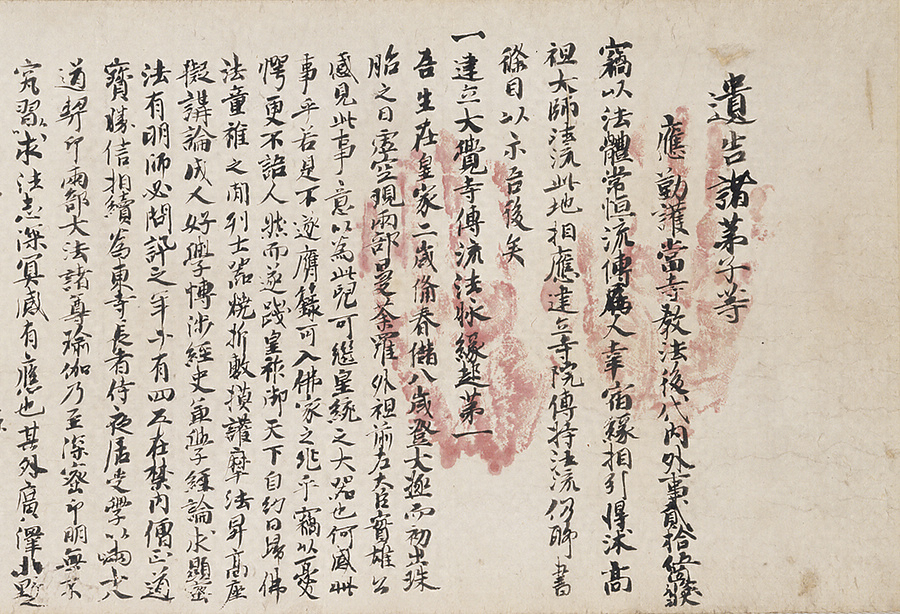
Red palm prints spread beneath black writing on a scroll preserved by Daikaku-ji. The document is the retired emperor Go-Uda's handwritten testament, addressed to his disciples. Its opening instruction concerns establishing Daikaku-ji and transmitting a religious lineage. This is an emperor making provision for a future that cannot be arranged simply by naming the next occupant of the throne.[1]
Go-Uda wrote in the early fourteenth century, long after an imperial villa had become a temple here. He inherited a place with royal associations; his instructions addressed what people should do within the religious establishment. Study, initiation, discipline, and services all needed attention.
The scroll provides a way through Daikaku-ji's imposing imperial identity. What did royal ancestry give this temple—and what did its religious life require beyond ancestry? The answer connects the pond outside its halls with a teacher's permission, a written programme for disciples, and sacred manuscripts whose importance depends partly on how they are approached.
1. The palace inheritance
Daikaku-ji began with Emperor Saga's villa on the western outskirts of the capital. In 876, his daughter Princess Masako arranged its conversion into a Buddhist temple. Prince Tsunesada, a son of Emperor Junna who had entered religious life, became its founding abbot. Royal family, residence, and religious institution were connected from the beginning.[2]
An imperial temple could consequently inherit more than a building. It possessed a relationship to particular members of the ruling family, a name in the history of the court, and ground already associated with aristocratic life. The later designation monzeki identifies this kind of court-connected religious establishment. It does not mean that every abbot throughout Daikaku-ji's history was an emperor or prince; the temple's own chronology records a long intervening association with the Ichijō-in of Kōfuku-ji.[2]
The most expansive reminder of the villa is Ōsawa Pond, east of the principal halls. Water and islands preserve a landscape larger than the surviving buildings. The temple associates its composition with China's Dongting Lake, a traditional account of its model rather than a surviving design brief. The pond's long history does not make every bank, planting, or neighbouring structure ninth-century fabric.[3]
One feature north of the pond makes absence unusually articulate. The former Nakoso Waterfall is associated with a poem by Fujiwara no Kintō: its sound has long ceased, yet its name still flows and is heard. The wordplay gives the lost waterfall a second kind of duration. Kyoto City's account identifies the place with the old imperial garden and notes that the poem already described its silence in the Heian period.[4]
The garden had therefore become a remembered landscape long before Go-Uda made Daikaku-ji his religious home. A name and a poem could preserve attention to something that no longer performed its original work. That was one form of inheritance available here. Running a temple required another: people had to learn and repeat activities that would cease if everyone merely remembered them.
2. A sovereign becomes a pupil
Go-Uda entered monastic life in 1307 and became one of Daikaku-ji's imperial abbots. His religious undertaking belonged to Shingon Buddhism, the tradition associated with Kūkai. Within it, particular ritual practices and teachings passed through lines of authorized teachers and disciples. Possessing a text and receiving permission to practise or transmit its teaching were related, but different, achievements.[5]
Documents preserved at Daigo-ji, a separate temple across Kyoto, reveal something of the learning behind Daikaku-ji's imperial abbot. The scholar Fujii Masako identifies a draft certificate recording Go-Uda's receipt of a transmission initiation from the monk Kenjun in 1307. It took place before Go-Uda formally became a monk. Kenjun's disciple Ryūshō criticized the proceeding as premature. Royal access could produce an exceptional sequence; it did not prevent someone within the teaching lineage from questioning it.[6]
After entering monastic life, Go-Uda sent Kenjun three letters seeking further transmission in the Sanbō-in lineage. In a passage translated into modern Japanese by Fujii, he proposes continuing to visit and ask questions if the teacher remains ill. He presents his request as a means of bringing bodies of religious learning together. Kenjun imposed conditions on his conduct as a practitioner; Go-Uda's reply accepted them.[6]
These exchanges give a concrete shape to the word “transmission.” Someone had to agree to teach; the pupil had to seek admission to a particular succession of instruction; conditions accompanied the grant. The relationship required more than the movement of a manuscript from one collection to another.
It would be misleading to make the episode a tale of rank becoming irrelevant. The early initiation itself shows how unusual the imperial pupil's position was. But rank did not specify the content of the teaching, supply its teacher, or eliminate questions about the proper order of admission. Those were matters within a religious community whose distinctions the emperor engaged through requests, certificates, and promises.
The documents remain at Daigo-ji, not in an imagined classroom beside Ōsawa Pond. Their relevance to Daikaku-ji is the qualification of its abbot: his religious authority had a history of instruction elsewhere. He brought relationships with teachers into this imperial setting, rather than acquiring all his religious knowledge from the setting itself.
3. A programme for the people who came next
At Daikaku-ji, Go-Uda in turn addressed disciples of his own. His testament survives in twenty-one clauses. The historian Nishi Yayoi places its composition between his withdrawal to Daikaku-ji in the closing part of 1321 and his death in 1324. Its concerns range from protecting the realm to teaching, devotional services, and the conduct of the religious community.[7]
The contents turn “an imperial Buddhist centre” into a series of tasks. One clause calls for establishing the Kyōō Jōjū-in and encouraging study. Others concern contemplative practice, the observance of precepts, and the sequence in which disciples receive initiation and instruction. Another calls for clarity about ritual matters, doctrine, and the tradition's purpose. These were complementary requirements: having a place to study did not settle what should be learned or when a pupil should advance.[7]
Read together, the instructions describe a school of practice rather than a storehouse. A storehouse can preserve books while everyone who knows how to use them disappears. The programme envisaged here requires learners, standards of conduct, occasions for instruction, and a way of deciding who should undertake which activity. Its continuity would depend on relationships between people as well as the survival of written material.
That distinction was particularly consequential for an establishment associated with one unusually placed abbot. Go-Uda's own combination of royal standing and religious training could not simply be reproduced in every successor. Written instructions separated some of the institution's intended work from the particular person then directing it. A disciple could be told to observe a sequence of learning without needing to possess the emperor's biography.
The programme also looked beyond advanced teaching. Its clauses call for prayers for people of high and low status and warn against neglecting specified memorial observances. Alongside these services stands a restriction: religious transmission to laypeople should not be granted casually.[8]
These provisions distinguish receiving religious benefit from receiving authority within a teaching lineage. A person could be included among those for whom prayers were performed without thereby qualifying to transmit a restricted ritual practice. The two relationships needed different arrangements. To describe the whole temple as either open or closed would obscure the different kinds of participation that the instructions envisaged.
The testament is evidence of that intended programme, not a register proving that every provision was observed. Its specificity is nevertheless valuable. We can identify what Go-Uda sought to organize at Daikaku-ji, instead of inferring an entire religious life from the grandeur of an imperial title.
4. Writing himself into a religious lineage
Go-Uda's brush also looked backwards. Daikaku-ji preserves his Biography of Kōbō Daishi, written on silk in 1315. Kōbō Daishi is Kūkai's posthumous title. The surviving work gives the emperor a place as a writer about a religious predecessor, as well as a source of instructions for his own followers.[9]
That relationship helps explain the form of his testament. Nishi's study shows how Go-Uda worked in conscious relation to the twenty-five-article testament attributed to Kūkai. The attribution belongs to the text's religious history; modern scholarship does not treat the transmitted work as an uncomplicated deathbed document written by Kūkai himself. What matters for Go-Uda's undertaking is that an authoritative model for leaving instructions was available to him.[10]
A biography and a testament point in opposite directions. The biography sets out a predecessor's life for later readers. The testament tells later readers what they should do after its author. Placed together within Daikaku-ji's collection, they make the imperial writer both a recipient of religious precedent and a maker of directions for the future.
The physical writing gives these relationships a particular form. The biography is a hanging work on silk; the testament is a scroll bearing the emperor's handprints. Neither is simply an anonymous copy of words. The national catalogue identifies the writer, while the visible marks associate the instructions with an individual body. Their force as historical objects comes from the combination of what was written, who wrote it, and how that authorship was presented.
This is also a reason not to treat calligraphy as decoration added after religious business was finished. The emperor's written works participated in that business. One placed Kūkai's life before readers; another addressed disciples about the future of a temple. Their beauty and protected status now can coexist with those earlier functions.
5. A later palace inside the old imperial temple
The buildings through which Daikaku-ji presents its imperial character have a different chronology from these manuscripts. The Shinden, an aristocratic residential hall, dates to 1619 in the national cultural-property register. The temple records that Emperor Go-Mizunoo granted it and associates its earlier use with his consort Tōfukumon-in, the Tokugawa-born Masako. This is a different Masako from the princess involved in the ninth-century foundation.[11]
The distinction changes what the building can tell us. Its courtly form is not a surviving room from Saga's villa, nor the intact headquarters of Go-Uda's teaching. It belongs to a later renewal of the temple's connection with the imperial household. Court architecture continued to reach Daikaku-ji after the original residence had long disappeared.
A building of this kind provides more than a commemorative label. A residential hall brings rooms, verandas, and a way of arranging reception into the precinct. The title “former imperial palace” can therefore be encountered in actual architecture, while the date explains which episode of imperial association that architecture preserves.
The temple's history records repeated losses through fire and war. Those changes make it impossible to assign the entire ensemble to a single founding patron.[2] They also explain why the manuscript collection matters so much. Go-Uda's instructions survive independently of a complete set of rooms in which they might once have been put into practice. The Shinden offers a later material expression of court affiliation; the testament offers an earlier written programme. Each preserves something the other cannot supply.
Around the pond, the contrast is larger still. The landscape recalls the villa phase, while the later halls give the continuing institution places to function. Daikaku-ji's imperial character has been renewed through gifts and reconstruction, rather than maintained by leaving one ninth-century residence untouched.
6. The manuscript kept behind a seal
One group of writings is approached through an even more deliberate separation of object and observer. Daikaku-ji's tradition says that Emperor Saga copied the Heart Sutra, a short Buddhist scripture, during the calamities of 818, following Kūkai's counsel, and that the crisis subsided. The temple preserves this as the origin story of its imperial sutra-copying devotion. It is a religious account of efficacy, not medical evidence that a manuscript ended an epidemic.[12]
The attributed imperial copy and later imperial copies are kept under seal. The temple describes a sixty-year cycle of ceremonial opening, with the seal broken by the emperor or an imperial representative. The manuscripts' restricted accessibility is part of their religious treatment, not merely an inconvenience in the operation of an exhibition.
The architecture makes this relationship legible. The octagonal Chokufū Shingyōden, the hall containing the sealed sutras, belongs to the temple's rebuilding in the 1920s. Its stated architectural model is the Yumedono at Hōryū-ji. In front stands a worship hall made from a building transferred from the arrangements for Emperor Taishō's enthronement. The temple identifies that front hall's completion here as 1925.[13]
A worshipper can thus be brought into relation with the sacred manuscripts without handling them or seeing their pages. The front hall provides a place for devotion; the building beyond preserves the guarded objects. The spatial sequence distinguishes approaching a manuscript religiously from examining it as a reader or researcher.
That arrangement does not require every sacred copy to belong to an emperor. Daikaku-ji also invites people to copy the Heart Sutra themselves, using lined paper or a faint model for tracing. Its explanation presents copying as an activity of body, speech, and mind: writing, reciting, and directing one's thoughts towards the Buddha. These are the temple's religious terms for the practice, not a claim that copying gives someone the qualifications of an initiated Shingon teacher.[14]
There is room here for both a guarded original and repeated participation. Ordinary copies need not become imperial relics to have a religious purpose. Conversely, reproducing the same words does not reproduce the attributed authorship or ritual history of Saga's manuscript. Text, writer, and occasion give different copies different relationships to the temple.
7. What a name cannot transmit by itself
Daikaku-ji's royal inheritance supplied a landscape, distinguished associations, and recurrent connections with the imperial household. Its religious work required other forms of succession. Go-Uda sought teaching from an authorized master, wrote about a revered predecessor, and left instructions for disciples. These activities joined his imperial identity to particular kinds of learning and responsibility.
The difference is visible across the precinct's surviving evidence. The pond can retain a name after a waterfall has fallen silent. A teaching programme, by contrast, needs people to undertake it. A royal manuscript can be protected by restricting access; a devotional text can also be made part of repeated practice through new copies. Preservation means different things in each case.
Go-Uda's handprinted scroll is especially direct about the future it contemplated. It does not merely ask that its author be remembered. It specifies study, conduct, teaching, prayer, and remembrance as work for a community. We cannot recover every occasion on which that work was done, but we can recover the programme he sought to leave at Daikaku-ji.
The emperor's other inheritance was therefore something to be learned and practised. Royal ancestry helped give the institution its identity. The instructions beneath the red handprints addressed what its disciples were to make of it.
Next topic · HO Guides
Kitano Tenmangū: Writing for a God
Painted legends, linked verses, and poems kept in the sanctuary explain how literary accomplishment became something to offer Tenjin, rather than simply something to ask him for.
Continue readingSources and NotesView sourcesHide sources
Sources consulted 16 September 2026. Japanese historical months are not silently converted to Gregorian months. No current visiting arrangements are implied.
- [1]
Agency for Cultural Affairs, Cultural Heritage Online, “後宇多天皇宸翰御手印遺告,” object 126217, complete object entry: https://online.bunka.go.jp/heritages/detail/126217. The linked reproduction: https://online.bunka.go.jp/heritage/43967/_114127/43967_114127701813185049940_900.jpg. The opening address, black writing, red palm impressions, and first clause's heading are visible. The catalogue identifies Go-Uda's autograph and Daikaku-ji ownership. This is not a claim to have read or independently authenticated the complete original scroll. The chronology and clause contents are supported by notes 7–8.
Return to the reference ↑ - [2]
Daikaku-ji, “大覚寺について,” historical account, especially the paragraphs on the 876 foundation, the third through twentieth abbots, and the later losses and rebuilding: https://www.daikakuji.or.jp/about/. Used for the villa conversion, Princess Masako, Prince Tsunesada, and the qualified history of imperial connections, not as proof that every abbot was royal or every present building ancient. The broad explanation of what an institution may inherit is the essay's analysis of that history.
Return to the reference ↑ - [3]
Daikaku-ji, “大沢池,” introductory landscape description and descriptions of its islands and garden features: https://www.daikakuji.or.jp/oosawanoike/. Dongting Lake is presented as the temple's transmitted explanation of a model; the essay does not reconstruct the original shoreline or adopt a national “oldest” claim. This source supports the pond's relation to the villa landscape, not an untouched ninth-century garden.
Return to the reference ↑ - [4]
Kyoto City, historical stone-marker record UK036, “名古曽滝址,” explanatory paragraph and location: https://www2.city.kyoto.lg.jp/somu/rekishi/fm/ishibumi/html/uk036.html. Compare Daikaku-ji, “大沢池,” entry “名古曽の滝跡,” note 3. The body paraphrases the public-domain poem attributed to Fujiwara no Kintō, “滝の音は絶えて久しくなりぬれど名こそ流れてなほ聞こえけれ”; it is not a quotation from a modern English translation. The city summarizes archaeological evidence, but the underlying excavation report was not read and no reconstructed flow or exact drying date is asserted.
Return to the reference ↑ - [5]
Daikaku-ji, “大覚寺について,” Go-Uda paragraph, note 2; Fujii Masako, “特集9 後宇多天皇と醍醐寺,” opening account and discussion of initiation certificates: https://www.daigoji.or.jp/archives/special_article/sp_vol_9.html. The institutional history identifies Go-Uda's 1307 entry into monastic life and Daikaku-ji association. The explanation of religious transmission is confined to the teacher–disciple relationships evidenced in Fujii's archival discussion; it is not a universal description of every Shingon practice.
Return to the reference ↑ - [6]
Fujii, “後宇多天皇と醍醐寺,” paragraphs beginning “後宇多上皇は退位後” and “その後、後宇多上皇は,” the displayed modern-Japanese rendering of the first letter, and the following account of conditions and replies. Its concrete archival locators include the draft initiation certificate 77函22号, Ryūshō's criticism 11函6号1番, and related transmission material 3函47号2番・4番. Go-Uda's three letters are identified as “後宇多法皇宸筆当流紹隆教誡.” The essay uses the scholar's discussion and displayed translated passage, not an independent transcription of all manuscripts. The page equates Tokuji 3 with 1307 in one place; that era year corresponds to 1308. The body therefore retains the secure 1307 initiation and subsequent sequence without repeating the inconsistent letter-year conversion. Fujii's conjectures about private motives and the teacher's feelings are not adopted.
Return to the reference ↑ - [7]
Nishi Yayoi (西弥生), “真言宗の文書・聖教—醍醐寺調査と目録作成をふまえて—,” Shigaku 90, nos. 2–3 (May 2022): 71–96, especially pp. 89–90 (continuous pagination 219–220), Table 2 and the paragraph beside it: https://koara.lib.keio.ac.jp/xoonips/modules/xoonips/download.php/AN00100104-20220500-0071.pdf?file_id=165456. See table 2 on printed p. 90. It reproduces the twenty-one clause headings. The study places composition after Go-Uda's twelfth-month withdrawal in 1321 and before his death in 1324, rather than establishing one exact writing day. The body reports the programme from the headings, not a full translation of every clause or proof of implementation. Kyōō Jōjū-in is the establishment named in clause 4, not a claim to identify a surviving medieval classroom in today's precinct.
Return to the reference ↑ - [8]
Nishi, Table 2, clauses 7–10, 13–14, and 19, same URL as note 7. The calls for contemplative practice, precepts, orderly instruction, prayers for high and low, specified memorial observances, and caution about lay transmission come from the displayed public-domain clause headings. The distinction between receiving services and receiving teaching authorization is this essay's reading of the provisions together. It does not claim that all non-monastics were excluded from every ceremony or that the clauses describe actual attendance.
Return to the reference ↑ - [9]
Agency for Cultural Affairs, Cultural Heritage Online, “後宇多天皇宸翰弘法大師伝,” object 126107, material, date, format, and ownership fields: https://online.bunka.go.jp/heritages/detail/126107. Identifies the silk hanging work, 1315 date, and Daikaku-ji ownership. Compare Taitō City, the report on the Tokyo National Museum's 2025 Daikaku-ji exhibition, discussion of Go-Uda's writings: https://www.culture.city.taito.lg.jp/ja/reports/36013. The complete biography was not transcribed or translated; the essay concerns its documented subject, authorship, and format.
Return to the reference ↑ - [10]
Nishi, “真言宗の文書・聖教,” discussion of the twenty-five-article testament attributed to Kūkai and Go-Uda's adoption of the model, especially pp. 89–90, with the earlier textual-history discussion. The article treats the transmitted Kūkai testament's formation critically. The essay distinguishes that textual history from its authority as a model for Go-Uda; it does not call the work an authenticated transcript of Kūkai's last words. The comparison of biography and testament is the writer's analysis, not a claim of reconstructing Go-Uda's unrecorded intentions.
Return to the reference ↑ - [11]
Agency for Cultural Affairs, Cultural Heritage Online, “大覚寺宸殿,” object 122897, full building record: https://online.bunka.go.jp/db/heritages/detail/122897. Gives 1619. Daikaku-ji, “境内のご案内,” “宸殿”: https://www.daikakuji.or.jp/precincts/. It supplies the grant by Go-Mizunoo and the association with Tōfukumon-in's earlier residential use. These sources do not supply the essay with a securely dated transfer operation, so the body does not turn 1619 into an asserted relocation date. No current room access, historical seating plan, or surviving Saga-period fabric is claimed.
Return to the reference ↑ - [12]
Daikaku-ji, “写経・写仏とは,” “勅封般若心経” discussion and the account of Saga and Kūkai: https://www.daikakuji.or.jp/shakyou-2/whatsshahutsu/. Used as evidence of the temple's tradition about 818, the sealed imperial copies, the sixty-year opening cycle, and the authorized breaking of the seal. Neither the attributed Saga manuscript nor a contemporaneous record of the claimed healing was independently examined. The tradition's religious importance is not treated as verification of its medical causation or manuscript dating.
Return to the reference ↑ - [13]
Daikaku-ji, “境内のご案内,” “心経前殿(御影堂)” and “勅封心経殿,” URL in note 11. The precinct guide gives 1925, while the separate general history gives 1924 for construction of the sutra hall; the essay uses “the 1920s” for that hall, without inventing a start/completion distinction. The front hall's transfer from the Taishō enthronement banquet arrangements and its 1925 completion are stated separately. Architectural model, guarded inner hall, and worship frontage are drawn from the descriptions, not a claimed visit or reconstruction of a specific ceremony.
Return to the reference ↑ - [14]
Daikaku-ji, “写経・写仏”: https://www.daikakuji.or.jp/shakyou-2/, practice description; “写経・写仏とは,” “写経・写仏は三密行,” URL in note 12. Used for model-assisted copying and the institution's explanation of bodily, vocal, and mental practice. Current prices, daily times, therapeutic promises, and participation totals are omitted. The contrast between an ordinary new copy and an attributed imperial manuscript is the essay's analysis of their different authorship and ritual treatment, not a denial of the religious worth assigned to either.
Return to the reference ↑