Read the article below. Interactive reading tools are available when scripts load.
Quick
Shōmu was born in 701, a son of Emperor Monmu. That fact placed him from birth near the center of the early eighth-century imperial succession, but it tells us far less about his childhood than later biography might tempt us to imagine. The safest starting point is institutional rather than psychological. He belonged to an imperial house governing through the still-young ritsuryō state, a political order that joined the throne to a developing bureaucracy, an aristocratic court, and provincial administration.
Shōmu’s later reign would become inseparable from some of the most visible monuments of Nara-period Buddhism, above all Tōdai-ji and the Great Buddha. Yet none of that should be read backward into the child born in 701. At this stage, the historical point is simply his position within a succession system in which lineage mattered enormously but never operated in isolation from court politics and the availability of acceptable heirs. His story begins not with a known private destiny, but with a structural fact: he was born into a family for whom succession was an issue of state.
Shōmu ascended the throne in 724. He inherited a state centered on Heijō-kyō and organized through the ritsuryō order, with court offices, provincial administration, aristocratic power, taxation, labor obligations, and an imperial ideology that placed the sovereign at the center of government. The throne was powerful, but it did not make the emperor a solitary or absolute decision-maker.
That distinction matters because the next two decades of Shōmu’s reign would be crowded with events that are easy to personalize: the fall of Prince Nagaya, a devastating epidemic, Fujiwara no Hirotsugu’s rebellion, repeated changes of political center, the provincial temple program, and the Great Buddha project. Modern narrative can follow those events through Shōmu’s life, but historical explanation must keep the institutions around him visible. His accession gave him the highest office in the state; it did not erase the court, the bureaucracy, aristocratic networks, provincial constraints, or the limits of what the center could actually accomplish.
In 728, Crown Prince Motoi, Shōmu’s son and heir, died. The loss belongs to family history, but it also entered institutional history. Tōdai-ji traces part of its early development to a religious foundation established to pray for the dead prince, later associated with Kinshōsen-ji. Long before the Great Buddha existed, a connection had therefore formed between Shōmu’s household, memorial Buddhist practice, and the religious complex that would become Tōdai-ji.
The event should not be turned into a psychological origin story for everything Shōmu later did. The existing record allows us to connect the prince’s death with memorial action; it does not allow us to describe the exact shape of the emperor’s grief or to claim that this single loss caused the later Great Buddha project. What it does show is more concrete and, in its own way, more revealing: private bereavement could be expressed through religious institutions, leaving consequences that endured far beyond the moment of mourning.
In 729, Prince Nagaya, a major imperial politician, was accused of treason and forced to take his own life. His fall was one of the defining court crises of Shōmu’s early reign. The event itself is well established; the full chain of responsibility behind it is not.
That boundary is essential. Later narratives can easily turn the incident into a solved conspiracy and assign its design to Shōmu, Empress Kōmyō, or particular Fujiwara figures. The surviving evidence does not authorize that certainty. A responsible account should therefore distinguish what happened from what remains interpretive: Nagaya was accused, his political position collapsed, and he died; the precise intentions and coordination of the people around the throne remain unresolved. The incident matters because it changed court politics—and because it teaches us how little a confident story can sometimes rest on.
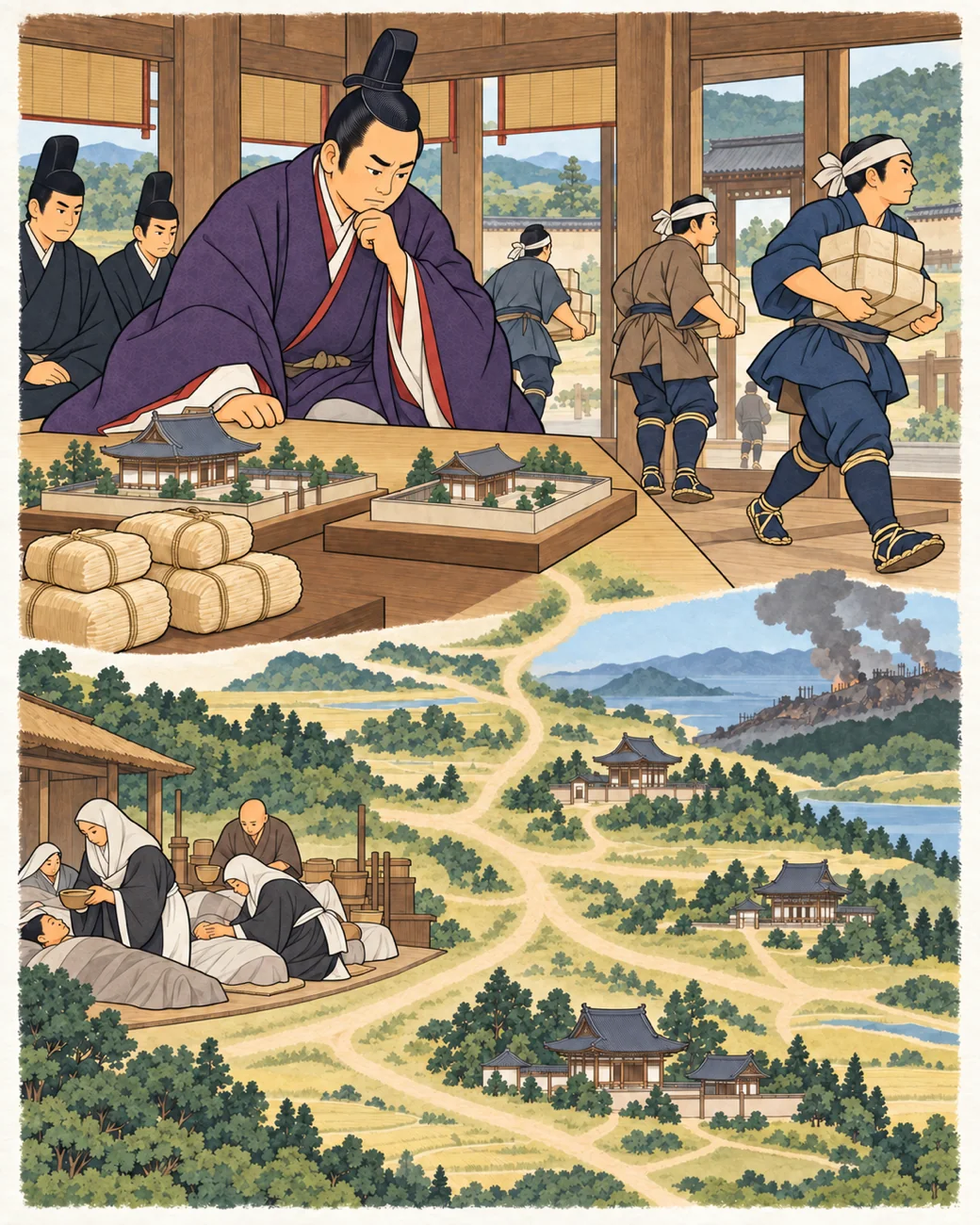
A severe smallpox epidemic struck Japan in the 730s, and in 737 the four Fujiwara brothers who held major positions at court died in close succession. The disaster therefore reached far beyond health. It caused mass mortality and destabilized the political leadership on which the court depended.
For Shōmu’s government, the epidemic belonged simultaneously to social, fiscal, administrative, and political history. Death and disruption affected households that supplied taxes and labor; the loss of leading aristocratic officeholders altered the structure of power at the center. Later Buddhist measures unfolded in the shadow of this crisis, but they should not be reduced to a single formula in which the epidemic automatically “caused” the provincial temples or the Great Buddha. The more responsible connection is contextual: Shōmu’s reign experienced extraordinary instability, and religious policy became one of several ways the state sought order and protection within that unstable world.
In 740, Fujiwara no Hirotsugu raised an armed rebellion in Kyushu. Shōmu’s reign had already been shaken by epidemic and political reorganization; now the government faced open resistance away from the capital.
The rebellion matters because it exposes the distance between a state’s claim to order and the work required to enforce that order across the provinces. It also sat within a complicated field of court appointments, regional administration, and political conflict. Hirotsugu’s action should not be reduced to a single private grievance. What can be said safely is that the revolt turned political tension into military confrontation and forced the central government to answer a challenge that could not be managed only through court procedure. It forms a crucial bridge between the post-epidemic reshaping of politics and the extraordinary years of movement that followed.
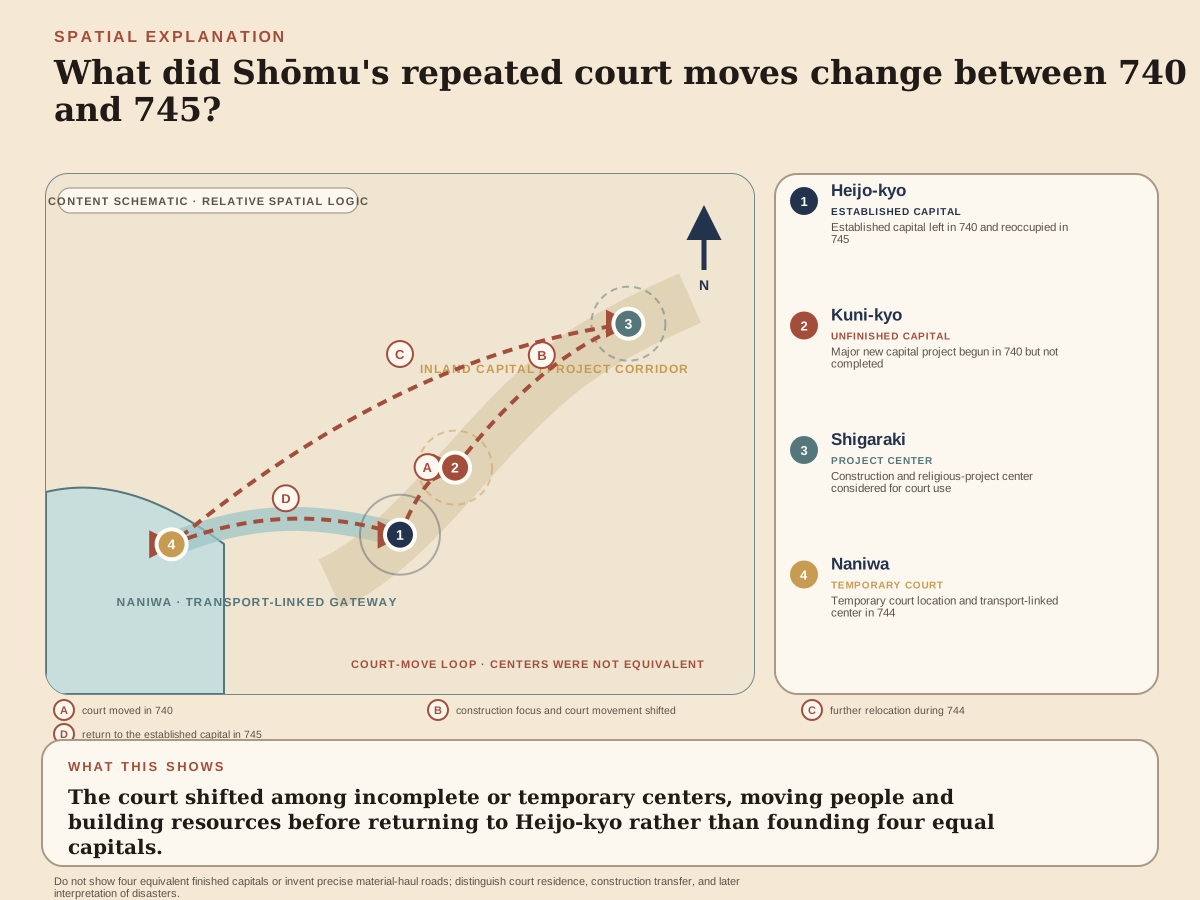
From 740 to 745, Shōmu’s government repeatedly changed its political center. The court moved from Heijō toward Kuni, became connected with Shigaraki and Naniwa, and ultimately returned to Heijō in 745. The sequence can be reconstructed with much greater confidence than the reason for the sequence.
That distinction is central to understanding these relocations. Political crisis, religious projects, geography, logistics, and elite networks may all belong to explanations of the moves, but the evidence does not establish one master motive. The narrative should resist the temptation to turn repeated relocation into a solved psychological mystery about Shōmu. What the chronology itself reveals is already extraordinary: the seat of government was not immovable, and for several years the court repeatedly reconsidered where political and ritual life should be centered. The instability of place became part of the instability of the reign.
Archaeology makes the relocation more literal. Major elements of Heijō's First Imperial Audience Hall precinct were dismantled and transferred to Kuni. When the court returned in 745, the old ceremonial compound was not simply restored in its previous form. Government moved through timber, foundations, walls, offices, records, and labor as well as through the emperor's presence.
In 741, the government ordered the establishment of provincial monasteries and nunneries. The program gave state-supported Buddhism a nationwide institutional form: religious foundations in the provinces were connected to an order centered on the imperial state, while Tōdai-ji later became the leading temple within that wider network.
The significance of the decree lies in its scale. Buddhism at court was not new, but the provincial temple system turned religious patronage into administrative infrastructure. Temples, clergy, prescribed texts and rituals, land and resources, and provincial government all became part of the same project. The order should not be confused with instantaneous or identical completion in every province; implementation varied. Even so, the policy marks a decisive widening of the relationship between Buddhism and government. Shōmu’s religious kingship was no longer expressed only through institutions near the capital. It was being projected across the territorial structure of the state.
The order was issued on the fourteenth day of the second month of 741. It called for both a monastery and a convent in every province and prescribed the Golden Light Sutra of the Most Victorious Kings for the provincial monastery's pagoda. The network joined gendered religious institutions, texts, buildings, provincial officials, and court claims of Buddhist protection.
In 743, Shōmu issued the proclamation for the creation of a colossal Vairocana Buddha. The decision transformed religious aspiration into a public undertaking on an extraordinary scale. The proclamation’s public language preserves an important feature: the project was not presented as something the court alone would accomplish, but as an undertaking that invited broad participation.
The proclamation is therefore valuable evidence for the ideals the state chose to express. It can tell us how the project was publicly framed—through Buddhist purpose, imperial sponsorship, and collective contribution. It cannot be treated as a transparent record of Shōmu’s entire private psychology. That boundary protects the history from a familiar mistake: turning an official text into a diary. What survives is a political and religious declaration, and its historical power lies precisely in the way it connects sovereign authority to a project that would require resources and labor far beyond the person of the emperor.
After the court returned to Heijō in 745, the Great Buddha project continued at the site that became Tōdai-ji. Over the following years, a declaration had to be translated into an immense material undertaking. By 749, the bronze body of the image had been completed.
The scale matters, but the more revealing story is organizational. A colossal metal Buddha required materials, technical knowledge, staged casting, transport, administration, and large amounts of labor. The emperor’s proclamation could authorize and sanctify the project; it could not physically produce the image. The finished statue was therefore a demonstration of institutional capacity as much as religious ambition. It made visible a chain connecting the court to specialists, resources, and workers. At this stage, the Great Buddha stops being only an idea and becomes an engineering problem—one that the Nara state and its collaborators had to solve in matter.
The Great Buddha was not Shōmu’s work alone. Tōdai-ji’s own historical tradition gives important roles to Rōben, Gyōki, and the many people who contributed to the project. Gyōki was associated with mobilizing support and donations, while Rōben belonged to the temple’s organizational history. Artisans, officials, donors, carriers, laborers, and other participants turned the undertaking into a collective achievement.
This matters because biographies naturally pull shared events toward a single protagonist. In Shōmu’s biography, the emperor remains the person whose life organizes the sequence, but the historical event must not be reduced to imperial will. The Great Buddha is a better example of power when power is understood as coordination: a sovereign could sponsor a vast project, yet its completion depended on religious networks, technical skill, institutional administration, and participation from people at many levels of society. The monument’s scale is therefore also the scale of the collaboration behind it.
In 749, Shōmu abdicated and his daughter Kōken ascended the throne. Shōmu became a retired sovereign rather than disappearing from the political and religious world. The transition changed his formal position and shifted the center of imperial authority to the next generation.
The event should not be burdened with a private motive the surviving evidence does not establish. What is secure is the institutional change: the reigning emperor became a retired emperor, while Kōken became the sovereign. That change matters because abdication in this political culture did not necessarily equal complete withdrawal. Shōmu would still be present at the Great Buddha consecration in 752, and the political world around Kōken would develop its own tensions and actors. His biography therefore does not end with the throne. Instead, 749 opens a new phase in which status, authority, and succession no longer coincide in the same way.
The transfer occurred on July 2, 749. Abdication changed Shōmu's office but did not make him absent from the religious politics of the dynasty. Three years later he attended the Great Buddha consecration as retired emperor while Kōken appeared as reigning sovereign and Kōmyō as empress dowager.
In 752, Tōdai-ji held the great consecration ceremony for the colossal Buddha. Empress Kōken was the reigning sovereign, while the retired Shōmu and Kōmyō were also present. The ritual marked the public culmination of a project that had survived political crisis, repeated moves of the court, changes of site, years of construction, and Shōmu’s own abdication.
The ceremony was more than a celebration of engineering. It brought together imperial authority, temple organization, Buddhist ritual, and participants connected to religious networks beyond the immediate court. Yet it should not be described as proof that the realm was unified in consensus or that every earlier crisis had been resolved. A consecration gives a monument ritual life; it does not erase the costs or conflicts that preceded it. In Shōmu’s life, 752 is a climax because a long public project became fully visible and ritually activated while he was still alive to witness it.
The ceremony also left an unusually rich material archive. Headdress ornaments, brushes, an ink stick, silk ropes used in the eye-opening act, masks, costumes, and aristocratic gifts survive in the Shōsōin world. They allow the event to be studied not only through chronicle prose but through objects that performed, adorned, and recorded the rite.
Shōmu died in 756, several years after the consecration of the Great Buddha. His death creates a hard boundary for reconstructed first-person narration. Up to this point, a carefully bounded first-person reconstruction can present what a living Shōmu might plausibly have understood from his position. After death, that first-person channel closes.
The biography does not end, however, because a historical person continues to exist in records, institutions, objects, and the actions of survivors. Shōmu’s death immediately shifts the narrative burden toward Kōmyō, Tōdai-ji, dedicatory records, and the possessions associated with him. This is not merely a matter of storytelling technique. It is a statement about evidence. A dead person cannot comment on later events, revise his motives, or explain his legacy. From here forward, Shōmu can only be studied through what was left behind and through what others did with that inheritance.
After Shōmu’s death, Kōmyō dedicated many of his treasured possessions and medicines to the Great Buddha at Tōdai-ji, beginning on June 21, 756. These objects became a central part of the holdings associated with the Shōsō-in. Because they were accompanied by dedicatory records, they preserve something rare: a chain connecting physical objects to the imperial household, to an act of offering, and to a religious institution.
That makes the Shōsō-in an unusually strong ending for Shōmu’s biography. Instead of closing with a simple label—great ruler, failed ruler, pious ruler—the narrative returns to evidence. Objects can reveal court craft, medicine, exchange, religious practice, and material life, while the records attached to them help establish provenance. They do not answer every question about Shōmu, and individual objects require their own exact histories. But together they allow the reader to encounter a surviving material world linked to his life. After the first-person voice has ended, things and documents carry the story forward.
The posthumous transfer was documented in the Kokka chinpō chō, dated to the twenty-first day of the sixth month of 756. Item-level catalogue links remain for objects such as Shōmu's kasaya and the lacquered cases made to hold sets of robes. The collection preserves not an untouched bedroom but a selected, inventoried offering made by Kōmyō to Tōdai-ji.
Classic
To say that Shōmu was “born to be emperor” would make early eighth-century succession sound more automatic than it was. Imperial lineage was indispensable, but succession was not a simple mechanical rule in which the throne always passed directly from father to eldest son. Shōmu belonged to a succession sequence running from Emperor Monmu through the reigns of Genmei and Genshō before his own accession in 724. That sequence is important because it reminds us that continuity of the dynasty could be maintained through different members of the imperial house while a future male heir remained part of the succession landscape.
This is the deeper historical problem behind an otherwise simple birth date. A court monarchy can be strongly hereditary without possessing a single, rigid law of inheritance that settles every transition in advance. Bloodline defines who may plausibly belong within the circle of succession; political conditions, age, court alignments, and the availability of candidates help determine how that succession actually unfolds. Shōmu’s position therefore combined privilege with dependence. His ancestry made him a possible future sovereign, but the office he would eventually inherit existed within a political system larger than the person who occupied it.
The ritsuryō state had already been taking institutional shape before Shōmu’s birth. That matters for understanding his later career. When he eventually became emperor, he did not create the political order from nothing. He entered a court with offices, procedures, aristocratic families, provincial administration, taxation and labor obligations, and an established language of imperial rule. The throne stood at the center of this order, but “at the center” should not be confused with “acting alone.” A recurring safeguard in Shōmu’s biography is therefore to resist turning every later state action into a direct expression of one ruler’s personality.
His maternal and paternal connections also belonged to the social reality of the court, but the surviving evidence does not support reconstructing the detailed emotional or educational world of his childhood. That absence is historically useful. It shows the difference between a structural biography and a novelistic one. We can explain why a child’s lineage mattered without inventing the lessons he was taught, the ambitions he formed, or the feelings he attached to the throne.
Seen this way, Shōmu’s birth establishes a method for reading his life as a whole. Shōmu’s story will repeatedly move between personal events and institutions: a son’s death becomes part of a temple’s history; an epidemic becomes a political crisis; religious vows become administrative programs; a monumental Buddha becomes a product of many institutions and many hands. The same principle begins here. His birth matters because it placed a human life inside a succession system. What he would later do with imperial authority is a separate historical question, to be answered event by event rather than assumed from the beginning.
That restraint also keeps succession separate from destiny. The fact that Shōmu eventually became emperor gives the earlier years a clear endpoint to us, but contemporaries experienced them as an unfolding political present. Biography should preserve that asymmetry between what later readers know and what historical actors could know.
Shōmu’s accession is the right place to correct a common visual illusion. Later monuments can make an emperor look larger than the political system that produced them. Tōdai-ji’s Great Buddha is so physically overwhelming that it is easy to imagine a ruler issuing commands and a state simply carrying them out. The ritsuryō order was more complicated. The emperor stood at its apex, but government depended on offices, aristocratic households, provincial administration, fiscal extraction, labor, communication, and cooperation across many levels.
A deeper question is whether a Nara-period emperor should be understood as an absolute monarch. Not if “absolute” means that policy was simply the personal will of one man converted directly into action. Shōmu’s name appears at the center of major initiatives because imperial authority mattered. Yet authority had to travel through institutions. Orders required officials. Revenue had to be gathered. Provincial responsibilities had to be assigned. Large projects required materials, transport, expertise, and labor. Court politics shaped who held office and who could influence decisions.
That is why the ritsuryō state belongs inside a biography. It defines the machinery through which Shōmu could govern and the constraints under which he governed. The state reached into the provinces, but central intentions did not automatically produce uniform local outcomes. The provincial temple program later in his reign makes this especially visible: a nationwide order created a common institutional design, but actual implementation depended on conditions beyond the capital. The same is true of large religious construction. A proclamation can authorize a project; it cannot by itself mine, move, cast, organize, or feed the labor required to complete it.
Court society also mattered. Imperial relatives and great aristocratic lineages were not decorative figures around the throne. They occupied offices and formed networks that affected political life. The Nagaya incident in 729 and the deaths of the four Fujiwara brothers in 737 are striking precisely because the political system was populated by powerful people whose disappearance altered the balance of government. A ruler who remained on the throne could nevertheless find the political environment around him transformed by accusation, disease, or rebellion.
This helps us read Shōmu’s reign without flattening it into either hero worship or royal helplessness. He was not merely symbolic. The imperial office could sponsor institutions, issue major proclamations, and give religious policy state-wide form. But neither should every development be described as “Shōmu decided” unless the evidence supports that level of personal attribution. Historical prose gains accuracy when it distinguishes the office, the person, and the state apparatus that connected imperial intention to social reality.
The years after 724 will repeatedly test this system. A political crisis will raise questions about responsibility that the sources do not settle. Epidemic will remove leading officeholders. Rebellion will expose the problem of enforcing order across distance. Capital moves will demonstrate that even the seat of government could be unstable. Buddhist policy will reveal the state’s capacity to create networks, while the Great Buddha will reveal the enormous coordination required to turn authority into material form. Shōmu’s accession therefore matters not simply because one man became emperor, but because it placed him at the center of a machine whose power and limits would become visible under stress.
The death of Crown Prince Motoi demonstrates how a personal event inside the imperial family could acquire a life far beyond the palace. The prince’s death in 728 is connected with a Buddhist foundation created for his memorial and with the early institutional history that eventually led toward Tōdai-ji. That connection is more historically useful than any invented scene of imperial grief because it shows how emotion, ritual, patronage, and institutions could meet without requiring us to know the private thoughts of the participants.
Memorial Buddhism offered a way to act after death. A bereaved family could support ritual, clergy, buildings, and devotional activity intended for the benefit of the deceased. In the case of a ruling house, such acts were never purely private. Imperial patronage carried resources, visibility, and political weight. A foundation established in relation to a dead crown prince could therefore become part of the religious landscape of the capital and, over time, be absorbed into a larger institutional history.
The chronology matters. In 728 there was no Great Buddha at Nara. There was no completed Tōdai-ji of later memory. Treating the prince’s death as if it were already the first step of a fully conceived master plan would impose hindsight on the record. Institutions grow by accumulation. A memorial foundation can later become connected to larger temples, new state programs, different buildings, and new religious meanings. The later importance of Tōdai-ji makes the earlier foundation visible to us, but it does not mean contemporaries in 728 could see the whole future trajectory.
This distinction also prevents a seductive but unsupported causal chain: Shōmu lost his son, therefore he became more religious, therefore he built the Great Buddha. The surviving evidence does not authorize that sequence. Later Buddhist programs unfolded amid many other events—court conflict, epidemic, rebellion, repeated changes of political center, and the institutional development of state-supported Buddhism. The prince’s death belongs within that larger life, but it should not be made to explain everything that follows.
What we can say is that the event created a durable junction between dynasty and religious institution. That is a recurring pattern in premodern history. A ruler’s family life does not remain confined to the household when mourning is expressed through patronage. Buildings, endowments, clergy, rites, and records can transform a personal loss into something collective and long-lived. The physical and institutional world may preserve the consequence of an emotion even when the emotion itself is inaccessible.
This episode therefore also offers a lesson in historical restraint. The safest prose does not have to be emotionally empty. The death of a child and heir was plainly a grave event. But responsible historical writing can acknowledge the human weight of loss while refusing to manufacture the emperor’s exact thoughts. The stronger story is the one the evidence actually supports: a prince died; memorial action followed; that action became entangled with the early history of a temple that would later stand at the center of Shōmu’s public legacy.
The institution thus preserves an action more securely than it preserves an emotion: we can follow what mourning caused people to build even when we cannot recover exactly what mourning felt like.
The historical problem in the Prince Nagaya incident is not whether something important happened. It is how far explanation can go beyond the event itself. The secure core is this: in 729, Nagaya was accused of treason and forced to take his own life. It simultaneously preserves uncertainty over who engineered the accusation, how responsibility should be distributed, and how directly the incident should be connected to the political rise of other actors at court.
This is exactly the kind of case in which narrative history can become more certain than its evidence. A dramatic death invites a dramatic culprit. Once later developments are known, it becomes tempting to read the event backward: Nagaya fell, other people benefited, therefore those beneficiaries must have designed the whole sequence. Benefit, motive, opportunity, accusation, and responsibility are not the same thing. The fact that an event altered the political landscape does not by itself prove who intended every consequence.
Shōmu’s own position makes the problem sharper. He was the reigning emperor. State action occurred under his rule, and it would be misleading to write him out of the political system. But it would be equally misleading to convert imperial position into proof of personal orchestration. The ritsuryō court involved multiple officials, aristocratic networks, imperial relatives, and institutional procedures. A ruler could possess supreme status without leaving us a complete record of the deliberations that produced a crisis.
The incident therefore becomes a model of visible uncertainty. The basic narrative can tell the reader what is stable; deeper analysis must ask what kind of conclusion the evidence permits. Any reconstructed first-person perspective must be even more disciplined: Shōmu cannot be made to confess, deny, or explain a hidden plan that the evidence has not established. This is not evasiveness. It is a way of teaching the reader that historical confidence should vary from claim to claim.
The incident also shows how quickly court politics could reorganize. A major imperial politician disappeared. Positions, alliances, and opportunities around the throne did not remain unaffected. The precise distribution of advantage remains uncertain, but the structural consequence is clear: political authority at Nara depended on people and networks, so the removal of one major figure changed the environment in which the emperor governed.
The deeper lesson is methodological. Political history is often written as if every event has a single hidden answer waiting to be uncovered. Sometimes the responsible conclusion is narrower: we can reconstruct the outcome more confidently than the plot. That asymmetry should remain visible in the narrative. It protects the reader from two opposite errors—pretending that nothing can be known, and pretending that everything can.
Shōmu’s biography benefits from that restraint. The incident remains significant without being converted into a morality play. It tells us that his early reign contained lethal political conflict at the highest level of the court. It also warns us not to mistake the clarity of a later storyline for the clarity of contemporary evidence. Here, uncertainty is not an empty space around history. It is part of the history.
Archaeology adds institutional scale without solving the accusation. The Nagaya household tablets document a large residence with personnel, food distribution, estate deliveries, craft work, and its own administrative writing. They show that Nagaya was not merely a name in a court chronicle: he stood at the center of a household capable of organizing people and resources across regions. That material power helps explain why his removal altered the political field. It does not identify the author of the treason charge or turn later beneficiaries into proven conspirators.
An epidemic becomes political history when it changes not only who is alive, but what the state is able to do. The Tenpyō smallpox crisis belongs in Shōmu’s biography because it struck both society and government. The deaths of the four Fujiwara brothers in 737 mark a concentrated loss of elite officeholders that made the political consequences impossible to separate from the medical disaster.
At the level of ordinary administration, large-scale mortality threatened the systems on which the ritsuryō state depended. Population was not an abstraction. Households were counted because people produced, paid, served, and worked. When disease killed or displaced large numbers, the effects could reach tax collection, labor obligations, local administration, and the capacity of provincial and central institutions to carry out policy. A fuller account must therefore consider tax registers, labor, and provincial administration. Those connections should be understood structurally rather than as a claim that the available evidence allows every local consequence to be reconstructed in equal detail.
At court, the effect was more immediate. The four Fujiwara brothers were not merely members of a famous family; they were part of the leadership network of the state. Their deaths created vacancies and forced political reorganization. This is one reason epidemic cannot be confined to a history of medicine. Disease redistributed political opportunity without needing to possess any political intention. The disappearance of officeholders could alter who advised the throne, who controlled offices, and how factions or family networks related to one another.
Religious response forms another layer. Shōmu’s reign later produced the provincial temple system and the Great Buddha project, and it is natural to place those policies in a world recently shaken by epidemic, rebellion, and insecurity. Yet a simple one-directional chain—smallpox happened, therefore Shōmu built the Great Buddha—goes beyond what the evidence can sustain. Historical events of this scale rarely have only one cause, and public religious programs had institutional, political, and doctrinal dimensions of their own. The epidemic belongs in the context of crisis; it should not be made the sole engine of everything that followed.
This distinction matters because causal narratives are powerful. Once readers are told that a catastrophe “caused” a monument, later events can appear inevitable. But Shōmu and his contemporaries did not live inside a completed timeline. They faced successive problems whose outcomes were not yet known. The deaths of 737 did not announce the rebellion of 740, the capital moves, or the proclamation of 743. Those later developments should be connected through chronology and structural pressure without being turned into a scripted sequence.
The epidemic also reveals a central feature of premodern states: administrative systems can look strong in law and fragile in crisis. The ritsuryō order aspired to organize population, territory, office, and obligation. A disease moving through communities could expose how much that order depended on living bodies, functioning households, and a stable elite. In that sense, the epidemic tested the state from below and above at the same time.
For Shōmu, the result was not simply personal anxiety, though a bounded reconstruction can convey the pressure of governing amid mass death. The deeper historical point is that his reign’s religious and political initiatives emerged within a state repeatedly forced to respond to disruption. The epidemic did not explain everything. It changed the conditions under which everything else had to be attempted.
Fujiwara no Hirotsugu’s rebellion raises a structural question: what does “central rule” mean when the center must govern across distance? The ritsuryō state organized Japan through a hierarchy of court and provincial institutions, but an administrative map is not the same as effortless control. A rebellion in Kyushu made that difference visible. Authority had to be communicated, mobilized, and enforced far from Heijō-kyō.
The uprising belonged to a world of court appointments, Kyushu administration, and political reorganization after the epidemic. That is enough to establish the problem without turning the rebellion into a one-sentence psychological story. Hirotsugu was a Fujiwara figure operating within a political world shaped by the court, but the surviving evidence does not support a definitive reduction of his motives to personal resentment or a single grievance. His action should instead be read within a system in which elite careers, central politics, and regional office could intersect.
A rebellion also changes the meaning of political disagreement. Court conflict can remain within accusation, office, ritual, and factional maneuvering. Armed resistance crosses another threshold. It challenges the state’s capacity to compel obedience and forces administrative power toward military response. For Shōmu, this mattered regardless of the finer points of Hirotsugu’s intention. The sovereign presided over an order that had been publicly defied.
The geography is equally important. Kyushu was not simply “far away” in a vague sense; within the logic of the biography, the location demonstrates that the political world of Nara extended beyond the capital. Provincial administration was one of the state’s claims to coherence. A major revolt in a region distant from the court exposed the dependence of that coherence on local officials, communications, logistics, and forces capable of acting on central orders. The capital could declare; it still needed institutions on the ground.
The rebellion should also be considered alongside the epidemic. In 737, the court lost leading Fujiwara figures. By 740, a Fujiwara rebel was in arms. These facts belong near one another chronologically, but chronology must not be converted into a simplistic causal line. The rebellion emerged in a political environment already unsettled by earlier crisis; that does not mean the epidemic mechanically produced it. The connection should therefore remain contextual rather than mechanical.
The aftermath also leads into the next historical problem: Shōmu’s repeated changes of political center from 740 to 745. It is tempting to explain the moves entirely through fear of rebellion or entirely through some other single cause. The evidence does not support that certainty. What the rebellion does establish is that the first move away from Heijō occurred in a moment of severe political tension. That context matters even though it does not settle the motives behind every later relocation.
Hirotsugu’s rebellion therefore matters to Shōmu’s biography not because it was the largest military conflict in Japanese history, but because it reveals the state under strain. The ritsuryō order was not merely a legal design. It had to survive disease, elite turnover, regional discontent, and armed resistance. Shōmu’s reign would answer those pressures with movement, institutional religion, and monumental construction. The rebellion is one point at which the gap between an ordered state on paper and a contested state in practice becomes impossible to ignore.
Few episodes in Shōmu’s reign invite overconfident explanation more strongly than the repeated moves of 740–745. A timeline can list Kuni, Shigaraki, Naniwa, and the return to Heijō. A biography naturally asks why. The evidence gives different confidence levels to those two questions. The chronology is comparatively firm. The total motive is not.
That gap matters because “moving the capital” can sound like one decision repeated several times for one reason. In reality, each relocation belonged to a changing political and material situation. The rebellion of 740 forms part of the immediate context. Buddhist projects were also developing. Different places had different geographic, logistical, and political implications. Elite networks and institutional interests may have mattered. But a list of plausible factors is not the same as a proven hierarchy of causes.
The safest interpretation is therefore comparative rather than declarative. Political crisis may help explain why remaining at Heijō no longer seemed sufficient in 740, but it does not automatically explain every subsequent move. Religious construction may help us understand Shigaraki’s importance, but it should not be made the universal key to the entire five-year sequence. Geography and logistics matter because a court is a large institution that must be housed, supplied, connected, and administered; yet practical considerations alone do not exhaust the political meaning of relocating the center of government.
The episode also forces us to rethink what a capital was. Heijō-kyō was the established center of the Nara state, but the court’s repeated movement shows that political centrality could be transferred. Government was not identical with one fixed urban landscape. Officials, records, rituals, supply systems, and the sovereign’s presence together created a functioning center. Moving them was therefore both a political statement and an administrative burden.
For the people who served the court, repeated relocation must have had consequences even if the surviving evidence does not allow us to narrate every one of them. State institutions require continuity. Repeated moves test that continuity by forcing networks of communication and provisioning to adjust. The Great Buddha project, which also changed location before returning to the Nara area, demonstrates how closely political geography and monumental religion could become entangled during these years.
This is also a good example of the difference between historical explanation and character diagnosis. Later writers may be tempted to describe Shōmu as fearful, indecisive, obsessed, or spiritually driven and then use that personality label to explain the relocations. The surviving evidence does not support such certainty. A person-level narrative can show that the moves occurred during his reign and under his sovereign authority while still admitting that we cannot reduce them to one state of mind.
The return to Heijō in 745 closes the sequence but does not solve it. What follows—the continued casting of the Great Buddha at what became Tōdai-ji—can make the earlier wandering look like a detour on the way to an inevitable Nara-centered outcome. That is hindsight. During the moves themselves, the future location of the political and religious center was still being made.
This episode therefore teaches a sophisticated but simple lesson: knowing what happened is not the same as knowing why it happened. Good narrative history should not hide that difference. The uncertainty is not a defect to be repaired with a confident guess. It is part of the historical landscape of Shōmu’s reign.
The First Imperial Audience Hall supplies the clearest material correction to an abstract map of capitals. Its architectural elements were taken down at Heijō and moved to Kuni, leaving absences that archaeology can trace. After the return, the earlier precinct followed a different building history rather than reverting neatly to its starting state. A relocation could therefore redistribute the physical apparatus through which sovereignty appeared, and every reversal left material consequences.
The provincial monastery system is one of the clearest places where religion and administration meet in Shōmu’s reign. The 741 order did more than encourage piety. It created a framework in which Buddhist institutions were expected to exist across the provinces as part of a state-supported network. The central question is therefore not simply “why did Shōmu like Buddhism?” It is how religious practice could be organized territorially through the same state that governed provinces, mobilized resources, and defined official responsibilities.
The terms kokubunji and kokubunniji refer to the provincial monasteries and nunneries in this system. Their significance lies in repetition across space. A court institution in Nara can be magnificent without changing the structure of the realm. A provincial network attempts something different: it links the center to localities through a common religious program. Temples become nodes through which ritual obligations, texts, clergy, land, and government support are connected.
This does not mean religion was reduced to bureaucracy. The program had explicitly Buddhist purposes and belonged to a worldview in which ritual could be directed toward the protection and well-being of the realm and its people. But those aims required material organization. Clergy had to be present. Buildings had to exist. Texts and ritual practices had to be supported. Provincial administrations had to interact with the program. Religious ideals therefore took institutional form.
The distinction between decree and implementation is crucial. A national order creates a common policy; it does not guarantee that every province builds at the same pace, with the same resources, or to the same degree of completion. The 741 decision should not be confused with identical local results, because that distinction reveals a basic feature of premodern governance: central authority can be ambitious while local execution is uneven.
Tōdai-ji’s later position within this network gives the program a visible center. Yet the network is conceptually more important than the center. If readers remember only the Great Buddha, state Buddhism may look like one extraordinary monument in Nara. The provincial temples show something broader: Shōmu’s reign attempted to make Buddhism part of the territorial architecture of government.
This helps connect the political crises of the 730s and 740s with later religious policy without falling into a single-cause story. A state shaken by epidemic, elite deaths, and rebellion had strong reasons to value order, protection, and institutional reach. But the provincial temple program should still be understood on its own terms—as a religious and administrative design, not merely as a symptom of fear. Its importance lies in the way it joined ritual purpose to state structure.
The policy also clarifies what “imperial Buddhism” means in this context. It was not simply the emperor’s private devotion enlarged. The moment a program spreads across provinces, it depends on officials, resources, clergy, and local conditions. Shōmu’s authority could initiate and authorize the design, but the actual network existed through many institutions and actors.
That same pattern will reappear in the Great Buddha project. A monumental vision associated with the sovereign becomes real only through collective material action. In 741, the state began to distribute Buddhist institutions across the map. In 743, Shōmu would proclaim a single colossal image whose making was also framed as a collective undertaking. Together, the two initiatives show how his reign joined central symbolism with broad mobilization.
The prescribed scripture clarifies the program's logic. The Golden Light Sutra of the Most Victorious Kings presented righteous rule and the protection of the realm within a Buddhist cosmology, and a copy was to be enshrined in each provincial monastery's pagoda. Text, architecture, and geography were therefore designed as one system. The edict did not merely ask provinces to display imperial piety; it attempted to reproduce a protective ritual order across the administrative map.
An imperial proclamation is both evidence and performance. It tells us what the court chose to say publicly, the values through which a policy was justified, and the kind of participation the state wished to encourage. It does not automatically tell us everything the sovereign privately thought. The 743 Great Buddha proclamation is therefore unusually rich for Shōmu’s biography precisely because it must be read on two levels at once: as a statement of religious-political purpose and as a public instrument of mobilization.
The proclamation emphasizes broad participation. That feature changes the meaning of the Great Buddha project. A colossal image associated with an emperor might otherwise be read simply as a monument imposed from above. The public language instead presents contribution itself as part of the project’s meaning. The state’s highest authority sponsors the image, but the image is to be made through participation extending beyond the palace.
That does not make the project non-hierarchical. Imperial sponsorship mattered. State institutions mattered. Large-scale construction and casting required administration, materials, and labor that could not be coordinated by private devotion alone. But the proclamation’s rhetoric complicates a simple ruler-and-subject model. It gives religious value to collective involvement and thereby creates a public language through which a state project can be described as something wider than an emperor’s possession.
The Buddha at the center was Vairocana, and the proclamation belonged to a Huayan Buddhist religious world. The most responsible reading is to preserve the structural point without pretending that every doctrinal implication is equally recoverable: the chosen image belonged to a religious vision in which a universal Buddha could support a grand conception of order and connectedness. The proclamation therefore joined theological scale to political scale.
Yet official language must not be confused with private motive. A proclamation is crafted for an audience. It legitimizes, instructs, and invites. Shōmu may have held sincere religious convictions, but the text cannot be treated as a transcript of unmediated interiority. A reconstructed first-person voice may paraphrase the public aim, but it must remain clearly a reconstruction rather than a recovered quotation.
The proclamation also demonstrates the gap between decision and achievement. In 743, the Great Buddha existed as a declared project. It still had to become matter. The next stage of the story shifts from ideology to engineering: copper, gold, furnaces, casting stages, transport, institutional coordination, craft knowledge, and labor. That transition is historically important because monumental religion is often remembered in finished form. The proclamation lets us recover an earlier moment when the monument was not yet a fact but an intention that had to recruit a society capable of building it.
Seen in this light, the document’s importance is not that it reveals a secret Shōmu. It reveals the public grammar of his kingship. Religious purpose, imperial authority, collective participation, and material ambition were brought together in one program. The text tells us how the project wished to be understood. The history that follows tells us how difficult it was to make that language real.
Monumental history often hides its own production. Once a colossal statue exists, the eye is drawn to the finished form and to the ruler whose name is attached to it. The Great Buddha at Tōdai-ji requires a different approach. A deeper historical reading turns from royal intention to material process: copper and gold, casting stages, furnaces, craft expertise, transport, labor, and institutional coordination.
The important point is not to recreate technical specifications that the surviving evidence does not securely establish. It is to understand the kinds of capacities the project demanded. Bronze on this scale had to be obtained, moved, prepared, and cast. A monumental image could not be produced in a single effortless pour. Specialists had to coordinate successive stages of work. Materials had to reach the construction site. Food, tools, housing, supervision, and communication had to support the people involved. Gold and other resources added further demands. The Great Buddha was therefore a religious image embedded in an enormous logistical system.
This makes the project a test of state capacity. Shōmu’s government could proclaim an objective, but realization depended on institutions capable of organizing resources across distance. The building of Tōdai-ji also required an administrative structure. We do not need to expand that point into unsupported office-level detail to see its significance: large works require durable organization. The project had to outlast changes of location, political instability, and the limits of any one individual’s attention.
The return to Heijō in 745 gives the material story a geographic focus. The preceding years had seen repeated moves of the political center and changes in the setting of the Great Buddha enterprise. By continuing the work in the area that became Tōdai-ji, the project entered the landscape through which it is remembered today. But even here, hindsight should be resisted. In 745 the final monument was still unfinished. The familiar temple complex of later memory should not be projected backward as if it already existed in completed form.
Engineering also changes how we think about religious agency. A Buddha image may be conceived within doctrine and ritual, but bronze does not move because of belief alone. Craftsmen and laborers transformed symbolic purpose into physical structure. Their contribution is not secondary decoration around the emperor’s achievement. It is the mechanism by which the achievement became possible. This leads directly to the project’s collaborative character, made explicit through figures such as Gyōki and Rōben and through the many participants whose names are not equally visible.
The project’s material demands also complicate any simple celebration of scale. A huge monument demonstrates capacity, but capacity has costs. Resources directed toward construction cannot be understood only as abstract devotion. The state and its collaborators had to gather and allocate real material and human effort. The evidence here does not support a precise fiscal verdict or calculation of burdens. It does, however, show that monumental religion belongs to economic and administrative history as well as to art and devotion.
By 749, the completion of the bronze body marked an extraordinary stage in the project. But “completion” here should be understood carefully. The image was materially present before the great consecration of 752 gave it its most famous ritual culmination. The sequence—proclamation, construction, material completion, consecration—shows how many different kinds of work were required before a religious idea became a public monument. Shōmu’s role remained central, but the bronze itself is the strongest argument against telling the story as the work of one man.
A person-centered history faces a built-in distortion: the closer the narrative follows one protagonist, the easier it becomes to make shared achievements look personal. Shōmu’s connection to the Great Buddha is undeniable, but the evidence prevents the monument from becoming a “great man” story. Tōdai-ji’s own history names Rōben and Gyōki and emphasizes the participation of many people. A deeper account restores that network.
Different participants occupied different kinds of roles. Rōben represents the temple’s institutional and clerical organization. Gyōki represents a form of religious and social mobilization that could connect a court-sponsored project to wider participation and fundraising. Craftsmen supplied technical knowledge. Officials organized. Donors contributed resources. Laborers and carriers turned resources into work. The project therefore existed simultaneously as religious devotion, administration, engineering, and social mobilization.
This network perspective does not require flattening all actors into equality. Shōmu’s authority mattered in ways that an individual laborer’s authority did not. The state could sponsor, authorize, and direct resources on a scale unavailable to ordinary people. Monks with large followings could mobilize forms of trust and participation that bureaucratic command alone might not generate. Specialists possessed technical capacities without which the image could not take shape. Historical explanation improves when those differences are preserved rather than collapsed into either “the emperor built it” or “the people built it.”
Gyōki is especially important because his presence complicates the boundary between official and social religion. He is associated here with fundraising and public mobilization. In Shōmu’s biography, that means the emperor’s project required someone who could connect the monumental ambition of the court with broader networks of participation. The proclamation’s language of collective contribution was not only rhetoric; the project needed mechanisms through which contribution could actually occur.
Rōben’s role points in a different direction. Temples are institutions, not only buildings. They require continuity, clerical organization, ritual life, and administrative memory. By keeping Rōben visible, the narrative reminds us that Tōdai-ji cannot be explained entirely through the sovereign who patronized it. Religious specialists gave institutional form to a project that would outlive the reign.
The unnamed participants matter as well. Monumental works are biased toward preserving the names of rulers, elite monks, and officials. The labor that makes those works possible is often less individually documented. The absence of recorded names should not invite invented biographies, but those workers’ historical existence can still remain visible. “Many hands” is not sentimental decoration; it is an analytical correction to the archive’s tendency to foreground elites.
This also changes the meaning of imperial power. If Shōmu had simply ordered and the statue had appeared, the Great Buddha would tell us little about institutions. Because completion required networks, the project reveals power as the ability to coordinate different forms of capacity. Court authority, religious legitimacy, technical skill, material resources, and physical labor had to converge.
The Great Buddha can therefore be viewed through several lives without becoming the same story each time. From Shōmu’s position, the structural question is how imperial ambition depended on collaboration. From Gyōki’s, mobilization and the relationship between a monk and wider society come forward. From Rōben’s, temple organization becomes central. The factual core overlaps, but the historical question changes with the person.
The result is a stronger account of Shōmu, not a weaker one. His significance does not depend on pretending that he personally made what thousands of others made possible. It lies partly in the kind of project his reign could sponsor—and in the networks required to transform that sponsorship into an enduring monument.
Abdication is easy to misread through a modern political vocabulary. If a ruler resigns office today, we may expect a clean transfer from public authority to private life. Shōmu’s case warns against applying that assumption too mechanically. In 749 he ceased to be the reigning emperor and became a retired sovereign, while his daughter Kōken took the throne. His formal status changed, but he did not simply vanish from the political and religious order.
The first distinction is between office and presence. The throne was now Kōken’s. That fact should not be blurred by describing Shōmu as if he continued to reign unchanged. Yet retired sovereigns could remain socially and politically significant, and Shōmu’s participation in the 752 Great Buddha consecration makes clear that his public religious role did not end with abdication. The transition therefore created overlapping forms of authority and prestige even if the formal sovereign was unambiguous.
The second distinction is between documented change and private motive. The surviving evidence does not settle a personal reason for Shōmu’s abdication. It is legitimate to explain what the change did institutionally; it is not legitimate to invent a confession about why he chose it. His private motive therefore remains unresolved.
The succession also redirects the narrative. Until 749, Shōmu’s reign provides the principal chronological line. After Kōken’s accession, the political world increasingly belongs to her biography and to figures such as Fujiwara no Nakamaro and, later, Dōkyō. A person-centered biography must also know when to hand the historical center to another life rather than stretching one protagonist across events that are no longer primarily his.
Retired sovereignty itself is a useful institutional concept. It reminds readers that monarchy is not only a sequence of isolated reigns. Former rulers, current rulers, consorts, heirs, and major aristocratic actors could coexist within the same political field. Status could be layered. A person might no longer possess the throne yet still command reverence, resources, networks, and religious authority.
That layered world becomes even more important later in the Nara story, when questions of dual authority and competing centers of influence become sharper. Shōmu’s abdication does not by itself create those later conflicts, and it should not be written as foreshadowing that makes them inevitable. But it gives the reader the institutional vocabulary needed to understand how political life could continue around a retired sovereign.
The Great Buddha also crosses the boundary of the abdication. The bronze body was completed in 749, the year Shōmu left the throne; the consecration followed in 752 under Kōken’s reign. The project therefore cannot be contained neatly within one reign even though it is deeply associated with Shōmu. It passes from one sovereign context into another while retaining continuity of purpose, institutions, and participants.
This makes 749 a powerful biographical hinge. Shōmu’s career changes from reigning authority to retired authority. Kōken’s career begins as sovereign. The same religious project links both phases. Rather than ending the story, abdication shows how succession rearranged political roles without erasing the people who had previously occupied them.
The 752 ceremony gives a dated test of what survived abdication. Kōken led the officials as sovereign; retired Shōmu and Kōmyō were also present. Their different statuses were not interchangeable, yet all three belonged to the ritual coalition around the Great Buddha. This is stronger than assuming that Shōmu retained unspecified legal powers: it identifies one public arena in which his post-abdication authority remained visible.
The Great Buddha’s consecration in 752 is often described as the moment when the image “opened its eyes.” Historically, the ceremony mattered because it joined several kinds of completion that should not be confused. The bronze body already existed. The temple institution was operating. The political project had passed from Shōmu’s reign into Kōken’s. The consecration gave the image a major ritual culmination and turned years of material and institutional effort into a public Buddhist event.
The ceremony connected imperial authority, temple organization, spectacle, material achievement, and Buddhist networks that extended beyond the immediate Japanese court. The presence of Bodhisena is one sign of those wider connections. The responsible formulation is specific rather than grandiose: participants of non-Japanese origin were involved in the ritual world of the event, demonstrating that Nara Buddhism existed within broader networks of movement and learning. The term “international” can be useful only when grounded in such concrete connections, not as a vague label of cosmopolitanism.
The ceremony also reveals a layered political scene. Empress Kōken was the reigning sovereign. Shōmu was a retired sovereign. Kōmyō remained a major figure in the religious and dynastic world around them. The Great Buddha project, initiated under Shōmu, therefore culminated ritually under a different reign. That fact alone prevents the event from being reduced to a personal victory ceremony for one man.
Ritual made political order visible, but visibility is not the same as consensus. A vast ceremony can project harmony even when society contains unequal burdens, unresolved tensions, or competing interests. The consecration should not be treated as evidence that everyone approved of the project or that the crises of Shōmu’s reign had somehow been redeemed. The event should be allowed to be magnificent without being made totalizing.
This is where material culture becomes especially important. Ceremonies are temporary, but objects associated with them can survive. The consecration can also be connected to material evidence later preserved in the Shōsō-in. That connection links the consecration to the final two chapters: as the protagonist approaches death, historical knowledge increasingly moves from reconstructed viewpoint toward objects, documents, and provenance.
The ceremony also changes how we perceive time. In 743, the Great Buddha was a proclamation. In 745–749, it was an engineering undertaking. In 752, it stood at the center of a major ritual. These are not three versions of the same fact; they are stages in a process through which an idea becomes institution, matter, and public religious experience. The sequence is one reason the Great Buddha can anchor several chapters without becoming repetitive.
For Shōmu personally, a bounded reconstruction may convey the significance of seeing the project reach consecration because he was present and because it had been associated with his reign for years. It must stop short of inventing a precise feeling of triumph, repentance, relief, or spiritual attainment. The evidence supports presence and long involvement, not a transcript of emotion.
The strongest historical reading of 752 is therefore neither purely devotional nor purely political. It is a convergence. A ruler’s earlier proclamation, a state’s organizational capacity, religious networks, technical labor, temple institutions, and a new sovereign’s court all met in one ceremonial moment. The Great Buddha did not simply “finish.” It entered history as a ritualized public monument whose meaning had been made by many layers of action.
Surviving objects distribute agency more precisely. A brush and ink belonged to the ritual act; silk ropes extended that act to participants; masks and costumes organized performance; headdress ornaments marked rank; donated objects converted attendance into material patronage. None alone explains the ceremony. Together they show how sovereign sponsorship became an environment of touch, movement, hierarchy, sound, and preservation.
Biography can make a protagonist seem omniscient after death. Writers often continue to speak of what a dead figure “would have thought,” how he “saw his legacy,” or what later events “meant to him.” A firm boundary against posthumous first-person narration prevents that slide. Shōmu’s death is therefore both a historical event and a methodological boundary.
Before death, any reconstructed viewpoint is already constrained. It is not quotation and not fiction. It reconstructs a plausible viewpoint from position, interests, known events, and preserved uncertainty. After death, even that bounded reconstruction stops. Shōmu cannot know what Kōmyō later dedicates, how objects are catalogued, how later political conflicts unfold, or how historians eventually judge his reign. No first-person reconstruction is supplied after his death.
This rule changes the narrative rather than ending it. Other forms of evidence take over. The actions of living people can still be narrated. Documents can still record transactions, offerings, titles, or possessions. Objects can preserve physical relationships to the deceased. Institutions can continue programs begun in his lifetime. In Shōmu’s case, this transition is particularly powerful because the final chapter moves directly into the Shōsō-in and the donation of his treasured possessions by Kōmyō.
Death therefore changes the nature of the evidence. A living ruler generates evidence through action. A dead ruler becomes increasingly dependent on how survivors preserve, transfer, describe, and use what remains. This is one reason provenance matters so much in the next chapter. Objects do not explain themselves. Their historical value grows when records connect them to persons, institutions, and acts of dedication.
The methodological boundary also protects against retrospective moralizing. Shōmu cannot be made to endorse later praise of the Great Buddha or apologize for later criticism of its costs. He cannot predict what the Shōsō-in will become. He cannot know the long future of Tōdai-ji. Later significance may be discussed by the historian, but it must remain outside the dead protagonist’s reconstructed consciousness.
This is not a loss of narrative richness. In fact, it can make the ending more concrete. Instead of inventing a final speech, the narrative lets the historical world change speakers. Kōmyō acts. Temple records record. Objects remain. The absence of Shōmu’s viewpoint becomes meaningful because it marks the point where personal experience gives way to material and documentary evidence.
The same principle applies to every historical figure. It creates consistency and prevents a subtle form of hindsight leakage. A figure can only “know” what was available while alive. Once the death boundary is crossed, later developments belong to other people’s perspectives or to third-person historical analysis. This matters especially when readers move among different people connected to the same event. A dead participant must never be allowed to speak from a future that only later readers know.
Shōmu’s death in 756 thus closes one kind of history and opens another. His life can no longer supply a first-person anchor. His legacy must now be approached through evidence that survives him. The final chapter does exactly that, ending not with a verdict but with things.
The Shōsō-in changes the scale of historical intimacy. A ruler known through proclamations, court crises, capital moves, and monumental religious projects suddenly becomes connected to individual possessions. After Shōmu’s death, Kōmyō dedicated treasured objects and medicines associated with him to the Great Buddha at Tōdai-ji. This 756 dedication and its records create one of the strongest provenance chains in the biography.
Provenance is the key concept. An old object is not automatically evidence about a particular person simply because tradition later associates the two. Historical value depends on the chain connecting object, record, owner, transfer, institution, and preservation. The Shōsō-in is powerful because dedicatory documentation helps tie parts of the collection to a specific act performed after Shōmu’s death. That relationship allows objects to enter biography without turning every beautiful artifact into a personal possession by assumption.
This is also why caution is necessary at the item level. The collection contains many objects, and whether a particular treasure belonged to Shōmu depends on its documentary relationship to the relevant inventory. The responsible claim is therefore collective: Kōmyō’s dedication of Shōmu-associated possessions became a central source of the Shōsō-in holdings, without implying that every object in the collection was individually his.
Objects can answer questions that narrative texts cannot. Materials, techniques, designs, medicines, and patterns of use can reveal aspects of court life that are not captured by political chronology. They can also connect Nara to wider networks of exchange and craft. Those dimensions are historically meaningful, though specific claims about particular objects depend on object-level evidence.
The Shōsō-in also completes the biography’s movement from person to institution. The biography first connected the death of Shōmu’s son to a memorial foundation that entered the early history of Tōdai-ji. It now connects Shōmu’s own death to another act of dedication, one that preserved a material archive within the same religious world. The symmetry is historically meaningful without requiring us to claim that anyone designed the life to have this shape. Loss is twice converted into religious action, and religious action twice leaves institutional traces.
Kōmyō becomes the active historical agent here. Shōmu is dead; no first-person reconstruction follows. The preservation of his possessions depends on what she and the institution did. That shift prevents legacy from being written as something a ruler owns. Legacy is made after death through the choices of survivors, institutions, archivists, ritual communities, and later custodians.
Material evidence also resists simple judgment. A political narrative may invite a final scorecard: Was Shōmu successful? Was the Great Buddha worth its cost? Did state Buddhism strengthen or burden the realm? Those are legitimate historical questions, but the evidence does not compel a single verdict. Ending with objects gives the reader something more disciplined than praise or blame. It shows what can still be connected to the eighth-century court and asks the reader to build interpretation from evidence.
In that sense, the Shōsō-in is not merely an appendix to the Great Buddha story. It is an argument about how history survives. Shōmu’s voice is gone. The political world of his reign is gone. Many participants in his projects are unnamed. Yet records and objects preserve relationships across time: emperor, consort, temple, offering, craft, medicine, and material culture. They cannot restore the past whole, but they make parts of it unusually tangible.
This is a fitting final note. The biography began by refusing to invent the mind of a child born in 701. It ends by refusing to invent the mind of a dead emperor in 756. Between those limits, institutions, crises, policies, collaborators, monuments, documents, and objects make a life historically legible. The Shōsō-in does not give us Shōmu entire. It gives us something better than a legend: evidence with a traceable relationship to the world he left behind.
The date and catalogue change the meaning of survival. The Kokka chinpō chō did not neutrally record everything Shōmu owned; it constituted a posthumous offering by naming and organizing selected objects. A robe identified as his and the case that held robes carry different kinds of provenance, yet both entered a documentary system that linked person, donor, temple, storage location, and later museum scholarship. The archive is therefore an act of curation as well as preservation.