Read the article below. Interactive reading tools are available when scripts load.
Quick
By 737, an epidemic had spread from Kyushu to much of Japan. Modern historians generally identify it as smallpox, although the surviving court records describe an epidemic rather than a laboratory-confirmed disease. It had appeared in Kyushu in 735, a region connected to the continent and to the capital through travel and official exchanges. The records do not establish every link in its transmission.
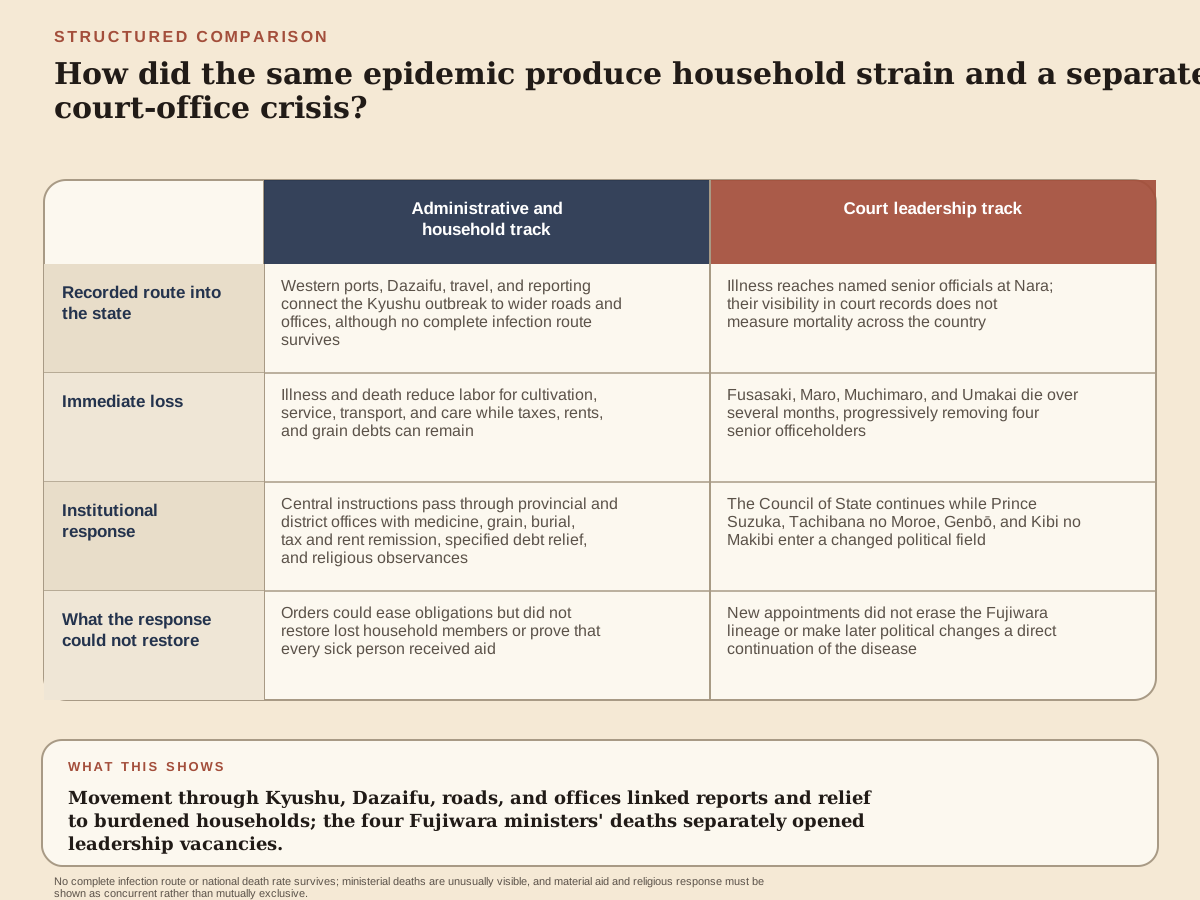
The Shoku Nihongi, the court history completed in 797, makes some of the disruption concrete. In 737 the court ordered assistance and medicine for poor households affected in Kyushu. Disease coincided with drought and threatened crops. In the sixth month, ordinary court attendance was suspended because officials were ill.
The four sons of Fujiwara no Fuhito all died that year: Fusasaki, Maro, Muchimaro, and Umakai. They had occupied influential positions at Emperor Shōmu's court. Their deaths removed a concentration of ministerial power, but the epidemic's effects reached far beyond their family. Surviving households faced lost labor, obligations to pay taxes, and old grain-loan debts.
In the eighth month, the government remitted the year's rent and taxes and specified outstanding public and private grain debts for cancellation. Prayer, scripture recitation, and appeals to divine protection accompanied material relief. These responses belonged to the same administration; religious action did not replace the recorded aid.
Prince Suzuka was placed over the Council of State, and Tachibana no Moroe became a senior councillor in 737, then Minister of the Right in early 738. Shōmu's provincial-temple edict followed in 741 and his Great Buddha vow in 743. The epidemic was part of the troubled background to those projects, alongside political upheaval and further calamities. The records show severe losses, but do not support a single precise national mortality rate.
Classic
Widespread illness was reported in 737, following an earlier outbreak in Kyushu in 735. Kyushu contained Dazaifu, the court's regional headquarters for western affairs, and ports linked to travel across the sea. Movement between the region and the capital provided opportunities for infection to spread, though a complete route cannot be reconstructed from the surviving notices.
Emperor Shōmu governed from Heijō-kyō at Nara. Four brothers—Muchimaro, Fusasaki, Umakai, and Maro—had inherited the political connections of their father Fujiwara no Fuhito and held senior office. An outbreak among officials therefore threatened both daily administration and the balance among court families.
Beyond the court, taxes and labor obligations depended on households able to cultivate fields, produce goods, and send workers. Death and illness could leave survivors with the same obligations and fewer people to fulfill them. The grain-loan system added debts that became harder to repay after crop or labor losses.
Evidence and interpretation · Smallpox, measles, or overlapping outbreaks?
The usual identification as smallpox is a reconstruction from written records. Yagisawa Morimasa and colleagues distinguish the smallpox terminology of 735 from the red-spotted disease of 737, which they interpret as measles.
Dong Ke discusses why the distinction remains difficult. The Council of State’s description resembles measles, supporting Mitsui Shun’ichi’s reading; another medical instruction from the same year names a pox disease and discusses treatment of its marks. Dong treats that second document as evidence for smallpox and considers the possibility that more than one disease was circulating.
The records may describe different illnesses or apply inherited medical categories unevenly. They do not provide a laboratory identification of the people who died, and the labels alone cannot establish that the outbreaks of 735 and 737 were identical.
Shōmu and his officials explained the crisis through moral and religious ideas while also issuing practical orders concerning illness, burial and household obligations.
Connected government depended on more than the ministers at Nara. Provincial offices assembled grain, labor and transport, while households cultivated land and cared for dependents. Reports of illness reached the court through those institutions. The archive is consequently uneven: ministers’ deaths receive names and career notices, whereas the losses of cultivators, women, children and caregivers usually appear indirectly in accounts of distressed households and unmet obligations.
The earlier outbreak in Kyushu was followed by reports of widespread illness in 737. In the fourth month, the court ordered relief and medicine for poor households in the affected region and sent offerings to shrines. Assistance was directed at people whose illness and poverty had combined to make survival harder.
Disease occurred alongside drought. A royal proclamation in the fifth month linked the suffering to failures of the sovereign's virtue and ordered assistance for vulnerable people, including the elderly, widows, orphans, and the sick. Burial and relief measures accompanied the proclamation. The moral explanation was part of the court's response, not evidence of the pathogen's cause.
In the sixth month, the court suspended attendance because its officials were ill. Fusasaki died in the fourth month, Maro and Muchimaro in the seventh, and Umakai in the eighth, using the chronicle’s calendar. Their deaths progressively removed men who had conducted and supervised government business; they were not one simultaneous event at a single gathering.
In the eighth month, an order remitted the year's rent and taxes and covered specified older public and private grain debts. This addressed obligations surviving families still carried. It was an order of remission, not a count of how many households had already received relief in every province.
Scripture recitation, shrine offerings, and prohibitions on killing on prescribed days accompanied these measures. The records name administrative responses and religious observances more clearly than they reveal the experiences of individual patients. They leave the full scale and local variation of mortality uncertain.
A separate sixth-month Council of State instruction set out seven provisions on care and diet. It ordered receiving provincial offices to copy the document and dispatch a district official onward without delay. Provincial governors were to circulate its contents to households and supply official grain when patients lacked food. This gives a concrete communication chain: central instruction, local copying, onward delivery, public notice and provision. It records an attempt to extend care, rather than proof that every sick person was reached.
Relief also appears in named regional notices during the seventh month, including Yamato, Izu and Wakasa, followed by Iga, Suruga and Nagato. The geography of such orders shows several areas reporting distress; it is not a timetable of infection in every village. Reports, treatment instructions and remissions could move through the same administrative routes that linked travelers and supplying households.
By the end of 737, all four leading Fujiwara brothers were dead. Their offices and their concentrated influence could no longer be maintained by the same men. The family survived, but a particular ministerial grouping had been removed in a matter of months.
The reorganization was not simply Tachibana no Moroe replacing the brothers at once. Prince Suzuka was appointed to oversee the Council of State in 737; Moroe became a senior councillor that year and Minister of the Right in the first month of 738. The court retained its institutions while changing the officials directing them.
Tax and debt remission acknowledged economic losses among surviving households. The orders did not restore lost family members or demonstrate that fields everywhere had resumed production. Court reports of distress and indebtedness indicate why obligations, rather than deaths alone, required a governmental response.
No complete census of epidemic deaths survives. The deaths of ministers are unusually visible because court history tracked their careers. Household losses appear less individually, through relief orders and disrupted obligations. The prominent Fujiwara deaths should therefore not serve as a measure of the country's entire suffering.
The Fujiwara family’s position at court also survived through relationships outside the four brothers’ offices. Kōmyō remained Shōmu’s empress. Muchimaro’s son Nakamaro later rose through senior posts and the trust of his aunt Kōmyō; this was a later reconstruction of influence, not an automatic inheritance in 737. Even that year the chronicle records promotion of younger Fujiwara, including Toyonari and Nagate. The loss of a ministerial grouping therefore differed from the removal of the whole lineage.
Lost cultivation had consequences for both households and government. A remission could ease surviving families’ pressure while reducing expected receipts at the center. In 736 the court had already described abandoned agricultural work and poor yields in Dazaifu’s region. The later reclamation law of 743 permitted qualifying newly opened land to remain private property, but it also addressed problems with earlier tenure rules. Epidemic damage belonged to this agricultural setting without explaining the law by itself.
The political opening endured beyond the epidemic year. Moroe's promotion placed another family at the center of ministerial government, while the monk Genbō and the scholar-official Kibi no Makibi gained prominence at Shōmu's court. Fujiwara no Hirotsugu later challenged their influence in the rebellion of 740. That later conflict was a political development, not a further episode of the disease itself.
Shōmu ordered provincial monasteries and nunneries in 741 and issued the Great Buddha vow in 743. These projects gave religious protection an institutional and material form through buildings, scripture recitation, and networks of temples. The epidemic belonged to their background together with drought, rebellion, and unsettled government.
The surviving remission orders also show how an epidemic entered the administrative record: a household's losses mattered to the court through cultivation, taxation, debt, and the supply of officials and workers. The record preserves some of those responses while giving no equal account of every region or patient.
Material relief and religious protection were administered together. The same court that ordered medicine, grain and remissions arranged scripture recitation and shrine offerings; its proclamations attributed calamity to shortcomings of royal virtue. Those explanations tell us how rulers understood responsibility, rather than how a modern pathogen works. The specific copying and delivery orders show that religious language coexisted with attempts to carry practical instructions beyond the capital.
Fiscal accounts offer another view of the losses. Entries for borrowers who died before repaying grain preserve disruption outside the named court elite. Such borrowers are a selected administrative group, and accounts differ by place and purpose. Their recorded losses cannot be converted directly into a national mortality percentage. Read beside relief orders and career notices, they show illness disrupting the people who cultivated, carried, lent and administered the state’s resources.
The epidemic also opened a ministerial vacuum. Tachibana no Moroe rose within the court that had lost the four Fujiwara brothers; this was a political consequence of mass mortality, even though Moroe was not an actor in the epidemic itself.
The man later called Tachibana no Moroe was born in 684 with the royal name Katsuragi. His father, Prince Mino, belonged to the descendants of Emperor Bidatsu; his mother, Agata Inukai no Michiyo, served within the court. These were different kinds of connection with royal power. The father supplied a recognized royal genealogy, while the mother’s service linked her to the practical life of successive sovereigns and their households. Michiyo later married Fujiwara no Fuhito, who became one of the court’s most influential ministers. The children of her two marriages belonged to intersecting political families. Katsuragi’s younger maternal half sister Kōmyō, Fuhito’s daughter, would become Shōmu’s empress. A description of Moroe as simply a rival from outside the Fujiwara obscures this shared household background.