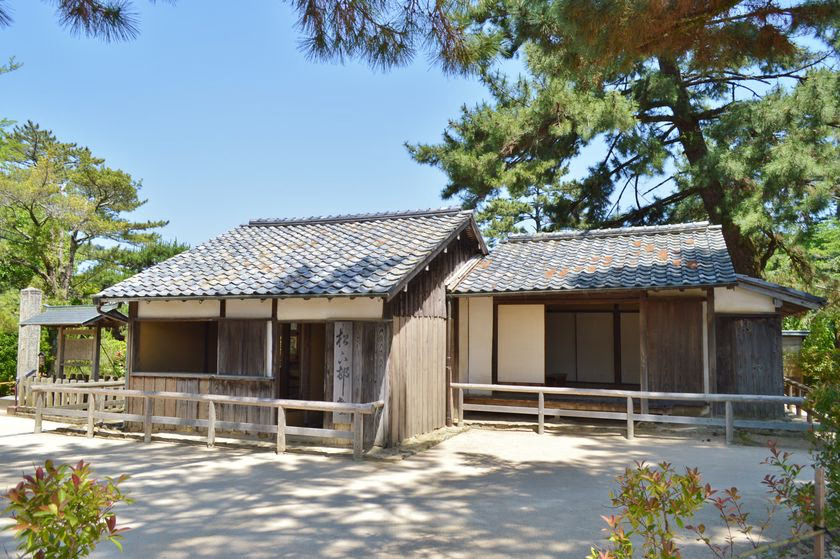
Shokasonjuku and a Compressed Political Network
Attraction
Shokasonjuku is a small wooden school building, yet its historical reach exceeds its scale. Yoshida Shoin taught there briefly in the 1850s, bringing questions of defense, foreign knowledge, political obligation and action into direct conversation with young men of Choshu. Students and associates included Takasugi Shinsaku and Ito Hirobumi; later networks also connected Kido Takayoshi and Yamagata Aritomo to the domain's transformation. The building should not be treated as a factory that automatically produced Meiji leaders. Its value lies in showing how intense study, personal loyalty and argument could operate outside a large official institution. The modest rooms make a political network spatially legible: pupils sat close to a teacher whose execution in 1859 turned unfinished ideas into a powerful memory for surviving followers.
Current visibility
“Shokasonjuku and a Compressed Political Network” can still be read at Hagi: Shokasonjuku and the Castle Town through the surviving school building and its setting; the visibility claim concerns that setting, not a past moment preserved intact.
Meirinkan and the Domain's Official Knowledge System
Attraction
Meirinkan represents the institutional counterpart to Shokasonjuku. Founded as the Hagi domain school and later moved to this central site, it trained retainers within an official curriculum and a hierarchy maintained by the Mori government. The surviving complex includes later school architecture, so visitors must distinguish the domain-school site and retained features from buildings created for modern education. That layered use is historically useful. Choshu's political activists did not emerge from an intellectual vacuum: official scholarship, martial learning, imported knowledge and private teaching overlapped. Reading Meirinkan beside Shokasonjuku prevents a heroic story in which one teacher alone created the Restoration. It shows a domain investing in knowledge before political crisis redirected educated samurai toward military reform and national government.
Current visibility
The surviving setting at Hagi: Shokasonjuku and the Castle Town anchors “Meirinkan and the Domain's Official Knowledge System”; its physical context is the school building, the surviving building, and the reconstructed building.
Hagi Castle Town: The Order the Reformers Inherited
Attraction
Hagi Castle Town was laid out after Mori Terumoto established his base here following Sekigahara. Streets, canals, earthen walls and surviving houses preserve distinctions between castle, upper-retainer districts and merchant quarters. This urban order formed the social world inherited by late-Tokugawa reformers. Residences associated with Kido Takayoshi and the later villa of Ito Hirobumi connect national biographies to particular neighborhoods, but the street plan is the larger object: it reveals rank, administration and commerce before those men entered a new state. The castle itself was dismantled in the Meiji period, while its town endured. That reversal makes Hagi unusually clear historical evidence. The domain center that nurtured opposition to the shogunate later lost its ruling castle, yet continued to carry the spatial record of domain society.
Current visibility
“Hagi Castle Town: The Order the Reformers Inherited” is encountered across the present Hagi: Shokasonjuku and the Castle Town landscape, with the castle compound, the streetscape, and the present landscape carrying the reading rather than one uniformly accessible object.