Read the article below. Interactive reading tools are available when scripts load.
Quick
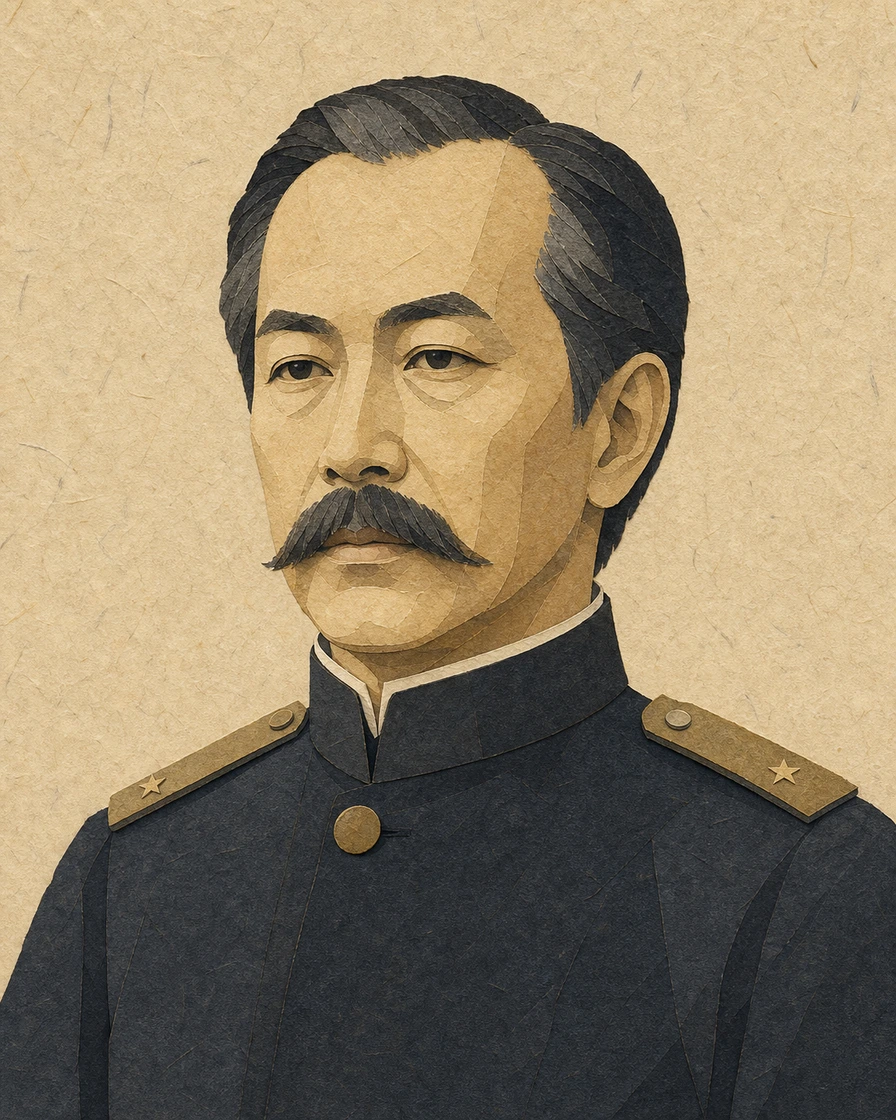
Yamagata Aritomo was born near Hagi on 14 June 1838. His family belonged to a low-ranking service group attached to the treasury of Chōshū, the Mōri domain in western Honshu, below the foot soldiers in its hierarchy. Hereditary rank offered no easy route to senior command. As the Tokugawa political crisis deepened, he entered the circle influenced by Yoshida Shōin's small private school, Shōka Sonjuku. Kusaka Genzui, Takasugi Shinsaku, and other Chōshū activists developed distinct positions within that broad network; they were not pupils carrying one fixed programme into the future. [2][11]
His early service and study connected him to activists outside the domain's senior retainer circle. A military emergency would give him a faster route to command than hereditary rank ordinarily allowed.
Takasugi Shinsaku organized the Kiheitai at Shimonoseki in 1863 after foreign naval retaliation exposed Chōshū's coastal weakness. Accounts differ over whether its beginning should be dated to the sixth or seventh day of the Japanese calendar's sixth month. The Shiraishi merchant household supplied a place and support; Takasugi retains founding agency. Kiheitai means 'extraordinary corps.' The unit recruited beyond the normal structure of a lord's hereditary retainers. Some farmers, townsmen, monks, and men of mixed standing entered alongside warriors. That did not make it a classless national army.
Yamagata became an important military supervisor in the corps. Recruiting beyond the usual retainer ranks required officers to organize training, pay and supply under common rules. Membership remained selective and disciplined, but it opened a new route for advancement during Chōshū's crisis. [2]
In 1864, British, French, Dutch, and United States forces attacked Chōshū positions around Shimonoseki. Yamagata served in the domain's military response. Foreign firepower exposed weaknesses in batteries, weapons, command, and coastal defense, but defeat did not automatically create one reform programme. Chōshū also faced punishment by the Tokugawa shogunate and an internal contest between conservative authorities and reform activists. Takasugi and allied corps overturned the conservative administration through armed action. Yamagata's military advancement occurred inside that internal struggle, not through neutral professional promotion. [2]
When the Tokugawa shogunate launched another expedition in 1866, Chōshū forces resisted on several fronts. Imported arms, reorganized units, local knowledge, leadership, transport, and political weakness within the bakufu (Tokugawa shogunate) coalition all mattered. Later success did not prove that one European model had already been mastered. It showed that a domain under pressure could combine weapons, mixed units, political mobilization, and logistics more effectively than opponents whose numerical strength concealed coordination problems. [2]
Yamagata fought for the new imperial government in the Boshin War of 1868–69, the civil conflict following the overthrow of Tokugawa rule. Chōshū troops joined Satsuma, Tosa, and other forces in campaigns that extended far beyond the first battles near Kyoto. The label “imperial army” described political allegiance more clearly than institutional uniformity. Units retained domain officers, training, equipment, pay arrangements, and loyalties. Court appointments and central orders coordinated a coalition, but a national conscript system, unified officer education, permanent staff, and common logistics had not yet been built. [2]
Yamagata's service in northern operations gave him experience with distance, mixed commands, supply, occupation, and resistance. Victory depended on troops, porters, boat crews, clerks, medical attendants, local guides, and requisitioned households—not on one Chōshū officer. The war created central authority through armed defeat as well as proclamation. Communities associated with the losing side endured death, displacement, fire, confiscation, and political punishment. A future national army would be built partly from lessons learned in this civil war.
In 1869, the Meiji government sent Yamagata and Saigō Tsugumichi abroad to investigate military conditions. An official record identifies Russia and France. The journey began before the Iwakura Mission departed in late 1871 and was not part of that mission. European armies offered more than weapons or uniforms. Recruitment and reserves made manpower available beyond a single emergency. Officer education, staff planning and dependable budgets allowed armies to train and supply those men. Yamagata returned convinced that Japan needed a centrally organized army. [4]
The army developed through Japanese fiscal limits and former-domain forces, with French instruction and later German influence. Building it at home would require recruitment laws and administrative power that the new government did not yet fully possess. [4]
After returning, Yamagata entered senior military administration. He became junior vice minister in 1870, senior vice minister in 1871, and a leading official of the Army Ministry after army and navy administration separated in 1872. Central military power was assembled from former-domain forces, especially Satsuma, Chōshū, and Tosa contingents, while the Imperial Guard gave the government force near the capital. Offices had to create ranks, budgets, depots, arsenals, schools, medical services, regulations, and accounts. The Yamashiroya affair exposed how personal networks and weak financial control accompanied rapid construction. [1][2]
The merchant Yamashiroya Wasuke received unsecured army advances, failed to repay them and died by suicide in the ministry on 29 December 1872. Yamagata relinquished senior posts during the controversy but returned as army chief in June 1873. The affair exposed weak oversight and the influence of trusted former-comrade networks over public money. [3]
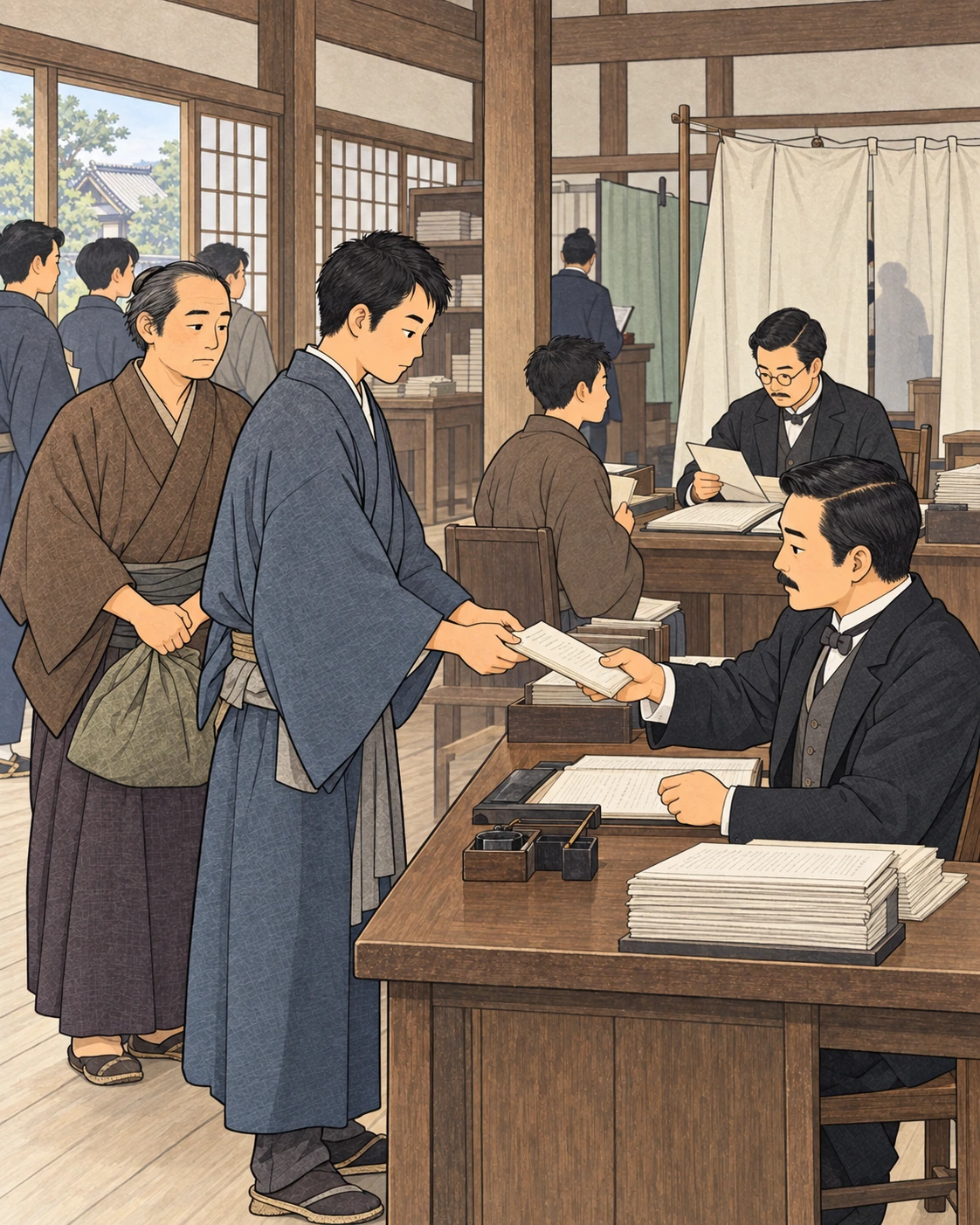
The government issued the Conscription Ordinance in January 1873. Men were examined at age twenty; selected conscripts served three years in the standing army and then four years in the reserve. Males from seventeen to forty entered a wider national-service register. Yamagata was a principal advocate, but the system depended on cabinet authority, household registration, prefectures, local officials, doctors, officers, barracks, budgets, and families. It transferred military obligation beyond the old samurai monopoly without making service equal. [5]
The ordinance exempted important categories, including officials, some students, household heads, and men able to pay a 270-yen substitute fee. Wealth and household structure shaped who actually entered. The government's “blood tax” wording, derived from a foreign expression for military obligation, fed rumors that officials would literally take blood. Anti-conscription disturbances also reflected concrete fears: lost labor, barracks discipline, unfamiliar state power, and danger. Resistance was not simply ignorance, and repression was not neutral education. [5]
The Satsuma War began in February 1877 and ended in Kagoshima in September. Prince Arisugawa Taruhito held formal command; Yamagata served as an expeditionary staff officer alongside Kawamura Sumiyoshi, Ōyama Iwao, and other commanders. Government forces drew on conscripts, former samurai officers, police units, naval transport, telegraph, arsenals, taxes, and repeated reinforcement. Satsuma forces included experienced former warriors and private-school networks but faced a state able to replace losses and move resources nationally. The siege of Kumamoto Castle and the fighting around Tabaruzaka showed that the new army could sustain a major domestic campaign. They also exposed uneven training, command friction, supply problems, illness, and severe casualties. Victory did not validate every feature of conscription, and defeat did not reduce Satsuma fighters to an antimodern remnant. Civilians endured requisition, displacement, fire, and disrupted livelihoods. [2]
In August 1878, Imperial Guard soldiers mutinied at Takebashi in Tokyo. Their grievances included reward and treatment after recent campaigns. The episode showed that troops proclaimed loyal to the emperor could still act collectively over material and institutional disputes. That December, the government established a General Staff Office separate from routine army administration, with Yamagata as its first head. The change strengthened professional planning and helped distinguish command from the ministry's supply and administrative work. [1][2]
On 4 January 1882, the emperor issued the Military Rescript to soldiers and sailors. Yamagata helped shape the project, but imperial promulgation, earlier military instruction, drafting and revision associated with figures such as Nishi Amane, officer education, and unit ritual all mattered. The rescript directed military loyalty toward the emperor and away from former domains and party politics. A text did not eliminate grievance or political effect. Officers interpreted it, schools taught it, ceremonies repeated it, and military institutions continued to bargain over budgets, appointments, and national policy. [2]
Yamagata became Home Minister in 1883 and remained responsible for domestic administration in the first Itō and Kuroda cabinets. The ministry oversaw prefectures, police, public order, local administration, and other functions that carried central decisions into daily life. His tenure joined institution building to repression. Police surveillance and the 1887 Security Preservation Ordinance restricted activists and removed hundreds from the capital zone. Freedom and People's Rights groups, journalists, women in political networks, families, and local communities experienced administrative order from unequal positions. [1][2][11]
Yamagata also led work on local-government law, consulted European models, and studied abroad again. The City Code and Town and Village Code were promulgated in 1888. These measures created councils and local offices, but participation was restricted by age, sex, tax, property, and indirect procedures. Governors and county officials supervised below; the Home Minister retained power over key appointments. Local self-government trained selected property holders in administration while keeping the national chain strongly centralized.
Yamagata became Japan's third prime minister in December 1889. His cabinet entered office after the Constitution had been promulgated but before the Imperial Diet met. Ministers were appointed through imperial government, not selected by a lower-house majority. The first lower-house election in July 1890 filled 300 seats. Fewer than half a million tax-qualified men could vote. The House of Peers, bureaucracy, military commands, emperor, and cabinet retained authority independent of the elected chamber. When the Diet opened in November, opposition representatives demanded spending restraint and tax relief. [1]
Yamagata defended military expansion by distinguishing the territory Japan ruled from an external strategic zone affecting its security. The argument concerned Korea and continental power without obtaining or representing Korean people's consent to Japanese intervention. The cabinet had to negotiate because the lower house possessed budget leverage. Compromise did not turn Yamagata into a party leader. His 1890 prefectural and county laws similarly joined elected local elements to appointed supervision and restricted participation.
When war with Qing China began in 1894, Yamagata commanded Japan's First Army. It was formed around the Third and Fifth Divisions. By the time he landed at Incheon, Nozu Michitsura was already directing the Pyongyang operation; Yamagata left that immediate command with him. The First Army moved north through Korea, crossed the Yalu, and entered Qing territory. Operations depended on staff, divisions, Korean roads and ports, carriers, translators, medical units, animals, ships, and supply. [1][6]
Disease and exposure accompanied combat. Yamagata became ill and was recalled in December 1894. Nozu succeeded him. Yamagata therefore did not personally command the entire war or its final campaigns. Japan's victory led to the Shimonoseki Treaty, colonial possession of Taiwan, and then forced return of Liaodong after Russian, German, and French intervention. Taiwanese resistance, Korean politics, Qing civilians, and soldiers remain part of the event. Yamagata briefly served as War Minister in 1895. On 9 June 1896 he signed a protocol in Moscow with Russian foreign minister Lobanov-Rostovsky concerning Korea. It addressed financial assistance and telegraph lines, retained a provisional arrangement for equal troop numbers and required consultation over further intervention. The protocol managed competition between the powers; it did not establish a fixed partition of Korea. [6]
After his first cabinet, Yamagata remained influential through military office, the Privy Council, imperial access, appointments, and the network later called the Yamagata faction. The network included real patronage and shared institutional interests but was not a machine whose members never disagreed. The Ōkuma–Itagaki party cabinet of 1898 collapsed within months. Yamagata then formed his second cabinet, serving from 8 November 1898 to 19 October 1900. His government strengthened professional civil-service rules and, on 19 May 1900, required army and navy ministers to be active-duty generals or lieutenant generals, and admirals or vice admirals. [1][2][8]
The rule formalized an existing practice and gave the services leverage over cabinet formation. The March 1900 Public Peace Police Law restricted political and labor organization and reinforced women's exclusion from political association. These measures shared a preference: preserve administration and coercive institutions from mass or party pressure. Their later effects involved successors, repeal, revival, and new crises; they were not Yamagata's solitary master plan.
In the years before war with Russia, Yamagata participated in senior strategic and diplomatic discussions, including meetings at his Murin-an residence. Japan's leaders disagreed over negotiation, preparation, timing, and the risks of Russian expansion. After war began in 1904, Yamagata became Chief of the General Staff. He did not command every force. Ōyama Iwao led the Manchurian Army, Kodama Gentarō directed its staff work, Tōgō Heihachirō led the principal fleet, and Katsura Tarō's cabinet and Komura Jutarō's diplomacy had independent responsibilities. [1]
Victory depended on conscripts, officers, sailors, railways, ports, merchant shipping, foreign loans, intelligence, factories, medical workers, and families. Battles caused enormous death and injury; disease, transport, and finance constrained strategy. The war was fought largely on Korean and Qing territory and accelerated Japan's control over Korea. Korean sovereignty and Chinese civilian life were not expendable scenery. The Portsmouth settlement produced relief and anger rather than unlimited triumph.
After the Russo-Japanese War, Yamagata continued to influence cabinet succession, military appointments, the Privy Council, and the network of officers and officials associated with him. In 1907 he received the highest kazoku peerage title, conventionally translated as prince or duke; this was a noble rank, not membership of the imperial family. Authority no longer depended on holding the premiership. His life was not confined to offices. At Murin-an, created in 1894–96, Yamagata set a naturalistic direction while master gardener Ogawa Jihei VII and many workers built the landscape. Other residences, poetry, ceremony, and patronage expressed elite taste supported by wealth, land, water, and labor. [1][2][7]
Yamagata remained politically influential through military and bureaucratic appointments. Parties had gained seats and cabinet access, while the institutions he protected still limited their control. Korea's annexation in 1910 extended an empire that did not give colonized people equal political rights. At Emperor Meiji's death on 30 July 1912, Yamagata was living and the contest over national authority remained unresolved. [1]
Classic
Yamagata Aritomo was born on 14 June 1838 in Kawashima near Hagi, the castle town of the Mōri rulers in Chōshū, western Honshu. His childhood name was Tatsunosuke. His household belonged to the chūgen service group attached to the domain treasury, ranked below the ashigaru foot soldiers. Service gave the family a connection to domain institutions, but senior office was far beyond its normal standing. His subsequent advancement would depend on the openings created by military and political crisis. [2][11]
Rural households delivered taxes; merchants supplied credit; artisans made clothing, weapons, tools, buildings, and paper; carriers moved messages and provisions. Servants and women maintained households whose male representatives became visible in political records. Their work did not make them equal participants in councils or schools. The arrival of foreign warships and the treaty crisis confronting the bakufu (the Tokugawa warrior government) altered this structure without dissolving it. Domain governments needed intelligence, coastal defense, weapons, messengers, and energetic organizers. Urgency could make ability more valuable, especially when senior officials disagreed and inherited procedures appeared inadequate. Yoshida Shōin's Shōka Sonjuku became one place where young Chōshū men argued about external danger, imperial legitimacy, learning, and action. Yamagata's attendance connected him to a famous network. Kusaka Genzui emphasized activist imperial loyalism; Takasugi Shinsaku later improvised military organization; Itō Hirobumi moved through violent exclusionism, overseas study, and government.
Their later trajectories show that a shared teacher was a starting relationship, not an identical ideology. Yamagata learned in a political culture where personal ties carried information and opportunity. A recommendation could open an assignment; failure or association with a defeated faction could close it. Such networks were not merely corruption added to a neutral state. They were a working means by which domains selected men when regular offices could not meet crisis demands. That system also encouraged a lasting political habit. If national survival seemed to depend on a small number of trained men who knew one another and had proved themselves in emergency, it became easy to regard their continued control as prudence. Outsiders could see the same pattern as a clique protecting its own authority.
In the late 1850s Yamagata entered Shōka Sonjuku, Yoshida Shōin's small private school. There he encountered a network of Chōshū activists whose arguments joined imperial authority to the domain's survival. These relationships offered opportunities unavailable through his family's rank alone. Military emergency would soon give them an organizational form. [11]
In 1863 Chōshū fired on foreign shipping in the Shimonoseki Strait and suffered naval retaliation. Takasugi Shinsaku proposed a new force that would recruit beyond the usual retainer corps. The Shiraishi merchant household supplied its early base and commercial support. Accounts place formation on the sixth or seventh day of the Japanese calendar's sixth month. The one-day difference does not change Takasugi's founding role or the importance of local backing.
Kiheitai means 'extraordinary corps.' Its recruits included men outside the hereditary retainer establishment, although officers still selected entrants and enforced a military hierarchy. Yamagata became an important supervisor and commander. The unit could admit someone for skill or usefulness without giving him equal authority over strategy. Domain approval and funding continued to bound this experiment in recruitment.
Yamagata's work was nevertheless formative. A force assembled from varied backgrounds required rules that could function without a single inherited household chain. Officers had to organize watches, drill, ammunition, pay, food, intelligence, and punishment. Authority increasingly attached to a defined role within a unit. That shift carried an ambiguity. Task-based recruitment could weaken old privilege, yet strict military discipline could create a new hierarchy. A farmer admitted as a rifleman did not thereby become equal to a commander; a merchant who financed food did not control strategy; a household that lost labor to service bore costs that official unit histories might omit. The Kiheitai also existed among other Chōshū corps. It was not the only irregular unit, and Chōshū's military adaptation was not one organization's solitary achievement. [2]
Domain officers, local sponsors, imported weapons, coastal communities, and competing activist groups all affected capacity. Nor was participation a stable identity. Men could join for loyalty, wages, defense, pressure, local ties, or political conviction. Later commemoration often assigns a single national purpose to everyone who entered. Contemporary motives were more varied and sometimes unrecoverable. For Yamagata, the institution offered opportunity that his family rank alone might not have supplied so quickly. It rewarded administrative endurance and command within a crisis network. That experience could support a later belief that disciplined organization mattered more than formal class origin. Yet it would be misleading to draw a straight line from Kiheitai recruitment to universal conscription. The former was a domain emergency force with selective mixed-status membership.
Kiheitai service accelerated Yamagata's rise by rewarding sustained organization during crisis. It gave him experience in commanding a force whose membership reached beyond the old retainer corps. Later national conscription would extend recruitment much further, through a legal obligation imposed on households across Japan.
The four-power naval attack at Shimonoseki in 1864 confronted Chōshū with an extreme difference in naval reach and gunnery. Shore batteries could be targeted by warships whose crews, weapons, and coordination had been developed for oceanic combat. Yamagata's participation placed him near a material lesson: political will could not substitute for range, accuracy, supply, and command. The defeat did not produce agreement across Chōshū. Officials had to consider foreign indemnity, punishment by the Tokugawa shogunate, court standing, internal legitimacy, and the danger that armed activists might escape domain control. Conservative leaders could interpret survival as requiring submission and the removal of radical figures. Reform activists could interpret the same crisis as proof that the domain needed stronger independent military capacity and a different political leadership. [2]
The first bakufu expedition forced concessions and strengthened conservative leaders who punished activists. Takasugi's armed rising then overturned that administration with support from several corps and local backers. Yamagata served the reform side. Once it controlled the domain, officers could reorganize units and distribute imported rifles under stronger political authority. [2]
Imported equipment was only useful when an administrative system put it into trained hands. The second bakufu expedition in 1866 was fought across separate operational areas rather than as one duel. Chōshū's forces used terrain, mobility, firearms, and local support. The bakufu side included multiple domains with differing incentives and uneven willingness to sustain the campaign. This difference helps explain why a smaller political unit could resist a nominally larger coalition. A centralized number on paper did not guarantee common supply, command, or purpose. Conversely, Chōshū's success did not mean every unit had become professionally uniform. For rural and urban residents, reorganization carried burdens. Movement consumed food and animals; fighting threatened homes and trade; recruitment removed labor; new weapons required payment.
Villages and towns supplied food, transport and money for the reorganized force. Yamagata gained experience inside a partisan victory: one Chōshū coalition had defeated another and now determined the domain's military policy. Technical reform and control of appointments developed together. The successful resistance of 1866 strengthened both the corps and the officers who administered them.
During the Boshin War of 1868–1869, the new imperial government fought opponents of its settlement of Tokugawa power. Yamagata served as a Chōshū organizer in the northern campaigns. The coalition drew forces from several domains, each retaining its officers, weapons and pay arrangements. Imperial appointments coordinated these contingents without making them a uniform national army. [2]
Units traveled over long distances; food and ammunition had to follow; wounded and sick men required care; messages crossed uncertain roads; captured territory needed administration. Domain variation complicated these tasks. Ammunition might not be interchangeable; drill commands differed; officers answered through separate chains; pay and reward expectations came from distinct governments. The coalition could concentrate force, but it could not assume the everyday regularity of a later national army. Civilian labor filled the gaps. Porters carried military loads; boat crews moved men and supplies; artisans repaired equipment; farmers surrendered grain or animals; towns lodged troops. Some cooperation was paid or voluntary, some negotiated under pressure, and some compelled. The human costs followed political geography. A community could be treated as hostile because of its domain's alignment even when residents had no role in high policy.
Burning, requisition, displacement, and disrupted harvests do not disappear because the victorious side later called the war national unification. Yamagata could observe that common allegiance required material standardization. A flag and court commission might unite purpose, but units needed shared regulations, records, ranks, depots, training, and a dependable source of recruits. Those observations supported later centralization. They did not dictate one institutional answer. A state might coordinate domain contingents, maintain a smaller professional force, or impose conscription. Fiscal capacity, fear of domestic revolt, foreign threats, and the political future of the samurai all shaped the choice. Victory also elevated networks. Men whose domains formed the core coalition gained access to central office. Their practical experience was real, but office distribution reproduced regional advantage.
Victory made Chōshū service a credential in the new central military offices. Yamagata's wartime relationships could now support recommendations and appointments. The officers who had fought to establish a national center would help reduce the military independence of the domains from which they came.
In 1869 the government sent Yamagata and Saigō Tsugumichi abroad to investigate military conditions. The official dispatch record names Russia and France. This was a separate military inquiry, preceding the Iwakura Mission's departure in late 1871. European armies offered examples of permanent recruitment, reserves and officer education at a time when Japan still relied heavily on domain forces. [4]
Officer schools required teachers, textbooks, selection, and salaries. Staff planning required maps, statistics, reporting, and authority over field commands. Barracks concentrated men who had previously lived through household and domain ties. They needed food, clothing, sanitation, discipline, medical care, and rules for leave. Arsenals and depots required skilled labor, imported machinery, finance, and transport. The state had to decide which costs would fall on taxation, local communities, soldiers, or their families. Yamagata traveled as an official of a government whose domestic institutions were unfinished. Domains still existed when the trip began. The central state lacked a settled national revenue system, a complete population registry, and a universally accepted right to remove men from households for service. European methods had to be adapted to these fiscal limits and to troops still organized through former domains.
The travelers compared armies while interpreters and diplomatic hosts mediated what they could see. Saigō Tsugumichi would follow his own military and naval career after returning. Early Japanese training retained considerable French influence; German staff methods entered later through further advisers and studies. Yamagata's commitment to centralized organization developed within that changing mixture of models. [4]
German influence later became important in staff and constitutional thought, but it entered a system already formed by domain experience, French missions, conscription, civil war, and Japanese administrative choices. Yamagata's own preference for centralized command made some foreign features more attractive than others. Selection was political. Learning from an institution did not require adopting its society, and invoking foreign precedent could strengthen a domestic proposal against rivals. The trip nevertheless changed scale. Kiheitai experience had shown how emergency organization might loosen status recruitment. European armies demonstrated how law, registry, budget, and education could make mass mobilization a continuing state capacity rather than a temporary domain expedient. That possibility carried both inclusion and coercion. A national army could replace the samurai monopoly, but it could also claim years of ordinary men's lives, discipline their bodies, and direct them into domestic or overseas war.
Yamagata returned committed to stronger central military institutions. Their construction would depend on domestic recruitment law, finance and former-domain forces, giving imported methods a setting quite different from the armies he had inspected.
Yamagata returned to a government that possessed revolutionary authority but only partial administrative reach. The abolition of domains would remove formal regional governments in 1871, yet their troops, officers, weapons, debts, and habits could not be transformed by decree alone. Military offices changed names and jurisdictions as leaders searched for a workable structure. Yamagata moved upward through this unsettled administration. Titles mattered because they defined legal responsibility, but they did not mean that one officeholder personally performed every task attributed to “the army.” The Imperial Guard drew heavily on Satsuma, Chōshū, and Tosa forces. It gave the new center an armed body less dependent on summoning distant domains. It also concentrated Restoration-coalition influence at the heart of government. Former-domain soldiers did not instantly become interchangeable national servicemen. [1][2]
Officers brought regional relationships; units had different training; arsenals held varied weapons; pay systems had to be reconciled. New insignia and regulations could standardize appearance more quickly than practice. An army ministry needed reliable personnel and financial records, translated manuals and officer training. Medical and transport staff turned those administrative plans into a force capable of service. The public image of a founder compresses this institutional labor into one name. Money was especially dangerous. The government wanted modern arms and reliable supply faster than its audit systems matured. Personal connections to former activists and merchants could provide speed and trust, but they could also bypass safeguards. Yamashiroya Wasuke had Kiheitai connections and a close relationship with Yamagata.
Yamashiroya received repeated unsecured advances for trade and military procurement. Losses and failure to deliver or repay turned the arrangement into a public scandal. A 2023 study by Sugawara Morikuni examines the advances and the disciplinary responsibility of army and navy personnel. Yamashiroya killed himself in the ministry on 29 December 1872, the date corresponding to the twenty-ninth day of the old calendar's eleventh month. Destruction of his papers left parts of the transaction history difficult to recover. [3]
Pressure from Imperial Guard officers had already led Yamagata to relinquish its command in August 1872. He resigned his senior Army Ministry post in April 1873, but returned as army chief in June. The financial affair thus interrupted his offices without ending his influence. Sugawara's study follows specific loans and disciplinary proceedings; it does not turn the survival of Yamagata's career into proof that the lending system was sound. Conscription was meanwhile giving the ministry a recruit base beyond the former-domain units.
The Conscription Ordinance of January 1873 ended the principle that military service belonged chiefly to hereditary warrior households. Men faced examination at twenty, with selected recruits entering three years of active service followed by four years in reserve. A broader register covered males from seventeen to forty for potential national service. Household registers and local officials made these obligations enforceable before a recruit reached the barracks. [5]
The principle of broad liability coexisted with extensive exemptions. Government employees, students in designated study, household heads, and other categories could avoid active service. Most strikingly, a payment of 270 yen could purchase exemption under the initial system. That sum placed escape far beyond ordinary means. Wealth did not simply improve a conscript's equipment; it could prevent service itself. Household law also distributed burden unevenly, because the legal identity of a family head differed from that of younger sons. For farm families, the absence of a young man could remove labor during planting, harvest, forestry, fishing, or transport. Women, older people, siblings, tenants, and hired workers absorbed that loss. The state measured a recruit; the household experienced a missing worker. [5]
Military service also carried cultural disruption. Men lived under unfamiliar schedules, clothing, diet, hygiene, punishment, and hierarchy. They could be sent away from local language and custom. Former samurai officers often commanded men whose communities had recently experienced those warriors as tax or coercive authority. The phrase conventionally rendered as “blood tax” intensified fear. It originated in an imported metaphor for payment through military service, but rumors interpreted it literally. Officials and later commentators often presented the resulting violence as proof of rural credulity. Rumor mattered, but it did not exhaust opposition. Villagers could misunderstand one phrase and accurately perceive that the state demanded lives, labor, taxes, and obedience. Resistance sometimes joined anti-conscription anger to hostility toward schools, registries, and local officials because these institutions made the new government present in daily life.
Violent disturbances also harmed people and property. Explaining material causes does not turn every action into justified protest. Police, troops, local leaders, villagers, and targets of crowd violence retained different positions and responsibilities. Yamagata's role was central but not solitary. Government councillors had to approve the system; military offices drafted and revised it; local administrators enforced it; exemptions emerged from political compromise. Former-domain contingents remained essential while the first cohorts were trained. Conscription widened state membership in a coercive form. A man could be recognized as useful to the nation because he was liable to serve, without receiving an equal vote, secure rights, or control over the wars he might fight. Obligation expanded faster than representation. Over time, exemptions changed and the army became more socially extensive.
Conscription broke the old warrior monopoly while creating a new national chain of command. The initial exemptions left exposure unequal, and recruitment still depended on negotiation and enforcement in local communities. As the first cohorts trained, the government retained former-domain contingents alongside its new servicemen.
The Satsuma War began in February 1877, when Saigō Takamori's rebellion challenged the young central military system. Prince Arisugawa Taruhito held formal command; Yamagata served as a staff officer and administrator alongside field commanders including Kawamura Sumiyoshi and Ōyama Iwao. The government's great advantage was sustained recruitment and supply from beyond Kyushu. It could replace losses that a regional rebellion could not readily replace. [2]
Telegraphy accelerated information, but a message could not move supplies by itself. Clerks encoded and transmitted orders; railway and port workers supported segments of travel; sailors and boat crews carried units; animals, carts, and human porters served routes beyond modern transport. Kumamoto Castle denied the Satsuma army an easy strategic center. Its defenders, including officers and ordinary soldiers under severe pressure, shaped the campaign independently of Yamagata. The siege fixed rebel resources while government reinforcements assembled. Tabaruzaka became a sustained and costly struggle. Rain, mud, terrain, ammunition, fatigue, and close fighting mattered alongside strategy. A later narrative of inevitable state victory hides how uncertain a young army's performance could be. Conscripts were not simply peasants confronting samurai. The government army included former-samurai officers and specialists; police formations included many men of warrior background.
Satsuma forces used firearms and organization as well as swords. The opposition was political and institutional, not a clean duel between medieval and modern types. The government's financial capacity rested on taxpayers and monetary policy. War costs spread into households far from Kyushu, even when their members had no role in deciding the conflict. Medical systems treated some wounded and failed others. Disease and infection could remove men who survived combat. Families waited for information carried through administrative systems still prone to delay and error. Kagoshima civilians lived inside the final concentration of violence. Homes, commerce, and food supply were affected by both military presence and destruction.
Yamagata's organizational approach gained prestige because the government endured. Yet performance revealed needs for improved staff work, training, discipline, reserves, and logistics. Success generated further reform rather than certifying completion. The war also expanded the army's domestic political meaning. National troops had defeated a major armed challenge from within the Restoration coalition. Central military institutions were not only defense against foreign powers; they were instruments for deciding conflicts among Japanese citizens and former elites.
The rebellion ended in September. The central army had suppressed a major challenge from within the coalition that created it, making its domestic political role unmistakable.
The Takebashi mutiny by Imperial Guard soldiers in Tokyo in August 1878 revealed that formal loyalty did not dissolve material conflict. Imperial Guard soldiers had fought for the government and expected reward, recognition, and fair treatment. When some believed those expectations had been violated, they did not behave as passive instruments of command. Mutiny was a grave breach of discipline and exposed the state to violence in its capital. It was also evidence about army organization. Pay, promotion, promises, and communication were not secondary to morale; they were part of the institution commanders had to govern. The government's response included punishment, but the episode belonged to a wider reassessment. A national army needed central planning that could operate beyond one campaign and beyond the routine business of an army ministry.
The General Staff Office, established in December 1878 with Yamagata as its first head, separated operational planning from much military administration. Staff officers could prepare mobilization, intelligence, maps, and campaign plans while the ministry handled personnel, supply, and budgets. Separation promised expertise. It also created a difficult constitutional question before the constitution itself was promulgated: how would a planning command relate to ministers, cabinet, legislature, and emperor? Institutional independence could protect professional judgment and reduce ordinary political control. Yamagata did not create staff knowledge by title alone. Surveyors made maps; statisticians compiled information; language specialists read foreign materials; instructors trained officers; clerks maintained secret records. Access to this work became another source of bureaucratic power. The Military Rescript of 1882 addressed identity and obedience. [1][2]
The Imperial Rescript to Soldiers and Sailors of 4 January 1882 directed recruits toward service to the emperor rather than former domains or parties. Yamagata's earlier military instruction helped shape the project, and Nishi Amane participated in its drafting. Schools and units taught its principles through explanation, memorization and ceremony. Obedience became an explicitly imperial duty, reinforced by repeated practice within military life. [2]
The demand that soldiers remain outside party politics could also portray the military's own institutional preferences as above politics, even when those preferences affected budgets, cabinets, and empire. Direct imperial loyalty strengthened command against mutiny and former-domain division. It also reduced the legitimacy of civilian criticism when military leaders claimed privileged access to the sovereign's authority. This consequence developed over time and was shaped by many actors; it was not a complete 1882 blueprint for later military government. The rescript did not pay a soldier, feed a barracks, or correct an unjust promotion. Ethical instruction could not replace administration. Takebashi remains important precisely because it shows the danger of treating discipline as a problem of belief alone. Yamagata's answer joined structure and morality. A specialized staff would plan; an imperial ethic would bind; schools and regulations would reproduce both.
This was a coherent military project, but coherence did not make it politically neutral. By 1882, the army possessed more of the everyday machinery absent in 1868. Its command system was also becoming harder for emerging parties and representative institutions to control. Professionalization and autonomy grew together, setting a conflict that would continue through Yamagata's later cabinets.
Yamagata became head of the Home Ministry in 1883. It supervised prefectures and police as well as public works and local administration, carrying national policy into daily life. He sought local bodies that could manage resources and train selected residents in administrative responsibility under central supervision. Governors remained appointed state officers. The Freedom and People's Rights Movement challenged this concentration of authority through petitions, meetings and local assemblies. [1][2]
Its members disagreed among themselves, and their visions of representation often excluded women and the poor. Those limits did not make state repression neutral. Police monitored meetings and speech; administrative rules constrained association; arrests and trials weakened organizations. The Security Preservation Ordinance of December 1887 authorized severe restrictions around the imperial capital and displaced hundreds of activists. Removal did not affect only a named political leader. Families lost income and residence; printers and meeting organizers lost networks; landlords and neighbors faced official pressure. Women who sustained households and political communication remained largely outside formal franchise even while bearing punishment's effects. Yamagata's local-system project proceeded in the same period. A commission studied institutions, and German adviser Albert Mosse contributed comparative legal expertise. [11]
Yamagata also undertook another European study in 1888, distinct from his 1869 military journey. The City Code and Town and Village Code, promulgated on 25 April 1888, created a more systematic local order before the constitution and national Diet came into operation. Councils and offices gave some communities arenas for budgets, public works, and local decisions. Participation remained narrow. In cities, voting and eligibility depended on being a tax-paying male of the required age. Wealth influenced electoral weight and access. Women, most laborers, poorer tenants, younger men, and residents without qualifying tax standing remained outside. Appointment procedures preserved supervision. A city council could nominate candidates for mayor, but the Home Minister sought imperial appointment. Prefectural and county officials watched local bodies.
Administrative legality did not mean the central state withdrew. Supporters believed local service would educate responsible citizens and prevent national politics from becoming uncontrolled competition. “Responsible” often meant property-owning men thought capable of bearing tax and office. Social hierarchy was built into the educational theory of self-rule. Local bodies could still gain practical agency. Councillors learned budgets, negotiated roads and schools, and sometimes resisted officials. Law never determines every use. A bounded institution could become a platform for demands its designers did not intend. Yamagata's combination was therefore internally consistent: controlled participation below, strong bureaucracy above, police against disruptive mobilization, and an army protected from party control. He valued organized public work more than open popular sovereignty. This system was not merely military rule translated into civilian form.
Local councils gained practical experience with budgets, roads and schools, while governors and the Home Ministry retained supervisory power. Yamagata's influence now reached beyond barracks through police, local offices and appointments. Controlled participation became a civilian counterpart to the military institutions he had built.
Yamagata became Japan's third prime minister in December 1889, following Itō Hirobumi and Kuroda Kiyotaka. The Constitution had been promulgated, but the first Diet had yet to meet. The election of July 1890 filled 300 lower-house seats through a franchise restricted to tax-qualified adult men. Fewer than half a million qualified. The cabinet would face an elected chamber within a state whose military commands, bureaucracy and imperial appointments were already operating. [1]
Those voters were not politically meaningless. They selected representatives who could debate laws and refuse or reduce budget proposals. Parties and organized groups gained a national arena in which criticism could be recorded and coordinated. But the lower house was only one part of the system. The House of Peers was not elected on the same basis; ministers did not require lower-house confidence; the military possessed direct imperial-command claims; bureaucrats continued across cabinet changes. Dissolution and new election remained government weapons. Yamagata approached the first session with a strong-administration view. Opposition members associated with popular-rights traditions pressed for lower spending and relief from the land-tax burden. They questioned the cost of a state that asked rural households to finance institutions while restricting participation.
Military spending became a central conflict. In his policy address, Yamagata distinguished the state's sovereign territory from a surrounding strategic zone whose condition could affect national security. The formulation was a way to justify defense beyond the home islands. Korea was central to that strategic thought. Korean territory and politics did not become Japanese property because a Japanese prime minister defined them as security concerns. Korean officials, reformers, court factions, farmers, merchants, and foreign representatives had their own interests. The security doctrine also created an expandable logic. Railways, ports, neighboring governments, and distant military positions could be described as vital to Japan. The boundary between defense and influence was political, not supplied by geography alone. The lower house's budget power forced negotiation.
Government and opposition participants split, bargained, and revised. Some representatives could be persuaded through local interests or policy concessions. Party labels did not produce perfect discipline. This bargaining matters because it disproves both a sham-parliament account and a full parliamentary-government account. Representatives could obstruct a cabinet they did not appoint. The cabinet could survive without becoming their executive, but not always without adjusting money. The Prefectural and County Codes promulgated in May 1890 extended Yamagata's local architecture. Councils existed, yet indirect and limited elections favored landlords and property holders. Governors and county heads supervised from the central chain. Yamagata treated such structures as political education under control. Critics saw oligarchic rule preserving itself through police, appointed offices, and narrow franchise.
Both descriptions refer to real features: participation expanded, and its limits were deliberately institutionalized. His cabinet resigned in May 1891. It had not converted the constitutional order into party government, nor had it prevented representative pressure from becoming operational. The first Diet demonstrated that even a strong bureaucratic-military cabinet had to reckon with a chamber able to contest funds. Yamagata's answer in later years would not be to abolish the Diet. He would build personnel, legal, and military arrangements that kept key institutions from falling under party control while negotiating with parties when necessary. Constitutional politics became a field he managed and feared, not an event he could ignore.
In the war with Qing China that began in 1894, Yamagata commanded the First Army, formed around the Third and Fifth Divisions. Nozu Michitsura was already directing the operation against Pyongyang when Yamagata arrived in Korea. Yamagata left that immediate command with Nozu. He subsequently led the army's northward advance toward the Yalu, within a war directed by the cabinet and imperial headquarters. [1][6]
Japanese operations took place across Korean territory. Korea was not an empty corridor between Japan and China. Court factions, officials, the Donghak movement, farmers, port residents, laborers, and reformers confronted both domestic crisis and foreign armies. Japanese troops required landing points, roads, food, animals, interpreters, and information. Some resources were purchased; others were requisitioned under unequal military power. Local people could assist, resist, flee, negotiate, or be compelled. After Pyongyang, the First Army advanced toward and across the Yalu. Entry into Qing territory extended the supply line. Rivers, mountains, weather, and road conditions constrained operational schedules more reliably than patriotic imagery acknowledged. Soldiers faced combat, but disease removed many from service. Medical officers, stretcher bearers, nurses and attendants, sanitation workers, and burial details sustained the army's human system. [6]
Disease reduced the army's strength alongside combat losses. Yamagata became ill and was recalled in December 1894; Nozu succeeded him. Later campaigns therefore fell under different command. Japan's eventual victory brought territorial gains under the Shimonoseki Treaty, including Taiwan. Occupation there met resistance from inhabitants who had not consented to the transfer.
Soldiers, local leaders, communities, Qing officials, and Japanese administrators created a history not reducible to treaty text. Domestic parliamentary development did not grant colonized subjects equal participation in the decision. The Triple Intervention of 1895, by Russia, Germany and France, forced Japan to return the Liaodong Peninsula. Military success therefore met the diplomacy of stronger European empires. Yamagata briefly served as War Minister in 1895. On 9 June 1896, Yamagata signed a protocol in Moscow with Russian foreign minister Lobanov-Rostovsky concerning Korea. It provided for consultation over financial assistance, addressed telegraph lines and continued a provisional arrangement for equal numbers of Japanese and Russian troops until Korea organized its own force. Secret clauses also called for separated areas of operation if the two powers agreed to send additional troops. This was an arrangement between foreign powers over Korea, not a treaty partitioning the peninsula along a fixed boundary. The cabinet and imperial headquarters, along with naval and army leaders, retained responsibility for treaty and colonial policy. The war strengthened arguments for larger forces, more budgets, and strategic influence beyond sovereign territory. It also created veterans, bereaved families, debt, and colonial obligations.
Yamagata's army command ended before the war did. His subsequent diplomatic role shows how military expansion led into negotiation with another imperial power. The 1896 protocol sought to manage rivalry over Korea; it did not remove that rivalry.
After his first cabinet ended in 1891, Yamagata retained power outside the premiership. Yamagata held military and Privy Council positions, advised on cabinet formation, and influenced appointments. Former Chōshū associates and men promoted through army or Home Ministry careers formed a recognizable network. The word “clique” captures patronage and concentration but can imply more unity than existed. Officers competed over doctrine and promotion; bureaucrats had departmental interests; protégés acquired independent ambitions. Yamagata's influence worked through repeated consultation and placement, not a single command transmitted to obedient agents. Parties were also changing. The first Diet had shown their budget leverage; elections built local organizations; leaders bargained with oligarchs and accepted cabinet office. No stable line separated pure popular representation from corrupt administration. The Ōkuma–Itagaki cabinet of 1898 made the party problem immediate. [1][2]
It was the first cabinet substantially formed from party leaders, though appointment, military, peers, bureaucracy, and narrow suffrage still limited responsible government. Internal division destroyed it before routine parliamentary rule could be tested. Yamagata's second cabinet followed, serving from November 1898 to October 1900. Its existence did not erase parties. The government needed legislative cooperation and negotiated with organized representatives, including forces moving toward Itō's Seiyūkai. Opposition and transaction coexisted. Civil-service reform offered one defense against party patronage. Competitive qualifications and protected careers could make administration more competent and continuous. They could also preserve an existing official elite and narrow the posts available to electoral victors. The same ambiguity appeared in military appointments. On 19 May 1900, revised army and navy regulations specified that the ministers must be serving officers of high rank. [1][8]
Supporters argued that high military office required experienced serving professionals. Yet a cabinet needed those ministers in order to exist. Refusal by a service to provide an eligible officer could obstruct its formation or continuation. The regulation formalized a practice that already favored active officers, giving that professional qualification an explicit political consequence.
The Public Peace Police Law, enacted in March 1900, addressed a different arena with a related suspicion. Labor organization and political assembly could be limited; police gained tools against movements treated as threats to order. Women were already excluded from the national franchise, but restrictions on political association went further. Women who organized, spoke, supported strikes, printed materials, or maintained activist households faced a state that denied them formal participation while policing their public action. For workers, “order” could mean protection of employers and official policy against collective bargaining. For officials, strikes and mass meetings could appear to threaten production and authority. The law encoded the government's choice between those interests. Yamagata's system was therefore constitutional and restrictive at once.
A Diet met; parties negotiated; laws were enacted through formal institutions. Bureaucratic careers, military offices, police power, peerage, and imperial appointment prevented electoral majorities from becoming the sole source of government authority. The second cabinet made this architecture more durable. It did not eliminate political competition, and it did not predetermine the twentieth century. It did ensure that Japan's expanding party public would confront institutions designed to call themselves national, professional, and above party while exercising profound political power.
The Russo-Japanese War of 1904–05 emerged from imperial competition in Korea and Manchuria, not from a private duel between military geniuses. Russian expansion, Japanese security claims, Korean sovereignty, Qing weakness, alliance diplomacy, and failed negotiation formed the setting. Yamagata was one of Japan's most experienced senior figures. Meetings at Murin-an connected his residence to prewar discussion, but a meeting room did not command the state. Itō remained a senior adviser, while Prime Minister Katsura Tarō and Foreign Minister Komura Jutarō held distinct cabinet and diplomatic responsibilities. Army and navy chiefs reported through their own command structures. When Yamagata became Chief of the General Staff in June 1904, the war was already under way. His office coordinated army planning at the imperial center. It did not erase the operational command of the armies in the field. Ōyama Iwao commanded the Manchurian Army; Kodama Gentarō was central to its staff; field army and division commanders made decisions under local conditions. [1]
Information reaching Tokyo was delayed, selected, and interpreted through reports. The navy had its own command, logistics, intelligence, and strategic problems. Fleet commander Tōgō Heihachirō operated within naval institutions separate from Yamagata's army command. Sea control affected reinforcement and supply, but it did not make army and navy one organization. Modern operations consumed material at a scale Kiheitai experience could not have predicted. Ammunition and provisions had to reach armies throughout the campaign, along with winter clothing and medical supplies. Shipping and railway capacity required continuing investment. Workers in arsenals and factories produced supplies. Railway and port laborers loaded them. Merchant crews faced risk. Telegraph operators and clerks moved information. Banks and foreign lenders financed a state whose domestic revenue could not make cost disappear.
Conscription distributed battle exposure broadly among Japanese households, but not equally. Rank, assignment, health, and exemption history shaped risk. Women and older relatives maintained farms, shops, and families, waited for letters, and managed injury or bereavement. Battles such as Liaoyang, Port Arthur, and Mukden produced immense casualties. Tactical claims to ground cannot express the physical destruction. Medical systems saved lives and were overwhelmed; disease and exposure remained military forces in their own right. The war's geography was colonial. Japanese and Russian armies operated in Korea and Qing territory. Korean and Chinese residents faced requisition, movement controls, damaged livelihoods, and danger without commanding either empire's strategy. Japan's military success intensified coercion over the Korean Empire. Treaties and protectorate institutions were produced under unequal force.
Japanese victory strengthened coercive control over Korea. The Portsmouth negotiations nevertheless took place under financial exhaustion and uncertainty about further campaigning. The treaty recognized strategic gains but failed popular expectations of an indemnity. Hibiya unrest in Tokyo exposed the anger produced by sacrifice and wartime expectations that the settlement could not satisfy. Yamagata's staff office remained responsible for central army planning within these military and financial constraints.
The conflict demonstrated the reach of the army he had helped institutionalize. It also revealed a limit inside his project: a disciplined national force could magnify state power beyond the home islands while requiring deaths, debt, labor, and colonial coercion on a vast scale. Organizational success was not a moral verdict.
After 1905 Yamagata often exercised influence without a cabinet portfolio. As a genrō, an informal elder statesman advising the emperor, and a Privy Council leader, he participated in decisions about prime ministers and appointments. Katsura Tarō and Saionji Kinmochi alternated in cabinet leadership through their own negotiations and party relations. Itō Hirobumi remained a rival and collaborator until his assassination in 1909. [1][2]
The Yamagata network was durable because institutions reproduced it. Officers promoted officers; senior bureaucrats recommended successors; shared schooling and regional origin built trust. The network could coordinate without requiring agreement on every issue. Critics called this domain-faction government because men connected to Restoration victors retained disproportionate power. The criticism had force even when individual appointments were technically qualified. Expertise and privilege could reinforce one another. Yamagata's gardens complicate the public image without redeeming it. Murin-an was created in Kyoto between 1894 and 1896. Yamagata directed its broad aesthetic preference, while Ogawa Jihei VII supplied exceptional design knowledge and practical execution. Water from the Lake Biwa Canal, shaped ground, plants, stones, buildings, and framed views made the garden possible. Gardeners, carpenters, laborers, servants, water managers, and later caretakers turn “Yamagata's garden” into a collective material work. [7]
Murin-an joined private taste to elite political access. Flowing water and borrowed scenery formed an intentionally naturalistic landscape, and the residence also hosted prewar discussions. Poetry, calligraphy and patronage occupied Yamagata alongside public office. The resources supporting these pursuits came with the status and property of a senior figure in the imperial state.
By 1912 parties had become permanent participants in national politics, yet military autonomy and protected bureaucratic careers still limited what an electoral majority could control. Korea's annexation in 1910 had further extended imperial rule. When Emperor Meiji died on 30 July 1912, Yamagata remained an influential elder statesman with the highest peerage title, conventionally translated as prince or duke—not an imperial-family rank. The political contest between party strength and the institutions he had protected was still open. [1]