Asuka Palace Site: Government Before a Permanent Capital
Attraction
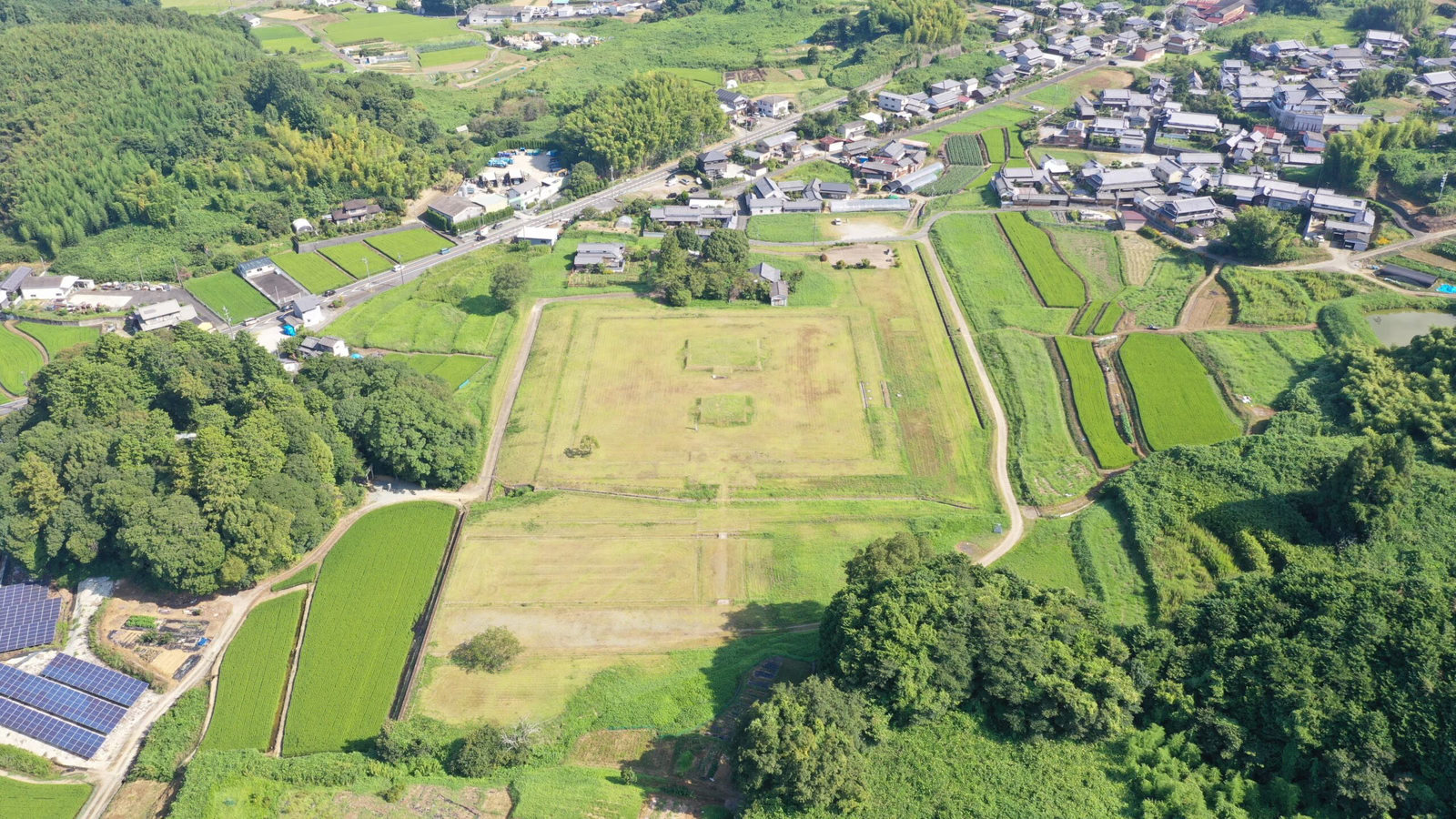
The Asuka Palace Site preserves successive court compounds rather than one surviving palace building. Excavated postholes, stone settings and reconstructed ground plans mark spaces where rulers received officials, conducted ceremonies and directed government during the seventh century. This was a political center, but not yet a capital fixed in the monumental form familiar from later Nara. Court location could shift with a ruler, while residences, administrative halls and ritual settings accumulated within the Asuka basin. That difference is the point of the site. Read the low archaeological markers against the surrounding hills and settlement land: authority was becoming more centralized even while its architecture remained largely timber and earth. The remains therefore connect rulers such as Empress Saimei and Emperor Tenmu to a changing institution, not to a picturesque lost palace. What survives is a researched plan in the ground, so reconstructions and signs must be distinguished from excavated fabric.
Current visibility
Excavated postholes, stone settings, and reconstructed ground plans mark the successive Asuka court compounds; no standing palace building survives from that phase.
Asuka-dera and the Political Arrival of Buddhism
Attraction
Asuka-dera belongs in the story of government because early temple building was also a declaration of political and international alignment. The temple was established under Soga patronage in the late sixth and early seventh centuries, when conflict over Buddhism intersected with rivalry at court. Its original complex does not survive intact, but archaeology reveals a large precinct organized around a central pagoda and surrounding halls. The present temple preserves the famous Asuka Daibutsu, while the wider site must be reconstructed mentally from markers and excavated plans. This gap between living temple and buried layout is historically useful. It separates the history of the first monumental Buddhist institution at Asuka from later devotional continuity. Imported religious forms, specialist skills and continental connections became visible here in architecture, images and ritual. Asuka-dera thus turns the Mononobe–Soga conflict and Prince Shotoku's world from abstract biography into a material change in how power was represented.
Current visibility
The present Asuka-dera temple, excavated remains of the earlier central pagoda, and ground markers provide different layers of evidence; the original temple complex does not survive intact.
Water Clock and Ritual Stone: New Ways to Order Time and Authority
Attraction
The Asuka Water Clock Site and the nearby Sakafuneishi ritual complex show that early state formation was not expressed only through palaces. At the water-clock site, excavated channels and structural remains are associated with a device used to measure and announce time. Regulated time helped coordinate court service and ceremony, making chronology an instrument of government. Sakafuneishi, by contrast, preserves enigmatic carved stone and a reconstructed setting associated with water and ritual activity. Its exact ancient use should not be presented as settled, but the investment in engineered stone and controlled water is clear. Together the sites reveal two forms of ordering: administrative time and ceremonial space. Neither offers a standing hall, yet both make institutional change visible through infrastructure. The restrained remains are precisely why this Place belongs in a history product—visitors must connect physical traces to the emergence of practices that later capitals would embed in larger bureaucratic and ritual systems.
Current visibility
“Water Clock and Ritual Stone: New Ways to Order Time and Authority” is carried by archaeological evidence at Asuka and Fujiwara: Ancient Capitals, chiefly the ritual setting, the excavated remains, and the administrative landscape; no intact structure from the historical phase is claimed.
Elite Tombs and the Changing Language of Rule
Attraction
The tombs around Asuka are not interchangeable archaeological curiosities. Ishibutai exposes an enormous stone chamber traditionally associated with Soga no Umako, while Takamatsuzuka and Kitora are protected for painted interiors that cannot be experienced as ordinary open rooms. The joint tomb of Emperor Tenmu and Empress Jito connects burial geography directly to the rulers whose reigns advanced legal and capital reforms. Read these sites as evidence of changing elite representation. Monumental stone construction, continental visual motifs, controlled access and later conservation each belong to a different historical layer. Protective facilities and reproductions are not substitutes to hide; they explain why fragile paintings survive and why direct viewing is limited. The burial landscape also prevents the history of state formation from becoming a sequence of edicts alone. Political households, funerary commemoration, technical exchange and the authority claimed by named rulers were all given durable form outside the palace compounds.
Current visibility
“Elite Tombs and the Changing Language of Rule” is carried by archaeological evidence at Asuka and Fujiwara: Ancient Capitals, chiefly the burial precinct and the interior; no intact structure from the historical phase is claimed.
Fujiwara Palace and the First Fully Planned Capital
Attraction
Fujiwara-kyo marks a decisive change from the shifting courts of Asuka. Empress Jito transferred the capital here in 694, and the palace stood within a large rectilinear city whose roads, government offices and ritual center expressed a more systematic state. The site is now mostly open ground, with posts, planting and interpretation used to indicate vanished structures. That apparent emptiness should be read as urban evidence. Sightlines across the former palace help reveal scale, while the relationship between the central enclosure and the wider grid makes bureaucracy spatial. Fujiwara was occupied for only sixteen years before the court moved to Heijo-kyo, but short duration does not make it marginal. It was a working step in consolidating ritsuryo government, fixed capital planning and court ceremony. The present landscape joins archaeology to later agricultural use, allowing visitors to see both the ambition of the plan and how completely timber architecture can disappear when political centrality moves elsewhere.
Current visibility
“Fujiwara Palace and the First Fully Planned Capital” is carried by archaeological evidence at Asuka and Fujiwara: Ancient Capitals, chiefly the road and path, the ritual setting, and the present landscape; no intact structure from the historical phase is claimed.
From Buried Capitals to a World Heritage Landscape
Attraction
Asuka and Fujiwara were inscribed together on the UNESCO World Heritage List in 2026 as a serial property of nineteen components. The designation does not turn the whole region into one continuous ancient surface. Modern villages, roads, fields, museums and protected archaeological zones sit among places whose original buildings are largely gone. That fragmentation is central to reading the landscape honestly. A palace outline, an active temple, a sealed mural tomb and an exhibition room preserve different kinds of evidence and permit different levels of access. Moving between them shows how modern archaeology and conservation have rebuilt knowledge without rebuilding every structure. The historical argument is larger than any single monument: over roughly 588–710, court compounds, Buddhist institutions, planned government space and elite burials record the formation of a centralized state shaped by East Asian exchange. The present landscape makes both that transformation and the work required to recover it visible.
Current visibility
“From Buried Capitals to a World Heritage Landscape” is encountered across the present Asuka and Fujiwara: Ancient Capitals landscape, with the road and path, the present landscape, and the surviving building carrying the reading rather than one uniformly accessible object.