

Skip to content
Chronicle

Search History Omakase

Start typing to search.

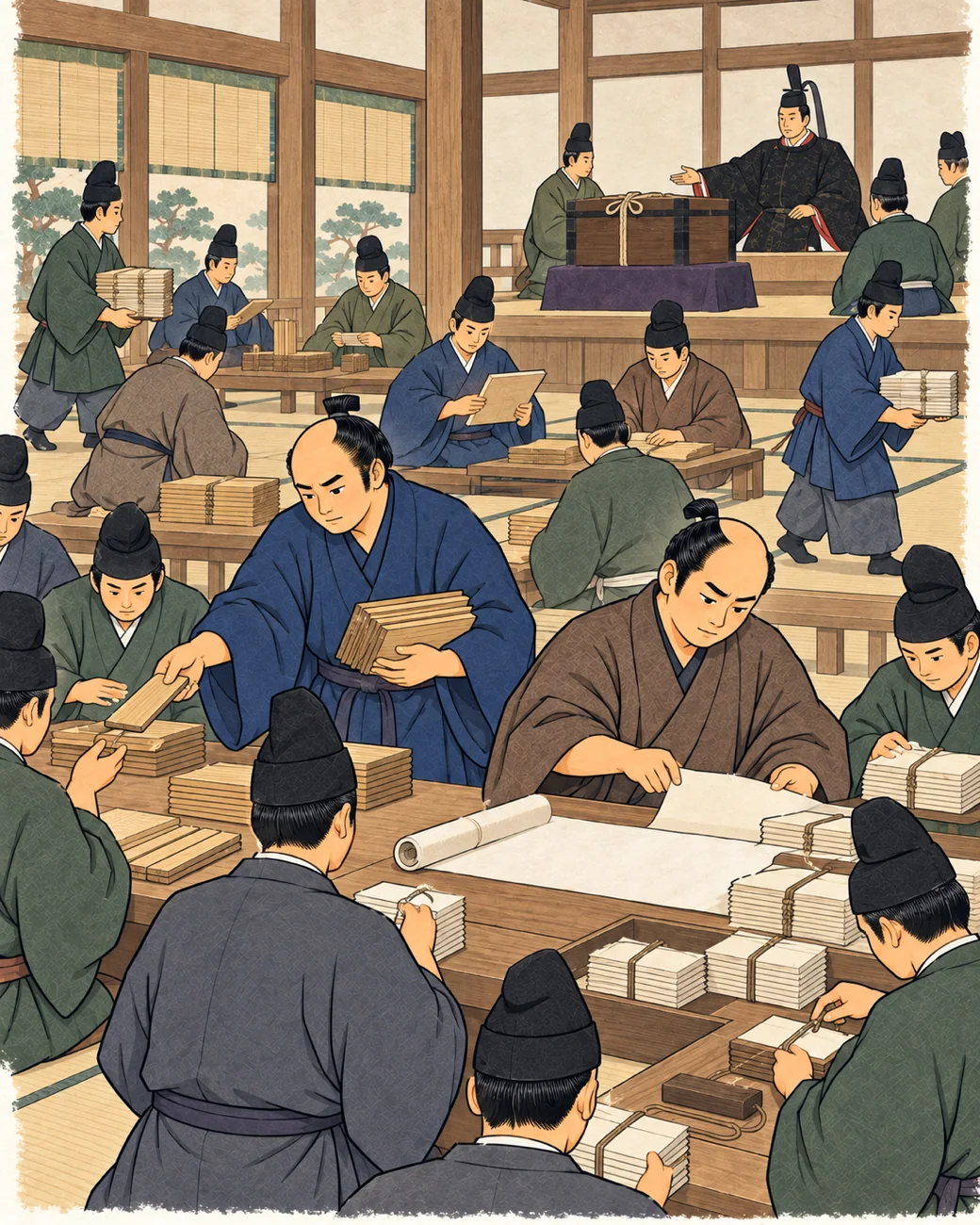
    Illustration for The Taihō Code Enters Government

    700–702 | Asuka period

    The Taihō Code Enters Government

    大宝律令の施行

    Choose a reading depth

    Overview

    Under Emperor Monmu, Prince Osakabe, Fujiwara no Fuhito and a larger group of learned officials prepared the Taihō Code. Modern reference accounts distinguish stages across 700–702: compilation and presentation, promulgation, reorganization of offices and ranks, instruction, distribution and practical use.

    The code joined penal rules to administrative provisions adapted from continental models. It organized central offices, court ranks, provincial and district government, household registration, taxes and labor obligations. These categories gave the court a written framework for assigning people and resources, but did not make practice uniform everywhere at once.

    Fuhito was a central compiler, not sole author, and Monmu's reign provided the authority under which the code entered government. The original text has not survived intact; much of its content is reconstructed through later legal works and quotations.

    Read The Taihō Code Enters Government

    Read the article below. Interactive reading tools are available when scripts load.

    Quick

    The Taihō Code Enters Government

    Monmu took the throne in 697 after his grandmother Jitō abdicated. His court remained at Fujiwara-kyō, the planned capital established in 694. Work on law did not begin from nothing in his reign: earlier rulers had changed ranks, offices, registers and local administration. The Taihō project attempted to assemble such measures into a more systematic penal and administrative order.

    Prince Osakabe and Fujiwara no Fuhito were leading participants within a group often counted as nineteen compilers. Learned officials worked with legal models from Tang China while adapting them to the court's own titles, households and territorial practices. The named leaders matter, but the project cannot be assigned to Fuhito alone or used to make him author of every clause.

    Accounts place completion and presentation around 701, with implementation continuing in 702. The sequence included changing office structures and ranks, explaining provisions and distributing rules. The code distinguished criminal prohibitions from administrative law and set out relationships among the sovereign, central departments, provinces, districts and registered households. Written categories became tools for appointment, taxation, labor and judgment.

    A promulgated code could direct government without ensuring that every locality immediately followed it in the same way. Officials had to learn the rules, records had to be produced, and older practices continued. The original Taihō text is also lost as a complete manuscript; later codes and commentaries preserve much of what can be reconstructed. Its impact was durable, but its evidence and implementation both require staged language. The gap between rule and practice is part of the Event.

    Classic

    From reform measures to a connected code

    The Taihō Code followed decades of experimentation in rank, office, taxation and local organization. Earlier courts had issued reform edicts and created new titles, while registers and dated wooden records show administrative categories taking shape unevenly. By Monmu's reign, the problem was no longer only whether to change government. It was how to join many functions in a written order that officials could use.

    Fujiwara-kyō supplied a physical setting for this work. Its planned palace and offices gathered the ruler, council and scribal administration in one capital. Monmu had received the throne from Jitō in 697, and the succession preserved the court that had built the city. The existing HO Events for the 694 move and 697 abdication remain separate; the Taihō Event begins with the legal project that followed.

    Continental law offered models, but borrowing was not copying without choice. Court ranks, ministerial titles, local divisions and household obligations had to be expressed for an archipelago with its own ruling lineages and established claims. Adaptation required people who could read, compare, draft and negotiate.

    Compilation, promulgation and application

    Prince Osakabe, Fuhito and other learned officials formed the compilation group. Reference accounts commonly identify nineteen participants, while emphasizing leading roles for Osakabe and Fuhito. The number should not be turned into a picture of equal or individually documented authorship. What survives is a collective project with named leaders and a court able to authorize its result.

    The project moved through several stages around 700–702. Drafting and presentation were followed by promulgation, changes to offices and ranks, instruction and distribution. Differences among modern reconstructions of the exact sequence are retained in the date range rather than hidden behind one day of enactment.

    The code combined ritsu, penal provisions, with ryō, administrative provisions. It ordered central government through principal offices and departments, linked provinces and districts to the capital, and described registration, tax and labor responsibilities. These were rules for moving information and resources as well as for punishing offenses.

    Monmu's role was sovereign authorization, not personal drafting of every provision. Fuhito's was sustained participation in the compilation and later government, not sole invention. Keeping those roles separate makes the event legible as institutional action rather than biography enlarged into law.

    Written categories enter daily administration

    The immediate result was a framework officials could use to define rank, jurisdiction and obligation. Central offices received names and relationships; provincial and district officers worked within a hierarchy; households became units for registration and assessment. The system gave the court a shared administrative language even where local capacity differed.

    Implementation required teaching and copying. A code held in the capital could not govern by existence alone. Officials needed texts, instructions and records, while subjects encountered the new order through taxes, labor, local offices and legal judgments. This practical work extended beyond the years attached to the event.

    The Taihō framework did not end legal revision. Fuhito later worked on the Yōrō Code.

    Historical disagreement · When was the Yōrō revision finished?

    The conventional account dates completion to 718. Hayakawa Shōhachi argues that revision continued and stalled after Fuhito’s death in 720 without reaching completion. Yagi Atsuru notes that rewards came in 722 and that another tradition places completion within the wider Yōrō era, leaving the precise endpoint uncertain.

    The code’s implementation in 757 is a different event from finishing its compilation. Revision, promulgation and long-term use must not be compressed into a single date.

    A durable order preserved through later law

    The code helped define the ritsuryō state: a government organized through written criminal and administrative law, ranked service, territorial offices and registered obligations. The label describes an institutional direction and body of practice, not a claim that every rule operated identically in every village from 702.

    Because the original Taihō text is not extant as a complete document, later codes, commentaries and quotations mediate what can be known. That loss is part of the Event's history. A legal order can have far-reaching consequences even when the first authorized text survives only through later transmission.

    The event also clarifies Fuhito's importance. His career connected compilation, ministerial service and family strategy, but the code was a collective court project under Monmu. Its significance cannot be reduced either to one man's ambition or to an abstract state acting without named workers.

    Sources and notes

    1. 大宝律令 · Ishigami Eiichi and Hayakawa Shōhachi, signed Nipponica and World Encyclopedia entries
    2. 飛鳥宮跡 解説書 · Kansai University Archaeology Laboratory and Asuka Village
    3. 石神遺跡の木簡 · Ichi Hiroki, Nara National Research Institute for Cultural Properties
    4. 文武天皇 / 藤原不比等 · Signed specialist reference entries
    5. Yagi Atsuru / Hayakawa Shōhachi, 養老律令 · Yagi Atsuru / Hayakawa Shōhachi, 養老律令

    About these sources

    Reading preferences

    Text size
    Glossary intensity

    Choose how much explanation appears as you read.

    Saved on this device. All terms remain available in the glossary.

    Browse the glossary →
    History Omakase

    Opening reading…