Read the article below. Interactive reading tools are available when scripts load.
Quick
Before he became Emperor Tenmu, he was Prince Ōama, a son of Emperor Jomei and Empress Kōgyoku, who later reigned again as Saimei, and a younger brother of the future Emperor Tenji. His year of birth is not securely established. Royal descent placed him close to sovereignty, but seventh-century succession did not pass automatically to the eldest son of the previous ruler. A claimant's family standing and political support mattered alongside the reigning sovereign's choice. Ōama's marriages connected him closely to Tenji's family, including Princess Uno-no-Sarara, the future Empress Jitō. These ties supplied status and obligations, not a guaranteed throne. [1][2][4]
In 671 Emperor Tenji's death approached while his son Prince Ōtomo held the newly prominent office of daijō-daijin (Great Minister of State). Prince Ōama remained an experienced royal adult with his own family and supporters. The Nihon Shoki, a court chronicle completed in 720, presents a dangerous sickbed encounter after which Ōama declined political succession, became a monk, and withdrew to Yoshino. The broad succession tension is secure; the precise constitutional status and intentions of each man are not. Recognition in 1870 names Ōtomo Emperor Kōbun, while the completed Nihon Shoki did not organize 672 around a recognized Kōbun reign. Neither later title nor victor's narrative gives direct access to secret plans. Tenji's death left commands, offices, and armed capacities without a universally automatic transfer rule. [4]
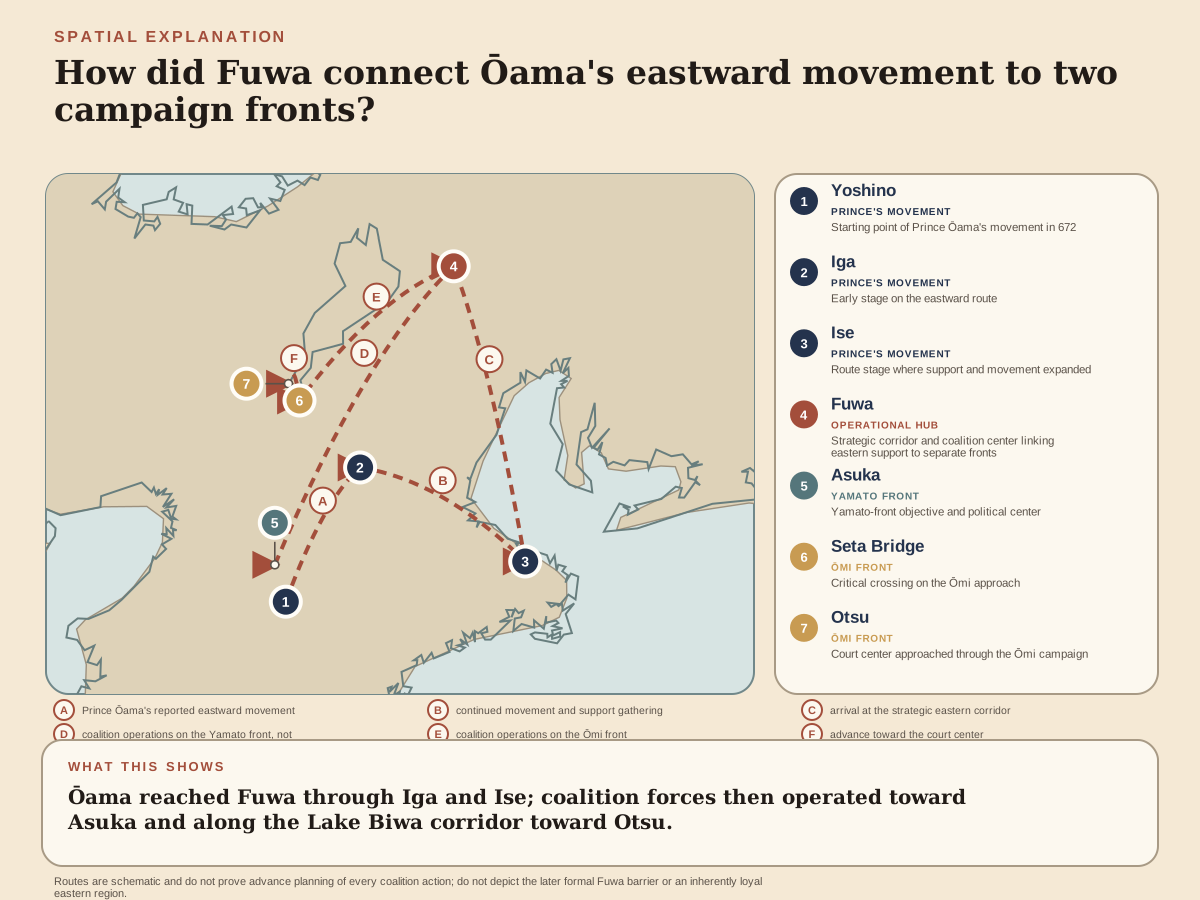
Prince Ōama left the Ōmi court near Lake Biwa for Yoshino, a mountain region south of Nara, in late 671, accompanied by Princess Uno-no-Sarara and a small household. He adopted the appearance and status of religious withdrawal. Yoshino placed him away from immediate court power but on routes leading through Iga and Ise toward Mino and the eastern provinces. The move could contain renunciation, fear, protection, and strategy at once. Later victory does not prove that Ōama entered Yoshino with a completed campaign plan. Distance reduced his exposure and gave him a place from which reports could be judged. When he left in 672, Yoshino changed from refuge into the starting point of a claim backed by movement and force. [1]
In the sixth month of the traditional calendar in 672, Ōama left Yoshino after receiving reports that the Ōmi government was mobilizing. Family and attendants traveled with him through Iga toward Ise while agents sought support in Mino, in present-day Gifu Prefecture. This became the Jinshin War. Regional officials and powerful families supplied the men and provisions that a small royal household lacked. Ōama's claim gained force as messages were obeyed and routes secured. [1]
Ōama's route ran from Yoshino through Iga and Ise toward Mino. Supporters secured the Fuwa corridor, the narrow east–west passage between the Ibuki and Suzuka/Yōrō mountain systems. Mino and other eastern resources supplied forces, while separate armies advanced toward Yamato and the Ōmi capital. Regional leaders such as Muge no Kimi Hiro appear in official cultural-property history as helping close the Fuwa route against enemy reinforcement. Fuwa later became one of the formal Three Barriers, but the later barrier installation under ritsuryō—the court-centered legal and administrative order—was not yet present in its mature form in 672. The passage could be secured only with local troops and supplies. “Eastern support” was a chain of particular choices, not a faceless reserve waiting for Tenmu. [1][7]
In the seventh month of 672, Ōama's forces defeated the Ōmi side after fighting on several fronts, including the approach around the Seta River bridge. The chronicle records Ōtomo's flight and suicide after the Seta defeat. The victor could then punish opponents and reward supporters. Modern imperial lists recognize Ōtomo as Emperor Kōbun, but whether he formally reigned before the war remains disputed: the Nihon Shoki does not give him an intervening reign. Actual control of the Ōmi government and formal enthronement are separate questions; historian Toshiyuki Yamada's 2018 review quotes Haruo Sasayama's interpretation that Ōtomo held sovereign power even though an accession ceremony cannot be established. [1][4][7]
Prince Ōama took the throne as Emperor Tenmu in 673 at Asuka Kiyomihara Palace. Archaeological interpretation identifies the complex as an enlargement and adaptation of an earlier palace rather than construction on empty land. The spatial choice returned the governing center from Ōmi to the Asuka landscape. Accession turned victory into a public royal office, but ceremony alone could not routinize obedience. Tenmu had to reward supporters, reassign responsibilities, stabilize ritual, and make provincial officials recognize the new center. Reusing palace space paralleled his political task: institutions and personnel from earlier rule were adapted under a sovereign whose authority had been won in civil war. [1][2]
In 673 scriptures were copied at Kawara-dera for Saimei's memorial. In 673–674, his daughter Princess Ōku prepared for and entered service at Ise, the shrine center dedicated to Amaterasu, the sun deity revered as an imperial ancestor. Beginning in 675 the court repeatedly sent offerings to the shrine centers Hirose for water or harvest-related protection and Tatsuta for wind. Tenmu also regulated monks and temples and commissioned Buddhist prayers. In 680, when Uno-no-Sarara became ill, Tenmu vowed to build Yakushi-ji for her recovery. He died before its completion; Jitō and later governments continued it. Royal patronage connected family care with recurring protection for cultivation and the court. [2][9][10]
Tenmu placed the sovereign and royal family more visibly at the center of government. Princes received political and military responsibilities, while officials were rewarded, disciplined, dispatched, and ranked. Court notices also addressed taxation, provincial reporting, military preparedness, dress, and conduct across the reign. This was not modern absolute monarchy. Tenmu depended on experienced officials, regional lineages, scribes, ritual experts, soldiers, and material flows that no palace could directly replace. His government sought to make those dependencies answer through a clearer royal hierarchy. The Jinshin War had exposed the weakness of coordination; postwar rule tried to turn personal allegiance and provincial capacity into more regular service. [2]
Tenmu's court pursued a larger capital and a more systematic legal order. A 676 notice indicates planning for a new capital, and archaeology beneath Fujiwara-kyō preserves work dating to his reign. In 681 he authorized legal reform in the second month of the traditional calendar, then ordered imperial histories recorded in the third. Neither project reached its later public form before his death. Jitō promulgated the Asuka Kiyomihara Code in 689 and moved to Fujiwara-kyō in 694. The code does not survive complete; the capital developed through changing plans. The later dates mark the continuing work of her government. [2][3][8]
In 679 Tenmu returned to Yoshino with Uno-no-Sarara and six princes. Kusakabe, Ōtsu, Takechi and Osakabe were Tenmu's sons; Kawashima and Shiki were Tenji's sons. They swore to cooperate like brothers despite different mothers and branches, while Tenmu and Uno-no-Sarara pledged parental care. In 681 the chronicle calls Kusakabe crown prince, though scholars including Akiko Yoshie and Mitsuru Honma question whether the later formal office already existed. His preference within the family is clearer than the office's institutional form. The oath joined two royal branches without erasing their different maternal connections and followings. It made unity a public obligation precisely because rivalry remained possible. The ruler who had won a succession war tried to prevent repetition through family ritual and hierarchy; his death would still require new decisions. [2]
Tenmu's 681 program included reviewing imperial genealogies and inherited narratives. The Kojiki preface, written within a work completed in 712, later connected him with an effort to correct Teiki genealogies and Kyūji narratives of antiquity, and with the court reciter Hieda no Are. The Nihon Shoki was completed in 720. Tenmu did not author either surviving book. How the lost earlier materials and the 681 activity relate to the two surviving chronicles remains disputed. What is secure is the political importance of ordering descent and precedent. The dynasty helped produce the archive through which its founder's own war is known. [1][12]
In 684 Tenmu announced the yakusa no kabane, an eight-rank ordering of hereditary lineage titles headed by mahito for houses of royal descent, with ason and sukune distinguishing leading nonroyal lineages. Grants recorded in the chronicle reclassified leading houses in relation to the royal center. In 685 the court also revised ranks and continued regulating dress and precedence. Lineage title, personal court rank, office, and clothing were related but not identical. The reforms did not erase ancestry; they gave the sovereign greater authority to organize its public value. Nor did one decree instantly create a complete bureaucracy. It made hierarchy more explicit in names and bodies while later governments continued legal and administrative construction. [2][6][8]
Tenmu became gravely ill in 686. The court sought recovery through Buddhist prayers, releases or offerings, and missions connected with kami, Japanese deities, including those worshipped at Ise. Uno-no-Sarara and their son Prince Kusakabe assumed central responsibility for affairs. The era name Shuchō was announced during the final illness, and Tenmu died at Asuka Kiyomihara Palace on the ninth day of the ninth month in the Japanese calendar. The sources do not support a secure modern diagnosis or a private deathbed plan for every succession step. His designated heir did not immediately accede. The accusation and death of Prince Ōtsu followed after Tenmu's death and cannot be narrated as his known decision without evidence. [2]
After Tenmu's death, Jitō's government promulgated the Asuka Kiyomihara Code in 689 and moved to Fujiwara-kyō in 694. Yakushi-ji's principal image was opened in 697 and the first temple was substantially completed under later rule. The Kojiki and Nihon Shoki were finished in 712 and 720. Jitō was eventually buried with Tenmu at Hinokuma no Ōuchi mausoleum. His victory and reign changed the direction of royal government, law, hierarchy, ritual, capital building, and historical compilation. [9][10]
His successors completed and altered the projects, while their histories preserved the account of his war. Tenmu's importance lies in the stronger royal center and the directions of government that survived his death.
Classic
Before he became Emperor Tenmu, he was Prince Ōama, a son of Emperor Jomei and Empress Kōgyoku, who later reigned again as Saimei. His older brother became Emperor Tenji. His birth year is uncertain. Ōama also married daughters of Tenji, including Uno-no-Sarara, the future Empress Jitō. These marriages placed his household within both royal branches. Their children would inherit claims through their mothers as well as their father. Seventh-century succession allowed several patterns: a sovereign's son, brother or other close relative might become a plausible successor, with maternal standing and political support helping determine whose claim prevailed. [1][2][4]
Modern reference works repeat different estimates, and the National Diet Library's authority record supplies the death year without a secure birth year. Age comparisons with Tenji and Prince Ōtomo therefore depend partly on reconstruction. The principal narrative source is the Nihon Shoki, a court chronicle completed in 720 under a court descended from the order Tenmu's victory made possible. It preserves essential names, kinship, commands, and chronology. It also organizes the past around a victorious dynasty. A prince later remembered as state founder may receive a more coherent prehistory than he possessed while events were open. This does not require treating all early information as propaganda. Ōama was a senior prince; he participated in the court formed under Saimei and Tenji; his marital relationships were politically consequential. [4]
What remains unsafe is the claim that his status contained an unambiguous right which Tenji or Ōtomo merely violated. Eligibility worked through capacity. A potential ruler needed recognizable descent, personal attendants, communication with major lineages, and the possibility of securing regional cooperation. These were not yet an army or administration of his own, but they were relationships from which one might be made. The uncertainty also restores decision to other actors. Officials did not simply wait for hereditary mathematics to announce a winner. Royal households and the officials who carried orders into the provinces would interpret competing commands. Their choices helped determine which genealogy became governing authority. Tenmu's story therefore begins with proximity without possession. Prince Ōama was close enough to the throne to become powerful and dangerous. [4]
In 671 Emperor Tenji was gravely ill. His son Prince Ōtomo held the office of daijō-daijin, Great Minister of State, at the Ōmi court near Lake Biwa. Tenji's brother Ōama remained another possible successor, with a household and supporters of his own. Ōtomo's office placed him close to the working government; it did not by itself establish that he had already taken the throne. Tenji's weakening condition made Ōama's position dangerous. A senior brother could serve the reigning emperor and still become an alternative center once that emperor could no longer arbitrate. [4]
Fear of exclusion does not prove that Ōtomo had issued an assassination order. The Nihon Shoki gives the winning side a morally powerful sequence. Ōama rejects ambition, takes religious vows, leaves the court, and later fights only when reports show that the Ōmi side is preparing against him. This architecture legitimizes action as compelled defense. The individual notices may preserve real events while the sequence still performs justification. Ōtomo received the posthumous imperial title Kōbun in 1870, nearly twelve centuries after the crisis. Tenji's sickbed was also an administrative problem.
Officials needed to know whose instructions carried force. Palace guards, treasuries, post stations, provincial offices, and lineage networks did not cease while the sovereign weakened. Whoever could keep those systems responding would possess more than genealogical argument. The court's geography intensified uncertainty. Tenji's government was based at Ōmi, while the older Asuka political landscape retained royal households, temples, roads, and elite connections. The distribution of people and institutions meant that succession could split spatially as well as personally. Ōtomo stood within his father's governing center. Ōama had reason to fear that center after Tenji's death. The sources do not preserve a neutral transcript proving when either side decided that violence was unavoidable. War emerged through successive interpretations of danger. Later victor-centered narration cannot provide the missing neutral record.
Late in 671, Ōama withdrew from the Ōmi court to Yoshino, in the mountains south of Nara, with Uno-no-Sarara and a small household. He adopted religious withdrawal, a recognizable declaration that he no longer sought political office. Yet leaving the palace did not erase his royal descent or other people's suspicions. Yoshino separated him from the court while retaining routes through Iga and Ise toward the east. The household could receive visitors and news, although it lacked a capital's treasury and defenses. Uno-no-Sarara was Tenji's daughter and the mother of Ōama's son Kusakabe; her presence kept a major dynastic relationship at the center of the retreat. [1][2]
The victorious narrative calls attention to danger approaching Ōama. Reports of military preparations by the Ōmi side become the trigger for action. Those messages survive in the eventual winner's account and do not independently establish every Ōmi plan. Yet the possibility of surveillance and preemption was structurally real. Withdrawal can change the options available to both sides. At court, a prince might be contained, observed, or arrested. At Yoshino, acting against him required sending orders and forces through a wider landscape.
He also faced new vulnerability: a small group far from a treasury could be isolated if regional contacts failed. The retreat had both a religious form and consequences for his political safety. A person may desire escape from an impossible court, perform a recognizable renunciation, and still preserve contingency. His precautions do not reveal whether he expected eventually to return to power. Later dynastic memory turned Yoshino into a place of origin and renewal. Tenmu returned there in 679 for the famous oath among princes; Jitō repeatedly visited it. Those later layers can make the 671 retreat look like a predetermined sacred beginning. At the moment of arrival, however, Yoshino held uncertainty rather than triumph. The same landscape changed function across events.
In the sixth month of the traditional calendar in 672, Ōama left Yoshino after reports that the Ōmi government was mobilizing. This departure began his campaign in the civil war now called the Jinshin War. Family and attendants traveled with him through Iga toward Ise, while messengers sought support in Mino, in present-day Gifu Prefecture. The small Yoshino household could not defeat a capital's forces on its own. Its survival depended on leaving before routes closed and on persuading regional officials and powerful families to respond. Each successful message brought more than reassurance: it could release troops, horses or provisions for the next stage. [1]
Hard travel, temporary shelter, uncertain provisions, and rapidly changing reports belonged to the political event. The Nihon Shoki follows the party's movements in detail, although its reports of divine signs belong to the chronicle's presentation of a legitimate victor. The opposing side also issued orders. Prince Ōtomo and the Ōmi court had officials, troops, storage, and capital defenses. Their problem was that established office did not automatically produce uniform provincial obedience. A provincial administrator could delay, defect, split resources, or calculate which side would prevail. Those calculations created a feedback loop. Early obedience made later obedience safer. Control of a route allowed more messengers through; additional troops made a claimant's commands look more credible; credibility released still more resources. [1]
What later appears as inherent legitimacy may have been legitimacy accumulating through operational success. The language of rebellion is therefore time-sensitive. A later state must classify armed resistance. During the crisis, participants confronted two royal commands whose final legal ranking had not yet been secured. This does not erase responsibility for violence; it explains why classification followed victory as well as precedent. Authentication was part of the danger. A messenger had to convince a recipient that an urgent order truly came from Ōama and had not been altered or invented. Personal recognition, trusted intermediaries, tokens, route knowledge, and corroborating reports could all matter before later documentary systems made commands more regular. The state Tenmu built after victory would address a weakness the campaign had exposed: authority had to travel without the ruler.
The Ōmi court possessed palace institutions and an existing administrative center. Ōama's coalition gained leverage by controlling movement between the central region and the east. Fuwa lay where mountains narrowed passage. A force positioned there could watch travelers, protect friendly communications, and make reinforcement of the enemy more difficult. The later Fuwa Barrier gives the landscape a monumental afterlife. Under the ritsuryō (the court-centered legal and administrative order based on penal and administrative codes) state, Fuwa joined Suzuka and Arachi as a formal set of strategic barriers with regulated functions. Archaeology and official designation illuminate the corridor's long significance. They do not prove that all later buildings, gates, and rules existed during the war. The campaign depended on Mino relationships. Official local histories preserve the role of Muge no Kimi Hiro, a powerful regional leader, and other residents who responded to Ōama's order. [1][7]
Seki City's account interprets Hiro's later foundation of Miroku-ji, a Buddhist temple, as a reward for his wartime contribution; permission to found it is an attribution, rather than a surviving grant quoted in that account. Mobilization was material. Men had to leave households; weapons and horses had to be gathered; food had to move along roads; messengers needed remounts and local guidance. A command promising legitimate government still imposed burdens. The chronicle rarely gives equal voice to families supplying labor or to communities through which armies passed. Operationally, Ōama did not lead every fighting column. Commanders and royal sons acted on different fronts. Ōama's son Prince Takechi joined the wartime leadership; other agents moved toward Asuka, secured roads, or confronted Ōmi forces. Delegation allowed simultaneous action, while creating dependence on information arriving late or incomplete.
The struggle for Yamato was distinct from the advance on Ōmi. Controlling the old political landscape at Asuka prevented the Ōmi government from monopolizing royal and administrative space. The war's geography was therefore not a straight march to one palace; it was a contest over junctions, regional sources, and more than one center. Why did people support Ōama? Family connections and local interests could lead people into the same coalition without giving them identical reasons to fight. Victory can make logistical competence look like charisma. Tenmu's leadership was real, but the deeper explanation joins political relationships to terrain. [1]
In the seventh month of 672, Ōama's forces broke the defense of the Seta crossing, on the approach to the Ōmi court near Lake Biwa. The Nihon Shoki records the attack on the twenty-second day and Prince Ōtomo's flight and suicide the following day. Fighting on the Yamato front had also weakened the Ōmi side's ability to coordinate resistance. These dates follow the chronicle's traditional calendar. After victory, the new court classified those who had opposed it. The eighth-month settlement included the execution of the senior official Nakatomi no Kane and the exile of other leaders and their children; others received pardons. Rewards followed for Ōama's supporters. The outcome changed the security of households as well as the identity of the ruler. [1][7]
Whether Ōtomo had formally become emperor remains a different question from whether he exercised power at Ōmi. The Nihon Shoki supplies no intervening reign or accession ceremony. In his 2018 review of early succession, Toshiyuki Yamada quotes Haruo Sasayama's influential interpretation that Ōtomo possessed the actual authority of a sovereign, while formal enthronement cannot be established. His posthumous recognition as Emperor Kōbun in 1870 belongs to a later layer of reception. It does not supply the missing seventh-century ceremony. Supporters of Ōama meanwhile expected wartime service to receive public recognition. A local account of Muge no Kimi Hiro links that service to the founding of Miroku-ji; its explanation of royal permission is qualified as an interpretation. [1][4]
Punishment and reward helped turn a victorious coalition into a governing order. Tenmu still needed people who knew how provincial offices and the court worked, including some who had served the defeated government. The chronicle gives much greater attention to leading men than to the families supplying armies or living through the settlement. Ōtomo's own account does not survive. That imbalance limits what can be said about individual motives and losses, even where the sequence of battle, defeat and punishment is clear. [1]
Ōama took the throne as Emperor Tenmu in 673 at Asuka Kiyomihara Palace. The governing center returned from Tenji's lakeside court at Ōmi to Asuka, south of present-day Nara. Officials now had to learn which appointments and commands would remain valid under the victor. Enthronement gave that change a public ritual form, but the new reign still needed people who knew how the court worked. Archaeological interpretation identifies the palace as an adaptation and enlargement of the earlier Later Asuka Okamoto complex associated with Saimei. Tenmu inherited a working royal landscape and changed it. [1][2]
The return from Ōmi also had political meaning. Asuka contained royal residences, temples, workshops, lineages, and memories older than Tenji's lakeside capital. These networks could support the new reign. They also constrained it; the emperor could not simply replace everyone who knew how government functioned. Reward was one bridge from army to administration. Commanders and local supporters had to receive visible acknowledgment. Some could enter new offices or receive ranks that translated personal wartime loyalty into institutional precedence. The translation was never perfect. A successful soldier did not automatically become an effective administrator, and unequal rewards could preserve grievance. Punishment formed the other side. The new government needed to distinguish principal opposition from routine service under the previous center.
The chronicle shows the sovereign judging cases, but it cannot reproduce every negotiation by which defeated personnel and families were reintegrated or excluded. The royal family became a governing resource. Princes could carry prestige into assignments and reduce reliance on a single great ministerial lineage. This pattern is often called royal-family government. It strengthened Tenmu's center while planting several highly ranked succession possibilities inside it. Palace reuse also carried institutional memory. Officials who had served at the earlier complex knew entrances, audience spaces, stores, and working routines. Enlargement could create new ceremonial scale without discarding all accumulated knowledge. Archaeology cannot identify the motive of every wall, but it shows that political transformation was built through selective continuity rather than a purely symbolic return to Asuka. [2]
The palace brought the new order into daily use. Audiences placed officials according to rank; reports reached the sovereign; commands left for distant offices. Tenmu's victory had changed who stood at the center, while much of the knowledge needed to govern remained with people who had served earlier courts.
In 673 Tenmu ordered Buddhist scriptures copied at Kawara-dera to commemorate his mother, Empress Saimei. Scribes and temple patrons turned royal mourning into a substantial religious work. The following year his daughter Princess Ōku entered service at Ise, the shrine center dedicated to Amaterasu, the sun deity revered as an imperial ancestor. Her preparation at Hatsuse and separation from the court made a royal daughter the continuing link between the sovereign's household and the shrine. Her service required attendants and supplies as well as purification and ritual duties. [2]
Hirose and Tatsuta, shrine centers associated with water and wind, formed another recurring pair. From 675, offerings were sent for the forces that shaped cultivation and security—water, food production, wind, and protection from destructive weather. Their repetition in spring and autumn helped turn situational petition into a court calendar later regulated under the ritsuryō system. Buddhist patronage was equally administrative. Tenmu ordered prayers, supported temples, and addressed the conduct and distribution of monks and nuns. Patronage could protect the realm while regulation made clergy legible to the court. Neither political use nor supervision makes individual belief recoverable. Yakushi-ji joined the intimate and institutional. The 680 vow responded to Uno-no-Sarara's illness through the healing Buddha. [2][9][10]
A sovereign's concern for a consort could mobilize a temple project whose buildings, images, land, artisans, and resident clergy outlived the immediate crisis. The present Nara temple is a later place layer; the first project belonged near the future Fujiwara capital. Tenmu did not see the temple completed. Official Yakushi-ji history dates the principal image's opening to 697 and major completion to Jitō and Monmu's governments. The vow gave direction and legitimacy; successors turned it into durable material form. Religious patronage addressed the imperial household's illness and mourning alongside the recurring needs of cultivation and protection. [9][10]
Centralization is often imagined as subtraction: remove great families, provincial powers, and personal networks until only the sovereign remains. Tenmu's state could not operate that way. The same groups that mediated rule supplied literacy, horses, soldiers, local knowledge, ritual skill, and access to resources. Government needed them while trying to classify and supervise them. Royal princes offered one solution. Assigning high responsibility to close kin could place prestigious agents between sovereign and officials without surrendering the center to one ministerial house. High Prince Takechi's wartime service and later political prominence illustrate the opportunity. The danger was equally clear: a prince with office, followers, and reputation could become a future succession pole. Tenmu used repeated interventions rather than a single constitutional redesign. [2]
The chronicle records appointments, rank adjustments, commands on weapons and horses, inquiries into service, and judgments of official behavior. Such detail can make the emperor look personally omnipresent. In practice, orders moved through people who interpreted and executed them. Inspection turned dependence into information. Provincial conditions had to be reported; personnel needed classification; military resources such as horses and weapons had to be known. A 684 notice emphasizing military affairs and later records concerning branded horses show that preparation was institutional, not simply the memory of battlefield courage. Rewards also required conversion. Wartime merit was a relationship to a unique crisis. Rank and office gave it a place in peacetime hierarchy. But neither was a neutral measurement of ability. Reward strengthened loyalty, advertised the sovereign's capacity to recognize service, and altered competition among houses. [2]
Discipline communicated a different capacity. A government that could punish dereliction claimed that office was not private possession. Yet punishment depended on information and could be political. The victor's chronicle naturally presents strict judgment as orderly rule; individual cases need their own evidence before motive is assigned. Royal centrality also depended on ceremony. Access to the sovereign, position in an audience, dress, and titles made hierarchy visible to participants who might never read a legal code. Performance did not merely decorate power. It trained officials to encounter themselves within a ranked order. The court had also experienced a severe defeat abroad. In 663, troops sent to help restore Baekje, a fallen Korean kingdom, were defeated at Baekgang by forces of China's Tang dynasty and its Korean ally Silla. The loss raised fears of attack on Japan. Historian Yoshiaki Kawamoto's account of the regional settlement also notes that Tang pressure diminished after its conflict with Silla and withdrawal in 676. That changing situation supplied a background to defense and diplomacy, not a single cause for every reform of Tenmu's reign. [5]
The throne became more necessary to the public standing of these groups, even where their local resources remained indispensable. Tenmu could reward service and demand information; he still needed officials and families able to carry those demands beyond the palace.
In 681, Tenmu and Uno-no-Sarara summoned princes and ministers to undertake new regulations and reform the laws. The Nihon Shoki places this authorization in the second month of the traditional calendar; an order to record imperial history followed separately in the third. The legal project required officials to divide responsibilities rather than change every rule at once. Its later product, the Asuka Kiyomihara Code, is known through historical notices and subsequent legal development, not a complete surviving text. This makes its place in the development of government easier to establish than every provision it contained. [2][3]
Historians can identify its position between earlier reforms and the Taihō system of penal and administrative codes adopted in 701 more securely than every rule it contained. Promulgation in 689 belonged to Jitō's government. Calling her a clerk executing a finished will would erase the judgment required after Tenmu's death. The text had to be completed or selected, announced, transmitted, and made usable. Later administrative practice could also change what nominal promulgation meant on the ground. Fujiwara-kyō presents a parallel chain. Official local history reads a 676 notice as evidence of a new-capital initiative. Archaeological work has found construction-related layers, canal materials, and wooden documents dating to the 680s. Yet the city moved through planning phases and was occupied as capital only in 694. A gridded capital did more than provide a grand residence. [8]
Streets, palace compounds, offices, markets, temples, storehouses, and allocated plots made hierarchy spatial. A government trying to classify personnel and collect information required places where those people and documents could be organized. Excavated canal deposits and wooden documents dated to the 680s give the project a material chronology independent of a finished-city story. Some pieces fall around 682–684; another rank-bearing document reflects the 685 system. They show administration and construction interacting before the 694 move. They do not prove that the eventual city's entire plan had been fixed at the first order. Law and capital therefore reinforced one another. Rules defined offices, ranks, obligations, and procedure; urban space gave those distinctions recurring physical form. Neither eliminated provincial distance or older lineage power. [2][8]
In 679 Tenmu returned to Yoshino with Uno-no-Sarara and six princes for an oath of cooperation. Kusakabe, Ōtsu, Takechi and Osakabe were his sons by different mothers; Kawashima and Shiki were sons of Tenji. The gathering joined the branches divided by the Jinshin War at the place from which Ōama had begun his campaign. Tenmu and Uno-no-Sarara pledged parental care, and the princes were to behave as brothers despite their different maternal lines. Uno-no-Sarara's position was especially consequential: she was Tenji's daughter, Tenmu's consort and Kusakabe's mother. An interpretation of the oath sees it as strengthening her status and Kusakabe's precedence, though its words do not establish a simple succession rule. [2]
The words preserved by the Nihon Shoki make different mothers an explicit problem. Royal polygyny created several maternal networks whose status mattered. To call the princes “brothers” was biologically true but politically insufficient; the oath demanded that they behave as though maternal difference created no faction. Yoshino had been the refuge from which Ōama began the 672 campaign. Returning there converted a landscape of divided succession into a setting for pledged unity. The dynasty made memory perform prevention. The ceremonial sequence could discipline future interpretation. If a prince later resisted the established order, the oath offered grounds to describe him as breaker of sworn harmony. Thus a ritual intended to prevent violence could also strengthen the moral classification applied after conflict.
Historical disagreement · What did Kusakabe’s crown-prince title mean in 681?
The chronicle calls Kusakabe crown prince in 681 and associates him with government. This gave hierarchy to the promise. Modern interpretation of the title is less settled: Yamada's 2018 review notes that Akiko Yoshie and Mitsuru Honma question whether a formally established crown-prince office can be read back into this notice.
That objection concerns the institutional form, not the absence of a preferred royal son.
Unity did not mean that all six possessed equal succession standing. Yet designation did not automatically produce accession. A prince needed to survive, maintain support, and enter a transition whose timing could not be controlled. The later Ōtsu case reveals why the oath cannot be read as a successful constitutional settlement. It does not prove that Ōtsu was secretly disloyal in 679, nor that Tenmu planned his death. The event is therefore neither empty theater nor a fixed succession law. It was an attempt to make royal unity visible, bind conduct with memory, elevate a preferred line, and incorporate the defeated branch. Its failure to eliminate contingency tells us how difficult the problem was.
In the third month of 681, Tenmu ordered princes and officials to put the history of the emperors and matters of antiquity into writing. Prince Kawashima, Tenji's son, and Prince Osakabe, Tenmu's son, were among those assigned the work. The Nihon Shoki singles out the officials Nakatomi no Ōshima and Heguri no Kobito as taking up the writing themselves. Genealogies and precedents mattered to a court deciding who belonged to the royal line and how inherited claims should be recognized. The terms Teiki and Kyūji refer to genealogical and narrative materials whose original forms are lost. One influential reconstruction distinguishes imperial genealogies from older legends: Kokugakuin University's commentary cites Iwao Yoshii's argument that different words for marriage in the Kojiki reflect those different sources. The commentary also questions whether such wording differences can be reduced to two hypothetical source collections. Their precise forms and relationship to the surviving book remain unresolved. The surviving titles do not establish that two complete books existed in the forms later summaries describe. [12]
The surviving notices name earlier projects without preserving their complete texts. The Kojiki preface makes Tenmu central to its origin story. The preface was written for the completed 712 work under Empress Genmei, after Tenmu's death. It can preserve earlier memory while also explaining the authority of the book being presented. Source distance belongs inside the fact. The Nihon Shoki poses an additional reflexive problem. It is the fullest source for the Jinshin War and was compiled under a court formed by Tenmu's descendants and close royal network. Its account preserves operational detail that would otherwise vanish. Its narrative also gives the victory a dynastic and moral architecture. Historical compilation creates exclusions as well as preservation. [12]
A central genealogy can subordinate variant family memories. The defeated Ōmi side had less power to define terms. Later recognition of Kōbun shows that succession memory continued to change after the first great chronicles were complete. Tenmu's influence could survive through agenda. By making records a government concern, he encouraged successors to invest labor and authority in them. Later compilers could revise, select, and arrange for their own period. Influence is not dictation; a posthumous legacy can generate texts whose exact sentences the initiator never imagined. Conflating them creates a false author. Separating them reveals the more consequential role of a sovereign who made control of the past part of state formation. Textual survival is also selective. A later preface may preserve an earlier commission while organizing it for a new sovereign and audience.
In the tenth month of 684, Tenmu decreed an eight-grade ordering of kabane, hereditary titles attached to elite lineages. Grants began with mahito, assigned to houses of royal descent; ason and sukune distinguished leading nonroyal houses, including lineages that had previously held different titles. The grades positioned inherited standing in relation to royal recognition. The chronicle names particular recipients, rather than demonstrating uniform implementation throughout the realm. Nara Prefecture's explanation also notes that two of the eight grades were never conferred. The reform therefore needs to be understood through the grants actually made, as well as its orderly eight-part scheme. [2][6]
The closer the state moved toward rules, the more important it became to say who stood inside the royal body and who served it as subject. This policy could reward allies without describing itself as wartime patronage. A new hereditary title translated a sovereign judgment into a status meant to endure in descendants. That durability made classification powerful and contentious. Houses placed lower could retain local resources while losing symbolic precedence at court. Court rank addressed persons rather than whole lineages, and office defined assigned function. A man might inherit one title, receive an individual rank, and occupy a particular administrative or military role. Collapsing these dimensions into a single “nobility grade” hides how the court managed both inherited and service-based claims. [6]
Dress made the classification visible. Color, form, and permitted ornaments could tell observers where a person belonged before speech. Regulations reduced ambiguity in audience and ceremony while borrowing and adapting continental modes. Clothing was administrative information carried on the body. The 685 rank changes belong to the same direction but not necessarily to one finished blueprint. Tenmu's reign repeatedly revised forms. Experiment and correction are evidence of state formation, not failure to enact a master plan. Later ritsuryō offices and ranks would organize personnel differently again. Surviving material evidence rarely records the decree's full social reception. Tomb inscriptions, wooden documents, and later genealogies sometimes preserve titles attached to particular people, but each object has its own date and possible retrospective wording. [2][8]
A new hereditary title made royal recognition part of a family's durable public status. It could reward service and alter precedence without taking away every local source of power. The revisions of 685 show a court continuing to reshape hierarchy rather than administering an order already complete.
Tenmu became seriously ill in 686. The court called on Buddhist clergy, made offerings and sent royal women on missions connected with Ise. These notices show the range of healing responses available to the household, not a secure diagnosis. As the illness worsened, Uno-no-Sarara and their son Kusakabe were authorized to conduct affairs. Delegation kept government working while giving the future Jitō practical authority before she took the throne. [2]
The announcement of the Shuchō era name belongs to this crisis. Era naming could mark auspicious renewal and place time under sovereign order. Its proximity to death makes it poignant, but the historical mechanism was public: officials and documents had to use a new temporal designation even while the ruler's future was uncertain. Tenmu's death date is stable in the chronicle: the ninth day of the ninth month, 686, at the main palace. His birth year remains unresolved, so his precise age at death depends on the birth-year convention chosen. A firm endpoint does not repair an uncertain beginning. Death initiated an extended mortuary and political sequence. The sovereign's body, mourning rites, speeches, ranks, and burial organized the court over time. [2]
Such mogari practices—temporary enshrinement and extended mourning before burial—allowed memory and hierarchy to be performed while succession remained active. Tenmu could no longer control what those rituals would authorize. The Ōtsu accusation followed rapidly. The charge is preserved by the victorious succession order and remains source-sensitive even though Ōtsu's execution is certain. Kusakabe's failure to accede immediately shows that designation and transfer were different acts. Uno-no-Sarara governed and later took the throne. The institutions Tenmu strengthened survived, but survival required her judgment, support networks, and willingness to occupy authority. The end of the reign therefore tests the centralizing project. It did not collapse into another Jinshin War. Neither did it operate automatically. Continuity was an achievement of the living, not proof that Tenmu had solved succession in advance.
Jitō's government promulgated the Asuka Kiyomihara Code in 689 and moved to Fujiwara-kyō in 694. Both achievements continued projects begun under Tenmu, while requiring new decisions after his death. The code had to be completed, announced and put into use. Work on the capital also continued through changing plans: Tenmu had pursued a new site, but Jitō's government supervised the later construction and the move. These dates mark the work of a successor's reign, rather than finished objects left behind by Tenmu.
Yakushi-ji began with a 680 healing vow. The emperor's death left the project unfinished; Jitō continued it, and official temple history places image opening in 697 and completion into Monmu's reign. The temple later moved or was rebuilt at Nara, while the Motoyakushi-ji archaeological site preserved another place layer. “Tenmu's temple” is true only if the shared chain remains visible. Historical writing produced the strongest legacy and the greatest source problem. The Kojiki preface made Tenmu an initiating ruler, while the Nihon Shoki narrated the war from which his dynasty emerged. These books secured memory of participants and events.
They also placed the winner near the origin of the order that authorized their completion. The mausoleum adds a bodily relationship across reigns. The Imperial Household Agency identifies Jitō's Hinokuma no Ōuchi mausoleum as a joint burial with Tenmu. Whatever the later physical and documentary history of the mound, joint commemoration expresses a political partnership that cannot be reduced to widow carrying out husband's plan. Tenmu's reforms likewise require calibrated language. The legal and lineage reforms strengthened a royal center whose projects his successors could continue. He did not finish the mature Nara ritsuryō system, abolish regional mediation, or create an unchanging national religion. The dynasty's success can produce outcome bias. Because later governments built on his reign, every measure can look like one step in a blueprint for the eighth-century state.
Tenmu's 672 victory created exceptional political leverage. His reign used it to reorganize the conditions under which later rulers governed. Jitō and their successors inherited legal work, a capital project, temples and a stronger royal center, but also unresolved succession risks. What endured depended on their decisions as well as his.