Monmu died in 707. His son Obito was a child and did not immediately succeed. Princess Abe, Monmu's mother and a daughter of Tenji, became Empress Genmei. The transfer preserved the ruling line through an adult sovereign whose reign could hold the court together until the next generation was ready. It was a new accession, not a continuation of Monmu's personal government.
Fujiwara-kyō had served Jitō, Monmu and Genmei, but in 708 the court ordered a capital farther north. The choice involved terrain, roads, water, ritual orientation and room for a larger planned city. Fuhito was a leading minister within the government, yet the evidence does not make him sole designer or turn the move into a private family project.
Genmei's accession also changed relationships close to the throne. Agatainukai no Michiyo had served successive sovereigns and connected children from an earlier royal marriage to Fuhito's household. In 708 Genmei granted her the name Tachibana as a personal honor. Michiyo's sons adopted that name only in 736. The distinction keeps a sovereign's specific reward separate from a later hereditary branch.
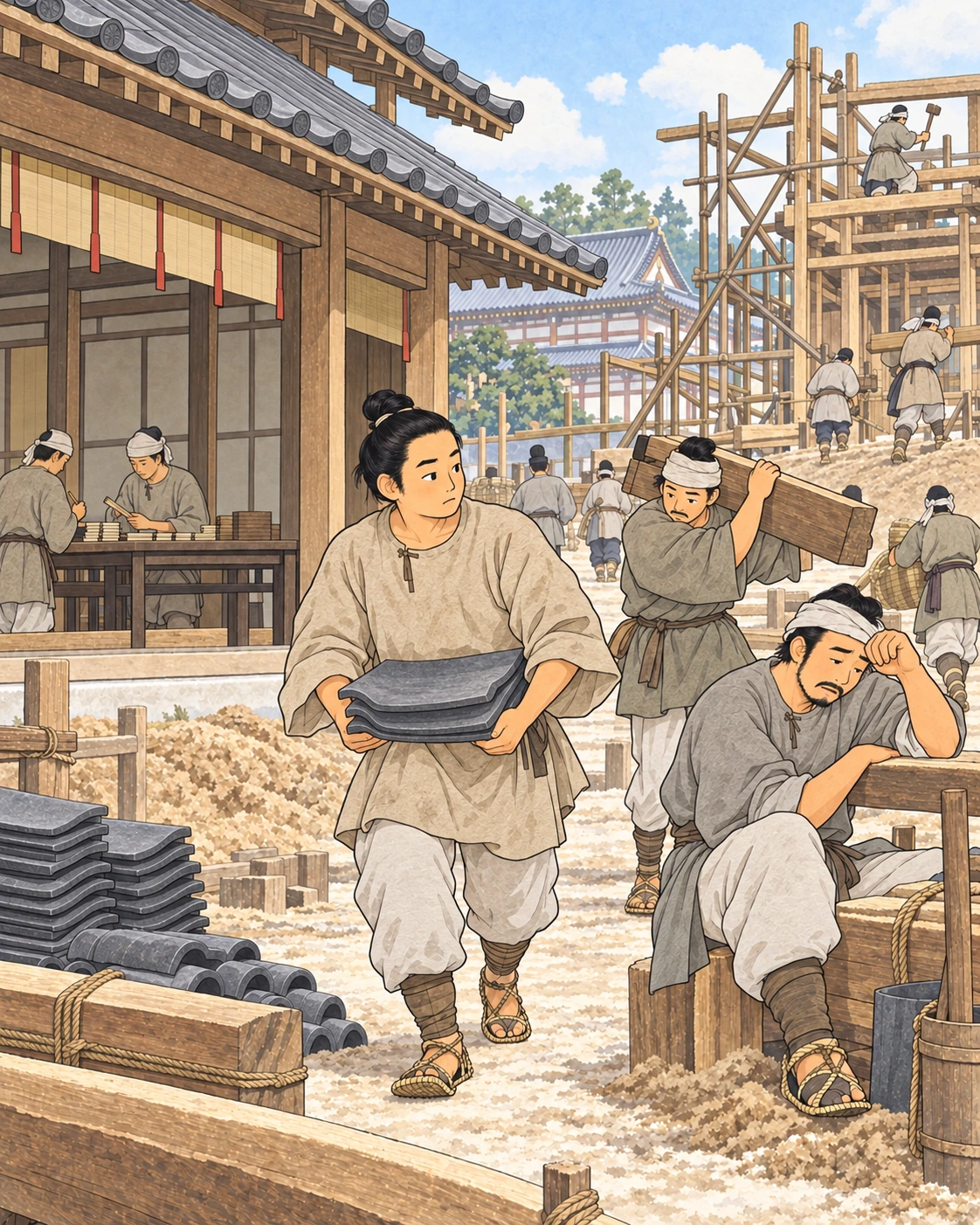
The court entered Heijō-kyō in 710. Palaces and avenues made government visible, but construction did not stop when the ruler arrived. Provincial workers supplied labor, while taxes and transport fed the building effort. A later record of exhausted workers fleeing in 711 shows that the capital's ordered plan rested on coercion and unfinished work.
Heijō-kyō became the setting for ministries, ceremonies, aristocratic residences, temples and markets. Fuhito's family temple was moved and renamed Kōfuku-ji, tying household patronage to the new city. The capital did not freeze court politics: succession crises and rival households continued. What changed was the spatial framework through which the court governed and displayed itself.