Read the article below. Interactive reading tools are available when scripts load.
Quick
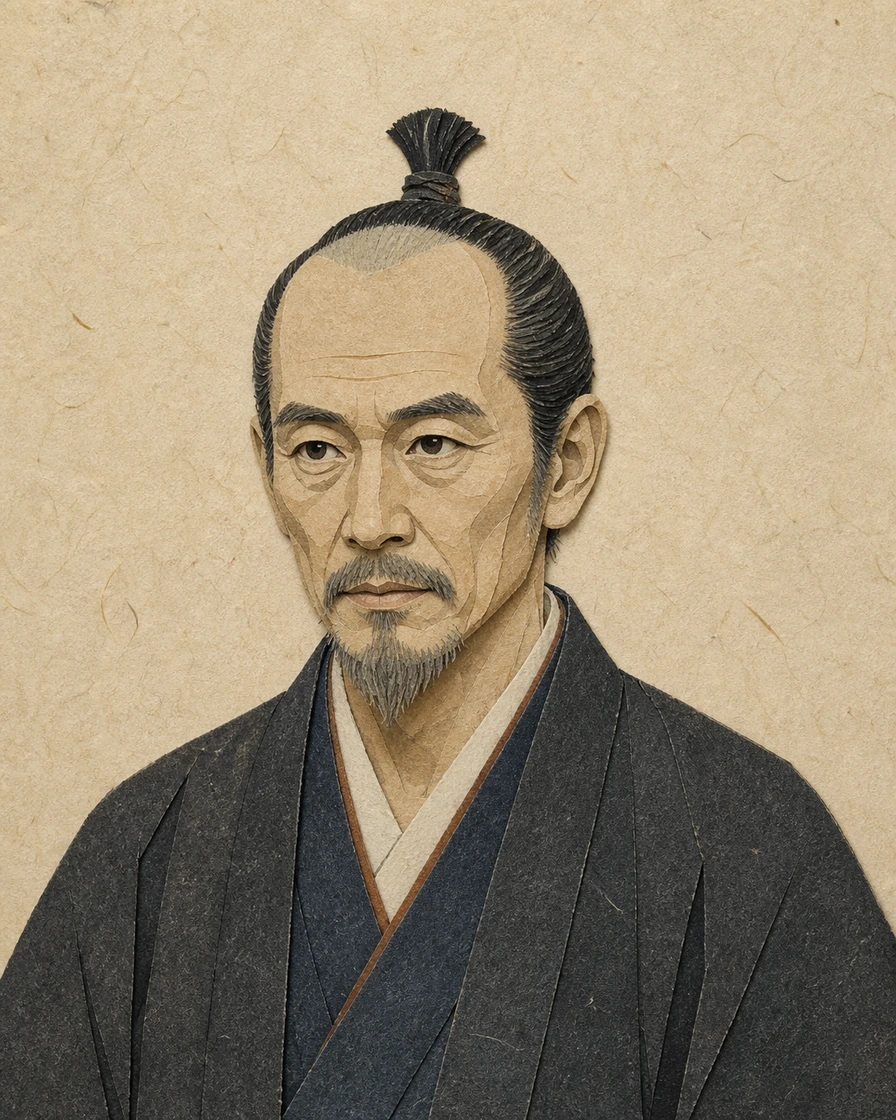
Zeami was born around 1363 into his father Kan’ami’s performance household in Yamato, around modern Nara. The troupe performed sarugaku, the medieval theatrical tradition from which nō, masked theatre combining chant, music, and dance, developed. Kan’ami incorporated the rhythm of kusemai, a popular sung dance, into its work. The son learned an art already changing through performance. [1][2]
In the mid-1370s, Kan’ami and Zeami performed at Imakumano in Kyoto before Ashikaga Yoshimitsu, the shogun who headed the military government. His support brought new audiences and opportunities. The Japan Arts Council dates the encounter to 1375; Nabari City’s introduction gives 1374. Both connect it to the beginning of this patronage relationship.
In 1378 Zeami joined a poetry gathering at the residence of the court noble and poet Nijō Yoshimoto. Participants composed linked verse by adding successive verses. Court poetry thus entered his experience through a specific encounter. He later applied yūgen, subtle and suggestive depth, to acting: voice and controlled movement could evoke more than literal imitation.
Kan’ami died in 1384, and Zeami took responsibility for the Kanze troupe. Acting and writing now belonged to the work of sustaining a professional household. Other performers needed skills and roles they could carry forward. Teaching became part of keeping the troupe active after its founder’s death.
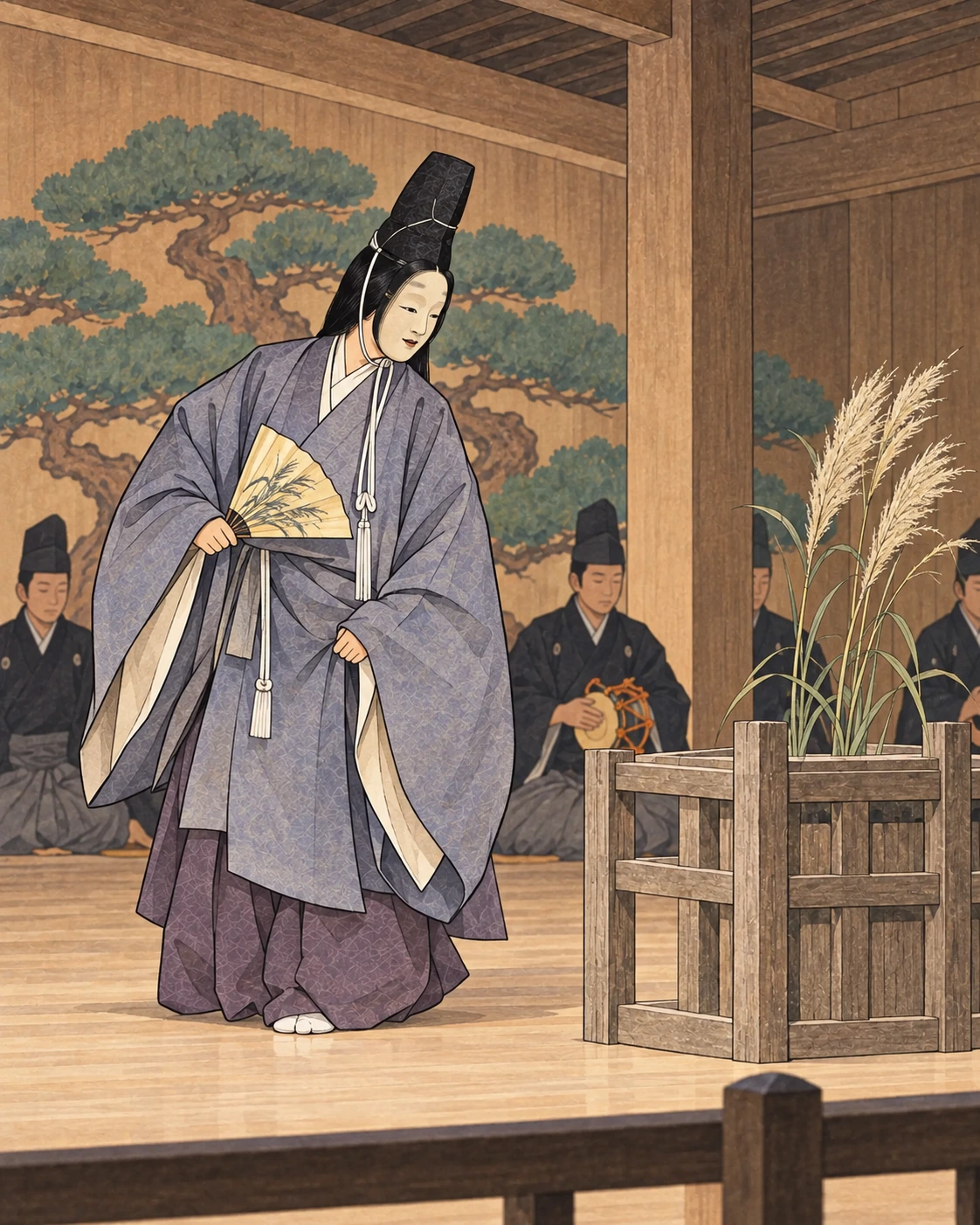
Zeami developed plays in the form called mugen nō, or ‘dream nō.’ In Izutsu, ‘The Wellhead,’ a priest meets the spirit of the wife of Ariwara no Narihira, an early poet. The story comes from the Tales of Ise, a collection of stories around Japanese poems. Wearing her husband’s clothing, she recalls their childhood and looks into the well’s reflection. Memory becomes stage action.
Around 1400 Zeami began the early sections of Fūshikaden, a treatise on performance. Its ‘flower’ is the freshness or interest an actor creates for spectators. Youth can attract attention before mature skill develops; that advantage fades. Training must help an actor find new effects at different ages. The wider seven-part body of teaching is commonly called Kaden.
Zeami entrusted writings to selected recipients rather than publishing them for spectators. Konparu Zenchiku was his son-in-law and a performer and theorist in another troupe. In 1428 he received the treatises Rikugi and Shūgyoku Tokka. Teaching crossed between troupes through a family connection; its survival depended on particular recipients and manuscripts.
Meanwhile, the patronage world had changed after Yoshimitsu’s death in 1408, though Zeami continued working. In 1422 his son Motomasa took over as head of the Kanze troupe; Zeami took Buddhist vows but continued acting. The later shogun Yoshinori favored Zeami’s nephew On’ami. In 1429 he forced the cancellation of a planned performance by Zeami and Motomasa at the retired emperor’s residence.
Motomasa died young in 1432. He had already led the troupe and written plays, including Sumidagawa, about a mother confronting her son’s death. Zeami wrote a memorial, Yume no Ato Isshi. Losing this son meant losing a particular performer, playwright, and successor, even though other members of the family and profession remained.
In 1434 Yoshinori’s government exiled Zeami to Sado, a Sea of Japan island off present-day Niigata. The punishment is established, but the precise charge is unknown. Changed patronage and family competition give context; they do not prove the immediate motive for exile. The elderly master was separated from Kyoto’s stages and household activity.
From Sado, Zeami wrote to Zenchiku in 1435, thanking him for supporting his wife and offering performance advice. He compiled Kintōshō in 1436. After Yoshinori’s assassination in 1441, a pardon is possible but not securely documented. Another reconstruction places him back at a temple in Nara. The often-given death year 1443 remains a proposal, not a certain endpoint.
Nō continued through performing lineages while many of Zeami’s writings remained narrowly transmitted. In 1909 the Nōgakukai published Yoshida Tōgo’s annotated Sixteen Treatises of Zeami. A wider public could now study the teaching beside the living stage tradition. This recovery increased his visibility as a theorist; it did not make him the sole creator of nō.
Classic
Zeami was born around 1363, the son of the performer Kan’ami. He grew up in the Kanze troupe in Yamato, the region around modern Nara. Its work belonged to sarugaku, a medieval performance tradition from which nō developed. Nō combines acted roles with chant, instrumental music, and dance. [1][2]
His first training was within a working household. Performers had to sustain engagements and audiences as well as pass skills to the next generation. Temple and shrine occasions connected their art to religious settings, while travel brought them before different spectators.
Kan’ami was changing the art his son learned. He incorporated the rhythm of kusemai, a popular form of sung dance, into sarugaku. This gave his troupe a rhythmic resource beyond its inherited dramatic impersonation. Zeami grew up with a repertory that could absorb another performance tradition rather than simply repeat an established model. [2][3]
The father’s experience gave the son access to a living repertory and a way of learning through repeated performance. Other members of the troupe supplied the support without which a leading actor could not appear. The art was already collaborative before Zeami received elite patronage.
In the mid-1370s, Kan’ami and the young Zeami performed at Imakumano in Kyoto before Shogun Ashikaga Yoshimitsu. The shogun’s interest brought the Kanze troupe into a new circle of patronage and audiences.
Accounts differ over the precise year. The Japan Arts Council gives 1375, noting the age recorded in Shūgaku Dangi, a later record of discussions of Zeami’s teachings. Nabari City’s historical introduction gives 1374. Both place the encounter at Imakumano and connect it to Yoshimitsu’s support; the difference does not alter the sequence of the young performer’s career. [1][3]
Yoshimitsu headed the military government centered in Kyoto. His attention could bring resources and prestige unavailable through regional engagements alone. It also placed the performers in contact with courtly learning and judgments formed outside their original professional setting. [1][2]
Favor brought the regional troupe before spectators close to the political center. It did not give performers the hereditary status of court nobles, or turn access to an elite stage into something their household could own. Changes in a ruler’s preferences would later have practical consequences for engagements and succession.
In 1378, the young performer took part in a linked-verse gathering at the residence of Nijō Yoshimoto, a court noble and poet. Linked verse, or renga, was composed by participants contributing successive verses. Here courtly learning had a specific social setting: Zeami was participating in poetry with an eminent practitioner, not merely watching educated spectators from the stage. [1][3][4]
Yūgen, a quality of subtle, suggestive depth, belonged to earlier discussions of poetry. Zeami applied it to the effect of performance. His plays used poetic language to bring a character’s emotions and the surrounding scene together.
For a newcomer to nō, the idea is easier to grasp through what the actor attempts. A role need not communicate everything through direct, literal imitation. Controlled movement and a carefully shaped voice can suggest an emotion or presence that the audience completes through its own attention.
Zeami’s contribution was to make inherited aesthetic language part of practical teaching. Refinement had to be embodied by a performer, not merely named by a critic after the event. Training and judgment determined whether it appeared in a particular role before particular spectators.
Kan’ami died in 1384. Zeami assumed responsibility for the Kanze troupe, inheriting the work of sustaining a professional household as well as its reputation. He had to develop performers capable of carrying the repertory forward. [1]
An admired appearance could not by itself keep the troupe active. Its members needed further engagements and skills that could be reproduced. Zeami’s own artistic development was therefore bound to the problem of teaching others.
The change in 1384 gives his writing a practical context. He was not simply recording thoughts for an unknown public. He was helping sustain an art inside an organization for which he was responsible. The playwright, actor, teacher, and household leader were connected roles. His later worries about succession grew from the same need to ensure that performance could continue after an individual master was gone.
Zeami wrote and revised plays associated with the form now called mugen nō, often translated as ‘dream nō.’ A traveler encounters a figure connected to a place; the stranger’s identity is revealed, and the past returns through chant and dance. The dramatic action gives memory a visible form. [4][6]
Izutsu, ‘The Wellhead,’ draws on the Tales of Ise, an earlier collection of stories built around Japanese poems. Its remembered lover is Ariwara no Narihira, an early poet. A traveling priest visits a place associated with him; a woman recounts the lovers’ childhood and marriage, then reveals herself as the wife’s spirit.
She returns in the priest’s dream, wearing Narihira’s clothing, and looks into the well’s water. The costume and reflected image make remembered intimacy visible. An earlier literary story becomes something an actor can embody before spectators.
The Japan Arts Council lists Izutsu among Zeami’s representative works. That attribution concerns a specific play; it does not settle every traditionally attributed work or make him the sole inventor of dream nō. The wider repertory took shape through other playwrights, revisions, manuscripts, and repeated performance.
Zeami began writing the early sections of the Fūshikaden around 1400. This treatise on performance and transmission developed over time. Its teachings concern training at different ages, the enactment of roles, and the judgments an actor makes before an audience.
The ‘flower’ describes the interest or freshness a performer creates for spectators. A child may attract attention through youth even before possessing mature skill. That advantage passes. An older actor has to find an effect sustained by technique and judgment rather than assume that the charm of an earlier age will remain. [5]
The teaching is therefore concerned with change across a working life. Training should prepare a performer for different bodily capacities and different roles. Success depends on what appears new or compelling to the audience at the occasion concerned.
The Japan Arts Council distinguishes the original title Fūshikaden from the broader seven-part body commonly called Kaden in scholarship. Later sections extended the teaching, including its highest discussion of the flower. Together they addressed a performer’s changing demands beyond a single moment of youthful success.
Zeami’s teachings were entrusted to heirs and selected disciples. They were not originally issued as public books for ordinary spectators. Written knowledge supported the household’s professional position and imposed responsibility on the person receiving it.
One route ran through his son Motomasa; another through Konparu Zenchiku, his son-in-law and a performer and theorist in the Konparu troupe. In 1428 Zeami transmitted the treatises Rikugi and Shūgyoku Tokka to Zenchiku. A dated transfer makes the relationship concrete: teaching crossed between troupes through a trusted family connection. [1][4][5]
These manuscripts were part of a professional inheritance, alongside roles learned through practice. A recipient needed the skill to turn written advice into performance. Restricting access could protect a household’s teaching, but it also left later readers dependent on what particular lineages preserved.
While he was writing and transmitting these teachings, Zeami continued working through changes at the political center. Yoshimitsu died in 1408. Under the later shogun Yoshimochi, who preferred dengaku, another theatrical tradition, Zeami remained active. The loss of his first great patron did not immediately remove him from the stage. [1]
In 1422, Zeami took Buddhist vows and his son Motomasa succeeded as the Kanze troupe’s tayū, its leading performer and head. Zeami continued acting. The son now held a working position at the head of the household. [1]
Under Shogun Ashikaga Yoshinori, Zeami’s nephew On’ami, also known as Motoshige, received strong support. In 1429 Yoshinori forced the cancellation of a planned performance by Zeami and Motomasa at the retired emperor’s residence. A change in patronage now had a visible consequence: the father and son lost that engagement.
Household succession and patronage were pulling in different directions. Zeami could entrust teaching to his chosen recipients, but that did not determine whom the military ruler would allow or favor on an important stage.
Motomasa died in 1432 while still young. Zeami lost a son and a performer expected to carry important parts of the household’s future. The death occurred after years in which patronage and succession had already placed pressure on that branch. [1][4]
Motomasa was a playwright as well as an actor. His Sumidagawa depicts a mother searching for her son and confronting his death. The Japan Arts Council contrasts the concentration on extreme suffering in his plays with his father’s more song-and-dance-centered works. The successor had been developing a dramatic voice of his own.
Zeami wrote the memorial text Yume no Ato Isshi, ‘A Record of the Trace of a Dream.’ The writing gives grief a direct place in the surviving record. It also belongs to the larger body of texts through which he tried to sustain memory and transmission.
The lost heir could not simply be replaced by another reader of a manuscript. Motomasa had already led the troupe and possessed his own repertory and skills. Other relatives and disciples remained, but the future organized around this particular son had ended. Two years later, Zeami himself would be removed from Kyoto.
In 1434, Yoshinori’s government exiled Zeami to Sado, an island in the Sea of Japan off the coast of present-day Niigata. He was an elderly performer whose career had once depended on favor near the shogunal center. [1][10]
The punishment is established. The precise accusation and decision process are not. The Japan Arts Council’s chronology records the charge as unknown. Succession tensions and changed patronage form the context, but they should not be converted into a securely documented personal motive for the order.
Exile separated Zeami from Kyoto’s stages and from direct participation in the household’s activity there. Artistic authority did not protect him from the military government’s coercive power.
His writings and letters nevertheless continued. They preserve the experience of displacement and the professional concerns that survived it. The government’s punishment is certain even though its immediate cause remains obscure: an artist who had worked near the political center was now writing from an island far from its stages.
In a letter to Zenchiku in 1435, Zeami thanked his son-in-law for support given to his wife and offered advice about performance. Family provision and artistic teaching continued across the separation from Kyoto. In 1436 he compiled Kintōshō, a collection of songs and sung-dance pieces associated with his journey and island experience. [1][10]
Yoshinori was assassinated in 1441. The Japan Arts Council leaves open whether Zeami was subsequently pardoned and gives 1443 as one proposed death year. A Nohgaku Performers’ Association account describes another reconstruction: a return to Nara and residence at Fuganji, inferred partly from a temple land register recording his memorial date. These accounts do not supply a securely documented return journey or exact death year.
Sado’s later flourishing nō culture belongs to a further history. The association places its broad development in the Edo period, under patrons such as the island administrator Ōkubo Nagayasu. That later institutional growth should not be collapsed into Zeami’s exile. His own surviving letter and collection offer a more intimate ending: continued work and family ties, without a certain final destination.
Nō continued through performing lineages and patronage while many of Zeami’s treatises remained restricted or little known outside the households that held them. Their modern recovery changed how readers understood his achievement. [7][9]
In 1909, Yoshida Tōgo’s annotated Zeami Jūrokubushū, ‘Sixteen Treatises of Zeami,’ was published by the Nōgakukai. This edition made a substantial body of performance thought available in a new form to scholarship and a wider reading public.
Zeami became more visible as a theorist alongside the playwright and actor remembered through living performance. His discussions of training, audience, and transmission could now be studied together rather than encountered only through narrower professional routes.
The performing tradition and the recovered books were different routes of inheritance. Kan’ami, other troupe members, later playwrights, and transmitters had all contributed to nō. The public edition made Zeami’s thought easier to study without turning that collective history into the achievement of one solitary founder.