HO Guides
Yashima: A Battle with an Audience
Along a changed shoreline, a fan, a fallen bow and a painted fleet reveal how the telling of a battle gives people somewhere to watch.
Quick · About 2 min
The story in five points
A short route through the argument. Follow a point into Classic for its context and sources.
A coastal base remained connected to land
Yashima joined Inland Sea routes with the Sanuki hinterland and housed an imperial household as well as warriors. The 1185 fighting forced a Taira withdrawal by sea; their final defeat occurred later at the distinct Dan-no-ura battlefield near Shimonoseki.
Read in contextThe fan story turns on its audience
In the Heike, Yoichi’s successful shot produces appreciation across enemy lines. His subsequent shooting of a dancer divides that response. Ending the retelling at the fan removes the episode’s change in how spectators judge a display of skill.
Read in contextObjects carried reputations beyond combat
Kagekiyo displays captured helmet protection; Yoshitsune retrieves a bow to prevent enemies displaying it for ridicule. The narrative uses objects to make encounters visible and tellable. It does not thereby establish the historical commander’s private motives.
Read in contextMemorial places select particular stories
Rocks locate prayer and archery in tradition, while monuments connect named deaths on opposing sides. Reclamation changed the coastline centuries after the battle. These sites organize remembrance without authenticating precise positions, final words, or every person’s experience.
Read in contextPainting and drama created new viewers
A later screen gathers separate episodes and the Taira household into one view. Noh returns Yoshitsune as a fighting spirit before a traveling priest. Each form gives the remembered battle a new audience rather than restoring an eyewitness panorama.
Read in context
Opening
In the Tale of the Heike, the archer Nasu no Yoichi shoots a fan from a Taira boat. Warriors afloat beat the sides of their vessels in appreciation; their opponents ashore strike their quivers. For a moment, the enemies respond to the same accomplishment. Then an older man begins dancing where the fan had stood. Another order reaches the archer. This time his arrow strikes a person. The story gives the spectators different responses: approval from some, condemnation from others.[1]
The second shot changes the meaning of the first scene without changing its basic arrangement. There is still an archer, a boat and an audience. Accuracy alone no longer explains what the audience has seen.
These episodes belong to the literary history of the battle fought at Yashima in 1185. Around the plateau's eastern foot in present-day Takamatsu, monuments attach that history to particular stretches of ground and water. The sites do not preserve a complete medieval battlefield. They preserve something more selective: places from which an action can be imagined, watched and told again. Following those selections reveals how a dispersed coastal battle became a sequence of close, memorable encounters.
1. A base between the plain and the sea
Yashima's military importance began with connections. The plateau stood beside the Seto Inland Sea, with the Takamatsu plain behind it and island routes extending toward the opposite coast. In a lecture on the region's medieval history, Kagawa Museum historian Shibuya Keiichi places Yashima at this junction of maritime movement and the resources of Sanuki, the province occupying northeastern Shikoku.[2]
The Taira, a warrior house closely connected with the imperial court, used Yashima during their struggle with the Minamoto. Their presence involved an imperial household as well as fighting men. Local traditions place the residence of the child emperor Antoku near the site now marked by Antoku Shrine. A nearby Sōmon tradition identifies a gate associated with the base. Neither is a surviving twelfth-century palace or entrance.[3]
A shoreline base could receive people from the sea and maintain contact with the settled country inland. Those advantages also created different directions from which it could be approached. The Heike describes Minamoto no Yoshitsune approaching through Awa, the province to the southeast. The historical fighting around Yashima in 1185 forced a Taira withdrawal by sea; it did not destroy their fleet. Their final defeat came later at Dan-no-ura, far to the west beside Shimonoseki.[4]
This geography can be obscured by two familiar names. Yashima's eastern-foot area also bears the name Dannoura, but it is not the Shimonoseki battlefield. And the ancient fortress called Yashima Castle belongs to the seventh century, not to a castle built for Yoshitsune's opponents. The 1185 battle is associated principally with the foot of the plateau, its shoreline and the adjoining waters.[3]
Land and sea therefore need to remain in the same account. A retreat into boats could remove people from an immediate land attack without taking them beyond all contact with the shore. The Heike makes extensive use of precisely that interval: close enough for challenges, arrows and recognition, yet divided by water.
2. The island that changed its outline
The water's present arrangement is itself historical. An official account of the Aibiki channel describes reclamation under Ikoma Takatoshi in 1637, which joined Yashima to the mainland. A decade later, under Matsudaira Yorishige, a channel was cut through the reclaimed ground. The island relationship was altered, then partly restored through engineering.[5]
These changes occurred centuries after the battle. They help explain why a modern road, riverbank or field cannot simply be inserted into an 1185 scene. Even the apparent certainty offered by two points on opposite banks depends on which shoreline is being used. A distance measured now would measure the transformed landscape, not independently settle the range of an arrow in the Heike.
The memorial geography works differently. Across the channel in Mure, Inori-iwa marks the place where tradition locates Yoichi's prayer. Koma-tate-iwa is associated with his mounted shot. They give two stages of one story separate addresses: first an appeal for help, then the attempt.[6]
That separation is useful without treating the rocks as archaeological proof of the archer's positions. It allows a listener to move from preparation to action. An episode that passes quickly in a book acquires an interval in the landscape. The approach to the water becomes part of the remembering.
The Heike's scene is exceptionally suited to such treatment. Its participants occupy two sides of a visible division. The fan supplies a small focal point between them. Modern commemoration can attach that arrangement to a shoreline even where reclamation has changed the ground. What is being preserved most securely is a relation among the story's parts, rather than a surveyed diagram of the original shot.
3. Making the enemy watch
The fan episode begins with interpretation. A woman aboard the approaching boat raises the target and gestures toward shore. Yoshitsune asks what the gesture means. His adviser understands it as a challenge, while also suggesting that it could conceal a trap. Before anyone shoots, the narrative has made the opposing boat something to be read.[7]
Yoichi is then summoned. The command is to hit the fan and give the enemy something to see. He initially objects that a miss would disgrace his side; Yoshitsune insists. The archer's task is consequently larger than striking an object. He is being asked to produce a public result for people who have not agreed to judge him favorably.
The scene narrows as he approaches the water. His own men are behind him, the target ahead, the Taira watching from their vessels. In the narrative, the boat rocks and the fan moves. Yoichi prays to Hachiman and deities of his home region before taking the shot. The story gives this moment an inward voice that neither of the two watching armies could have heard.[7]
That movement between outer spectacle and private prayer is part of the episode's construction. The reader can attend to the archer's fear, then return to the action available to everyone. The fan rises after the arrow strikes it and falls toward the water. The response passes back across the same space: sounds from the boats answered by sounds from the shore.
The later shooting of the dancer interrupts this shared response. On the Taira side, the sound stops; approval and disapproval appear in the narration. The text does not present an undivided audience merely cheering every successful arrow.[8]
A shortened retelling that ends with the fan preserves the accomplishment and removes this change. The longer sequence lets the same shoreline host a different reaction to the same skill. It is one reason Yashima's literary history cannot be reduced to a catalogue of remarkable feats. The stories are also occupied with how an act appears, who is made to witness it, and what happens when their responses cease to coincide.
4. What the enemy might carry away
Other episodes shift attention from an arrow's target to objects that can change hands. In one encounter, the Taira warrior Kagekiyo seizes the protective neck guard attached to an opponent's helmet. The guard tears away and the man escapes. Kagekiyo holds up what he has taken and announces himself, calling on those nearby to see and those farther away to hear.[8]
The damaged piece becomes a means of showing an encounter to people who did not stand within reach of it. The escape and the capture of the object are different results; the narrative allows Kagekiyo to present the second publicly. A small fragment of equipment carries a story beyond the instant in which it was torn off.
Yoshitsune's fallen bow raises the reverse problem. During fighting in the shallows, he loses it into the water and persists in recovering it despite calls to abandon it. Afterward, the text gives him an explanation: he feared that enemies would exhibit his relatively slight bow and ridicule the commander who used it.[9]
The bow's value in this explanation lies in the story that could be attached to it. Its loss would place an identifiable possession in someone else's hands. Recovering it prevents an opposing audience from acquiring that prop. The danger of the attempt and its justification remain the narrative's account; the speech is not a transcript establishing the historical commander's private motive.
The two objects create a revealing contrast within the Yashima sequence. Kagekiyo wants an object seen. Yoshitsune wants an object kept from view. The shoreline is the setting for both because combat here repeatedly brings people and equipment between firm ground, shallow water and boats. Something lost need not disappear; it can be retrieved by the other side.
The fan, neck guard and bow thus do different work. One invites a display of skill. Another supplies a visible remnant of a struggle. The third threatens to support an opponent's description of its owner. The objects make the battle narratable at a human scale without supplying a comprehensive explanation of why the Taira lost their base.
5. Two deaths given places
The eastern-foot memorial landscape also retains the names of Satō Tsugunobu and Kikuōmaru, men remembered on opposing sides. Their linked deaths receive a sustained episode in the Heike.[3]
In that account, Tsugunobu falls while protecting Yoshitsune from arrows. Kikuōmaru, serving the Taira warrior Noritsune, advances to take his head. Tsugunobu's brother shoots the approaching retainer. Noritsune retrieves Kikuōmaru into a boat, but the wound proves fatal. The narrative then returns to Tsugunobu, who speaks of the future remembrance of dying in his lord's service.[10]
The story repeatedly changes where attention rests. The fallen man is first a protector, then the object of an enemy's advance; the advancing enemy becomes a casualty whom his own superior recovers. Boat and shore divide the parties without making only one side capable of attending to a wounded follower.
The present monuments give these names durable locations. They do not preserve the sequence of arrows or authenticate every final word. Their more direct effect is selection: amid a dispersed field of fighting, these two deaths can still be approached separately and connected through a story.
That connection keeps the named sites from becoming interchangeable markers of generalized bravery. The men occupy different positions in the episode, and one action brings the next about. Remembering them together restores this relationship. It also leaves the larger, unnamed population of the battle outside the frame. A narrative can make two people unusually distinct without becoming an account of everyone who fought nearby.
6. A fleet arranged for another viewer
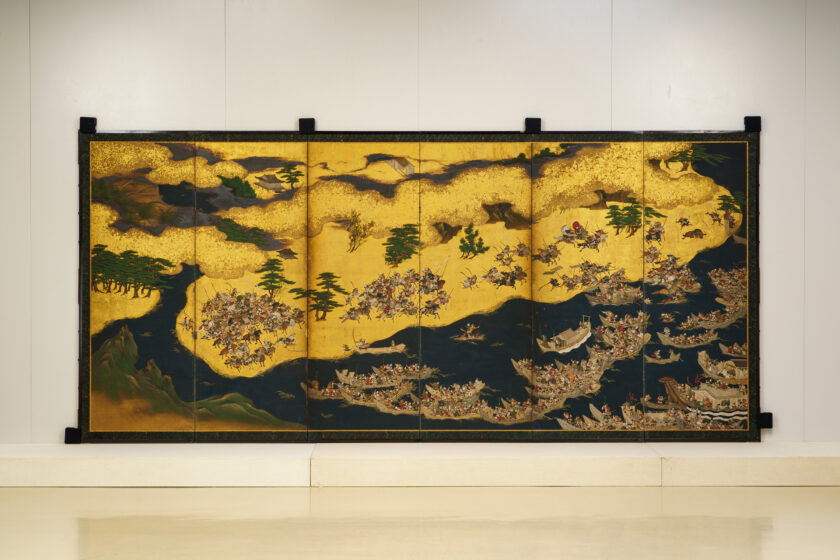
A seventeenth-century folding screen in the Kagawa Museum gathers several Yashima episodes onto one surface. The museum dates the anonymous painting approximately to the Kan'ei era, 1624–1644. Its catalogue identifies the death of Tsugunobu, the fan shot, Kagekiyo's struggle and Yoshitsune's retrieval of his bow, distributed across the composition.[11]
The screen offers a kind of access unavailable to a participant. Instead of remaining on one patch of shore or aboard one vessel, the viewer can move between separate episodes. Golden land and dark water keep the two environments legible while the painter brings different moments into the same field of vision.
The boats at the lower right make the change especially clear. Their roofed compartments open toward the viewer. The catalogue identifies Antoku, his grandmother and Taira leaders within them. The painting supplies visual access to the household carried by the fleet, alongside actions taking place outside it.
This is not simply an enlargement of the fan episode's audience. It is a new position for looking. The painted fleet's occupants can themselves be inspected, and the viewer can compare incidents separated by the narrative's sequence. The screen holds together a court, combatants and selected gestures without requiring them all to have been visible from a single historical lookout.
Its date belongs in that understanding. The picture was made more than four centuries after the battle. It records an established repertoire of Yashima stories and a painter's means of arranging them, rather than a recovered eyewitness panorama. The Kagawa Museum similarly explains that war tales and their pictorial descendants contain creative additions to historical events.[12]
At the local monuments, separate places spread the episodes out. On the screen, a single object brings them together. Both arrangements give the familiar actions another setting in which they can be encountered.
7. When the watcher is a priest
The Noh play Yashima, attributed to Zeami, creates a different audience again. Noh is a form of drama combining chant, music and highly controlled movement. Here a traveling priest seeks shelter near the old battlefield and encounters an elderly fisherman whose knowledge of the fighting becomes increasingly personal. The fisherman is eventually revealed as Yoshitsune's ghost.[13]
The second half returns the warrior to combat, including the struggle to recover his bow. The audience is now watching someone who cannot leave the battle behind. Yoshitsune belonged to the victorious side at Yashima; the play nevertheless places him within the Buddhist realm of fighting spirits, where conflict continues after death.[14]
The location performs a double role. For the priest, it is a shore reached on a journey. For the ghost, it becomes the battle again. The drama lets these different experiences occupy the same place without making the priest a participant in the original fighting. The landscape receives another act of narration rather than another military campaign.
At dawn, the martial vision gives way to coastal sounds and forms: seabirds in place of the enemy, the wind in place of the battle cries. The shore remains when the reenacted combat withdraws. This ending depends on the difference between an enduring place and an event repeatedly returned to it.
Yashima's modern memorial ground offers a quieter version of that difference. The channel has been remade; the twelfth-century base has vanished; the named sites remain available to stories. A rock can locate a prayer in tradition, a screen can arrange several encounters at once, and a stage can make the victor return as a ghost. Each gives the battle a new audience under different conditions.
The lasting connection is therefore specific. Yashima's shore allows these accounts to separate people while keeping them within sight, hearing or reach of one another. What survives in the best-known episodes is not only what a fighter does. It is what someone else is placed to see—and how another telling changes that position.
Next topic · HO Guides
Kōchi Castle: A Household in Separate Enclosures
A bridge with furnished rooms, gate-specific passes and carvings from vanished palaces recover the connections around a surviving ceremonial hall.
Continue readingSources and NotesView sourcesHide sources
- [1]
The Heike Monogatari, translated by A. L. Sadler, second instalment, Transactions of the Asiatic Society of Japan 49/1 (1921), Book XI, “Nasu no Yoichi,” pp. 233–236, and opening of “The Dropped Bow,” p. 236. Digitized text: https://archive.org/stream/TheHeikeMonogatari/HeikeMonogatari._djvu.txt . These passages were read as a public-domain translation of a literary narrative, not contemporary testimony. Compare the Japanese texts of “扇的” and “弓流” in notes 7–8. The opening paraphrases the episode; no historical speech or surveyed proportion of approving spectators is asserted. Sadler's spelling Tsuginobu is normalized to Tsugunobu in the essay.
Return to the reference ↑ - [2]
Shibuya Keiichi (渋谷啓一), Kagawa Museum, “屋島・讃岐から瀬戸内・西日本へ,” lecture handout, 29 June 2013, PDF pp. 1–2, geographical outline and sections on the Taira's Yashima base; p. 5, reproduced textual extracts. https://www.city.takamatsu.kagawa.jp/kurashi/kosodate/bunka/bunkazai/kako/kako.files/20736_L86_dai1kai.pdf . The author frames Yashima through its relation to the Takamatsu plain and Inland Sea connections. The essay does not convert the handout's quoted military figures or literary claims to territorial control into independently verified totals. This was an outline and selected source extracts, not the full lecture, a complete geographical survey or an independent reading of the underlying manuscripts. The Taira's use of Yashima is not said to have begun only after Ichi-no-Tani.
Return to the reference ↑ - [3]
Takamatsu City, “屋島,” cultural-property description, updated 2 July 2019, 解説, especially the paragraph beginning “屋島の合戦は元暦2年…”. https://www.city.takamatsu.kagawa.jp/smph/kurashi/kosodate/bunka/bunkazai/shiteibunkazai/shiseki/yashima.html . Used for the eastern-foot battlefield, Dannoura name, Antoku residence tradition and named memorials, and for the distinction from the seventh-century fortress. Present commemorative identifications are not evidence of intact 1185 buildings, independently authenticated burial remains or exact combat positions. The historical battle's second month belongs to the Japanese lunar calendar; the article does not convert it to a Gregorian February date.
Return to the reference ↑ - [4]
Kagawa Prefectural Library, digitized regional chronology, “710年(和銅3)~,” printed p. 41, 1183–1185 entries, especially the 1185 second-month attack and withdrawal entries, which cite Gyokuyō, Heike and Azuma kagami. https://www.library.pref.kagawa.lg.jp/know/local/local_2033-29 . Read as a compiled chronology, not an independent reading of those three originals. The text’s erroneous-looking exact day for Dan-no-ura is not adopted; only the sequence and maritime withdrawal are used. For the explicitly attributed approach through Awa, Sadler, Book XI, pp. 225–230; compare the later “Fight at Dan no Ura,” pp. 242–245, URL in note 1. No precise force totals, weather, elapsed marching times or single decisive tactical trick are adopted as established facts. The distinct local Dannoura place-name follows note 3.
Return to the reference ↑ - [5]
Japan Tourism Agency / Ministry of Land, Infrastructure, Transport and Tourism, multilingual interpretation database, “相引川 / Aibiki River,” R3-00391, prepared for the 2021 Yashima regional multilingual-interpretation project, historical paragraphs on 1637 and 1647. https://www.mlit.go.jp/tagengo-db/R3-00391.html . The reclamation and recutting are presented through the public interpretation's historical account, not independently inspected engineering orders. Competing name-origin traditions and present sluice operations are not used to reconstruct medieval hydraulics. The warning about measuring an altered shoreline is the essay's geographical inference, not a new calculation of the fan shot.
Return to the reference ↑ - [6]
Japan Tourism Agency / MLIT, “祈り岩・駒立岩,” R3-00408, same 2021 interpretation project, the two named-site explanations. https://www.mlit.go.jp/tagengo-db/R3-00408.html . Used for the local association of prayer and mounted archery with separate rocks. The essay explicitly treats these as narrative/commemorative locations, not archaeological confirmation of Yoichi's exact position. No present line of fire, distance, tidal height or material age of a marker is asserted.
Return to the reference ↑ - [7]
『平家物語』巻第十一「扇的」, original Japanese text reproduced in 日本古典文学摘集, complete chapter, especially the exchanges beginning “いかに宗高…”, the shore/boat spectators and the prayer-to-shot passage. https://www.koten.net/heike/gen/163/ . Compared with Sadler, pp. 233–236. This was a reading of a modern electronic presentation of the classical text, not manuscript collation or an independent verification of its editing. The site's modern-Japanese translation was not used as the source of an English quotation. Dialogues, inner prayer, wind and moving target are described only as features of the narrative. Sadler's uncertain distance conversion is not adopted.
Return to the reference ↑ - [8]
『平家物語』巻第十一「弓流」, original Japanese text in 日本古典文学摘集, opening dancer passage and the following Kagekiyo/helmet-neck-guard episode. https://www.koten.net/heike/gen/164/ . Compared with Sadler, “The Dropped Bow,” pp. 236–238. The essay paraphrases literary reactions and public display, not a historical audience survey or a judgment of the historical commanders. No modern code of conduct is inferred from the scene. Both the Japanese text and the translation contain distinctions or variation in wording; no critical reconstruction of all versions is claimed.
Return to the reference ↑ - [9]
Sadler, “The Dropped Bow,” pp. 238–239, and the Japanese “弓流” passage beginning “判官いかがはし給ひたりけん弓を懸け落されぬ”, URL in note 8. Used for the retrieval, objections and narrative explanation of possible ridicule. The account of an object becoming a prop for an enemy's story is this essay's interpretation of the stated explanation. It is not a diagnosis of Yoshitsune's personality or a claim that his actual motive has been established.
Return to the reference ↑ - [10]
『平家物語』巻第十一「嗣信最期」, 日本古典文学摘集, linked injury/death passages beginning “能登殿の童に菊王丸…”, and Sadler, “The Death of Tsuginobu,” pp. 230–233. Japanese text: https://www.koten.net/heike/gen/162/ . See the Japanese text through the injury and household-service passages; See the concluding deathbed exchange in Sadler. Kikuōmaru is a retainer in this text, formerly attached to Michimori and then Noritsune; the essay does not adopt a conflicting description of him as Noritsune's son found in a modern Noh synopsis. No claim is made that the final words or full combat sequence are historically authenticated.
Return to the reference ↑ - [11]
The Kagawa Museum, “源平合戦図屏風(屋島),” collection B96000565, catalogue description and supplied image. https://www.kmuseum.pref.kagawa.lg.jp/collection-list/post-1780/ . The catalogue dates the anonymous sixfold screen to the seventeenth century, approximately Kan'ei 1624–1644, identifies the four main episodes and the figures within the roofed boats. The image: https://www.kmuseum.pref.kagawa.lg.jp/wp-content/uploads/2025/12/39_main-840x560.jpg . Visual observations concern the broad composition, land/water contrast and exposed compartments; individual identities follow the catalogue, not independent identification at this image's limited resolution. No troop count, measured distance, accurate ship reconstruction or simultaneous occurrence of the episodes is inferred.
Return to the reference ↑ - [12]
The Kagawa Museum, “源平合戦を描く,” exhibition introduction for 1 November–22 December 2024, paragraph explaining the relationship between military tales, historical events and creative additions. https://www.kmuseum.pref.kagawa.lg.jp/exhibition-list/post-3100/ . The page's later website update is not treated as the exhibition date. Used for the institution's characterization of the narrative/pictorial tradition, not as independent confirmation that any one celebrated feat occurred exactly as depicted. No claim is made that the screen is permanently on display.
Return to the reference ↑ - [13]
the-Noh.com, “Yashima (Yashima Island),” story outline and performance-information page, “Author,” “Subject,” “Scene”. https://www.the-noh.com/en/plays/data/program_019.html ; https://www.the-noh.com/en/plays/data/detail_019.html . Used for attribution to Zeami, the traveler/fisherman/ghost structure and its source episodes. These are professional interpretive summaries and performance data, not a complete score independently read in this research. No precise premiere date, historical visit by the fictional priest or identification of a surviving medieval hut is asserted.
Return to the reference ↑ - [14]
Nohgaku Performers' Association, “屋島,” complete play explanation, based on the Hinoki Shoten Kanze-school text, especially the second-half discussion of the bow, the realm of fighting spirits and the dawn ending. https://www.nohgaku.or.jp/guide/commentary_yashima . Read as evidence of the play's dramatic structure and its interpretation by a performers' institution. The page's inconsistent historical date and its Kikuōmaru genealogy are not used. The essay's comparison between a traveler's shore and a warrior's recurring battle is literary analysis; neither ghosts nor afterlife combat are asserted as historical events.
Return to the reference ↑