Read the article below. Interactive reading tools are available when scripts load.
Quick
The man later known as Sen no Rikyū was born in Sakai in 1522 to a prosperous merchant household. He was known as Yoshirō before taking the Buddhist name Sōeki; “Rikyū” belonged to a much later stage of his public career.
Sakai was a port, manufacturing, and commercial center connected to wider Japanese and overseas routes. Its leading residents negotiated urban affairs among temples, warehouses, workshops, and trading households. Archaeology has recovered streets, houses, defenses, and many ceramics, including tea wares; the evidence shows a city with local institutions operating under growing outside pressure.
Merchant wealth gave Yoshirō access to objects, guests, teachers, and time for disciplined practice. His later authority still depended on training, patronage, and political change. The traditional Sakai residence site marks his urban origin, though no intact childhood room survives there.
As a young adult, Yoshirō learned tea in Sakai. Kitamuki Dōchin and Takeno Jōō are central to the received account of his training, and other practitioners, religious relationships, hosts, guests, object dealers, and craftspeople also formed the environment in which he learned. He later used the name Sōeki.
Tea knowledge was not one secret curriculum delivered intact by one master. It included preparing the room, handling utensils, judging objects, arranging food and fire, inviting appropriate guests, keeping records, and interpreting the expectations of different communities. Jōō's importance does not erase earlier lines or Rikyū's contemporaries.
Family and school histories later organized this network into a clear genealogy. It preserves important relationships, although the day-to-day development was less orderly. Rikyū's mature practice arose from repetition, comparison, social judgment, and selective change within an existing tea world.
By the mid-sixteenth century Sōeki was hosting and attending recorded gatherings. His later fame is most closely associated with wabi tea: controlled spaces, restricted selections, irregular or everyday materials, and intense attention to the relationship between host and guests.
“Simple” does not mean cheap, accidental, or socially equal. An apparently plain bowl could require rare knowledge, a handmade commission, a distinguished history, or the authority to prefer it over an imported treasure. Small rooms were carefully made environments supported by carpenters, plasterers, mat makers, gardeners, cooks, and servants.
Earlier tea people and Rikyū's contemporaries had already questioned display based only on prestigious Chinese objects. His contribution was to push selection, scale, choreography, and relationships with makers into a highly influential practice. The modern phrase “wabi-sabi” was not his manifesto; surviving objects and gatherings show the changes more clearly than a single slogan.
Before Rikyū became a tea servant of national rulers, Sakai's leading tea people already interacted with regional warlords. By the mid-sixteenth century Sōeki was hosting and attending recorded gatherings there, learning how a host could arrange guests, objects, and precedence in a small room.
Nobunaga's advance into Kyoto changed Sakai's position. He demanded a major levy and brought the city under his power. Leading merchants used payment, gifts, objects, and personal access while trying to protect households and trade; Sōeki belonged to this political environment, but the record does not make him the author of every civic negotiation.
Tea was politically useful because invitation controlled encounter and objects communicated rank, even when no policy was decided in the room. Sakai's experience showed Sōeki that cultural skill could mediate armed authority while remaining vulnerable to it.
By about 1573 Sōeki was serving as one of Nobunaga's tea specialists, alongside other Sakai practitioners and warrior officials. The precise date of appointment is unclear, but recorded gatherings place him inside Oda ceremonial and cultural activity.
Nobunaga collected celebrated utensils, displayed them, gave them as rewards, and restricted or granted opportunities for retainers to host prestigious tea. Cultural permission could mark rank when land and office were not the only honors a ruler distributed. Sōeki helped operate this system; he did not invent it or control it alone.
His service was not politically innocent. An Omotesenke chronology records a 1575 gift of matchlock ammunition to Nobunaga's forces, a claim that still needs independent confirmation. When Nobunaga died in 1582, Sōeki lost a patron and entered the unstable competition from which Hideyoshi emerged. The tea network survived because its people, objects, and skills were not contained in Nobunaga's person.
Sixteenth-century tea people used the term meibutsu for celebrated objects whose history, quality, and ownership distinguished them. A tea container or bowl could become an elite gift or a sign of succession; its significance did not follow from raw material alone.
In 1574, an Omotesenke chronology records Nobunaga showing Sōeki and other specialists the celebrated Hatsu-hana tea caddy. Its value rested on prior ownership, expert recognition, and display before powerful viewers as much as on the ceramic object itself. Rikyū's judgment could add to such value, but owners, makers, records, and later custodians also shaped an object's history.
The popular claim that a utensil was worth a province conveys political intensity, not a universal exchange rate. Land supplied recurring revenue; an object condensed prestige and relationship. Makers and repairers kept famous objects usable, so Rikyū's authority belonged to a material network rather than floating above it as pure taste.
Nobunaga's death forced tea specialists and merchants to reassess patronage. Hideyoshi defeated Mitsuhide at Yamazaki and built a coalition around Oda succession. Sōeki's skills and relationships entered the new center, where he became increasingly important.
From 1583 Hideyoshi constructed Osaka Castle on and around the former Ishiyama Honganji site. The project joined military defense, residence, administration, warehouses, waterways, ceremonial display, and urban growth. Quarrying, transport, carpentry, earthwork, provisioning, and coerced or obligated labor made the castle possible. Sōeki's authority concerned tea and reception, not authorship of the entire complex.
The scale of Osaka did not make small tea spaces irrelevant. A ruler who received many lords needed both monumental distance and controlled intimacy, and tea could sort access within the vast household. Sōeki's shift to Hideyoshi reflected the dependence of cultural professionals on patrons; it did not make him the castle's master planner.
In 1585 Hideyoshi served tea before Emperor Ōgimachi as part of his increasingly formal relationship with the court. Sōeki organized and performed the tea work at the center of the occasion. Around this setting he received or adopted the lay title by which he is now known: Rikyū, under court authorization.
The name change mattered because a Sakai merchant tea practitioner now carried a title recognized within an imperial and Toyotomi ceremony. It did not make him a court noble or political minister. Hideyoshi's own appointment as kanpaku, chief adviser to an adult emperor, required court office, genealogy, ritual, and political negotiation beyond tea.
The gathering joined service and elevation. Rikyū's expertise helped Hideyoshi present rule in a courtly register, while Hideyoshi's patronage gave Rikyū unprecedented public standing. Many people made the event possible: court officers, monks, scribes, messengers, utensil keepers, cooks, and attendants. Later biography centers two famous men, but ceremony was institutional labor. The title “Rikyū” should therefore be used chronologically, not projected onto every earlier gathering as if his identity had never changed.
Hideyoshi used a portable golden tea chamber whose brilliant surfaces made his wealth and command immediately visible. Rikyū participated in the Toyotomi tea world that produced and used it. Exact authorship should not be reduced to “Hideyoshi imagined, Rikyū designed”: carpenters, surface workers, metal artisans, textile specialists, attendants, and officials were necessary.
The golden chamber did not abolish small, earthen, bamboo, or black-bowl tea. Hideyoshi and Rikyū could use contrasting settings for different audiences and political effects. Gold projected exceptional ruler status; wabi could display concentration, learned restraint, and controlled closeness.
Drama and biography later turned the two spaces into portraits of irreconcilable personalities. Yet Rikyū participated in courtly magnificence, and Hideyoshi repeatedly valued his restrained judgment. Tension may have developed, but no room by itself proves a psychological break. Surviving golden chambers are modern reconstructions based on textual and material research.
On 1 November 1587—the first day of the tenth month in the Japanese calendar—Hideyoshi staged the Kitano Grand Tea Gathering at Kitano Tenmangū in Kyoto. A broad proclamation invited people beyond the usual highest-ranking circle, including those with modest equipment, to establish temporary tea spaces. Participants could be assigned by lot to receive tea from Hideyoshi, Rikyū, Tsuda Sōgyū, or Imai Sōkyū.
The gathering expanded visibility and participation while displaying the ruler's ability to assemble and classify a crowd. It was not democracy: Hideyoshi defined the invitation, location, leading hosts, security, and duration. Social differences did not disappear because people shared tea on the same grounds.
The event had been announced on a larger timetable but ended after one day. Proposed explanations include political or military news, weather, turnout, fatigue, and dissatisfaction; no single reason is established. Rikyū's role confirms his position at the center of Toyotomi public culture, but organization depended on shrine authorities, builders, suppliers, attendants, officials, and participants. Kitano made tea mass spectacle without making every small gathering identical to a private wabi meeting. [43][44]
At the height of his career, Rikyū taught or hosted powerful warriors, corresponded with patrons and practitioners, and controlled valuable access to tea at Hideyoshi's center. A daimyō was a territorial warrior lord; Rikyū held no such domain or formal ministry. Later tradition names a group of “seven disciples,” though the lists vary.
Letters, introductions, judgments of objects, and carefully arranged meetings could affect relationships. Rikyū also knew what rulers, merchants, clerics, and commanders valued, which made others seek his favor and suspect his reach.
His prestige could assist clients, raise object values, and shape who entered an intimate setting with the ruler. That was real political influence without the powers of a secret minister. It also made him vulnerable: access based on a patron's trust offered no independent protection when that trust was withdrawn.
Taian at Myōkian in Ōyamazaki is a two-mat tea room from the Tenshō era and the most important surviving early small-room structure associated with Rikyū. Its low, concentrated interior uses windows, earth surfaces, ceiling variation, hearth, and adjoining service space to manage movement and perception. Official architectural authority describes it as built in Rikyū's preference; that is stronger than calling every component a surviving autograph design.
Rikyū also worked through makers. Chōjirō's hand-built black and red tea bowls became central to the ware later known as Raku. Bamboo scoops and flower containers shifted attention toward material shape and direct handling. Attribution and later box inscriptions must still be checked object by object.
These works were collaborative. Potters controlled clay and firing, carpenters and plasterers converted dimensions into rooms, and attendants made them usable. Rikyū's choices and commissions could transform reputation, but “Rikyū made” may mean designed, preferred, selected, used, ordered, or later attributed. Taian and surviving utensils make his preferences tangible only when those actions remain distinct.
In 1589 Rikyū financed completion of the upper level of the sanmon, the main gate of the Zen monastery Daitokuji; the structure was later called Kinmōkaku. A wooden image of him was placed above. The gate reflected patronage, religious relationship, family memorial practice, and extraordinary public status.
The image became a stated issue when Hideyoshi moved against Rikyū more than a year later. Near-period records also repeat accusations that he profited improperly from tea utensils. Neither charge by itself explains why punishment became lethal in early 1591. Stories about a rejected demand for his daughter, aesthetic rebellion, policy opposition, or one hostile faction survive on weaker and unequal evidence.
Rikyū joined the Odawara campaign environment in 1590 and remained active at tea. Hideyoshi's killing of Rikyū's associate Yamanoue Sōji after the Hōjō surrender demonstrated the danger surrounding cultural men who lost favor. It does not prove Rikyū's private interpretation. By early 1591, his personal influence had no institutional protection against a ruler redefining patronage, transaction, religious honor, and proximity as offenses.
Rikyū's last recorded tea gathering was for Tokugawa Ieyasu in early 1591. Hideyoshi then ordered him to Sakai in confinement, recalled him to Kyoto, and commanded him to kill himself on the twenty-eighth day of the second month. He died at his Juraku-area residence under guard.
Accounts of the execution remember Furuta Oribe and Hosokawa Tadaoki seeing him off, dramatic weather, final composure, speeches, and a death verse. These details come from differently supported source layers, so they cannot all be treated as eyewitness fact.
The political fact is clear even when motive and ritual details are not: Hideyoshi destroyed the career of the cultural authority his regime had elevated. Rikyū's household and disciples faced danger, dispersal, and uncertainty. His death was not an abstract victory of simplicity over luxury. It was a sovereign punishment imposed within a personal hierarchy where cultural service had no independent protection. That event became the foundation for later martyr-like interpretations, but those interpretations cannot be placed inside his final consciousness.
Rikyū's execution did not leave one complete institution ready to continue unchanged. Family members and disciples preserved practices and objects under risk. Shōan was later permitted to restore the Sen household in Kyoto, and his son Sōtan strengthened its foundation. The lines now called Omotesenke, Urasenke, and Mushanokōjisenke developed through Sōtan's sons in the seventeenth century, not as three organizations founded by Rikyū before 1591.
Later generations codified teaching and succession through rooms, exercises, texts, memorials, and founder stories. Some influential attributed teachings come from contested textual traditions rather than direct transcripts. Even the phrase “ichi-go ichi-e” took its familiar formulation in later Edo tea writing, though it develops an earlier idea about the unrepeatable gathering.
Through the Meiji era, former daimyō networks, tea families, collectors, industrialists, museums, publications, and education adapted tea to a new society. By 1912 Rikyū had become national cultural ancestor as well as lineage founder. That image preserved real sixteenth-century influence while adding centuries of institutional work.
Classic
Sen no Rikyū was born in Sakai in 1522 to a prosperous merchant household. He was first known as Yoshirō. The Buddhist name Sōeki belonged to his later religious and tea life, and “Rikyū” was a still later public name associated with Toyotomi Hideyoshi's court. Using Rikyū throughout a modern biography is convenient, but the sequence of names matters because each one marks a different social position.
Sakai was a port and commercial city on Osaka Bay. Warehouses, workshops and shipping connected regional products to the Inland Sea and to longer trading routes. Leading merchants participated in councils and negotiated with armed rulers, but Sakai was not an equal democratic republic. Wealthy households held disproportionate influence, while artisans, porters, sailors, servants, women and poorer residents performed much of the work that sustained urban commerce.
Tea was already part of this environment. Imported Chinese objects and ceramics made elsewhere in Japan circulated through trade, gifts and temple networks. A bowl, jar or hanging scroll acquired value through material quality, provenance and the judgment of people trusted to recognize it. Archaeology in Sakai has recovered streets, houses, stores, defensive works and many tea-related wares. Those finds do not prove that every resident practiced the same formal ceremony, but they show that tea material was more widely embedded in urban life than a story focused only on famous masters suggests.
Merchant wealth could give Yoshirō access to objects, guests, teachers and the time required for disciplined practice. It also left households exposed to war, levies, disrupted shipping and the demands of powerful patrons. Tea operated inside these relationships. A gathering brought people, utensils, food, architecture and conversation into a controlled setting where a host could demonstrate resources, judgment and restraint.
Sakai produced other important tea practitioners, including Imai Sōkyū and Tsuda Sōgyū. Rikyū's later fame should not erase the field of teachers, competitors, merchants and monks from which he emerged. Nor should a commemorative residence site be treated as an intact sixteenth-century room. The surviving marker and reconstructed landscape preserve a connection to Sakai, not direct evidence of the moment an aesthetic philosophy was born.
Nothing in this background makes Rikyū's later influence inevitable. It explains why tea expertise could be cultivated in Sakai and why such expertise might eventually become useful to warlords. The next question is how Yoshirō learned within this already active world and began to make choices that distinguished his practice from that of other men with access to the same city.
As a young adult, Yoshirō learned tea in Sakai. The Urasenke lineage history names Kitamuki Dōchin as his first teacher and says that, at nineteen, he began studying under Takeno Jōō. He later used the Buddhist name Sōeki.
Tea was learned by attending gatherings: watching how a host received guests, arranged charcoal and water, served food, and presented utensils according to season and occasion. Jōō was important in the development of a more restrained Sakai tea, but he too inherited practices associated with Murata Jukō, merchant collecting, linked-poetry circles, and Zen institutions. The later lineage from Jukō to Jōō to Rikyū describes a real inheritance without capturing every teacher and peer involved.
The surviving account is uneven. Tea diaries may record a host, date, guests, room, and utensils while saying little about a private lesson. Later biographies are more willing to supply speeches and tests. Greater vividness often comes with greater distance. Rikyū's adult religious name Sōeki signals his relationship to Buddhist institutions and modes of cultural identity. It does not prove that every design decision was a direct expression of one Zen doctrine. Religious practice, social position, and aesthetic judgment interacted without collapsing into each other. Learning involved objects whose histories mattered. A Chinese painting, Korean bowl, Japanese vessel, bamboo implement, or textile entered a gathering with different associations. The learner had to know how selection changed the tone and rank of an occasion.
It also involved service labor. Water was carried, spaces cleaned, food prepared, fuel managed, objects repaired, and messages delivered. A master narrative centered on the host can conceal the workers who made effortless control possible. Merchant calculation and aesthetic attention were not opposites. Acquiring an object required price knowledge and commercial trust; presenting it required judgment about when not to emphasize price. Sakai practitioners could be dealers, collectors, civic actors, and hosts at once. Competition encouraged innovation. A tea gathering established reputation among people capable of comparison. A host could gain authority by using a familiar object differently or by discovering value in material others had overlooked.
Later schools clarified lines of descent because teaching names, property, and succession depended on them. Those genealogies are important sources, but dated tea records and surviving objects must also be checked. Rikyū's mature style grew from inherited practice, repeated gatherings, and collaboration with makers; it was not handed to him as a finished code.
By the mid-sixteenth century Sōeki was hosting and attending recorded gatherings. His later fame is most closely associated with wabi tea: controlled spaces, restricted selections, irregular or everyday materials, and intense attention to the relationship between host and guests.
Wabi had histories before Rikyū. In tea, it could mark restraint, insufficiency transformed into awareness, and distance from overt magnificence. Its meanings were not fixed by one dictionary definition. The adjective simple can hide design. A restricted room required decisions about dimensions, light, openings, surfaces, movement, storage, and the sight line between host and guest. Removing display made every remaining element more exposed to judgment. Material plainness also depended on workmanship. Earth walls, bamboo, rough wood, paper, mat edges, hearth placement, and an entrance small enough to alter bodily movement had to be designed and built. Named masters did not cut every beam.
Objects gained significance relationally. A Korean bowl made for another use could be selected for tea; a bamboo tube could become a flower container; a locally made vessel could stand beside an old imported painting. The gathering created a temporary hierarchy among them. This did not abolish expensive objects. Rikyū and his circle knew celebrated Chinese wares and provenance-rich utensils. Authority partly came from being able to choose restraint while possessing, borrowing, or judging magnificence. The host controlled scarcity. Showing only one painting or one flower can intensify attention, but the ability to withhold alternatives is itself power. Minimal display should not be confused with absence of resources.
Guests brought cultural capital. They recognized references, compared earlier gatherings, and understood why an unexpected object mattered. An uninformed visitor might perceive only roughness. Wabi tea was accessible through sensation yet stratified through knowledge. Tea records provide evidence through lists and sequences. They show objects entering combinations on dates and before named guests. They rarely deliver a complete theory of what everyone felt. Modern interpretation must not make catalogues speak like manifestos. Later anecdotes give Rikyū perfect lessons in simplicity: a garden deliberately altered, a flower withheld, an ordinary object elevated at the ideal moment. These stories express values retained by tea communities. Their moral clarity requires source labeling.
The modern compound “wabi-sabi” should not be projected backward as Rikyū's own school name. Wabi had earlier poetic and tea meanings, while sabi followed a partly different history. Rikyū's contribution lay in repeated choices: smaller rooms, fewer objects, new uses for bamboo and local wares, and a style of controlled intimacy that could stand beside grand display.
Material restraint carried operational demands: smoke had to leave, water stay clean, food arrive at proper temperature, and fire remain safe in confined rooms. Sensory refinement depended on practical systems that aesthetic description often ignores. The transformation was collective. Potters, metalworkers, lacquerers, bamboo cutters, carpenters, textile workers, gardeners, cooks, and apprentices turned aesthetic judgment into usable things. Rikyū's authority influenced their work, but their skill set physical limits and possibilities. Wabi tea therefore reorganized value rather than escaping it. Price, provenance, touch, scarcity, labor, invitation, and recognition remained present. The most austere room could be one of the period's densest social constructions.
Before Rikyū became a tea servant of national rulers, Sakai's leading tea people already interacted with regional warlords. Gatherings connected merchants, warriors, clerics, and connoisseurs; commercial credit, military supply, protection, and cultural reputation moved through overlapping relationships.
Sakai's prosperity attracted armed patrons long before Nobunaga. Miyoshi and Matsunaga power shaped the region, while merchants traded across changing frontiers. Urban survival required working with rulers whose coalitions could collapse. Tea gatherings created a disciplined form of access. A host selected guests, arranged precedence, displayed knowledge, and managed time in a setting smaller than a formal audience hall. Such control could support trust, but did not erase differences in force. Imai Sōkyū, Tsuda Sōgyū, and other practitioners demonstrate that Sōeki was not Sakai's lone diplomatic artist. Merchant-tea networks contained cooperation, rivalry, kinship, shared teachers, and competing claims to objects and patronage.
Commerce connected culture to war. Sakai merchants dealt in goods needed by armies as well as luxury and everyday commodities. Firearm production, powder ingredients, shipping, and credit placed the city inside military economies. Nobunaga's levy showed the limit of autonomy. A city could negotiate terms and still submit because refusal risked attack and commercial destruction. Payment was not evidence of free partnership. Objects could become instruments of approach. Presenting a celebrated tea container or arranging a gathering offered more than beauty: it recognized the ruler's status and could request protection or favorable treatment. The gift also left the giver without the object.
Tea expertise was portable in a way urban office was not. A merchant whose civic influence depended on Sakai could bring connoisseurship, hospitality, records, and connections into a ruler's service. This possibility helped transform Sōeki's career. Yet every tea meeting should not be decoded as secret policy. Hosts and guests pursued many ends, and no record of utensils alone proves the content of conversation. Political density is not the same as a hidden decision. Temples gave gatherings protected spaces and prestigious associations. They also held property and political interests. Religious setting could support mediation while remaining entangled in regional conflict.
Neighborhoods and working populations bore the consequences of elite negotiation. A levy ultimately required resources; military control changed markets and security; fire and siege threatened dwellings. The tea room's calm rested on a city managing collective risk. Sōeki learned that a cultural specialist could gain influence precisely because power was unequal. The ruler wanted expertise and recognition; the merchant wanted survival and access. Each side valued what the other could supply, but only one commanded armies. Foreign commerce did not place Sakai beyond Japanese political geography. Goods entered through regulated routes, and merchants depended on coastal security, regional lords, temple relations, and shipping knowledge. The port's outward connections increased rather than removed the need to negotiate inland power.
Armed urban defense could raise the cost of intervention, but it could not match a large territorial coalition indefinitely. Sakai's institutions were designed for bargaining and collective survival as well as resistance. Submission under Nobunaga was a reconfiguration, not the instant disappearance of urban practice. This asymmetry continued under Nobunaga and Hideyoshi. Rikyū's later closeness to supreme power did not abolish the structural vulnerability visible when Sakai submitted. The city therefore belongs inside his whole biography. It explains commercial knowledge, collective practice, and political mediation, while preventing the later “pure artist versus tyrant” story from erasing his formation within wealth and war.
By about 1573 Sōeki was serving as one of Nobunaga's tea specialists, alongside other Sakai practitioners and warrior officials. The precise date of appointment is unclear, but recorded gatherings place him inside Oda ceremonial and cultural activity.
Nobunaga entered a culture in which famous utensils already carried histories of ownership and judgment. He did not create their prestige from nothing. Military power enabled him to collect, compel transfer, and redefine circulation on a larger scale. The process later called a hunt for famous objects combined gift, purchase, pressure, and confiscatory possibility. Sources do not make every transfer identical. The common condition was that refusal before a dominant ruler carried unequal risk. A celebrated container could perform several political functions. It demonstrated access to an inherited cultural world, rewarded a retainer without immediately transferring land, and created an obligation to recognize the giver's judgment.
Permission to hold tea also turned practice into distinction. A warrior could possess money and still lack authorization to display connoisseurship at the highest political level. Tea specialists authenticated this economy: they recognized objects, remembered earlier gatherings, arranged display, and supplied judgments that made differences legible. Sōeki shared this field with Imai Sōkyū, Tsuda Sōgyū, and other tea specialists. The later prominence of Rikyū can falsely turn Nobunaga's tea world into a private partnership.
Recorded temple gatherings show tea operating near the political center. Guests observed objects and hierarchy while the host demonstrated control. A ceremonial room could cultivate allies, yet it did not replace councils, armies, documents, or revenue administration. An Omotesenke chronology records Sōeki presenting ammunition to Nobunaga in 1575. Because that detail currently rests on a lineage chronology, it should be attributed rather than treated as independently corroborated. If correct, it is a sharp reminder that tea service, merchant supply, and war occupied the same political world.
Nobunaga's system was not modern arts policy. It joined personal lordship, household hierarchy, warrior reward, merchant supply, temple venue, and elite sociability. A single later label should not make it more bureaucratically uniform than the evidence supports. Nor should wabi tea be imagined as silent protest against every magnificent object Nobunaga collected. Sōeki knew and used famous imported works. Selective restraint could coexist with service inside a culture of treasure and conquest. Honnōji ended Nobunaga's person, not the networks created around him. Objects had custodians and histories; tea people had ties to multiple commanders; Hideyoshi could inherit or reassemble cultural authority while competing for military succession.
Survival of an object through the Honnōji rupture depended on where it was kept, who retrieved it, and whether later claimants recognized its chain of custody. “Nobunaga's collection” was never one indestructible cabinet. Political dispersal became part of provenance. Tea permission also affected retainer identity. Receiving authorization could mark closeness and give a warrior a stage on which to host peers, while denial limited display. The specialist's judgment helped make that distinction credible even when he did not decide who received it. It marks patronal rupture and political relocation. His Nobunaga years reveal the fundamental bargain of his career. Armed power magnified tea expertise, while the expert helped armed power appear cultivated, ordered, and worthy of recognition. Neither side remained untouched by the exchange.
Sixteenth-century tea people used the term meibutsu for objects whose fame, history, quality, and recognized ownership distinguished them. A tea container or bowl could become an elite gift, a pledge of allegiance, a sign of succession, or a focus of negotiation. Its significance did not follow from raw material alone.
An object entered the tea world with a place and time of manufacture, but its later identity was cumulative. Ownership, use by respected hosts, appearance before powerful guests, names, containers, repairs, and written references added layers. Chinese objects often carried association with courtly and shogunal collecting traditions. Political newcomers could acquire inherited legitimacy by possessing and correctly displaying them. The imported object was also reinterpreted in Japan. Korean bowls demonstrate a different conversion. Vessels made within Korean ceramic economies could be selected by Japanese tea people for uses and meanings not identical to their original production. Admiration does not erase the unequal and later violent relations through which objects moved.
New Japanese wares show that authority could also be created rather than inherited. A respected tea person might encourage a maker, select a form, use it before influential guests, and establish a model for later production. The maker's agency remains essential. Clay, glaze, firing, metal, bamboo, wood, textile, and lacquer behaved through skilled manipulation and material contingency. The patron could request but not personally manufacture every result. Tea diaries stabilized reputation. A written list connected an object to a date, host, and audience. Later readers could reconstruct provenance, though copying errors and selective preservation complicate a perfect pedigree.
Boxes and accompanying materials extended the object. A cloth bag, lid, inscription, certificate, and story could acquire their own authority. The object encountered by a later collector was a bundle of material and documentary evidence. Appraisers occupied a powerful position because classification could change price and prestige. Rikyū's eye became valuable within this system. That authority also created suspicion that judgment and commercial interest might overlap. Price did matter. Merchants needed markets, liquidity, and knowledge of demand. Describing symbolic capital should not make money disappear. A politically favored object could attract a high price precisely because recognition changed demand.
Comparison with a territory is rhetorical but revealing. Land meant tax, cultivation, residents, jurisdiction, and military obligation over time. A famous tea container could mark honor and closeness to a ruler, but could not feed a garrison by itself. The object might nevertheless alter a political decision. Giving it could settle a relationship, signal submission, or distinguish an heir. Its small physical scale made it portable across ruptures that destroyed castles and houses. War threatened and redistributed collections. Fire at castles or temples could destroy records and utensils; surrender could transfer treasures; defeated households might use valued objects in negotiation. Provenance often contains coercion as well as admiration.
Named objects make this system visible. In 1574 an Omotesenke chronology records Nobunaga showing Sōeki and other tea specialists the celebrated Hatsu-hana tea caddy. Its value rested on prior ownership and expert recognition as much as on clay and glaze. New Japanese wares could acquire prestige by a different route: a respected tea person requested or selected a form, used it before influential guests, and attached judgment to a maker's work.
Meibutsu value was therefore collectively produced and politically concentrated. Rikyū was a central evaluator, but owners, makers, writers, rulers, workers, and later schools sustained the meanings that his name could amplify.
Nobunaga's death forced tea specialists and merchants to reassess patronage. Hideyoshi defeated Mitsuhide at Yamazaki and built a coalition around Oda succession. Sōeki's skills and relationships entered the new center, where he became increasingly important.
Honnōji disrupted patronage because Nobunaga's cultural authority had been attached to objects, permissions, hosts, and specialists. These assets did not disappear; competing successors could claim or recruit them. Hideyoshi's victory at Yamazaki gave him the language of vengeance, but not automatic ownership of every Oda relationship. He had to persuade, reward, intimidate, and stage continuity while expanding his own household. Sōeki possessed portable capital. His expertise, name, records, relationships with Sakai merchants, knowledge of objects, and capacity to organize elite gatherings could serve a new patron without moving a territorial army.
The word transfer suggests one contract ending and another beginning. Sixteenth-century service was more layered. Sōeki had relations with multiple tea people and warriors, and Hideyoshi's supremacy developed over time. Osaka Castle announced concentration. Built at a site previously occupied by Ishiyama Honganji, it converted a landscape of long religious-military resistance into a Toyotomi center. Place succession carried political meaning. The castle's visible mass depended on distributed work. Daimyō obligations mobilized stone and labor; boats moved materials; craftsmen built structures; communities supplied food; officials recorded demands. Monumental authorship belonged to a regime, not one designer.
Within that environment, tea created another scale of rule. A small gathering limited the number of bodies, reduced physical distance, and made invitation itself a scarce resource. Intimacy could intensify hierarchy rather than dissolve it. Sōeki could choreograph rooms, implements, service, and tempo. Those choices influenced how a powerful guest encountered Hideyoshi. He provided a technology of reception inside the wider castle technology. This did not give him general command over building or policy. A tea specialist might influence a room or occasion without directing fortifications, taxation, or military appointments. Later admiration can enlarge aesthetic authority into universal design authorship.
The small room was not automatically opposed to castle grandeur; Hideyoshi used both. Monumentality addressed crowds and rivals, while controlled tea addressed selected guests and demonstrated mastery over restraint. Sakai merchant networks still supplied objects, credit, information, and people. Sōeki's rising prestige cannot be detached from Toyotomi force. Present-day Osaka Castle Park, rebuilt after later destruction and reconstruction, is not one continuous Rikyū-era surface.
Tea work itself mobilized resources within the castle household. Rooms needed preparation, utensils moved under guard, and guests arrived through controlled gates. The small ceremony relied on the monumental institution it seemed to contrast with. At the same time, his continued work should not be reduced to servility. Hideyoshi valued him because expertise could not be improvised by command. Dependence ran both ways, although punishment remained radically unequal. The Osaka transition therefore multiplied Sōeki's influence while preserving vulnerability. The grand castle and small tea room were complementary stages in Hideyoshi's construction of central power.
In 1585 Hideyoshi served tea before Emperor Ōgimachi as part of his increasingly formal relationship with the court. Sōeki organized and performed the tea work at the center of the occasion. Around this setting he received or adopted the lay title by which he is now known: Rikyū, under court authorization.
Hideyoshi's military dominance did not automatically supply every recognized court status. Imperial rank and office followed inherited forms, negotiated precedents, and the work of aristocratic and clerical intermediaries. Tea offered a medium in which the ruler could display discipline, possession, cultural knowledge, and service. Performing before the emperor reversed the ordinary image of a lord simply receiving hospitality and placed Hideyoshi within ceremonial obligation. Sōeki's role was indispensable because credibility required trained handling, selection, sequence, and space. A ruler could command that tea be served, but command alone could not create practiced expertise.
The Rikyū title emerged from this world of court authorization. Accounts often say it was bestowed by Emperor Ōgimachi. A careful formulation preserves the recognized grant while avoiding an invented personal conversation or exact decision scene. A lay Buddhist title linked religious culture, status, and public identity. It did not ordain Rikyū as a monk in the sense of leaving household and professional life. Names crossed institutional categories. The change also altered retrospective language. Modern history calls him Rikyū from birth because readers need one stable name. Hideyoshi's 1585 appointment as kanpaku belonged to a broader political construction. Tea could help stage cultivated authority, but did not itself produce Fujiwara genealogy, office, taxation, military submission, or court administration.
Rikyū's elevation was different. He did not receive sovereign office or a daimyō domain. His status came from recognized mastery, proximity, service, and the capacity to shape elite behavior within a defined cultural field. That field could still have political effects. Controlling preparation and access meant knowing who attended, how rank was displayed, and which objects were attached to the ruler's image. Influence need not take the form of a signed policy order. Institutional workers must be restored. Palace preparations, cleaning, food, fire, water, textile, transport, documentation, and security required many hands. The appearance of effortless ceremony was a collective achievement.
The event also shows a merchant-derived skill entering the highest courtly setting. Sakai was not being admitted as an equal corporate body; one practitioner was elevated because Toyotomi power made his expertise useful to central representation. Rikyū gained authority from the occasion and became more exposed. His name and judgment were now tied publicly to Hideyoshi's regime. Disagreement could no longer remain merely a private question of taste. The title did not change the grammatical history of his family name into the aristocratic construction implied by English “Sen no” in every context. Modern romanization is conventional; period names and signatures should be read as historical forms rather than translated into one timeless full name.
Court recognition also traveled through documents and intermediaries. The emperor's institutional presence does not require an intimate personal exchange with Rikyū. Ceremony can bestow extraordinary legitimacy through ordered distance. Later tea institutions treated the title as a founder's name. That reception is legitimate lineage memory, but it should not erase the historical moment when service, court recognition, and Toyotomi ambition converged. The imperial gathering therefore produced unequal mutual elevation. Rikyū made Hideyoshi's tea culturally authoritative; Hideyoshi made Sōeki's mastery visible under the name that history would preserve.
Hideyoshi used a portable golden tea chamber whose brilliant surfaces made his wealth and command immediately visible. Rikyū participated in the Toyotomi tea world that produced and used it. Exact authorship should not be reduced to “Hideyoshi imagined, Rikyū designed”: carpenters, surface workers, metal artisans, textile specialists, attendants, and officials were necessary.
Political display does not require stylistic consistency. A ruler addresses different audiences at different moments. Monumentality, portability, intimacy, antiquity, novelty, imported prestige, and local craft can all serve authority. Gold made abundance visible. Reflective surfaces altered light and surrounded the tea act with material exception. The chamber said that Hideyoshi could concentrate wealth around a practice already recognized as elite. Portability added another claim. A movable structure could bring the ruler's controlled environment into a palace or campaign setting. Logistics turned architecture into traveling performance. The chamber required hidden systems. Panels, joints, packing, guarded transport, repair, textiles, utensils, heat, water, and service had to function. Calling it Hideyoshi's idea or Rikyū's design cannot substitute for makers.
Rikyū's role remains important. A golden room still needed tea sequence, object selection, bodily management, and an understanding of what would appear authoritative rather than merely excessive. Expertise disciplined spectacle. Wabi tea disciplined attention differently. Earth surfaces, bamboo, asymmetry, restricted light, and a small selection could make guests examine detail and relationship. This was not the absence of power but another means of organizing perception. Hideyoshi could benefit from both languages. The man capable of filling a room with gold could gain additional prestige by demonstrating that he also understood the value of a plain bowl. Restraint is most legible when alternatives are available.
Rikyū likewise did not exist only in poverty-colored rooms. He handled famous and costly works, participated in imperial ceremony, and served the greatest concentration of wealth in the country. His wabi authority developed inside magnificence, not outside it. Later conflict invited aesthetic causation. If Hideyoshi ordered Rikyū's death, readers could make gold and earth predict the ending. Contrasting surfaces then became moral portraits of tyrant and artist. Some later records do preserve memories of disagreement over rooms and design. Their dates and institutional purposes must be identified. Evidence that tastes sometimes differed does not prove that aesthetic disagreement alone caused execution.
Modern reconstructions create another layer. They use documentary descriptions, surviving techniques, comparison, and curatorial choice. Visitors encounter a reasoned model, not an untouched original. The golden chamber also concentrated resources extracted by Toyotomi rule. Precious surfaces were not politically neutral. Yet wabi rooms too required privileged labor and access. Ethical judgment should examine systems, not assign innocence by color. Gold leaf is material and labor, not an adjective. Producing a portable golden interior required preparation of surfaces, adhesion, finishing, protection from abrasion, and repair after movement. The brilliance depended on workers whose names were less important to the political story than the patron's.
No intact sixteenth-century chamber survives for direct inspection. Texts, images, comparisons, craft experiments, and surviving fittings inform reconstruction at different strengths. A modern model should declare its choices instead of presenting conjectural dimensions as recovered certainty. Both spaces changed guest behavior. Clothing, movement, seating, vision, and speech were choreographed. The ruler's ability to determine the setting remained the common political fact beneath aesthetic contrast. The useful conclusion is not that Rikyū secretly defeated gold with simplicity. It is that Toyotomi tea could absorb opposite visual registers, and Rikyū's authority lay partly in making each register function.
On 1 November 1587—the first day of the tenth month in the Japanese calendar—Hideyoshi staged the Kitano Grand Tea Gathering at Kitano Tenmangū in Kyoto. A broad proclamation invited people beyond the usual highest-ranking circle, including those with modest equipment, to establish temporary tea spaces. Participants could be assigned by lot to receive tea from Hideyoshi, Rikyū, Tsuda Sōgyū, or Imai Sōkyū.
The proclamation was remarkable because it addressed people beyond a closed set of daimyō and wealthy connoisseurs. It invited participants to bring utensils suited to their means and create temporary stations. Such language recognized that tea practice existed at more than one economic level. Archaeology and urban records likewise undermine the notion that only a handful of masters drank tea in organized ways. The gathering ground turned plurality into spectacle. Booths, paths, crowds, water, fire, objects, food, waste, and security had to be coordinated. Temporary architecture made a political city around tea.
Four leading stations placed Hideyoshi alongside Rikyū, Sōgyū, and Sōkyū. This arrangement honored Sakai expertise while keeping the ruler at the apex of the event he commanded. Selection by lot could create encounters not determined solely by ordinary precedence. Chance operated within a framework already designed by power. It did not redistribute land, office, or lasting legal status. Participants arrived with unequal resources and knowledge. A modest utensil could be welcomed rhetorically, while recognized objects and famous hosts still drew attention. Inclusion and hierarchy coexisted. Kitano Tenmangū supplied sacred history, space, and urban accessibility. Using shrine grounds joined ruler display to an established institution. The shrine was an actor and venue, not empty land.
Rikyū's expertise helped make high-standard service possible before unfamiliar guests. This enlarged his public authority. It also placed wabi and connoisseurship inside a mass Toyotomi performance. The event should not be imagined as thousands entering one tiny tea room. Multiple stations and temporary spaces distributed activity. Scale changed the sensory and social experience.
Evidence and interpretation · Why did a ten-day gathering last one day?
The announced duration and the early ending are easier to establish than Hideyoshi’s reason. The Chado Museum reconstructs Kitano through diaries and the Kitano Ōchanoyu no Ki, while distinguishing those records from the celebrated painting made in 1843. A picture of a crowded gathering is evidence of later remembrance, not an eyewitness explanation of its cancellation. [43][44]
Ending after one day does not, by itself, prove low attendance, bad weather, a military emergency or the host’s displeasure. Those explanations require evidence about the decision, not just the event’s short duration. [43][44]
Early termination does not make the event a failure. Its proclamation, gathering and later representation shaped the history of public tea. A completed ten-day plan is not required for historical consequence.
The modern word democracy imports equal citizenship and institutional participation that the event did not provide. A ruler temporarily widening access can reinforce his sovereignty by showing that access depends on his will. Temporary occupation of shrine grounds required negotiation with an institution whose rituals and property continued beyond the event. Clearing, building, fuel, water, fire prevention, crowd movement, and dismantling created costs not visible in a proclamation's language of invitation. Participants also produced their own record through memory, objects, and later local representation. The crowd was not simply a passive audience for Hideyoshi. Individuals made judgments about hosts and carried the event's prestige back into their communities.
At the same time, dismissing the gathering as propaganda would lose genuine participation. Individuals prepared spaces, displayed objects, met other practitioners, and experienced tea at an extraordinary scale. Political purpose did not cancel personal experience. Kitano therefore held two truths. It widened the field of visible tea and concentrated control over that widening in Hideyoshi's regime. Rikyū's place near the center shows how cultural authority could serve both expansion and hierarchy.
At the height of his career, Rikyū taught or hosted powerful warriors, corresponded with patrons and practitioners, and controlled valuable access to tea at Hideyoshi's center. Later tradition names a group of “seven disciples,” but lists vary and should not be treated as a fixed academy with enrollment records.
Office leaves recognizable traces: titles, appointments, seals, land assignments, subordinates, jurisdiction, and recurring administrative responsibility. Rikyū's record does not place him at the head of a daimyō domain or national bureau. Access leaves a different archive. Invitations, letters, gifts, requests, attendance, and testimony about relationships show people seeking contact. Such evidence can establish influence without identifying a constitutional power. Tea gave Rikyū control over scarce conditions. Not everyone could attend a private gathering with Hideyoshi, be introduced through a respected specialist, or have an object evaluated by the most prominent tea authority. Gatekeeping created consequence.
His surviving correspondence often concerns practical matters rather than abstract philosophy. Messages, arrangements, objects, and people reveal the work that sustained cultural power. They should not be mined only for timeless maxims. Warrior practitioners including Hosokawa Tadaoki, Furuta Oribe, Gamō Ujisato, and Takayama Ukon entered traditions of instruction and association. Their military, religious, and political careers remained their own; discipleship did not make them Rikyū's agents. The later category of seven principal disciples gives memory a manageable circle. Variant lists show that the category was curated. It expresses recognized importance rather than one secure roster fixed by Rikyū.
Yamanoue Sōji is particularly important because his 1588 record preserves contemporary tea judgments and histories. His text is a participant's situated account, not a stenographic record of everything Rikyū taught. Sakai merchants remained part of the network. Object acquisition, information, and family relations connected Rikyū's court-facing work to his urban origins. Cultural elevation did not sever commercial infrastructure. Daitokuji clerics supplied religious relationships, memorial services, titles, spaces, and calligraphic authority. Rikyū's patronage supported the institution, while association with renowned monks strengthened his own standing. Influence could affect value. If Rikyū praised a bowl, selected a maker, or used an implement before famous guests, demand and reputation might rise. This made aesthetic judgment economically consequential.
The same mechanism invited accusations. Competitors could describe appraisal as manipulation or access as faction. Because no impersonal office defined legitimate boundaries, influence was difficult to distinguish from improper advantage. Rikyū's closeness to Hideyoshi also made private difference politically visible. A disagreement between ordinary hosts might remain local; a dispute inside the ruler's ceremonial world could be interpreted as defiance, faction, or failure of service. Household women again appear mostly through kinship and later story, even though hosting, inheritance, marriage, and the protection of people and objects relied on them. Claims about a daughter causing Rikyū's death are weaker than the evidence for women's structural importance to continuity.
Access also generated surveillance. Those near Hideyoshi observed rivals, repeated reports, and interpreted favor. A tea gathering could build confidence for one participant while convincing another that an informal circle had become too strong. Calling him a hidden minister exaggerates documentary authority. Calling him merely an artist erases social mechanism. A more precise category is an elite cultural intermediary whose judgments, rooms, letters, and relationships shaped the environment in which political actors met. That position depended on continued patronal recognition. Rikyū could not appeal to an independent legal tenure if Hideyoshi redefined his conduct as punishable. Personal access magnified him and left him exposed to personal command.
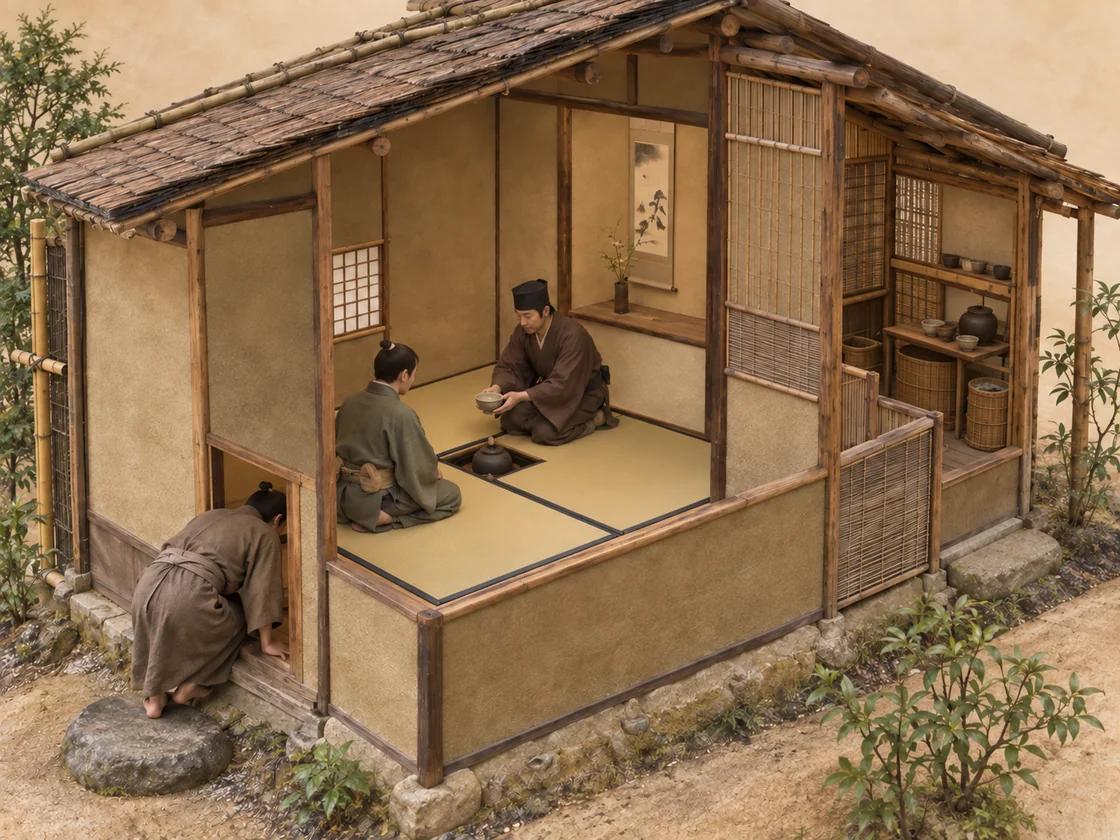
Taian at Myōkian in Ōyamazaki is a two-mat tea room from the Tenshō era and the most important surviving early small-room structure associated with Rikyū. Its low, concentrated interior uses windows, earth surfaces, ceiling variation, hearth, and adjoining service space to manage movement and perception. Official architectural authority describes it as built in Rikyū's preference; that is stronger than calling every component a surviving autograph design.
Taian survives as material evidence rather than solely a literary ideal. Its two-mat main room, adjoining spaces, hearth, windows, ceiling, and surfaces constrain claims about early small-room tea more effectively than a later anecdote alone. The building is dated broadly to the Tenshō era. Association with Rikyū is exceptionally strong in architectural tradition, and official designation language calls it Rikyū preference. The absence of a modern signed drawing makes exclusive authorship a different claim. A tea room is not just its main floor area. Preparation space, approach, threshold, water, storage, ventilation, repair, and the movements of attendants make the gathering possible. Photographs of the empty room conceal service.
Small dimensions alter bodies. Guests crouch, turn, sit close, and see surfaces at short distance. Such choreography can reduce some forms of display while increasing the host's control over every movement. Earth walls and limited light are not raw nature. Plaster composition, texture, openings, frames, roofing, and drainage required skilled decisions. Wabi space was built precision. Chōjirō's bowls reveal another collaboration. They were shaped by hand rather than a wheel and finished through techniques that produced distinct black or red surfaces. Rikyū's preference and use helped make them authoritative. Chōjirō was not Rikyū's hand. Clay response, shaping, glaze, kiln heat, and failure belonged to the maker's knowledge. Describing the bowls only as embodiments of Rikyū's mind erases ceramic invention.
The bowls also changed bodily attention. Form, weight, lip, temperature, and surface are encountered in the hand and mouth. Bamboo offered another path. The Tokyo National Museum preserves Onjōji, a bamboo flower vase attributed to Rikyū and dated to the 1590 Odawara campaign. Its cut opening and surviving cracks make the worked plant itself visible; later boxes and inscriptions also belong to the object's history. The campaign setting is well established, but no source licenses an invented scene of the precise moment he cut it.
Modern visitors encounter conservation. Floors, roofs, plaster, and wooden members require repair; objects rest in controlled storage and may be shown selectively. Survival is the outcome of institutional labor after the founder's lifetime. Taian's official protection began in the early twentieth century, within this project's pre-1912 reception scope, and later designation strengthened it further. Legal heritage status is not a sixteenth-century property of the room; it is a modern decision about national value. Conservation also faces the paradox of use. Tea architecture acquires meaning through bodies, heat, moisture, and handling, while those activities can damage fragile material. Custodians negotiate between living practice and preservation rather than choosing a perfectly unchanged past.
Copies have historical value. Reproducing Taian or a tea bowl allowed later practitioners to study proportions and ideals while adapting to another site. A copy is evidence of reception, not proof that every reconstructed detail is original. Rikyū's authorship is best understood as relational. He selected, commissioned, judged, used, and gave public meaning within collaborations. Recognizing makers does not diminish his influence; it explains how influence acquired durable material form.
In 1589 Rikyū financed completion of the upper level of Daitokuji's Sanmon, later called Kinmōkaku. A wooden image of him was placed above. The gate reflected patronage, religious relationship, family memorial practice, and extraordinary public status.
Daitokuji's gate had its own history before Rikyū. Rebuilding after destruction occurred in phases. His patronage completed an upper structure and tied his household to a major Zen institution. Placing the patron's image above the passage gave later accusation a vivid form. A ruler and other elites might be described as passing beneath the feet of a merchant-born tea practitioner. The scene condensed hierarchy into architecture. The gate was completed in late 1589, while the decisive crisis came in early 1591. This gap does not make the image irrelevant. It prevents a simple story of immediate spontaneous rage.
Near-period records give the image substantial evidentiary weight as a public charge. They also mention accusations around object appraisal, sale, and profit. Both belonged to activities central to Rikyū's authority. Connoisseurship was commercially vulnerable. When expert recognition could raise value, opponents could frame judgment as manipulation. Proving improper gain in each transaction would require records the general accusation does not supply. Public charges and political causes need not be identical. A ruler may punish conduct long known when relationships change, or select a visible offense to justify a broader break. Source criticism must preserve both the charge and the remaining causal gap.
Rikyū's Daitokuji relationship was not merely decorative. He supported building and memorial observance and associated with leading monks. That network gave religious prestige while potentially appearing as an independent concentration of honor. At Odawara in 1590, Toyotomi military supremacy surrounded tea activity. Campaign headquarters required ritual, gifts, service, and moments of controlled sociability. Rikyū's bamboo-vessel tradition locates material creativity inside conquest rather than away from it. Yamanoue Sōji's death offers another warning against a sanitized art world. Sōji had criticized or offended Hideyoshi in a relationship already damaged and was killed after entering Toyotomi hands. Exact dramatic details vary, but the execution is secure.
Rikyū could observe that cultural distinction did not shield an associate once the ruler withdrew tolerance. It would still be fiction to supply the precise conclusion he drew or to make Sōji's death the sole trigger of his own conflict. Stories that Hideyoshi demanded Rikyū's daughter and was refused provide a personal grievance. Their source position is weaker and later. They should remain reception, not be integrated as an established episode. The claim that Rikyū opposed a Korea invasion plan is especially vulnerable to retrospective ethical desire; his death preceded the 1592 launch, and no secure evidence makes him a policy dissident whose execution removed opposition.
Aesthetic conflict is plausible at the level of differing preferences and remembered design disputes. It becomes overreach when gold versus wabi is treated as a complete indictment file. Near-period diaries and notices deserve priority for the public charges and chronology, but they were written by observers with partial access. Agreement can establish that an accusation circulated without revealing the complete deliberation inside Hideyoshi's household. The distinction between pretext and cause is also difficult. Calling the image a pretext may imply it had no real meaning; calling it the cause may imply no other pressure mattered. It could be an authentic offense within a larger deterioration.
Factional competition among Toyotomi officials may have shaped accusation and access. Naming one official as the jealous author of the entire outcome simplifies a decision for which Hideyoshi retained sovereign responsibility. The evidence supports convergence: image, status, transaction suspicion, personal access, changing trust, and a ruler accustomed to exemplary punishment. It does not rank each pressure inside Hideyoshi's mind.
Rikyū's last recorded tea gathering was for Tokugawa Ieyasu in early 1591. Hideyoshi then ordered him to Sakai in confinement, recalled him to Kyoto, and commanded him to kill himself on the twenty-eighth day of the second month. He died at his Juraku-area residence under guard.
Chronology supplies the firm frame. A final recorded gathering for Ieyasu shows Rikyū still functioning shortly before the crisis. The subsequent order to Sakai marked withdrawal of access and public favor. Confinement in his home city did not return him to the independent merchant world of youth. Sakai was under Toyotomi authority, and a command from Hideyoshi defined his movement and safety. Recall to Kyoto brought him again within the ruler's immediate punitive reach. Guards around his residence made private household space part of state coercion. Ordered self-killing gave the punishment a warrior form while retaining Hideyoshi's authorship. Rikyū's act under command should not be romanticized as wholly free aesthetic self-expression.
Accounts of Oribe and Tadaoki seeing him off express disciple loyalty under danger. The story may preserve real action, but each gesture and speech requires source assessment. Later tea lineages had reason to remember courageous devotion. Weather is narratively powerful. Thunder, hail, or a darkened sky can make nature mourn and transform a political killing into cosmic drama. Meteorological detail cannot be accepted simply because it fits the scene. Death poems are a genre as well as possible final documents. Attribution, textual transmission, copying, and later ritual use must be checked. Reproducing a familiar verse would add little to the factual account and risk turning contested words into direct access to mind.
Descriptions of the cutting, assistant, body, head, bridge display, or relation to the gate image differ in detail. What does not vary is the destruction of position. Rikyū could no longer host, correspond, recommend, preserve household property, or negotiate as a living authority. His dependants had to survive a political rupture. Hideyoshi's responsibility must remain explicit. Officials may have reported accusations or managed confinement, but the ruler commanded the punishment. Uncertain motive does not mean uncertain agency. The execution also changed object histories. Utensils, letters, rooms, and relationships could be confiscated, hidden, dispersed, reassigned, or preserved by allies. Cultural continuity became a problem of people and material custody.
Disciples faced competing duties. Public defense of Rikyū might invite punishment; quiet preservation might look disloyal; distance could protect a household. Their later celebration should not erase immediate risk. The dates are recorded in the Japanese lunisolar calendar. Translating them into an unqualified modern Gregorian sequence can create false precision, especially around an intercalary month. Retaining year and traditional month-day order makes the source framework visible. Language of voluntary suicide is equally hazardous. Rikyū performed the fatal act under a sovereign command backed by guards and threat to household. Agency within the ritual does not remove coercion or Hideyoshi's responsibility for the death.
The pure-artist interpretation emerged because the conflict lends itself to moral contrast. Yet Rikyū had spent years serving coercive rulers, and Hideyoshi had supported wabi as well as gold. The ending was produced inside their shared system. A responsible narrative therefore refuses two false comforts: a final confession explaining every cause and a beautiful death resolving power into art. The archive gives an order, a victim, a ruler, several charges, and many later meanings. It does not give permission to invent the missing private answer.
Rikyū's execution did not leave one complete institution ready to continue unchanged. Family members and disciples preserved practices and objects under risk. Shōan was later permitted to restore the Sen household in Kyoto, and his son Sōtan strengthened its foundation. The lines now called Omotesenke, Urasenke, and Mushanokōjisenke developed through Sōtan's sons in the seventeenth century, not as three organizations founded by Rikyū before 1591.
Execution disrupted household continuity. Family and disciples had to manage confiscation, danger, patronage, and dispersal. Survival was an achievement, not an automatic inheritance of founder charisma. Shōan became central to restoration. Later permission to return and rebuild a Kyoto household required mediation within the same broad political world that had punished Rikyū. Institutional continuity depended on reconciliation with power. Sōtan inherited a tradition already shaped by rupture. His teaching, household management, rooms, and sons established forms from which later Sen houses developed. Calling Rikyū their founder is genealogically meaningful but chronologically compressed.
The lines later known as Omotesenke, Urasenke, and Mushanokōjisenke followed different descendants and residences. Their separation was a seventeenth-century development. Rikyū did not administer three named headquarters. Other disciples formed important trajectories outside the Sen household. Furuta Oribe and later daimyō tea specialists adapted practice to warrior government. Rikyū's afterlife was plural before schools standardized memory. Objects helped lineages endure. A bowl, scoop, letter, portrait, room, box, or inscription could materialize connection to the founder. Custody and authentication became institutional responsibilities and sources of authority. Texts did similar work. Manuals and remembered sayings turned embodied instruction into portable rules. The more useful a teaching became, the stronger the temptation to place it directly in Rikyū's mouth.
Evidence and interpretation · Whose voice survives in the Nanpōroku?
The Nanpōroku presents teachings attributed to Rikyū through Nanbō Sōkei. Its recovery narrative instead comes into view around Tachibana Jitsuzan, roughly a century after Rikyū’s death. The Tohoku University Library exhibit describes Jitsuzan’s encounter with a tea text in 1686 and further copying in 1690. [41][42]
Sakuramoto Kaori’s research treats Jitsuzan as the compiler and investigates his relationships with Zen teachers as part of the work’s intellectual setting. A later compilation can preserve inherited teaching while also shaping it. The text’s influence on Rikyū’s legacy is firmer ground than treating every passage as his recorded speech in 1591. [41][42]
Founder anecdotes and familiar sayings could likewise acquire later forms. Their teaching power remains part of tea history even where a particular scene or quotation cannot be verified.
Centenary and other memorial observances renewed attention to Rikyū. Commemoration selected objects, reconstructed lineage, and encouraged periods of deliberate return to an imagined founding austerity. Each return was also innovation for its own present. The Meiji Restoration weakened former patronage structures and changed the social position of tea families. Adaptation included public teaching, new supporters, print, exhibitions, and relationships with modern education and women's training. Industrialists and political elites collected tea objects and used gatherings for sociability in a new economy. Their practice resembled sixteenth-century intersections of wealth, objects, and power while operating within capitalism and the modern state.
Women's expanding participation through education and household culture changed the social body of modern tea. This development cannot be projected backward as Rikyū's program, but it was essential to how lineages survived the loss of older daimyō patronage. Printed books and exhibitions widened access while standardizing images. A reproduced portrait or rule could reach readers who never entered a hereditary tea household. Public reach therefore increased together with editorial selection. National heritage language further enlarged Rikyū. Taian's early twentieth-century protection, museum display, reproduced portraits, and historical writing made his material world part of public culture beyond hereditary pupils.
By 1912, “Rikyū” named several connected authorities: a documented merchant tea practitioner, Hideyoshi's servant, a design preference, a moral exemplar, a family ancestor, and a national aesthetic symbol.