HO Guides
Daitoku-ji and Jukō-in: Remembering Through Tea
A warrior's memorial, a painted religious interior, and an eighteenth-century tea-room gift reveal how remembrance became a continuing relationship between a monastery and tea families.
Quick · About 2 min
The story in five points
A short route through the argument. Follow a point into Classic for its context and sources.
A subtemple with its own obligations
Jukō-in is one foundation within Daitoku-ji, whose shared halls serve a larger Zen community. Individual memorial relationships could gather in a smaller compound without turning the whole monastery into one family’s monument.
Read in contextTea joined an older memorial
Miyoshi Yoshitsugu established Jukō-in in 1566 for his adoptive father Nagayoshi. Rikyū later chose it as his mortuary temple through his connection with its monk Shōrei; successive Sen tea families inherited reasons to return for Buddhist remembrance.
Read in contextPaintings worked within religious rooms
Kanō Eitoku and Shōei’s painted partitions belong to a working religious interior. Opening them changes the rooms as well as the image; portraits, shrine space and paintings together supported remembrance rather than functioning simply as a collection of separate masterpieces.
Read in contextAn anniversary could create something new
Around 1740, Joshinsai donated Kan’in-seki in connection with Rikyū’s memorial. Adapted from an existing building and supported by adjoining preparation and reception spaces, this later tea room honoured inherited practice while making future practice possible.
Read in contextContinuity required renewed acts of care
A documented 2021 observance combined family tea offerings with abbot-led chanting and remembered women as well as famous masters. Modern reproductions and new painting commissions likewise sustain different relationships with the temple’s rooms, each with its own purpose and date.
Read in context
Opening
On 7 September 2021, members of the Urasenke tea family gathered at Jukō-in for memorial services. Among those remembered were two women: the wife of Sen Sōtan, honoured at her 350th memorial observance, and the wife of Urasenke's ninth head, honoured at her 250th. The family's report records offerings of tea followed by sutra chanting led by the temple's abbot.[1]
Neither woman is the name most readily associated with Jukō-in. That is Sen no Rikyū, the sixteenth-century tea master whose grave makes the subtemple an important place in tea history. Yet this family observance opens another part of the institution's history. Jukō-in could remember a founder of a tradition and generations of people connected with its continuation.
The temple had not even begun as Rikyū's memorial. It was established for a warrior. How did that foundation become a place where tea families maintained relationships with their dead—and why did the process produce paintings, new rooms, and continuing ceremonies rather than simply a cemetery?
1. One monastery, more than one centre
Jukō-in belongs to Daitoku-ji, a Rinzai Zen monastery in northern Kyoto. The larger precinct is essential to understanding the smaller foundation. Daitoku-ji developed around the teacher Shūhō Myōchō in the early fourteenth century, suffered destruction during the Ōnin War, and was revived under Ikkyū Sōjun. Its buildings subsequently acquired different patrons and dates.[2]
The main ceremonial axis runs through gates towards the Buddha Hall and Dharma Hall. These give the monastery a shared religious centre. Around that centre stand subtemples, or tatchū: smaller compounds with identities and histories of their own. Jukō-in is one of them. It is not another name for the whole monastery, nor is it simply a side room in the main hall.
The distinction permits two scales of belonging. A family could establish a particular memorial relationship within a smaller foundation while connecting it to Daitoku-ji's religious community. The monastery's common identity did not require every patron's dead to become indistinguishable from everyone else's.
Daitoku-ji's principal Dharma Hall offers an instructive parallel to the gifts later made at Jukō-in. The institutional record dates its rebuilding to 1636, for the 300th memorial observance of the monastery's founding teacher, with support from the Inaba family. An anniversary helped occasion a substantial building project.[2]
A memorial date can do something that general respect cannot: it establishes a particular occasion for action. A building supplied for that occasion may then remain useful long afterwards. At the centre of Daitoku-ji and within Jukō-in, remembrance became one reason to add to the monastery's architecture.
This gives the precinct a history different from that of a single palace constructed to one patron's programme. The axial halls and surrounding foundations belong together, but they do not all commemorate the same person or embody one simultaneous act of building. Following Jukō-in's relationships means entering that larger arrangement, then attending to the particular obligations gathered within one compound.
2. A warrior, a teacher, and a new parishioner
In 1566, Miyoshi Yoshitsugu founded Jukō-in in memory of his adoptive father, Miyoshi Nagayoshi. Nagayoshi had been a daimyō, a military lord, and had died two years earlier. The founding monk was Shōrei Sōkin, an abbot of Daitoku-ji.[3]
Patron and monk brought different kinds of continuity to the project. Yoshitsugu's relationship with the dead man belonged to a warrior household. Shōrei's religious position connected the new memorial with Daitoku-ji. The foundation made a particular family's remembrance part of an institution capable of performing Buddhist services.
That first purpose still has an identifiable object. The national cultural-property register records a coloured painting on silk of Nagayoshi, owned by Jukō-in and dated 1566. It is a posthumous image belonging to the same year as the foundation.[4] The warrior is consequently present in the temple's surviving material history, not merely mentioned in the preface to a story about tea.
A portrait gives remembrance a specific subject. The image of Nagayoshi identifies the person for whom this foundation was established. Rooms provided a place for observance; the portrait gave his memory a visible presence within the institution.
Rikyū's connection came through Shōrei. The temple's published history records his Zen study with the monk and his choice of Jukō-in as his mortuary temple. It later became the burial place of successive heads of the three Sen tea families: Omotesenke, Urasenke, and Mushakōjisenke.[5]
This was an additional relationship, not a replacement foundation. The temple could preserve the memory of a warrior patron, its own founding monk, and a tea master. Their connections converged through a religious institution without making them members of one literal household.
The sequence helps explain the difference between influence and belonging. Admiring Rikyū's tea practice might lead someone to imitate an arrangement of utensils. Choosing a mortuary temple established another kind of connection, one involving services and commemoration after death. The later tea families inherited reasons to return to Jukō-in that were more specific than admiration for an elegant historical setting.
3. Paintings with a religious address
Jukō-in's main hall makes these relationships architectural. The national building record dates it to 1583 and identifies a six-room hōjō plan, excluding later enlargements. A hōjō is an abbot's residence and working religious interior. The term should not conjure a purpose-built picture gallery.[6]
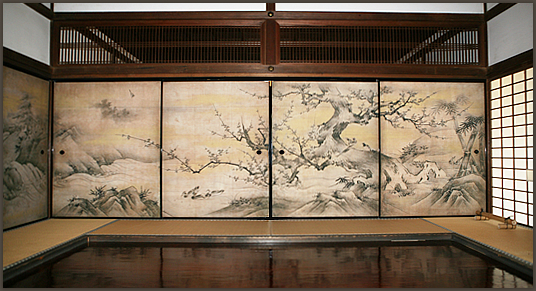
Painted sliding partitions, called fusuma, form part of the rooms. Kanō Eitoku and his father Shōei supplied the celebrated sixteenth-century painting programme. In Eitoku's bird-and-flower composition, a spreading tree crosses the divisions between panels. The handles remain plainly visible within the painted world. These surfaces are images and architectural fittings at the same time.[7]
The room does not ask its occupants to choose between those functions. Closed partitions make the image continuous across a wall; opening a partition changes the enclosure. A painting made for such a setting participates in the ways the rooms can be joined or separated. Removing it to a museum preserves an object but changes the relationship through which that object was originally encountered.
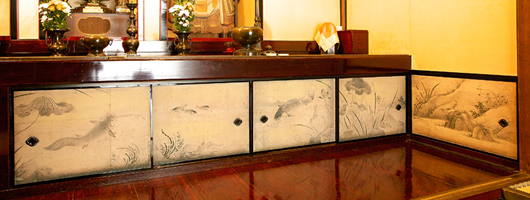
The contrast in scale within the interior is equally instructive. Eitoku's composition occupies the large partitions of the central room. Shōei's fish-and-lotus paintings decorate smaller panels in the Buddhist shrine room. In the published installation photograph, an altar and its offerings stand above those smaller paintings.[8] The images belong to a place of worship without each having to depict a Buddhist figure.
Art historian Gregory Levine's study of Jukō-in argues that its portraits, paintings, and architecture should be understood together within mortuary practice, rather than treating the sliding-door paintings as detached masterpieces. His account particularly emphasizes the memorial images of Nagayoshi, Shōrei, and Rikyū.[9]
The portrait identifies a person; the painted partitions organize an interior; the shrine room supplies an explicitly devotional setting. Together they give a memorial community more than one way to engage with its surroundings, from addressing an image to moving between rooms furnished for different activities.
It also explains why Jukō-in's art is relevant to its transition into a tea-family memorial. The new relationship entered a religious interior that already had its own patrons, images, and purposes. Tea did not arrive at an empty aesthetic stage. Its practitioners became connected with a place where other memories had already acquired form.
4. Building after Rikyū, rather than building by Rikyū
A later gift makes the continuing relationship particularly clear. Around 1740, Jukō-in received the tea room Kan'in-seki from Joshinsai, the seventh head of Omotesenke. Temple interpretation associates the donation with Rikyū's 150th memorial observance. It describes the three-mat room as expressing his preferred manner of tea.[10]
The two propositions belong together: the room was a later act of remembrance, and its makers referred back to Rikyū. Calling it a room “in Rikyū's taste” is therefore quite different from calling it a room he built or personally used.
Architectural historian Nakamura Masao gives the donation a more concrete setting. He dates it to 1740, identifies an account book for Jukō-in's small room, and notes the recorded name of a carpenter, Jūemon. He describes the tea room as made by altering part of the shoin, the residential or reception building behind the main hall.[11]
The evidence brings the anniversary down to the level of an actual project. Someone had to provide a room, adapt an existing building, and record expenditure. The tea family's reverence took the form of a useful addition to the temple, rather than remaining a statement about the superiority of an earlier age.
The protected building is larger than the tiny tea room alone. Its national register lists the three-mat Kan'in-seki, a two-mat preparation space, another tea room called Masudoko-seki, two six-mat rooms, and a veranda.[12] The intimate setting depended on neighbouring spaces with different functions. Preparing tea and receiving people required provision beyond the small area in which host and guests would meet.
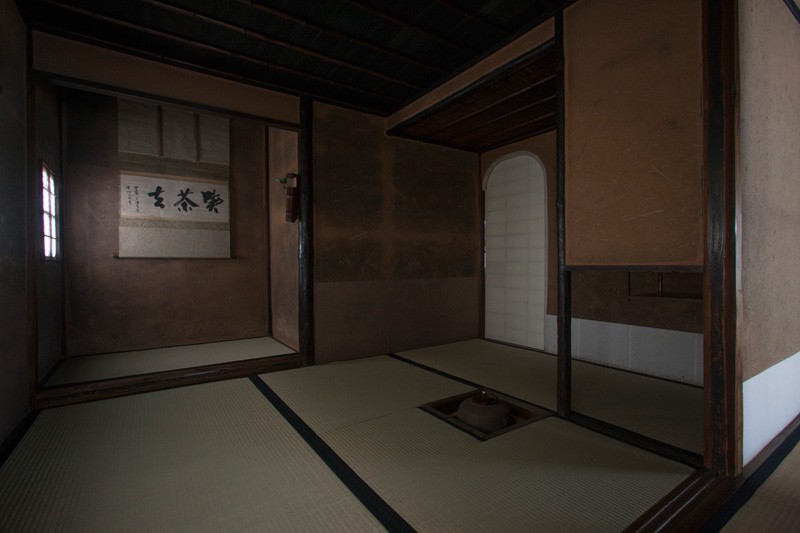
A photograph of Kan'in-seki shows how concentrated that smaller room is: the hearth interrupts the matting, a post and partial wall divide the interior, and a hanging scroll occupies the alcove. The image records a furnished setting, not a ceremony in progress.[13] Its compactness becomes more intelligible when placed within the larger group of rooms rather than imagined as an isolated hut.
The anniversary gift could thus serve both recollection and future activity. It referred to Rikyū while providing a place in which tea could continue to be practised. The donor's generation did not merely preserve an old possession; it made something new through its understanding of the inherited practice.
Here the memorial generated a commission, and the commission furnished a setting available beyond the commemorative occasion. Kan'in-seki made an anniversary useful to later generations: a room associated with Rikyū's memory could also accommodate their own practice.
5. The calendar does not stop with the founder
Architecture provides capacity, but an anniversary still needs people to observe it. The 2021 service shows the relationship being enacted rather than merely inherited as a title.
The two women commemorated that day were identified through several generations of the tea family. Sōtan's wife was also the mother of Urasenke's fourth head. The wife of its ninth head was the mother of its tenth. The report also records observances for other members of the family, including a former head and his wife. Living relatives attended; representatives of the tea family offered bowls; the temple's abbot led the chanting.[1]
The division of activity is revealing. The descendants did something distinctive to their tradition, while the monk conducted Buddhist worship. Tea and temple service met in one observance without becoming the same act. Jukō-in supplied a religious relationship that a family tree or a display of historic utensils could not supply by itself.
The women's presence in the record also changes the scale of the story. A succession of celebrated masters is only one way of describing a lineage. This ceremony remembered people through marriage and parenthood as well as through formal succession. Its family history was wider than a row of professional titles.
The report gives little of the women's individual lives, but names them as recipients of observances centuries later. The family had reasons to remember them other than professional achievement in tea.
There is a shorter rhythm as well. An Urasenke notice dated 24 August 2024 announced that Rikyū's monthly memorial service at Jukō-in on the twenty-eighth would be conducted privately because of an approaching typhoon. People were asked not to come.[14]
The notice separated holding the service from receiving visitors. Its practical message was that the observance would proceed within a smaller circle. Remembrance could continue without being offered as a public event.
Taken together, the anniversary report and the monthly notice show two ways time brings people back to this particular temple. A major memorial can prompt a new room; a recurring service can require little public display at all. The enduring relationship lies in having reasons to perform these acts again, not in making every occasion equally grand.
6. Old images, new commissions
Jukō-in's painted interior has also acquired new forms of care. DNP, the company that produced high-resolution reproductions of part of the Kanō programme, describes scanning and printing the originals, with damage such as insect holes reduced through supervised digital work. Those interventions were made in the reproductions, not presented as repairs physically carried out on the original paintings.[15]
The distinction allows two different things to be retained: fragile painted objects and the experience of an image occupying its architectural position. A substitute panel cannot supply the original paper's material history. It can preserve a relationship of image, scale, and room that would otherwise be difficult to encounter when the original is elsewhere.
This is a selective act of transmission. Even a reproduction made from the existing work involves decisions about whether damage should remain conspicuous. The aim described by the producer was not to create a newly imagined Kanō painting, but to make the surviving composition legible while limiting the distraction of losses. The reproduction must still be identified for what it is.
An event documented at Jukō-in in 2018 used these reproductions for close study with a museum curator. The programme also included the abbot's account of the temple, the tea rooms, and Rikyū's grave.[16] That occasion connected art appreciation with the place's other relationships rather than treating the rooms as containers for isolated pictures.
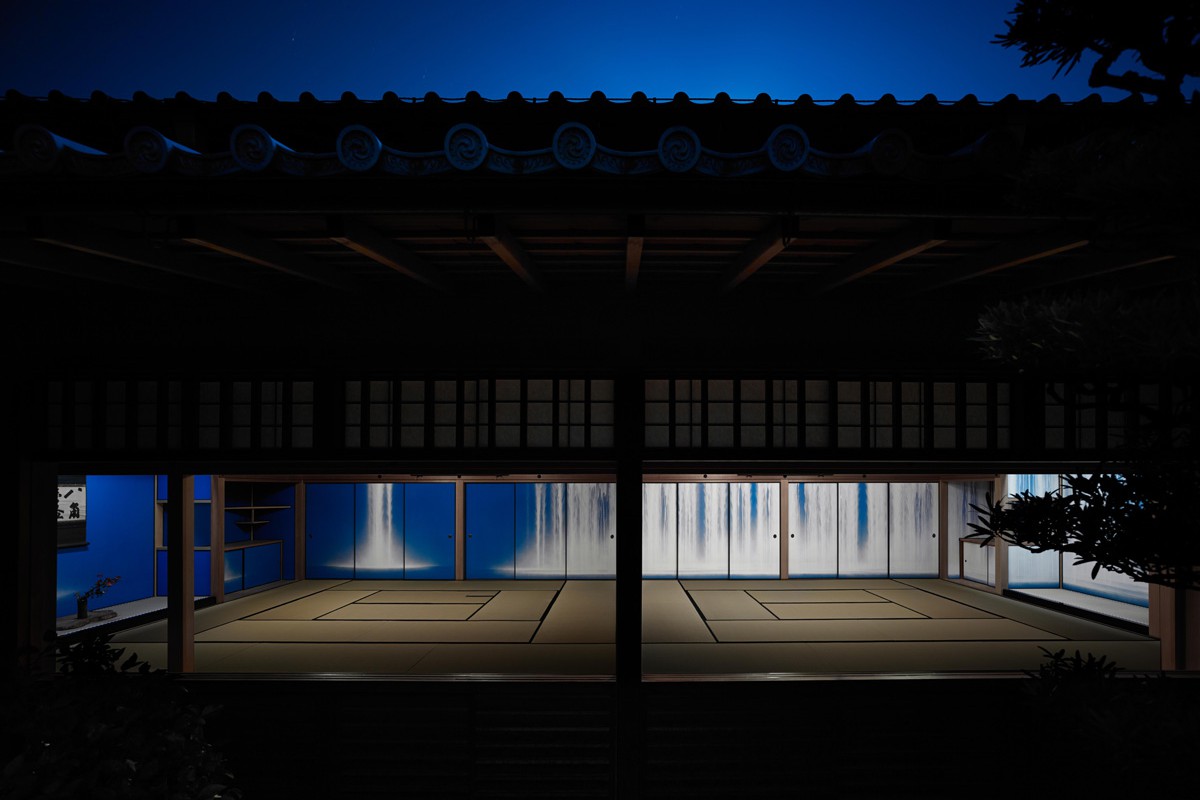
Another addition works differently. Hiroshi Senju's waterfall paintings were dedicated to the shoin completed in 2013. A published photograph of the Kyoto installation shows white falls against blue fields, extended across the room's partitions.[17] These are new paintings, not replacements pretending to be sixteenth-century surfaces.
The new commission and the Kanō reproductions answer different needs. One continues an inherited composition in its setting; the other gives a later building an artistic identity of its own. The compound now accommodates both forms of work, each with its own date and purpose.
For Jukō-in, this is a continuation of a documented local pattern: later relationships have added to the foundation without erasing its earlier purposes. The eighteenth-century tea-room donation and the modern painting commission are not the same kind of gift. Both, however, prevent the temple's material history from being confined to the year of its establishment.
7. An inheritance with something to do
Jukō-in's history contains several routes by which a relationship could continue after death. A warrior's family founded a memorial. A monk linked it to Daitoku-ji. A tea master chose it as his mortuary temple. Later descendants marked anniversaries, added rooms, and returned for services.
These connections did not transform the entire monastery into Rikyū's monument. Daitoku-ji retained its shared religious centre, while Jukō-in retained memories older than its tea associations. The smaller foundation could accommodate a growing network of obligations precisely because it was an institution, with a setting and religious work of its own.
Reverence could generate further activity. A gift made for an anniversary furnished another place for tea. A family practice became part of an offering to the family's dead. A painted interior continued to be used and interpreted while its vulnerable surfaces received different treatment.
The tea offered at the 2021 service brings that history to a particular action. An inherited practice was used to honour people within the inheritance. Jukō-in provided the religious place where the gesture could become part of a memorial service. The connection between tea and temple was renewed in the offering and the service that followed it.
Next topic · HO Guides
Tenryū-ji: Building for a Former Enemy
A dead emperor, a merchant's undertaking, and a Zen teacher's difficult questions explain how a memorial was built while the conflict behind it continued.
Continue readingSources and NotesView sourcesHide sources
Sources consulted 16 September 2026. Historical events and documented images are distinguished from current access. Jukō-in is not presented as an unrestricted public interior.
- [1]
Urasenke, “真巌宗見大姉三百五十年回忌・浄嶽宗巌信女二百五十年回忌法要 ならびに無限斎碩叟宗室居士・清香妙嘉大姉祥当命日法要,” 7 September 2021: https://www.urasenke.or.jp/archive/1242.html. It identifies the two women, their family relationships, the gathering, offerings, and abbot-led chanting. The account is used as the organizing family's contemporary report, not as evidence that the writer attended or as a complete biography of the women. It does not locate the ceremony in Kan'in-seki.
Return to the reference ↑ - [2]
Rinzai–Ōbaku institutional website, “龍寶山 大徳寺,” “概略・歴史” and entries “仏殿” and “法堂”: https://rinnou.net/head-temple/daitoku/. Supports the founder, war damage and recovery, main axis, and the 1636 Dharma Hall rebuilding for the founder's 300th memorial. The widely retold claim linking Rikyū's gate statue to the cause of his death is not needed and is not adopted. The essay uses no current subtemple count or presumed interior access.
Return to the reference ↑ - [3]
Kyoto Shunju, “大徳寺 聚光院,” “沿革”: https://kyotoshunju.com/temple/daitokuji-jukoin2026/. Compared with DNP's institution description in note 7, which explicitly identifies Yoshitsugu as Nagayoshi's adopted son, and Gregory Levine's dissertation abstract, note 9, for Nagayoshi's 1564 death. These sources support the 1566 memorial foundation and Shōrei Sōkin's role. No unverified account of Nagayoshi's campaigns or the commission's private motives is supplied.
Return to the reference ↑ - [4]
Agency for Cultural Affairs, National Cultural Properties Database, “絹本著色三好長慶像〈/永禄九年七月四日宗〓賛〉,” registration 00533, record 201/1348: https://kunishitei.bunka.go.jp/heritage/detail/201/1348. It gives 1566 and Jukō-in ownership. The inscription field contains an unresolved character in the online record; the essay does not expand it, assign an otherwise unlisted painter, translate the inscription, or claim direct visual examination of this portrait.
Return to the reference ↑ - [5]
Kyoto Shunju, “沿革,” URL in note 3. Used for the temple's account of Rikyū studying with Shōrei, choosing Jukō-in as his mortuary site, and the three Sen families' subsequent burial relationship. No exact year is assigned to Rikyū's choice because the original donation document was not read. The later ceremonies are independently documented by the family in notes 1 and 14.
Return to the reference ↑ - [6]
Agency for Cultural Affairs, Cultural Heritage Database, “聚光院本堂,” object 194270: https://online.bunka.go.jp/db/heritages/detail/194270. It dates the hall to 1583 and identifies the six-room plan with later extensions excluded. The customary dating of the paintings to 1566 is separately reported in Levine's abstract and other interpretation; this essay does not invent a transfer, replacement, or completion sequence to make those dates identical. The body describes the paintings broadly as sixteenth-century.
Return to the reference ↑ - [7]
DNP, “【高精細複製】国宝襖絵 大徳寺塔頭聚光院方丈 襖絵 24面,” “実施概要”: https://www.dnp.co.jp/biz/case/detail/20173140_4968.html. Image: https://www.dnp.co.jp/biz/case/detail/__icsFiles/afieldfile/2021/06/10/08daitokuji_d01_p01.jpg. The image supports the tree crossing panel joints and visible handles; it is an installation photograph of the reproduction project, not a claimed inspection of original pigments. The entry assigns sixteen bird-and-flower panels to Eitoku and eight small fish-and-lotus panels to Shōei.
Return to the reference ↑ - [8]
DNP, same project record, “仏間,” and the corresponding image: https://www.dnp.co.jp/biz/case/detail/__icsFiles/afieldfile/2021/08/05/08daitokuji_d01_p03.png. The altar, offerings, and smaller painted panels are visible. No identification of every devotional object, reconstructed historical rite, or claim about the specific participants in a sixteenth-century service follows from that modern photograph.
Return to the reference ↑ - [9]
Gregory Levine, Jukoin: Art, Architecture, and Mortuary Culture at a Japanese Zen Buddhist Temple, Princeton University dissertation, 1997, author abstract reproduced by Penn State Libraries: https://openpublishing.psu.edu/ahd/content/jukoin-art-architecture-and-mortuary-culture-japanese-zen-buddhist-temple. Abstract only. Used for the explicitly stated interpretation connecting mortuary images, architecture, and liturgical practice, and the basic dates supplied there. Neither the dissertation, its inventories and repair evidence, nor Levine's later monograph was read in full. The body's local explanation also rests on the separately inspected building, object, project, and ritual records.
Return to the reference ↑ - [10]
Kyoto Shunju, “茶室『閑隠席』,” URL in note 3; national building record, note 12. The institutional interpretation associates Joshinsai's gift with Rikyū's 150th memorial and labels the connection to Rikyū's preferences as a received understanding. Nakamura, note 11, dates the donation to 1740; the national record dates the tea-room building approximately to 1739. The body uses “around 1740,” not an invented start/completion distinction.
Return to the reference ↑ - [11]
Nakamura Masao (中村昌生), “数寄屋大工が歩んできた道,” in Gallery A4, 数寄屋大工―美を創造する匠―, paragraph beginning “それにもかかわらず、棟札によると”: https://www.a-quad.jp/exhibition/053/p03.html. It names the 1740 donation and “聚光院小座敷金銀納下帳,” describes adaptation of the shoin, and identifies the recorded carpenter. Nakamura's further hypothesis that another carpenter actually executed the work is not adopted. The original account book and building-repair report were not independently inspected.
Return to the reference ↑ - [12]
Agency for Cultural Affairs, National Cultural Properties Database, “聚光院茶室,” record 102/1610, designation 01014: https://kunishitei.bunka.go.jp/heritage/detail/102/1610. The listing distinguishes Kan'in-seki, the preparation room, Masudoko-seki, two larger rooms, and veranda. Its “four mats” for Masudoko-seki differs from visitor descriptions of four-and-a-half including its unusual alcove; the essay avoids making an unexamined floor-plan reconciliation. The preparation-room function is used to explain the listed group, not to reconstruct a particular service.
Return to the reference ↑ - [13]
Kyoto Shunju, photograph captioned “茶室『閑隠席』”: https://kyotoshunju.com/sL7hryut/wp-content/uploads/jukouin_021.jpg. The description concerns visible hearth, matting, post, partial wall, and alcove. The date of the photographic arrangement and the scroll's authorship are not established; no original furnishing inventory or measured light level is claimed.
Return to the reference ↑ - [14]
Urasenke / Konnichian Foundation, “8月28日、聚光院での月忌法要について,” 24 August 2024: https://www.urasenke.or.jp/info/84530.html. It announces that the monthly memorial would be conducted privately because of an approaching typhoon. The essay reports the notice's intention, not an independently witnessed subsequent event or a guarantee of uninterrupted monthly services over four centuries.
Return to the reference ↑ - [15]
DNP project record, note 7, opening technical paragraph and “伝匠美” specifications. Used as the producer's account of scanning, printing, and supervised digital reduction of visible damage. The company's claims of fidelity are not independent conservation assessments. This particular project records twenty-four National Treasure panels plus four other panels; it is not represented as one documented contract for every panel in the forty-six-panel Kanō programme.
Return to the reference ↑ - [16]
DNP, “千利休の菩提寺聚光院で 狩野永徳唯一の国宝障壁画を堪能,” “プログラム1,” events in March–April 2018: https://www.dnp.co.jp/biz/case/detail/20173161_4968.html. Used for the documented combination of curator-led reproduction viewing, abbot's explanation, tea rooms, and grave visit. The unrelated speculative claim in the 2019 programme that Rikyū and Eitoku disliked each other is not adopted. This is a past event, not an access recommendation.
Return to the reference ↑ - [17]
Kyoto Shunju, “千住博筆『滝』,” URL in note 3, supplies the 2013 shoin dedication; Hiroshi Senju, official artist exhibition record “Daitokuji Jukoin,” Kyoto, 2016–2017: https://www.hiroshisenju.com/exhibitions/daitokuji-jukoin/1. The related Kyoto Shunju installation photograph: https://kyotoshunju.com/sL7hryut/wp-content/uploads/jukouin_pr-1200x800.jpg. It shows the blue-and-white waterfall composition across the partitions. The artist exhibition dates are not substituted for the 2013 dedication. As of 16 September 2026, the forthcoming opening notice explicitly identifies the Kanō display as reproductions; it is not evidence that a future opening has already occurred.
Return to the reference ↑