Read the article below. Interactive reading tools are available when scripts load.
Quick
Katsushika Hokusai was born in 1760 near Honjo Warigesui, in eastern Edo, the Tokugawa warrior government's capital and the city now called Tokyo. The surviving account of his childhood is uneven. His father is identified only as a man named Kawamura, and a later tradition says that the boy was adopted by Nakajima Ise, a mirror maker serving the shogunate, the warrior government. Museum chronologies repeat traditions that he drew from six, worked around a lending library at twelve, and learned woodblock engraving in adolescence. [1]
His childhood occupations are less securely documented than his later apprenticeship. Edo nevertheless offered a practical setting for learning: lending libraries brought illustrated books to many readers, while publishing workshops employed designers and skilled craftspeople. In 1778 he would enter an established school and begin a documented professional career.
In 1778, at about nineteen by Japanese counting, Hokusai entered the school of Katsukawa Shunshō, a leading designer of actor prints. He received the art name Shunrō and began producing within an established visual and commercial lineage. The school taught more than a style. It linked a young designer to models, senior artists, publishers, theater subjects, and an audience able to recognize a Katsukawa image. Actor prints demanded identifiable roles and performers while working within the conventions and censorship of Edo publishing.
Shunrō's surviving work was not confined to actors of kabuki, Japan's commercial theater. It includes illustrated popular books and images of children, warriors, sumo, famous places, toys, and religious subjects. Variety was already part of professional practice. The apprenticeship gave him an audience and publishing experience that remained useful after he left the school.
Hokusai left the Katsukawa school in 1794 and took the name Sōri, associated with an Edo branch of Rinpa, a decorative painting tradition. The new connections brought commissions for poetry prints and illustrated books. Later biography describes an expulsion caused by his study of Kanō, a painting school associated with elite patrons. The departure is secure, but its precise cause remains uncertain.
Imported and copied pictures brought other spatial techniques within reach. Using them in a book or print required adjustment to its format. Leaving one school could cost an established audience, while the Sōri affiliation and poetry groups offered new commissions. His work developed through these connections as well as through study of other pictures.
An art name could identify a school affiliation or pass from a teacher to a pupil. Hokusai used Shunrō in the Katsukawa school and Sōri in his next phase. Later he used Taito for much of his drawing-manual work, then Iitsu for the celebrated Fuji prints. In 1834, under the late identity Manji, he published One Hundred Views of Mount Fuji, an illustrated book extending his exploration of the mountain.
Hokusai relinquished the Sōri name to a follower when he established a more independent identity around 1798. This practice creates an attribution problem. A signature may date a work, but a lineage name can also outlive one holder, and later impressions may retain an earlier design's signature. Counting every form produces different totals. The repeated changes are evidence of professional reinvention, not proof that Hokusai stood outside convention. He used an early modern naming system unusually often and strategically. His present global identity condenses that moving history into a single name he did not use throughout his life.
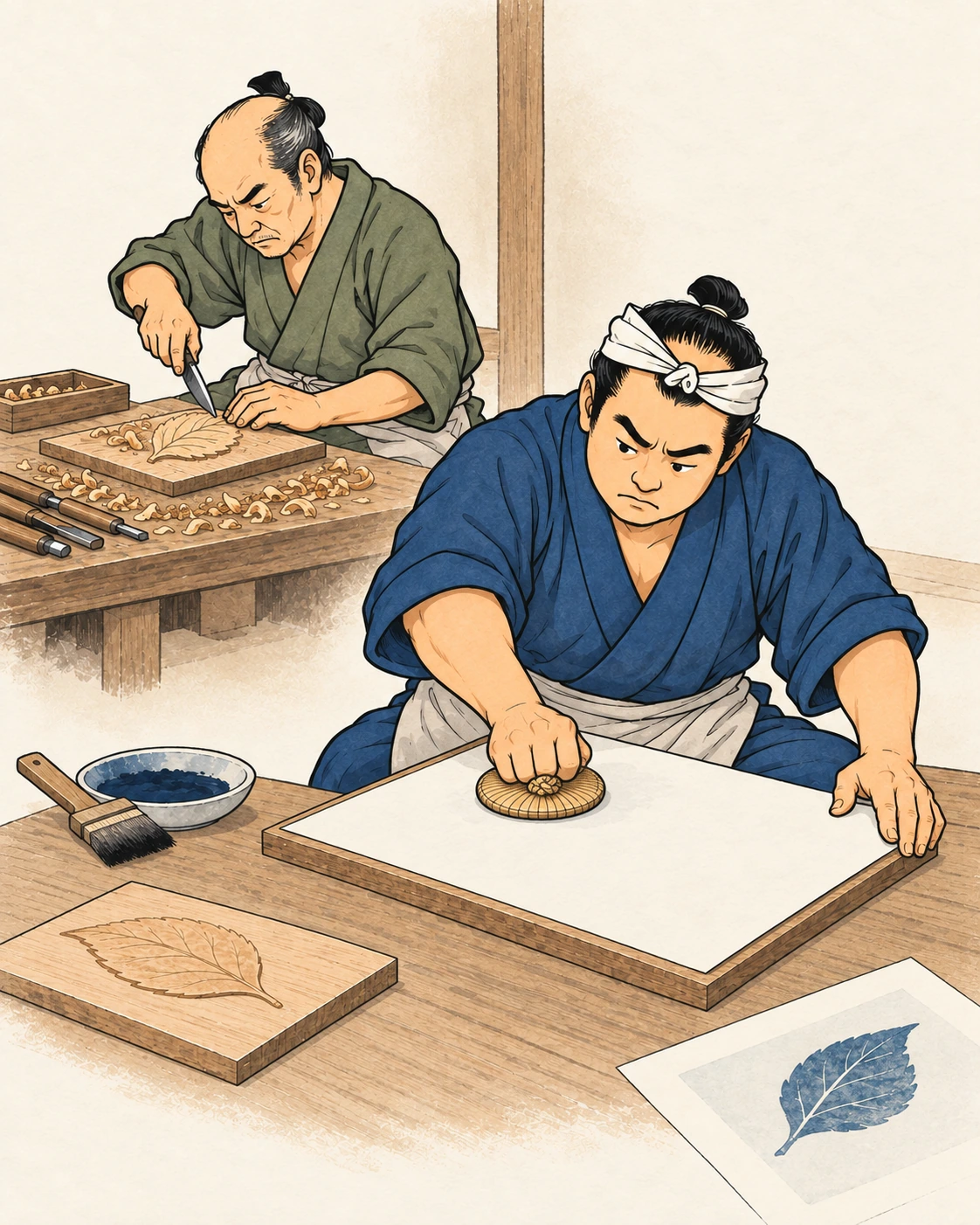
A publisher financed a woodblock print and coordinated its makers. Hokusai supplied the design; a specialist carver cut its lines into wood; a printer aligned paper with the blocks and controlled color and pressure. The publisher could choose format and series length, paying for production before sales recovered the cost. Fine lines and gradation depended on the workshop's skill.
Repeated printing wore the blocks, and later runs could change colors or omit effects. Two sheets from one design may therefore look different. Hokusai's authorship remains at the design stage, but the particular impression also preserves decisions by its carver, printer and publisher.
The landscapes now used to summarize Hokusai occupied only part of his career. During the Sōri period he supplied elegant images for kyōka, comic or witty verse, in privately sponsored prints and poetry books. From about 1804 he produced large numbers of illustrations for yomihon, long popular narratives usually printed mainly in black. These forms joined different publics. A poetry circle could commission costly paper and subtle printing for limited distribution. A commercial publisher could sell an illustrated narrative to broader readers.
Manuals and pattern books could be used by students and craftspeople. A book illustration had to work with the narrative and page order; a poetry print could give a verse an indirect visual partner. Moving between these formats sustained Hokusai's career and trained him to arrange varied subjects. Landscapes became a celebrated part of that work, not its only purpose.
During an 1812 stay in Nagoya with his pupil Maki Bokusen, Hokusai assembled drawings that helped form the first volume of Hokusai Manga, published in 1814 by a Nagoya-centered network including Eirakuya Tōshirō. The books gather people at work and play, bodies in motion, animals, plants, landscapes, architecture, deities, monsters, and comic observation. Here manga refers to collections of sketches, not modern panel-based comics. The volumes functioned as drawing models, collections for viewing, and sources usable by students and craftspeople.
Early volumes appeared rapidly, but the fifteenth was published only in 1878, almost three decades after Hokusai's death. Some installment dates remain debated. Publishers continued to select and issue drawings after the artist could no longer direct the work. The complete series includes that later editorial history as well as his original designs.
Hokusai pictured roads, waterfalls, bridges and distant views for readers who could not visit them all. Some travel is documented, including his 1812 stay in Nagoya and later journeys to Obuse. He also drew on earlier images, guidebooks and information from others. A named landscape therefore need not record a visit by the artist.
Meisho, or famous places, were already layered with poems, pilgrimage, road knowledge, and repeated images. A print did not simply copy terrain. It selected a viewpoint, arranged travelers and labor, and made a place recognizable within inherited expectations. Printed geography expanded mobility imaginatively while depending on real roads, commercial distribution, and customers' desire to travel. Hokusai helped readers see a connected country, but the connection was cultural and market-made, not a neutral survey.
In the early 1830s the publisher Nishimuraya Yohachi issued Hokusai's Thirty-Six Views of Mount Fuji. The artist was around seventy. Fuji supplied a repeated anchor, appearing beyond cargo boats, timber workers, roads and city rooftops. Some sheets made it dominant; others placed a small peak behind ordinary work. After the initial designs succeeded, Nishimuraya added ten, making forty-six views under the unchanged title.
Early sheets often used blue outlines, while the later additions used black. The newly affordable Prussian blue gave the series vivid water and sky. Hokusai's designs and Nishimuraya's decision to add views both shaped the project; collecting one view could encourage a buyer to seek another.
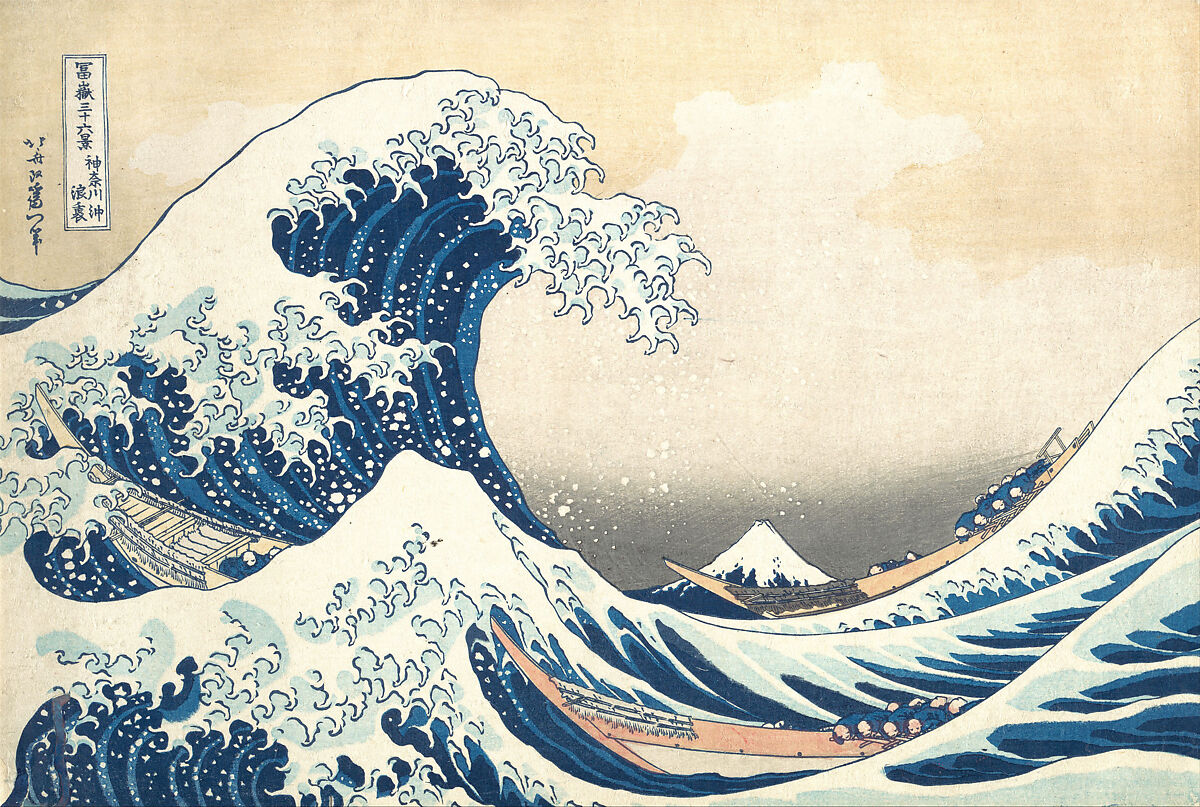
The print now called The Great Wave was titled Under the Wave off Kanagawa and belonged to Thirty-Six Views of Mount Fuji. It was probably issued in late 1831 by Nishimuraya Yohachi. Three narrow oshiokuri boats, used to carry fresh fish rapidly toward Edo, enter a violent sea while Fuji appears small in the distance. The composition makes the wave enormous without removing human work. The crews' work required speed and exposed them to dangerous weather.
Fuji's apparent stillness is a pictorial relation, not proof of Hokusai's philosophical intention. Several blocks and specialist printing produced the image. Surviving impressions differ as blocks wore and colors changed; thousands were probably printed as demand continued. Its later global status must not be moved backward. The sheet began as an affordable commercial design within a larger series, not as an official national symbol or a message composed for modern museums. French collectors and artists celebrated it from the late nineteenth century, while its near-universal popular-icon status developed later still.
Another famous sheet from the Fuji series is Gaifū kaisei, commonly translated Clear Day with a Southern Breeze and nicknamed “Red Fuji.” Probably issued in late 1831, it shows the mountain without foreground figures. The upper slopes catch a reddish light above a darker, wooded base; small clouds cross the blue sky. The title and image evoke weather associated with clear conditions and a southerly wind. Later explanations often specify a late-summer or early-autumn sunrise, but the print is not a dated field observation of one recoverable morning.
Its apparent simplicity required collaboration. Hokusai organized the mountain as a strong field of color, while the carver preserved its contours and the printer controlled blue, green, red-brown, and gradation. Surviving impressions differ substantially in color and sky. Natural observation and manufacture are not opposites. The design makes a plausible atmospheric transformation legible through conventions and workshop decisions. “Red Fuji” is therefore neither a photograph nor pure symbol. It is weather remade for repeated printing.
The intense blues of Hokusai's Fuji series depended on a pigment invented far from Japan. Prussian, or Berlin, blue was a synthetic color developed in Europe. By the late 1820s it became available to Japanese publishers at much lower cost, with substantial supplies reaching the market through China within wider regulated trade. The pigment was strong and relatively resistant to fading compared with dayflower and some earlier blues. Printers could use it for large skies and seas, combine it with indigo, or mix it with yellow to produce green.
A 2021 study of ‘Red Fuji’ identified Prussian blue, indigo and a yellow arsenic sulphide mixed with blue in green areas. The yellow could be natural orpiment or a synthetic product. The laboratory findings establish materials more firmly than the path of a particular shipment. Merchants made the pigment available; Hokusai, Nishimuraya and the printers turned it into a landscape series.
Hokusai's daughter Katsushika Ōi, also known as Ei or Eijo, trained with him and became an accomplished artist. She married painter Minamizawa Tōmei, a pupil of Tsutsumi Tōrin III, then returned to her father's household after their separation. This identifies her husband's teacher, not an independent apprenticeship of hers. Her figure painting and treatment of light had a distinct character. In 1847 she supplied illustrations for the second volume of Onna Chōhōki, a book of instruction for women. She also lived and worked with Hokusai during much of his late career.
Signed works establish Ōi's independent practice, while the division of work in her father's studio is less clear. Assistance should not be enlarged into a claim that she painted every unsigned late work. Nor should living in his household erase her own pictures. Attribution must begin with particular objects and their evidence.
In 1839 a fire destroyed Hokusai's Edo residence and many drawings and materials. He continued working. In his eighties he traveled to Obuse in Shinano, in present-day Nagano Prefecture, probably first around 1842, under the patronage of the wealthy merchant, pupil, and painter Takai Kōzan. Obuse offered space and commissions for large-scale painting. Hokusai designed ceiling panels for festival floats: dragon and phoenix images for Higashimachi, associated with an 1844 rebuilding, and later wave panels for Kanmachi. A monumental phoenix at Iwamatsu-in, a Buddhist temple, is also tied to his last years in the town.
Kōzan provided working space and financed the Kanmachi float with his own money. Its wave panels were made in 1845–1846; he colored the surrounding border designs from Hokusai's drawings. Local makers built and installed the float for communal use. These commissions gave the elderly painter architectural surfaces quite unlike a handheld print, while their survival depended on continued local care.
Hokusai died in Edo in spring 1849, conventionally aged ninety by Japanese counting. Images related to Hokusai Manga had already appeared in Siebold's Nippon, issued from 1832. Around 1856 Félix Bracquemond encountered a volume in France. After the 1867 Paris Exposition, Japanese prints drew growing European interest, part of the movement called Japonisme, in which artists and collectors adapted Japanese art to new uses.
Later actors made “Hokusai” into a historical subject. Iijima Kyoshin's Japanese biography appeared in 1893; Edmond de Goncourt published a French monograph in 1896. Henri Rivière's 1902 Thirty-Six Views of the Eiffel Tower openly reworked the series idea. This reception selected, translated, detached, and reprinted. It did not simply reveal a reputation waiting unchanged inside the works.
Classic
Hokusai was born in 1760 near Honjo Warigesui, east of the Sumida River in Edo, the Tokugawa warrior government's capital and the city now called Tokyo. His biological father is recorded as a man named Kawamura. The neighborhood lay within a growing city whose theaters and publishing shops created work for artists and craftspeople. Illustrated books circulated through lending libraries; single-sheet pictures brought actors and famous places into customers' homes. This was the world in which the boy began to draw. [1]
The Sumida Hokusai Museum presents his adoption by Nakajima Ise, an official mirror maker, as a tradition rather than an established household fact. It gives the same qualification to stories that he drew from six, worked in a lending library at twelve, and learned engraving as a teenager. Such work would have brought him close to the making of images: books passed between many readers, while a block cutter learned to reverse a drawing and preserve its lines in wood. The uncertain record leaves his exact route into that trade unclear. [1]
An artist in Edo could earn a living through several kinds of work. A drawing might become an actor print, a page in popular fiction, or a pattern copied by a craft worker. Each format imposed different demands. A line that looked graceful on paper still had to survive cutting into a block; an illustrated page had to fit the writer's story. Hokusai's later range grew within this practical culture of drawing for reproduction.
A connection to an artisan household could offer training and contacts, though it guaranteed neither a secure income nor a distinguished career. The clearest early professional step came the following year, in 1778, when Hokusai joined Katsukawa Shunshō's school. The apprenticeship supplied a teacher and an established name under which to sell his work. It would also give him a style he could eventually move beyond.
In 1778 Hokusai joined Katsukawa Shunshō, a leading designer of actor prints, and received the art name Shunrō. Sharing part of his teacher's name announced membership in the Katsukawa school. That affiliation could help a young designer find publishers and customers. Shunshō's specialty drew on kabuki, the commercial theater known for its stylized acting and elaborate costumes. Audiences recognized performers and favorite roles; an actor print needed to preserve those identities within a familiar pose and composition. [1]
A 1786 print shows actor Matsumoto Kōshirō IV as Shinshichi, an assistant manager in a named theatrical role. Buyers needed to recognize the performer and character. Shunrō also illustrated kibyōshi, comic fiction books for adults, and designed pictures of children and warriors. The apprenticeship required him to adjust figure, costume and page arrangement for different subjects. Publishers' decisions about which designs to commission helped determine what customers could see. [1]
A school supplied recognizable models and relationships with publishers, while senior artists could restrict acceptable styles. Actor prints also depended on the theater's changing performances. Shunrō acquired working experience inside these connections; the surviving range of his subjects does not support a career confined to one genre until a dramatic rebellion released him.
By his departure in 1794, Shunrō had acquired a substantial repertoire and years of publishing experience. Leaving meant losing the protection of a familiar school identity. His next work depended on other artistic connections and on poetry circles willing to commission unfamiliar designs. Figures and page arrangements learned under Shunshō remained useful, even as he began to sign with a different name.
In 1794 Hokusai left the Katsukawa school and took the name Sōri, associated with an Edo branch of Rinpa, a decorative painting tradition. The familiar account says he was expelled for studying the rival Kanō painting school's methods. The cause of his departure is less secure than the change of affiliation itself. Sōri offered a recognized identity in another artistic network, particularly useful for the poetry prints and books that now occupied more of his time. [1]
Hokusai studied other visual traditions, including Kanō, the painting school long associated with elite patrons, and Chinese models. European-derived perspective and shading also reached Japanese artists through imported or copied images. Uki-e, perspective pictures using such spatial effects, already had a place in Edo's market. He did not need to travel abroad to encounter these methods, though their adoption required adapting them to a new page or print. [1]
The Sōri phase connected him closely with kyōka, comic or witty verse practiced in poetry circles. These groups commissioned illustrated books and privately sponsored prints. Money for fine paper and careful printing could sustain experiments too costly for a routine shop sheet. The new affiliation thus supplied both subjects and customers while Hokusai developed a recognizable manner of his own.
His commissions show a widening practice: he could adapt a style to a poetry book, a privately commissioned print, or another publisher's needs. In 1798 he passed the Sōri name to a pupil and began using Hokusai Tokimasa. The move gave him greater latitude to present his work independently, while his livelihood continued to depend on the connections established during these years.
Shunrō and Sōri announced affiliations with schools. Around 1798, after passing Sōri to a pupil, the artist began using Hokusai Tokimasa. Taito belonged to much of his teaching and drawing-manual work. Iitsu, adopted around 1820–1822, appears on his celebrated Fuji prints. In 1834 he used Manji and the phrase Gakyō Rōjin, the old man devoted or ‘mad’ for painting, as he published the illustrated book One Hundred Views of Mount Fuji. Its black-and-white pages extended his investigation of the mountain beyond the color-print series. Names sometimes overlapped, so these phases have no perfectly sharp boundaries. [1]
An art name could pass to another person. Relinquishing Sōri let Hokusai announce a new phase while sustaining a pupil's lineage. Earlier designs could still circulate with the old signature, since publishers continued to print their blocks. Contemporary customers thus encountered changing names within one working career, rather than one permanent identity on every product.
These conventions make attribution more demanding. A work signed Sōri may belong to another holder of the name, and a later impression of Hokusai's design may retain a signature from an earlier phase. Style, paper, printing and documentary evidence have to be considered together. The signature identifies the designer's claim; it does not name every person who made the sheet.
The names outlined here span several decades; the following work belonged to overlapping phases rather than sharply separated careers. Taito's drawing books and Iitsu's landscapes used skills and publishing relationships acquired under earlier signatures.
A publisher, or hanmoto, financed the making and sale of a woodblock print. Paper, carved blocks and skilled printing had to be paid for before enough sheets could be sold to recover the cost. Hokusai prepared the design. A carver pasted the drawing face down on wood and cut through it to form the principal lines, usually destroying the paper original in the process. Separate blocks carried the colors. The printer dampened each sheet, aligned it against registration marks, applied pigment to the blocks, and rubbed the paper against them in sequence. Every stage could alter how the drawn image finally appeared. [5][6]
Printing pressure and moisture affected the color transferred to paper. A skilled printer could produce gradation across sky or water; poor registration displaced color from its outline. These effects were part of the picture, not a neutral copying process. Publishers coordinated the work and bore the cost. Nishimuraya Yohachi, who later issued the Fuji series, could commission more designs if sales justified extending it.
Publishing also faced censorship and changing restrictions on subjects or luxury. After sale began, the object continued to change: repeated printing wore the blocks, and later runs could use different colors or fewer costly effects. An early and a late impression of the same design can therefore preserve different stages of production. Neither is simply a photograph of Hokusai's paper drawing. [5][6]
The carvers and printers frequently remain unnamed, although their skill is visible in the finished sheets. The blocks were reusable assets largely controlled by the publisher, who could order more impressions while demand lasted. Hokusai supplied the design; the publisher's workshop determined how often, and in what condition, customers could buy it.
During the Sōri years, Hokusai supplied illustrations for kyōka, witty verse in the classical thirty-one-sound-unit form. An anthology such as Kyōka Sandara-kasumi, issued in the late 1790s, placed poems beside images contributed by several artists. Poetry groups also commissioned surimono, privately distributed prints often combining verse and pictures. Their sponsors could pay for fine paper, embossing and delicate color effects beyond the budget of an ordinary shop print. The image belonged to a literary exchange as well as to an artist's body of work. [1]
From about 1804 he worked intensively on yomihon, extended popular narratives generally illustrated in black and gray. Differences in ink density could create depth and make a small page opening dramatic. His 1808 illustrations for A Modern Ghost Story on a Starry Night belong to this period. The finished volume joined an author's narrative to the artist's images and a publisher's page order. The British Museum's estimate of nearly 270 illustrated books gives the scale, although counts depend on how titles, volumes and reissues are treated. [1]
The variety demanded different pictorial solutions. A black-line book illustration had to follow a narrative and work within the page; a costly poetry print could give a verse an oblique visual partner. Drawing models could be copied by students and craft workers. Audiences overlapped, but the formats were not interchangeable. Repeated commissions helped sustain Hokusai's household and his connections with publishing workshops.
This earlier work gave the landscape designer years of experience arranging figures, structures and action for print. Fuji became a powerful late anchor, not the hidden subject of every earlier page. A biography confined to the mountain would miss the working illustrator who supplied books and pictures for many kinds of reader.
In 1812 Hokusai stayed in Nagoya with his pupil Maki Bokusen. Drawings gathered there helped form the first volume of Hokusai Manga, issued in 1814 through a publishing network centered on Eirakuya Tōshirō. Bokusen is credited with assisting in the preparation of designs as well as hosting the artist. Pupils and publishers outside Edo were extending Hokusai's teaching presence through printed models. [6]
Here manga means a collection of loosely gathered sketches, not a modern story in successive comic panels. The books bring figures in motion together with animals, buildings and comic invention. Some pages could be copied as drawing models; others invited amused viewing. Students who could not remain beside Hokusai could study his treatment of a pose or motif, and craft workers could adapt patterns. Woodblock reproduction carried those uses beyond his immediate circle. [6]
The books continued to appear over many years. Volumes two through ten came out largely between 1815 and 1819; later installments followed at intervals, and some dates remain disputed. Volume thirteen appeared around Hokusai's death, while the fifteenth was published in 1878. Publishers could select and reuse the drawings he left behind, and the demand for new volumes outlasted the artist. The earliest books thus belong to his active teaching career; the completed fifteen-volume series includes later editorial decisions.
Individual volumes reached European readers before the series was complete. They offered poses, movements and decorative forms that could be copied without knowledge of the original teaching network. Abroad, these fragments helped establish Hokusai's reputation for extraordinary observation. At home, successive editions continued to make his drawing models available to people who had never met him.
Hokusai's landscapes offered movement through places that many customers would never visit. His 1812 Nagoya stay and later Obuse journeys are documented, but a named print does not prove he observed every viewpoint in person. Earlier meisho, famous-place, books and other artists' images already supplied recognizable sites. Maps and information from pupils or patrons could extend that repertoire.
A view could connect a post station to a road, a waterfall to pilgrimage or Fuji to work performed far from its slopes. Hokusai constructed the viewpoint: bird's-eye images rise above any ordinary observer, and compressed routes bring distant landmarks together. People in the foreground give the site scale and activity. Their postures and tools can identify an occupation while also making it a recognizable sign of place. [1]
Actual travel required money and permission, and publishing did not remove those constraints. Prints nevertheless let buyers imagine distant places at a modest cost. A series could encourage them to collect the next bridge or waterfall. Hokusai worked within this market and inherited poetic geography, changing the relation between a familiar site and the people, weather or structures around it.
Printed repetition made some localities central, left others invisible, and taught viewers to imagine distant lives within a connected field. Hokusai's later Fuji series would exploit this mechanism with unusual force. The mountain could remain recognizable while foreground work, road, water, and weather changed. That achievement depended on a print culture already practiced in traveling by image.
Mount Fuji was a sacred mountain visible from much of the Kantō region around Edo and from the Tōkaidō, the main road linking Edo with Kyoto. Hokusai and Nishimuraya designed a series capable of converting that accumulated significance into sustained visual variation. The publishing period is usually placed from about 1829 to 1833, with individual designs dated more narrowly or broadly according to evidence. Hokusai signed in his Iitsu phase. Nishimuraya Yohachi, using the Eijudō trade name, organized the venture. The recurring mountain links varied foreground scenes. Fast cargo boats face the sea. Sawyers work beneath timber. Travelers pause along roads. Other views look beyond bridges and dense Edo rooftops. [1][7]
Scale changes the relationship. In some sheets the peak fills the image; in others it is a small triangle found through a wave, barrel, roofline, or structural opening. The series teaches the buyer to search for a repeated form. Recognition becomes participation. Fuji-kō, devotional groups organized around the mountain and its pilgrimage, formed part of the audience. Devotion, novelty and the pleasure of collecting different views could each matter. Surviving prints do not provide a complete census of motive. The number thirty-six carried cultural precedent and made a coherent title. Commercial success then changed the object. Ten supplementary views were added, creating forty-six designs without renaming the series. [5]
The expansion is evidence that the publisher responded to demand, not that Hokusai secretly intended a fixed forty-six-sheet masterpiece from the beginning. Production differences preserve that history. The earlier group is associated with blue outlines; the supplementary designs used black. Later impressions of earlier sheets could also change. A “complete set” assembled by a collector may therefore join production moments that were never simultaneously present in one shop. The new blue pigment expanded the visual proposition. It could sustain water and sky across a landscape series with greater intensity and resistance to fading than several earlier blue colorants. The material gave the design and printing workshops a new range of effects. The publisher's risk was substantial. The cost of blocks and printing had to be recovered through sales.
Series format encouraged repeat purchase, and Nishimuraya's decision to add views records the publisher's response to demand. Workers' bent bodies, tools and exposure to weather make Fuji part of material life. The market also turned that work into pictures consumed by others; visibility in a print says little about whether a worker's circumstances improved. The signatures and surviving impressions preserve the history of design and workshop production together.
The familiar English nickname removes location and production history. The historical title, Kanagawa-oki nami-ura, usually rendered Under the Wave off Kanagawa, places the image within waters near a Tōkaidō post-station area and within a named Fuji series. The British Museum dates a major early impression probably to late 1831 and identifies Nishimuraya Yohachi as publisher. Hokusai supplied the design in his Iitsu phase. Carvers and printers converted it into a repeatable color woodblock sheet. The three boats are oshiokuri-bune, fast craft used to transport fresh fish and other goods toward Edo. This corrects the loose label “fishing boats.” The distinction restores an economic system: perishable cargo, speed, coastal navigation, urban appetite, and workers exposed to danger. The print captures no documented single disaster. [7]
Its wave is a constructed form refined through Hokusai's earlier experiments with water, Japanese graphic conventions, and European-derived recession. The spray echoes the snow-capped peak, while curved force encloses the boats and frames distant Fuji. The mountain can appear stable against human peril; the wave can seem clawed or alive; the boats can suggest endurance. These readings are supported by the design, not recovered statements of Hokusai's one intended philosophy. Material production complicates singularity. The image likely required several blocks, including a key block and color blocks. Registration had to align the boatmen's bodies, foam, contours, and blue fields. The printer controlled color density and atmospheric effect. Blocks wore as impressions accumulated. Early copies preserve sharp details that later ones lose.
Sky and color vary. Estimates based on wear and market practice indicate several thousand impressions, but no exact surviving publisher ledger establishes one universally accepted first-edition total. Affordable does not mean valueless. A sheet cost far less than an original painting and could circulate widely, yet price, place, and timing still structured access. Most impressions did not survive in museum condition. Collecting and conservation later made rarity from an object designed for multiplication. The title “masterpiece” also conceals series economics. A buyer could encounter the print beside other Fuji views. Nishimuraya continued producing what the market would absorb. No official institution commissioned a national emblem, and no state declared the wave to represent Japan. French collectors and artists responded strongly from the late 1870s, after Japanese prints had entered new markets and exhibition cultures.
As the image circulated abroad, it was increasingly reproduced on its own. The named Fuji series and the fish-transport route became less familiar than the cresting wave. Even today, two museum copies can show different colors and different stages of block wear. Its international reputation rests on Hokusai's forceful design, but the particular sheet a viewer admires also preserves decisions made in the printing workshop.
The print's economy can make it seem self-evident. Fuji rises alone, red-brown above a darker lower zone, with sparse snow traces and small clouds against blue. The title supplies a clear day and southern breeze; the popular nickname supplies a color event. The British Museum dates the design probably to late 1831 and identifies Nishimuraya Yohachi as publisher. Hokusai signed as Iitsu, a name he had used since the early 1820s. These production facts are more secure than the exact morning often imagined for the scene. Under some conditions Fuji can appear reddened by low sunlight. Curatorial interpretation associates the effect with clear weather in late summer or early autumn. Yet no diary entry establishes that Hokusai stood at a named location on a specified dawn and transferred a single observation directly to the block design. [1][5]
The mountain is generalized. No foreground fixes the viewer to one road or village. Clouds are arranged as small rhythmic forms. The tree line marks scale while allowing the upper slopes to dominate. This abstraction makes atmospheric change feel monumental. Color creates the event. The red-brown area is not simply “Fuji's true color.” Pigment, paper, and printing pressure determine what a viewer sees. The lower mountain can combine blue and yellow materials to make green, while outlines and sky use different blues. Printer agency is especially visible in surviving copies. The pale sky block could be wiped or inked unevenly to make gradation. Some impressions retain different cloud shapes or tonal transitions because of how color was applied and because later production simplified effects. [5]
Beside crowded roads, boats and city views, this nearly empty mountain sheet asked buyers to look at color and sky. Differences between its impressions can make that weather appear pale or saturated, even though the underlying design remains recognizable.
Hokusai omitted a foreground that might identify one vantage point. The carver preserved the clean mountain outline; printers varied the sky and slopes through inking and gradation. The apparent simplicity of ‘Red Fuji’ depended on precise work at several stages. Roger Keyes distinguished eleven successive printing states; the 2021 study of ninety-three impressions instead proposed five, using block wear and color differences to reconstruct their order.
Prussian blue was a synthetic pigment developed in Europe in the early eighteenth century. Japanese printers had long used indigo and dayflower blue; the newer material offered a deep blue relatively resistant to fading. British Museum research places a major fall in its price in the late 1820s, with supplies available in quantity from China. Wider Asian and European trade made that supply possible, though a particular shipment's route to an Edo workshop cannot be reconstructed from the pigment alone. [5]
Regulated trade through Nagasaki allowed materials to enter Japan without an artist leaving the country. Importers and wholesalers brought pigment within reach of publishers, who judged whether its price and novelty justified a print run. Printers still had to prepare and apply it consistently. A newly affordable color made extensive water, sky and blue outlines commercially practical; chemistry supplied an opportunity that local workshops had to realize.
Material analysis of ten ‘Red Fuji’ impressions in a 2021 study identified Prussian blue and, in several blue outlines, indigo. Eight examined green areas contained Prussian blue mixed with yellow arsenic sulphide; the researchers allowed either natural orpiment or a synthetic product. The latter distinction matters: laboratory evidence identifies the chemical materials more firmly than their exact source. Printers used several colorants within one design, and their preparation affected the color on each sheet. [5]
The Fuji series therefore belongs to a history of trade and manufacture as well as design. Imported pigment enlarged what the publisher could afford and the printer could achieve. Scientific examination can recover part of that material history even when invoices or a particular shipment's itinerary have not survived.
Hokusai's daughter Katsushika Ōi, also known as Ei or Eijo, became an accomplished painter. Her life dates remain approximate. She learned from her father and married Minamizawa Tōmei, a pupil of Tsutsumi Tōrin III; that connection does not by itself establish her own apprenticeship in the Tsutsumi school. After the marriage ended, she returned to Hokusai's household. Father and adult daughter lived and worked together through much of his last period. Her surviving paintings reveal a particular command of figures and dramatic effects of light and shadow. [3]
In 1847 Ōi supplied illustrations for the second volume of Onna Chōhōki, a book of instruction for women. The Sumida museum's 2025 exhibition catalogue identifies the volume under her name. She also supported Hokusai's late household and is commonly described as assisting him in the studio. The extent of that assistance remains uncertain. Signed works establish her own practice, but unsigned paintings and works bearing Hokusai's name do not always reveal who performed each part. [3][4]
Later biography and collecting concentrated attention on the father's name. That made the daughter's contributions easier to overlook. Yet assigning unsigned late paintings to her solely to redress that imbalance creates another unsupported certainty. Her acknowledged works offer a firmer foundation for recognizing her achievement. The unclear division of household work remains an attribution question, not a reason to reduce either artist to the other.
Ōi's later years are themselves unclear. That uncertainty belongs to her biography and illustrates the archive's unequal survival. Restoring her changes the meaning of his late productivity. It also prevents care from becoming invisible infrastructure: sustaining an aging artist's work was consequential labor even where no surviving document assigns a brushstroke. Credit can therefore be widened without turning uncertainty into a sensational claim of concealed authorship.
In 1839 fire destroyed Hokusai's Edo residence and many drawings and materials. He and Ōi continued working after the loss. Around 1842 he is thought to have made his first visit to Obuse in Shinano, present-day Nagano Prefecture. Accounts vary on the exact itineraries and number of journeys, but the visits brought him into the patronage of Takai Kōzan, a wealthy local merchant, painter and pupil. [2]
Kōzan welcomed the elderly painter and supplied support and studio space. Obuse lay far from Edo, making the journey demanding for a man in his eighties. The commissions changed medium and scale: festival-float ceiling panels would be seen from below within large wooden structures. Design had to answer architecture rather than a handheld sheet. For the Higashimachi float's 1844 rebuilding, Hokusai supplied dragon and phoenix imagery.
The Kanmachi float's wave panels followed in 1845–1846. Kōzan financed this float with his own money and colored the surrounding border designs from Hokusai's drawings. In 1848, the great phoenix attributed to Hokusai at Iwamatsu-in, a Buddhist temple, placed his imagery on a ceiling. These commissions served local buildings and communal display. Their survival depended on repair and continued care of both painted panels and wooden structures. [2]
Regional patronage offered new surfaces and support when age made continued work harder. Tenpō, the reform campaign of the early 1840s, also restricted luxury and publishing, but those conditions do not establish censorship as his sole reason to visit Obuse. The pupil relationship and concrete commissions provide firmer evidence of what the visits made possible.
Hokusai died in Edo in spring 1849, conventionally aged ninety by Japanese counting. Biographies preserve wishes to live longer and perfect his art, but their exact deathbed wording is not securely recoverable. Some of his images had already traveled abroad: material related to Hokusai Manga appeared in Philipp Franz von Siebold's Nippon, issued in installments from 1832 to 1851. The far larger international reputation that followed developed after his death. [1]
Around 1856 French printmaker Félix Bracquemond encountered a volume of Hokusai Manga. The often-repeated episode illustrates a book's new use as a source of line and ornament outside its teaching network. The 1867 Paris Exposition increased European attention to Japanese objects. Japonisme, the European interest in and adaptation of Japanese art, developed through collecting and trade. Selected prints offered unfamiliar viewpoints and arrangements of space, though similarity between two images alone cannot establish direct borrowing.
Still, documented collecting and graphic response make the broader relation strong. Japanese scholarship also reconstructed him. Iijima Kyoshin, publishing under the name Iijima Hanjūrō, issued the two-volume Katsushika Hokusai den in 1893. That work preserved invaluable testimony and traditions while participating in Meiji-era biography. It is a source about Hokusai and an event in making Hokusai. Edmond de Goncourt's 1896 French monograph presented Hokusai to another readership. Translation, aesthetic hierarchy, and the availability of objects shaped its portrait. A European book could enlarge reputation while filtering Edo institutions through foreign categories. Henri Rivière's Thirty-Six Views of the Eiffel Tower in 1902 made the act of reuse explicit. A modern Parisian monument replaced Fuji as repeated anchor. The homage demonstrates not passive influence but an artist choosing, transforming, and marketing a Japanese serial form. [8]
Collecting changed the status of the sheets. Prints once issued in thousands became rare objects whose impressions were compared, conserved and priced individually. Museum captions emphasized one master's name; exported images could lose their titles and their place in a series. By 1912 Hokusai held a major place in Japanese and European accounts of art. That reputation had been built through selected works, translations and new artistic uses, while much of his varied working career remained less familiar.