HO Guides
Hokusai’s Sumida: The City Inside the Picture
A timberyard advertises prints, a river journey becomes a private painting, and a lost shrine offering returns through the imperfect evidence of a photograph.
Quick · About 2 min
The story in five points
A short route through the argument. Follow a point into Classic for its context and sources.
The district supplied different artistic connections
Hokusai’s birth vicinity, depicted workplaces, a commissioner’s house and a shrine destination establish different relationships with Sumida. Filled waterways and changing addresses require reconstruction through records. None automatically identifies a surviving studio or the spot where a design was drawn.
Read in contextA lumberyard also advertised a publisher
In Tatekawa in Honjō, workers and timber organize the view towards Fuji. Lettering inserts the publisher’s business and print-series stock into the scene. This commercial joke is part of the image’s history, not proof that the publisher owned the depicted yard.
Read in contextA local commission assembled a larger city
Enba commissioned the Sumida river scroll at his Honjo home and contributed its closing words. The handscroll sequences waterways, approaches and interiors into a represented excursion. It documents artistic collaboration, not an authenticated joint journey by artist and patron.
Read in contextA shrine offering had another purpose
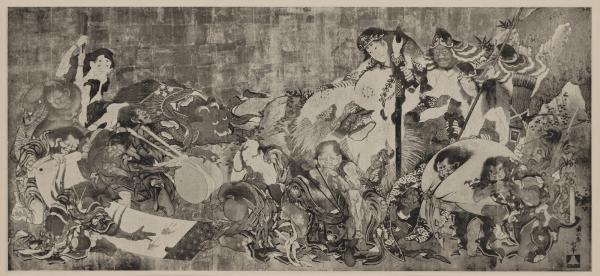
Hokusai’s Susanoo painting was dedicated at Ushijima Shrine as an image concerned with protection. Its devotional role differs from commercial prints and private commissions. After the original burned, a monochrome reproduction preserved evidence of the lost local offering.
Read in contextRecovery preserves uncertainty as well as appearance
The shrine painting’s reconstructed colors were tested against photographic and comparative evidence, yielding an estimated result rather than a uniquely proven palette. Returning an original scroll and constructing this new interpretation were different acts, both helping a changed district examine its past.
Read in context
Opening
The timberyard appears to be selling the wrong stock. Among the markings on its wooden frame are references to Nishimura, the publisher of Hokusai’s Thirty-six Views of Mount Fuji, and to a new edition of the series itself. The lettering belongs inside the picture, where a viewer might expect an ordinary merchant’s name. A scene of men working with lumber has become an advertisement for the print in the viewer’s hands.[1]
Hokusai’s Tatekawa in Honjō, produced in the early 1830s, locates this joke in the eastern part of Edo, the city later renamed Tokyo. It is close to the neighborhood traditionally identified with his birth. Yet knowing that he belonged to the district does not turn the picture into an inventory of a real business. Its local setting and its commercial invention work together.
That combination offers a way into the Hokusai historic area around Ryōgoku and Kamezawa. The district supplied places to depict, people who commissioned pictures, and places where pictures were used. Following those connections reveals more than a collection of views. It shows how an inhabited city became material for art—and how the art later helped a changed city recover parts of its past.
1. Begin with a waterway, not a studio
Hokusai was born in 1760 near Honjo Wari-gesui, according to the Sumida Hokusai Museum’s account. The name refers to a drainage channel that once ran through the neighborhood. The channel has been filled, and the street associated with its course is now Hokusai-dori. No surviving birth house supplies a room in which to stage the beginning of his career.[2]
The lost waterway is a better starting point than an imagined studio. It places the artist within an urban arrangement that has to be recovered through names, records, and images. His connection is to a vicinity and a changing set of addresses, not to a single building preserved around his possessions.
The Tatekawa canal belonged to this wider watery geography. It linked the Sumida and Nakagawa rivers, and lumberyards stood beside it. Hokusai’s print took its title from that local setting.[3] Canal and business help explain one another: a yard beside a water route occupied a position through which bulky material could move. The print makes the wood conspicuous, but its location gives that wood an urban context.
For the modern reader, two recoveries are therefore necessary. One concerns the physical arrangement of canals and streets. The other concerns the activities that made a location useful. A street name can preserve a memory of water without preserving the traffic once carried upon it. A picture can preserve an idea of work without documenting a particular day’s deliveries.
Sumida’s historical map makes this layered approach explicit. It places modern streets and Hokusai-related sites alongside an Edo map, using separate symbols for places connected with his life and places he depicted.[4] The categories are worth keeping apart. Painting a view establishes one kind of relationship; living nearby establishes another. Neither, by itself, locates the precise spot where a design was drawn.
2. What the planks are doing
In Tatekawa in Honjō, timber occupies the foreground while Fuji appears beyond it. Upright boards and sloping pieces divide the view; men saw and move the material. The familiar mountain remains recognizable, but ordinary work determines how it can be seen. The Sumida and Shimane museum descriptions both emphasize the lumberyard and its arrangement rather than treating the foreground as disposable scenery.[3][5]
This is a consequential choice for a series named after a mountain. The viewer has to look through a place where people are doing something else. The men’s attention is directed toward their tasks. Fuji belongs to the picture without becoming the object of everybody’s attention inside it.
The boards serve several purposes at once. They identify the business, give the workers something to handle, and supply strong lines against the distant mountain. The design makes labor visible through relationships among bodies, tools, and material. It offers no names or wages for these men, but neither does it reduce them to interchangeable figures placed beside a landmark. Their depicted actions help organize the composition.
Then the lettering introduces another activity. The markings refer to the publisher Nishimuraya Yohachi, whose publishing name was Eijudō. They also give the Bakurochō address associated with the business and play on the idea of stock for the Thirty-six Views.[1][6] A person reading the signs can move from the represented timberyard to the business responsible for issuing the picture.
The address is especially revealing. It should not be used to relocate the depicted yard to the publisher’s premises, or to give the publisher a timber business. Hokusai has made the appearance of a commercial marking carry another commercial message. The picture joins two kinds of stock through a visual joke.
That joke also changes what it means to use the print as local evidence. The yard remains a credible subject in this canal district. Its commercial wording, however, includes a deliberately inserted reference to the picture’s own production. The invention is part of the historical information: an artist could use the recognizable surfaces of a working neighborhood to communicate with the buyers of his work.
There is no need to choose between an accurate view and a clever image as though only one could matter. The local activity gives the design something specific to transform. Its transformation explains why merely locating the mountain’s sightline would leave much of the picture unread.
3. A river journey made in a Honjo house
A different relationship between district and picture appears in Hokusai’s Scroll of Scenery along Both Banks of the Sumida River. Dated 1805, it is a painting extending more than seven meters, rather than a sheet issued as part of a print series. Its ending carries writing by Utei Enba, a comic writer whose involvement is recorded in the dated inscription.[7]
The museum identifies Enba as the commissioner and states that Hokusai painted the work at Enba’s home in Aioichō, within the area now covered by parts of Ryōgoku and Midori. The neighborhood supplied a working address as well as a subject.[8]
This is a firmer local connection than an attractive guess about where Hokusai must have stood. It joins a named commissioner, a documented place of production, and a surviving object. Enba also contributed words to the finished work. The commission thus produced a combination of painting and literary participation, not simply a view delivered to an unnamed customer.
The scroll’s geographical sequence follows the route toward Yoshiwara, Edo’s licensed pleasure quarter. It moves from the river around Yanagibashi toward the San’yabori canal, then through the approach along the Nihonzutsumi embankment, into the quarter and eventually an interior.[8] The river is one stage of an excursion, not the entire subject enclosed within a panoramic view.
A handscroll gives such a sequence a particular form. Its great length is encountered by revealing one section after another. A reader need not imagine seeing the whole seven meters from a single fixed point. The change from riverbanks to approach, district, and room can unfold as a succession of settings.
The final interior, reproduced in the museum’s opening-exhibition material, brings figures into a furnished space divided by screens and architectural boundaries.[9] After the extended outdoor passage, the movement inward gives the sequence a destination. Hokusai has organized the city as something to pass through, ending in a kind of access that a distant view of the river could not provide.
The depicted excursion should still remain a depicted excursion. The scroll is not a passenger list establishing that Enba and Hokusai made this exact trip together. Nor does a painted gathering identify the private experience of every figure in the room. What the surviving object establishes is the itinerary chosen for representation and the local collaboration that made it.
Read beside the timberyard, the scroll gives the Sumida another role. Water can belong to the working geography around a lumber business; it can also carry the first part of an imagined journey to entertainment. The difference comes from what a picture selects and how it arranges the selection.
Here, the commissioner’s house in Honjo matters even though much of the represented route lies beyond it. A neighborhood room became a place for assembling a much larger stretch of the city into a painting. The resulting work could leave that room without losing the evidence of the relationship through which it had been made.
4. A picture the neighborhood received
In 1845, Hokusai made a large painting for dedication at Ushijima Shrine. Its subject was Susanoo, a kami—a deity in Japanese religious worship—bringing disease spirits under control. Instead of a recognizable view of the shrine or its surroundings, it offered a scene of supernatural authority.[10]
The surviving monochrome image shows the deity and attendants set against a crowded group of strange figures. The museum’s explanation identifies the action as obtaining written promises that the spirits will cease doing harm.[10][11] The confrontation is resolved through an undertaking recorded in writing. The disruptive figures are made answerable to an authority within the painting.
For local history, the important geographical connection is the destination of the object. Hokusai did not have to paint a street in order to make something that belonged to the district’s life. A religious offering placed his work in a shrine, where the subject of protection could be encountered within worship.
This use differs from both the publisher’s printed series and Enba’s commission. The timberyard put an issuing business into the design. The river scroll joined a private commission to a literary contribution. The large shrine painting was made for dedication, with a subject concerned with averting harm. Its value cannot be described adequately by calling it another product in the same market.
Nor does recognizing its devotional role require a claim that it prevented disease. The historical action is the making and dedication of an image of protection. That action locates Hokusai’s work among the things people entrusted to a religious place.
The original painting burned in the Great Kantō Earthquake of 1923. A black-and-white reproduction published before the disaster preserved its appearance in another medium.[11] Much later, that substitute would become central to the museum’s effort to recover this local connection. The object’s relationship with Sumida continued through a record of something no longer there.
5. Working backward from black and white
For the museum’s opening, a reconstruction project asked how far the lost painting could be recovered from its surviving image. The available evidence included a monochrome collotype published in Kokka in May 1910. Toppan, which participated in the reconstruction, describes a method that compared surviving paintings with their contemporary photographic reproductions to investigate how colors had become shades of gray.[12]
The team used those inferred photographic conditions to test its proposed reconstruction against the old image. It also studied Hokusai’s late color manual and comparable paintings. Digital work allowed repeated adjustments; selected surface effects received hand finishing. The result, completed for the museum in 2016, was explicitly an estimated reconstruction.[12]
The problem was not simply that an old photograph lacked attractive color. It had preserved some information while changing the form in which that information could be read. A dark area could show the position of a shape clearly without identifying the pigment once used there. Recovering an outline and choosing a color therefore demanded different evidence.
The project’s comparison provides a way to test a proposal: would the proposed colored image produce something compatible with the surviving monochrome record under the inferred conditions? Compatibility is useful. It does not, by itself, establish that only one original palette could have produced the record. The term “estimated” preserves that difference.
This gives the reconstruction a historical interest of its own. A visitor can encounter the scale and subject of a lost local offering, while the research record explains how its renewed appearance was assembled. The reproduced picture carries knowledge and uncertainty together; concealing the latter would misdescribe what the researchers achieved.
The old photograph also acquired a purpose its makers could not have relied upon at the time. Once the original burned, the printed image became evidence for an object that could no longer be examined directly. A reproduction prepared while a painting existed entered a later attempt to understand its absence.
6. Returning pictures to a changed district
The river scroll followed a different route. It survived as an original painting, passed through the collection of the art dealer Hayashi Tadamasa, and spent a long period abroad. Sumida acquired it in 2015. Its return became a central subject of the museum’s opening exhibition in 2016.[8][9]
Acquiring that object and reconstructing the shrine painting were different acts. One returned surviving material to the district in which it had been made. The other created a new object from records and comparative evidence. Placing them within one institution made both available for interpretation without making them equally original.
The museum itself occupies another historical layer. Designed by Sejima Kazuyo, it stands on land associated with the Edo residence of the Tsugaru lords of Hirosaki, not on a preserved Hokusai studio. Its contemporary architecture gives the institution passages opening toward the neighborhood while protecting the galleries within.[13] It establishes a place to study the local artist rather than pretending that his own house has been recovered.
Beyond the building, municipal interpretation reconnects images with named locations. Sumida’s register includes a board for Tatekawa in Honjō at Ryōgoku and distinguishes it from other places associated with Hokusai.[14] Such a board supplies a meeting point between a modern street and a historical representation. It cannot restore the missing canal or promise that the street will reproduce the view on the print.
The resulting historic area is necessarily dispersed. Birth vicinity, commissioner’s house, depicted workplace, and shrine destination describe different kinds of place. Their connections become intelligible through pictures and records rather than through a continuous row of original buildings.
Hokusai’s district is most revealing when those differences remain visible. The lumberyard supplied a working scene that could also advertise a publisher. Enba’s house supplied the setting for a painting that led its reader along the river and into another part of the city. Ushijima received an image concerned with protection. Each relationship gave art a particular use within urban life.
The pictures have since acquired another use: helping Sumida explain itself. They do this most effectively when read as things made for particular purposes, rather than as windows through which the entire old city remains intact. The lettering on the timberyard is a good place to begin. Even where Hokusai seems to be showing what stood before him, the picture is already doing work of its own.
Next topic · HO Guides
Bashō in Fukagawa: The Company a Hermit Kept
Frog poems, departing letters, and a transplanted banana reveal a retreat sustained by relationships—and a writer who sometimes needed to close its gate.
Continue readingSources and NotesView sourcesHide sources
Web sources were consulted on 16 September 2026. Artwork descriptions distinguish the represented scene from an independently documented event. No current exhibition, original-object display, or visitor-access schedule is promised.
- [1]
Metropolitan Museum of Art, Tatekawa in Honjō (Honjō Tatekawa), collection record JP2982, ca. 1830–32, curatorial description and object metadata. The description identifies the publisher’s name, address, and references to stock and the series within the picture. https://www.metmuseum.org/art/collection/search/56386 . The inscriptions are used through the museum’s reading, not as proof of an actual Nishimura lumberyard.
Return to the reference ↑ - [2]
Sumida Hokusai Museum, “ゆかりの地MAP,” entries “本所割下水・北斎通り” and the neighborhood overview. https://hokusai-museum.jp/modules/Page/pages/view/403?lang=ja . Used for the 1760 birth vicinity and filled canal beneath the modern street relationship. The account does not establish an exact surviving household parcel; no precise filling or street-naming year is required here.
Return to the reference ↑ - [3]
Shimane Art Museum, “冨嶽三十六景 本所立川,” complete catalogue explanation. https://shimane-art-museum-ukiyoe.jp/shimane/c-shimane/h05.html . Supports the canal’s connection between the Sumida and Nakagawa, the lumberyard subject, and the composition’s vertical and diagonal timber. The essay’s explanation of the relationship between transport position and bulky material is an inference, not a recovered delivery record.
Return to the reference ↑ - [4]
Sumida City, 北斎ゆかりの地マップ, November 2016, both sides, especially the modern/Edo map comparison and its separate life/depiction categories. https://hokusai-museum.jp/modules/xelfinder/index.php/view/259/北斎ゆかりの地マップ_1107.pdf . The older map reproduced there is identified as an 1843 Edo map. No measured equivalence of its boundaries with a modern cadastral survey is asserted.
Return to the reference ↑ - [5]
Sumida Hokusai Museum, “冨嶽三十六景 本所立川,” complete object explanation, ca. 1831. https://hokusai-museum.jp/modules/Collection/collections/view/1010?lang=ja . Broad composition was also checked against a displayed image of the Adachi Institute’s modern woodblock reproduction, https://store.adachi-hanga.com/en/products/uk_hokusai032 . That reproduction is not an Edo impression. Original museum image downloads were unavailable; no conclusion about original pigments, condition, or edition-specific color depends on it. Descriptions of the represented work and lettering rely on the museum catalogues in notes 1, 3, 5, and 6.
Return to the reference ↑ - [6]
MOA Museum of Art, “北斎 冨嶽三十六景 Digital Remix 作品解説,” gallery 5, entry “76 本所立川.” https://www.moaart.or.jp/kaisetsu_gallery5/ . The selected entry identifies the inscribed Bakurochō address, Eijudō stock, and reference to the new Thirty-six Views. It supports reading the signs as publisher references, not identifying the owner of a photographed business.
Return to the reference ↑ - [7]
Tokyo National Research Institute for Cultural Properties, dated-artwork database, record 11554, “隅田川両岸景色図巻,” 1805; dimensions 28.5 × 716 cm; attribution to Hokusai with Enba’s inscription and transcription of its dated closing. https://www.tobunken.go.jp/materials/nenki/2063651.html . The 2016 exhibition catalogue cited by the database was not separately read.
Return to the reference ↑ - [8]
Sumida Hokusai Museum, “隅田川両岸景色図巻,” complete collection description. https://hokusai-museum.jp/modules/Collection/collections/view/195?lang=ja . Used for Enba’s commission, production at his Aioichō home, the geographical sequence, and the Hayashi/overseas provenance. The account does not identify a documented joint excursion by artist and commissioner. The discussion of sequence is a reading of the work’s recorded arrangement, not a claim to have inspected the entire original scroll.
Return to the reference ↑ - [9]
Sumida Hokusai Museum, opening-exhibition press release, September 23, 2016, 北斎の帰還―幻の絵巻と名品コレクション―, PDF pp. 3–4; p. 4, including the reproduced final interior of the scroll. https://hokusai-museum.jp/kikan/ . Supports acquisition in 2015 and the 2016 opening exhibition. Interior remarks describe the reproduced painting, not a verified meeting or individual identities. The exhibition is historical, not a current listing.
Return to the reference ↑ - [10]
Sumida Hokusai Museum, “キッズ北斎,” entry on 須佐之男命厄神退治之図. https://hokusai-museum.jp/modules/Page/pages/view/2148?lang=ja . See the explanation of the deity obtaining the spirits’ written undertaking. See also Sumida City, すみだと北斎 (August 2011), second side, “幻の大作/牛嶋神社,” for the 1845 dedication and 1923 destruction: https://hokusai-museum.jp/modules/xelfinder/index.php/view/257/すみだと北斎.pdf . The essay does not infer medical efficacy or Hokusai’s unrecorded private motives.
Return to the reference ↑ - [11]
Monochrome reproduction of Hokusai’s shrine painting in Kokka 240 (May 1910), as reproduced by Toppan: https://www.holdings.toppan.com/library/oldnews/4395/web2.jpg . It establishes the reproduced composition; the journal issue itself was not read in full. The date and reproductive medium are documented in the project account in note 12.
Return to the reference ↑ - [12]
Toppan Printing, “凸版印刷、北斎幻の大絵馬を推定復元,” November 17, 2016, historical description and sections “写真科学的調査,” “人文的調査,” and “原寸大彩色複製の制作.” https://www.holdings.toppan.com/ja/news/2016/11/newsrelease161117.html . This is a participant’s account of the method, not independent validation of a uniquely correct palette. The essay’s distinction between compatibility and uniqueness is an evidential inference, not the company’s quoted verdict.
Return to the reference ↑ - [13]
Sumida Hokusai Museum, “Architecture,” passages on Sejima’s design, neighborhood-facing passages, protected galleries, and the former Tsugaru residence site. https://hokusai-museum.jp/modules/Page/pages/view/605 . The design’s intended relationship to its surroundings is not treated as an independently measured social outcome. The source’s anecdotal attribution of a different Hokusai commission to the Tsugaru family is not used.
Return to the reference ↑ - [14]
Sumida City, “高札・案内板一覧,” table “北斎案内板,” entry “本所立川 冨嶽三十六景” at Ryōgoku 4-1, on the page updated September 3, 2026. https://www.city.sumida.lg.jp/bunka_kanko/annnai/kankou/kousatu-annnaibann.html . Used to identify the municipal interpretive relationship with Ryōgoku, not to guarantee that a sign remains unobstructed on a particular visit.
Return to the reference ↑