Map: GSI Japan Sumida connects Katsushika Hokusai to the eastern Edo neighborhoods in which he was born and spent most of his life. It is not an intact artist's quarter: the house traditionally associated with his birth has gone, waterways and streets have changed, and modern reconstruction followed fires, earthquakes, and war. The historical value lies in reading those changes together. Municipal interpretive boards identify places that entered Hokusai's work or biography, Hokusai-dori preserves the course and name-memory of the former Wari-gesui canal, and the Sumida Hokusai Museum gives the district a contemporary center for research and display. The area makes artistic production part of ordinary urban history rather than separating Hokusai from the city that supplied his subjects.
A birth vicinity without a surviving house
Attraction
Sumida City places Katsushika Hokusai's birth in 1760 near Honjo Wari-gesui, usually described more specifically as the vicinity of Honjo Minami Wari-gesui. No birth house, studio, or securely bounded household parcel survives for inspection. The useful object is therefore the neighborhood relationship, not a reconstructed room: this eastern Edo environment remained central to Hokusai for most of his life even as he changed residences repeatedly. Modern interpretation should identify the traditional vicinity while keeping the missing building and uncertain exact footprint explicit.
Current visibility
The modern neighborhood can be identified, but no securely located or surviving Hokusai birth house is visible.
Wari-gesui beneath Hokusai-dori
Attraction
Hokusai-dori follows the memory of Wari-gesui, a drainage canal that once structured movement and addresses through this part of Honjo. Sumida's account explains that the canal was filled after the 1923 Great Kantō Earthquake and that the rebuilt street received its present Hokusai-dori name in 1999. The road is not an Edo canal preserved in stone. It is a modern urban layer whose alignment and naming let a lost waterway, disaster reconstruction, and Hokusai commemoration be read together rather than mistaken for one period.
Current visibility
The street is visible, but the canal was filled; the present name and streetscape are modern commemorative and reconstruction layers.
Sixteen markers across a changed city
Attraction
Sumida City has installed sixteen interpretive boards at places connected with Hokusai's life or work. Together they treat the ward itself as a distributed historical source: bridges, shrines, river edges, former residences, and depicted scenes connect an artist's biography to the city's working geography. The boards are modern interpretation, and the urban views around them have changed substantially since Hokusai's lifetime. Their value is not to promise a frozen print view but to help compare a documented association, a reproduced image, and the present city at the same location.
Current visibility
The municipal boards and their modern settings are generally visible outdoors, although individual conditions can change.
A contemporary museum on a different historical site
Attraction
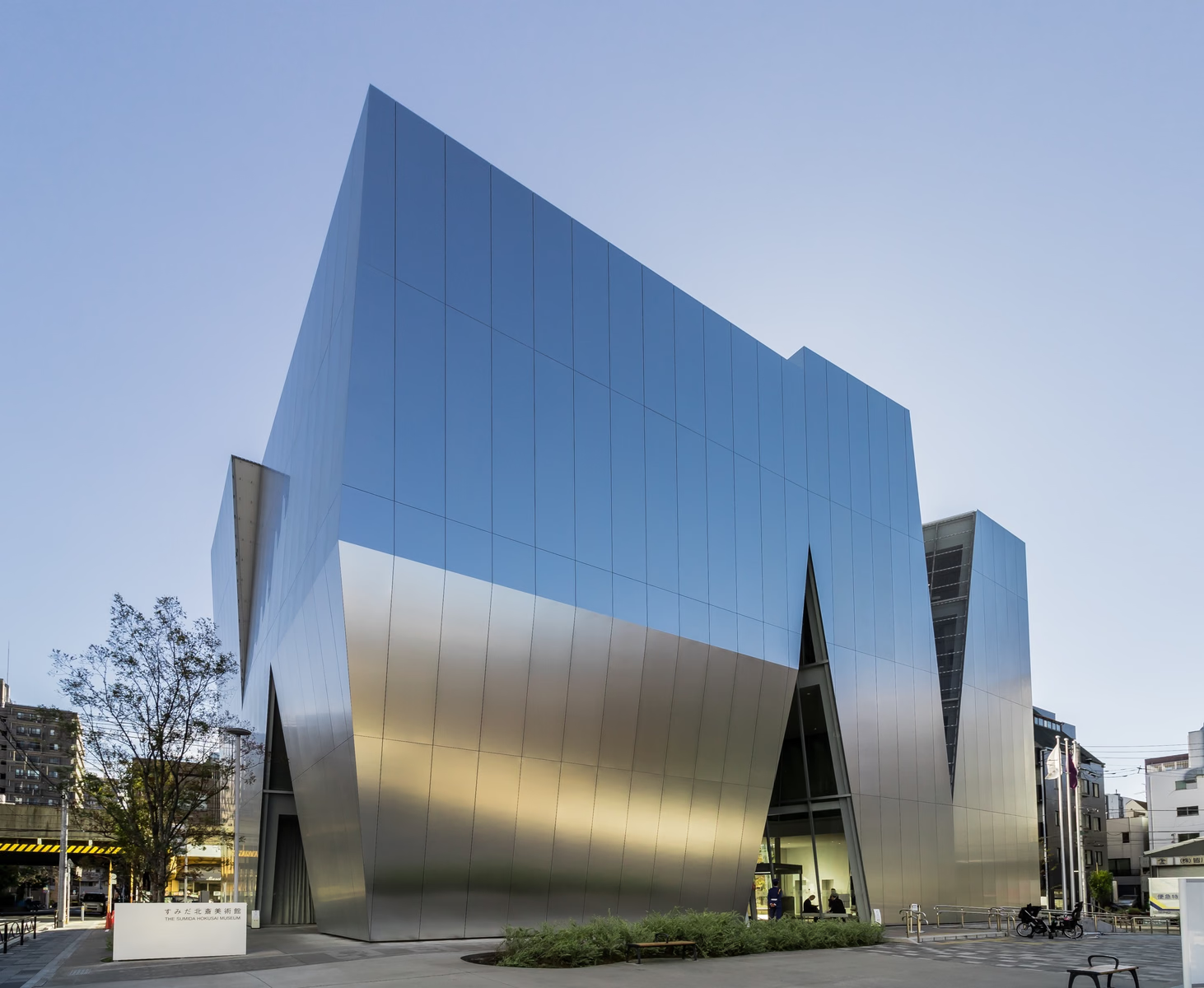
The Sumida Hokusai Museum opened in 2016 in a sharply folded metal building designed by Sejima Kazuyo. Its site had belonged to an Edo-period residence of the Tsugaru lords, giving the plot a history distinct from Hokusai's homes. The museum should therefore not be labeled his surviving studio or birthplace. It is a twenty-first-century institution placed within his wider home district, where architecture, local research, reproductions, and changing exhibitions create a new public center for studying Katsushika Hokusai and the city around him.
Current visibility
The modern museum exterior is visible; admission, galleries, temporary exhibitions, and closures require a current official check.
Research, replicas, and changing displays
Attraction
The museum's historical importance lies less in claiming one permanent set of originals than in making Sumida a continuing research base. Its stated program combines scholarship on Hokusai, local cultural history, collection care, temporary exhibitions, and high-quality reproductions that explain works not always available for display. Prints and books are light-sensitive, loans rotate, and gallery arrangements change. Readers should treat a particular object list as time-sensitive, while the stable experience is the institution's method: connecting Katsushika Hokusai's production, reception, and home district through evidence and interpretation.
Current visibility
The institution is active, but original works, reproductions, gallery content, admission, and temporary closures vary and must be checked officially.