Read the article below. Interactive reading tools are available when scripts load.
Quick
Kazunomiya was born in Kyoto on 3 July 1846, after the death of her father, Emperor Ninkō. Her mother, Hashimoto Tsuneko, later called Kangyōin, raised her within the maternal Hashimoto household. Her older half-brother became Emperor Kōmei. [1][7]
In 1851 the court betrothed her to Prince Arisugawa Taruhito. His house was a collateral branch of the imperial family. The agreement promised a future within familiar Kyoto relationships, although the wedding would wait while she grew. Later accounts portray a lost romance; the engagement is firmer evidence than the pair’s private affection. National policy would eventually overturn this family plan and send Kazunomiya to Edo, the seat of the shogun, head of Japan’s warrior government. [1][7][10]
In 1858 the warrior government signed foreign commercial treaties without imperial approval. Emperor Kōmei opposed the opening. Ii Naosuke, its great elder, punished opponents in the Ansei Purge and was assassinated in 1860. [11][12]
Senior councillors Andō Nobumasa and Kuze Hirochika then pressed a marriage between Kazunomiya and Tokugawa Iemochi, the fourteenth shogun. Kōbu gattai meant court–shogunate cooperation: family ties were meant to repair their governments’ relationship. Kōmei initially refused; Kazunomiya resisted abandoning Taruhito and Kyoto. Negotiations dissolved that betrothal while protecting her rank, attendants and court customs. Kōmei accepted a foreign-policy pledge whose wording and timetable developed across documents. Permission came in the tenth Japanese calendar month of 1860. The marriage would proceed before the disagreement over treaties was resolved. [1][2][6][10][12]
In the fourth Japanese calendar month of 1861, Kōmei formally declared Kazunomiya a naishinnō, or imperial princess, and gave her the personal name Chikako. Kazunomiya remained her familiar designation. The formal name and rank would accompany her into the Tokugawa household. [2]
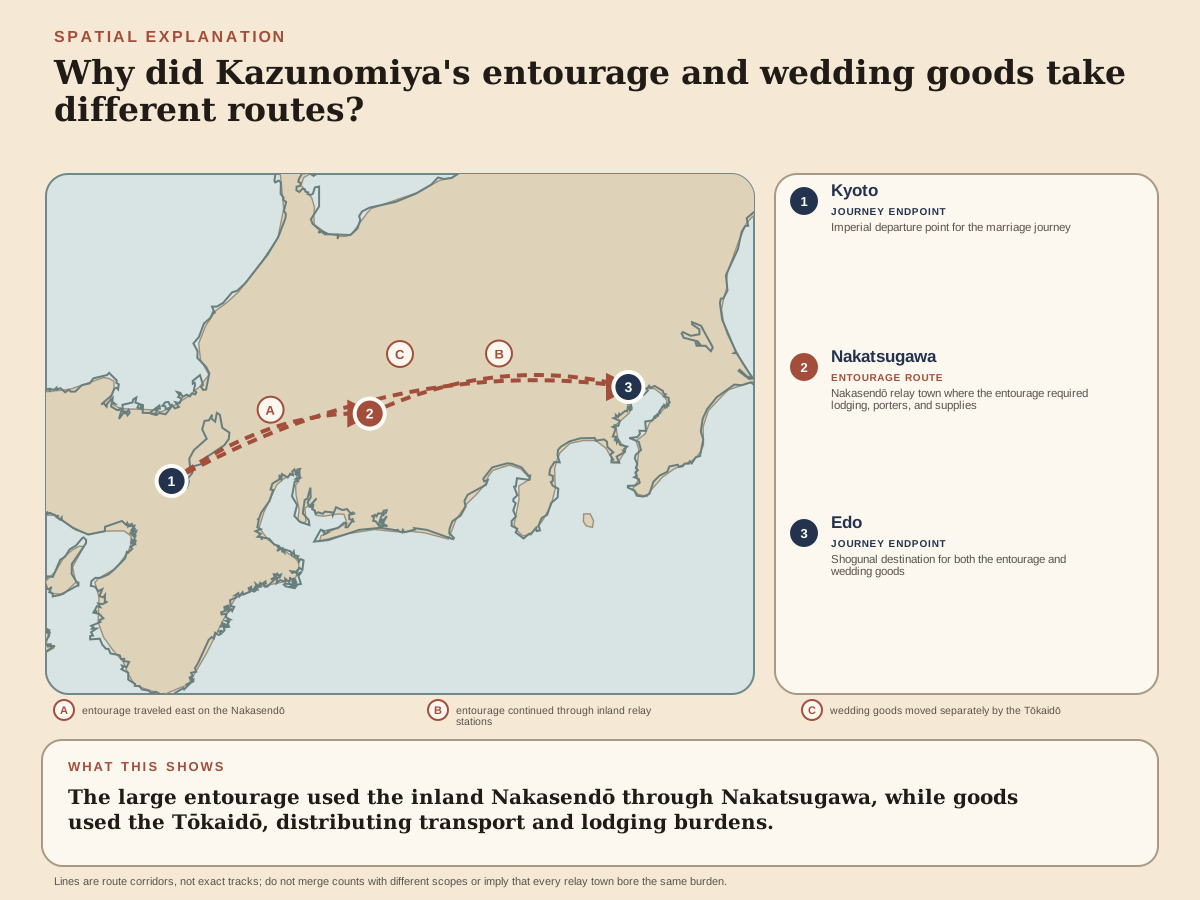
Kangyōin prepared to travel with her. Niwata Tsuguko, a senior court woman, would advise her and keep records. Keeping Kyoto practices required attendants who knew them. Officials arranged lodgings, furnishings and entry into Edo Castle, with an initial stay at the Shimizu Tokugawa residence. Imperial emblems and the Tokugawa hollyhock appeared on marriage goods. Those goods traveled separately along the coastal Tōkaidō; the princess’s party would take the inland Nakasendō. The transfer required several coordinated movements. [2][6][10]
Kazunomiya left Kyoto on the twentieth day of the tenth month of 1861 and reached Edo on the fifteenth day of the eleventh month, in the Japanese calendar. The twenty-five-day journey followed the Nakasendō for roughly 544 kilometers. [6][8][9]
Post towns supplied lodging and relays. Nearby villages furnished sukegō, compulsory transport labor. At Nakatsugawa, porters spent a rainy night in roofless enclosures, with sickness and distress recorded. The elite journey imposed costs on communities outside the marriage negotiations. [6][8]
Participation estimates differ: Honjō’s reconstruction gives about ten thousand including security, while Nakatsugawa’s account gives eighteen thousand for the main procession there. Guards changed along the route, so these are not a secure count of one continuous traveling column. The party entered Edo with its Kyoto attendants still beside the princess. [6][8]
Kazunomiya first stayed at the Shimizu residence, then entered Edo Castle in the twelfth Japanese calendar month of 1861. Her attendants joined the Ōoku, the castle’s women’s residential and service quarters. Tenshōin, widow of the preceding shogun Iesada, held senior household authority; Iemochi’s birth mother Jitsujōin occupied a different position. [2][4][10]
The wedding took place on the eleventh day of the second month of 1862 in the Japanese calendar, not Gregorian 11 February. Both spouses were fifteen in completed years and seventeen by traditional counting. An Edo notice then authorized calling Kazunomiya midaidokoro, the shogun’s principal wife. She retained imperial status and Kyoto practices. The staffs had to accommodate these different ranks in daily ceremony while Kōmei expected Iemochi to fulfill the foreign-policy pledge. [1][2][7][10]
Kazunomiya and Iemochi were married for just over four years. His journeys west separated them, making letters and gifts important. Waka, classical poems of thirty-one Japanese sound units, provided a shared form of attention. [2][10]
Kazunomiya requested prayers at Hikawa Shrine and prayed before the Black Amida, a Buddha image at the Tokugawa-associated temple Zōjōji. Attendants and priests carried out these observances. Surviving exchanges support considerate conduct within the marriage, without proving that its coerced beginning had become a freely chosen one. [1][2][10][14]
The couple had no child. Meanwhile Kōmei continued demanding expulsion of foreigners, and the shogunate had treaties and foreign naval power to manage. Concern for Iemochi could sustain their relationship; it could not settle the political disagreement between her brother and husband.
Iemochi visited Kyoto in 1863, the first shogun to do so since 1634. He went west again in 1864 and departed Edo in 1865, eventually remaining at Osaka. Kazunomiya stayed behind. [11]
The Ōoku still required provisions, service and ceremonies. Kazunomiya and Tenshōin both helped sustain the main household while lower-ranking women performed much of its daily work. Their cooperation grew alongside differences over precedence. [4][10]
Messages brought news from Kyoto and Osaka. Kazunomiya could arrange prayers and communicate concern, but she did not direct treaty negotiations or military campaigns. Fighting in Kyoto and expeditions against Chōshū, a domain in western Honshu, kept Iemochi away. His 1865 departure became their last separation. In Edo, her household would receive the consequences of decisions made at the western headquarters. [10][11]
Iemochi died at Osaka in the seventh Japanese calendar month of 1866. Kazunomiya was in Edo. Niwata Tsuguko’s records preserve her participation in mourning and funeral arrangements. [1][4][7][14]
Kitagami Mao’s 2009 study examines entries of the twenty-fourth and twenty-sixth days of that month. Tenshōin proposed the child Tayasu Kamenosuke, invoking an instruction attributed to Iemochi. Kazunomiya questioned a child’s ability to govern and the need for a capable guardian, then accepted Tenshōin’s unchanged position. These household discussions are not two independently verified deathbed wills. [4][13]
Yoshinobu became fifteenth shogun in 1866. Kamenosuke later became Tokugawa Iesato and inherited the family, not the abolished shogunal office, in 1868. Kazunomiya took Buddhist tonsure as Seikan’in. Kōmei died in January 1867; the new emperor, Meiji, was her nephew. [4][7][13]
In 1867 Yoshinobu returned governing authority to the emperor. A later court coup abolished the shogunate. Seikan’in remained in Edo Castle while officials disputed the Tokugawa house’s future. [11][13]
Fighting near Toba and Fushimi in January 1868 turned the dispute into war. Satsuma, a domain in southern Kyushu, and Chōshū supplied forces fighting on the new government’s side. Imperial banners allowed them to classify Tokugawa forces as enemies of the court. Yoshinobu withdrew to Edo. [11][13]
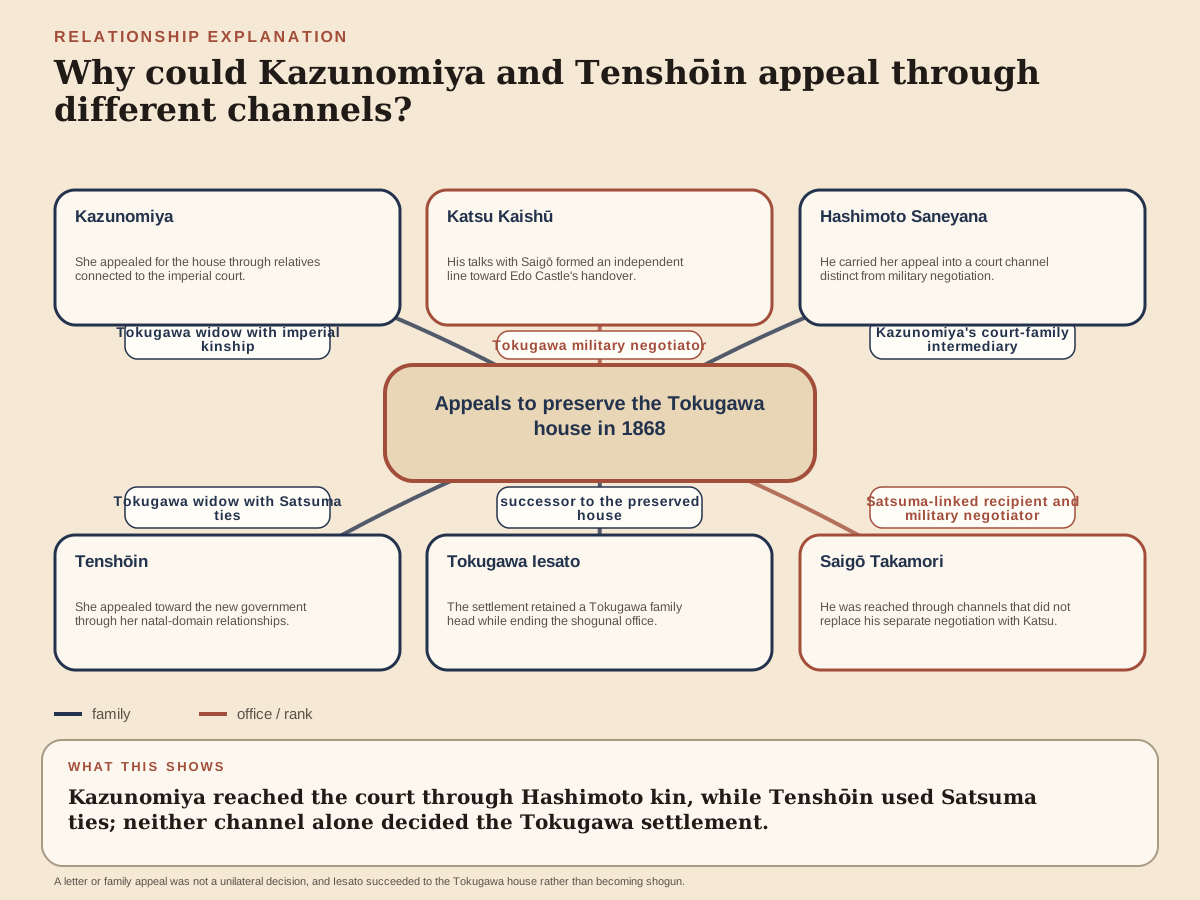
Seikan’in was Meiji’s aunt and Iemochi’s widow. Destruction of the Tokugawa house threatened the people attached to her late husband’s family. She could appeal through court relatives; Tenshōin had separate Satsuma connections. Both sought mercy as the new government’s army advanced toward Edo. [1][11]
A surviving letter dated the twentieth day of the first Japanese calendar month of 1868 shows Seikan’in appealing to Hashimoto Saneyana, a court relative involved in the eastern advance. She asked to clear the Tokugawa house’s enemy stigma and offered to stake her life on that plea. Other appeals passed through relatives and attendants. Tenshōin sought mercy through her own connections. [3][5][11]
Katsu Kaishū represented the Tokugawa side in military negotiations with Saigō Takamori of the new government’s army. They arranged matters that petitions alone could not settle. [3][5][11]
Edo Castle was handed over in the fourth month without the planned assault. Yoshinobu was spared. Iesato, formerly Kamenosuke, inherited a reduced Tokugawa house at Sunpu, present-day Shizuoka. Seikan’in’s advocacy helped seek preservation; military negotiation and government decisions established the settlement. [3][11][13]
Seikan’in left Edo Castle with Iemochi’s mother Jitsujōin on the ninth day of the fourth Japanese calendar month of 1868, two days before its handover. They moved to the Shimizu residence. She delayed returning to Kyoto until the Tokugawa transfer to Sunpu had progressed. [3]
In 1869 she moved to Kyoto and lived there for about five years. Her diaries record worship, social visits and recreation, including autumn leaves around Arashiyama. Imperial institutions funded and supervised the household while former Tokugawa personnel remained in reorganized service. [3][7]
She sought a residence for Tenshōin, received vaccination and gained second court rank in 1873. In July 1874 she returned to Tokyo. Imperial relatives, the surviving Tokugawa family and Iemochi’s grave were now among her relationships in the eastern capital. [3][7]
From 1874 Seikan’in lived in Azabu, Tokyo. She visited Iesato and Zōjōji, maintained relations with Tenshōin and participated in imperial society. She contributed a poem to a court gathering in 1875; Meiji and Empress Shōken visited her residence. [2][3][9]
In August 1877 she went to Tōnosawa in Hakone for treatment. She stayed at Motoyu, later called Kansuirō. Accounts identify beriberi, associated with vitamin B1 deficiency, and a fatal cardiac crisis. She died on 2 September, aged thirty-one. [1][3]
Imperial officials administered much of the funeral; Matsudaira Kakudō represented the Tokugawa family because Iesato was in Britain. She was buried beside Iemochi. A 1878 inventory counted 178 titles in 1,361 volumes. Some books entered the imperial collection in 1879–1880; much of the library’s destination remains uncertain. [3][14]
Classic
Kazunomiya was born in Kyoto on the tenth day of the intercalary fifth month of Kōka 3, corresponding to 3 July 1846. She was Emperor Ninkō’s eighth daughter. He had died earlier that year. Her mother, the court woman Hashimoto Tsuneko, later known as Kangyōin, raised her through the maternal Hashimoto household. [1][7]
The residence associated with her maternal grandfather Hashimoto Sanehisa placed her among the noble houses serving the imperial court. Her older half-brother became Emperor Kōmei and gave her the childhood name Kazunomiya. The same sovereign relative would later authorize decisions about her marriage. [1][7]
Imperial rank brought a household of attendants who knew court practice. Her mother and other women managed access and correspondence as well as daily care. Clothing and formal encounters followed expectations inherited from the court. Protection and connections did not give the child an independent choice over the family’s plans for her. [1][7]
In 1851 she was betrothed to Prince Arisugawa Taruhito. The Arisugawa house was a miyake, one of the imperial family’s collateral princely households. Taruhito was substantially older. The wedding could wait while Kazunomiya grew, but the agreement already gave both households an expected future. [1][7]
That future lay in Kyoto. A marriage within the imperial network would allow more familiar forms of service and easier access to maternal relatives. Attendants could prepare for a life that did not require moving into a distant warrior household. The distinction would supply concrete grounds for objection when another marriage was proposed. [1][7]
Later accounts portray Taruhito as a lost beloved. The betrothal and its dissolution are better documented than the precise nature of the pair’s childhood affection. Ending it still meant giving up a recognized commitment. The prince’s house also had a stake in the release from an arrangement that the court had authorized. [1][7][10]
Kōmei’s roles as brother and emperor could support the same decision until national policy demanded something different. The family had initially planned a marriage within its own Kyoto relationships. Nothing in the child’s first betrothal made becoming the wife of the shogun, head of Japan’s warrior government, in Edo an inevitable next step.
In 1858 the shogunate, Japan’s warrior government, signed commercial treaties without prior imperial approval. Emperor Kōmei opposed the foreign opening. Ii Naosuke, its tairō or great elder, enforced policy and punished opponents in the Ansei Purge of 1858–1859. Hostility deepened, and he was assassinated outside Edo Castle in 1860. [11][12]
The marriage proposal had roots in Naosuke’s late administration. Senior councillors Andō Nobumasa and Kuze Hirochika continued it after his death. Kōbu gattai meant cooperation between the imperial court and warrior government. If Kazunomiya married Tokugawa Iemochi, the fourteenth shogun, kinship might help repair a relationship that official requests and punishment had not stabilized. [12]
The parties wanted different results. Edo sought stronger legitimacy for administering the treaties. Kōmei wanted a return toward maritime exclusion and greater obedience to imperial purposes. Court mediators, including Kujō Hisatada and Iwakura Tomomi, worked through channels whose interests were not identical. A wedding could connect the houses without resolving their foreign-policy disagreement. [6][10]
Kōmei initially refused because his sister was already betrothed. Kazunomiya also resisted the move. She would have to abandon a recognized engagement and leave the court surroundings in which she had been raised. Her position passed through her mother, attendants and relatives. Acting through them was a normal means of making an elite woman’s objections known, although not every negotiated condition can be assigned to her alone. [1][6][10]
The court dissolved the Arisugawa commitment. Continued negotiations protected her rank, Kyoto attendants and court practices within Edo. These provisions gave the princess some continuity with the life she was leaving. They would also require the shogunal household to accommodate a staff whose duties remained tied to imperial service. [2][10]
Kōmei’s consent depended on a foreign-policy pledge. Wording developed across documents and contemplated a reversal of treaty opening, with differing time horizons and possible courses of action. Court activists could hear a binding promise of exclusion where Edo officials saw an objective requiring preparation and negotiation with stronger foreign powers. [6]
Permission was granted on the eighteenth day of the tenth month of 1860, in the Japanese calendar. Kazunomiya’s resistance had helped make the costs and protections explicit, but consent came after the previous alternative had been removed. The two adolescents would live within a political arrangement made largely by adults. [6]
On the nineteenth day of the fourth month of 1861, Kōmei formally declared Kazunomiya a naishinnō, an imperial princess, and gave her the personal name Chikako. The change strengthened the imperial rank with which she would enter the Tokugawa household. Kazunomiya remained her familiar designation; the new name recorded a particular act of court authority. [2]
The emperor’s handwritten grant survives through Hamuro Nagatoshi, an official involved in the transfer. Its preservation connects the naming ceremony to the people who arranged her journey. It is a formal record, not a complete account of the siblings’ feelings about the separation. [2]
Kangyōin would accompany her daughter. Niwata Tsuguko, a senior court woman, became an important adviser and recorder. Her duties joined familiar court service to the practical problems of life in Edo. Keeping Kyoto rituals would require people who knew them, not simply a clause in a marriage agreement. [2][10]
Courtiers and shogunal officers organized the stages of travel and entry into the receiving household. Their work included scheduling lodgings and arranging the people and goods needed after arrival. Kazunomiya would stay first at the Shimizu Tokugawa residence before moving into Edo Castle. That intermediate household gave officials time to complete preparations. [2][10]
Marriage furnishings made the intended union visible. Chrysanthemum and paulownia designs associated with imperial and court usage appeared alongside the Tokugawa hollyhock. Combined emblems could represent cooperation on objects used in daily life while distinct sets preserved different occasions and customs.
People and goods did not follow the same route. Kazunomiya’s procession would take the Nakasendō, the inland post road between Kyoto and Edo. Major marriage goods traveled by the coastal Tōkaidō. Each movement had its own schedule, personnel and requirements. [2][6]
Inventories assigned furnishings to containers and personnel to stages of service. They preserve the scale of preparation more securely than a claim that every object later kept in a collection had traveled beside Kazunomiya. By the time these arrangements were complete, her departure was approaching as a scheduled household transfer.
Kazunomiya’s party left Kyoto on the twentieth day of the tenth month of Bunkyū 1 and reached Edo on the fifteenth day of the eleventh month. The twenty-five-day journey covered about 136 ri, roughly 544 kilometers. A ri was a Japanese measure of distance. These dates belong to the contemporary Japanese calendar. [6][8][9]
The Nakasendō crossed mountain passes and post towns. Political insecurity helped favor the inland road, though the Tōkaidō remained available for the separately transported marriage goods. A road’s suitability depended on what was moving and the precautions required around it. [6][8]
Post stations supplied relays, lodging and provisions. Nearby villages furnished sukegō, compulsory transport service owed to the stations. Farmers and carriers had to leave ordinary work to make the elite journey proceed. Domains took responsibility for security along assigned sections, with guards joining and leaving as jurisdictions changed. [6][8]
At Nakatsugawa, a surviving plan describes roofless enclosures for porters. One was marked for 1,500 people, with room also occupied by their belongings and cooking arrangements. The municipal museum reports rain during the night and records of sick or distressed workers. The protected traveler and the people carrying the procession did not experience the road under comparable conditions.
Estimates of total participation differ. Honjō’s reconstruction gives about ten thousand including security; Nakatsugawa’s account gives eighteen thousand for the main procession passing there. Those figures should not be merged into a precise count of people who traveled together for the entire route. The changing guards and staged movements make a fixed continuous column an unsafe assumption. [6][8]
Illustrated sheets named participants and represented the procession for readers in Edo and Osaka. Public curiosity spread beyond the towns supplying its labor. A princess moving from the imperial capital to the shogunal city made cooperation visible, while every stage also imposed work on communities with no part in negotiating the marriage.
Kangyōin and the court attendants continued beside Kazunomiya as the party entered Edo. The journey’s completion would bring their practices into a household already organized around Tokugawa rank. Reaching the city ended the road passage, not the accommodation between the two houses.
Kazunomiya entered the Shimizu Tokugawa residence on reaching Edo in the eleventh month of 1861. On the eleventh day of the twelfth month she moved into Edo Castle. A diagram preserved in the imperial archives marks the route. Entry was a planned progression into the Ōoku, the castle’s women’s residential and service quarters. [2]
The Ōoku had ranked offices, controlled access and substantial household work. It remained connected to the shogun and external suppliers through documents and provisions. Kazunomiya arrived with Kangyōin, Niwata Tsuguko and other court attendants. Their presence made the promised Kyoto practices something that could be maintained and defended. [2][10]
Tenshōin, widow of the preceding shogun Iesada, held senior authority in the main household. Iemochi’s birth mother Jitsujōin had a different claim through kinship. Kazunomiya brought imperial precedence. A single ranking of wife, mother and widow could not settle how these positions would work together. [4][10]
The wedding took place on the eleventh day of the second month of Bunkyū 2, in 1862. It was not Gregorian 11 February. Both spouses were fifteen in completed years and seventeen by traditional Japanese counting, which starts at one and adds a year at each New Year. [1][2][7][10]
The next day, an Edo town notice authorized calling Kazunomiya midaidokoro, the shogun’s principal wife. The title recognized her place in Tokugawa usage without cancelling Chikako or her imperial status. Different institutions could continue to recognize her through different names. [2][7][10]
Customs governing greetings and dress remained sensitive because they could express the respect owed to the court and warrior house. Niwata’s records represent the Kyoto household’s view of those questions, rather than Kazunomiya’s unmediated private voice. Practical cooperation developed alongside friction. The same staffs still had to arrange ceremonies and communications when their principals differed over precedence. [4][10]
Marriage gave Edo a public connection to the emperor’s family. Kōmei expected his brother-in-law to honor the foreign-policy pledge. The ceremony made the marriage valid immediately; it did not determine how the government would fulfill that expectation. Within the castle, the couple and their attendants now had to build a shared household. [2][10]
Kazunomiya and Iemochi’s marriage lasted just over four years. Letters crossed the distances created by his journeys west. Waka, classical poems of thirty-one Japanese sound units, and gifts offered forms of attention familiar to both court and warrior elites. [2][10]
Hair ornaments and textiles survive in collections associated with the couple. Their dates and provenance help establish exchanges, though preservation also reflects later family and museum choices. A gift might be considerate and ceremonial at once. Its survival cannot supply everything the giver or recipient felt. [2][10]
When Iemochi traveled, Kazunomiya requested prayers at Hikawa Shrine and repeatedly prayed before the Black Amida, an image of the Buddha, at Zōjōji, a temple closely associated with the Tokugawa family. Attendants arranged observance, priests received instructions and messages reported what had been done. Her concern had a practical expression through other people’s work. [10][14]
The exchanges support a relationship of considerate conduct after a marriage she had resisted. Her later care for Iemochi belongs to that married life; it cannot establish how she had felt about abandoning the Arisugawa betrothal. The political failure of the alliance and the couple’s domestic relations followed different courses. [1][10]
The couple had no child. That absence would matter when the shogunal succession reopened in 1866. During the marriage, however, their household was also occupied by the demands of repeated travel. Formal gifts and written messages are particularly visible in the surviving record; ordinary conversations and routine days are much less complete.
Kōmei continued to press for expulsion of foreigners while the shogunate had treaties to administer and foreign naval power to reckon with. Kazunomiya’s brother and husband occupied the two offices connected by her marriage. She could maintain relations and follow his safety, but affection within the household did not resolve their governments’ incompatible expectations.
In 1863 Iemochi became the first shogun to visit Kyoto since 1634. He returned west in 1864 and left Edo again in 1865, ultimately remaining at Osaka. Kazunomiya stayed in Edo. The marriage that had carried an imperial princess east now helped connect a government increasingly required to appear in the imperial capital. [11]
The Ōoku continued working during his absences. Provisions, service and ceremonies could not wait for the shogun’s return. Kazunomiya and Tenshōin both had a stake in maintaining the main household, though lower-ranking women performed much of its daily labor. [4][10]
Cooperation complicates a picture of permanent palace rivalry. Their different origins and precedence remained important, but neither gained from a household unable to function. Attendants carried messages and arranged observance through institutions in which the senior women had influence. [4][10]
Communication from Kyoto and Osaka was not immediate. Information passed through officials and household channels before reaching Kazunomiya. Letters and prayers let her act on what she learned about her husband’s safety; they do not show her directing the expulsion deadline or negotiating the treaties. [10][11]
The conflicts around his journeys became household concerns. Kyoto’s factional struggles were followed by fighting at the palace gates and expeditions against Chōshū, a domain in western Honshu. The government’s campaign decisions took Iemochi farther from Edo, shortening their time together in the same residence.
In 1865 he established himself at Osaka Castle for renewed punishment of Chōshū. The departure was final, although Kazunomiya could not know that when it began. The western headquarters and the household in Edo remained linked by messages. She maintained the institution that would have to receive the consequences of the campaign without commanding its operations. [10][11]
Iemochi died at Osaka on the twentieth day of the seventh month of Keiō 2, or 1866. Kazunomiya was in Edo, not beside his deathbed. Officials managed news of the death while the second Chōshū expedition was failing and the succession remained unsettled. [1][14]
Mourning required household work as well as personal observance. Niwata Tsuguko’s records preserve Kazunomiya’s participation in messages and funeral duties. The attendant wrote from the position of someone serving the imperial princess and defending the dignity of her conduct. Her account records actions without becoming a complete record of the widow’s mind. [4][7]
In a 2009 study, Kitagami Mao examines Niwata’s entries for the twenty-fourth and twenty-sixth days of the seventh month. The first reports Tenshōin proposing the child Tayasu Kamenosuke as heir, invoking an instruction attributed to Iemochi. Kazunomiya raised concern about a child’s ability to govern and the need for a capable guardian. The later entry records acceptance of Tenshōin’s unchanged position. [4][13]
These are changing household positions recorded by an attendant, not two independently verified deathbed wills. They show that Kazunomiya could express a political judgment and then accommodate another senior woman’s insistence. The household’s agreement still did not appoint the next shogun on its own. [4][13]
Yoshinobu, an adult Tokugawa leader and Iemochi’s former guardian, became house head and fifteenth shogun in 1866. Kamenosuke later became Tokugawa Iesato and inherited the family headship in 1868 after the shogunate ended. The senior women had expressed preferences within the Ōoku; the appointment of a shogun required decisions beyond it. [4][13]
Iemochi was buried at Zōjōji as Shōtokuin. Kazunomiya cut her hair in the twelfth month and took the Buddhist name Seikan’in. Tonsure marked widowhood without requiring her to abandon staff, property or political relationships. [1][4][7][14]
Kōmei died soon afterward, on the twenty-fifth day of the twelfth month, corresponding to 30 January 1867. The emperor who had authorized her marriage was gone as well as her husband. The new emperor, Meiji, was her nephew. Appeals to the court would now pass through a changed circle of officials. [4][13]
In 1867 Yoshinobu returned governing authority to the emperor. The proposal did not immediately determine the Tokugawa house’s future. Court leaders and powerful domains disagreed over the institutions and military powers that should remain. [11][13]
A court coup in the twelfth Japanese calendar month abolished the shogunate and reorganized offices under Emperor Meiji. Seikan’in remained in Edo Castle. Its household continued to require provisions and information even as the government that had given it its position was dismantled. [11][13]
The fighting near Toba and Fushimi in January 1868 turned political disagreement into war. Satsuma, a domain in southern Kyushu, and Chōshū supplied forces on the new government’s side. Imperial banners and orders allowed Yoshinobu’s opponents to identify Tokugawa forces as enemies of the court. [11][13]
Yoshinobu withdrew from Osaka to Edo. Seikan’in had not been at the battle or in his field council, but she faced its consequences. Punishment of the whole house could endanger the dependants and retainers connected with Iemochi. An eastern military advance also brought the possibility of destructive fighting in Edo. [1][11][13]
Her birth and marriage did not place her neatly in one mutually exclusive camp. The reigning emperor was her nephew; the threatened household belonged to her late husband’s family. She could advocate its preservation without denying imperial authority. [1][11]
Hashimoto relatives and court attendants supplied channels for appeals. Tenshōin could seek mercy through another set of relationships, including her Satsuma origins. Their immediate interests now converged on persuading the new government to distinguish Yoshinobu’s actions from the fate of everyone attached to the Tokugawa house.
After Toba–Fushimi, Seikan’in appealed to court contacts as the new government’s forces advanced east. A letter dated the twentieth day of the first month survives. Its recipient, Hashimoto Saneyana, was a court relative with responsibilities in that advance. She sought to clear the Tokugawa house’s enemy stigma and expressed willingness to stake her life on that plea. [5]
Further appeals moved through Hashimoto relatives and attendants, including Tsuchimikado Fujiko. Seikan’in’s imperial standing allowed concern for the Tokugawa household to be presented within the court’s own family relationships. Correspondents could carry the plea to officials whom she did not meet directly. [3][5][11]
Tenshōin sought mercy through different correspondents and through her standing in the warrior house. The two women retained their own staffs and connections, even when the preservation they sought was shared. Their cooperation extended relationships that had developed during Iemochi’s absences. [3][5][11]
Katsu Kaishū represented the Tokugawa side in negotiations with Saigō Takamori, a leading figure in the new government’s army. They dealt with military terms and the immediate question of attacking Edo. A petition could affect willingness to spare a house, but it could not by itself arrange the transfer of troops, weapons or ships. [3][5][11]
The possibility of a general assault threatened residents beyond the castle. Fire and street fighting could destroy homes and businesses belonging to people who had no direct voice in the negotiations. Avoiding that assault required submission and restraint backed by credible force as well as advocacy.
Edo Castle was handed over on the eleventh day of the fourth Japanese calendar month without the planned attack. Seikan’in had left it two days earlier. Yoshinobu was spared but did not remain ruler. Kamenosuke, now Iesato, inherited a reduced Tokugawa house at Sunpu, present-day Shizuoka, rather than a restored shogunal office. [3][11][13]
Her petitions joined other channels that helped make preservation possible. Katsu and Saigō negotiated military arrangements, and the new government authorized the settlement. The kinship created by the failed marriage policy had remained a practical means of pleading against collective punishment. [3][11][13]
Seikan’in left Edo Castle with Iemochi’s mother Jitsujōin on the ninth day of the fourth Japanese calendar month of 1868. They moved to the Shimizu residence before the castle’s handover on the eleventh. The same residence that had received the bride in 1861 now sheltered a widow leaving the former seat of shogunal power. [3]
Her diary records a wish to return to Kyoto and a decision to restrain it until the Tokugawa transfer to Sunpu had progressed. She waited for the house she had helped petition to preserve to acquire a viable new position. The sequence gives her conduct a practical obligation beyond grief. [3]
In early 1869 she moved to Kyoto and lived there for about five years, first at Shōgo-in and later in a former princely residence. Kōmei was dead and the court’s political center had moved toward Tokyo. The return could renew maternal and religious connections without restoring the world she had left as an adolescent. [3]
Five autograph diary volumes cover 1868–1873. They record selected activities rather than every day’s experience. Visits to imperial tombs and Sennyūji, the imperial family’s Buddhist temple, stood alongside calls on female royal relatives and Hashimoto connections. Festival viewing and an autumn-leaf excursion around Arashiyama give her life recreation as well as ceremonial duty. [3]
Her administrative position required adjustment. Imperial institutions funded and supervised her household while former Tokugawa or Shizuoka personnel continued in reorganized service. Karei were household administrators and kafu their assistants. Officials had to settle support and employment without replacing every person who had served under the old arrangement. [3][7]
Seikan’in received vaccination and obtained second court rank in 1873. Earlier, at an audience with Meiji, she had sought a residence for Tenshōin. Cooperation established during the crisis continued after the castle was gone. [3][7]
In July 1874 she returned to Tokyo. Zōjōji and Iemochi’s grave mattered, but the move cannot be explained only as a romantic return to her husband. Emperor Meiji, the imperial household, Iesato and Tenshōin were among the relationships now centered in the eastern capital. [3][7]
From July 1874 Seikan’in lived in Azabu, Tokyo. Iemochi’s former household survived within a city now organized around the emperor and new ministries. She visited Iesato and Zōjōji and continued relations with Tenshōin. Widowhood had not secluded her from either Tokugawa or imperial society. [2][3][9]
In January 1875 she contributed a poem to a court gathering. The surviving strip of paper expresses a wish for Meiji’s reign to endure. In the collection it stands beside a contribution from her former betrothed, Arisugawa Taruhito. The juxtaposition preserves their participation in the same court culture, not evidence of a renewed private attachment. [2][3][9]
Meiji and Empress Shōken visited her residence, and Empress Dowager Eishō also called. Household officers regulated these encounters. Imperial and Tokugawa connections continued through formal visits and messages rather than one simple decision to remain loyal to a vanished government. [2][3][9]
Health increasingly constrained her. In August 1877 she went to Tōnosawa in Hakone for hot-spring treatment. The inn was then called Motoyu and later Kansuirō. Institutional accounts identify beriberi, an illness associated with vitamin B1 deficiency, and describe a fatal cardiac crisis. She died on 2 September, aged thirty-one in completed years and thirty-two by traditional counting. [1][3]
Her funeral on 13 September at Zōjōji expressed the two households’ continuing involvement. Iesato was studying in Britain, so Matsudaira Kakudō acted for the Tokugawa family. Imperial officials handled much of the administration and expense. She was buried beside Iemochi according to her wish; imperial funds supported a grave managed through the Tokugawa house. [3][14]
Her books also had an afterlife. In 1878 they were transferred in stages to imperial officials, and an inventory was completed in October. It counted 178 titles in 1,361 volumes. Entries from 1879–1880 record some books being incorporated into the ministry’s collection. The destination of much of the library remains uncertain. [3][14]
The inventory includes literary and warrior-house works. Possession does not prove that she read or endorsed every volume. Its survival nevertheless preserves a household with interests extending beyond the tragic marriage. Petitions and later court participation likewise show a career that continued after coerced departure and early widowhood. [3][14]