Read the article below. Interactive reading tools are available when scripts load.
Quick
Hōjō Yoshitoki was born in 1162 or 1163: the National Diet Library uses 1162, while other public histories use 1163. He belonged to Hōjō Tokimasa’s locally important family in Izu, now part of Shizuoka Prefecture, and was Masako’s younger brother. His later position as shikken, the regent governing for the Kamakura shogun, had yet to develop. The family’s opening into wider politics came through Masako’s marriage to Minamoto no Yoritomo. [1][2][6]
Before 1180 Yoritomo lived in Izu as an exiled member of the Minamoto warrior family, under provincial authority aligned with the Taira family then dominant in Kyoto. Masako's marriage associated the Hōjō with his claim and exposed them to retaliation if he rebelled. The courtship scenes come through later accounts; the lasting connection, and the family's eventual support for the rising, are firmer than their dialogue. [2]
The marriage brought Yoshitoki close to Yoritomo through an alliance sustained by his sister. His elder brother Munetoki was still alive, and Yoshitoki had not yet become the Hōjō's leading administrator. Larger eastern warrior houses controlled forces of their own; family access could not guarantee that they would join a rebellion.
Yoritomo rose in 1180 with Hōjō support, beginning with the attack on Yamaki Kanetaka, a local official on the Taira side. The coalition was then defeated at Ishibashiyama. Yoshitoki's elder brother Munetoki was killed during the failed withdrawal. Yoritomo and surviving supporters escaped, crossed to Awa on the southern Bōsō Peninsula, now in Chiba Prefecture, and rebuilt strength through alliances with Chiba, Kazusa, Miura, and other eastern houses. The east did not rise automatically for a Minamoto heir. Some warriors fought Yoritomo; others waited or changed sides as his prospects improved. Ishibashiyama matters because it exposed the possibility of total Hōjō ruin and changed the family through personal loss. Continuing after defeat required refuge, maritime movement, negotiation, and decisions by allies whose later rivalry would shape Kamakura. [2][3]
Yoshitoki entered Yoritomo's close service and was selected for night-guard duty in 1181. He later joined the western campaign led by Minamoto no Noriyori, Yoritomo's brother, and the 1189 campaign against the northern Fujiwara. These experiences linked household trust to field service, logistics, and the growing land-and-judgment system. His domestic life also formed political geography. Yasutoki was born in 1183; the mother's identity is thinly preserved. In 1192 Yoshitoki married Hime no Mae, a woman of the Hiki line and a lady in Yoritomo's household, reportedly with Yoritomo mediating the match. Their children included Tomotoki, Shigetoki, and a daughter. Yoshitoki had other children through other women and later married Iga no Kata. These maternal lines created distinct descendants, affines, residences, and succession interests rather than one simple Hōjō household. [4][13]
After Yoritomo died in 1199, his son Yoriie succeeded and thirteen senior men, including Yoshitoki, were assigned a role in government. Traditionally this meant curtailing Yoriie's personal decisions. Ōsawa Izumi's 2022 account instead describes limiting who could present matters to him, strengthening his government rather than ending his authority to decide. There is little evidence of the thirteen meeting repeatedly as a council. A collective accusation then brought down Kajiwara Kagetoki, a trusted Yoritomo officer. Expelled in 1199, he was killed while moving west in 1200. Yoshitoki gained standing among the surviving leaders, but did not yet control the government. [5][11]
When Yoriie became gravely ill in 1203, succession exposed a struggle between the Hiki, connected to his wife Wakasa no Tsubone and son Ichiman, and the Hōjō, connected through Masako and positioned around Yoriie's younger brother Sanetomo. Tokimasa invited Hiki Yoshikazu, the family's leading political figure, to his residence and killed him; Hōjō forces destroyed much of the Hiki faction. Yoriie was removed, Sanetomo became shogun, and Yoriie was killed in Izu in 1204. Yoshitoki stood with the victorious Hōjō, but surviving narrative was shaped under later Hōjō power. [3]
The later Hōjō narrative presents the attack as preemption, without securely establishing every private instruction. Hime no Mae was Hiki kin, and her marriage to Yoshitoki ended amid the rupture; she later remarried in Kyoto. The victory strengthened him within the government while breaking an alliance inside his own household. [4][5]
In 1205 Tokimasa and his later wife Maki no Kata moved against Hatakeyama Shigetada and his son Shigeyasu after allegations of disloyalty. Shigetada, a respected Yoritomo-era gokenin and Hōjō affine, was killed by a larger Kamakura force. Yoshitoki participated in the regime that destroyed him, though received accounts also show reluctance and later blame directed toward Tokimasa's circle. The crisis continued when Tokimasa sought to replace Sanetomo with Hiraga Tomomasa, who had married a daughter of Tokimasa and Maki no Kata. Masako and Yoshitoki opposed their father; Tokimasa took tonsure and retired to Izu. Removing the patriarch strengthened Hōjō leadership because his succession politics had begun to threaten the coalition on which it depended. Shigetada's destruction remained part of how they had gained that power. [3]
After Tokimasa’s removal, Yoshitoki became a leading Hōjō figure alongside Masako. By 1209 he appears as a head of the Mandokoro, the shogunal household and financial office. Later lists count him as the second shikken. His authority grew through access to Sanetomo, officials handling documents and cases, and followers whose cooperation was necessary. It remained exercised through a shogun whose lineage and appointments he did not replace.
Wada Yoshimori was an old Yoritomo retainer and head of the Samurai-dokoro, the office associated with gokenin and military affairs. In 1213, a conspiracy investigation implicated members of his family. Yoshitoki's handling of the prisoners and a disputed estate deepened resentment. Wada mobilized, and intense fighting spread through Kamakura before his coalition was defeated. Afterward Yoshitoki added Samurai-dokoro leadership to his Mandokoro position. The victory therefore destroyed a house and transferred institutional power. Azuma Kagami supplies indispensable chronology from within the later Hōjō order; its framing of Wada as rebel cannot settle who engineered escalation. Yoshitoki clearly benefited and bore governing responsibility. The resulting concentration of the two offices is clear; the existence of a single concealed plan is not. [12]
Sanetomo pursued waka, classical Japanese court poetry, relations with Go-Toba, the retired emperor in Kyoto, and rapid court promotion, eventually becoming minister of the right. Yoshitoki administered much of Kamakura, but the shogun was not an empty figure. His Minamoto lineage and court status organized gokenin loyalty and linked the military government to imperial rank in ways Yoshitoki's office could not replace. Yoshitoki also acted through religion and family memory. In 1215, the year Tokimasa died, Yoshitoki built the South New Hall at Ganjoju-in in Izu, continuing a three-generation Hōjō foundation despite having removed his father from power. The new hall belonged to Yoshitoki's phase of the temple's development; the surviving Unkei sculptures came from Tokimasa's earlier patronage. [9]
On the traditional twenty-seventh day of the first month of 1219, Kugyō, Yoriie's son and a senior cleric at Tsurugaoka Hachimangū, killed his uncle Sanetomo there. Kugyō was killed that night. Yoshitoki’s absence fueled a theory that he organized the attack; another implicates Miura Yoshimura. Historian Sakai Kōichi argues instead for Kugyō’s group acting without either organizer, a view he reported as more widely supported in 2022, though conspiracy remains unproved. Masako and Yoshitoki sought a new lord. Go-Toba refused an imperial prince; Mitora of the Kujō family arrived in 1219 and became shogun as Yoritsune only in 1226. [7]
In 1221 Go-Toba ordered Yoshitoki’s punishment. Masako appealed to the gokenin by invoking their obligations and benefits under Yoritomo; the famous wording comes through later narrative. Ōe no Hiromoto urged a rapid advance on Kyoto. Yoshitoki stayed in Kamakura while Yasutoki, Yoshitoki's younger brother Tokifusa, and other commanders led the armies west and defeated the court’s forces. The victory depended on their field command as well as mobilization from Kamakura.
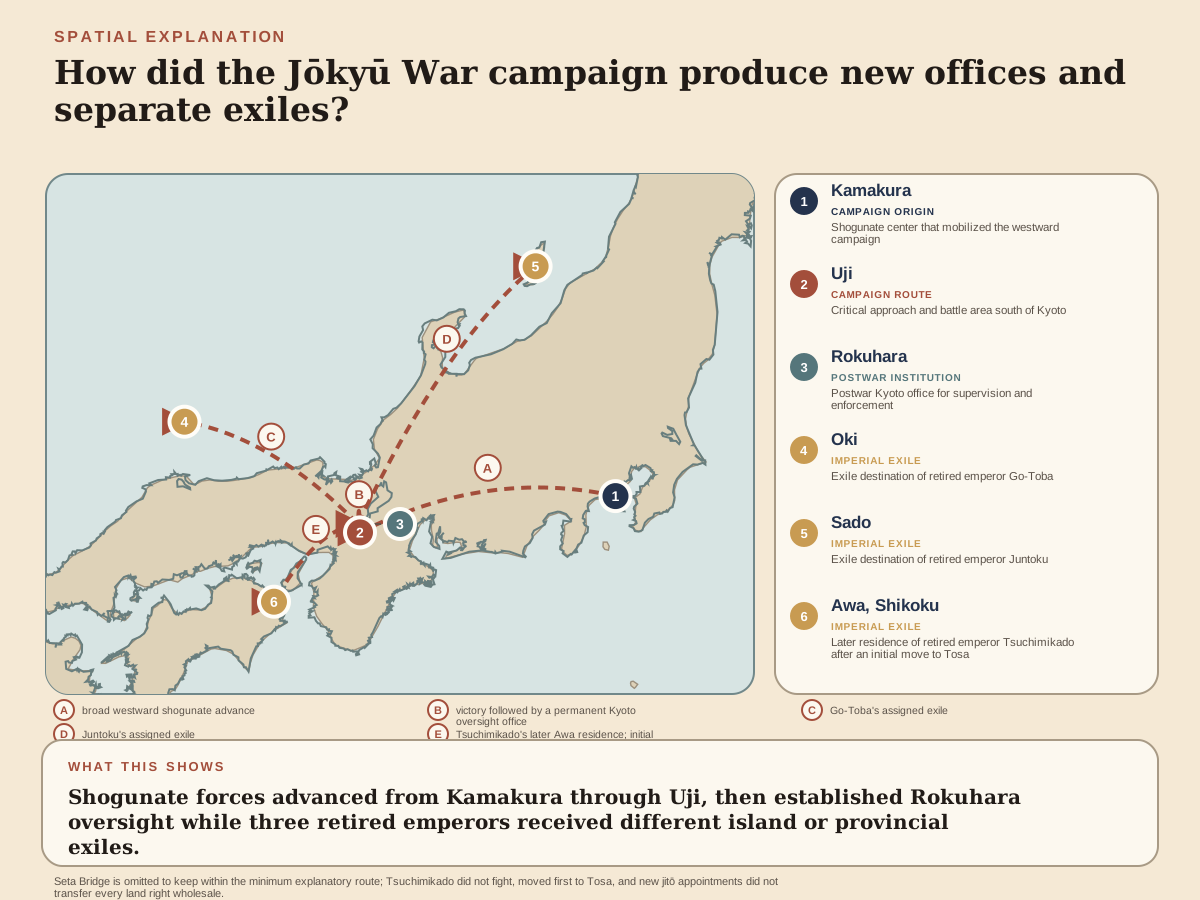
Kamakura's victory brought a settlement of exceptional scope. Go-Toba was exiled to Oki, Juntoku to Sado, and Tsuchimikado—who had not led the rising but chose to share responsibility—to Tosa and later Awa, both on Shikoku. The briefly enthroned Chūkyō was removed, and Go-Horikawa became emperor. Court and retired-imperial lines continued, but Kamakura now intervened decisively in succession. Lands associated with the defeated were confiscated on a very large scale; later summaries often say roughly three thousand holdings, a useful magnitude rather than a perfectly secure universal count. New stewards extended eastern warrior interests westward. Yasutoki and Tokifusa remained at Rokuhara, Kamakura's Kyoto base, to supervise security, court relations, and disputes. Yoshitoki's victory thus became durable through personnel, records, land allocation, and local enforcement, whose costs reached cultivators and resident proprietors far from the commanders.
Yoshitoki died in the sixth month of 1224 in the Japanese calendar. Azuma Kagami describes illness and summer heat; a memorial text describes pain and confinement to bed. Historian Yamamoto Minami's 2020 study interprets the combined evidence as compatible with leg trouble and diminished appetite, favoring death from illness rather than poisoning. Other researchers give weight to a 1227 report that the captive monk Sonchō accused Yoshitoki's wife of giving him a fatal drug. The report preserves an allegation, not a contemporary investigation proving murder. Yasutoki was away in Kyoto when his father died, and Masako managed the immediate transition. [1][2][6]
Masako managed the transition and supported Yasutoki. Yoshitoki’s memorial hall was built east of Yoritomo’s. Iga no Kata and her relatives were punished over an alleged plan for another son and an alternative shogunal lord. Historians differ over the alleged plot and the widow’s rights in household succession; the punishment does not itself settle those questions. Later Hōjō memory honored Yoshitoki as a founder, while the family’s divided claims continued after him. [6][8][10]
Classic
Hōjō Yoshitoki was born in 1162 or 1163 into a locally rooted family in Izu, the peninsula in present-day Shizuoka Prefecture. The National Diet Library’s authority record uses 1162; other public histories use 1163. He was a son of Hōjō Tokimasa and a younger brother of Masako. His mother was a daughter of Itō Sukechika, a local lord in Izu. The family held land and connections around the Kano River, but larger eastern warrior houses commanded forces the Hōjō could not simply direct. Its later regency was not yet part of the child’s inheritance. [1][2][6]
Later accounts count Yoshitoki as the second shikken, the regent exercising authority for the shogun, the titled lord of the warrior government at Kamakura, south of present-day Tokyo. Those powers grew through office and crisis rather than arriving as a settled post in his childhood. Much of the detailed narrative survives in Azuma Kagami, a chronicle compiled under later Hōjō rule. It records earlier conflicts from within the regime that emerged from them.
Before 1180, Yoritomo was an exiled member of the Minamoto warrior family in Izu, under provincial authority aligned with the Taira family then dominant in Kyoto. His family name carried prestige, but he had no government or army to offer the Hōjō. Masako's marriage brought Yoshitoki close to him while exposing Tokimasa's household to retaliation if the exile rebelled. Accounts of Tokimasa's resistance and the couple's resolve were written later; their dialogue cannot recover every step of the marriage. [2]
Yoshitoki entered this relationship as Masako's younger brother. His elder brother Munetoki was also alive, and Yoshitoki had not yet become the family's dominant political figure. Masako sustained an alliance whose importance grew through Yoritomo's revolt and, later, her authority as his widow. Neither relationship placed her under Yoshitoki's command.
The marriage gave the Hōjō access to Yoritomo; it could not supply all the forces he would need. Larger eastern houses still controlled their own men and land. When rebellion came, the survival of both households depended on whether those men joined him.
In 1180 Yoritomo rose against the Taira with Hōjō support, beginning with an attack on the residence of Yamaki Kanetaka, a local official associated with the Taira side. The rebels soon met a stronger force under Ōba Kagechika at Ishibashiyama. Defeat scattered them through difficult terrain. Yoshitoki's elder brother Munetoki was killed during the retreat; Yoritomo survived and eventually escaped across the water to Awa, on the southern Bōsō Peninsula in present-day Chiba. [2]
Accounts of Kajiwara Kagetoki helping Yoritomo evade capture became famous, but their dialogue and explanations of his motives come through later narratives. Recovery took place among eastern warrior houses. Chiba Tsunetane, Kazusa Hirotsune and Miura kin brought their own forces to Yoritomo, expecting protection and recognition of their holdings. These were the relationships from which the gokenin, the shogun's directly bound warrior vassals, emerged. Hōjō loyalty alone could not have rebuilt the defeated army. [3]
For Yoshitoki, defeat changed both his family's place in the rebellion and its own future. Munetoki's death removed an elder brother, while the growth of Yoritomo's coalition brought the Hōjō into cooperation with much stronger houses. Yoshitoki remained close to the leader during this vulnerable period. That service gave him standing in the government that followed, alongside men whose troops had made recovery possible.
In 1181 Yoshitoki was selected for close attendance and night-guard service around Yoritomo. In the mid-1180s he served in the western campaign led by Minamoto no Noriyori, Yoritomo's brother. In 1189 he joined the campaign against the northern Fujiwara after the death of Yoshitsune, another of Yoritomo's brothers. These campaigns took him beyond Izu into a growing network of warrior service and land rewards. His son Yasutoki had been born in 1183; a later genealogy names the mother as Awa no Tsubone but leaves her origins uncertain. [4][13]
In 1192 Yoshitoki married Hime no Mae, a daughter of Hiki Tomomune who served in Yoritomo's household. The received courtship account has Yoritomo mediate the marriage after requiring an oath against separation. The match joined Hōjō and Hiki kin inside the same government. Their sons Tomotoki and Shigetoki later headed important family branches. Yoshitoki also had children through other women: Aritoki through a daughter of Isa Tomomasa, and later Masamura and Saneyasu through his wife Iga no Kata. His descendants therefore carried several different maternal connections into future inheritance disputes. [4]
Yoshitoki's households occupied residences close to the working government in Kamakura. Research distinguishes more than one residence phase, though their precise sites and functions are not all secure. Meanwhile, older followers such as Kajiwara, Wada and Miura retained influence around Yoritomo. Yoshitoki's close service gave him a place among them without guaranteeing that he would dominate the succession.
Historical disagreement · Did the thirteen senior men replace Yoriie’s authority?
Yoritomo died in 1199, leaving his son Yoriie to lead the Kamakura government. Yoshitoki and Tokimasa were among thirteen senior men assigned a role in its business. The traditional interpretation holds that they curtailed Yoriie's personal judgment and substituted collective decision. Curator Ōsawa Izumi's 2022 account describes a shift in research: the restriction concerned who could present matters to Yoriie, reinforcing the young lord's government rather than ending his own authority to decide.
Evidence for the thirteen repeatedly meeting as a council is lacking.
The group included Kyoto-trained administrators as well as warriors, bringing document work and court connections into the succession. [5]
The arrangement did not settle the standing of every senior follower. Kajiwara Kagetoki had won Yoritomo’s trust by reporting and disciplining warriors, work that also accumulated enemies. A petition gathered gokenin against him after the founder’s death. Yoriie and Masako took part in the response; Yoshitoki was one influential participant rather than an official above them. [11]
Kajiwara was expelled from Kamakura after the accusation won broad support. In 1200 he attempted to move west but was killed in Suruga, in present-day central and eastern Shizuoka. Members of his household died with him. Removing a trusted founding-era officer weakened one of the government's old centers of influence. Yoshitoki gained standing within the surviving leadership, but the sequence does not establish that he privately directed the entire affair. [11]
The petition had turned grievances against one officer into a collective challenge after the founder's death. It also showed the danger of expulsion: Kajiwara's loss of office ended in armed destruction, before the new lord had established a stable balance among his followers.
In 1203 Yoriie became gravely ill. His wife Wakasa no Tsubone belonged to the Hiki household, and their son Ichiman offered that family a place beside a future lord. Tokimasa and Masako supported another successor, Yoriie's younger brother Sanetomo. The later Hōjō chronicle presents the ensuing attack as a response to a Hiki threat disclosed through private conversation. Its account provides a sequence of events while also justifying the victorious side. [3]
Tokimasa invited Hiki Yoshikazu, the family's leading political figure, to his residence and killed him. Hōjō forces then attacked the Hiki household, whose destruction included Ichiman's death. Yoriie was removed from power, Sanetomo installed in his place, and Yoriie killed in Izu in 1204. Masako lost a son and grandson in a struggle won by her father and brother's side. Yoshitoki's alignment with that leadership is clear; the surviving accounts do not recover every command he gave. [3]
The same crisis broke Yoshitoki's marriage. Hime no Mae was part of the wider Hiki kin network that the match had once brought closer to the Hōjō. After separation she moved to Kyoto and remarried. Their children retained their maternal Hiki ancestry, even as their father's family emerged stronger. Yoriie's hostile portrait survives mainly through successor-favorable traditions; removal and death do not make every charge against him reliable. [4][5]
Sanetomo's installation increased Hōjō influence around a young lord. Tokimasa now headed the Mandokoro administrative office, while Yoshitoki remained part of the governing family. The destruction had also ended the Hōjō–Hiki cooperation embodied in Yoshitoki's marriage.
In 1205 Hatakeyama Shigeyasu, son of the senior warrior Hatakeyama Shigetada, was killed after a conflict involving Hiraga Tomomasa. Shigetada was then attacked and killed by a much larger Kamakura force. Tomomasa had married a daughter of Tokimasa and his later wife Maki no Kata, placing the quarrel within rival household connections. The received narrative treats the accusation against Shigetada as unjust and depicts Yoshitoki as reluctant. Yoshitoki nevertheless participated in the governing leadership responsible for the destruction. A chronicle favorable to his branch could also condemn Tokimasa while reducing his son's responsibility. [3]
The destruction damaged trust among Yoritomo’s old followers: senior service had not protected Shigetada from a vastly stronger force sent by the governing household. Tokimasa’s subsequent plan to replace Sanetomo with Hiraga Tomomasa threatened another part of that settlement. Masako’s son and the Minamoto focus of gokenin allegiance were now at risk. [3]
Masako and Yoshitoki opposed their father and isolated him from the shogunal household. Tokimasa took religious vows and retired to Izu, where he lived until 1215. Sanetomo remained lord. The siblings' intervention secured their position in government, but it followed the destruction of a respected household that had served Yoritomo. The conflict exposed competing interests within the Hōjō, rather than a family acting throughout according to one plan. [3]
Yoshitoki emerged as a leading protector of Sanetomo's government beside Masako. Shigetada's death remained part of how that change had occurred, a loss that later accounts of Yoshitoki's reluctance could not undo.
After Tokimasa's removal, Yoshitoki worked through the Mandokoro, the office handling the shogunal household's financial and administrative business. He first appears in the surviving record as its bettō, or head, in 1209. Later lists count him as the second shikken after Tokimasa. The regency's powers developed through this office and through his relationship to the shogun; they were not a national premiership already defined when he succeeded his father.
Land rewards and family holdings supported Yoshitoki's household and followers. They also gave other warriors reasons to seek decisions from the government and to dispute them. Administrative business passed through residences where officials received petitions and prepared orders, rather than through a separate modern ministry. The officials working with Yoshitoki remained essential to making his authority effective.
Wada Yoshimori, an old follower of Yoritomo, still headed the Samurai-dokoro, the office responsible for the government's retainers and policing. In 1213 an investigation into the Izumi Chikahira plot implicated members of his family. Yoshimori obtained relief for some, but Yoshitoki's treatment of his nephew Tanenaga as a bound prisoner offended the household. A disputed forfeited estate added another grievance. The challenge came from inside Kamakura's own leadership. [12]
Wada gathered kin and allies, and fighting spread through Kamakura. Miura Yoshimura did not join him, despite the families' connections. The defeated Wada household lost men and property; the fighting also exposed residents and servants to destruction. Azuma Kagami classifies Wada as a rebel from the perspective of the later Hōjō order. Its account cannot by itself settle how far Yoshitoki intended the escalation. [12]
After the Wada defeat, Sanetomo appointed Yoshitoki to the Samurai-dokoro. Yoshitoki now combined that office with his Mandokoro role, bringing military-personnel business and administration closer together around one Hōjō leader. The transfer reduced the counterweight once provided by Wada Yoshimori, at the cost of his household and followers.
Sanetomo continued to pursue a place of his own within the imperial court's world. He composed waka, classical Japanese court poetry, and developed relations with Go-Toba, the retired emperor ruling from Kyoto. His rapid promotion culminated in the office of minister of the right in 1218. Court rank gave the Kamakura lord prestige that Yoshitoki's administrative office could not supply. It also created relationships beyond the regent's direct control.
Masako remained an independent influence as Sanetomo's mother and Yoritomo's widow. The government thus depended on relationships among the shogun, his family and the officials around him. Yoshitoki managed much of its administration and military business without replacing the Minamoto lord.
In 1215 Yoshitoki added the South New Hall at Ganjoju-in, the Buddhist temple in Izu supported by his father. The surviving Unkei sculptures belong to Tokimasa's earlier phase of patronage; Yoshitoki's hall was a separate project. Tokimasa also died in 1215, ten years after his political removal. Temple building continued the family's connection to Izu despite the earlier conflict between father and son. [9]
Sanetomo's court advancement and Yoshitoki's temple patronage were different ways of maintaining status and relationships. Both belonged to a government in which the Hōjō's growing executive power still operated around another family's lordship.
Historical disagreement · Was someone behind Sanetomo’s assassination?
In 1219, Sanetomo was killed after worship at Tsurugaoka Hachimangū by his nephew Kugyō, Yoriie’s son and a senior cleric at the shrine-temple. Yoshitoki’s absence from the attack helped generate a theory that he organized it. A Miura theory instead links Kugyō’s action to Yoshimura, whose support he sought afterward. Historian Sakai Kōichi argues for Kugyō’s group acting without either organizer, noting Yoshitoki’s participation in the princely succession project and Yoshimura’s help in killing Kugyō.
Sakai reports wider scholarly support in 2022, but the larger conspiracy remains unproved.
Sanetomo’s death created a succession crisis as well as an opportunity for Hōjō control. [7]
Kugyō was killed that night, ending his attempt to claim a succession through Yoritomo’s line. Masako, widow of the founder and mother of the two dead shoguns, became central to preserving lordship. Government still operated, but its administrators needed a new person around whom direct vassal service could be organized. [7]
Masako and the senior leaders renewed their request for an imperial prince to come to Kamakura. Go-Toba refused. Mitora, a very young child of the aristocratic Kujō family with a genealogical connection to Yoritomo, arrived instead in 1219. He supplied a prospective lord around whom the household could be maintained, but received formal appointment as shogun, under the name Yoritsune, only in 1226. [7]
Mitora’s household required guardians and attendants, while officials continued government in his name. Hōjō influence grew around the child’s access and administration. The replacement preserved the distinction between the recognized lord and the family exercising much of the executive authority.
In 1221 Go-Toba issued an order for Yoshitoki's punishment. Naming the regent rather than all of Kamakura offered warriors a way to oppose Hōjō leadership while claiming loyalty to the court. Allegiance was genuinely divided: Miura Yoshimura remained with Kamakura, while his brother Taneyoshi sided with Go-Toba. The emperor's authority and the warriors' obligations to the shogunal government pointed in different directions.
Masako appealed to the gokenin through their memory of Yoritomo's protection and land confirmations. The famous speech comes through later narrative, not a verbatim record. As the founder's widow she could make the defense of Yoshitoki's position a matter of preserving the followers' own settlement. Administrator Ōe no Hiromoto urged a rapid advance toward Kyoto rather than waiting in the Kantō, the eastern region around Kamakura.
Yasutoki, Yoshitoki's son, and Tokifusa, Yoshitoki's younger brother, led armies west along several routes with other commanders. Yoshitoki stayed in Kamakura. Rapid mobilization brought enough eastern warriors to overcome the court's forces before Go-Toba could establish a stronger coalition. The outcome depended on those followers' decisions and the commanders in the field, as well as the leaders who organized the response at home.
After defeat, Go-Toba was exiled to the Oki Islands and Juntoku to Sado, both in the Sea of Japan. Tsuchimikado, another retired emperor who had not led the rising, requested exile and went first to Tosa, later to Awa, on Shikoku. This Awa was a different province from Yoritomo's refuge on the Bōsō Peninsula in 1180. The briefly enthroned Chūkyō was removed and Go-Horikawa installed. Kamakura had intervened decisively in the imperial succession while retaining the court and its authority to grant offices and rank.
The victors confiscated holdings associated with the defeated on an exceptional scale. The customary summary of roughly three thousand conveys the magnitude, but is not a precise universal count. New jitō, military estate stewards, brought eastern warrior interests into western lands where proprietors and religious institutions already held rights. Stewardship did not erase those claims. Collection of dues and the exercise of local authority could produce disputes long after the fighting ended.
Yasutoki and Tokifusa remained at Rokuhara, Kamakura's base in Kyoto for security, court relations and western disputes. Yoshitoki depended on his relatives and officials there to make the settlement effective across distance. Confiscation required identifying whose right had been forfeited and enforcing a new appointment among existing claimants. Victory had widened the government's reach; it had not completed every transfer of possession.
The settlement reached people far from the principal commanders. A new steward could change who collected dues and heard claims, while a defeated lord might be absent or replaced. Those local disputes became part of the government inherited by Yoshitoki's successors.
Yoshitoki died in the sixth month of 1224 in the Japanese calendar. Azuma Kagami describes illness and heat in his final decline. A text prepared for a memorial service, examined by historian Yamamoto Minami in 2020, describes pain and confinement to bed. Yamamoto combines that material with the chronicle to suggest leg trouble and an appetite worsened by the heat. Those symptoms are her interpretation, not a full list directly stated in the memorial, and the medieval disease terms do not establish a modern clinical diagnosis. [1][2][6]
The poisoning allegation comes through a different chain. In 1227 the captive monk Sonchō reportedly demanded death by the same drug that Yoshitoki's wife had given him; the courtier Fujiwara no Teika recorded the report in his diary Meigetsuki. Some researchers regard it as evidence for poisoning. Yamamoto favors death from illness and questions whether a hostile prisoner's outburst establishes murder. Iga no Kata's later succession conflict supplied a possible political motive, but cannot prove the accusation. No contemporary investigation known from these accounts resolves the question.
Yasutoki was away from Kamakura when his father died, leaving Masako to manage the immediate transition. Yoshitoki’s offices and family property could not be treated as one simple inheritance: other sons and their maternal relatives had claims at stake.
Masako oversaw the immediate funeral and succession arrangements. Yoshitoki's memorial hall was built east of Yoritomo's, connecting the memory of the regent to the government's founder. Excavations there in 2005 found a square building foundation and roof tiles. Kamakura's heritage account identifies it as the probable early-thirteenth-century hall by comparing its position and finds with Azuma Kagami. The remains had gone out of use around the end of the thirteenth or beginning of the fourteenth century; later memorial markers belong to another phase. [10]
Historical disagreement · Who could decide the Hōjō succession after Yoshitoki?
Succession did not proceed by seniority alone. Masako backed Yasutoki, while Iga no Kata’s family was accused of seeking power for her son Masamura and son-in-law Ichijō Sanemasa. Punishment and exile followed. The conventional account treats this as a thwarted plot. Historian Nagai Susumu instead emphasizes the widow’s claim to manage the Hōjō household succession and questions Masako’s intervention. Hongō Kazuto’s scholarly review challenges the household model underlying that interpretation.
The disagreement concerns both the coherence of the alleged plot and who had authority to arrange succession; it is not resolved merely by accepting the victorious chronicle’s accusation. [6][8]
Yoshitoki's land also had to be divided among heirs from different maternal lines. The admired account of Yasutoki conceding more to his siblings became part of the next regent's reputation, but their agreement mattered to the division. Yoshitoki's offices and property were not one undifferentiated inheritance. The sons received institutional opportunities alongside claims that could divide the family. [4][6][8]
Yoshitoki’s executive role survived him through Yasutoki and the officials around the shogunal household. His purges and the Jōkyū settlement had widened Hōjō authority, while leaving inheritance rivalries and disputes over confiscated land. The institution he helped build carried those costs into its next generation.