HO Guides
Oki: The Work an Exile Could Still Do
On Nakanoshima, Go-Toba continued to edit poems, arrange encounters on paper and send instructions across a sea he could not freely leave.
Quick · About 2 min
The story in five points
A short route through the argument. Follow a point into Classic for its context and sources.
Exile restricted movement without ending work
Defeat in the Jōkyū conflict brought Go-Toba to Oki, where he remained until his death. Poems, revisions, and instructions reveal continued activity dependent on texts and other people. Neither an intact palace nor an imagined prison cell explains that record.
Read in contextIsland poems held more than sorrow
Go-Toba’s seasonal sequence moves between local observation and separation from Kyoto. Pond water, visiting concern, and an address to the sea produce different poetic stances. These crafted speakers preserve a range of responses, rather than a single posture of imperial grief.
Read in contextThe anthology remained open to revision
He continued selecting and cutting the Shinkokin anthology in exile. Manuscripts preserve both marked fuller texts and selected-only versions. His island labor entered transmission without simply replacing every earlier form of the collection.
Read in contextPoems could assemble an absent company
A paper contest paired living writers separated by distance, prominently honoring Ietaka. Another work paired poets across generations without declaring winners. Selection and arrangement sustained specific literary relationships, rather than restoring Go-Toba’s former government.
Read in contextWhat left Oki required later keepers
Go-Toba’s final instruction addressed associates elsewhere and requested posthumous observances. Its original and the museum’s reproduction have different custodial histories. The residence site, cremation mound, later shrine, and museum likewise preserve distinct parts of the exile’s continuing story.
Read in context
1. A ruler removed from his surroundings
Go-Toba had ceased to be the reigning emperor in 1198. Abdication, however, had not ended his role in government: he exercised authority as a retired sovereign. In 1221 he issued an order against Hōjō Yoshitoki, the leading figure in the military government based at Kamakura. The resulting Jōkyū conflict ended in defeat for Go-Toba's side and his removal to Oki.[2]
This was a change in his ability to act, not simply a change of address. Decisions once made within reach of the court would now have to cross water and depend on people elsewhere. The capital retained its offices, houses and gatherings. Their former organizer could no longer enter them at will.
On Nakanoshima, the site identified with his residence is Genpuku-ji, a temple whose medieval buildings no longer survive. Go-Toba remained on the island from 1221 until his death in 1239. Local accounts commonly call this nineteen years, counting both the first and last calendar years. It was the final, nearly eighteen-year stretch of his life, rather than a brief interruption before a restoration.[3]
The absence of a palace can make that interval difficult to picture. Yet replacing the missing building with an imagined prison cell would be equally misleading. The local tradition places him at a temple residence within a settled island community. The Murakami family is remembered for its connection with his custody and, later, the care of his burial place; the surviving accounts do not provide a daily register of his movements.[4]
What can be followed with greater precision is his work. Poems, revisions and a final written instruction record repeated acts of composition and selection. They also reveal dependence: on earlier books, on correspondents, on recipients and eventually on copyists. Exile changed the conditions under which those relationships operated. It did not reduce every one of them to silence.
2. An island made of more than distance
Beside the residence site is Katsuta Pond, now accompanied by a poem monument. The association encourages attention to a small inland feature rather than only to the sea surrounding Oki. Go-Toba's island poetry similarly moves between broad separation and close observation.[3]
The hundred-poem sequence known as the Entō hyakushu passes through spring, summer, autumn and winter before a miscellaneous group. In one summer poem, the speaker wonders whether seasonal rains have raised a pond: white waves are passing over floating lotus leaves. Elsewhere, boats at an Oki harbor bring the distance from the capital into the foreground. These are compressed compositions within an organized sequence, not entries in a weather log.[5]
The pond poem is particularly useful beside Katsuta Pond without requiring us to place the poet at an exact spot on its bank. Its opening is a question. The water may have risen; the floating leaves give the speaker a way to consider it. A very small change in the local landscape becomes enough material for a poem. The island is consequently present as a place where attention continues, not only as the opposite of Kyoto.
Other verses resist consolation. One can be rendered literally: “Being asked after brings no joy—the casual concern of those who have not crossed this sea.” The complaint distinguishes hearing about someone's condition from sharing the journey that produced it. It does not establish that every correspondent was indifferent. Its force comes from the speaker's refusal to treat an inquiry from afar as an adequate substitute for presence.[5]
Another poem addresses the sea itself: “I am the new island keeper. Rough winds and waves of Oki's sea, blow with care.” Here the person sent away names himself through his new place. The imperative gives the verse an assertive voice, but it is a poetic address, not evidence that he could command the weather. What changes between these poems is the stance of the speaker: questioning, resentful, commanding. The surviving sequence preserves that range instead of leaving us with a single posture of imperial sorrow.
3. The book that still needed work
Go-Toba also brought a much larger literary undertaking into exile. In 1201 he had commissioned the Shinkokin wakashū, the “New Collection of Japanese Poems Ancient and Modern.” The anthology had a celebration in 1205, but that occasion did not settle its text. Poems continued to be removed, inserted and rearranged. On Oki, Go-Toba resumed selection, now making extensive cuts.[6]
Editing an anthology is different from composing a poem of one's own. The editor works with the contributions of many people, including the dead. Selection determines which voices appear; arrangement determines which a reader encounters together. The very title of the Shinkokin sets different ages in conversation. Go-Toba's continuing involvement concerned the shape of that shared book, not merely the survival of his personal verses.
The process had a physical vocabulary. Kiritsugi, cutting and joining, referred to revision of the manuscript, including the cutting and rejoining of paper. Literary scholar Terada Tatsuo describes this extended editing history and the further reductions made in exile. A text celebrated as complete could remain an object of practical work for years afterward.[7]
Kokugakuin University researcher Araki Yūya summarizes the island selection as a reduction from roughly two thousand poems to roughly sixteen hundred. Manuscripts preserve the work in two different ways: some retain a fuller text with signs indicating selection or omission, while others copy only the chosen poems. In the first, the decision remains visible beside material it rejects. In the second, the result is presented as a continuous collection.[8]
A medieval manuscript preserved by the Reizei family gives this distinction substance. The surviving upper volume of its Oki version contains 793 poems in the first ten books, omitting 196 found in the earlier text to which the cultural-property description compares it. The copy is dated to the middle of the thirteenth century, not long after Go-Toba's death. It is a witness to the revised selection, not a manuscript catalogued as his own handwriting.[9]
These copies make it possible to identify an effect of his island labor without exaggerating it. The revisions entered manuscript transmission. They did not simply displace every earlier version: fuller texts continued to circulate too. Go-Toba could produce another selection, and other people could preserve it, while readers inherited more than one form of the anthology.
At the residence site, the manuscripts restore a particular undertaking to the years of exile. A man unable to recover his former position kept making decisions about a book. Some of those decisions crossed the sea and survived in copies. Their durability depended on the work remaining legible and on someone choosing to transmit it.
4. A meeting conducted through poems
The anthology dealt largely with an accumulated body of writing. Correspondence offered a different connection: another person could still answer. Ietaka, one of the poets involved in the Shinkokin, continued literary exchanges with Go-Toba after the banishment. The island's modern commemorative account places this exchange alongside the exiled ruler's continuing composition, rather than treating the sea as a complete break in communication.[10]
The 1236 contest gave their relationship an organized form. An utaawase brings poems into paired comparison. In this case the structure could be made from written poems: ten poems for each of sixteen poets produced 160 poems, or eighty pairs. The record is dated to the seventh month of the Japanese lunar calendar, not automatically to July in the modern calendar. A later copy in the Imperial Household Agency's collection preserves the title, eighty-match format and attribution of the judgments to Go-Toba.[1][11]
The organizer's choice to pair all his own poems with Ietaka's made their exchange conspicuous. The National Institute of Japanese Literature identifies recognition of the aging Kyoto poet as a major purpose of the work. A contest could thus provide a framework for honoring a relationship, as well as a procedure for comparing poems.[1]
It helps to separate the actions involved. Writing a poem created material that could travel. Pairing it with another poem created an encounter within the text. Adding a judgment gave that encounter an authorized reading within the contest. None of these actions required the participants to stand before the organizer. They required the material to reach him, and the resulting arrangement to remain available to others.
This does not turn correspondence into a substitute government. Its reach was narrower and more specific. Go-Toba could sustain a literary occasion across distance, recognize a correspondent and continue to exercise judgment in a form familiar to both. The contest preserved an exchange in a form that other readers could revisit. It gave the absent correspondent a defined place beside the organizer: a pairing that remained available after the occasion for which the work had been compiled.
5. An assembly larger than the living court
A related work brought together people whom no host could have assembled physically. The Jidai fudō utaawase, the “Poetry Contest of Different Ages,” places one hundred poets in fifty pairs, selecting three poems by each. Go-Toba's arrangement, associated with his island years, reaches across the history of imperial anthologies. Earlier and later poets meet on the page.[12]
Here the contest form does not culminate in a set of verdicts. Terada notes the absence of judgments in the work: juxtaposition itself carries the comparison. A reader receives paired poems rather than a final declaration of which poet has prevailed. The old competition format becomes a way of presenting literary history.[7]
This is a second kind of solution to the problem of assembling people. The Entō contest connected living writers separated by geography. The Jidai fudō joined writers separated by generations. Poems could serve both purposes because they remained available apart from the bodies and immediate circumstances of their makers.
For the history of this particular island, the consequence is important. Nakanoshima did not have to acquire the buildings or population of a capital for Go-Toba to continue arranging a company of poets. The materials of such an assembly were portable. Once present in a book, they could be divided, paired and copied again. His physical location remained fixed while the range of voices he could bring into a composition extended well beyond it.
6. Instructions that required a recipient
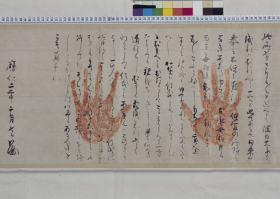
In 1239, another kind of writing left Oki: an instruction addressed to members of the Minase family, connected with Go-Toba's former residence near Kyoto. The document bears two red handprints across its written surface. It acknowledges the difficulty of rewarding their service with other suitable lands, directs them concerning the two named estates, including Minase, and asks for observances after his death.[13]
The original belongs to Minase Shrine and is deposited at Kyoto National Museum. Ama's Go-Toba museum includes a reproduction among its interpretive materials. That separation is part of the document's history. The instruction was written to be received elsewhere, and its later custody followed the relationship with the recipients. A reproduction returns the text to the island story without returning ownership of the original.[13][14]
The request also reveals a limit that the poetry alone cannot show. Selecting a verse was an act Go-Toba could perform on a manuscript before him. Arranging observances after death depended on people who would outlive him, on their access to property and on their willingness to carry out the instruction. The document joins an expression of obligation with a request for future action. Its recipients were indispensable to what it sought to accomplish.
The handprints make the surviving object unusually direct. The text gives instructions in words; the impressions add the trace of the writer's own hands. Together they establish the form in which this final instruction presented itself. The writer was still addressing other people about what they should do, even though the place from which he wrote would also become the place of his death.
7. What the island keeps
Go-Toba died on Nakanoshima in 1239 and was cremated there. The protected mound near the former residence preserves that local association. Oki Shrine belongs to a much later layer: it was established in 1939 for the seven-hundredth anniversary of his death. The museum opened in 1980. The medieval residence site, burial place, shrine and museum therefore do different historical work; they are not fragments of one surviving imperial compound.[15][14]
Their relationship is most useful when the texts are allowed back into it. The pond draws attention to the local scale of a poem. The residence site gives a location to years of composition and revision. The museum brings dispersed documentary material into view, including reproductions whose originals have their own histories of transmission. The mound marks the point at which the writing ceased to be the work of a living resident and became the responsibility of others.
Go-Toba did not return from Oki to resume rule. What did leave the island was more varied than a single message of defeat: an altered anthology, a constructed contest, an arrangement of poets across generations and instructions directed to surviving associates. Their continued existence depends on different people and different kinds of keeping. Reading them together restores activity to the long interval between banishment and death. Exile restricted where Go-Toba could go; it left specific work that could still be done, sent out and taken up elsewhere.
Next topic · HO Guides
Matsue Castle: The Tower's Wooden Records
An inquiry into missing prayer plaques opens a history of numbered timbers, named suppliers and salt counted inside the keep.
Continue readingSources and NotesView sourcesHide sources
- [1]
National Institute of Japanese Literature (NIJL), “『新古今和歌集』とその周辺”, exhibition, 26 January–21 March 2017, introduction subsection “後鳥羽院と藤原定家・家隆” and catalogue entry “遠島御歌合” (display case 4, entry 4-2). https://www.nijl.ac.jp/pages/event/exhibition/2016/shinkokinshu.html . The entry identifies a desk-compiled contest, sixteen poets, ten poems apiece, eighty matches, Go-Toba's judgments, the pairing of his poems with Ietaka's, and the aim of honoring Ietaka. Used as scholarly institutional description; the manuscript itself was not independently transcribed. The work's lunar seventh month is not converted to Gregorian July.
Return to the reference ↑ - [2]
National Diet Library, “Emperor Gotoba,” Japan Search gallery, biographical paragraph beginning “1180–1239”, updated 23 February 2023, https://jpsearch.go.jp/en/gallery/ndl-nJZvp3j8WQfowdR ; Shimane Prefecture, “後鳥羽上皇”, biographical opening, https://www.pref.shimane.lg.jp/life/bunka/shinkou/internet_kikakuten/bungaku/bungakusha/gotoba.html . Used for Go-Toba's 1198 abdication, retired-sovereign rule, the 1221 order against Yoshitoki, defeat and exile. The Japan Search English page contains an erroneous subsequent statement about Tsuchimikado dying in 1202; that statement and its succession chronology are not used here. No private motive or comprehensive reconstruction of the war is inferred from these brief profiles.
Return to the reference ↑ - [3]
Oki Islands Tourism Association, “後鳥羽上皇行在所跡”, main site description, https://www.e-oki.net/spots/6017/ ; Shimane Prefecture, “後鳥羽上皇”, “後鳥羽院行在所跡” entry, https://www.pref.shimane.lg.jp/life/bunka/shinkou/internet_kikakuten/bungaku/bungakusha/gotoba.html . These identify Genpuku-ji and the nearby Katsuta Pond/poem monument. The article distinguishes a commemorated residence site from a surviving medieval interior. “Nineteen years” is the inclusive calendar-year convention for 1221–1239, not nineteen elapsed years.
Return to the reference ↑ - [4]
Oki Islands UNESCO Global Geopark, “後鳥羽院御火葬塚・隠岐神社”, historical site description, https://www.oki-geopark.jp/geopark-sites-features-list/1281/ ; Ama Town, “村上家資料館”, opening historical description, https://www.town.ama.shimane.jp/torikumi-shisetsu/shisetsu/murakami-re . The Murakami relationship is presented as local historical tradition, not as an independently reconstructed thirteenth-century system of surveillance or an authenticated unbroken genealogy. No detailed rules of Go-Toba's confinement are asserted.
Return to the reference ↑ - [5]
International Research Center for Japanese Studies (Nichibun), Waka Database: 後鳥羽院遠島百首, poem IDs 00027, 00076, 00079 and 00097, https://lapis.nichibun.ac.jp/waka/waka_i057.html . The two quoted English renderings are this essay's literal translations of the public-domain Japanese texts of 00079 and 00097; the pond and harbor poems are paraphrased from 00027 and 00076. The sequence's seasonal organization is also described by the 後鳥羽院顕彰事業実行委員会, “和歌”, subsection “遠島御百首”, https://www.gotobain-kensyo.com/event . The database's collection-formation metadata is not treated as a composition date for every poem. Poem 00027 does not name Katsuta Pond, and the article does not claim it was composed at a documented point on that pond. Literary speakers are not used as factual witnesses to every visitor's behavior or to weather control.
Return to the reference ↑ - [6]
NIJL, “『新古今和歌集』とその周辺”, subsection “『新古今和歌集』の成立”, https://www.nijl.ac.jp/pages/event/exhibition/2016/shinkokinshu.html . Supports commission in 1201, continued work after the 1205 celebration, deletions/additions and renewed selection in exile. The celebration is not mislabeled the completion of a single immutable text.
Return to the reference ↑ - [7]
Terada Tatsuo, “Two Competitions among Poets of Different Generations in Medieval Germany and Japan: Fürstenlob and Jidaifudō utaawase,” 北海道大学大学院教育学研究院紀要 144 (2024), pp. 135–158, specifically p. 148 on the anthology's editing and p. 152 on the structure and absence of judgments in Jidai fudō utaawase. DOI: 10.14943/b.edu.144.135. https://eprints.lib.hokudai.ac.jp/repo/huscap/all/92706/08-1882-1669-144.pdf . This is not a claim to have studied all of the article's German comparative material. Its conjectures about private emotions or boredom are not adopted. The explanation of what pairing permits a reader to do is the present essay's limited interpretation of the documented format.
Return to the reference ↑ - [8]
Araki Yūya, “【学問ノ道】文学をひろく伝える國學院の責務,” Kokugakuin University, 4 June 2018, paragraphs explaining the Oki recension and its two manuscript forms, https://www.kokugakuin.ac.jp/article/69832 . The roughly 2,000-to-1,600 reduction follows the author's rounded figures, not an assertion that every recension has an identical poem count. The contrast between a marked fuller text and a selection-only text is the source's; the discussion of their different reading effects is interpretive.
Return to the reference ↑ - [9]
Agency for Cultural Affairs, “新古今和歌集(隠岐本)上,” Cultural Heritage Online, object catalogue, https://online.bunka.go.jp/db/heritages/detail/167835 . The catalogue describes the Reizei-ke Shiguretei Bunko volume, its ten books and 793 poems, 196 omissions relative to the compared earlier text, and mid-thirteenth-century copying. Read at catalogue-description level; neither a complete facsimile nor every omitted poem was inspected. No claim is made that this is Go-Toba's autograph or that its transmission history is conclusively known.
Return to the reference ↑ - [10]
後鳥羽院顕彰事業実行委員会, “後鳥羽院の和歌,” the opening paragraphs and subsection “遠島歌合”, https://www.gotobain-kensyo.com/event . Used for the local account of literary exchanges with Ietaka, alongside NIJL's independent literary catalogue. The committee's broader celebratory language and weather legend are not used as established events.
Return to the reference ↑ - [11]
Imperial Household Agency, Archives and Mausolea Department, “遠島御歌合(嘉禎2年7月・八十番・1巻),” shelf mark 501・579, bibliographical fields for title, authorship and copying, https://shoryobu.kunaicho.go.jp/Toshoryo/Detail/1000018910000 . The catalogue identifies an early-Edo copy, with a title slip attributed to Emperor Reigen, not Go-Toba's surviving autograph. Only the catalogue record was available; no manuscript images are supplied in this record. The 160-poem total is arithmetic from NIJL's sixteen poets and ten poems each.
Return to the reference ↑ - [12]
NIJL, “『新古今和歌集』とその周辺,” entry “時代不同歌合絵巻”, https://www.nijl.ac.jp/pages/event/exhibition/2016/shinkokinshu.html ; National Diet Library, “Emperor Gotoba,” related-work entry “Segment from Poetry Match among Poets of Different Eras,” https://jpsearch.go.jp/en/gallery/ndl-nJZvp3j8WQfowdR ; Terada, “Two Competitions,” p. 152, cited above. Together these support the fifty poet-pairs/one hundred poets and three poems per poet. The text has revisions and dating questions; the essay does not impose an exact completion year or infer direct causation of Hyakunin isshu. The NIJL exhibition's Edo-period illustrated excerpt is not treated as a medieval portrait from life.
Return to the reference ↑ - [13]
Shimamoto Town, “島本町の文化財”, entry “後鳥羽天皇宸翰御手印置文”, explanatory paragraphs and supplied object photograph, https://www.town.shimamoto.lg.jp/site/rekishi-bunka/2412.html ; photograph: https://www.town.shimamoto.lg.jp/uploaded/image/2146.jpg . Supports the document's 1239 date, Minase recipients, land/reward instructions, request for posthumous observances, Minase Shrine ownership and Kyoto National Museum deposit. The photograph was actually inspected and shows two red handprints. The town's emotional reading of the handwriting is not adopted. The document's contents are summarized through the institutional explanation, not presented as this writer's independent full paleographic transcription.
Return to the reference ↑ - [14]
Oki Fūsha, “海士町後鳥羽院資料館,” institutional history and numbered collection themes, especially “資料館について” and “御手印置文(複製)”, https://okiofusha.co.jp/museum . Supports the museum's 1980 opening and its use of reproductions, including the testament. Read on 16 September 2026; this essay describes the institution's documented interpretive materials, not a guarantee of the display of a specific object on any future visit. The original testament's ownership/deposit is checked separately in note 13.
Return to the reference ↑ - [15]
Oki Islands UNESCO Global Geopark, “後鳥羽院御火葬塚・隠岐神社,” paragraphs on the 1239 death/cremation and 1939 shrine foundation, https://www.oki-geopark.jp/geopark-sites-features-list/1281/ ; Shimane Prefecture, “後鳥羽上皇,” “隠岐神社” entry, https://www.pref.shimane.lg.jp/life/bunka/shinkou/internet_kikakuten/bungaku/bungakusha/gotoba.html . The geopark site's erroneous Western-year parenthesis for an unrelated Meiji-era event is not reproduced or silently repaired. The essay uses the corroborated 1239 and 1939 dates, does not reconstruct all intervening custodial changes and does not imply entry into the mound's protected enclosure.
Return to the reference ↑