HO Guides
Ganjōju-in and the Hōjō Residence: What Prayer Required
The hidden contents of Buddhist images, an unfinished vow, and a convent on former household ground reveal different kinds of work behind a warrior family's religious life.
Quick · About 2 min
The story in five points
A short route through the argument. Follow a point into Classic for its context and sources.
Prayer began inside the household
The Azuma kagami places Yoritomo’s religious consultation at the Hōjō residence before his uprising. An unfinished recitation vow required clerical advice and a ceremony. Religion formed part of preparing for uncertain action, rather than decoration added after political success.
Read in contextThe sculpture commission had an interior
Tokimasa’s surviving commission includes Amida, Bishamonten and Fudō with attendants. Hidden tablets identify Unkei and other participants while carrying sacred writing and provisions for relics. Their placement served a religious purpose beyond publicly identifying patron and maker.
Read in contextSacred writing supplied presence
The Hōkyōin dharani’s scriptural setting explains deposits inside images and pagodas through promises of protection and sacred presence. This helps explain concealed writing, but scriptural prescriptions do not prove that every described ritual was performed at Ganjōju-in.
Read in contextThe temple accumulated occasions
The sculptures’ carving date precedes the dedication recorded for Yoritomo’s northern campaign. Later halls and memorial provision extended the family’s patronage across generations. Commission, dedication and commemoration should not be compressed into one construction date for the entire compound.
Read in contextWomen gave family ground another future
After the Hōjō government fell, Enjō-ni established a convent on former residential land. Grants recognized its religious community under new political authorities. Later women leaders, buildings and ordinary utensils show an inhabited institution continuing beyond its founder’s bereavement.
Read in context
Opening
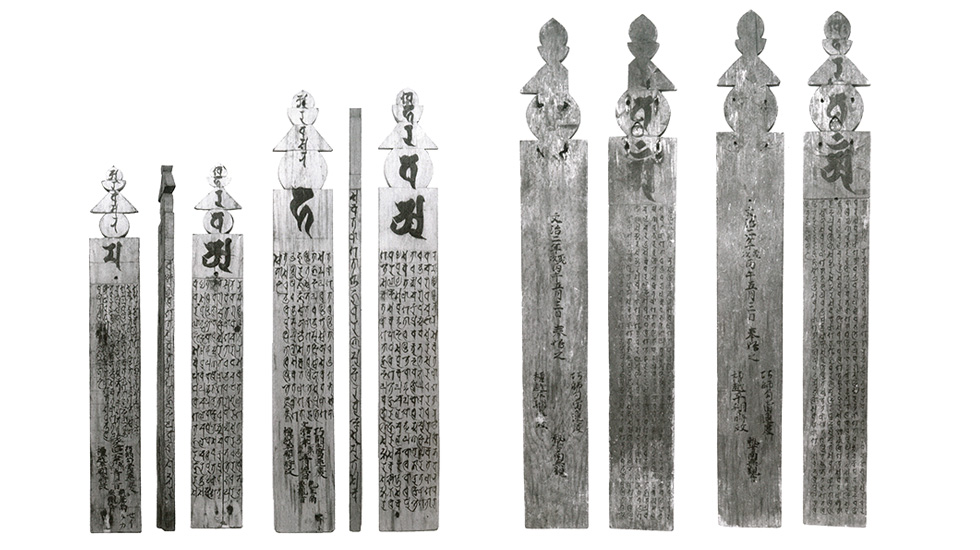
Four wooden tablets belong to the history of Ganjōju-in's celebrated sculptures. Two came from the bodies of the formidable figures Fudō and Bishamonten; two belonged inside Fudō's smaller attendants. The tablets name a sculptor, Unkei, and a patron, Hōjō Tokimasa. They also carry sacred writing. The two larger ones have holes made to receive tiny relic containers.[1]
These were unusually elaborate things to put out of sight. Their usefulness did not depend on the audience being able to admire them.
The tablets offer a way into the religious landscape around Moriyama, a low hill in Izu. On one side stood the Hōjō family's residences; on the other, Ganjōju-in. Later, women established a convent on the former residential ground. Across these neighboring places, prayer required different preparations: a vow had to be addressed, an image furnished, and a community given somewhere to live. The family name connects the activities, but each made a different demand on the people involved.
1. Religion Was Already in the House
The Hōjō residence site lies on Moriyama's northwestern side, across the hill from Ganjōju-in. The family belonged to Izu before its members became central figures in Kamakura's warrior government. Tokimasa's daughter Masako married Minamoto no Yoritomo, an exile living in the province; her father supported Yoritomo's uprising in 1180.[2]
A residence here was more than a single distinguished room. Excavation revealed buildings, fences, wells, and repeated alterations to the compound. An archaeological handout places its principal domestic phase between the late twelfth and early thirteenth centuries. Its plans show a household occupying and reorganizing a valley, rather than a mansion waiting unchanged for the family's great moment.[3]
The written record places religious decisions within that household setting. The Azuma kagami, the later chronicle of the Kamakura government, locates Yoritomo at the Hōjō residence when an appeal for action against the Taira reached him in 1180. A subsequent entry concerns something less familiar than recruitment: what to do about a vow he could not finish in time.[4]
According to the entry for the fifth day of the seventh lunar month, Yoritomo had undertaken a thousand recitations of the Lotus Sutra. With events becoming urgent, only eight hundred had been completed. He summoned Kakuen, a cleric from nearby Izusan, and asked whether he could proceed with a religious declaration before fulfilling the entire undertaking. Kakuen assented, and a ceremony followed, with incense and flowers placed before a Buddhist image.[5]
The account presents a consultation, not a private decision that the missing recitations no longer mattered. A numerical promise had encountered a practical deadline. Yoritomo sought someone entitled to address the religious difficulty, and the household became the setting in which that answer was acted upon.
The chronicler also describes a gift to the cleric and a promise of a further gift when peace returned. Religious work thus entered the same uncertain future as the uprising. No excavated room can be assigned to this ceremony, and the chronicle is not a contemporary transcript. Its account nevertheless locates a particular relationship at the residence: a warrior asking for religious assistance before he knew the outcome of his enterprise.
2. Five Bodies, Different Forms of Attention
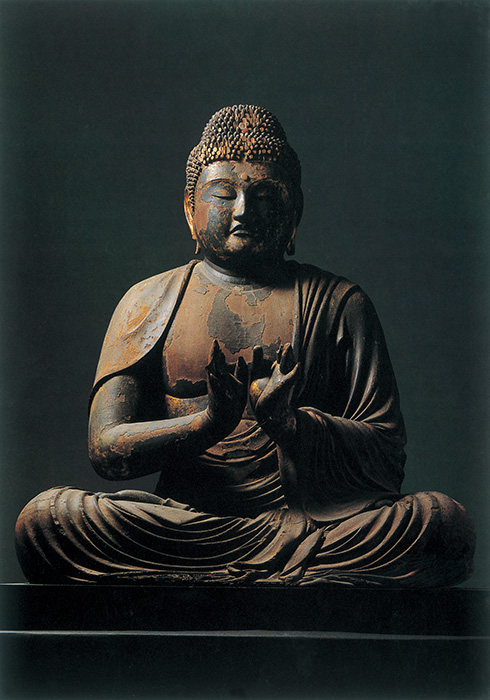
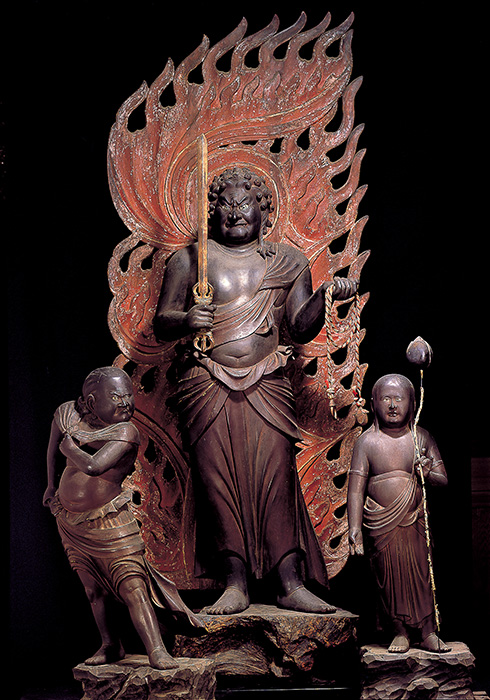
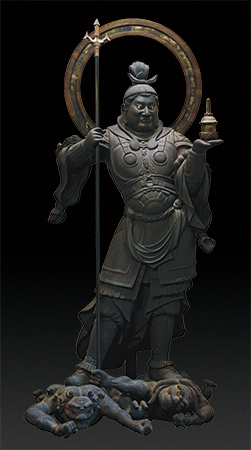
The five surviving sculptures from Tokimasa's 1186 commission give the family's religious provision a much more tangible form. There is a seated Amida Buddha, a standing Bishamonten, and Fudō accompanied by two youthful attendants, Kongara and Seitaka. The group is recognized as Unkei's work, supported by its associated inscriptions, rather than attributed through resemblance alone.[6]
Seen together, the figures do not repeat a single expression of strength. Amida's hands rise before his chest in a teaching gesture. The broad seated body gathers the folds of the robe around a stable center. Bishamonten stands in armor, with a miniature pagoda in one hand and small beings beneath his feet. In the temple's photograph of Fudō's group, the central figure holds a sword and a rope, while the attendants introduce contrasting postures and expressions on either side.[7]
These differences direct attention. A seated teacher, an armored protector, and a fierce sacred figure accompanied by children offer several relationships between the viewer and the divine. The figures' bodies make those relationships visible before a viewer knows the name of their patron.
The contrast is especially useful at a temple associated with a warrior family. Armor does not make Bishamonten a portrait of Tokimasa. Nor does Fudō's weapon turn the whole group into a celebration of combat. These are Buddhist identities, expressed through bodies and attributes. The temple itself describes protection from calamity as part of their religious meaning.[1]
Unkei's work also connected Izu with a larger world of production. The Tokyo National Museum places these figures within a career rooted in Nara and extending to eastern patrons and the imperial court. A commission for a provincial warrior did not require an artist detached from established Buddhist institutions.[8]
Tokimasa supplied patronage; Unkei supplied sculptural work. The resulting images also required things neither a donor's name nor the surface of a carved body can fully explain. Some of the most specific evidence lies inside them.
3. A Sacred Interior
The wooden tablets have long stems and upper sections shaped like small five-element pagodas. Their fronts carry lines of sacred characters; their other faces include records of the commission. The date refers to the beginning of carving on the third day of the fifth lunar month of 1186. Alongside Tokimasa and Unkei appears the name of the person who wrote the inscriptions, Namu Kannon.[9]
A modern label would normally face outward, telling an audience who made an object. Here the record belonged with writing and relic containers enclosed within sacred bodies. The names identify human participation in a religious undertaking; the placement makes that undertaking different from public self-advertisement.
The sacred formula is the Hōkyōin dharani. A dharani is an utterance credited with religious efficacy, preserved in writing as well as recited. The associated Buddhist scripture explains why a text might be placed inside an image or a pagoda. In its Chinese version attributed to the translator Amoghavajra, depositing the scripture brings the protection and presence of innumerable Buddhas to that place.[10]
The scripture begins with a striking mismatch between appearance and significance. What looks like a ruined mound contains a marvelous sacred presence. The Buddha recognizes it; other people need an explanation. Later passages say that a pagoda made of ordinary materials acquires extraordinary qualities through the text placed within it.
This gives the hidden writing a purpose that visibility cannot fulfill. A person approaching the image need not inspect its interior for the deposit to matter within this religious understanding. Its location inside the body is part of the arrangement, not an inconvenience preventing the object from being properly appreciated.
The scripture also connects the deposit with actions outside it. It describes offerings of incense and flowers, worship, and circumambulation. Elsewhere it promises help for the dead when descendants recite the formula in their names. These are claims within the Buddhist text, not a record that every prescribed act occurred at Ganjōju-in.
Read beside the tablets, however, they keep the commission's religious ambition in view. Wood could become a carved body, an inscribed support, or a miniature sacred structure. A relic could be enclosed rather than displayed. Those choices assembled several kinds of presence in one image. Calling the tablets signatures would tell us something true while leaving most of their work unexplained.
4. A Temple Could Receive More Than One Beginning
The commission already had a history when the Azuma kagami described a major act of foundation at Ganjōju-in. Its entry for the sixth day of the sixth lunar month of 1189 connects Tokimasa's project with prayers for Yoritomo's campaign against the Northern Fujiwara in northeastern Japan. It records building work and dedication, and specifically says that the principal images had been made beforehand.[11]
The chronicler therefore did not imagine every part of the temple appearing at once. An image could be commissioned before the occasion through which a building entered the record. The inscription's 1186 date and the chronicle's 1189 ceremony answer different questions. They do not authorize us to give the entire medieval compound one construction date.
The same entry makes the location important. Tokimasa went to the site in Izu himself, and the account relates the establishment to ancestral ground. His religious provision was being placed back in the landscape from which his household had risen. The family's involvement in Kamakura had not emptied Izu of obligations or possibilities.
A later addition extended the relationship across generations. In 1215, the chronicle records the dedication of a new southern hall sponsored by Tokimasa's son Yoshitoki. Its images included an Amida triad and the Four Heavenly Kings. In 1236, a northern pagoda was associated with Yasutoki's thirteenth-year memorial observance for his father Yoshitoki.[12]
A patron could thus become the person remembered by the next patron. A site used for prayers concerning an approaching campaign could also receive provision for the dead. These were new undertakings within an established place, not simply repetitions of the first commission.
The surviving sculptures make this sequence easier to grasp than an imaginary panorama of all the lost halls. The medieval precinct has not survived intact, and its proposed pond layout remains incompletely established by excavation.[13] What can be followed more securely is the accumulation of gifts and religious occasions: a body made, a hall dedicated, a father commemorated, another structure added.
5. Returning Did Not Mean Restoring the Old Household
In 1333, the Kamakura government fell. Hōjō Takatoki and many members of the ruling family died. His mother survived. Known by her religious name Kakukai Enjō, or Enjō-ni, she was also the widow of the former regent Sadatoki. Her subsequent establishment at Moriyama was a convent, Enjō-ji, on former Hōjō residential ground.[14]
A family residence and a convent both needed buildings in which people could live. Their purposes were nevertheless different. Enjō-ni was not simply reopening her son's administration in a safer district. The recorded religious purpose concerned those who had died, while the community itself offered a place for living women connected with the family.
That purpose appears in the account of a grant issued by Ashikaga Tadayoshi in 1339. The document identifies Enjō-ni as founder and describes women associated with the Hōjō residing at the temple, where the dead of the recent upheaval were to be aided through Buddhist practice. A copy of Tadayoshi's grant survives in the Egawa family archive.[15]
The issuer matters. Tadayoshi belonged to the Ashikaga leadership of the new warrior government. Recognition for this religious establishment did not come from a restored Hōjō regime. The survival of women, the existence of a convent, and acknowledgment of its resources crossed a change in political rule.
In 1333, Enjō-ni had already received confirmation concerning the Hōjō residence and an estate interest. The 1339 grant directed further local holdings and specified estate-management rights in nearby Suruga toward Enjō-ji.[16] These records distinguish possession of an old family connection from recognized rights that an institution could use.
They do not give us a balance sheet. Nor do they establish a single private motive for the new rulers' support. They show something narrower and more concrete: a religious community could be described, supplied with rights, and acknowledged by authorities who had not inherited the family's former political position. Returning to family ground could begin a new institution rather than reverse the defeat.
6. The Convent Had to Be Lived In
Enjō-ji continued beyond its founder. Women from the Uesugi family later served as its heads, and the excavated convent includes substantial fourteenth- and fifteenth-century remains. The history of Moriyama's women therefore cannot be confined to one moment of bereavement.[17]
The archaeological presentation gives that later community a different shape from the earlier residence. Its plan identifies stone-supported buildings, a pond, wells, and channels dividing the precinct. These features belong to the convent west of Moriyama; they should not be transferred across the hill to fill gaps in Ganjōju-in's plan.[18]
The arrangement suggests how much work could lie behind the phrase “a place of prayer.” Buildings needed prepared ground. Water required routes through the compound. Different areas could be separated while remaining part of one establishment. These are elementary requirements, but they prevent religious life from dissolving into an image of women simply remembering the dead.
Objects make the distinction still clearer. Finds include ritual vessels, incense burners, candle holders, tea utensils, and earthenware dishes bearing soot. The latter are interpreted as lamps used in religious activity. Their modest appearance is part of their value: repeated use could leave a mark on an object that no one had commissioned as a monument.[18]
Tea utensils also belong to the inhabited institution. They establish a material provision for preparing and serving tea, without identifying a particular gathering or proving that every resident participated. The range of finds gives the community more than one activity, just as the earlier residential compound contained more than a place for military consultation.
The important continuity is therefore neither an unchanged building nor an unbroken line of Hōjō administrators. People continued making this ground serviceable for religious life. New heads, different buildings, and ordinary equipment gave Enjō-ji a history after the event that helped bring it into existence.
7. What the Gifts Made Possible
Around Moriyama, the Hōjō story can be read through three different preparations for prayer. In the residence, Yoritomo consulted a cleric about a vow that urgent events had interrupted. At Ganjōju-in, Tokimasa's commission combined visible figures with writing and relic deposits concealed inside them. At Enjō-ji, women required an inhabited precinct and recognized resources to sustain a religious community.
Each arrangement joined belief to something that had to be done. None becomes intelligible by treating religion as an ornament attached after the political action was over. The recitations preceded the uprising; the images preceded the ceremony recorded in 1189; the convent developed after the fall of the government.
The family lost its ruling position, but that event did not bring every use of its home ground to an end. Moriyama preserves the more particular changes: who could give, what a gift contained, whom religious work concerned, and who remained to carry it forward.
Next topic · HO Guides
Ishibashiyama: When the Followers Had to Leave
After the defeat of 1180, protecting Yoritomo required dispersal, local help, and messages that could never tell everyone the whole story at once.
Continue readingSources and NotesView sourcesHide sources
- [1]
Ganjōju-in, “寺宝,” subsections 五輪塔形木札 and the three sculptural groups: https://ganjoujuin.jp/temple_treasures.html. The tablet locations, holes, relic-container identification, sacred formula, and inscriptions are the temple's object documentation. Its suggestions about the artist's emotions or particular warrior models are not adopted.
Return to the reference ↑ - [2]
Izunokuni City, “北条氏邸跡(円成寺跡),” historical and location description: https://www.city.izunokuni.shizuoka.jp/bunka_bunkazai/manabi/bunkazai/kunishite/hojoshi.html; Azuma kagami, 1180, fourth month, twenty-seventh day, original-language text in note 4, for Tokimasa as Yoritomo's father-in-law and the residence setting. The city's erroneous era-year pairing for 1333 is not repeated.
Return to the reference ↑ - [3]
“史跡北条氏邸跡(円成寺跡)の概要,” two-page illustrated archaeological handout, p. 1, hosted by Kanagawa University: https://www.arch.kanagawa-u.ac.jp/lab/shimazaki_kazushi/shimazaki/JAPANCasle/398izumoriyama/panf02.pdf. See both pages, including the separate residence and convent plans. Publisher and date are not identified in the supplied scan; university hosting is not authorship. No particular excavated room is assigned to a named person.
Return to the reference ↑ - [4]
Azuma kagami (吾妻鏡), book 1, 1180, fourth month, twenty-seventh day, transcription based on the 1903 Kokushi taikei, vol. 5: https://ja.wikisource.org/wiki/吾妻鏡/第一. The original-language entry places the appeal at 北条舘. For the chronicle's compilation and transmission, National Archives of Japan, “吾妻鏡”: https://www.archives.go.jp/exhibition/digital/rekishitomonogatari/contents/08.html. The chronicle was compiled much later than these events; no manuscript collation is claimed.
Return to the reference ↑ - [5]
Azuma kagami, 1180, seventh month, fifth day, same transcription, from “昨日遣御書” through the cleric's departure. See the complete kanbun entry: the thousand-recitation vow, eight hundred completed, Kakuen's consultation, offerings, and promised further gift. The prose paraphrases the chronicle's reported exchange, not a verified verbatim conversation. All medieval month-and-day references retain the lunisolar calendar.
Return to the reference ↑ - [6]
Izunokuni City, “運慶作諸仏,” description of the five figures and associated inscriptions: https://www.city.izunokuni.shizuoka.jp/bunka_bunkazai/manabi/bunkazai/unkeisakusyohutu.html. The attribution is stated at the level of the recognized ensemble; the essay does not reconstruct the sequence of every modern attribution dispute.
Return to the reference ↑ - [7]
Photographs of the original sculptures: Amida, https://ganjoujuin.jp/image/tts_p01.jpg; Fudō and attendants, https://ganjoujuin.jp/image/tts_p02.jpg; Bishamonten, Tokyo National Museum, https://www.tnm.jp/uploads/fckeditor/exhibition/special/2017/20170926unkei/uid000276_20170710164024b3f002e7.jpg. The observations describe the photographed forms, not an in-person encounter or a finding that all visible surfaces and accessories remain unrepaired twelfth-century material.
Return to the reference ↑ - [8]
Tokyo National Museum, “UNKEI—The Great Master of Buddhist Sculpture,” 2017 exhibition introduction, Parts 1–2: https://www.tnm.jp/modules/r_free_page/index.php?id=1861. Used for the Nara-centered career and range of patrons. The museum's tentative suggestion about greater freedom under eastern patrons is not promoted into a demonstrated cause of the style.
Return to the reference ↑ - [9]
Ganjōju-in's four tablets, photograph https://ganjoujuin.jp/image/tts_p04.jpg, alongside the object description in note 1. Used for form and layout; the date, starting-work wording, names, and identification of the formula follow the published reading. The available photograph was not sufficient for a complete independent diplomatic transcription of every character.
Return to the reference ↑ - [10]
Yiqie rulai xin mimi quanshen sheli baoqieyin tuoluoni jing (一切如來心祕密全身舍利寶篋印陀羅尼經), Chinese translation attributed to Amoghavajra, Taishō 19, no. 1022B, pp. 712c–714b; University of Tokyo SAT transcription: https://21dzk.l.u-tokyo.ac.jp/SAT/ddb-sat2.php?mode=detail&useid=1022B. See the original Chinese narrative, especially 713b9–c23 on deposits, offerings, and protection, and 714a25–b1 on descendants and the dead. This supplies the formula's scriptural setting, not a claim that the whole scripture was inscribed on the tablets or that a specified rite occurred at Enjō-ji.
Return to the reference ↑ - [11]
Azuma kagami, 1189, sixth month, sixth day, paragraph beginning 北條殿の御願として, kundoku transcription: https://www5a.biglobe.ne.jp/~micro-8/toshio/azuma/118906.html. It explicitly describes the images as made beforehand. Some characters elsewhere on this page are encoding-damaged; none supplies the dates or central relationship used here. No complete temple-construction timetable is inferred.
Return to the reference ↑ - [12]
Azuma kagami, 1215, twelfth month, sixteenth day: https://www5a.biglobe.ne.jp/~micro-8/toshio/azuma/121512.html, complete dedication passage; Izunokuni City, 史跡願成就院跡・史跡伝堀越御所跡・史跡北条氏邸跡(円成寺跡)保存活用計画 (September 2019), printed p. 20, dated summary of the 1236 memorial: https://www.city.izunokuni.shizuoka.jp/bunka_bunkazai/manabi/bunkazai/kunishite/documents/03_dai2shou_01_3.pdf. The latter chronicle entry was not independently retrieved. Its thirteenth-year memorial uses inclusive anniversary counting.
Return to the reference ↑ - [13]
Same preservation plan, printed pp. 25–26 and 30, research history and present archaeological assessment. The pond is a reconstruction proposed from terrain and historical evidence, not an entirely excavated feature. The source's older reprinted designation text is not used to override its more qualified archaeological assessment.
Return to the reference ↑ - [14]
Izunokuni City, residence-site account in note 2, on the post-1333 convent; Heibonsha, Nihon rekishi chimei taikei, “円成寺跡,” displayed excerpt: https://kotobank.jp/word/円成寺跡-1443383. Read the complete publicly displayed entry, not the longer subscription version. The founder's relationships and the convent's purpose are distinguished from an imagined account of the women's journey.
Return to the reference ↑ - [15]
Tadayoshi's 1339 grant is summarized in the Heibonsha entry in note 14 and the preservation plan, printed p. 15. National Institute of Japanese Literature, Egawa family archive, “足利直義寄進状写,” call number egawa/00002: https://archives.nijl.ac.jp/G000000225435/data/04750. The catalogue identifies a copy dated Ryakuō 2, fourth month, fifth day. Its full manuscript image was not retrieved; the essay uses published descriptions of content and does not present a new translation of the deed.
Return to the reference ↑ - [16]
Preservation plan, printed pp. 15, 20, and 23, descriptions of the 1333 confirmation and 1339 grant. The plan disagrees internally on the July day of the 1333 instrument, so no day is supplied. The Suruga grants are specified jitō/gōshi interests, not unrestricted modern ownership; no receipt or revenue calculation was read.
Return to the reference ↑ - [17]
Preservation plan, printed p. 24, Uesugi women as heads and the later convent phase; archaeological handout, p. 2, note 3. This is an institutional sequence supported by the published historical synthesis, not a reconstruction of each woman's biography or every intervening appointment.
Return to the reference ↑ - [18]
Archaeological handout, p. 2, convent plan and excavated objects, note 3; preservation plan, printed pp. 33 and 35, features and artifact discussion. See the plan and artifact photographs on p. 35. The practical explanation of prepared ground, drainage, and maintained use is the essay's inference. Lamp use is an archaeological interpretation of sooted dishes, not a count of completed services. Tea utensils are not evidence for a named tea gathering.
Return to the reference ↑