Read the article below. Interactive reading tools are available when scripts load.
Quick
Hōjō Masako was conventionally born in 1157, a daughter of Hōjō Tokimasa in Izu. The sources preserve almost nothing dependable about her childhood. Even “Hōjō Masako,” the name by which modern readers know her, is a convenient retrospective designation: contemporary records more often identified her by relationship, rank, residence, or religious status, and her formal name appears clearly only around her court promotion in 1218.
This silence is evidence about the archive, not permission to invent a precocious ruler. Masako first became visible through marriage, maternity, ritual, bereavement, and political crisis. Her later authority emerged from positions and choices that did not exist in 1157. A responsible biography begins with a locally important daughter whose future remained open.
Masako grew up in Izu, a province of estates, public lands, shrines, temples, roads, officials, and warrior households. The Hōjō possessed local standing and administrative experience, but later dominance makes their earlier position look larger and more unified than it was. Authority depended on relationships with provincial government, proprietors, neighbors, armed followers, and stronger patrons.
Izu also held Minamoto no Yoritomo, exiled after the Heiji conflict. His lineage brought prestige and danger but no army or legal right to rebel. Association with him could become kinship, liability, or opportunity. The provincial setting supplied knowledge and connections that later mattered, yet it did not dictate which local families would support him when war came.
Masako married Minamoto no Yoritomo during his Izu exile, and their daughter Ōhime was born before the 1180 rising. Later narratives describe Tokimasa opposing the match, another proposed husband, a dangerous flight, sanctuary, dreams, and Masako's refusal to yield. These episodes established a compelling image of determined love, but they are not a surviving contemporary diary of the couple.
The secure relationship is consequential enough. Marriage joined Yoritomo to a local Hōjō network and joined Masako to a watched political exile. Affection, household negotiation, defiance, and calculation need not be mutually exclusive. Neither spouse could know that the union would become the central family of a new Kamakura regime.
In 1180 Yoritomo attacked Yamaki Kanetaka and began open rebellion. The first campaign failed at Ishibashiyama. Yoritomo escaped by sea to Awa, gathered eastern allies, and entered Kamakura; Tokimasa and Yoshitoki took visible military roles. Masako did not command the battlefield, but rebellion exposed her, Ōhime, attendants, and kin to capture, separation, and collective punishment.
Later accounts describe her movement and protection during the crisis, including associations with Izu-san. Their exact sequence needs caution. The broader fact is firm: the war divided one household across uncertain routes. When Masako joined Yoritomo in Kamakura, survival had converted a dangerous marriage into the central family of an expanding coalition.
At Kamakura, Masako became principal lady of Yoritomo's household. The Ōkura residence was home, audience space, service center, archive, and guarded political site. Births, marriages, nursing arrangements, illness, ritual, and access affected succession and alliance alongside military offices and written orders.
Masako's 1182 pregnancy with Yoriie was linked to public prayer and the development of Wakamiya Ōji, the ceremonial approach to Tsurugaoka Hachimangū. In 1192 she gave birth to Sanetomo. Such events mobilized priests, attendants, messengers, gifts, and warriors. She did not secretly run every office, but early Kamakura government cannot be understood by treating its principal household as private scenery.
Masako and Yoritomo's children occupied different political routes. Yoriie, born in 1182, and Sanetomo, born in 1192, became potential successors. Ōhime was betrothed to Kiso Yoshitaka, whose attempted escape and killing in 1184 followed his father's defeat. Later court-marriage plans failed, and she died in 1197. A younger daughter, often called Ōtohime or Sanman, died in 1199.
Wet-nurse and foster networks placed children within additional households. The Hiki became especially close to Yoriie; that relationship later shaped succession conflict. Maternity gave Masako influence but not complete control. Her children were dynastic persons and loved family members, and the government's use of them repeatedly created grief it could not administratively contain.
Yoritomo died in 1199. Masako took Buddhist vows and became a tonsured widow, commonly described as ama-midaidokoro. Tonsure marked grief, devotion, and a transformed social status; it did not dissolve her property, kinship, household knowledge, or responsibility for the succession.
Seventeen-year-old Yoriie inherited a regime still organized around the founder's relationships. Senior figures began sharing and restricting decision-making, a development later summarized as a council of thirteen. It was not a stable constitution created in one clean meeting. Masako remained mother of the new lord, widow of the founder, and Hōjō kin. Her authority had no single office, but none of those roles could be ignored.
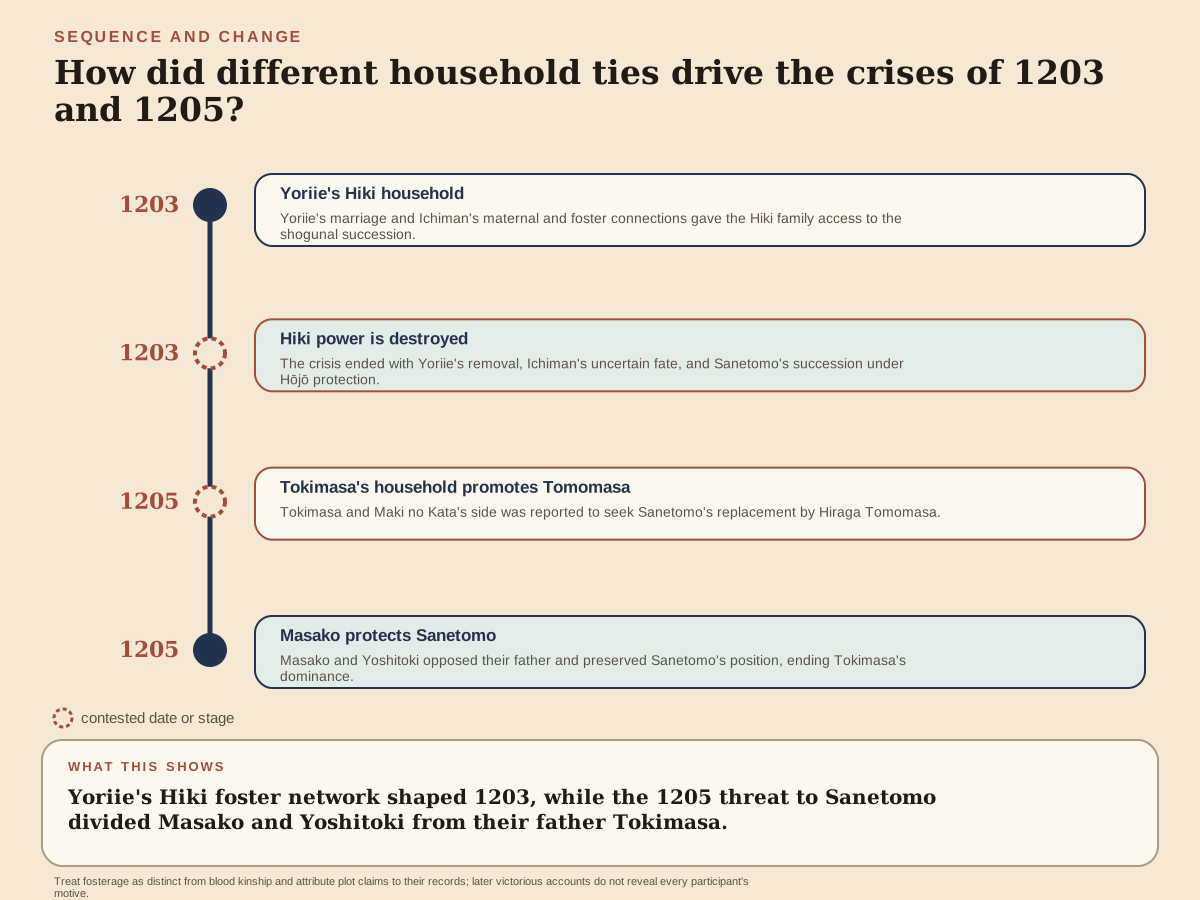
Yoriie's marriage and nurture networks tied him to the Hiki; his wife Wakasa no Tsubone and their son Ichiman gave that family a route to succession. In 1203, while Yoriie was gravely ill, the Hiki and Hōjō competed over the future. The Hiki were destroyed, Ichiman died in the violence, Yoriie was removed and sent to Izu, and Sanetomo became shogun. Yoriie was killed in 1204.
The Azuma Kagami explains the crisis through a Hiki plot that Masako overheard and reported. Other traditions differ on sequence and deaths, while court evidence contradicts parts of the chronicle's timing around Yoriie. Masako participated in the transfer of power, but neither innocence nor total authorship can be proven from the victors' fullest record.
In 1205 Hōjō Tokimasa and his wife Maki no Kata were associated with accusations that led to the killing of the respected warrior Hatakeyama Shigetada and his son. Conflict then centered on a reported plan to remove Sanetomo and elevate their son-in-law Hiraga Tomomasa. Masako and Yoshitoki transferred Sanetomo away from Tokimasa's control and forced their father into retirement; Tomomasa was killed in Kyoto.
The sequence reveals no unified “Hōjō will.” Masako acted against her father and his marital branch to preserve Sanetomo and the coalition. Later tradition often makes Maki no Kata a convenient female instigator, but armed men made the accusations and killings. Household marriage organized factions; it did not absolve their participants.
Sanetomo remained shogun after 1205 while Yoshitoki exercised growing administrative authority and Masako guarded the founder-household's continuity. Sanetomo was constrained but not empty: he cultivated waka, court ritual, religious patronage, and high aristocratic rank. His court-facing program offered legitimacy and created its own relationships.
In 1218 Masako traveled west under the framework of pilgrimage and met Fujiwara no Kaneko, a powerful woman close to Retired Emperor Go-Toba. Masako received third and then second court rank, with the formal name Masako appearing in this context. Discussion concerned a possible imperial successor to Sanetomo. The negotiation demonstrates female court–Kamakura diplomacy, but it did not guarantee a prince would be sent under every future condition.
In 1219 Sanetomo attended a ceremony at Tsurugaoka Hachimangū celebrating his appointment as right minister. Kugyō, Yoriie's son and a cleric associated with the shrine, assassinated him and was soon killed. Sanetomo left no child; Masako had now outlived her husband, daughters, both shogunal sons, and the direct Minamoto succession through them.
Later theories implicate Yoshitoki, Masako, Miura, or wider factions, but no secure evidence proves a larger command behind Kugyō. The shrine was simultaneously sacred center, ceremonial stage, and site of political murder. Masako's response joined grief to succession emergency. Her later memorial patronage for Sanetomo has material traces; it should not be treated as proof for or against undocumented conspiracy.
After Sanetomo's death, Kamakura sought an imperial prince, but Retired Emperor Go-Toba refused the request. A compromise successor came from the Kujō branch of the Fujiwara: the infant Mitora, related through his mother's line to Yoritomo's family, arrived in Kamakura in 1219. He later became Kujō Yoritsune and was formally appointed shogun only in 1226.
During the child's minority, Masako represented continuity with the founder and exercised exceptional political direction beside Yoshitoki and senior administrators. Later memory calls her ama-shōgun, “nun-shogun.” The label recognizes real power but was not the court office she held. Her authority worked through guardianship, rank, household access, mediation, and coalition legitimacy rather than a secret female version of the shogunal patent.
In 1221 Retired Emperor Go-Toba issued an order for Hōjō Yoshitoki's removal or punishment, expecting divisions among eastern warriors. Kamakura leaders chose armed advance rather than passive defense. Masako addressed the gokenin through Adachi Kagemori, invoking Yoritomo's benefits and demanding a choice of loyalty. The action is well attested in later Kamakura narratives, but no stenographic transcript survives; the Azuma Kagami and versions of the Jōkyūki preserve differently shaped speeches.
Eastern armies rapidly defeated court forces. Go-Toba, Juntoku, and Tsuchimikado were exiled under differing circumstances; land and offices were redistributed, and Kamakura strengthened western supervision. Masako helped mobilize the coalition, but commanders, messengers, supply networks, and warriors made victory. The war's victims and political consequences exceeded one famous speech.
Yoshitoki died suddenly in 1224 while his eldest son Yasutoki was serving in Kyoto. The Azuma Kagami presents a plot by Yoshitoki's widow Iga no Kata and her kin to elevate her son Masamura and son-in-law Ichijō Sanemasa. Masako brought Miura Yoshimura back toward Yasutoki, punished members of the Iga network, and helped secure Yasutoki's succession.
Modern scholarship has questioned whether a coherent conspiracy existed or whether Masako used rumor and widow-household rivalry to remove a competing branch. The record describes suspicion and sanctions more securely than a completed plan. Masako's intervention stabilized one succession, but the winning narrative cannot automatically make her action impartial or Iga no Kata naturally treacherous.
Masako died in 1225, conventionally aged sixty-nine. She left no formal shogunal appointment, political testament, or autobiography. She did leave a government whose direct Minamoto line had ended but whose offices, imported shogunal household, Hōjō leadership, and court–warrior relationship had survived successive crises.
Her religious patronage made mourning material. Kōyasan's Kongō Sanmai-in tradition connects her first to memorial work for Yoritomo and later Sanetomo; its surviving pagoda dates to 1223. Kamakura memory likewise associates her with devotional buildings and family memorials, but present objects and statues have different dates. Later ages called her nun-shogun, savior, jealous wife, cruel mother, or female usurper. None alone is the whole person.
Classic
Premodern records did not identify people by modern biographical convention. Women could appear as someone's daughter, wife, mother, lady of a residence, holder of court rank, or tonsured widow. Such designations were socially meaningful: they located authority in relationships and institutions. They also make it difficult to recover a continuous private identity from birth to death.
The conventional year 1157 and Tokimasa's paternity provide a chronological frame, but no contemporary diary opens a window onto Masako's infancy. We do not know her earliest education, preferred devotions, temperament, or expectations. Later tales and biographies repeatedly project determination backward because her adult actions made that quality persuasive. Projection is not documentation.
Source form determines what can safely be claimed. Hōjō Masako's conventional life dates are 1157–1225 and her father was Hōjō Tokimasa. The personal name Masako becomes securely visible in the context of her 1218 court promotion; earlier records commonly identify her by relationship, rank, residence, or tonsured status. That distinction is central to 1157 | A Daughter before the Public Name: an appointment, inventory, diary notice, accusation, and later tale may all preserve information, but they do not carry the same authority or answer the same question.
Her natal household also needs correct scale. The Hōjō were rooted in northern Izu and participated in local administration and warrior society. They were not yet the hereditary rulers of a national military government. Calling the child “daughter of the future regent” uses an office and political order that did not yet exist to explain a family whose later rise remained contingent.
The name problem makes the archive's gender especially visible. Masako's documented court rise in 1218 required a formal name and placed her within rank-bearing language. Earlier narrative commonly uses midaidokoro, “the lord's principal lady,” and after Yoritomo's death forms such as ama-midaidokoro or “the tonsured lady.” These are not evasions of personhood; they show which relationships male record-keepers considered publicly legible.
Silence can tempt two opposite errors. One is to make Masako passive until a male relative activates her. The other is to fill every undocumented year with training for national command. Both confuse what the archive fails to preserve with what a person did or did not possess. Her household life certainly involved skills, obligations, ritual, property, communication, and observation, but the precise curriculum cannot be recovered.
Beginning here protects causation. Masako's later power depended on marriage to an exile, Yoritomo's survival in 1180, the creation of Kamakura, the births and deaths of children, Hōjō alliances, court negotiation, and repeated institutional emergencies. Remove any several of those conditions and “the nun-shogun” is not the predictable result.
The first chapter therefore establishes a bounded person rather than a legend in miniature. She belongs to a household and region; she has relationships the record will later illuminate; she has no foreknowledge of the title by which posterity will compress her. Historical dignity lies not in pretending that destiny was visible, but in allowing a life to acquire consequence over time.
Izu was not a peripheral blank. Landholding rights were layered among cultivators, local managers, estate proprietors, provincial officers, temples, shrines, and armed men able to enforce claims. A dispute might move through documents, personal mediation, threats, ritual oaths, and violence. Household competence meant knowing people and obligations across those forms.
The Hōjō name did not yet identify a centralized ruling house. Tokimasa had standing, resources, and regional connections, while the exact scope of his office and holdings remains difficult to map. Later genealogies arrange descent; they do not reproduce every servant, affinal relative, foster relationship, rival branch, or neighbor through whom action became possible.
Women participated in this order even when records preferred male officeholders. Marriage could transfer residence and attendants; daughters could connect households; widows could retain land, manage devotional property, or speak for children. Broader research on early warrior society warns against imposing the later patrilineal ie as a timeless system. That context does not prove Masako owned a particular estate, but it prevents us from equating missing charters with social nonexistence.
Religious institutions were also practical nodes. Shrines and temples held land, received offerings, offered refuge, authenticated memory, and connected local actors to wider networks. Later stories of Masako and Yoritomo often place decisive movement at Izu-san. The association is important to reception and possibly to protection, but polished scenes must remain distinguished from dated contemporary evidence.
The record of violence requires separate levels of responsibility. The Hōjō were locally rooted in northern Izu before 1180 and should not be projected backward as already dominant national regents. For Izu | The Hōjō before the Regency, authorization, field command, participation, punishment, and later commemoration are related but not interchangeable; keeping them distinct prevents both heroic compression and automatic collective guilt.
Yoritomo's presence created unusual risk. He retained a famous Minamoto identity and traces of former court status, but he lived under punishment. A household that married into his line could gain prestige while exposing itself to authorities that had defeated his father. Before 1180, no one knew that Taira political dominance would fracture or that an anti-Taira call would reach Izu.
Local knowledge later became military infrastructure. Roads, coastal crossings, passes, residence networks, storehouses, and loyalties shaped the first rising and escape from defeat. Yet this knowledge was distributed. Itō, Hōjō, Yamaki, and other households did not share one regional will; Izu produced opponents as well as supporters of Yoritomo.
For Masako, this world supplied practical political literacy without a recoverable syllabus. She would have understood that kinship could bind and divide, that a household's reputation affected safety, and that ritual and material resources traveled together. We cannot turn those reasonable conditions into imaginary childhood lectures.
The Hōjō rose because repeated crises enlarged their position and removed rivals, not because provincial identity secretly contained the regency. Izu should therefore remain a Place with plural actors and layered rights. It explains resources available to Masako and her family while preserving the uncertainty in which every early choice was made.
The sources give outcomes more securely than feelings. Masako and Yoritomo formed a durable union; Ōhime was born; the Hōjō later risked themselves in Yoritomo's rising; Masako moved into Kamakura's principal household. Those facts demonstrate commitment and consequence, but they do not preserve the first private promise between the spouses.
Narrative traditions supplied what the archive lacked. In different retellings, Tokimasa fears punishment, sends Masako toward another match, and the young woman crosses difficult terrain to return to Yoritomo. A dream may assign world-order symbolism to the union. Temples and shrines become places of protection. Such stories are historically important because they shaped Masako's remembered character, not because every scene has equal evidentiary force.
Calling the marriage “political” does not solve the problem. A planned alliance normally assumes identifiable benefits. Yoritomo in exile had pedigree but little coercive power; connection to him could attract surveillance or reprisal. Tokimasa may have recalculated over time, and Masako may have exercised preference, but no preserved agreement outlines a program for national conquest.
Nor does emotional seriousness require a modern ideal of exclusive romantic marriage. Elite warrior households organized sex, offspring, residence, nursing, and inheritance in forms that do not map neatly onto modern expectations. Traditions concerning Yoritomo's relationship with an Itō woman and an infant son's death remain source-sensitive, yet they remind us that Masako's marriage entered an already complicated local social world.
Ōhime's birth gave the union a new public dimension. A child connected lineages and embodied a future that could be used for alliance. She was also a daughter whose later suffering would expose the violence of treating household members as political bonds. The family's political history begins before sons and formal succession.
Marriage also reorganized information. Masako could connect Yoritomo to her father's and siblings' household; Yoritomo brought old attendants, prestige, and external news. People serving either spouse could become messengers or witnesses. This is mechanism, not proof that Masako secretly administered a conspiracy during two decades of exile.
Campaign chronology disperses agency across a coalition. Masako married the exiled Minamoto no Yoritomo in Izu and their daughter Ōhime was born before the 1180 rising. In Before 1180 | Marriage without a Surviving Love Letter, command depended on routes, provisions, messages, local adhesion, and the willingness of other houses to act. Victory or defeat cannot by itself prove a single prior plan.
The couple's later partnership did not erase conflict. Yoritomo had other sexual relationships; the Kame-no-mae episode survives through a morally shaped later account in which Masako retaliates against a residence. It should not be used to diagnose her as a timeless jealous archetype, but it does show how household arrangements could become public political disputes involving Tokimasa and retainers.
A balanced chapter therefore keeps two truths together. Masako's choice and attachment mattered; the marriage's institutional consequences mattered. The lost private language cannot be recovered by choosing romance over politics or politics over romance. What history can show is the shared exposure created when a locally placed woman and a punished heir made one household before either possessed national power.
Battle chronicles privilege visible command. They list mounted followers, wounds, routes, and enemy positions. Household members appear intermittently—when they flee, give birth, receive news, enter a residence, or become targets. This structure can make noncombatants seem absent from events whose consequences surrounded them.
Masako should not be given invented weapons or orders to compensate. Agency does not require battlefield command. She had to preserve herself and a child, judge where safety lay, rely on messengers and religious or kin networks, and prepare for incompatible outcomes. Every person who sheltered her accepted risk; every delayed report could change a decision.
The initial attack at Yamaki was local and operationally fragile. Yoritomo needed Hōjō participation and other supporters, but opponents in Izu and Sagami possessed superior immediate force. Ishibashiyama demonstrated that prestige did not compel eastern loyalty. Ōba Kagechika and allied warriors fought for a different political alignment and nearly ended the rising.
Defeat widened the geography of danger. Yoritomo's escape depended on guides, concealment, maritime passage, and people who declined to capture him. Tokimasa pursued alliance in Kai; other survivors used separate routes. Masako could not experience these movements as the clean recovery sequence known to later historians. She faced fragments of news and the possibility that the revolt had already failed.
Stories placing her at Izu-san preserve a meaningful relationship between sacred refuge and political survival. Temples and shrines could provide networks, terrain, and moral protection. Yet a later shrine tradition cannot establish an exact diary for every night. Publication can retain the Place connection while marking the evidentiary layer.
Ōhime made the stakes intergenerational. If Yoritomo were killed, a daughter connected to his line could still carry danger. Collective liability reached homes, dependants, and affines because medieval rebellion was not prosecuted only against uniformed combatants. Masako's position was political before she issued any public directive.
Recovery required other households' independent choices. Chiba, Kazusa, Miura, and many smaller actors enlarged Yoritomo's coalition after the Awa crossing. The Hōjō did not deliver the Kantō as a dowry. Masako's natal kin became central within a plural alliance whose strongest members possessed their own land, followers, and objectives.
Entering Kamakura changed Masako's role. She was no longer principally the wife of an exile under supervision. She became the principal woman of a household receiving military service, petitions, ritual honor, and dynastic expectation. That transformation was not an automatic reward for courage; it depended on survival and coalition work beyond her control.
Armed outcome came after political and logistical choices. Izu contained layered provincial, estate, religious, transport, and warrior networks rather than an isolated exile landscape. These details give 1180 | Rebellion Reached the Household its scale: named leaders mattered, but forces moved through contingent alliances and material constraints that no protagonist could wholly control.
The shared Event architecture therefore assigns distinct routes. Yoritomo commands and recruits; warriors fight; local networks shelter and transport; Masako and the household bear, navigate, and later institutionalize the rebellion's risk. No route needs to appropriate another person's acts in order to remain historically consequential.
Early Kamakura institutions grew within a lord's household. The Ōkura complex had halls for reception, gates and guards, kitchens, stables, storehouses, clerical work, ritual space, and residences nearby. A visitor's access to the ruling family could affect petitions, appointments, marriage plans, and recognition. Domestic service and administrative service overlapped.
The archive preserves consequence more clearly than interior intention. Broader early warrior-society research does not support treating women's property and household roles as invisible under a timeless later patrilineal ie model; this is context, not a specific Masako land grant. A responsible reading of 1180–1192 | The Interior of Kamakura Government therefore uses convergence to establish action and outcome, yet leaves contested causation, remembered speech, and retrospective moral order visibly unsettled.
Masako's position as midaidokoro was relational but not vague. She was the principal wife of the coalition's leader, mother of potential heirs, and head of an attendant network. Ceremonies placed her publicly; illnesses and pregnancies generated formal prayers; messengers carried news of her condition. Rank and residence made an interior household publicly legible.
The 1182 pregnancy illustrates material consequence. Tsurugaoka Hachimangū had been relocated and developed as a central shrine. Wakamiya Ōji's traditional construction history connects its broad approach to prayers for safe delivery. Building a ceremonial road required land, drainage, surfaces, labor, and the reorganization of an existing settlement. Dynastic hope altered urban space.
Ritual cannot be reduced to propaganda. Masako and others could sincerely seek divine protection while the ceremony also displayed order and mobilized followers. Priests, shrine personnel, craftsmen, bearers, and donors participated. A birth mattered to political continuity precisely because maternal and infant mortality made succession precarious.
Household access formed factions before they looked like factions. Wet nurses, their children, attendants, foster relatives, and affines developed proximity to Yoritomo's children. Hiki no Ama's long connection to Yoritomo and the Hiki role around Yoriie later became politically decisive. The Hōjō were one powerful route into the family, not the only kin network.
Gendered evidence distorts scale. Documents more often preserve male officeholders who signed, witnessed, fought, or litigated. Women can disappear even when their service organized residence, child care, devotion, or communication. Conversely, later stories may assign a dramatic act to one famous woman and erase the attendants who made it possible. Both problems require a network model.
Masako's authority had limits. Yoritomo made military and legal decisions, cultivated other relationships, and could act against her wishes. The Kame-no-mae narrative, whatever its shaped details, shows household conflict spilling into retainer discipline and relations with Tokimasa. Principal-wife status did not make marriage or governance harmonious.
The household also bore costs of Yoritomo's consolidation. Children could be hostages or alliance instruments; defeated relatives could be killed; grief could be subordinated to security. Masako's access did not guarantee protection for everyone she valued. Proximity to the ruler increased exposure to decisions as well as capacity to influence them.
Kamakura's political interior therefore explains later intervention. After Yoritomo died, Masako did not enter government from nowhere. She already knew its followers, ritual calendar, children, residences, rival kin networks, and memory. That knowledge was not a formal office, but it was accumulated institutional capital embedded in relationships and place.
Succession requires more than naming an heir. A child needs attendants, nurses, tutors, guards, property, rituals, marriage alliances, and recognition by adult followers. Each support creates another household with access and expectations. The system designed to protect continuity can multiply competitors around it.
Yoriie's birth was celebrated because a son could inherit Yoritomo's lordship. Yet he grew through Hiki-connected nurture networks rather than under an abstract state. Hiki no Ama's earlier support for Yoritomo made her relatives trusted; Hiki Yoshikazu's daughter later married Yoriie and bore Ichiman. Maternal and foster relationships joined affection, service, and future political leverage.
Sanetomo's birth ten years later supplied an alternative male line within the same household. It did not make him a planned rival at infancy. His separate attendants and later court connections nevertheless created another route by which followers could imagine continuity. When Yoriie's position collapsed, that route became usable.
Campaign chronology disperses agency across a coalition. Masako married the exiled Minamoto no Yoritomo in Izu and their daughter Ōhime was born before the 1180 rising. In 1182–1199 | Motherhood Was a Succession System, command depended on routes, provisions, messages, local adhesion, and the willingness of other houses to act. Victory or defeat cannot by itself prove a single prior plan.
Ōhime's life reveals a different burden. Yoritomo accepted Kiso Yoshitaka, son of the competing Minamoto leader Yoshinaka, as a hostage-betrothed. After Yoshinaka's defeat, Yoritomo ordered Yoshitaka's death. The Azuma Kagami depicts Masako and Ōhime aiding an attempted escape; the exact scene belongs to received narrative, while the hostage's killing and the daughter's connection are secure.
Later record associates Ōhime with prolonged distress. It is responsible to acknowledge suffering without retroactively diagnosing a modern psychiatric condition from stylized descriptions. Yoritomo later explored a court marriage for her, including the 1195 Kyoto journey and negotiation, but she died in 1197 before any such future was realized.
The younger daughter also became part of court-facing plans and died in 1199, not long after Yoritomo. Her various names in scholarship reflect the gendered record. The loss mattered politically because it narrowed dynastic alliance, and personally because Masako had now buried two daughters in close succession.
Masako's motherhood was therefore not a single source of “maternal power.” She could advocate, arrange ritual, control access, and embody continuity, yet Yoritomo could make decisions she opposed, illness could defeat every plan, and adult men around each child could convert nurture into faction.
The children must also retain agency appropriate to age. Yoriie later governed and resisted constraints; Sanetomo cultivated court rank and poetry; Ōhime's reported refusal or illness affected marriage plans. Calling them pieces erases the very unpredictability that made succession difficult.
This chapter supplies the human mechanism behind the later Hiki–Hōjō crisis. The conflict did not erupt between impersonal ministries. It grew from households that had fed, guarded, married, and represented particular descendants. Masako stood across those bonds as mother, Hōjō daughter, founder's wife, and principal lady. No one identity could resolve the collisions created by the others.
Elite tonsure changed social identity without automatically erasing worldly rights. A widow might dedicate herself to memorial practice, manage property, supervise descendants, or act through a religious household. Renunciation and continued responsibility could coexist. Treating vows as theatrical disguise misunderstands devotion; treating them as complete retirement ignores practice.
Yoritomo's death removed the person who connected military followers, court recognition, household memory, and adjudication. Offices survived, but his individual promises and judgments could not simply be inherited as files. Followers needed to know whether Yoriie would recognize service and whether senior adults could constrain a young lord.
The familiar “thirteen-man council” comes from the Azuma Kagami's account of restricting direct litigation and channeling decisions through experienced men. Membership is important, yet the phrase can imply a permanent cabinet or collective coup at one instant. The arrangement changed as participants died, fought, or were removed. Yoriie also continued to act; he was not merely a vacant chair.
Masako did not appear on the standard male list. That absence illustrates rather than disproves her different route. She could speak as Yoriie's mother, control or influence household access, invoke Yoritomo's memory, and coordinate with Tokimasa or Yoshitoki. She did not need to sign every judgment to affect which coalition could govern.
Widowhood also separated her symbolically from remarriage. As the founder's tonsured principal wife, she could continue to represent his household rather than entering another husband's line. This continuity later made her appeals to Yoritomo's service relationships credible. It was a resource created by loss, not a formal grant of sovereignty.
Temple and shrine history makes the political field larger, not less concrete. Yoritomo died in 1199; Masako took Buddhist vows and continued acting as ama-midaidokoro rather than retiring from every public role. For 1199 | Tonsure without Disappearance, sacred authority moved through people, documents, provisions, buildings, and repeated rites, so neither private belief nor state command alone explains the result.
The Hōjō were still internally plural. Tokimasa's authority as maternal grandfather, Yoshitoki's growing administrative position, and Masako's founder-household status overlapped but did not always align. Later events would see Masako act against her father to protect Sanetomo and the regime.
Buddhist activity provided material continuity. Memorial rites required land, buildings, images, sutras, clergy, and funding. Masako's later patronage for Yoritomo, daughters, and Sanetomo was neither separable from politics nor reducible to it. It created durable places where family grief became public religious memory.
The source order complicates every interpretation. The Azuma Kagami was compiled under later Hōjō authority and tends to make the route toward regency intelligible. Court diaries observe different matters. Religious objects can establish patronage but rarely disclose political motive. No single source gives Masako's private transition from wife to widow.
The decisive continuity was relational knowledge. She had spent nearly two decades at the center of Kamakura's household, knew the children and their attendants, and had participated in ritual and alliance. Tonsure did not create that capital. It changed the social form through which she could use it when succession exposed the regime's fragility.
The outcome is not in doubt. Hiki Yoshikazu and his household were attacked in 1203; the Hiki political route was broken; Yoriie lost authority; Sanetomo succeeded under stronger Hōjō control. Any account that treats this as an ordinary family misunderstanding minimizes organized violence and regime change.
The factions were not simply unrelated parties. Hiki no Ama had supported Yoritomo; her kin helped raise Yoriie. Hiki Yoshikazu's daughter was Yoriie's wife and Ichiman's mother. The Hōjō were Yoriie's maternal family through Masako. Competing maternal and foster networks each claimed closeness to the same founder's line.
Yoriie's grave illness created an information crisis. Reports of dying, recovery, succession division, and orders traveled among Kamakura and Kyoto. Court diaries and the Azuma Kagami do not align perfectly. That disagreement matters because later chronology can make a seizure of authority look like an orderly response to an already vacant office.
The Azuma Kagami presents Masako overhearing Yoriie and Hiki Yoshikazu planning to eliminate Tokimasa, then warning her father. The scene creates necessity: Hōjō violence becomes preemption. As a compiled narrative rather than a contemporary transcript, it can preserve knowledge while also arranging motive in favor of the regime's ancestors.
The Gukanshō tradition supplies a different angle on the crisis and the fate of Ichiman. Variation does not mean nothing happened; it means exact rooms, conversations, and sequences should not be assigned the same confidence as removal, attack, and death. Source disagreement belongs in the story rather than in a footnote that leaves the dramatic version untouched.
Masako's position was morally and politically divided. Yoriie was her son; Ichiman her grandson; Tokimasa her father; Yoshitoki her brother; Sanetomo her younger son. Helping move authority away from Yoriie may have seemed necessary to prevent one household from dominating or to secure Sanetomo. It also enabled a purge from which her natal kin gained.
Yoriie retained agency and conflict. Later Hōjō-centered portrayal often makes him rash, sexual, arbitrary, or unfit, a characterization that helps legitimate restriction. His youth and decisions require examination, but personality alone cannot explain a structural contest over access to the shogunal house.
The archive preserves consequence more clearly than interior intention. Hiki no Ama and her kin formed a foster and wet-nurse network around Yoritomo and Yoriie, later reinforced by Yoriie's marriage and Ichiman's birth. A responsible reading of 1203–1204 | Yoriie, the Hiki, and the Victors' Archive therefore uses convergence to establish action and outcome, yet leaves contested causation, remembered speech, and retrospective moral order visibly unsettled.
After exile at Shuzenji, Yoriie was killed in 1204. The fact of violent death is secure; the precise operational chain and Masako's knowledge are not. Saying only that he “died” hides coercion, while making his mother issue an undocumented killing order turns inference into fact.
Masako should therefore remain implicated without being flattened into archetype. She helped a political transfer that destroyed one son's network and elevated another. She also lost son and grandson within that transfer. Historical rigor does not make the contradiction comfortable; it refuses both the saintly mother and the naturally cruel woman produced by later moral biography.
Kinship in this episode functioned as political infrastructure. In 1205 accusations against Hatakeyama Shigetada and his son led to their killing under the Tokimasa-centered coalition. The relationships inside 1205 | Removing Tokimasa carried nurture, inheritance, access, alliance, and succession claims, but they did not erase the separate interests of the people joined by them.
Hatakeyama Shigetada represented a powerful and respected eastern house with long service. His son Shigeyasu became entangled in hostility involving Hiraga Tomomasa. Tokimasa and Maki no Kata accepted or advanced charges of rebellion; Hōjō forces mobilized, and Shigetada was killed despite doubts recorded among participants.
The Azuma Kagami later portrays Yoshitoki as reluctant and morally troubled, a framing that distances the main Hōjō line from an unjust purge while condemning Tokimasa's household. That possibility does not erase the event. It requires separating the deaths and mobilization from speeches that distribute guilt advantageously.
Maki no Kata's role needs the same discipline applied to Masako. She was not an irrelevant wife: her children and son-in-law created a real affinal faction, and sources associate her with pressure against the Hatakeyama and plans for Tomomasa. But the familiar “scheming woman corrupts an old man” is a gendered narrative form. Tokimasa held authority; commanders and retainers carried violence; multiple actors expected benefit.
Sanetomo was the institutional prize. If the shogun could be moved or replaced, those who controlled his residence and person could redirect appointment, reward, and legitimacy. Masako reportedly had him taken from Tokimasa's residence to Yoshitoki's. The action was household movement and constitutional intervention at once.
Warrior alignment mattered. Tokimasa could not rule by paternal status alone if leading gokenin declined to support him. Masako's founder-household prestige and Yoshitoki's working relationships helped isolate their father. Retirement and tonsure converted a potentially wider armed struggle into a transfer, though Tomomasa's killing in Kyoto shows the settlement was not bloodless.
Masako's motivation cannot be reduced to maternal rescue. Protecting Sanetomo also protected the remaining source of shogunal legitimacy and the institutional order centered on Kamakura. The two aims reinforced each other. A woman can act from kinship and political judgment without one explanation cancelling the other.
The crisis also proves that “Hōjō regency” is a retrospective simplification. Tokimasa, Masako, Yoshitoki, Maki no Kata, and their affinal partners pursued conflicting routes. The durable line emerged by defeating other Hōjō-centered possibilities, not by obeying an inherited family plan.
Hatakeyama loss remained the moral cost. Stabilization language can hide that a major household was destroyed through allegations whose fairness was doubted even in the received account. Masako's later role in removing Tokimasa did not restore the dead or separate her coalition entirely from the violence that preceded the break.
After 1205, Yoshitoki's position strengthened and Masako became harder to bypass. She had shown that the founder's widow could move the shogun and help withdraw recognition from a regent. This was still not appointment as sovereign. It was relational authority becoming decisive at a crisis point—and thereby reshaping the institution it preserved.
After Yoriie's fall and Tokimasa's removal, it is tempting to call Sanetomo a puppet. The label converts structural constraint into personal emptiness. He could not freely command every military household, and Yoshitoki's administrative network was formidable, yet Sanetomo received petitions, advanced in rank, patronized ritual, and produced poetry that survives independently of Hōjō chronicle praise.
Masako's maternal relationship to him differed from her relation to Yoriie. She had helped elevate Sanetomo and then protect him from Tokimasa. That history gave her access but also responsibility for a son whose office rested on the destruction or removal of close relatives. The archive does not preserve an unbroken record of their private trust.
Source form determines what can safely be claimed. The personal name Masako becomes securely visible in the context of her 1218 court promotion; earlier records commonly identify her by relationship, rank, residence, or tonsured status. That distinction is central to 1205–1218 | Mother of a Shogun Who Was Not a Puppet: an appointment, inventory, diary notice, accusation, and later tale may all preserve information, but they do not carry the same authority or answer the same question.
Sanetomo married Bōmon Nobuko from a high court family, bringing another female household and Kyoto route into Kamakura. His devotion to court forms and promotions can be interpreted as cultural ambition, political strategy, or both. Court rank was not a harmless ornament: it situated the shogun within an order whose highest offices the Hōjō themselves did not occupy.
Masako's 1218 journey shows that succession planning preceded the assassination. Traveling in association with Kumano pilgrimage allowed devotion and diplomacy to coexist. In Kyoto she met Fujiwara no Kaneko, a woman whose proximity to Go-Toba and court household networks made her a consequential intermediary.
The encounter impressed the contemporary monk Jien enough that the Gukanshō framed these powerful women as bringing affairs to completion. His language is interpretation, not a constitutional record, but it establishes that contemporaries could perceive women—not only male regents—as conducting high politics between centers.
Masako was promoted to court rank during this visit, reaching the second rank later in 1218. Formal documents needed a name, helping explain why “Masako” becomes securely visible so late. Rank gave ceremonial precedence and made her legible at court; it did not appoint her shogun or regent.
Succession discussion contemplated a son of the sovereign or another imperial connection after Sanetomo. This planning acknowledged Sanetomo's lack of an heir and the danger of direct-line extinction. It also assumed that court and Kamakura interests could be joined through a child whose custody and future authority would have to be negotiated.
The agreement's limits became clear in 1219. Sanetomo's death altered bargaining conditions, and Go-Toba refused the immediate imperial-prince request as Kamakura presented it. A plan discussed between intermediaries was not a self-executing contract that bound the retired sovereign regardless of political change.
Masako's work here should not be rewritten as either maternal anxiety or Hōjō strategy alone. She was protecting a succession system, negotiating her son's future, pursuing pilgrimage, and gaining rank. Her career demonstrates that political women operated across religious, household, and court forms rather than through a separate category called “female influence.”
The ceremony had public meaning. Sanetomo's elevation to right minister placed the warrior lord extraordinarily high within court hierarchy. Procession, dress, shrine space, attendants, and precedence made his status visible. Tsurugaoka Hachimangū joined Minamoto memory to Kamakura legitimacy; violence there transformed ritual display into dynastic rupture.
Kugyō had his own relation to the succession. As Yoriie's son, he descended from the displaced second shogun and belonged to a line destroyed or excluded in the 1203–1204 settlement. His clerical position did not erase political genealogy. The act can be understood within that grievance without assuming that every detail of his thought is preserved.
The Azuma Kagami supplies a dramatic sequence, including weather, procession, positions, the attack, and pursuit. Other records confirm the core event while differing in detail. The chronicle's later Hōjō setting makes its distribution of absence and suspicion important: a precise scene is still not direct access to planning.
Conspiracy theories grow because several actors benefited or behaved in ways later readers find suspicious. Yoshitoki did not stand where he might have; Miura connections touched Kugyō's last movements; the Hōjō became stronger after the Minamoto line ended. Benefit, absence, and later dominance are prompts for investigation, not proof of an order.
Succession was made through relationships before it appeared as an office list. Masako and Yoritomo's children included Ōhime, Yoriie, a younger daughter often called Ōtohime or Sanman, and Sanetomo. These constraints deepen 1219 | Sanetomo's Murder and the End of Her Direct Line by showing how maternal lines, spouses, children, retainers, and rival branches could preserve a regime or turn one death into an institutional crisis.
Masako's putative involvement is especially vulnerable to stereotype. A powerful mother who had participated in earlier succession violence becomes easy to imagine sacrificing her remaining son for family control. The hypothesis conflicts with no universal law of politics, but the archive does not establish it. Biography must not use an already gendered reputation to fill missing evidence.
The personal loss was cumulative. Ōhime died in 1197, Yoritomo and the younger daughter in 1199, Yoriie in 1204, and Sanetomo in 1219. Political language such as “line extinction” is accurate but thin. The dead were also family members whose memorial care occupied land, ritual, objects, and time.
Sanetomo's widow and attendants possessed grief routes of their own. Many took vows. Masako was not the only bereaved woman or the sole custodian of his memory. A whole household lost its lord, while the broader government had to prevent ceremonial attendance and factional rumor from becoming war.
Memorial building makes grief visible without giving us a private transcript. Masako supported Buddhist works connected to Yoritomo and Sanetomo, including development at Kōyasan. A surviving pagoda dated to 1223 demonstrates patronage and craft after the crisis. Its material endurance is stronger evidence of action than later claims about every motive.
The assassination ended one method of legitimacy: adult sons directly descended from Yoritomo and Masako. It did not end Kamakura's offices, warrior relationships, or court dependency. Masako's next political task was therefore paradoxical—preserve her husband's institution by finding a lord outside the direct family whose extinction made her uniquely authoritative.
Kamakura needed a recognizable lord. Its judgments and military relationships had developed under successive Minamoto heads, yet no direct son remained. Simply declaring Yoshitoki shogun would have collapsed the distinction between Hōjō administration and the superior household whose authority it served.
An imperial prince offered prestige but also risk. Custody of a sovereign's son would intensify court involvement, and Go-Toba could refuse to place one under Hōjō control. The refusal after Sanetomo's assassination demonstrates that earlier succession conversation did not eliminate the retired sovereign's agency or suspicion.
Mitora provided another route. His father Kujō Michiie belonged to the regent house; through his mother he carried a genealogical connection to Yoritomo's family. Kinship was constructed widely enough to support continuity while his infancy ensured that adult Kamakura leaders would govern in practice.
Arrival did not equal immediate shogunal appointment. Mitora was a child head and symbolic center before the court conferred the title in 1226. Conflating 1219 and 1226 makes office seem automatic. The interval reveals negotiation between household recognition, effective governance, age, rank, and formal court authorization.
Masako's role resembled guardianship and regency in function without being reducible to either modern category. She could receive reports, mediate disputes, direct senior men, protect the child's position, and invoke Yoritomo's memory. Yoshitoki controlled major administrative and military mechanisms; Ōe no Hiromoto and other veterans contributed counsel. Authority was distributed but not equal.
The phrase ama-shōgun is therefore both valuable and dangerous. It corrects narratives that make Masako disappear after becoming a widow. It can also suggest a formal appointment for which there is no evidence, or make every action the execution of one woman's sovereign will.
Religious action here also operated as institution. After Sanetomo's death, Go-Toba refused Kamakura's immediate imperial-prince request and the infant Mitora from the Kujō line came to Kamakura in 1219. Within 1219–1220 | A Child from Kyoto and the Making of “Nun-Shogun”, devotion, office, land, personnel, ritual authorization, and political access must be separated before they can be related; none is simply a decorative expression of the others.
The history of the label itself belongs to reception. A medieval source tradition eventually used a comparable term, while later biographies, theater, education, and popular media made it central. The designation gathers her unusual power into two words; it does not reproduce the titles by which documents and contemporaries addressed her.
Infancy made household labor constitutional. Whoever selected nurses, guarded rooms, controlled audiences, transmitted decisions, and managed ritual access shaped the future lord. Women and attendants around Mitora were therefore part of government even where the record names male officials. Masako's long experience of succession households was directly relevant.
The settlement also changed the shogunate. The lord could now be imported from a court family while Hōjō-led institutions maintained daily rule. That division created stability and future tension: a maturing shogun might develop independent allies, while regents could treat the lord as replaceable. Masako preserved the office by helping turn dynasty into a renewable relationship between Kyoto pedigree and Kamakura control.
The crisis targeted Yoshitoki by name, but its implications reached every warrior whose land and status depended on Kamakura judgments. Go-Toba appears to have expected that opposition to one Hōjō leader could detach other eastern houses. That was not irrational: the coalition had experienced purges, family conflict, and competing ties to court.
Masako could reframe the order. By invoking the late Yoritomo's favors, she presented an attack on Yoshitoki as a test of the shared service order created since 1180. Whether each later sentence reproduces her words is less important than the political operation: individual resentment was converted into collective memory and collective risk.
The Azuma Kagami places the appeal in Masako's voice but says Adachi Kagemori delivered it to assembled warriors. Different Jōkyūki lines preserve related yet distinct orations. Both are later textual forms shaped by moral and literary needs. Convergence supports an important mobilizing intervention; variation forbids quotation as unmediated sound.
Memory of “benefits” had material content. Warriors held confirmed lands, appointments, documents, and expectations of judgment through relationships traced to Yoritomo. Some had also suffered under Kamakura. Masako's credibility did not rest on sentiment alone; she asked them to calculate what court victory might do to the rights and reputations created under the founder.
Senior counsel shaped strategy. The received account credits Ōe no Hiromoto with urging immediate advance rather than waiting at eastern defenses. Yoshitoki, Yasutoki, Tokifusa, Miura Yoshimura, and other commanders had distinct operational roles. Masako's assent or authority helped settle the choice, but she did not personally direct every column.
The armies moved along multiple routes and depended on provisions, horses, river crossings, local guides, and rapid adhesion. The Azuma Kagami's enormous final cavalry figure communicates scale and legitimacy, not an audited roster. Victory in about a month reflects court-force weakness and eastern mobilization, not a magical transformation caused by rhetoric.
Go-Toba was a political actor, not a ceremonial fool. He had managed court networks, warriors, succession, and religious patronage, and he sought to alter an increasingly intrusive balance. His defeat should not retroactively erase the grievances and calculations that made confrontation possible.
The settlement was severe. Retired sovereigns were exiled; court participants were punished or killed; estates changed hands; eastern warriors received western land; the Rokuhara apparatus strengthened Kamakura's presence in Kyoto. Cultivators and estate communities experienced new managers and enforcement. “Bakufu victory” names an institutional result, not the total human story.
Armed outcome came after political and logistical choices. In 1221 Go-Toba issued an order against Yoshitoki and Kamakura mobilized a rapid military advance that defeated court forces. These details give 1221 | The Jōkyū War and a Speech We Do Not Possess Verbatim its scale: named leaders mattered, but forces moved through contingent alliances and material constraints that no protagonist could wholly control.
Masako's speech became memorable because it joined gender, widowhood, founder memory, and military decision. Its historical importance survives source criticism. Indeed, refusing a false transcript makes her achievement clearer: she did not win through immortal phrasing alone. She possessed enough recognized authority to make a divided coalition hear its obligations as a common cause.
“Iga clan revolt” sounds like an armed uprising with recoverable plans and participants. Yet the received sequence begins after Yoshitoki's unexpected death, when authority, household headship, the child shogun's guardianship, and the regency all became vulnerable. Rumor itself could mobilize alignments before anyone launched open violence.
Succession was made through relationships before it appeared as an office list. Yoshitoki died suddenly in 1224 while Yasutoki was serving in Kyoto, creating a succession interval. These constraints deepen 1224 | The Iga Affair and the Danger of a Solved Plot by showing how maternal lines, spouses, children, retainers, and rival branches could preserve a regime or turn one death into an institutional crisis.
Yasutoki was the senior son and had commanded in the Jōkyū War, but he was away at Rokuhara. His absence created a practical interval. Yoshitoki's widow Iga no Kata stood within the deceased house; her son Masamura had his own legitimacy; her brother Iga Mitsumune and son-in-law Ichijō Sanemasa provided administrative and court-facing connections.
Historical disagreement · Was the Iga Incident a proven conspiracy?
The Azuma Kagami later frames their activity as a plan to make Masamura regent and Sanemasa shogun. It then shows Masako isolating the faction, securing Miura Yoshimura's support, and preserving the proper succession. This architecture legitimates the Yasutoki line and explains sanctions as defense.
Contemporary corroboration for the full plot is thin. The chronicle's language includes report and suspicion, while the punishments themselves are more visible. Some historians therefore argue that Masako and allies may have magnified or created the conspiracy to prevent Iga influence. That remains interpretation, not a newly proven reverse conspiracy.
Gendered narrative recurs. Iga no Kata can be made another Maki no Kata: a later wife promoting her own son and corrupting succession. But widowhood could carry genuine household authority, and maternal advancement was not uniquely female manipulation. Men around both women sought office, security, and access; Yasutoki's claim was also supported by a kin coalition.
Masako's meeting with Miura Yoshimura, as received, demonstrates relational politics. Miura military weight could decide whether rumor became civil war. Persuading or confronting him was not incidental conversation; it was a means of aligning force before formal arrangements settled.
The outcome was selective. Iga-linked adults were removed or exiled, while Masamura was not permanently destroyed. He later held high office within the Hōjō regime. That future complicates a narrative of indisputable treason and suggests that faction management could separate a useful lineage member from the household accused of promoting him.
Yasutoki's succession helped create the later image of orderly, lawful Hōjō government. Yet order emerged from an emergency in which informal authority, kinship, rumor, and coercive sanction preceded settled procedure. Masako again acted without holding the regent's office and shaped who would occupy it.
This chapter must therefore preserve ambiguity as part of Masako's political character. She was effective, rapid, and willing to punish a rival household. She may have prevented a destabilizing seizure; she may also have defined a rival possibility as conspiracy. The evidence permits neither automatic celebration nor confident condemnation. It shows an aging leader who understood that succession could be decided before proof became complete.
Her death closed an extraordinary span. She had entered the record as the wife of an exile, shared the 1180 reversal, headed Kamakura's principal household, become mother of two shoguns, taken vows, helped displace Yoriie and Tokimasa, negotiated with court women, selected a new child lord, mobilized warriors in 1221, and shaped the 1224 succession. No single office names that sequence.
Institutional survival is a real result, but it was not hers alone. Yoritomo created the initial coalition; warriors and administrators built procedures; Yoshitoki consolidated Hōjō control; court actors authorized and resisted; women and attendants sustained households; Yasutoki developed the next regime. Masako's distinctive contribution was repeatedly making founder-household legitimacy usable when offices alone could not settle crisis.
That work carried responsibility for violence. The Hiki were destroyed, Yoriie removed and killed, Ichiman lost, Tokimasa's faction displaced, the Jōkyū settlement punished court opponents, and the Iga household suffered sanctions. Exact responsibility differs by event, but a biography cannot convert stabilization into moral innocence.
Nor can it assume cruelty as feminine essence. Later political and moral narratives often judged powerful women through jealousy, sexual disorder, bad motherhood, or manipulation of men. Masako's conflict with Yoritomo's other relationship, actions against one son's network, and struggle with other politically active women made her especially available to that template.
The opposite template is also simplifying. Calling her Japan's only female shogun celebrates agency but risks inventing office and centralizing all government in one heroic figure. Recent scholarship asks whether medieval sources perceived her as exercising shogun-like authority, an important reception and institutional question. The answer need not erase the distinction between functional leadership and formal appointment.
Material religion resists some abstraction. Tradition traces Kongō Sanmai-in to her 1211 memorial foundation for Yoritomo and later rebuilding for Sanetomo; a multi-storied pagoda donated in 1223 survives. Timber, joinery, patronage, clergy, land, and ritual made remembrance durable. Its continued fabric does not reveal every prayer, but it confirms action beyond literary reputation.
Objects must remain dated. The familiar seated Masako statue in Kamakura's modern exhibition history is not a lifetime portrait; other images and devotional objects belong to different centuries. A later likeness can be important to memory without showing her face. Likewise, a memorial site can hold accumulated tradition without supplying an uncontested grave.
The sources themselves are part of her afterlife. The Azuma Kagami preserves essential detail while legitimating later Kamakura order. The Gukanshō, court diaries, war narratives, legal memory, temple records, and objects see different Masakos because they ask different questions. Historical rigor keeps them in conversation without flattening them into one omniscient voice.
Masako's most durable significance is architectural in the broad sense. She showed that political authority could pass through widowhood, maternity, religious status, rank, guardianship, memory, and personal access without becoming unreal because it lacked the principal male title. She also showed that such authority could be coercive, partial, and archive-making. The person is larger—and more historically responsible—than either praise or prosecution.