San-no-torii and the city axis
Attraction
Pause inside San-no-torii and look both ways. Northward, the shrine buildings rise in sequence toward the wooded slope; southward, Wakamiya-oji continues through the city. Minamoto no Yoritomo moved the shrine to its present site in 1180, and Kamakura's later urban structure developed around this religious and political center. The avenue was therefore more than an access road: it joined the shrine to the shogunal city and remains a legible north-south axis today. The torii marks the change from street to precinct, but the sightline shows that the two spaces were planned as a relationship rather than as separate attractions. Read the increasing enclosure and elevation ahead before walking on. This first view supplies the scale for the rest of the visit: ponds, ritual spaces, subsidiary shrines and the Main Shrine all occupy positions within an ordered approach, not a loose collection of monuments. Its raised, tree-lined median is the Dankazura, a nationally designated historic site that turns the city avenue into a ceremonial approach.
Current visibility
The surviving setting at Tsurugaoka Hachimangū anchors “San-no-torii and the city axis”; its physical context is the surviving building, the mountain terrain, and the road and path.
Genpei Ponds and Hataage Benzaiten
Attraction
The paired ponds interrupt the straight approach with a landscape shaped by clan memory. The shrine identifies Genji Pond with the Minamoto and Heike Pond with the Taira, and explains the three islands on one side and four on the other through wordplay associated with prosperity and decline. Present that symbolism as the shrine's transmitted account, not as proof of the designer's private intention. On the island in Genji Pond, Hataage Benzaiten is also easy to misdate: the present sanctuary was reconstructed in 1980 from an Edo-period plan for the shrine's eight-hundredth anniversary. Begin from the central approach, where both bodies of water can be read together, then move toward the island if the route is open. The contrast between an old ritual landscape and a modern reconstructed building is the point. What survives here is not one untouched medieval scene, but a place repeatedly interpreted, rebuilt and used.
Current visibility
At Tsurugaoka Hachimangū, “Genpei Ponds and Hataage Benzaiten” remains readable across the pond and water system, the shrine precinct, and the ritual setting; visibility belongs to the landscape relationship described in the body.
Attraction
The east-west horseback-archery range cuts across the shrine's dominant north-south approach. During yabusame, mounted archers in hunting dress gallop past three targets and shoot in succession; at ordinary times, visitors see the course rather than the performance. The shrine connects the rite with an event ordered by Minamoto no Yoritomo, while its annual festival program continues to present it as a living observance. Look down the length of the range so that distance, speed and the spacing of the targets can be imagined without pretending that an empty path is a reenactment. This distinction matters: the physical course is normally visible, but the mounted rite is time-specific and crowd management may change access. Verify the official festival calendar if seeing yabusame is essential. Even on a non-event day, the cross-axis demonstrates that the precinct was designed for ceremonial movement as well as for approaching buildings and offering prayer.
Current visibility
“Yabusame track” can still be read at Tsurugaoka Hachimangū through the performance space, the road and path, and the surviving building; the visibility claim concerns that setting, not a past moment preserved intact.
Attraction
The open Maiden occupies the lower forecourt as a stage for shrine ceremonies and weddings, not as an inner sanctuary. Shrine tradition places it on the site of the Wakamiya corridor where Shizuka Gozen is said to have danced, so the structure carries a remembered performance into present ritual use. Nearby Wakamiya, or Gegu, provides a different chronological lesson. Its present connected main hall, offering hall and worship hall date to 1624 and are designated Important Cultural Property; they are not surviving buildings from Yoritomo's lifetime. Read the two together from the forecourt. The Maiden keeps public performance at the center of the precinct, while Wakamiya embodies a formal sanctuary rebuilt under early-Edo patronage. If a wedding or ceremony is in progress, observe from the permitted edge rather than treating the stage as an exhibit. Their proximity makes continuity visible without collapsing legend, current practice and architectural date into one claim.
Current visibility
The surviving setting at Tsurugaoka Hachimangū anchors “Maiden and Wakamiya”; its physical context is the ritual setting, the shrine precinct, and the corridor.
Great Stone Steps and the ginkgo memory
Attraction
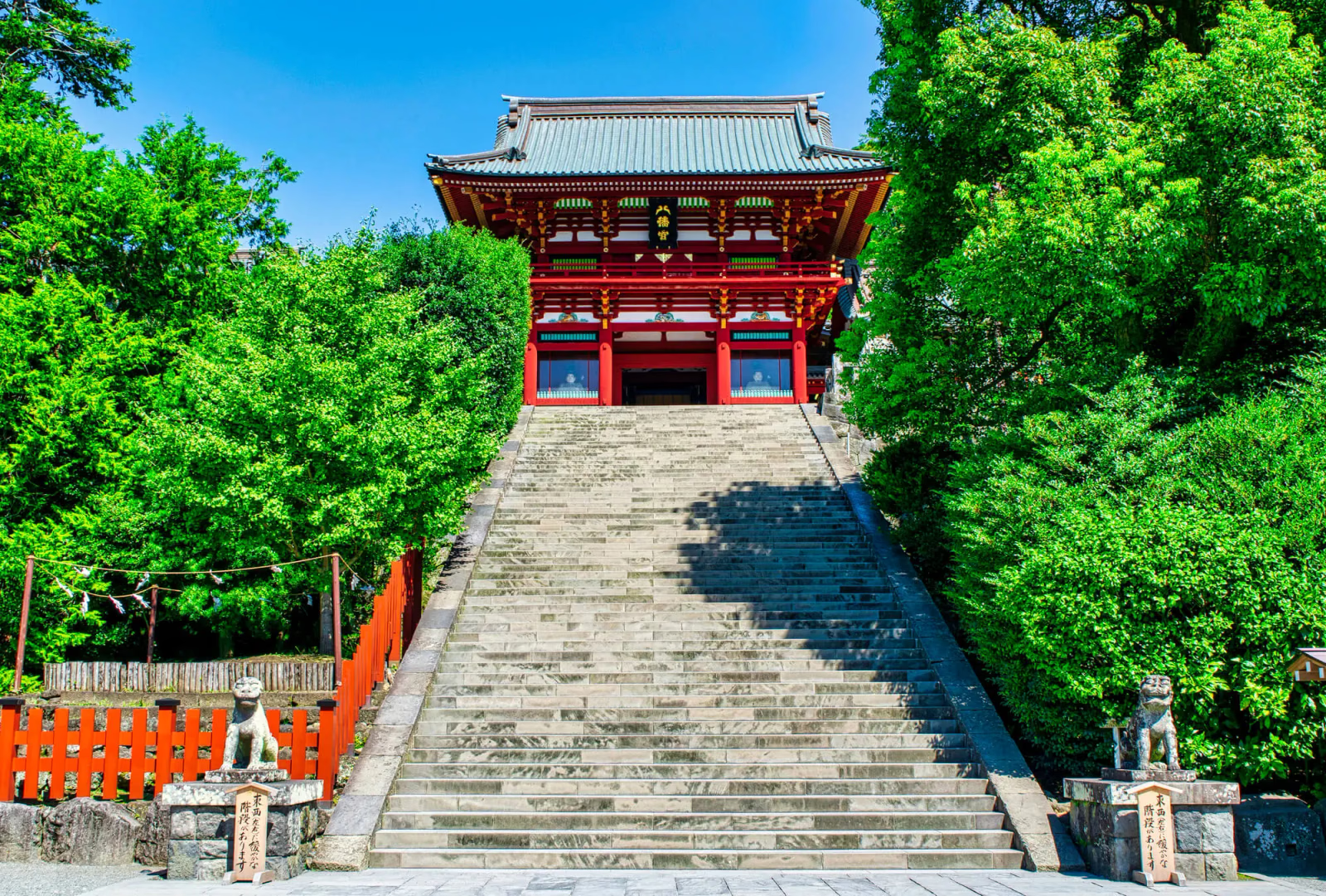
At the Great Stone Steps, the shrine's hierarchy becomes physical: the Main Shrine stands above the broad lower precinct rather than simply farther along it. This is also the setting associated with the assassination of shogun Minamoto no Sanetomo in 1219 after a ceremony. The old tree fell during a storm in 2010. What visitors see now is a deliberately preserved memory: a section of the fallen trunk was moved nearby and new growth was cultivated from the original tree. Look separately at the steep ascent, the surviving memorial arrangement and the historical event they have come to frame. Visitors unable to use the stairs should follow current accessibility guidance rather than assuming the ceremonial ascent is the only route. The setting matters because it combines a still-functioning approach, a documented political rupture and a landscape feature whose present form is recent conservation.
Current visibility
At Tsurugaoka Hachimangū, “Great Stone Steps and the ginkgo memory” is grounded in present on-site evidence—the shrine precinct, the ritual setting, and the stairway—without implying that every historical layer survives as fabric.
Attraction
The Main Shrine, or Jogu, is the ritual summit of the visit and the clearest place to separate institutional history from surviving fabric. After a fire in 1191, Minamoto no Yoritomo established the upper sanctuary and the paired Jogu-Wakamiya arrangement that still organizes the precinct. The complex visible today is later: the upper buildings burned again in 1821 and were rebuilt in 1828 under Tokugawa Ienari. They are nationally designated Important Cultural Property and retain the connected main hall, offering hall and worship hall characteristic of the complex. This is therefore neither a medieval building nor a replica without history. It is an Edo-period rebuilding at a sacred center maintained since the Kamakura age. Read the ensemble from the public threshold. The elevated terrace, vermilion structural members, dark roofs, gates and enclosed volumes concentrate attention after the open lower precinct. Worshippers still approach this as an active sanctuary. Access control is part of the building's current religious function: some sacred areas are not ordinary sightseeing space, and photography or proximity rules should be followed as posted. Avoid using restricted interiors as missing content; the meaningful visitor experience is the transition from the city axis and ponds to a sanctuary whose approach steadily narrows. The present architecture also records later shogunal patronage, preventing Yoritomo's foundation story from swallowing the site's subsequent seven centuries of rebuilding and worship.
Current visibility
The present precinct at Tsurugaoka Hachimangū still carries “Main Shrine”; visitors can ground the text in the shrine precinct, the ritual setting, and the mountain terrain.
Attraction
Maruyama Inari rewards a short detour west of the main axis. The shrine identifies its sanctuary as the oldest surviving building in the precinct, dating its form largely to around 1500 in the Muromachi period; Kamakura City's heritage planning material likewise distinguishes it as an Important Cultural Property. That makes this modest side shrine older in surviving fabric than the monumental Main Shrine rebuilt in 1828. Red votive banners associated with prayers for prosperity surround the building, while a November fire festival includes Kamakura kagura. Keep those living practices separate from the architectural date: the building is historically early, but its use and offerings continue. Look at its small scale, roof and relationship to the slope rather than expecting the visual grandeur of Jogu. The detour changes the chronology of the visit by showing that age and prominence do not coincide. Follow current signs and do not enter areas closed for ritual or maintenance.
Current visibility
At Tsurugaoka Hachimangū, “Maruyama Inari Shrine” remains directly identifiable; the visible reading rests on the shrine precinct, the surviving building, and the reconstructed building.
Attraction
Shirahata Shrine enshrines Minamoto no Yoritomo and Sanetomo, bringing the first and third Kamakura shoguns together in a subsidiary sanctuary. Its black-painted hall is a deliberate visual contrast with the Main Shrine's vermilion. The present buildings also preserve later history: Kamakura City records the main hall's Edo-period form and changes made when it was relocated in the Meiji era. Observe from the public approach and yield to worship or ceremonies.
Current visibility
“Shirahata Shrine” is materially legible at Tsurugaoka Hachimangū, especially through the shrine precinct, the surviving building, and the documentary evidence described in the Highlight.
Kamakura Bunkakan Tsurugaoka Museum
Attraction
This is the Kamakura Bunkakan Tsurugaoka Museum, not the separate Kamakura Museum of National Treasures. It occupies Junzo Sakakura's 1951 former Museum of Modern Art building, which reopened in its present role in 2019 and became a national Important Cultural Property in 2020. Exhibitions interpret Kamakura's history, culture and environment and change over time. Check the museum's own calendar before visiting; the architecture remains a major object even when a particular exhibition is unavailable.
Current visibility
The object or display associated with “Kamakura Bunkakan Tsurugaoka Museum” is not guaranteed on every visit to Tsurugaoka Hachimangū; check current gallery or special-opening notices, while reading the museum display and the surviving building as the stable context.
Attraction
Ima-miya enshrines the retired emperor Gotoba and emperors Tsuchimikado and Juntoku, all linked to the defeated imperial side of the 1221 Jokyu conflict. Shrine tradition dates its establishment to 1247 as an act of pacification, adding the memory of the shogunate's opponents to a precinct identified with warrior government. Access to this small sanctuary can be restricted by ritual use or conservation work; follow barriers and current notices rather than assuming a close view.
Current visibility
The place-specific feature discussed as “Ima-miya Shrine” is anchored by the shrine precinct and the ritual setting, but today's access or operating condition at Tsurugaoka Hachimangū requires a current official check.