Read the article below. Interactive reading tools are available when scripts load.
Quick
Princess Abe was born in 718, the daughter of the future Emperor Shōmu and Kōmyō, who would later become empress. She entered an imperial family in which succession was hereditary but not governed by a simple rule of father-to-eldest-son inheritance. Rank, lineage, the availability of acceptable heirs, and decisions made within the court all shaped who might eventually occupy the throne. The surviving evidence establishes Abe’s birth and family position far more securely than it reveals her childhood, education, or early ambitions.
Her later career would be extraordinary: she ruled first as Empress Kōken, exercised power after abdicating, and returned to the throne as Empress Shōtoku. None of that was predetermined in 718. Her birth matters because it placed her inside the dynasty that governed the ritsuryō state and connected her life to the political and Buddhist world of Shōmu and Kōmyō. The responsible beginning is therefore not a story of destiny, but the position from which future possibilities could emerge.
On January 13, 738, Princess Abe, then twenty-one, was formally appointed crown prince, placing her in the recognized position of heir to Emperor Shōmu. The appointment did not make her accession automatic, but it transformed her public status. She was no longer simply an imperial daughter with possible claims through birth. The court had identified her as the person expected to succeed to the throne.
Abe’s designation must be understood within Nara-period succession rather than through modern assumptions about gender equality. Women of the imperial line had ruled before, and the dynasty did not depend on an unbroken sequence of father-to-son transfers. At the same time, naming a woman crown prince was a consequential political act, not evidence that gender placed no limits on authority. The appointment addressed the needs of dynastic continuity after the loss of Shōmu’s male heir and gave Abe an institutional position around which households, officials, and political expectations could organize. Documents from 739–741 also attest a sutra-copying office associated with her Eastern Palace, showing that heirship acquired an operating religious and documentary environment rather than remaining only a place in a genealogy.
In 749, Emperor Shōmu abdicated and Princess Abe ascended the throne as Empress Kōken. The transfer changed the formal positions of three central members of the imperial household at once: Kōken became the reigning sovereign, Shōmu became retired emperor, and Kōmyō entered the position of empress dowager. Authority passed to a new reign, but the previous generation did not disappear from political or religious life.
Kōken inherited a court shaped by the ritsuryō state, powerful aristocratic networks, and her parents’ enormous Buddhist projects. The Great Buddha had been cast but had not yet reached its consecration, while figures such as Fujiwara no Nakamaro were building their own institutional power. Her accession therefore cannot be understood as a private daughter simply replacing her father. It placed her at the formal center of a government in which offices, retired sovereigns, the empress dowager’s household, temples, and elite families continued to matter. Becoming emperor gave Kōken the highest status in the state; governing required her to operate within this crowded field of authority.
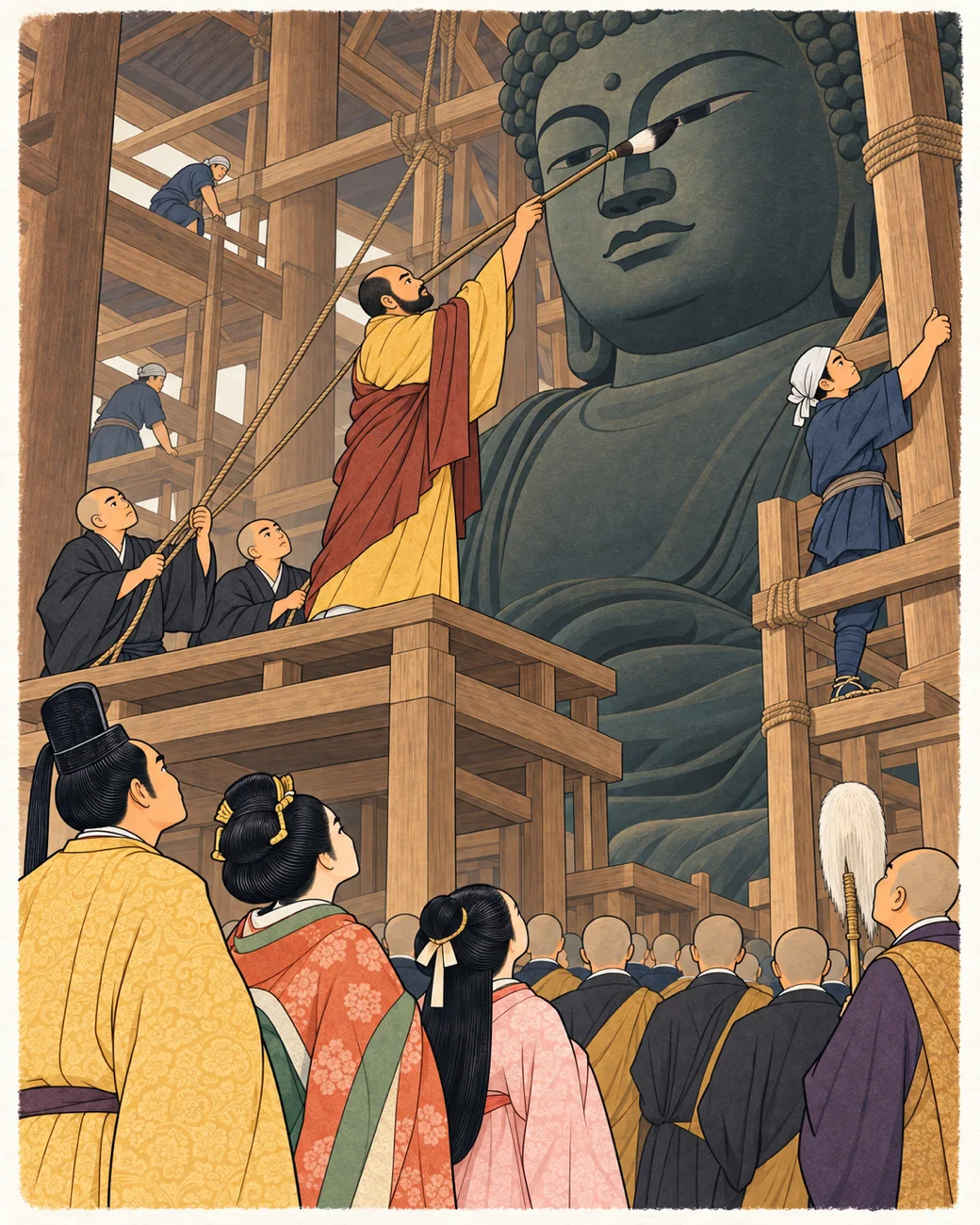
The eye-opening ceremony for Tōdai-ji’s Great Buddha took place on April 9, 752. By then, Kōken occupied the throne, Shōmu had become retired emperor, and Kōmyō held the position of empress dowager. Shōmu had initiated the colossal project, while the South Asian monk Bodhisena performed its central consecration rite. The occasion brought the imperial household, Buddhist clergy, court officials, and the material achievement of years of labor into one public event.
The consecration belonged to Kōken’s reign without becoming her project alone. Its proclamation, construction, casting, and ritual completion crossed formal changes of sovereign and depended on institutions and people far beyond the palace. For Kōken, the ceremony demonstrated both the authority of the reigning emperor and the continuity of her parents’ religious world. It also made visible a central feature of Nara government: imperial initiatives could acquire lives longer than a single reign, passing through temples, officials, artisans, donors, and rituals before reaching completion.
During Kōken’s first reign, Fujiwara no Nakamaro emerged as one of the court’s most powerful officials. A son of Fujiwara no Muchimaro, he rose through the institutions of the ritsuryō government and benefited from close ties to the political world around Empress Dowager Kōmyō. In 749 he combined the rank of senior councillor with leadership of Kōmyō’s Shibi Chūdai; by 757 he also headed its successor, the Shibi Naishō. His authority rested not on family name alone but on office, administrative experience, control of personnel, and an increasingly durable court network.
Nakamaro must be understood as a governing politician before he becomes the defeated rebel of 764. Under Kōken, he was part of the machinery through which policy and patronage operated, and his position gave him interests distinct from those of the sovereign. His later alliance with Emperor Junnin grew from this existing institutional base rather than appearing suddenly at the moment of conflict. For Kōken, Nakamaro’s ascent meant that the court contained another center of organized power—one connected to her mother’s network but capable of pursuing its own political future.
In 758, Kōken abdicated and Prince Ōi ascended the throne as Emperor Junnin. The transfer formally made Junnin the reigning sovereign and Kōken a retired emperor. It also marked the high point of Fujiwara no Nakamaro’s influence: closely connected to the new ruler, he received the name Emi no Oshikatsu and stood at the center of the new political arrangement.
Abdication did not remove Kōken from public authority. Her imperial rank, household, religious patronage, and established court relationships survived the change of title. Junnin, meanwhile, should not be described simply as Nakamaro’s puppet; he occupied the throne and possessed sovereign status even within a political order strongly favorable to Nakamaro. The transfer of 758 therefore created overlapping centers of power rather than a clean retirement. Kōken had relinquished the throne, but the unresolved relationship between formal sovereignty, retired-imperial authority, and Nakamaro’s institutional network would shape the conflicts that followed.
By 762, Kōken publicly claimed a decisive share of government as retired sovereign. On the third day of the sixth month, she summoned officials of the fifth rank and above, accused Emperor Junnin of failing in filial conduct, and announced that she would enter the Buddhist path and live apart. In the same declaration, she associated major affairs and rewards and punishments with herself while leaving ordinary government to Junnin. The declaration did not erase his throne, and scholars disagree over how completely it altered day-to-day administration. It nevertheless showed that abdication in 758 had failed to produce a single, uncontested center of rule.
This division was more than a quarrel between two personalities. Kōken retained the status, household, relationships, and religious connections of a former emperor; Junnin possessed the reigning title and the institutions attached to it. Fujiwara no Nakamaro's network strengthened Junnin's side, while Kōken's circle increasingly operated from a different political setting. The language of 762 exposed what the transfer of 758 had left unresolved: formal sovereignty and practical control could be separated, but the boundary between them was difficult to sustain.
In 762, while Kōken was ill at the Hōra Palace, the Buddhist monk Dōkyō treated her and gained her confidence. His access to the retired sovereign became the beginning of a political and religious ascent that would make him one of the most controversial figures of the Nara period.
The evidence supports treatment, proximity, trust, and later promotion. It does not by itself establish a romance, a sexual relationship, or a scheme in which Dōkyō manipulated an irrational ruler. Kōken’s subsequent announcement that she would enter the Buddhist path is essential context for a relationship structured around a monk and an increasingly religious sovereign, but religious status does not by itself prove or disprove private intimacy. His later ability to borrow a prized calligraphy screen from the Shōsōin in December 762 offers a concrete trace of exceptional access; it still does not reveal the private character of their bond.
From 762 into 763, the division between Kōken and Junnin became a working political reality. When Junnin returned to Heijō palace, Kōken did not accompany him into the capital. Her residence at Hokke-ji gave spatial form to the religious separation she announced and to the jurisdiction she continued to claim. Wooden tablets from the temple include requests to the palace Food Service for provisions, giving the conflict an administrative as well as narrative record.
The two centers were not separate states, but they represented competing routes to authority. Kōken claimed the right to decide major affairs and rewards and punishments; Junnin remained the reigning emperor, supported by a government in which Nakamaro held exceptional influence. Dōkyō was now part of Kōken's inner network. The split mattered because commands, information, people, and material resources had to move through one center or the other. Political disagreement was becoming institutional separation.
In September 764, the political struggle became armed conflict. Kōken's side moved quickly to control essential instruments of authority and mobilize forces. A Shōsōin record dated September 11, the day the rebellion began, lists swords, bows, armor, and archery equipment transferred to the inner palace. Fujiwara no Nakamaro attempted to move toward Ōmi, but his rebellion failed; he and members of his party were killed, and his political network was dismantled through punishment and administrative removal.
The rebellion was not a separate reality for every participant. It was one shared event connecting Kōken, Junnin, Nakamaro, and Dōkyō. From Kōken's route, its importance lies in the conversion of divided government into a struggle over the state itself. Victory destroyed Nakamaro's capacity to support Junnin and made Kōken's restoration possible. It does not prove that every earlier action had been planned toward this ending, and the exact motives and timing behind individual pre-conflict moves remain subject to source verification.
After Nakamaro's defeat, Emperor Junnin was deposed, reduced from sovereign status, and sent to Awaji. Kōken returned to the throne under the name Empress Shōtoku. The restoration ended the divided arrangement by reuniting formal sovereign office with the authority she had exercised as retired emperor.
Junnin’s story did not end at deposition. In the tenth month of 765, the court chronicle reports that he crossed the enclosure of his residence in an apparent attempt to escape, was intercepted and returned, and died there the following day. The sequence is recorded; the cause of his sudden death is not securely established. It should neither be softened into a documented natural death nor converted into proof that Shōtoku ordered his killing.
This was not simply the recovery of a position temporarily lent to someone else. Deposing a reigning emperor and restoring his predecessor altered the succession and publicly reclassified the defeated political order. Junnin's reign had been real; its termination was therefore a consequential institutional act, not the removal of a placeholder. Shōtoku's second reign began with unusually concentrated authority, the destruction of Nakamaro's network, and Dōkyō's growing prominence. Victory resolved who occupied the throne, but it did not settle how the new order would use its power.
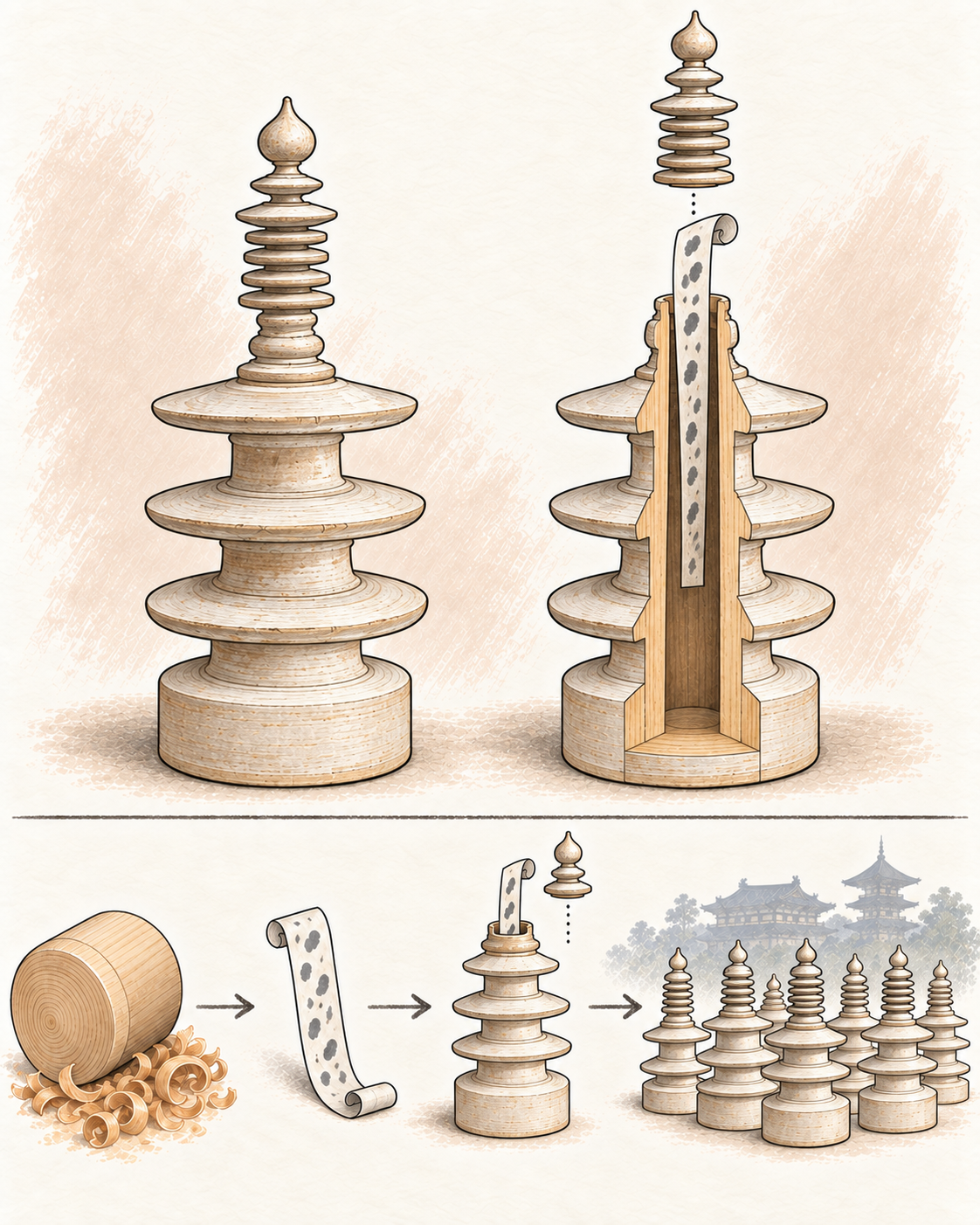
On September 11, 764, during the rebellion, Kōken vowed to commission gilded-bronze images of the Four Heavenly Kings, each seven shaku high; that vow became associated with the foundation of Saidai-ji. After victory, the court also sponsored the One Million Pagodas. Each small wooden monument was made to hold a printed dhāraṇī in its hollow core, joining Buddhist text, manufactured form, and distribution on an exceptional scale. These works made religious patronage part of the material settlement of the rebellion.
Dōkyō's offices rose at the same time. He became Daijō-daijin Zenji in 765 and received the title Hōō in 766, bringing clerical authority exceptionally close to the summit of government. Yet “a monk ruled Japan” is too simple. Shōtoku remained emperor; temples, officials, artisans, and provincial resources made the projects possible; and Dōkyō's precise control over individual works cannot be assumed. The new order integrated Buddhist and political authority without making them identical.
On February 4, 767, Empress Shōtoku visited Tōdai-ji and presented a silver jar whose dated inscription survives. She returned on April 3, 768, when a blue-ground painted stand and associated furnishing entered the temple’s material record. Four sutra scrolls dated May 13, 768, also preserve a vow connected with her. These acts returned her to the institution where, as Kōken, she had presided over the Great Buddha consecration in 752.
The visits make “Buddhist devotion” observable. A journey, a ceremony, and an offering joined sovereign presence to a specific institution, while records and surviving material associations allow historians to test broad claims against dated actions. The evidence does not disclose Shōtoku's private feelings, and not every object can be attributed without detailed verification. It does show continued patronage enacted through movement, ritual, and material transfer rather than merely asserted as a personality trait.
In 769, Nake no Asomaro, a senior religious official in Dazaifu, reported an oracle associated with the Usa Hachiman shrine saying that Dōkyō’s accession would bring peace. Wake no Kiyomaro traveled to Usa in place of his sister, the abbess Wake no Hōkin, and returned with a contrary message affirming dynastic succession. Dōkyō did not become emperor. Hōkin and Kiyomaro were then exiled, a punitive aftermath that later memory made central to the crisis.
The factual core does not settle every part of the story. The precise formation and transmission of the first oracle, whether Dōkyō personally engineered it, and what outcome Shōtoku intended remain disputed. Later memory sharpened the event into a contest between a loyal official and a corrupt monk, often casting the empress as either victim or accomplice. A responsible account separates the reported messages, the mission, the political result, and subsequent reputation rather than turning them into proof of motives the evidence cannot securely recover. [1][2]
Empress Shōtoku died on August 4, 770, while still occupying the throne. During the illness that followed her return from Yuge Palace, she did not personally hear government business for more than one hundred days; Kibi no Yuri alone is recorded as transmitting memorials to her. Prince Shirakabe was designated crown prince on the day of her death and later became Emperor Kōnin. Dōkyō rapidly lost the position he had held under Shōtoku and was ordered to Shimotsuke Yakushi-ji on August 21.
Her death ended the only perspective she could historically possess. Decisions taken afterward—including the complete process by which Kōnin was selected and the measures imposed on Dōkyō—belong to surviving actors and new canonical events, not to a posthumous Shōtoku voice. The transition nevertheless reveals the unresolved problem at the end of her reign: exceptional sovereign and clerical authority had not produced an accepted successor. Her biography closes at death, while the political consequences continue beyond her.
Classic
A royal birth is easy to narrate as the first step toward a throne. That approach gives the beginning of a life the certainty of its ending: because Princess Abe later ruled twice, the child born in 718 appears to have been moving toward sovereignty from the start. Early eighth-century succession did not work with that kind of inevitability. Imperial descent defined a field of eligible power, but it did not assign every child a fixed political future.
The distinction matters because the Japanese imperial house was hereditary without following a single, automatic law of male primogeniture. The succession sequence preserved in the frozen Shōmu publication runs from Emperor Monmu through the reigns of Empress Genmei and Empress Genshō before Shōmu’s accession in 724. Those two named female reigns are a concrete precedent for dynastic continuity passing through women of the imperial line. They should not be translated into modern political equality, but neither were they institutions outside the dynasty. Abe was born into a succession world in which a woman’s accession was historically intelligible even though no birth alone determined that outcome.
Abe’s parents gave her an exceptionally important position. Shōmu stood within the imperial succession, while Kōmyō brought the connections of the Fujiwara world into the sovereign household. Yet ancestry alone did not tell contemporaries that their daughter would become crown prince, emperor, retired sovereign, and emperor again. Those statuses were created by later events and formal acts. Treating them as latent facts present at birth would erase the political work required to produce each transition.
The limits of the evidence are equally important. The record allows a structural account of Abe’s place in the dynasty; it does not provide a safe reconstruction of her childhood character. We do not need to imagine an unusually ambitious girl, a child trained from infancy to rule, or a daughter already conscious of future conflict. Such claims would turn the silence of the sources into psychological evidence. A rigorous biography can instead explain why her family position mattered while leaving her early interior life unresolved.
This approach also prevents gender from becoming a modern moral shortcut. Abe’s later authority was real, but it operated inside an eighth-century court organized by dynasty, office, household, ritual, and aristocratic networks. Her eventual reigns did not abolish that order. They demonstrate that a woman of the imperial house could occupy its highest office and exercise formidable authority within it. The historical task is to understand the institutional conditions that made this possible, not to convert her into either a timeless feminist heroine or a passive exception controlled entirely by men.
chapter 1 therefore establishes possibility rather than destiny. Abe was born close to the center of government, into a family whose private relationships were inseparable from succession and state. That position made her future imaginable. It did not make it inevitable. The difference between those two claims is the difference between writing history forward from 718 and writing a known ending backward into a child’s birth.
The title “crown prince” can look like a simple label attached to the person who will become the next sovereign. In practice, designation performed political work. It identified an heir publicly, reduced one kind of uncertainty while creating new expectations, and gave the designated person a place within the organization of the court. Princess Abe’s appointment in 738 therefore mattered not merely because she later became emperor, but because the court formally reorganized the succession around her eleven years before her accession.
That act belonged to a dynastic system different from modern hereditary monarchy and different from a modern political order of equal citizenship. The Japanese imperial house had precedents for female sovereignty. A woman of the appropriate lineage could occupy the throne without the dynasty ceasing to understand itself as continuous. Yet this should not be simplified into the claim that men and women possessed interchangeable political opportunities. Succession operated through the imperial family, and a woman’s eligibility depended on her position within that family and on the political conditions surrounding a particular transfer of power.
The death of Crown Prince Motoi in 728 formed part of the succession landscape Abe inherited. A lost male heir did not mechanically cause her appointment a decade later, but it removed one path through which Shōmu’s line might otherwise have continued. By 738, designating Abe provided the court with a recognized successor drawn directly from the sovereign household. The appointment made dynastic continuity more legible, even though it could not settle every question about the future.
The institutional trail is now more precise. A chronology assembled by the Nara National Research Institute for Cultural Properties records an Eastern Palace office for copying the complete Buddhist canon from 739 through 741. It does not give us a complete staff list or prove that Abe personally supervised each manuscript. It does show that the household of the heir had a documentary and religious operation capable of leaving dated administrative traces. The crown prince was therefore not only a future sovereign but the center of an active institutional sphere.
A later biographical notice in the Shoku Nihongi says that Kibi no Makibi instructed Abe in the Book of Rites and the History of the Former Han. Because this information is preserved retrospectively, it should not be treated as a classroom diary. It nevertheless supplies a more specific educational tradition than the generic claim that a royal heir must have been “well educated.” The texts named in that notice concern ordered conduct, precedent, and rule; their presence in the record shows how later court memory represented her preparation for sovereignty.
The language of “female crown prince” can produce two opposite distortions. One treats Abe as a modern pioneer whose appointment represented a general advance for women. The other treats her as a placeholder with no authority of her own, inserted only until a suitable man could be found. Neither follows automatically from the evidence. Her designation was embedded in dynastic strategy, but dynastic status was itself a source of real political power. When she later became Kōken, she did not cease to be a woman; neither did womanhood make the throne merely symbolic.
What the appointment cannot tell us is how Abe privately understood it. We cannot safely write pride, reluctance, fear, or ambition into the formal record. This is where institutional history is more reliable than psychological biography. The court declared a future around her. The interior meaning of that declaration remains only partly recoverable.
The deeper importance of 738 is therefore the movement from eligibility to designation. Birth had placed Abe inside the succession field. Appointment gave that possibility an official form. It did not guarantee a smooth transfer or determine the character of her reign, but it made her the person around whom the next transfer of imperial authority was now expected to occur.
Accession narratives often imply a clean exchange: one sovereign leaves, another takes possession of the state, and a new reign begins. The canonical source locator places Shōmu’s abdication and Kōken’s accession on July 2, 749, in the relevant Shoku Nihongi entry. The transfer was formally decisive but institutionally layered. Princess Abe became the reigning emperor, Shōmu became retired emperor, and Kōmyō moved into the empress-dowager stage. Three statuses changed together, creating a new arrangement within the imperial household rather than erasing the people and projects of the previous reign.
The distinction between formal status and practical influence is essential. Kōken now occupied the throne. The current evidence does not provide a complete inventory of the legal rights, staff, or property retained by Shōmu and Kōmyō, so those mechanisms should not be supplied generically. It does provide a concrete test of continuity: in 752, Kōken appeared as reigning sovereign at the Great Buddha consecration while retired Shōmu and Empress Dowager Kōmyō remained within the imperial and devotional network recorded for the ceremony. Kōken’s sovereignty was real, and the unfinished religious project made the continuing public roles of the previous generation visible.
This helps explain why a family diagram alone is insufficient. Shōmu was Kōken’s father, and Kōmyō her mother, but they were also political actors with formal statuses and institutional resources. Their continued presence did not automatically reduce Kōken to a ceremonial daughter. Nor did her accession instantly transfer every relationship attached to their households into her personal control. Court power was distributed through offices, rank, aristocratic lineages, religious patronage, and access to the sovereign household.
The Buddhist world made that overlap especially visible. Shōmu’s Great Buddha project belonged to the previous reign in its initiation, but its material and ritual history crossed the accession. When the consecration took place in 752, Kōken would be the reigning sovereign while Shōmu and Kōmyō remained central members of the imperial and devotional network around the event. The project therefore cannot be assigned to one reign as though a change of emperor broke institutional continuity.
Kōken also inherited the political aftermath of earlier crisis. Epidemic, capital movements, and large-scale religious mobilization had altered the state before she took the throne. The bureaucracy, provincial system, taxation and labor obligations, and aristocratic competition did not reset in 749. The person at the apex changed; the machinery and accumulated pressures of government continued. This is why her accession should be narrated as entry into an existing political environment rather than the beginning of a self-contained personal drama.
Gender adds another layer but should not swallow the institutional story. Kōken was a woman exercising the imperial office, not a consort acting beside a male ruler. Her title gave her sovereign status. At the same time, her reign remained embedded in the dynastic and aristocratic structures that had made her designation possible. Understanding those structures does not diminish her authority. It explains the channels through which authority could be exercised and contested.
What changed in 749 was therefore both simple and complex. Kōken became emperor: that fact is clear. What did not change was the existence of other powerful people, offices, institutions, and unfinished projects around the throne. Her reign began not with an empty field, but with an inherited state whose overlapping authorities would shape both her first accession and the conflicts that eventually followed.
The Great Buddha consecration presents a problem of historical ownership. Shōmu had issued the proclamation and became the ruler most closely associated with the project. Yet by the time the eye-opening ceremony took place in 752, he had abdicated. Kōken was emperor, Kōmyō was empress dowager, Tōdai-ji was the institutional setting, and Bodhisena performed the central ritual act. To attribute the event to only one of these figures would confuse initiation with completion and sovereign authority with the labor of an entire network.
The eye-opening rite did not create the statue physically. By 752, years of design, material procurement, casting, recasting, transport, organization, and religious preparation had already made the image possible. The ceremony changed its ritual status. Painting or opening the eyes transformed a colossal object into a consecrated Buddhist image within a carefully organized religious event. That distinction helps explain why Bodhisena’s role mattered: ritual expertise could give a monk from outside Japan a central place in an event sponsored by the Japanese imperial state.
Kōken’s position was nevertheless indispensable. The ceremony took place under her reign, and the sovereign remained the highest political and ritual office in the state. Her presence represented continuity between the throne and the project. But reigning at the moment of completion did not make every preceding decision hers. Shōmu’s retired status likewise did not erase his connection to the undertaking. The imperial household now contained several people whose different titles reflected different relationships to the same monument.
This is why the consecration should not be narrated as a family ceremony enlarged to national scale. Tōdai-ji was a temple institution; clergy performed ritual functions; officials organized participation and resources; artisans had given the image material form; and the court presented the occasion as an event of broad religious and political significance. The Great Buddha stood at the intersection of sovereign patronage and collective production. Imperial authority could authorize, mobilize, and symbolize the project without personally performing the labor from which it was made.
The international dimensions also complicate a simple story of national achievement. Bodhisena’s participation placed the ceremony within wider Buddhist connections extending beyond the Japanese court. Buddhism supplied ritual languages, images, texts, and clerical networks that did not originate with Shōmu or Kōken. The state’s monument was therefore also evidence of religious transmission and adaptation. A project could be politically centered on the Japanese throne while drawing authority from a Buddhist world larger than the state.
A surviving material fragment sharpens the scene. Pieces of ceremonial crowns preserved with Shōsōin-related objects have been identified with the crowns worn by Shōmu, Kōmyō, and Kōken at the consecration. They cannot recover the full spectacle, but they connect three changing imperial statuses to a single ritual moment. The evidence is not merely that a ruling family attended: their differentiated ceremonial appearance helped stage continuity between the retired sovereign, the empress dowager, and the reigning emperor.
For Kōken’s biography, 752 demonstrates that accession did not break the projects of the previous reign. She inherited responsibility for a state in motion. The ceremony allowed her to preside over the culmination of an undertaking closely associated with her father while occupying the throne in her own right. That duality should not be reduced either to filial participation or to independent appropriation. She was the current sovereign within a project whose authorship was distributed across generations and institutions.
The deeper lesson is that monumental history rarely belongs to one person. Rulers become names through which projects are remembered, but monuments preserve the coordination of many forms of power: command, devotion, technical skill, administration, material extraction, ritual knowledge, and collective labor. The Great Buddha consecration was Kōken’s state ceremony, Shōmu’s long project, Tōdai-ji’s institutional triumph, Bodhisena’s ritual act, and the result of countless contributors at once.
Fujiwara no Nakamaro’s death in rebellion exerts a powerful pull on every earlier stage of his life. Once the ending is known, his acquisition of offices can look like preparation for usurpation, his administrative activity like camouflage for ambition, and his relationships like a conspiracy waiting to reveal itself. This is outcome bias: the tendency to make a later collapse explain everything that came before it. Kōken’s first reign requires a different Nakamaro—the successful official who had not yet become the defeated rebel of historical memory.
His power developed through the ordinary institutions of elite government. Nakamaro belonged to the southern branch of the Fujiwara family and was the son of Muchimaro. Kinship connected him to the wider Fujiwara world and to Empress Dowager Kōmyō’s political environment. But family connection should not be mistaken for automatic control. Aristocratic lineage created access and alliance; it still had to be converted into office, personnel, administrative reach, and the capacity to influence decisions.
This conversion is what made Nakamaro consequential. In 749 he held senior government office while directing the Shibi Chūdai, the organization serving Kōmyō. Research on its documentary practice shows a concrete political channel: commands associated with the empress dowager could pass through Nakamaro into the document procedures of the Council of State. By 757, when he headed the reorganized Shibi Naishō as well as the government’s upper administration, household proximity and state office had become mutually reinforcing. His influence was therefore built into the movement of written orders, not confined to persuasion in a private audience.
The exposure and suppression of the Tachibana no Naramaro plot in 757 supplies a further chronological marker absent from Modern. The canonical Nakamaro Modern payload records that his political position strengthened after the case and the large-scale treatment of opponents. The fact of that consolidation can be used here; the exact interrogation process and later judgments about Nakamaro’s cruelty require separate verification. By 758, his alignment with Prince Ōi rested on a network already strengthened before Ōi became Emperor Junnin.
Administrative competence also belongs in the account. The surviving canonical material warns against reducing Nakamaro’s career to “seizing power and rebelling.” He participated in fiscal, administrative, and institutional affairs, although individual policies require claim-by-claim source verification before publication at greater specificity. That caution does not make him politically empty. It means that the safest description emphasizes the kind of work through which a high official became indispensable without attributing every reform or administrative result to him personally.
Kōmyō’s support was important, but her relationship to Nakamaro should not collapse their agency into one family plan. She possessed her own religious, household, and political position. He used kinship and proximity as part of a broader career. Their interests could overlap without being identical, just as Fujiwara advantage did not require every Fujiwara actor to share one intention. This distinction becomes vital after Kōmyō’s death, when Nakamaro’s political base changed but did not instantly disappear.
From Kōken’s position, the rise of such an official created both capacity and constraint. A strong administrator could help government function. The same concentration of offices and dependents could give him leverage independent of the sovereign’s immediate wishes. Premodern court power was often built through this ambiguity: rulers needed capable networks to govern, but those networks acquired interests, loyalties, and resources of their own.
Nakamaro’s later relationship with Prince Ōi, who became Emperor Junnin, did not begin from nothing in 758. It became politically effective because Nakamaro already possessed an institutional platform. Understanding that sequence prevents Junnin from appearing as a puppet introduced only to carry out Nakamaro’s will. It also prevents Kōken’s later conflict with them from looking like a sudden personal quarrel. The political actors who would divide the court were already developing distinct positions within the same government.
chapter 5 therefore treats power as something constructed before it is contested. Nakamaro rose through kinship, office, administration, and organization. None of those facts proves that rebellion was his destination. They explain why, when conflict eventually came, he possessed enough standing to become a major opponent rather than a disposable court rival.
Abdication changes a title more clearly than it changes every relationship around the person who held it. In 758, Kōken ceased to be the reigning emperor and Junnin took the throne. If sovereignty were nothing more than the title of the current ruler, Kōken’s political story would largely end here. Instead, her retired-imperial position became the basis of a new phase of authority and eventually of open conflict.
The first distinction is between what the record directly establishes and what later events allow us to infer. Junnin now occupied the sovereign office, and Kōken became retired emperor. Claims about particular attendants, scribes, or appointment powers would therefore outrun the current ledger.
The stronger evidence arrives in 762, when the record explicitly assigns major affairs and rewards and punishments to Kōken while ordinary matters remain with Junnin. That later declaration proves that abdication had not ended her capacity to claim decisive jurisdiction. It should not be projected backward as proof that every such power was formally reserved in the 758 abdication instrument. chapter 6 establishes the transfer and retained status; chapter 7 supplies the documented operating mechanism.
The new reign also strengthened Nakamaro. His association with Prince Ōi and the institutions he had already built placed him in an especially favorable position when Ōi became Junnin. The grant of the name Emi no Oshikatsu marked the distinction of his status at this political high point. But describing Junnin as merely Nakamaro’s puppet would erase the emperor as a historical actor and convert political closeness into proof of total control. The safer account is that Junnin’s throne and Nakamaro’s network were closely aligned, giving their side of the court substantial formal and administrative strength.
Kōken’s abdication should therefore not be written as a trick in which she secretly kept everything, nor as a defeat in which she surrendered all power. At the moment of transfer, different forms of authority were redistributed. Junnin received the throne. Nakamaro’s position rose with the new arrangement. Kōken retained the resources of a retired sovereign. The later rupture was possible precisely because none of these forms of power was imaginary.
This distinction also separates chapter 6 from chapter 7. chapter 6 concerns the constitutional and ceremonial act of transfer: who took the throne, who abdicated, and which political network benefited. chapter 7 will examine how Kōken’s continuing authority operated and became explicit, especially when major affairs and rewards and punishments were divided from ordinary government. Without this separation, abdication and divided sovereignty become one repetitive story. With it, the reader can see a process: formal transfer first, contested practice afterward.
Gender should again be handled through institutions rather than stereotype. Kōken’s continuing influence should not be explained as an emotional inability to let go, just as Junnin’s reign should not be dismissed because a powerful retired woman and a powerful minister stood nearby. The political problem was structural. Several people possessed legitimate but different bases of authority, and the court lacked a mechanism that could make those interests automatically harmonious.
The deeper meaning of 758 is therefore not that Kōken “retired” in the modern sense. It is that abdication opened a new configuration of power. A reigning emperor, a retired emperor, and an ascendant minister now occupied overlapping political space. The titles were clear. The practical boundaries among them were not, and that uncertainty would become one of the defining conflicts of late Nara politics.
The political declaration associated with 762 is unusually valuable because it binds together two acts often narrated separately. Kōken announced religious withdrawal and separate residence, yet she refused political disappearance: in the same address she reserved a decisive jurisdiction for herself. The apparent contradiction is historical evidence. Entering religious life could change a person’s status, appearance, residence, and ritual commitments without automatically dissolving imperial rank, household relationships, or the capacity to command.
The declaration’s jurisdictional phrase can itself be parsed in more than one way: it may list “major affairs” together with rewards and punishments, or treat rewards and punishments as the two handles through which major affairs were controlled. Both readings make authority the issue, but they do not yield an identical constitutional map. Translation must therefore preserve the ambiguity instead of turning one grammatical solution into an uncontested fact.
Rewards and punishments mattered because they converted status into consequences. Appointments, honors, demotions, and penalties shaped the loyalties through which government worked. Control of major affairs likewise meant more than ceremonial precedence. It concerned the decisions by which the court defined danger, legitimacy, and the direction of policy. If Kōken reserved those powers, her retired title concealed neither political withdrawal nor merely private influence.
Junnin nevertheless remained emperor. Routine administration was not trivial, and the institutions of government continued to operate in his name and through officials aligned with his reign. To describe the arrangement as Kōken ruling while Junnin only pretended to rule would reproduce the same error as calling him Nakamaro's puppet. The evidence instead points to divided authority: each side possessed resources that the other could not simply declare nonexistent.
The division also reveals a weakness in the 758 settlement. Abdication had transferred the throne without establishing a durable settlement for Kōken's accumulated authority. Her household, former subjects, and religious connections survived. Junnin's accession created its own obligations and expectations. Nakamaro's administrative network supplied the new reign with additional capacity. What looked ceremonially clear in 758 became politically unstable when decisions had to be made.
This instability should not be reduced to gender or temperament. A retired male sovereign with the same rank, household, and alliances would also have represented a second center of power. Kōken’s religious declaration added another layer: the state now had to accommodate a former sovereign who adopted an explicitly Buddhist mode of life while still claiming the most consequential decisions. Her restoration in 764 would make the distinction between person and office even sharper, because religious status did not legally or politically prevent her from occupying the throne again.
chapter 7 therefore marks a change from overlapping authority to publicly articulated division. The declaration did not solve the conflict. It documented a claim about it. Modern scholarship has argued that Junnin and Nakamaro’s government continued to exercise substantial authority afterward, so the text cannot by itself prove that every major decision passed into Kōken’s hands. Once categories of major and ordinary affairs were invoked, however, disagreement over a decision could also become disagreement over who had the right to classify it. The court had two legitimate centers but no neutral authority above them, making further rupture increasingly possible without making it inevitable.
The evidentiary value of the declaration also has limits. Normative language tells us how authority was claimed or ordered, not whether every official consistently obeyed it. The categories “major” and “ordinary” were themselves open to contest. A personnel decision, religious appointment, or investigation might appear routine to one center and fundamental to the other. Practice must therefore be reconstructed from later actions, records, and institutional alignments. Even so, the need to announce a division proves that informal accommodation was no longer sufficient. The court had moved from latent overlap to an explicit struggle over jurisdiction.
Illness changes access. A ruler who is physically vulnerable depends on people permitted to approach, diagnose, advise, pray, or administer care. In a court where Buddhist ritual and healing possessed recognized authority, a monk's presence at a sickbed was not inherently evidence of scandal. It could nevertheless create a relationship outside the ordinary channels of office, and that relationship could later carry political weight.
The surviving narrative gives a firm sequence at a broad level: Dōkyō treated Kōken during illness; she trusted or favored him; his position subsequently rose. A Shōsōin chronology adds an object to this sequence. On December 14, 762, he borrowed a screen associated with original calligraphy by Ouyang Xun; it was returned in July 764. The loan is recorded as the first removal of an item from the repository to a place outside the palace. It demonstrates privileged access to a tightly controlled cultural asset without proving why that privilege was granted or what decisions followed from it.
The temptation to supply a romance is strengthened by the later political prominence of both figures. A powerful monk beside a female sovereign who had herself announced entry into religious life became an inviting subject for moralized history. Her new status changes the institutional setting: clerical counsel and Buddhist practice were now part of how she publicly defined her own life. It does not function as a chastity certificate. Sexual explanation remains unsupported because the surviving evidence does not establish it, not because a religious identity makes it impossible.
Dōkyō's clerical identity also matters. Buddhist institutions provided forms of learning, ritual efficacy, healing, and patronage that crossed the boundary modern readers often draw between religion and government. Kōken's confidence in a monk did not import an alien force into an otherwise secular court. It intensified relationships already present in Nara statecraft. The unusual feature was the degree of access and advancement, not the mere presence of Buddhist expertise near power.
This chapter therefore treats the sickroom as a point of connection, not a transparent window into private life. Illness helps explain how Dōkyō entered Kōken's closest circle. It cannot explain every later decision. His rise also depended on the court's institutional conditions, Kōken's continuing authority, the split with Junnin's government, and the political transformations after 764.
Responsible history sometimes ends with a bounded statement: they became close, and the nature of that closeness cannot be fully recovered. Refusing to sexualize the gap is not evasiveness. It preserves the difference between what the record supports and what later storytellers found compelling.
The same discipline should govern the language of “influence.” Influence can mean access to a ruler, success in recommending people, authority in religious affairs, or direct control of state decisions. The present evidence does not make all of these meanings interchangeable. Dōkyō's later offices show that Kōken deliberately elevated him; they do not demonstrate that her independent political agency vanished. A historically useful account must be capable of holding two claims together: his access became an important source of power, and she remained the sovereign actor who authorized much of that power. Replacing scandal with puppet-master theory would repeat the same unsupported simplification in different words.
Chronicles tend to compress conflict into declarations, accusations, and decisive acts. Detailed study of Hokke-ji “temple-request” wooden tablets identifies requests to the imperial Food Service at Heijō palace for provisions. The surviving notices do not recover the total economy of Kōken’s residence, but they reveal a precise administrative relationship: the separated center still drew supplies through an office of the palace establishment. Political division therefore coexisted with material dependence and routine documentary traffic.
Hokke-ji carried associations with the imperial Buddhist world and with Kōken's mother, Kōmyō. After Kōken announced entry into religious life, it could support a Buddhist residence and a network of attendants outside the reigning emperor's palace. Heijō palace, by contrast, remained the formal center of Junnin's reign and the ritsuryō government. The spatial division therefore joined religious identity, imperial households, and state administration rather than placing “religion” on one side and “politics” on the other.
Material evidence must still be handled conservatively. The Shoku Nihongi entry for the fifth month of 762 places Junnin back at Heijō palace and Kōken at Hokke-ji; the wooden tablets show provisions crossing the institutional boundary. Text and excavated documents therefore support spatially divided centers that were not administratively sealed from one another. They reveal neither private jealousy nor the full balance sheet of either household.
The split also clarifies Dōkyō's changing role. His proximity to Kōken placed him within a political network, but it does not follow that he created the entire confrontation. Kōken and Junnin had competing bases of legitimacy before Dōkyō's rise. Nakamaro's alignment with Junnin and Kōken's claim to major decisions supplied structural causes. Dōkyō became consequential inside that division, not necessarily its sole author.
Nor should the conflict be reconstructed as personal jealousy. Such an explanation turns jurisdiction, residence, and succession into emotional scenery. The evidence instead shows two imperial figures operating from distinct centers after Kōken had claimed major affairs and rewards and punishments. The provision requests prove one route across that divide; the complete movement of officials, messages, and resources remains a later source question.
chapter 9 is thus about infrastructure becoming constitutional evidence. The court's division was visible not only in formal language but in rooms, routes, personnel, and objects. By 763, reconciliation would have required more than resolving a private disagreement. It would have required recombining networks that had begun to govern, communicate, and imagine authority separately.
This perspective also changes how causation is assigned to the rebellion that followed. Spatial separation did not mechanically produce war, and a delivery record cannot predict military action. It did, however, reduce the everyday interdependence through which conflicts might have been moderated. Information could be filtered within each household, appointments interpreted as threats, and ambiguous orders tested against rival loyalties. Institutional separation made escalation easier by giving each side people and procedures through which to act. The evidence therefore supports a causal condition—organized division—without turning 762 or 763 into an inevitable prelude to 764.
The word “rebellion” describes Nakamaro's legal and political position after conflict began, but it can make the path to violence appear simpler than it was. For years he had been a central official, administrator, and ally of the reigning emperor. Kōken was a retired sovereign claiming authority over major affairs. Junnin held the throne. When their arrangements collapsed, institutions and relationships that had once governed together became opposing resources.
The sequence of armed conflict is more secure than every intention that preceded it. A Shōsōin chronology records a transfer to the inner palace on September 11 of forty-eight imperial swords, forty black-finished swords, 103 bows, one hundred suits of armor, and containers for arrows. The document does not narrate a battle plan, but its date and inventory make military preparation materially visible at the center of Kōken’s power. Nakamaro moved toward Ōmi, was defeated, and died. He and his supporters then faced a second defeat in documentation: Heijō palace wooden records preserve the administrative removal of members of his faction after the rebellion.
Speed mattered. Political networks depend on communication, recognized orders, routes, and the willingness of officials to act before the result is known. Once Kōken's side controlled the means by which legitimate commands could circulate, Nakamaro's offices and past influence could not automatically become military success. Authority accumulated over years could collapse rapidly when subordinates no longer believed it would prevail.
Kōken's victory should not be narrated as effortless inevitability. At the moment of crisis, the outcome was open to the participants. A failed rebellion is often retold as proof that its leader never possessed legitimate support or sound judgment. Yet the scale of the response and the consequences for the throne show that Nakamaro was not a marginal conspirator. He represented a political order closely tied to Junnin's reign.
Nakamaro's life story needs his calculations and losses; Junnin's needs the danger to his throne; Dōkyō's needs the transformation of Kōken's court; Kōken's needs her command and the restoration opened by victory. None is entitled to a contradictory war.
Victory also changed the archive. The successful side possessed the power to classify actions, punish enemies, and establish the language through which the crisis was remembered. That does not make the record false, but it requires historians to distinguish observable acts from moral totalization. Nakamaro rebelled and was defeated. Whether every earlier appointment, alliance, or reform was a step toward treason is a different and much weaker claim.
The administrative aftermath deserves equal attention, but only one mechanism is explicit in the current locator set: records of faction members being removed after the rebellion. Broader claims about confiscation or the redistribution of particular offices require later source QA. Even this limited evidence is historically material. It shows that victory was converted into changes in the administrative record, weakening the network that had sustained Junnin's reign and preparing the institutional ground for deposition and restoration.
Restoration sounds like correction: the rightful person returns, and an interruption ends. The Nara palace chronology places Junnin's deposition and Kōken's restoration on October 9, 764. That recorded act did not rewind the political order to 758. Junnin had reigned for six years, officials had served him, and Nakamaro's network had operated through his government. Deposition and re-enthronement converted the military result into a new sovereign order.
Deposition was both a personal catastrophe and an institutional classification. Junnin lost the sovereign office and was confined on Awaji. The act announced that the legitimacy attached to a reigning emperor could be withdrawn through political victory and court decision. Describing him only as Nakamaro's instrument would make deposition seem administratively simple, but it was precisely because he was emperor that his removal mattered so greatly.
The chronicle’s account of his final crisis in 765 is terse and troubling. It reports movement over the residence enclosure, interception, return, and death on the next day, but does not securely establish the cause of death or Shōtoku’s personal role. Later suspicion of killing arises from the compression and political setting of the sequence; suspicion is not a verdict. The responsible distinction is between secure endpoints—deposition, confinement, attempted flight as reported, and death—and an unresolved causal explanation.
For Shōtoku, restoration recombined forms of authority that had been separated. As retired sovereign she had retained status, household, religious connections, and the claim to major decisions. Now she again possessed the formal throne. The ambiguity of divided sovereignty diminished, but the powers accumulated during the struggle did not disappear. Her second reign began from a stronger and more centralized position than her first.
Names mark the transformation without creating two unrelated people. Kōken and Shōtoku refer to different reign identities of the same historical actor. The new regnal name signals a new political phase: first reign, abdication, retired authority, conflict, and restoration. Treating them as separate characters would break causation; treating the second reign as a simple continuation would hide the institutional rupture.
Dōkyō's advancement after 764 must also be kept in sequence. His position rose within the victorious order, but later prominence cannot be used to prove that he engineered every prior event or that restoration occurred to make him ruler. Shōtoku had her own imperial authority and political interests. Their alliance changed the distribution of office, religious patronage, and access, but it did not erase her agency.
The restoration resolved one constitutional question—who was emperor—while opening others. How should victory be translated into punishment and appointment? How far could Buddhist authority enter the upper reaches of government? How would a sovereign without a direct heir manage succession? chapter 11 is therefore not a triumphant ending. It is the foundation of the contested second reign.
Restoration also shaped memory unevenly. Kōken acquired a narrative of return and vindication; Junnin's identity became entangled with deposition; Nakamaro's career was reread through rebellion. These were not merely later literary effects. Court rank, posthumous treatment, official naming, and the preservation of records could all influence whose reign appeared legitimate. Historians must recognize the victorious order's power over classification without imagining that all classifications were invented. Shōtoku truly returned and Junnin truly lost the throne. The interpretive task is to explain how those institutional facts were made meaningful, rather than allowing the outcome to dictate every moral judgment about the people involved.
The projects of Shōtoku's second reign resist a clean division between religion and politics. The Saidai-ji excavation report dates her vow to September 11, 764, and specifies seven-shaku gilded-bronze images of the Four Heavenly Kings. Archaeological work near the traditional casting area has identified Nara-period casting remains. These finds do not prove the entire workshop sequence, but they place the temple’s monumental program within a recoverable landscape of metal production rather than leaving the vow as court language alone.
Material scale changes the meaning of patronage. The One Million Pagodas were turned from wood as miniature three-storied monuments; a dhāraṇī text was placed inside the opening at the top and closed beneath the finial. Repetition made doctrine into a production system: texts had to be printed, bodies shaped, pieces fitted, counted, and delivered. The evidence supports commemoration and prayers for order after the rebellion, but it does not provide a complete labor roster or allow every stage to be credited to Dōkyō.
Dōkyō's titles provide a concrete institutional sequence. The canonical Dōkyō payload places his appointment as Daijin Zenji after Nakamaro's defeat, his elevation to Daijō-daijin Zenji in 765, and the title Hōō in 766. Ministerial and clerical language were thus joined in offices of exceptional status. The titles demonstrate public elevation; they do not by themselves identify every decision he controlled or transfer the throne to him.
The phrase “clerical dictatorship” obscures more than it explains. Shōtoku remained sovereign and authorized the order in which Dōkyō rose. Other officials and institutions continued to operate. Buddhist establishments were themselves complex organizations rather than a single clerical will. At the same time, minimizing Dōkyō as merely a private favorite would ignore the unprecedented public authority expressed by his offices.
Evidence boundaries are especially important for Saidai-ji. The projects and Dōkyō's advancement are secure at the appropriate level, but the existing source ledger warns against assigning him detailed control of construction without further verification. Patron, officeholder, ritual authority, administrator, and artisan are distinct roles. Monumental history becomes misleading when every action is credited to the most famous person nearby.
The new order after 764 can thus be understood as a coalition of imperial restoration and Buddhist institution-building. It transformed victory into objects, temples, titles, and practices intended to endure. Those achievements also intensified anxieties about how religious charisma, personal access, and sovereign power were being combined. The same structure that made extraordinary patronage possible would shape the succession crisis of 769.
The factual depth here therefore comes from chronology, material form, archaeology, and office: a precisely dated crisis vow specified monumental bronze images; casting remains locate part of the temple’s making; the pagodas enclosed printed dhāraṇī; and Dōkyō's sequence of hybrid clerical-ministerial titles placed Buddhist authority visibly inside the upper court. How the full labor force was organized, and how far Dōkyō directed construction, remain open source questions.
Calling a ruler devout compresses different actions into a character judgment. The V3 research increment now identifies particular material traces. A silver jar bears a base inscription dated February 4, 767, the day Shōtoku visited Tōdai-ji. The Shōsōin chronology records her return on April 3, 768, with a blue-ground painted stand and an associated furnishing, and four sutra scrolls dated May 13 carry her vow. Object, inscription, and institutional chronology therefore converge more precisely than the earlier canonical extract allowed.
Tōdai-ji carried accumulated meanings for Shōtoku. The Great Buddha project had originated under Shōmu, reached consecration during her first reign, and remained connected to Kōmyō's offerings and the material world now associated with the Shōsōin. Returning in 767 and 768 placed Shōtoku within a family and imperial history without reducing her to a daughter repeating her parents' devotion.
The evidentiary gain is not an inventory of her inner faith. It is a chain of demonstrable acts: presence at the temple, transfer of a named vessel, later furnishings, and a dated textual vow. An inscription can secure a date and donor relationship; it cannot disclose the emotion with which the gift was made. The objects replace a vague adjective with evidence while keeping psychology outside the factual claim.
The visits also complicate any claim that Dōkyō wholly redirected Shōtoku's religious world. Her engagement with Tōdai-ji belonged to a much longer trajectory reaching back before his rise. The second reign added Saidai-ji, the pagoda program, and exceptional clerical offices, but it did not erase earlier institutions. Buddhist patronage was a network of temples and practices, not a single relationship between sovereign and monk.
Attribution must remain precise. The silver jar and the 768 furnishings may be connected to dated offerings without claiming that Shōtoku manufactured, handled, or personally selected every component. The surviving sutra vow supplies her sanctioned devotional language, not a transcript of private speech. Material specificity narrows the history; it does not authorize an invented scene.
chapter 13 thus uses objects to discipline biography. The visits matter not because they prove an unchanging inner faith, but because they show how Shōtoku enacted imperial Buddhism through institutions with histories of their own. Her patronage left administrative and material traces capable of surviving the hostile moral narratives later attached to her reign.
Continuity did not mean political stasis. The sovereign who returned to Tōdai-ji in the late 760s governed after the destruction of Nakamaro's network and the elevation of Dōkyō. The same temple relationship could therefore perform new work: affirm imperial presence, renew alliances with clergy, and locate the second reign within a revered project of the previous generation. These functions remain plausible institutional interpretations rather than documented private motives.
Material survival also introduces selection bias. Objects preserved in a prestigious repository are unusually visible, while perishable gifts, failed projects, and routine transactions disappear. Historians should not equate what survives with everything that mattered. The strength of the Tōdai-ji evidence is specificity, not completeness. It lets us replace a vague adjective with several demonstrable acts while reminding us that even a rich collection illuminates only part of a sovereign's religious and political practice.
An oracle enters history through people. Someone reports it, a court receives it, envoys travel, another pronouncement is transmitted, and officials decide how to act. Even if participants accepted divine communication as real, historians encounter a human chain of documents, speech, institutions, and interests. The Usa crisis cannot be understood by treating “the oracle” as one transparent sentence outside politics.
The later Shoku Nihongi narrative gives the chain identifiable participants. Nake no Asomaro transmitted the first report from the Dazaifu religious administration. Wake no Hōkin was initially connected to the verification mission, but her brother Kiyomaro traveled in her place. He brought back a contrary message; afterward Hōkin was exiled to Bingo and Kiyomaro to Ōsumi. This sequence is stronger than a generic tale of “two oracles,” but the retrospective source still does not make the first report’s authorship or sincerity transparent.
The stakes were extraordinary because the message concerned succession. Dōkyō was a monk of exceptional rank but not a conventional member of the imperial line. The possibility of his accession challenged established expectations about the throne, religious status, and dynastic continuity. This explains the crisis without proving that any one participant designed the entire sequence.
Wake no Kiyomaro's mission became the center of later heroic memory. His return with a message rejecting Dōkyō's accession could be remembered as loyalty defending the imperial order. That memory preserves an important political outcome, but hero-and-villain structure tends to simplify the evidence around it. Once Kiyomaro is made perfectly loyal and Dōkyō perfectly fraudulent, the first oracle must become a forgery and Shōtoku must become either deceived or corrupt. Those conclusions do not all follow automatically from the event.
Shōtoku's role is particularly vulnerable to retrospective certainty. As reigning emperor she had to receive, test, and respond to a claim touching the succession. Her dispatch of an envoy shows engagement with the question. It does not by itself reveal a fixed plan to enthrone Dōkyō, nor does the failure of that possibility prove she always opposed it. The current evidence infrastructure correctly keeps her intended outcome unresolved.
Historical disagreement · Did the Dharma King title designate a successor?
Katsuura Noriko interprets Shōtoku’s elevation of Dōkyō within a Buddhist conception of kingship: continuing the faith could justify choosing a holy monk outside the imperial line. Hori Yutaka’s later research rejects the equation of appointment as Dharma King with designation as the next emperor. The title’s significance is therefore part of the succession dispute, not an agreed answer to it. [1][2]
The origin of the first Usa message is a separate question. Dōkyō’s benefit from it does not identify its author, and sending an envoy to verify it does not by itself disclose Shōtoku’s preferred outcome. [1][2]
The crisis ultimately produced no Dōkyō accession. That negative result shaped the boundary of imperial legitimacy and supplied later generations with a story about protecting the throne. chapter 14 preserves both levels: a major 769 confrontation over divine authority and succession, and a contested archive whose moral clarity increased as direct access to individual intentions diminished.
The episode also demonstrates why religious evidence cannot be separated from its institutional route. Usa was not simply a distant source of supernatural information; it was a shrine with its own authority, personnel, geography, and relationship to the court. Sending an envoy acknowledged that authority while subjecting the reported message to verification. The journey created time in which factions could anticipate outcomes and raised the importance of the messenger's credibility. What reached the capital was therefore simultaneously a religious pronouncement and a politically consequential report carried by an official. Preserving both aspects avoids the modern error of treating belief as disguise and the opposite error of treating transmission as free from human interests.
The death of a reigning emperor is both a human endpoint and a constitutional emergency. Research on the palace chronology adds a period of constrained access before August 4, 770. After falling ill during the progress to Yuge Palace and returning to Heijō, Shōtoku did not personally hear government business for more than one hundred days. Kibi no Yuri is singled out as the person who transmitted memorials to her. The record therefore reveals not only illness but an information bottleneck at the end of the reign.
Prince Shirakabe was named crown prince on the day Shōtoku died and was enthroned as Kōnin on October 1. The tight chronology secures the result, not the complete negotiation that produced it. A person biography should not fill that gap by assigning the choice to Shōtoku, to a single minister, or to an inevitable dynastic logic. The information route during her illness and the selection process after death require distinct evidence.
Dōkyō's rapid fall demonstrates how much of his authority depended on Shōtoku's reign. He participated in the funeral arrangements and stayed near her tomb, yet on August 21 the new crown prince’s order transferred him to Shimotsuke Yakushi-ji. The sequence is more revealing than a generic statement that he “fell”: ceremonial proximity to the dead sovereign did not preserve political access under the next settlement. This reversal does not prove that all his earlier authority was illegitimate or merely personal. It shows that offices embedded in one sovereign coalition may lack an independent base when that coalition disappears.
Shōtoku's lack of a direct heir has often encouraged judgment of her reign through reproductive succession. Such a measure is too narrow. Her political significance lay in two reigns, an abdication, the exercise of retired authority, victory in civil conflict, restoration, Buddhist institution-building, and a succession crisis that exposed the limits of her order. At the same time, the absence of an accepted successor was not incidental; it shaped the vulnerability of her allies and the reorganization that followed.
The death rule protects both history and character. A dead person cannot witness the choice of Kōnin, interpret Dōkyō's exile, or summarize her own legacy. Allowing her to do so would convert later historical knowledge into invented consciousness.
chapter 15 therefore ends without a first-person conclusion. Modern records the death and immediate transition; Classic analyzes the structural consequences; later Events carry the story forward. Shōtoku's life does not need an imagined final verdict to have meaning. Its unresolved ending is itself historical evidence: sovereign authority can be highly concentrated during a reign and still prove unable to determine what follows it.
Her two names and two reigns also complicate the shape of a conventional royal biography. The sequence did not move cleanly from accession to government to death. It included abdication, authority outside the throne, restoration, and a second death-in-office ending. That structure shows why offices must remain distinct from persons: Kōken survived the loss of the throne, Shōtoku recovered it, and the same woman accumulated different kinds of legitimacy across both identities. At death, those forms of authority could no longer be exercised personally. What remained were institutions, objects, enemies, allies, and memories competing to define the period.