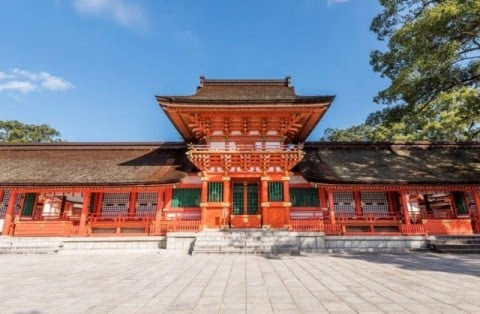
The Upper Sanctuary and Hachiman's National Role
Attraction
Usa Jingu's upper sanctuary is the center of a Hachiman tradition that expanded far beyond northern Kyushu. Its three principal sanctuaries embody a layered cult rather than a single founder's memorial, and the present buildings preserve the distinctive paired-roof form associated with Usa. Read the ascent and enclosure as an active institution: worship continues here, while access to sacred interiors remains restricted. Usa's historical importance grew through connections with the court and Buddhist establishments, including an oracle supporting the construction of the Great Buddha at Todai-ji. Hachiman could therefore operate as local deity, protector of the state and participant in Buddhist political culture. The sanctuary should not be treated as proof that modern categories of Shinto and Buddhism always existed separately. Its history is valuable precisely because ritual authority moved through overlapping shrine, temple and court networks.
Current visibility
The upper sanctuary's three principal buildings, ascent, and enclosure provide the visible setting; worship continues and access to sacred interiors remains restricted.
Attraction
In 769 an oracle attributed to Usa Hachiman became central to a succession crisis involving Empress Shotoku and the monk Dokyo. Wake no Kiyomaro was sent to seek confirmation; the resulting message rejected the transfer of the throne to someone outside the imperial line. The event did not occur as a simple contest between a corrupt monk and a heroic messenger. Existing historical records preserve uncertainty about who generated the earlier oracle, whether Dokyo actively sought the throne and what the empress intended. Usa matters because distant sacred authority was drawn directly into court politics. Go-o Shrine commemorates Kiyomaro within the wider precinct landscape, but later veneration should be distinguished from the evidence for 769. This Place enables a careful reading of how communication, divine speech and political legitimacy interacted across the distance between the Nara court and northern Kyushu.
Current visibility
The Upper Sanctuary and shrine interpretation anchor the 769 oracle crisis; the political event is historical, while the present precinct provides its visible setting.
Shrine, Temple and the History of Shinbutsu Relations
Attraction
Usa became a major center for relationships between kami worship and Buddhism. Hachiman was represented through Buddhist titles and images, shrine ritual interacted with temple institutions, and the deity's support for Todai-ji tied the precinct to a national Buddhist project. Those relationships changed sharply in the modern period when government policy separated shrines and temples and reassigned institutional identities. The current precinct is therefore not an unchanged example of timeless syncretism. Surviving routes, subsidiary worship sites, museum objects and historical records preserve different parts of a system that was repeatedly reorganized. Use the Treasure Hall when open to examine how portable objects—documents, ritual implements, images and ceremonial equipment—carry relationships no longer fully visible in architecture. Usa's value lies in showing that religious categories have histories, and that the state repeatedly intervened in how sacred institutions were connected or divided.
Current visibility
Surviving routes and subsidiary worship sites, historical records, and Treasure Hall collections preserve evidence of the changing shrine-temple relationships; hall opening and displayed objects may vary.
Treasure Hall and the Limits of What Is Visible
Attraction
The Treasure Hall provides the precinct's documentary counterweight. Its collections include oracle records, ritual equipment, images, weapons and objects connected with shrine ceremony. Displays may rotate, so the publication should not promise a particular document or sacred object. The stable reason to include the hall is methodological: it shows how historians move beyond later legends by comparing texts, material culture and institutional records. The active sanctuary presents worship; the museum helps explain how that worship acquired political reach and how its forms changed.
Current visibility
The Treasure Hall's documents, ritual equipment, images, and weapons are collection themes, not a promise that particular objects are displayed on every visit; check current gallery and special-opening notices.