Map: GSI Japan Saidai-ji began as an eighth-century imperial foundation on the western side of Heijō-kyō and was transformed in the thirteenth century by the monk Eison into the center of a revived movement of precepts, esoteric practice, and social relief. Almost none of the vast Nara-period compound remains above ground. The current temple is smaller and largely early modern, yet its halls preserve ancient foundation traces, major Kamakura sculpture, Eison's memory, and living ceremonies. This concentration makes Saidai-ji historically focused rather than minor: a modest present precinct carries two decisive institutional identities.
Shōtoku's 764 Vow and the Lost Imperial Monastery
称徳天皇の発願と創建伽藍
Attraction
Saidai-ji traces its beginning to 764, when retired Empress Kōken—soon restored as Empress Shōtoku—vowed images of the Four Heavenly Kings during the rebellion of Fujiwara no Nakamaro. The resulting imperial monastery occupied a vast area west of Heijō Palace, with two principal halls, east and west pagodas, and more than one hundred buildings recorded in a 780 property inventory. That complex no longer stands. The present temple preserves its name, institutional memory, archaeological foundations, and a much reduced boundary rather than an intact Nara-period plan. The contrast is essential: the Place connects Shōtoku's contested restoration and state-protection Buddhism to physical absence as much as to surviving objects.
Current visibility
The scale of the Nara-period monastery is known from records and foundations; the current precinct is much smaller and its standing halls are later.
Eison's Precepts Revival and the Ōchamori Tradition
叡尊の中興と大茶盛式
Attraction
Eison entered the decayed temple in 1235 and made Saidai-ji the base for a movement that joined renewed monastic precepts, esoteric Buddhist practice, preaching, and forms of relief. The temple's remembered phrase kōbō rishō treated the flourishing of Buddhism and benefit to living beings as one task. Ōchamori gives that program a continuing material form. Temple tradition traces it to Eison sharing tea after an offering in 1239, linking abstention from alcohol with tea's perceived medicinal value. Today's ceremony uses exceptionally large bowls passed with assistance among participants. It is a scheduled ritual, not a daily display, but it makes communal discipline and relief more tangible than a doctrinal label alone.
Current visibility
Eison's institutional legacy is present throughout the active temple; the large tea ceremony occurs only on announced dates or arranged occasions.
The Main Hall and Eison's Seiryō-ji-Style Shaka
本堂と釈迦如来立像
Attraction
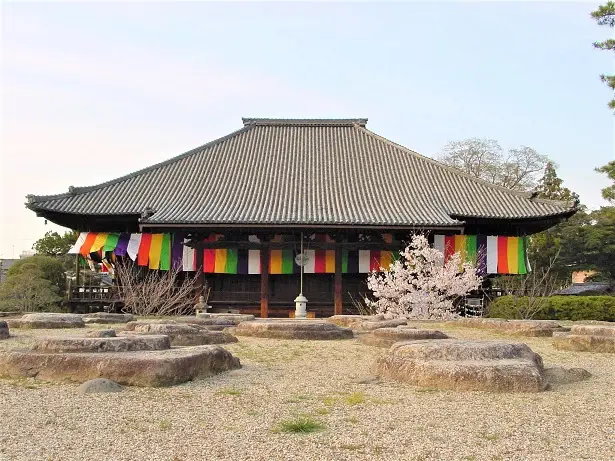
The current Main Hall was completed in the late eighteenth century and is a large, distinctive structure built without the ancient monastery's original fabric. Its principal image, however, belongs to the Kamakura revival. Eison sent sculptors to study the celebrated Shaka image at Seiryō-ji in Kyoto, and the Saidai-ji copy was consecrated in 1249. The unpainted wooden figure carries delicate cut-gold decoration and contained numerous objects within its body. For Eison's community it was not an art-historical reproduction alone but a root image for devotion to the historical Buddha. The hall therefore brings early-modern architecture and a thirteenth-century program of copying, consecration, and embodied sacred presence into one readable interior.
Current visibility
The Main Hall and principal image are normally part of temple admission, subject to current hours, services, and interior rules.
Shiōdō: The Founding Vow on an Ancient Platform
四王堂
Attraction
Shiōdō preserves the Four Heavenly Kings dedication that began Saidai-ji, although almost every visible component is later. The present hall was rebuilt in 1674, while its rammed-earth platform retains the scale of the Nara-period foundation. The Four Kings were remade in the medieval period, but the demons under their feet include fragments associated with the original eighth-century group. A large Eleven-Headed Kannon was transferred here from a Kyoto sanctuary in 1289, giving the hall its alternative name, Kannondō. The resulting ensemble is not a single-period survival. It is a deliberately maintained collection of ancient trace, medieval relocation and remaking, and early-modern architecture.
Current visibility
The hall is a public worship space under normal temple admission; access to individual images remains governed by current conditions.
Aizendō, Eison's Portrait, and a Converted Aristocratic Residence
愛染堂と興正菩薩寿像
Attraction
Aizendō stands on the site of Eison's former quarters but is itself an eighteenth-century adaptation. In 1767, a residence donated by the Konoe family in Kyoto was moved here and converted into a temple hall, preserving the broad proportions and interior divisions of elite domestic architecture. The building enshrines a small red Aizen Myōō commissioned by Eison in 1247 and a lifelike seated portrait of Eison completed in 1280. The Aizen image is a secret image shown only on announced occasions, while the portrait materializes the authority of the medieval restorer within a later memorial space. Relocated architecture, restricted image access, and continued lineage commemoration are all part of the Highlight.
Current visibility
The hall is generally included in temple visiting arrangements, but the secret Aizen image is unveiled only at announced times; current access must be checked.