Read the article below. Interactive reading tools are available when scripts load.
Quick
Ashikaga Tadayoshi, born in 1306, was the younger brother of Takauji, later founder of the Muromachi warrior government. Their family initially served the Kamakura shogunate, the military government based in eastern Japan. Senior membership in the same house gave Tadayoshi access to followers and political business. It would eventually make him a governing partner, with relationships and authority of his own. [3]
In 1333 the Ashikaga joined the rebellion against Kamakura and helped Emperor Go-Daigo restore direct imperial government. Tadayoshi then went east with the emperor’s son Prince Naruyoshi and administered affairs from Kamakura. The royal prince supplied imperial authority; the Ashikaga supplied the warrior organization needed to act on it. Handling petitions and property claims helped Tadayoshi build a regional following within the restored government.
Prince Moriyoshi, Go-Daigo’s son and a rival to Ashikaga influence, was arrested and held at Kamakura under the house’s authority. He was killed during the Hōjō attempt to recover the city in 1335. Tadayoshi had responsibility for his custody. Accounts that attribute a direct killing order to him are less secure than the facts of confinement and death; the precise command chain remains disputed.
Hōjō Tokiyuki, a survivor of Kamakura’s former ruling family, seized the city in the Nakasendai Rebellion of 1335. Tadayoshi retreated, but Takauji marched east and the brothers recovered Kamakura. Their victory opened a conflict with Go-Daigo over military authorization and rewards. By recognizing their followers’ service and remaining in the Kantō, eastern Japan, the Ashikaga exercised powers the emperor wished to control.
The break became open war. Driven out of Kyoto in early 1336, the Ashikaga withdrew toward Kyushu, gathered renewed support and returned. Victory at Minatogawa brought them back to the capital. Go-Daigo withdrew to Yoshino, creating the Southern Court, while the Ashikaga received imperial recognition from the Northern Court in Kyoto. Tadayoshi’s administration helped sustain the new regime by providing judgments and confirmation of property to its supporters.
The Kenmu Shikimoku of 1336 set out seventeen governing guidelines, named for the Kenmu era. It prohibited bribery, called for hearing poor and weak petitioners, and required fixed times for judicial business. These were expectations for officials, not proof that every case was handled fairly. Tadayoshi’s association with the program does not make him its sole author.
The government depended on both brothers. Takauji held the house’s supreme standing; Tadayoshi had extensive administrative and judicial authority. Historians have often described this as a diarchy, a division between military rewards and governing property. Historian Kameda Toshikazu’s 2019 legal-history reassessment stresses overlapping powers and Tadayoshi’s leading position instead. The substantial role of both brothers is clear, but a neat boundary between their authority is not. Their followers gained different routes to influence, which could become rival centers when cooperation broke down.
Tadayoshi put ninety-three questions to the Zen monk Musō Soseki. Musō’s answers became the Muchū Mondōshū, a guide to Buddhist teaching whose printing was financed by Tadayoshi’s retainer Ōtaka Shigenari. His governing circle supported religious learning as well as the settlement of land claims.
A ruling authorized by Tadayoshi in the Japanese twelfth month of 1348 concerned Saitō Hidesada’s land at Asahi in Ōmi, a historical province in central Japan. Hidesada sought protection against interference by relatives; the decision confirmed his existing holding. Such judgments gave claimants a document to use against rivals, though enforcement still depended on local power.
Kō no Moronao, Takauji’s senior deputy, gained influence through access to the house head and relationships with military followers. Tadayoshi had his own associates and governing authority. Their quarrel involved appointments and property: protecting an older holding could disappoint a warrior expecting reward, while a new grant could undermine an existing judgment. As each leader’s followers attached their interests to the dispute, personal rivalry began to divide the government.
In 1349 Moronao’s faction forced Tadayoshi from effective office. He took Buddhist vows, marking withdrawal from his previous position, while Takauji’s son Yoshiakira assumed administrative authority. Tadayoshi’s allies, including his adopted son Tadafuyu, remained active. Removing him from office had not dissolved their interests or following. Those relationships made an eventual return to armed opposition possible.
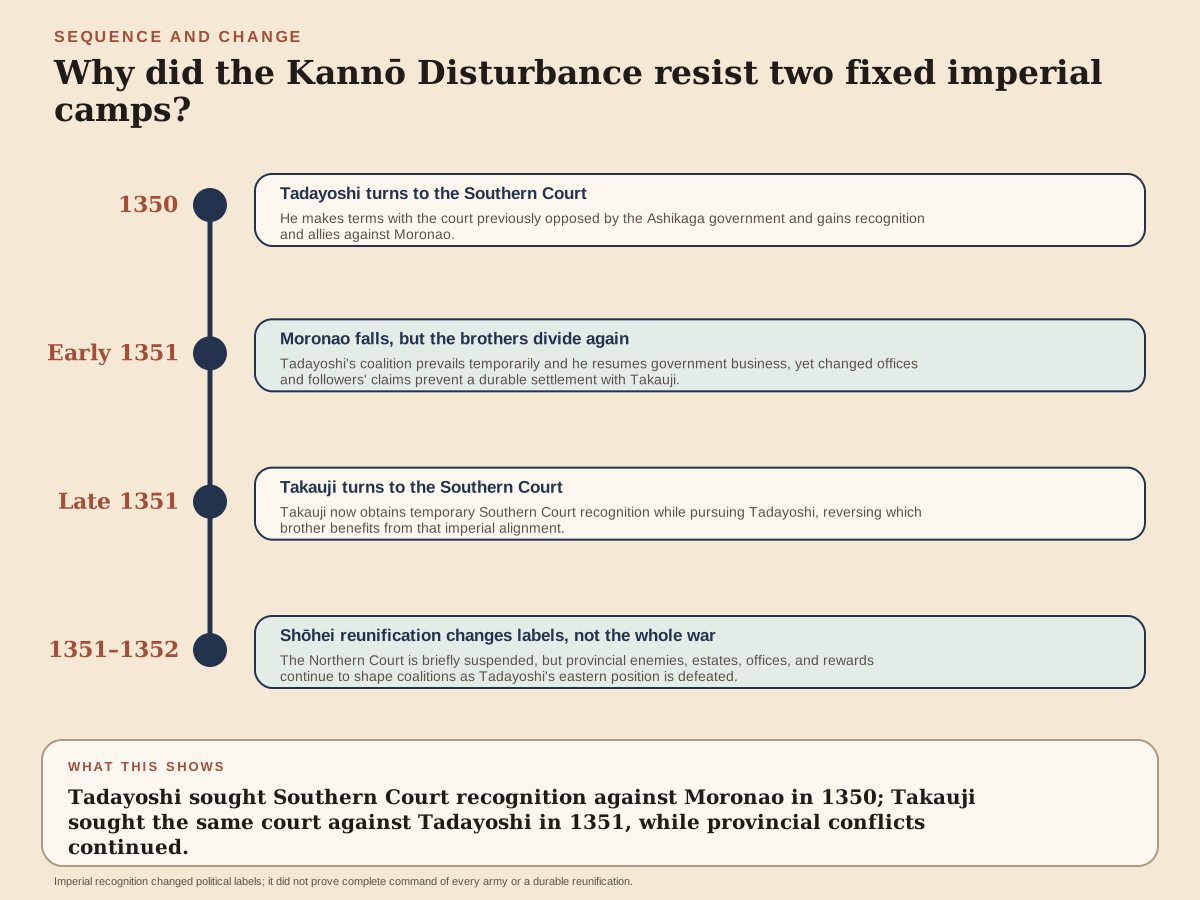
Tadayoshi returned to armed opposition in 1350 and came to terms with the Southern Court, previously the Ashikaga government’s enemy. The Kannō Disturbance spread through rival Ashikaga coalitions. The imperial court gained from the split; Tadayoshi gained allies against Moronao. Regional followers also pursued their own disputes. A conflict inside the ruling house had become a wider war because its leaders could mobilize people and authority accumulated through years of government service.
In 1351, Tadayoshi’s coalition prevailed temporarily and Moronao was killed. The brothers briefly reached terms, but offices and followers’ expectations had changed. Within the same year they separated again, and Tadayoshi moved toward Kamakura. Removing a rival had not restored an agreement about governing.
In 1351 Takauji made his own temporary agreement with the Southern Court, isolating Tadayoshi. The resulting Shōhei reunification briefly suspended the Northern Court’s position, but did not end the civil war. Imperial recognition changed while provincial conflicts continued. Takauji combined the new alignment with military pursuit, and Tadayoshi’s eastern coalition was defeated.
After surrender, Tadayoshi was confined at Kamakura and died in 1352. Some accounts present poisoning by Takauji as fact; others record illness and treat poisoning as an allegation. The suspicion circulated early, but the surviving evidence does not establish its mechanism or a precise order with confidence. His death ended the partnership; the government still needed the administrative work he had performed.
Tadayoshi helped make Ashikaga government work through judgments and recognition of property. Its civil war then exposed the dangers of governing through overlapping personal followings. His questions to Musō Soseki survived separately in print: a later impression of a 1647 edition carries an 1821 preface. His legacy extended beyond the failed partnership with his brother.
Classic
Ashikaga Tadayoshi was born in 1306 into a warrior house serving the Kamakura shogunate, the military government based in eastern Japan. His elder brother Takauji would become its most consequential rebel. At the beginning of Tadayoshi’s life, however, the Ashikaga belonged inside that order. Their standing rested on descent, service and relationships with other warrior families, not on possession of a national government. [3]
Brotherhood later gave Tadayoshi access to authority that an unrelated officer could not easily acquire. Takauji could entrust him with followers and political business because he acted as a senior member of the same house. The arrangement also allowed Tadayoshi to build relationships of his own. A warrior who dealt with him over an estate or an assignment might depend on his judgment, even while acknowledging Takauji as head of the family.
The brothers’ shared position was therefore an asset before it became a problem. Their rise began through service and rebellion within an established warrior system. The government they eventually created would depend on both of them, but it would have no easy way to settle a dispute when the brothers and their followers ceased to agree.
In 1333 the Kamakura order collapsed. Takauji turned against the government he had been sent to defend, and the Ashikaga joined the movement supporting Emperor Go-Daigo. Rebel victories in Kyoto and Kamakura allowed the emperor to attempt a restoration of direct imperial government, conventionally called the Kenmu Restoration. The victors still had to decide what would happen to land and offices previously controlled by the defeated regime.
Tadayoshi acquired a concrete role in that settlement. He went to Kamakura with Prince Naruyoshi, one of Go-Daigo’s sons, and took charge of eastern political business under imperial authority. The prince supplied a royal presence; the Ashikaga supplied a warrior organization capable of making that presence effective. An appointment intended to extend the restored court’s reach consequently gave the brothers an important regional base.
Kamakura’s fall had not erased the people who held property or expected rewards. Warriors wanted confirmation of claims, while temples and aristocratic proprietors sought protection of older rights. Tadayoshi’s work placed him where those expectations met. Administration was already a means of securing followers: recognition of a holding could bind a claimant to the officer who granted it. His eastern assignment made him more than Takauji’s assistant on campaign, without making him independent of the court that had authorized their position.
Prince Moriyoshi, another son of Go-Daigo, had been a prominent opponent of the Kamakura government and then a rival to Ashikaga influence. His arrest placed an imperial prince in the custody of the warrior house whose position he had challenged. He was held at Kamakura, where Tadayoshi exercised authority.
The arrangement tied a dispute at the imperial center to an eastern military command. Keeping the prince confined depended on the same personnel and defenses that sustained Ashikaga rule in Kamakura. In 1335, when Hōjō Tokiyuki’s forces advanced on the city, that system came under immediate pressure. Moriyoshi was killed during the upheaval.
The death belongs to Tadayoshi’s political responsibility because the prince was held under his authority. The degree of his direct responsibility is less secure. Some accounts attribute an order to him; a more cautious reading distinguishes the fact of Ashikaga custody and killing from the precise personal command reconstructed in narrative sources. The available evidence does not settle the order’s wording or the full chain of decision. That limit does not remove responsibility for custody, and it does not make every later account an equally reliable record of what occurred.
Hōjō Tokiyuki was a survivor of the family that had dominated the fallen Kamakura government. His attempt to recover its eastern center in 1335 is known as the Nakasendai Rebellion. For Tadayoshi it was a military defeat before it became an opportunity for the Ashikaga house: he lost Kamakura and retreated.
Takauji marched east, joined his brother and defeated Tokiyuki’s forces. Recovering the city restored Ashikaga standing, but the expedition also changed the brothers’ relationship with Go-Daigo. The court sought to control military authorization, appointments and the rewards that would follow victory. Takauji’s forces possessed enough strength to act without accepting every restriction imposed from Kyoto.
Rewarding followers was especially consequential. A warrior who fought to recover Kamakura expected recognition of service, and that recognition could take the form of rights to land. Issuing such rewards put the Ashikaga into business the emperor wished to reserve to his government. Tadayoshi’s regional authority and Takauji’s military response had begun as parts of imperial rule. Once the brothers could recover a city and sustain followers themselves, recalling them required more than an order. The regional emergency widened into a contest over who could govern.
The break with Go-Daigo developed through military commands and rival claims to reward followers. Nitta Yoshisada, a leading commander of the restoration, fought the Ashikaga on the emperor’s side. The brothers’ eastern strength did not immediately give them control of Kyoto. In early 1336 they entered the capital but were driven out and withdrew toward Kyushu.
Their recovery depended on renewed support beyond the court city. Returning east, the Ashikaga defeated the imperial forces at Minatogawa and re-established themselves in Kyoto. Go-Daigo’s subsequent withdrawal to Yoshino left two imperial centers. The Northern Court in Kyoto provided recognition to the Ashikaga; the Southern Court maintained Go-Daigo’s claim and continued resistance.
Tadayoshi’s importance in this transition lay partly in making rebellion administratively durable. Military followers needed rewards that would survive the next campaign. Holders of older rights needed a place to seek protection when those rewards threatened their property. Documents and judgments gave the Ashikaga a means to answer both demands, though no decision could satisfy every claimant.
This government remained vulnerable to war with the Southern Court and to disputes among its own supporters. It had emerged from a coalition that rejected the emperor’s settlement. Keeping that coalition together now required the brothers to make settlements of their own.
The Kenmu Shikimoku of 1336 was a set of seventeen governing guidelines, named for the Kenmu era. It addressed the location of government and the conduct of officials after years of political upheaval. Its provisions prohibited bribery, called for hearing the complaints of poor and weak petitioners, and required fixed times for judicial business. Delay could injure claimants, but speed was not to excuse a superficial judgment. [7]
Tadayoshi is closely associated with the administrative outlook expressed in the text. That association is not the same as proof that he personally authored every provision. The program belonged to a government taking shape through advisers, offices and inherited practice. It did not create a complete institutional system in a single act. [7]
Its practical significance was the demand that rule be more than the distribution of military rewards. A government depended on the behavior of the people who administered it and on claimants finding its procedures usable. Tadayoshi’s later work on property and judgments followed those concerns. Yet the same government owed its survival to men seeking advancement through war. Restraining conduct and confirming rights could conflict with the expectations of military followers.
The text therefore marks a problem the regime would continue to face. The Ashikaga had to offer the stability promised by lawful administration while rewarding the coalition that had brought them to power. Tadayoshi became central to the first task without being insulated from the second.
The early government is often described as a diarchy, or rule through two leading figures. Takauji held the house’s supreme dynastic standing and was associated with military leadership and rewards. Tadayoshi exercised extensive authority over administration, property confirmation and adjudication. The arrangement gave the regime more capacity than either brother could supply alone. [2][3]
The division was not absolute. A surviving letter of 1338 praises military service performed by a provincial deputy and is issued by Tadayoshi. His business could cross into campaigning, just as a grant made by Takauji could change the property order that Tadayoshi was expected to protect. Both acted through a single Ashikaga political world.
Historical disagreement · How did the Ashikaga brothers divide authority?
There is also a disagreement about how best to describe that world. Satō Shin’ichi’s influential model separates authority over followers and rewards from authority over government and property. Historian Kameda Toshikazu’s 2019 reassessment argues that the powers overlap too extensively for a rigid division; he emphasizes Tadayoshi’s leading position and distinguishes creating new rights from preserving existing ones.
These are competing explanations of the same documentary record, not rival claims that one brother did nothing. [2]
The broad fact of Tadayoshi’s substantial authority is secure. How neatly it can be divided from Takauji’s remains contested. The brothers’ followers could cooperate across their responsibilities, but they could also turn access to different leaders into competing routes to advancement.
Tadayoshi sought guidance from Musō Soseki, a Zen Buddhist monk. Musō’s responses to his ninety-three questions formed the Muchū Mondōshū, a guide to Buddhist teaching in accessible Japanese. Tadayoshi’s retainer Ōtaka Shigenari financed its printing. The relationship gave him another route to advice and connected his circle to the practical transmission of religious learning.
Land adjudication concerned income and service, not simply the ownership of an undivided plot. A temple or court family might hold an estate’s revenue rights while a warrior occupied land or served as its steward. A military reward could place another claimant over those existing interests. Tadayoshi’s judgments helped determine which claims the government would recognize.
A surviving ruling catalogued by the University of Tokyo concerns Saitō Hidesada’s claim to fields at Asahi in Ōmi, a historical province in central Japan. It is dated to the twelfth month of 1348 in the contemporary Japanese calendar and bears Tadayoshi’s authorization. According to the university’s description, Hidesada asked for interference by relatives to be stopped. The ruling confirmed the legitimacy of his existing holding after examination by the government’s deliberative office. It recognized a specific claim, without proving how readily the decision was enforced on the ground. [1]
An authorized judgment could provide a claimant with something to present against a rival’s demands. Its force still depended on compliance and the ability to enforce the decision locally. Documentary proof did not remove hierarchy, political access or armed possession from medieval justice. Tadayoshi’s attention to procedure nevertheless gave property holders a reason to bring cases to the Ashikaga government. [1]
That work also put him under pressure from different constituencies. Protecting a recognized holding might disappoint a warrior expecting reward for recent service. Granting a reward might injure a proprietor with an older document. The government’s military success increased the number of claims it had to reconcile.
Kō no Moronao was Takauji’s senior deputy, an officer whose access to the head of the Ashikaga house gave him considerable influence. His standing also rested on military service and relationships with other warriors. Tadayoshi had his own associates and authority over government business. Neither man operated alone. [3][6]
Their conflict involved appointments and the treatment of followers as well as personal hostility. A decision protecting older estate rights could limit what was available to reward military service. A grant favoring a commander could undermine a judgment made through Tadayoshi’s offices. Such decisions affected the standing of the people who had sought them.
The conventional contrast between a lawful administrator and a disruptive military deputy captures one part of the struggle, but the record of overlapping powers complicates that division. Provincial leaders could choose sides because of a local rival or a disputed holding rather than a consistent philosophy of government. The two circles became opposing concentrations of influence within a regime that still needed both. [2][3]
As the quarrel sharpened, access to Takauji ceased to be a routine matter of office. It became a means of removing an opponent. The dispute would reach Tadayoshi personally because there was no separate institution capable of enforcing a final settlement between the government’s senior leaders.
In 1349 military pressure from Moronao’s side forced Tadayoshi out of effective office. Taking Buddhist vows marked his withdrawal and changed his public status. It did not erase the people who depended on him or the disputes that had produced the confrontation.
Takauji’s son Yoshiakira moved into the administrative position Tadayoshi had occupied. The change brought succession within the Ashikaga house directly into the struggle. It was no longer only a contest between Tadayoshi and a deputy: another member of the ruling family now held authority that Tadayoshi’s followers had previously approached through him.
Tadayoshi’s adopted son Tadafuyu and other allies remained active. They had their own regional positions, grievances and possibilities for action. Retirement could reduce Tadayoshi’s immediate ability to issue decisions, but it could not make their interests disappear.
The settlement consequently rested on a distinction between removing a man from office and dissolving his political following. Moronao’s success achieved the first. The second would have required former allies to accept a new distribution of authority and rewards. When that acceptance failed, the same relationships that had supported Tadayoshi’s administration provided the means of returning to armed politics.
Tadayoshi returned to armed opposition in 1350. He sought support against Moronao and came to terms with the Southern Court, the imperial side the Ashikaga government had been fighting. The conflict known as the Kannō Disturbance spread through the brothers’ followers and regional allies. [6]
The change of alignment did not require every participant to adopt a new lifelong allegiance. The Southern Court could gain from a split in the Ashikaga regime. Tadayoshi could gain legitimacy and allies against rivals closer to him. Provincial warriors judged those possibilities in relation to their own enemies and property. The line between the rival courts no longer explained every army in the field.
This was a war within the government as well as a continuation of the wider civil war. Officers and followers carried authority accumulated through years of Ashikaga service into opposing coalitions. Tadafuyu’s regional activity widened the reach of the struggle, while Moronao’s enemies had reasons to support Tadayoshi without necessarily accepting every part of his program. [2]
Tadayoshi’s earlier retirement had therefore failed as a political solution. It removed his office but left him with relationships strong enough to challenge the men who had displaced him. Those relationships made a return possible, while exposing the whole regime to fighting over its own distribution of power.
Tadayoshi’s coalition gained the advantage in 1351. Takauji and his brother temporarily reached terms, and Moronao was killed. Tadayoshi returned to government business. The removal of his principal rival gave him a victory that withdrawal in 1349 had seemed to foreclose.
It did not restore the earlier partnership. Offices had changed hands, allies had fought one another, and followers had acquired new expectations of protection and reward. Men who had backed Moronao did not necessarily accept the return of Tadayoshi. Men who had fought for Tadayoshi expected the settlement to protect their position. Takauji remained head of a house now containing those antagonistic claims.
Within the same year the brothers again separated. Tadayoshi left Kyoto and moved through the northern provinces toward Kamakura. His retreat also demonstrated where he could still expect followers and where his authority had become difficult to sustain.
Moronao’s death had removed a leader without removing the political business around which opposition had formed. The government still had to allocate office and property, and every allocation could renew the conflict. Tadayoshi could defeat a deputy’s coalition, but recovering a stable place beside Takauji required agreement from people whose interests had been changed by the war.
Takauji now made his own temporary agreement with the Southern Court. The short Shōhei reunification of 1351–1352 suspended the rival Northern Court’s position and gave him a means of pursuing Tadayoshi under a changed imperial alignment. The two brothers had each turned toward the court once opposed to the Ashikaga regime.
“Reunification” describes the political arrangement, not a durable end to civil war. Recognition at the imperial level did not automatically settle provincial occupations, competing estates or the loyalties of armed followers. The agreement could alter who was called a rebel while leaving substantial power in the hands of the warriors who negotiated it.
For Tadayoshi, the reversal narrowed the room in which his earlier Southern alignment could protect him. Takauji combined that recognition with military pursuit. Tadayoshi’s coalition lost ground, and the struggle returned to the eastern region in which he had first exercised authority after Kamakura’s fall.
The episode makes the brothers’ conflict difficult to reduce to a simple contest of imperial loyalists against warrior rebels. Imperial claims remained consequential, but the men seeking recognition changed sides as their immediate struggle changed. The result for Tadayoshi was defeat, not the recovery of a secure administrative partnership.
After defeat, Tadayoshi surrendered and was confined at Kamakura. He died there in 1352, ending the brothers’ partnership and his own attempt to return to power. The political sequence is clearer than the medical cause of death. [3][6]
Historical disagreement · Was Tadayoshi poisoned?
Accounts differ in their treatment of poisoning. Some Japanese reference works present death at Takauji’s hands as a fact; others record illness and identify poisoning as an allegation. The Taiheiki, a medieval war chronicle, helped transmit the suspicion, and the Kanagawa Prefectural Archives notes that it circulated from the time of his death.
That early circulation establishes the history of the claim, not the substance used or a proven order from Takauji.
A cautious conclusion retains both the death and the allegation. Tadayoshi died after his brother defeated him, in circumstances that made suspicion politically plausible. The surviving evidence does not establish a precise mechanism with confidence.
His disappearance changed the government’s personnel without resolving the questions over which it had divided. Takauji and Yoshiakira still had to reconcile followers’ rewards with existing rights and govern through relationships reaching far beyond the ruling household. Tadayoshi’s defeat ended one concentration of authority; the work he had performed remained necessary.
Takauji’s appointment as shogun gives the Muromachi government a recognizable founder. Tadayoshi’s career reveals what that name leaves out. The regime needed property confirmation and judgments as well as victories, and a senior member of the ruling house supplied much of that work. Followers approached him as a person capable of making consequential decisions, not merely as a clerk executing his brother’s instructions.
His failure also belongs inside the story of institutional formation. The Kannō Disturbance did not interrupt a completed system from outside. It grew through offices, grants and personal relationships that had helped the Ashikaga secure rule. Those arrangements could distribute work effectively while the leaders cooperated; once they became rivals, the same followers and channels sustained competing armies. [2]
The government survived Tadayoshi, but survival was not the continuation of an unchanged division between two brothers. Their successors had to redistribute authority and secure support under conditions the conflict had altered.
His questions to Musō had a separate afterlife in print. Kyoto University preserves a later impression from an edition originally issued in 1647, carrying a preface dated 1821. That is evidence of the text’s transmission, not a count of its readers or proof of an unchanged interpretation. Tadayoshi could remain a named participant in religious learning even when political narratives concentrated on his defeat.