Read the article below. Interactive reading tools are available when scripts load.
Quick
Konishi Yukinaga came from the Sakai merchant world near present-day Osaka; his birth year and early upbringing are uncertain. His father is identified as Konishi Ryūsa. He served the Ukita house in present-day Okayama before entering the service of Toyotomi Hideyoshi, who was extending his authority across Japan. Yukinaga supervised shipping around the Seto Inland Sea and commanded naval forces in Hideyoshi’s campaigns. Ports and islands under his responsibility connected troops and supplies with coastal routes. He also became a Catholic Christian, using the baptismal name Agostinho. His military service helped bring a southern Higo lordship in 1588, turning a shipping commander into a governor of lands in present-day Kumamoto. [1][2][17][3]
In 1588 Hideyoshi placed Yukinaga at Uto in southern Higo, in present-day Kumamoto; Katō Kiyomasa received territories farther north. Yukinaga initially occupied the earlier Uto castle on Nishiokadai. From 1589 he began a new castle on nearby Shiroyama and developed its town. He also established Mugishima Castle in the Yatsushiro area. His authority extended to warrior houses in the Amakusa islands, who were expected to serve under the new arrangements. Their resistance, commonly connected with demands for castle-building assistance, led to warfare in 1589. Yukinaga and Kiyomasa campaigned against them together. The new lordship therefore rested on construction and local submission as well as Hideyoshi’s grant. [1][3][4][5][6]
Yukinaga was a Catholic Christian called Agostinho in missionary accounts. After Hideyoshi’s 1587 order against missionaries, he continued in Hideyoshi’s service and became an important protector of Christian activity. The Christian lord Takayama Ukon received his protection, and his patronage included charitable work. Christianity in Amakusa had begun before Yukinaga’s rule; local warrior houses and missionaries had already established communities there. Schools and printing activity run by the Jesuits, a Catholic religious order, flourished in the region during the 1590s. During the Korean war, Yukinaga requested the priest Gregorio de Céspedes to minister to Christian soldiers in Japanese garrisons. His faith linked households and institutions across the sea while he continued commanding forces engaged in conquest and occupation. [1][7]
Hideyoshi invaded Korea in 1592, seeking an advance toward Ming China. Yukinaga commanded the first contingent and crossed to Busan with forces that advanced through Seoul toward Pyongyang. Sō Yoshitoshi, lord of Tsushima and Yukinaga’s son-in-law, participated in the Korean military and diplomatic operations. Their advance brought Japanese occupation deep into the kingdom of Joseon. Korean resistance and Ming intervention prevented this from becoming a completed conquest. Ming and Korean forces recovered Pyongyang in 1593, and Yukinaga withdrew with the surviving troops. Negotiations with Shen Weijing, a Ming intermediary, had begun during the occupation and continued as Japanese forces pulled back. Yukinaga’s later pursuit of terms grew within his own career as an invading commander. [1][8][2][9][10][11]
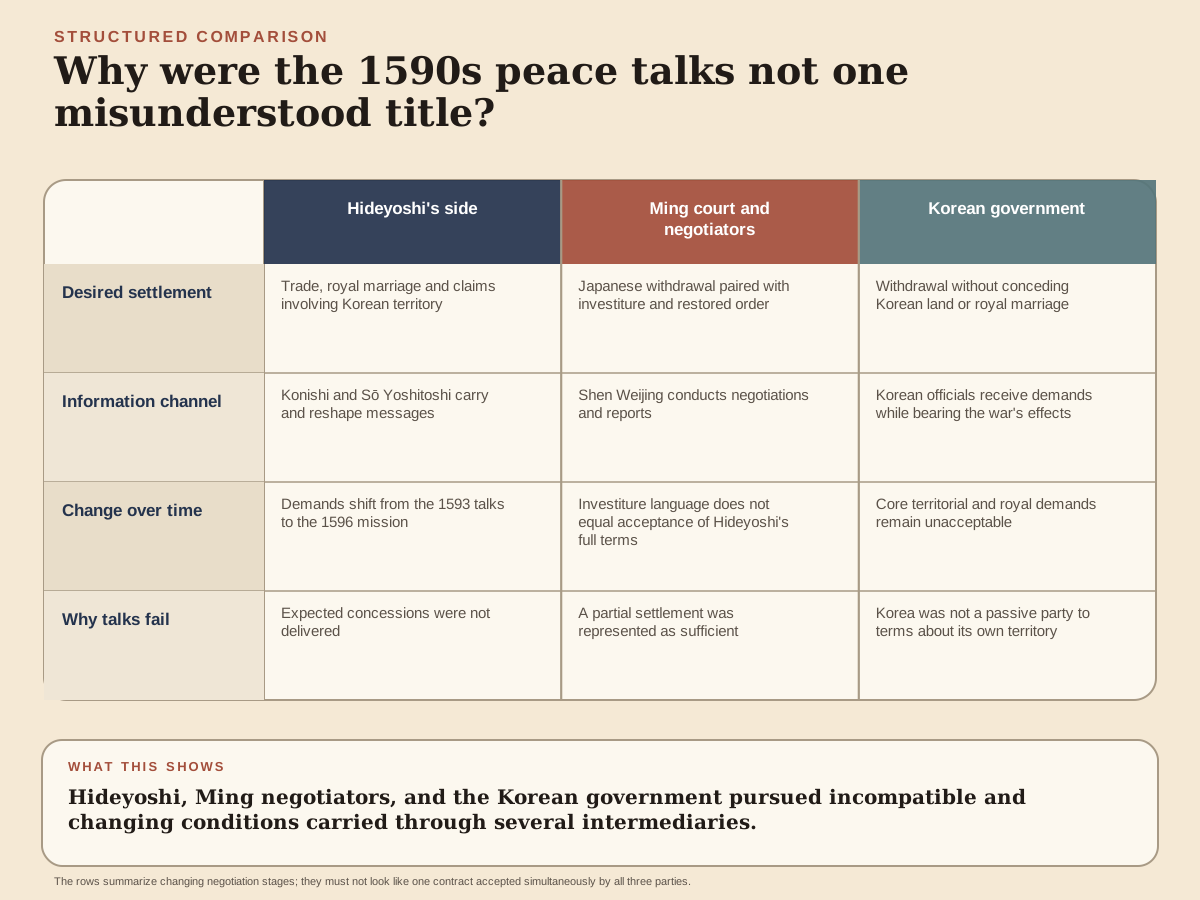
Yukinaga negotiated with Shen Weijing of Ming and worked with Sō Yoshitoshi, the Tsushima lord connected to Korea’s diplomatic routes. Hideyoshi’s demands included trade with Ming, royal marriage and control over part of Korea. Ming proposals required Japanese withdrawal and offered recognition of Hideyoshi as king of Japan within the emperor’s political order. The terms changed during the negotiations, and Korea’s government resisted demands involving its land and royal family. Yukinaga’s work also included garrison arrangements: a letter attributed to 1596 orders the transfer of a Tsushima castle and lands when a shipping officer returned. The embassy received at Osaka in 1596 failed to establish peace. The surviving documents and scholarly interpretations make its failure more complicated than a single moment of insult at a royal title. [1][2][9][8][14][16][15]
Yukinaga returned to the Korean war in 1597 after the failure of the embassy. Japanese armies again attacked while maintaining strongholds along the southern coast. Yukinaga held a position at Suncheon, where Ming and Korean forces attacked by land and sea in 1598. The Ming commanders Liu Ting and Chen Lin and the Korean admiral Yi Sun-sin participated in these operations. Hideyoshi’s death that year brought orders for the Japanese forces to return. Withdrawal still required departure from threatened coastal positions. Naval fighting continued around the sea approaches, and Yi died during the final campaign. Yukinaga reached Japan, but the invasion left Korean communities with destruction, captivity and losses that troop withdrawal could not repair. [1][2][8][12][18][19][7]
After returning from Korea, Yukinaga joined Ishida Mitsunari, a leading Toyotomi administrator, in opposition to the powerful lord Tokugawa Ieyasu. He brought forces to the western coalition that fought at Sekigahara in 1600. The coalition was defeated, and Yukinaga was captured. He was executed in Kyoto that year, ending his governing career and lordship. Christian accounts subsequently interpreted his death as martyrdom. That religious meaning should be distinguished from the political defeat that led to his execution. Uto’s later commemoration preserves the memory of its castle founder and Christian lord. His life also belongs to Korea’s history of invasion, occupation and failed negotiations. [1][3][17][7][8]
Classic
Yukinaga’s family was associated with Sakai, a trading city beside the Seto Inland Sea near present-day Osaka. His father Ryūsa and elder brother appear in accounts of a merchant household dealing in medicinal goods.
Historical disagreement · Can Yukinaga’s birth be dated?
Modern references commonly give 1558 as his birth year, while the major signed biographies leave it unknown. [1][2]
The record of his career becomes clearer with service to the Ukita house in Bizen, around present-day Okayama, and then to Toyotomi Hideyoshi, the military lord extending his authority across Japan. Hideyoshi’s growing military authority gave Yukinaga responsibilities that depended on connections beyond a single province. [1][17][2]
The Yamakawa reference dates his administration of Murotsu, a port in Harima, to 1581 and records an island grant in 1585. Murotsu, Shōdoshima and the Shiwaku islands belonged to the maritime region in which his shipping duties developed. Reports by Jesuits, members of a Catholic religious order, describe his supervision of vessels between Shiwaku and Sakai, as cited in the World Encyclopedia biography. He led naval forces during Hideyoshi’s campaign in Kii in 1585 and participated in the Kyushu campaign in 1587. Command at sea placed him within the movement of armies as well as the commercial world from which his family emerged. [2][1]
Yukinaga became known as Settsu-no-kami, a court title referring to Settsu province; the title should be distinguished from his actual lands and duties. His baptismal name Agostinho also appears in European accounts of Japanese Christian lords. Merchant kinship networks and sea routes connected missionaries with Japanese households, as Mihoko Oka’s research examines. Yukinaga’s place among those connections accompanied advancement in Hideyoshi’s military service. In 1588 he received territories in southern Higo, in present-day Kumamoto, and took Uto as his base. Here he had to establish authority over local warrior houses, build his own centers and meet further military obligations. [1][7][13][3][4][6]
Yukinaga entered southern Higo in 1588, after Hideyoshi had intervened in the province’s unsettled government. Katō Kiyomasa became a neighboring lord in the north. Uto already had a castle on Nishiokadai, occupied by earlier ruling houses. Yukinaga used that site before beginning a new stronghold on Shiroyama in 1589. The new castle established his governing base beside the older stronghold. Town development accompanied the new castle and helped shape the later Uto urban area. [1][2][3][4]
Mugishima in the Yatsushiro area was another castle founded under Yukinaga, dated 1588 in the city’s account. Its site extended roughly 400 meters in each direction including the moats. Together with Uto, it shows the establishment of more than one center within his holdings.
Historical disagreement · Assessing the size of the Higo lordship
The amount of land assigned to him is described differently in modern references, ranging from roughly 140,000–150,000 to 240,000 koku. Koku was a unit of rice volume also used to express assessed territorial resources. The differing totals do not alter the central change: Yukinaga acquired lands and local service obligations that his previous shipping command alone had not supplied. [5][3][1][2][17][6]
Local warrior houses, conventionally grouped as the “five Amakusa houses,” already exercised authority in the islands. Hideyoshi’s arrangements required them to serve under Yukinaga. Resistance to his demands is commonly associated with assistance for the Uto castle works. In 1589 Yukinaga and Kiyomasa used their forces against these houses. For the island households, the establishment of the new lordship brought demands on service and the danger of armed suppression. Some of the same region’s Christian warriors would later serve in the invasion of Korea. [6][7][1]
Hideyoshi’s 1587 missionary-expulsion order threatened Christian work during the same period in which Yukinaga advanced in his service. Yukinaga did not suffer the removal experienced by Takayama Ukon, another Christian lord, and in 1588 received southern Higo. Tani Naoki’s biography identifies him as a protector of Ukon and a supporter of care for leprosy sufferers and orphans. Christian patronage was one use of the resources he acquired through military service. It existed alongside the territorial demands imposed on the Amakusa houses and the military obligations owed to Hideyoshi. [1][6]
Amakusa’s Christian communities preceded Yukinaga’s arrival. Several local warrior rulers had converted while missionaries established churches and cultivated followers. Under the later governing arrangements, Jesuit educational institutions and a printing operation made the islands a center of Christian learning. The books produced there included religious teaching and Japanese and European literary works. These activities involved local converts, teachers and missionaries as well as a lord’s protection. [7][1]
At Yukinaga’s request, the Spanish Jesuit Gregorio de Céspedes traveled secretly to Korea late in 1593. He stayed chiefly at the Japanese coastal stronghold of Kumagawa and visited Christian commanders to celebrate Mass and hear confession. His letters, described by Taniguchi Tomoko, also reported hardship among Japanese troops and the negotiations with Ming. Taniguchi’s account follows Céspedes’s later contact in Japan with Korean captives, including baptism and the education of some children. These people had been displaced by the invasion. The same religious connections that served Yukinaga’s troops thus also crossed the lives of people brought from the country those troops invaded. [7][8]
In 1592 Yukinaga led the first contingent of Hideyoshi’s invasion into Korea. The forces landed at Busan, took the capital now called Seoul and continued toward Pyongyang in the north. Sō Yoshitoshi, lord of Tsushima, worked within the expedition and its dealings with Korea. He was connected to Yukinaga by marriage to Yukinaga’s daughter. The occupation reached far beyond the Japanese coastal embarkation points and placed invading forces within the kingdom of Joseon. Ming China intervened in support of the Korean government. [1][2][9][8][10][11]
The Joseon court received news of Pyongyang’s recovery in the traditional first month of 1593. Its annal records arrangements to thank the Ming commander and reward the bearer of the news. The more detailed Revised Seonjo Annals describes an assault led by the Ming commander Li Rusong, with Korean troops joining the attacks. The invading garrison used fortified positions and firearms, while the attackers employed artillery and fire. Yukinaga withdrew with the surviving men. The same compilation includes a memorial describing the recovery of Korean captives held in the city. For the Korean government and those captives, the reversal concerned the recovery of people and territory, as well as the defeat of an enemy commander. [10][11]
Evidence boundary · Retreat and victory in the revised annals
The revised annals preserve both an account of permission for retreat and a victory memorial stressing pursuit and enemy losses.
It was compiled retrospectively, and the memorial’s praise of Ming victory shaped its language and reported totals. [11]
Yukinaga had lost Pyongyang, and the Japanese advance could not continue as before. Meanwhile, negotiations had already begun with Shen Weijing during the 1592 occupation. After the reversal, the talks continued while Japanese troops withdrew toward the southern coast. Withdrawal from the northern cities still left garrisons on Korean soil and made their future part of the terms being discussed. [11][1][10][9][8][16]
Yukinaga’s negotiations operated through Shen Weijing, a Ming intermediary, and Sō Yoshitoshi’s connections with Korea. Hideyoshi’s 1593 terms sought renewed trade with Ming and a royal marriage, while also demanding Korean territory and royal hostages. A version of these terms was sent to Yukinaga and three other Japanese administrators. The proposed settlement would dispose of parts of Korea without making the Korean king an equal participant in those discussions. Zheng Jiexi’s examination of the negotiations argues that the Japanese side subsequently withdrew or adjusted demands, while Ming’s own position on trade also changed. Recognition as king, official tribute and commercial exchange were related issues, but the offer of one did not automatically settle the others. [1][2][9][8]
Historical disagreement · Who authorized the submission sent to Ming?
Yukinaga’s retainer Naitō Joan went to Beijing in the negotiations concerning Hideyoshi’s recognition. The submitted document presented a request consistent with Ming’s political framework. A familiar account treats it as a submission forged by Yukinaga and Shen. Zheng questions whether its authorization can be settled so simply, comparing Yukinaga’s letter defending its validity with Naitō’s statement that he acted on instructions passed through Yukinaga.
That evidence shows correspondence and claims of authorization; it does not remove the discrepancy among the terms transmitted. The governments still differed over withdrawal, trading rights and Korea’s position. [8][9][2]
One letter preserved among the Ōura family documents makes Yukinaga’s work visible on a smaller scale. Addressed to a retainer of the Sō house, it orders receipt of the castle and lands at Toyosaki, on Tsushima, after their inventory has been made. The transfer accompanies the return of Mōri Tomoshige, who had managed ships between Korea and Tsushima. The Tsushima History Research Center assigns the letter to 1596 from its content and places it in the reduction and reorganization of garrison service during the talks. For Yukinaga, diplomacy included arrangements through which officers could return and remaining positions could be reassigned. [16]
Historical disagreement · Why did the peace negotiations fail in 1596?
The 1596 embassy brought a document naming Hideyoshi king of Japan under the Ming emperor. Osaka Museum of History preserves that document, while the Imperial Household Agency holds a different 1595 instruction concerning peace conditions and gifts. The document retained at Osaka lacks damage corresponding to Rai San’yō’s later story that Hideyoshi tore it in anger. Japanese scholarship summarized in the joint history report challenges explanations centered solely on rejection of the title. Some readings emphasize demands for withdrawal and a Korean prince’s visit; Zheng stresses negotiated adjustments alongside continuing Japanese claims to superior status over Korea. The talks nevertheless failed, and Hideyoshi ordered another invasion in 1597. [14][15][8][9][1][2]
The failure of the 1596 embassy did not end Yukinaga’s military obligation to Hideyoshi. He crossed to Korea again in 1597, joining the second invasion. The Japanese armies’ coastal castles supplied fortified bases during continuing occupation. The coastal fortress at Suncheon had inner and outer enclosures, a moat and entrances that turned approaching movement through its defenses, as the surviving layout shows. The joint research survey connects their construction and maintenance with military service and the supply pressures facing Japanese lords. Yukinaga’s diplomacy thus remained tied to a position sustained by garrisons and troops on Korean soil. [1][2][8][18][16]
In 1598 Ming and Korean forces attacked the Japanese position at Suncheon, held by Yukinaga. Liu Ting’s Ming land forces and Chen Lin’s naval forces participated, alongside the Korean naval commander Yi Sun-sin. A study by Park Hyun Kyu examines letters concerning the Suncheon and Noryang operations preserved in a later Chinese family genealogy. His abstract describes Korean requests for stronger attacks and disagreement over a proposal to strike Namhae first. The allied forces also had to coordinate differing operational judgments. For Yukinaga, departure depended on these contested coastal and maritime approaches, as well as orders sent from Japan. [12][18][1][8]
Hideyoshi died in 1598, and Japanese forces withdrew. Yukinaga returned to Japan, while the final naval fighting included the battle at Noryang and Yi Sun-sin’s death. The return ended the Japanese attempt to hold its invading army in Korea. It did not return every captive or restore the communities damaged during the campaigns. People taken to Japan included children, scholars, craftspeople and others with very different subsequent lives. The wars’ consequences continued through captivity and later efforts at repatriation. [1][8][12][19][7]
The withdrawal from Korea returned Yukinaga to the Toyotomi political order after Hideyoshi’s death. Ishida Mitsunari, one of its leading administrators, opposed the growing power of the great territorial lord Tokugawa Ieyasu. Yukinaga joined Mitsunari’s side and commanded troops in the western coalition at Sekigahara in 1600. His allegiance followed years of campaigning and negotiating within Hideyoshi’s government. It was another military decision with consequences for the lands and followers he had acquired in Higo. [1][17][2][3]
Historical interpretation · Political execution and religious remembrance
The western forces lost at Sekigahara. Yukinaga was captured and executed in Kyoto in 1600. His defeat ended his rule at Uto. The church’s treatment of the death as martyrdom, recorded in Tani’s biography, belongs to its subsequent religious interpretation.
His execution followed his participation in a defeated political coalition. [1][17][2][3]
Uto remembers Yukinaga through the castle site, the town’s history and a modern statue. Mugishima’s later archaeological remains also preserve part of the castle landscape established under him. Missionary writings and documents from the negotiations retain another part of his career, extending beyond the lands he governed. Those records connect him with Christian troops, diplomatic intermediaries and people displaced by war. His attempt to secure terms did not free him from serving again in the invasion, and his return did not preserve his lordship through the next struggle. [3][4][5][7][9][16][8][1][2][6]