速读
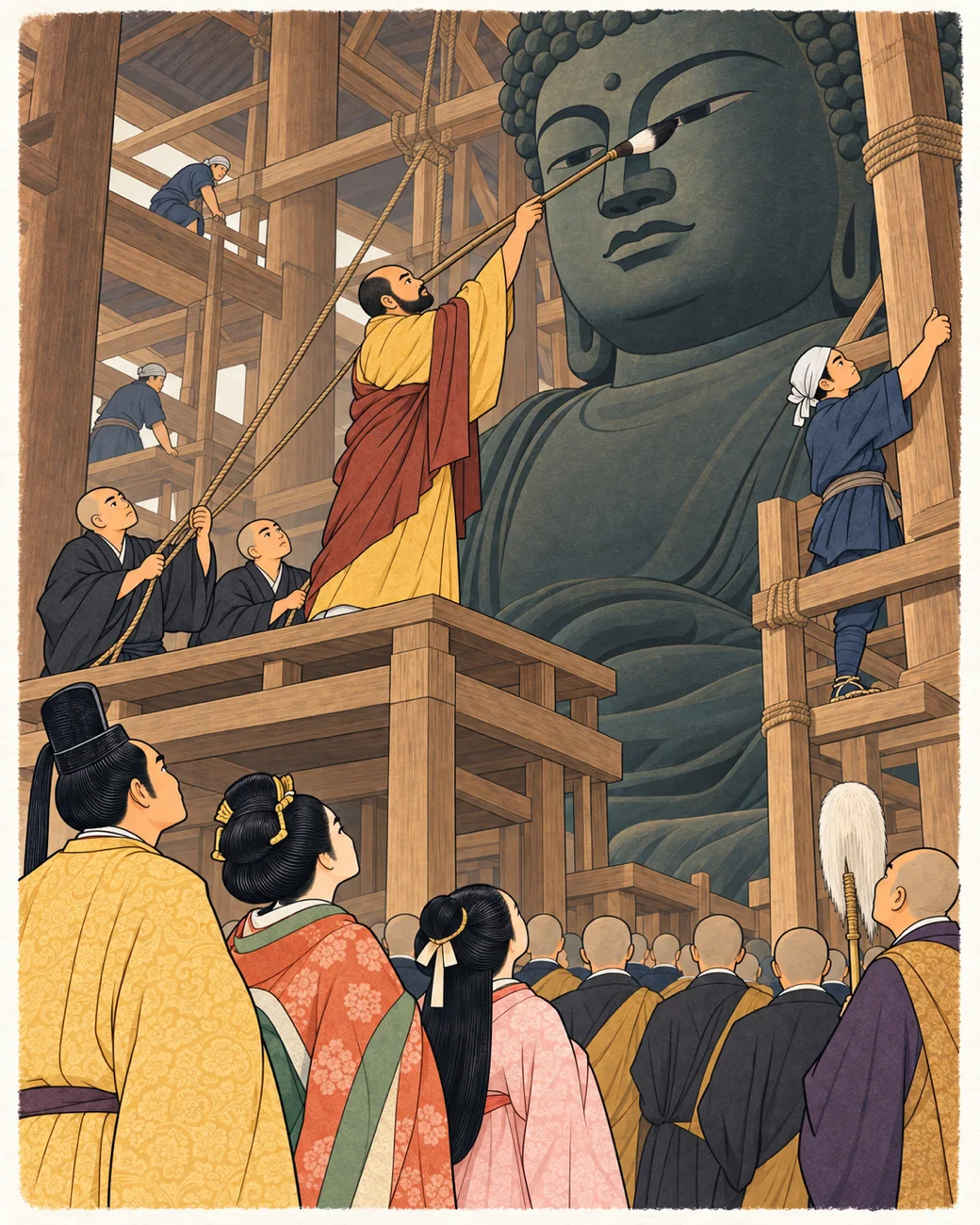
In 752, Tōdai-ji’s Great Buddha in Nara received its eye-opening ceremony. Bodhisena, a monk from India, painted the image’s pupils to consecrate it. Empress Kōken attended with her parents, retired Emperor Shōmu and Empress Dowager Kōmyō. The reigning sovereign and the patrons of the building project thus took part in the same ceremony.
Shōmu had announced the Great Buddha project in 743, after ordering paired provincial monasteries and nunneries in 741. Construction of the bronze image at Nara began in 745. Its body was cast in eight stages and completed in 749; the hall followed in 751. Officials, metalworkers and other builders carried out the work, while the monk Gyōki helped solicit donations. Gyōki died in 749, before the ceremony. Rōben, the temple’s first chief abbot, helped establish the institution around the image.
Eye-opening made a newly created Buddhist image an object of worship. The rite centered on the painting of the pupils, but participation extended beyond the officiant. The Shōsō-in collection preserves a blue silk cord associated with the brush; its catalog explains that participants are understood to have held it to share in the rite’s spiritual benefits. Brushes, ink, masks and costumes also preserve traces of the ceremony and its performances.
The ceremony completed a religious act, rather than every part of construction. Work on the image and the surrounding halls, pagodas and residential buildings continued. Four years later, after Shōmu’s death, Kōmyō donated possessions to the Great Buddha, linking the temple’s worship to the memory of its imperial patron.
The event gave Shōmu’s project a public ritual culmination and brought an Indian monk into its central religious role. Its objects survive in the Shōsō-in, while later repairs and reconstructions shaped the Buddha and hall seen today. The ceremony of 752 remains distinct from the earlier decisions to build them.
详读
The eye-opening ceremony followed nine years of work on Emperor Shōmu’s Great Buddha project. In 743, he announced his intention to create a monumental image of Vairocana, the Buddha associated with the all-embracing vision of the Flower Garland Sutra. This was a new undertaking within an existing program of imperial Buddhist patronage. The paired provincial temples had been ordered in 741.
The first plans were associated with Shigaraki. After the court returned to Nara in 745, construction proceeded on the grounds of the temple that became Tōdai-ji. The immense bronze body was cast in eight stages over three years, ending in 749. A hall was ready in 751. These stages explain what could be consecrated in 752: an erected image within its great hall, even though further work remained.
Shōmu’s sponsorship depended on collaborators. Officials organized construction, and artisans supplied the skills needed to cast and assemble the image. Gyōki, a monk known for his religious and charitable activity, helped gather donations. He died in 749 and did not take part in the eye-opening. Rōben became the temple’s first chief abbot, with responsibilities for the institution that would worship and teach around the Buddha.
By 752, Shōmu had relinquished the throne. His daughter Kōken was the reigning empress. Her mother Kōmyō, Shōmu’s wife, was empress dowager. The ceremony brought the current ruler together with her parents, whose patronage had supported the project.
The temple's institutional beginnings preceded both orders. Tōdai-ji traces its origin to a foundation established in 728 for Crown Prince Motoi, Shōmu's son. Its predecessor became Yamato's provincial monastery under the 741 policy. The royal memorial foundation, the provincial institution and the colossal-image project were successive developments on a connected site.
Shōmu's reign had meanwhile seen the fall of Prince Nagaya, a severe smallpox epidemic in the later 730s and Hirotsugu's rebellion in Kyushu in 740. Court relocations followed. The provincial temple order was issued at Kuni in 741 and the Great Buddha proclamation at Shigaraki in 743. Ritual protection accompanied the government's attempts to restore order, while moving the project to Nara required construction there to begin anew.
The 743 proclamation joined an ambitious material undertaking to the sharing of Buddhist merit. It invoked benefits extending to living beings and plants, welcomed even a small contribution of grass or earth and required participants to worship Vairocana daily. It also acknowledged the ruler's wealth and power and warned that merely exhausting people would fail its religious purpose. The prohibition on forced exactions was therefore part of the stated terms of participation. Officials still had to organize a project whose bronze casting and hall construction exceeded what the imperial family could perform themselves.
Bodhisena served as the eye-opening officiant. He had reached Japan in 736 with other monks, including Dōsen from Tang China and Buttetsu from Linyi, in present-day Vietnam. Their passage connected different Buddhist communities through travel to China and onward to Japan. In 751 the court appointed Bodhisena to the senior office of sōjō, while Dōsen and Ryūson received clerical appointments. The monk entrusted with the central rite consequently held a recognized place in the state's clerical order as well as authority associated with Buddhism's Indian origins.
Kōken was the reigning empress when the imperial family, court officials and clergy gathered at Tōdai-ji. Shōmu attended as retired emperor and Kōmyō as empress dowager. The ceremony took place on the ninth day of the fourth month in the calendar then used in Japan. Museum accounts describe ten thousand monks and civil and military officials. The monks' reported number indicates the stated scale, rather than a complete count of every person present. The change of sovereign had not severed the project from its earlier patrons.
The later compilation Tōdai-ji Yōroku describes a sequence of entrance, consecration, teaching and performance. Bodhisena entered from the east; Ryūson, who lectured on the Flower Garland Sutra, came from the west, while Enpuku served as reader. Bodhisena then advanced before the image and performed the eye-opening. Dōsen's assigned role involved prayer. This distribution of duties placed the brush action within a larger observance, rather than making every attending monk perform the same task.
The essential action was painting the Great Buddha's pupils. In an eye-opening rite, a new image is praised and consecrated for worship. Casting had already made the bronze body; the religious act established it as an image for worship. A blue silk cord associated with the brush survives in the Shōsō-in. Its official catalog explains that the cord was tied to the brush and that participants are understood to have held it to share in the spiritual benefits. Their connection to the officiant's implement extended participation beyond the hand painting the pupils.
Teaching followed the central rite in the Yōroku's account, with lecturer and reader taking their elevated seats. Music and dance then formed part of the gathering. Records include repertory identified with Linyi; later traditions associate its transmission with Buttetsu. His remembered role as a transmitter of music differed from Bodhisena's role in consecration. These accounts preserve a sequence and named functions, while the surviving masks and costumes supply evidence of the material preparation for performance.
Museum descriptions also associate surviving headdress ornaments with Shōmu and Kōmyō. Brushes, ink, silk cord, dress ornaments, masks and costumes belonged to different activities and ranks within the ceremony. The officials who organized construction, the artisans who made the image and hall, and the clergy who conducted the observance contributed at different stages. Gyōki's death before 752 makes that distinction particularly clear: the gathering consecrated a project whose making included people no longer alive to attend.
The rite brought the current throne, earlier royal patronage and Buddhist officiants into one public observance. Its assembled order expressed the sponsors' aspiration for shared merit. The proclamation's concern about exhausting people, however, remains relevant to the work that preceded it; a ceremonial gathering does not establish that every supporting household welcomed the demands of construction.
The immediate outcome was the consecration of the Great Buddha. An image created under Shōmu’s sponsorship had received the rite that established it for worship, with Kōken and her parents attending.
The event did not mark the completion of the entire complex. A chronology published by the Shōsō-in Office records work on the eastern pagoda precinct in 753, timber preparation for the lecture hall and monks’ quarters in 755, and the start of the refectory in 758. Gilding had begun shortly before the ceremony, and the great aureole, the backing representing the Buddha’s radiance, was erected in 771. Construction and maintenance remained institutional responsibilities after the crowds dispersed.
Alongside worship, Tōdai-ji developed as a center for Buddhist teaching and the training of learned monks. Lecture spaces and residential buildings supported that continuing activity. The temple’s place within the provincial system involved an institution with clergy and learning as well as a colossal image.
The project’s costs also extended beyond the sponsors visible at the rite. The 743 proclamation invited even small contributions and instructed provincial and district officials not to force exactions from the population. It stated how contributions ought to be gathered; the rule alone does not establish that every contribution met that condition. Casting bronze and erecting the hall still required substantial material, skills and labor.
In 756, after Shōmu’s death, Kōmyō donated his possessions to the Great Buddha. This later dedication added a memorial purpose to the temple’s imperial association. It belongs to the institution’s continuing life, rather than to the actions performed at the eye-opening four years earlier.
The continuing institution distributed the work seen together at the ceremony across permanent offices and spaces. The construction office developed pagodas, lecture halls and monks' quarters. Tōdai-ji housed doctrinal study associated with the six traditions of Nara Buddhism, adding further fields of learning in later periods. Its role as a leading monastery of the provincial system joined that teaching to rites for peace and well-being. Maintaining clergy, teaching spaces and worship consequently continued after the central image had received consecration.
Preservation also joined several histories that began at different dates. Implements and performance objects associated with 752 formed one group; the possessions and medicines dedicated after Shōmu's death in 756 formed another. Inventories, inscriptions and labels record their associations and later custody. The surviving cord retains a means of participation in the earlier rite, while the later dedication attached imperial remembrance to an already consecrated Buddha.
The ceremony gave the Great Buddha project a lasting ritual identity. Its most distinctive action was Bodhisena’s consecration of the image in the presence of the imperial family and clergy. The court supplied patronage and an immense building undertaking; an Indian monk performed the central religious act. That combination locates the event within the wider Buddhist world in which Nara participated.
The Shōsō-in treasures provide unusually concrete evidence for its remembrance. A brush, ink and cord preserve the implements associated with eye-opening, while masks and costumes document performance. Kōmyō’s dedication of Shōmu’s possessions in 756 added a separate memorial connection between the Great Buddha and the imperial household.
The Great Buddha and its hall suffered repeated damage. An earthquake in 855 brought down the head, fire destroyed much of the complex in 1180, and warfare caused another major destruction in 1567. The image was repaired and recast, and the hall was rebuilt on different scales. The Buddha seen today contains layers from several periods, while the present hall is not the structure in which the 752 ceremony occurred. Survival here means repeated reconstruction, not physical continuity without interruption.
Later paintings likewise record how the founding ceremony was remembered. The Tōdai-ji Engi painting in the Nara National Museum is a much later work, rather than an eyewitness view of 752. Its details can illuminate later representations of the temple and rite, but cannot be used to reconstruct the original gathering without other evidence.
Reconstruction also returned to the original rite. The brush and ink associated with 752 were used again at the eye-opening of 1185, after the destruction of 1180. Their later inscriptions and labels preserve that reuse. Small ceremonial implements thus connected a new consecration with the temple’s founding observance even as the immense image was remade.
Later reconstruction mobilized new patrons and resources. Chōgen began organizing recovery after the fire of 1180; the restored Buddha received consecration in 1185, and the rebuilt hall was dedicated in 1195. After the destruction of 1567, recovery was again prolonged. Kōkei sought donations and support from the shogunate and domain lords; a new consecration followed in 1692 and the hall dedication in 1709. Repeated eye-openings and the reuse of the earlier brush connected those materially different undertakings to the founding rite.
The temple also remembered its making through the Four Sages: Shōmu, Gyōki, Rōben and Bodhisena. That grouping united patronage, solicitation, institutional leadership and consecration in a later account of origins. Dōsen's clerical role and the Linyi repertory show that participation reached beyond even those four names. The Great Buddha's imperial identity developed within religious and performance networks that had crossed the sea before 752; later commemoration selected particular figures from that wider history.