Read the article below. Interactive reading tools are available when scripts load.
Quick
Taira no Tokuko was born in 1155, the daughter of Taira no Kiyomori and Taira no Tokiko. Kiyomori was a military aristocrat advancing at the Kyoto court. Tokiko maintained relationships within a household whose children entered marriages, public service and religious life. Court rank and estate revenues supported Tokuko's upbringing. Imperial marriage offered a route by which a noble family could become maternal relatives of a future emperor. It was the route Kiyomori would pursue for his daughter. [1]
Kiyomori's victories in the Hōgen conflict of 1156 and the Heiji conflict of 1159 strengthened his standing among the court's military supporters. Taira resources and marriages brought the family into closer relations with the dynasty. His ties to Retired Emperor Go-Shirakawa, who continued governing after abdication, made Tokuko's proposed entry into the reigning emperor's household possible. [4]
In 1171 Tokuko entered the household of the young Emperor Takakura, Go-Shirakawa's son. Kiyomori now had a daughter among the reigning emperor's consorts. Her attendants and assigned residence supported daily service at court, while her natal family remained responsible for maintaining her standing. A child of this union would belong to the imperial dynasty, with the Taira as maternal relatives. Higher consort rank followed the next year; entry itself had not settled succession. [1]
In 1172 Tokuko became chūgū, an empress-consort rank with a recognized household and ceremonial duties. The elevation gave her a more secure public position within Takakura's court. Her attendants managed access and service, and Taira resources supported the household. Kiyomori's family was following the maternal route to influence long used by aristocratic houses. The next decisive change would come with the birth of a surviving heir. [1][4]
In 1178 Tokuko gave birth to Prince Atsuhito, the future Emperor Antoku. The birth placed Kiyomori in the position of maternal grandfather to a possible sovereign. Tokuko and her child's health depended on care within the consort household. The prince joined an existing dynasty with other potential successors; court recognition still determined accession. His birth nevertheless gave the Taira a living link to the next generation of imperial rule. [1]
Takakura abdicated in 1180, and Atsuhito became Emperor Antoku while still a very young child. Tokuko was now the reigning emperor's mother, and Kiyomori his maternal grandfather. That same year an appeal by Prince Mochihito, Go-Shirakawa's son, helped mobilize resistance to Taira dominance, with regional Minamoto leaders building forces beyond Kyoto. [4]
In 1180 Kiyomori temporarily moved the court to Fukuhara, in present-day Kobe, closer to Inland Sea shipping. Tokuko and Antoku accompanied it, but Kyoto's residences and institutions proved difficult to replace, and the court returned that year. Takakura and Kiyomori died in 1181. Tokuko received the imperial title Kenreimon-in, marking a new court status years before her later Buddhist vows. [1][4]
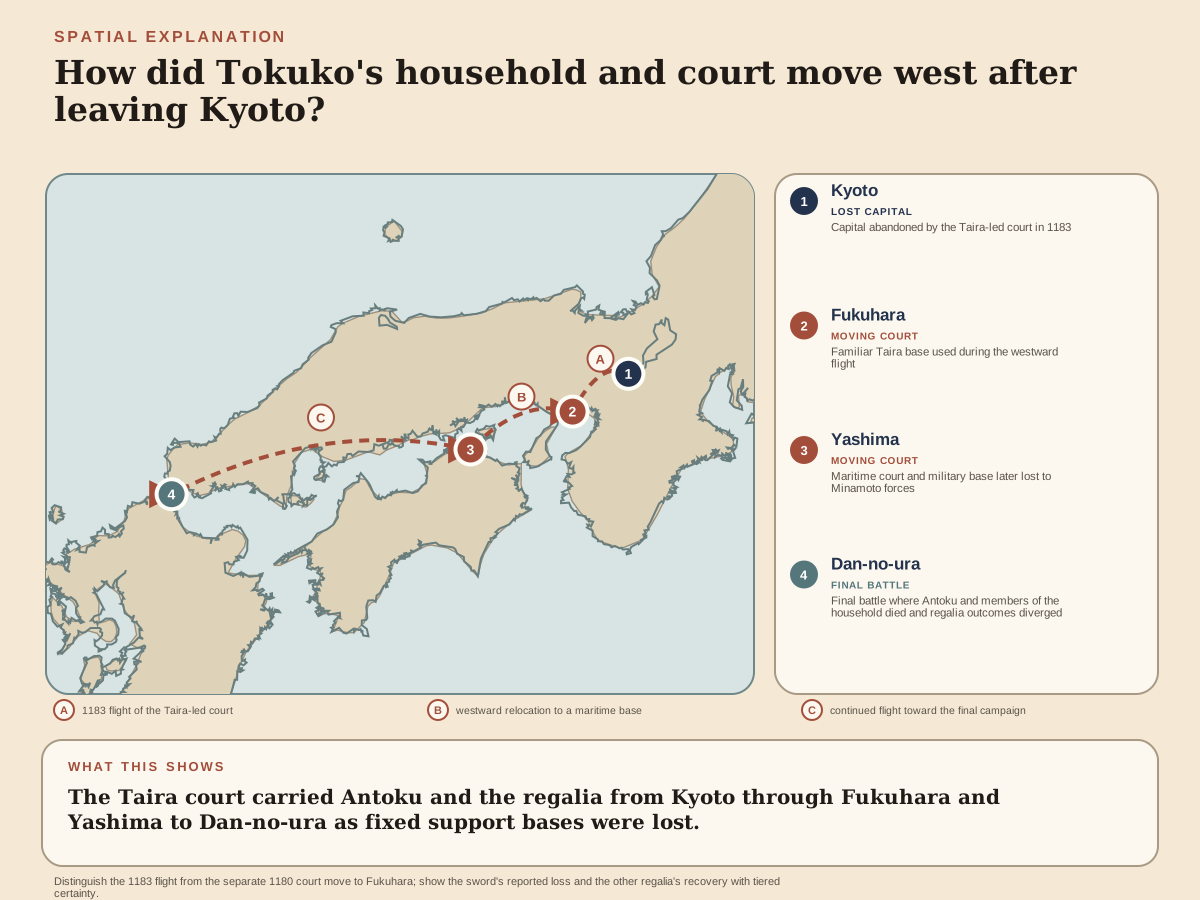
As the Minamoto commander Yoshinaka approached Kyoto in 1183, the Taira fled west with Antoku and his household. Tokuko and her mother accompanied the child emperor. They also carried the imperial regalia: the sacred mirror, jewel and sword associated with legitimate succession. Go-Shirakawa remained in Kyoto, where another child of the same dynasty became Emperor Go-Toba without all the regalia. Two courts now claimed imperial continuity. Antoku's court depended on ships, western allies and access to supplies. [1][4]
The Taira were defeated at Ichi-no-Tani near present-day Kobe in 1184. Important forces were killed or captured, narrowing the land base available to Antoku's mobile court. Tokuko remained with the emperor under Taira protection as the household continued westward. Go-Toba's court remained in Kyoto. The Taira still held ships and imperial objects, but maintaining a court required safe ports and dependable support ashore. Their remaining maritime bases now mattered more. [4]
Minamoto no Yoshitsune's forces attacked Yashima, on Shikoku, in 1185. The Taira lost another base and moved west with Antoku's household and the regalia. Sea routes that had supported the family's commercial reach now sustained retreat. Ships could carry the court, but lost ports and land support reduced the chance of restoring a durable government. The conflict moved toward the strait between Honshu and Kyushu, where the fleets would meet at Dan-no-ura. [4]
At Dan-no-ura in 1185, in the strait between Honshu and Kyushu, Minamoto forces defeated the Taira fleet. Antoku and Tokiko died in the sea, while Tokuko was pulled from the water alive. Antoku was six in completed years. The defeat ended the Taira's central governing coalition and left Go-Toba's court in Kyoto. Some regalia were recovered; the sword was reported lost. Accounts differ over the exact handling of these objects during the disaster. [1]
Tokuko had lost both her son Antoku and her mother Tokiko. The Tale of the Heike, the medieval war tale of Taira rise and defeat, gave the child's death an enduring farewell scene. His grandmother describes the sea through Buddhist imagery, making the fall of the imperial household part of a larger story of impermanence. The deaths are historical; the reported speech belongs to literary transmission. Tokuko's survival gave this story a further ending through religious life after the battle. [2]
Tokuko returned to Kyoto under the victors' control. Her imperial relationships remained, but the property and protection sustaining her former household had been dismantled. Residence, attendants and material support required new arrangements. She then entered Buddhist religious life. Tradition associates the name Shinnyokaku with her vows; Kenreimon-in remained the imperial title she had already received. Other Taira survivors followed separate postwar paths as the defeated household's relationships dispersed. [1]
Tokuko took Buddhist vows in 1185. Temple history places her at Jakkō-in, a Tendai Buddhist convent in Ōhara north of Kyoto, from that year's ninth month and remembers lifelong residence; the Enkyō Heike version also describes a later retirement elsewhere. Go-Shirakawa's traditionally dated 1186 visit became central to an influential Heike ending. Tokuko recounts her life through the six realms, Buddhist conditions of rebirth from hell to heavenly existence. The dialogue belongs to literary transmission, not a verbatim record. [1][2][3]
Tokuko's death is dated differently by the surviving texts: the Kakuichi Heike version gives 1191, court compilations give 1213 or converted early 1214, and other war-tale versions give 1223 or 1224. These accounts do not agree; her later daily life is not continuously documented. Jakkō-in and Heike performance preserved her as an imperial survivor. The temple records later patronage, including repairs ordered in 1603 by Toyotomi Hideyori, Hideyoshi's son. Its remembrance through 1912 belongs to later communities, not Tokuko's own actions. [1][2]
Classic
Taira no Tokuko was born in 1155, the daughter of Taira no Kiyomori and Taira no Tokiko. Her father combined military service with advancement at the Kyoto court. Her mother maintained kin relationships and authority within a household whose children could enter marriages, religious institutions and public office. The Taira were military aristocrats pursuing rank within the same court order as other nobles. Tokuko's upbringing belonged to that rising household, before imperial marriage had secured a place for her at the throne. [1]
As Tokuko grew up, Kiyomori fought in the Hōgen conflict of 1156 and the Heiji conflict of 1159, disputes among court factions that increased the influence of their military supporters. His victories helped the Taira gain higher rank and appointments. Estate revenues sustained the household, while attendants prepared daughters for the court conduct expected in an imperial marriage. [4]
Tokiko and other female kin maintained channels of communication between households. Their relationships mattered to marriage arrangements and the support a consort would need after entry. A daughter elevated at court required attendants and resources that could travel with her rank. Tokuko's later public position would therefore depend on more than an agreement made by her father.
Imperial marriage was an established route to aristocratic influence. If a consort bore an heir, her natal family could gain access as the emperor's maternal relatives. Kiyomori sought this route within the existing dynasty, joining military resources to court kinship. The strategy would place Tokuko inside both her natal house and the imperial household, giving her a public standing with obligations to each.
The Taira siblings followed distinct marriages and careers even as their positions reinforced the family's standing. Tokuko's eventual consort household would be one part of that network, with its own staff and ceremonial place.
Taira resources from estates and Inland Sea connections helped support Kiyomori's advancement. An imperial marriage needed court acceptance and a household capable of sustaining the consort's ceremonial standing.
Takakura, the future emperor, was a son of Go-Shirakawa, the retired sovereign who continued to exercise political authority. Kiyomori's relationship with that senior ruler brought opportunities and later conflict. Imperial marriage placed Tokuko between her natal family and the royal household. Her own consort circle would require attendants, property and sustained court service to turn rank into an effective position.
Preparing a consort household required women experienced in court service, as well as property and personnel. Once Tokuko entered, those attendants would manage access and daily obligations. Kiyomori's house was already participating in noble society; imperial marriage extended that participation. Its value depended on maternal ties within the dynasty rather than founding a separate military royal house.
Accounts describe Go-Shirakawa treating Tokuko as an adopted daughter in connection with her entry into Takakura's household. Ceremonial sponsorship could strengthen her placement while preserving her natal connection to Kiyomori. Takakura was Go-Shirakawa's son, so the union linked her to the retired sovereign through more than one relationship. Later disputes between Go-Shirakawa and the Taira would strain those ties.
In 1171 Tokuko entered the household of Emperor Takakura. He was young, and his father Go-Shirakawa continued exercising power as a retired sovereign. The arrangement gave Kiyomori a daughter among the reigning emperor's consorts. Ceremony, attendants and assigned residence made the relationship public and operational. Tokuko's household would now sustain service at court while remaining connected to the Taira relatives whose resources supported her position. [1]
The union followed the maternal route to influence used by earlier aristocratic families. A child of Tokuko and Takakura would belong to the imperial line, with the Taira as maternal relatives. Other consorts retained households and potential claims to succession. Entry created an opportunity for cross-generational influence without settling which child would eventually reign.
Tokuko entered a court in which other women's households already had rank, personnel and kin support. Recognition depended on the emperor's relations, ceremonial precedence and family resources. She had not yet received the title chūgū, a formal rank for an empress consort with its own household. Elevation to that position followed in 1172, making court entry and consort rank separate stages of advancement. [1]
Tokuko was still in her teens when adult relatives and court institutions arranged her entry. Her attendants made its daily work possible. Formal elevation followed in 1172.
Tokuko's elevation to chūgū in 1172 gave her household recognized ceremonial precedence and resources. Attendants managed access, correspondence and ritual service around the consort. Kiyomori gained a daughter formally placed near the throne, while Tokiko maintained links between the natal and imperial households. Takakura remained emperor, with Go-Shirakawa influential beyond him. The title operated within that existing hierarchy. [1][4]
The Taira pursued maternal influence through imperial marriage, a route long used by the Fujiwara aristocratic houses. Kiyomori added military resources and maritime connections to that court strategy. Tokuko's elevation strengthened the household's access, without settling succession: a surviving heir and recognition by the court were still needed. Pregnancy and infant care placed dynastic hopes in outcomes no family could simply command.
Religious patronage and memorial practices belonged to a high consort's household alongside dynastic obligations. Cultural exchange could also shape the circle's reputation at court. Tokuko now possessed an institutional center through which attendants, gifts and access were organized. Its importance increased with her formal rank, while future pregnancy and succession remained uncertain.
Several consort and retired-consort titles could coexist at the Japanese court. Chūgū identified Tokuko's particular rank and household at this stage. Her later title Kenreimon-in would mark another transition; it was neither the emperor's office nor a Buddhist name.
In 1178 Tokuko gave birth to Prince Atsuhito, the future Emperor Antoku. The child made Kiyomori a grandfather within the imperial line and strengthened Tokuko's standing as an imperial mother. Care continued beyond the birth through attendants, nurses and religious protection. Political celebration depended on mother and infant surviving, while the child's eligibility would still be judged within the wider succession system. [1]
Takakura was the prince's father and the reigning emperor; Go-Shirakawa remained an influential senior sovereign. Tokiko now joined the child's support network as his grandmother. Recognition involved these royal and maternal relationships, not Kiyomori alone. Other potential heirs still belonged to the court's field of choice. Maintaining the infant's household made the new maternal connection a continuing presence rather than a single ceremonial success.
Estate revenue and gifts supported the imperial child's household, linking maternal standing to a material base. The birth increased Kiyomori's incentive to influence succession. Atsuhito nevertheless belonged to Takakura's imperial dynasty, with the Taira holding a maternal position around him. If he acceded, Tokuko and her natal family would gain a far more consequential relationship to the throne.
Women who had served the consort now cared for an imperial child, linking his rooms to the royal and maternal households. Their access carried information and responsibility; it did not give them command over succession.
In 1180 Takakura abdicated and the young Atsuhito acceded as Emperor Antoku. Tokuko became the mother of the reigning emperor, and Kiyomori his maternal grandfather. Adults supplied the care and government surrounding a child sovereign. Takakura continued as a retired emperor, while Go-Shirakawa retained his own network. Opposition to Taira dominance soon drew on a rival claim by Prince Mochihito, Go-Shirakawa's son, and regional forces capable of fighting beyond the capital. [4]
Regional Minamoto leaders mobilized through different local interests rather than one command issuing orders from Kyoto. Temples and estate communities also responded unevenly. War made custody of Antoku and the imperial regalia—the sacred objects associated with the throne—politically valuable. Tokuko remained central as his mother without directing the military decisions around him. Her rank and family connection increased her exposure as royal conflict widened into regional war. [4]
Antoku belonged to Takakura's imperial dynasty, with the Taira as maternal relatives. That distinction mattered when a rival imperial child later reigned at Kyoto while the Taira held Antoku. In 1180, custody of a child sovereign gave the family influence but also made the household a focus of war. Nobles and regional forces took differing positions as resistance grew; imperial legitimacy did not produce a single, secure command.
In 1180 Kiyomori moved the court temporarily to Fukuhara, near present-day Kobe. Its access to Ōwada anchorage and the Inland Sea brought royal government closer to maritime networks important to Taira resources. Antoku and his maternal household moved with it, alongside senior royal figures whose interests were not identical. The site offered transport advantages, while Kyoto retained established offices, residences and ritual institutions. [4]
Kyoto's ministries, noble residences and religious institutions could not be reproduced quickly at a new center. Construction and provisioning continued during a rebellion, imposing demands on workers and neighboring communities. The anchorage made shipping convenient; it did not remove the costs of moving a functioning court.
The court soon returned to Kyoto. Moving sovereigns had proved easier than reproducing the ministries, supply and ceremonial relationships supporting them. Tokuko's rank and maternal household traveled, but their effective operation still depended on attendants and resources surviving each move. The brief experiment left maritime policy important without replacing the accumulated institutional advantages of Kyoto.
The rapid return exposed a tension between the court's established inland institutions and Kiyomori's western-facing transport network. Tokuko's rank traveled with her, but attendants and resources still had to make the household work at each residence.
Takakura and Kiyomori both died in 1181, removing two adult figures behind the succession. Tokuko also received the imperial title Kenreimon-in, a named status for her household after the consort phase. It was granted before Dan-no-ura and her later Buddhist vows. The Taira continued through surviving relatives, including Tokiko and Taira no Munemori, Kiyomori's son and successor, while Antoku's custody grew increasingly important to their court's claim. [1]
In 1183, as the Minamoto commander Yoshinaka approached Kyoto, the Taira withdrew west with Antoku, Tokuko, Tokiko and the imperial regalia. Go-Shirakawa remained in the capital, where Go-Toba, another child of the imperial line, was enthroned. The conflict now had two courts claiming continuity. Antoku's household carried a reigning emperor and sacred objects, while Kyoto retained the retired sovereign and the established machinery of court government. [1][4]
The Taira used Inland Sea routes and western allies to move their court. Ships carried the household, while hosts ashore supplied lodging and provisions. Support could change with military fortunes. Leaving Kyoto also removed access to residences, workshops and recurring revenues that could not be carried west. Movable symbols preserved an imperial claim, but did not bring the capital's full administrative capacity with them.
Tokuko remained both Antoku's mother and a member of the departing Taira house. The mobile court depended on sustained care and ritual service, alongside military protection. Its freedom of movement narrowed as allies and land bases were lost. Her status could travel with the household even when the practical resources supporting it were diminishing.
The Taira defeat at Ichi-no-Tani in 1184 reduced their foothold near Kyoto and the Inland Sea approaches. Experienced commanders were killed or captured, and forces supporting the western court were weakened. Antoku and his household remained mobile, with ships and western allies still available. Tokuko's imperial standing continued, but the court's claim now rested on a smaller military and territorial base. [4]
The Kyoto court gained practical strength from the victory while Antoku's household still held regalia associated with succession. Its fleet needed dependable ports and support ashore. Ichi-no-Tani's loss made the western bases more important, without yet ending the rival court. Later war tales made the battle famous through individual combats whose details are less secure than the overall defeat.
Antoku's court continued west with its remaining commanders and allies. It had lost important forces near the capital, making recovery of a durable land base harder.
In 1185 Minamoto no Yoshitsune's forces attacked Yashima, a Taira base on Shikoku, the island south of the Inland Sea. Its loss deprived Antoku's court of another refuge and supply point. Tokuko's household moved west within the remaining chain of bases. [4]
War-tale tradition made Yashima famous through an archery episode, in which Nasu no Yoichi shoots a fan displayed on a vessel. That memorable story is not a complete record of the fighting. The military result was loss of the base and further retreat. Go-Toba's court strengthened as its opponent lost material support, while Antoku's household still retained symbols of imperial continuity.
After Yashima, the Taira still sought support and moved people rather than simply drifting toward defeat. Each failed base removed stores, information and political contacts together. Commanders relied on sailors and local allies to preserve the court's remaining options. The next confrontation would take place in the Kanmon Strait between Honshu and Kyushu, with a fleet whose maritime strength was no longer matched by secure land support.
The next confrontation would test whether the Taira could preserve the court at sea after losing these refuges.
At Dan-no-ura in the Kanmon Strait in 1185, Minamoto forces defeated the Taira fleet. Antoku and his grandmother Tokiko died in the sea. Many leaders and attendants were killed or captured; Tokuko entered the water but was pulled out alive. Accounts reconstruct currents, command decisions and defections differently, so no single tactical sequence is secure in every detail. The defeat nevertheless ended the military support sustaining Antoku's alternative court. [1]
Rescue placed Tokuko among the surviving imperial and Taira relatives under the victors' control. The regalia also passed into the postwar settlement: traditions distinguish recovery of the mirror and jewel from the sword's reported loss. Their fate mattered to the Kyoto court's ceremonial continuity. The fleet's collapse removed a rival living emperor and a central governing coalition, without extinguishing every branch of the Taira family.
Tokuko's rank as Takakura's consort and Antoku's mother survived the destruction of the household's political base. She would return to Kyoto with the respect and restrictions attached to those relations. Meanwhile, the eastern organization of Minamoto no Yoritomo, the Kamakura-based Minamoto leader and Yoshitsune's elder brother, still had to negotiate with Go-Shirakawa and consolidate provincial authority. Ending the Taira court did not complete the entire postwar order.
Antoku was six in completed years, or eight by traditional Japanese counting, which begins at one and advances at New Year. The battle date is conventionally given as the twenty-fourth day of the third month of the traditional Japanese calendar in 1185. These conventions explain some differing modern displays. The child's short reign ended in the battle, while his mother's later life continued under a radically changed order.
The Tale of the Heike, the medieval war tale of Taira rise and defeat, gave Antoku's death a lasting literary form. In its famous farewell, his grandmother interprets the sea as a passage to another realm. Buddhist impermanence and the imperial regalia organize the scene around the collapse of both family and court. Versions circulated through manuscripts and performances by biwa reciters, musicians who accompanied narration on a short-necked lute. The speech belongs to that literary transmission, not a verified transcript from the battle. [2]
Different textual lines arrange details of the deaths and regalia differently. The surviving versions record how later communities made the loss intelligible. Go-Toba's court continued in Kyoto, while Antoku's death required ritual responses to a deceased sovereign. Tokuko's later vows and religious residence became part of memorial practice. The tale extended those events into a larger account of salvation and the instability of worldly power.
The farewell's endurance reflects how closely imperial legitimacy had been tied to a child's survival. Adults built a governing coalition around Antoku and carried that household into war. Tokuko's survival then allowed the literary tradition to center a figure who had passed from consort rank and imperial motherhood into defeat and Buddhist commemoration. Her life after the battle gave the tale a different ending from the commanders' deaths.
Tokuko was brought back to Kyoto after Dan-no-ura under the victorious coalition's control. Her titles and imperial relations remained, while the property and protection sustaining her former household had been dismantled. Go-Shirakawa's court now managed a survivor who was both the emperor's mother and Kiyomori's daughter. Residence and material support became immediate matters of the postwar settlement. [1]
Remaining estates, objects and attendants required new arrangements. Tokuko's religious residence could not be sustained without resources and people, even when later narratives represented it as seclusion. Other Taira survivors followed separate religious and household paths. The loss of central power dispersed relationships rather than erasing the entire kin network.
Tokuko's next documented transition was into Buddhist religious life. Kenreimon-in remained her earlier imperial title, granted in 1181 before the naval defeat. Tradition associates the religious name Shinnyokaku with her later vows. Rank and ordination therefore identify different phases of the same woman's life, linking the imperial survivor to a new religious household.
Temple traditions preserved a coherent religious story around Tokuko, while contemporary records retained only selected details of her later status and support. Her postwar life is consequently less continuously documented than the years around Antoku's reign. The move to a religious residence created a new institutional setting through which her survival would be remembered.
Tokuko took Buddhist vows in 1185 after returning to Kyoto. Kyoto's museum directory associates the tonsure with Chōraku-ji temple; a religious research article citing the contemporary diary Kikki names the monk Honjōbō Tangō as preceptor. Jakkō-in, a Tendai Buddhist convent in Ōhara north of Kyoto, dates her arrival to the ninth month of 1185 in its temple history. That history presents lifelong residence, whereas the Enkyō version of The Tale of the Heike also describes a later retirement to Hosshō-ji temple. These are distinct accounts of her movements, not a continuously documented itinerary. [1][2][3]
Go-Shirakawa's visit is traditionally dated to 1186 and forms the center of the Kanjō, or initiatory, book in an influential line of The Tale of the Heike. Tokuko recounts her life through the six realms, the Buddhist conditions of rebirth ranging from hell to heavenly existence. The scene gives the war tale a religious completion. Its staged dialogue and retrospective account belong to literary tradition rather than a verbatim audience record, even if a visit underlies it. [2]
Jakkō-in tradition connects Tokuko to women attendants, including Awa no Naishi, who helps arrange the meeting in the tale. Ōhara was a settlement with religious networks, not an empty landscape outside society. Support from attendants and local communities made residence possible. The memorial setting preserved the imperial mother's religious role while performers and writers elaborated what her survival meant.
The Ōhara story linked a former consort's household to the remembrance of the defeated court. It would become central to the way readers and pilgrims encountered Kenreimon-in long after contemporary documentation of her movements had grown sparse.
Tokuko's passage from imperial consort and mother to survivor and nun connected court history to Buddhist remembrance. The Kanjō, or initiatory, book of an influential Heike line centers the Ōhara visit and her retrospective account. Performance by biwa reciters carried that scene through voice and textual variation. Jakkō-in's temple history remembers prayer for Antoku and the Taira, while the surviving accounts differ over her later residence.
Tokuko's death has several transmitted dates. The Kakuichi version of Heike gives 1191; court compilations including Kōdaireki, a chronology of imperial reigns, give 1213, sometimes displayed as early 1214 after calendar conversion. The Enkyō, Nagato and Shibu versions of Heike give 1223, and Genpei Seisuiki gives 1224. A religious research article, quoting Saeki Shin'ichi's 2009 study, sets out these groups. Their different dates do not provide a single agreed endpoint for her life. Her postwar years cannot be filled with daily activities simply by choosing the latest date. [1]
Kenreimon-in, the imperial title granted in 1181, became her familiar name through literary and religious transmission. It preceded her vows by several years. Her rank, motherhood and later religious practice gave the defeated house a memorial figure beyond the deaths of its commanders.
Jakkō-in sustained that remembrance through later patronage and repairs. Its temple history records Toyotomi Hideyori, the son of the late ruler Hideyoshi, commissioning repairs to the outer hall in 1603 through his official Katagiri Katsumoto. This was a later ruler's act of support, not a structure built personally by Tokuko. By 1912 the temple and the transmitted Heike story belonged to centuries of commemoration after her living role had ended. [2]