Read the article below. Interactive reading tools are available when scripts load.
Classic
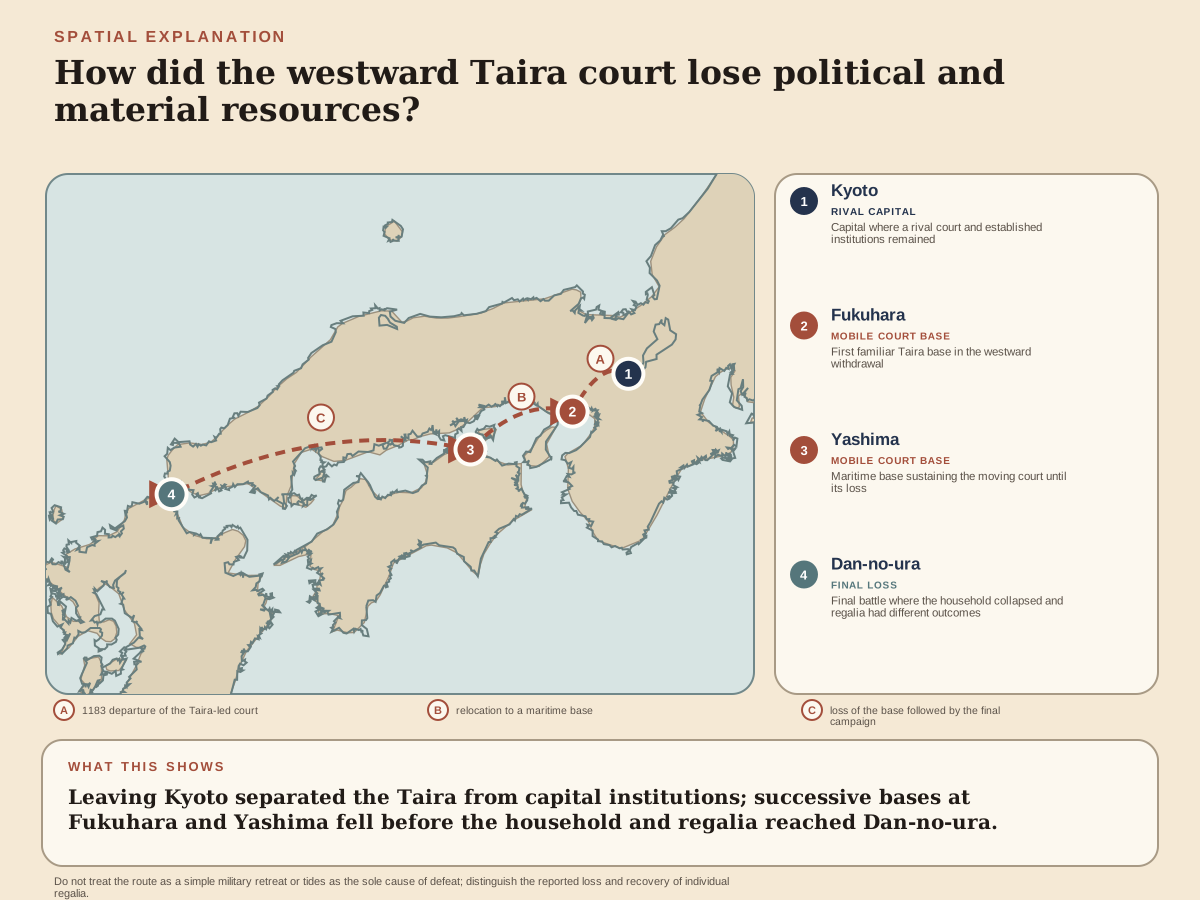
When the Taira withdrew from Kyoto in 1183, they took Antoku and the regalia with them. Retired emperor Go-Shirakawa remained in the Kyoto political world and arranged Go-Toba’s accession. The Taira fleet protected an alternative imperial court, allowing its leaders to continue claiming service to a reigning sovereign after losing the capital.
The war progressively reduced their shore positions. Ichi-no-Tani fell in 1184, and Yoshitsune’s attack on Yashima in the second month of 1185 forced another withdrawal. The western coalition retained vessels and bases around Hikoshima and the Kanmon Strait, connecting the Inland Sea with northern Kyushu.
The Minamoto side also depended on vessels, food and local cooperation. Noriyori’s western force had encountered supply difficulties: Azuma Kagami records residents in Bungo fleeing and followers wishing to return. Yoshitsune’s sea campaign required the recruitment of maritime supporters rather than an army’s effortless transfer from land to ships.
Antoku’s presence exposed his family and attendants to the fleet’s fate. He was a child carried through decisions made by adults. Custody of the regalia gave the campaign a further political stake, since those objects belonged to the apparatus of imperial succession while Go-Toba’s court continued without them in Kyoto.
The evidence describes this fleet from different positions. Azuma Kagami preserves the later Kamakura government's account. Kujō Kanezane's Gyokuyō is a court diary whose reports of the engagement reached Kyoto from elsewhere. The Heike traditions turn defeat into a Buddhist and familial drama. A report recorded near the time of the battle still differs from an account by someone aboard a ship; the sources cannot be combined into one seamless eyewitness narrative.
Regional support was necessary to both sides. A vessel required a crew able to navigate the strait as well as warriors able to fight from it. The Taira's Hikoshima base and the Minamoto coalition's recruitment of maritime supporters connected command to shore positions, supplies and people familiar with the sea. Possession of an emperor did not itself secure those resources.
Azuma Kagami records preparations during the third month. Rain delayed a planned departure, and Funadokoro Masatoshi, a maritime supporter in Suō, supplied vessels. Yoshitsune gave a written promise recognizing his service within the Kamakura retainer relationship. Local cooperation therefore had an identifiable exchange: ships for recognition, rather than loyalty inferred from a common surname.
The advancing fleet moved toward the strait, while Taira vessels came from their western base. On the twenty-fourth day the fleets fought at Dan-no-ura. Azuma Kagami describes the Taira ships advancing in three divisions, with Yamaga Hidetō and men of the Matsuura group among their commanders. The entry places the collapse of their formation by midday; soldiers then boarded the imperial vessel. Its reported ship totals and sequence belong to a later compilation. They identify approach, divided deployment and boarding without establishing a securely documented moment when the tide alone changed the winner.
The defeat produced different outcomes aboard the fleet. Antoku and Tokiko died in the water, as did leading warriors including Tomomori. Tokuko was rescued, and Munemori was captured alive. Accounts differ in the handling of the child during the descent into the sea: Azuma Kagami names a court attendant, whereas the familiar Heike narrative centers his grandmother. Both traditions require care beyond the shared outcome of his death.
The regalia were also caught in the collapse. The mirror and jewel were recovered; the sword was lost at sea. Azuma Kagami surrounds some of these objects with miraculous episodes, and the Heike provides memorable last words. Those religious and literary elements shaped remembrance of the battle without supplying an eyewitness account of every action.
The approach also involved local guidance. Azuma Kagami's entry for the twenty-second day records Yoshitsune assigning Miura Yoshizumi a leading position because he knew the Moji area. The fleet advanced, and the Taira came out from Hikoshima toward the opposing ships. This supplies a preparation and approach before the compilation's account of divided deployment, defeat and boarding.
Evidence and interpretation · Did a changing current decide the battle?
Kuroita Katsumi made strong tidal currents central to his reconstruction of the reversal at Dan-no-ura. Hanzawa Masao contrasts that account with Akagi Noboru and colleagues’ later calculations, which produced weaker daytime currents and reduced the explanatory weight placed on a sudden tidal reversal.
Neither calculation supplies an eyewitness timetable. Hanzawa notes that the Heike’s early arrow exchange, the Azuma Kagami’s noon defeat and the Gyokuyō’s noon-to-afternoon battle do not agree. The numerical reconstruction also assumes broadly comparable incoming tidal waves, coastline and seabed. It challenges one account of the current’s importance without recovering every movement of the fleets.
Historical disagreement · What role did Taguchi’s allegiance play at Dan-no-ura?
Taguchi Shigeyoshi, also named Naruyoshi in accounts, has a prominent role in explanations of Taira defeat. The familiar Heike tradition makes his change of allegiance a disclosure that helped the enemy. Azuma Kagami's report, by contrast, lists Naruyoshi among those taken captive.
Those different treatments leave the timing, motive and tactical effect disputed. A tide reversal or a single defection should not substitute for the wider breakdown of the fleet.
Dan-no-ura destroyed the Taira’s main fleet and the coalition sustaining Antoku’s western court. Leaders had died, been captured or dispersed, and the child sovereign was dead. This removed the Taira family’s central claim to direct imperial politics through Antoku, while surviving people of Taira descent continued to live elsewhere.
The Kyoto court remained. Go-Toba’s succession had already taken place in 1183, before the sea battle. The loss of the sword created a problem within the regalia tradition, but it did not cause a new dynasty to be founded. Court institutions and ritual practice maintained imperial succession through the existing line.
Yoritomo’s government had won a major military contest through commanders and supporters operating far from Kamakura. It still needed to settle claims to confiscated holdings and relations with Kyoto. Yoshitsune’s service in the victory was followed by conflict with Yoritomo later in 1185, showing that the victorious Minamoto coalition did not remain united automatically.
Tokuko returned to Kyoto, took vows and eventually lived at Jakkōin in Ōhara. The dead child’s mother became part of the religious commemoration that followed. Her survival is a recorded outcome; the long reflections later assigned to her in the Heike belong to the literary history of that commemoration.
The handling of survivors and holdings required decisions after news of victory traveled east. On the twelfth day of the fourth month, Azuma Kagami records an assignment for Noriyori to remain in Kyushu and investigate confiscated property, while Yoshitsune was to take the captives to Kyoto. Munemori was subsequently brought to Kamakura and sent west again; he and his son Kiyomune were executed in Ōmi on the twenty-first day of the sixth month. A captive's fate was settled through custody, communications and orders, rather than completed at the moment his ship was defeated.
Yoritomo's reach also remained incomplete geographically. The Northern Fujiwara still governed from Hiraizumi after the Taira fleet had fallen. Their defeat came in a separate campaign in 1189. Extending military control and distributing claims to land consequently continued beyond both the naval victory and the first appointments negotiated with Kyoto.
The defeat removed the main Taira military opposition to the eastern Kamakura coalition. Later in 1185, pursuit of Yoshitsune and Yukiie gave Yoritomo another occasion to seek court recognition for military agents and provisions collection. Victory opened the way to these negotiations, whose offices and reach still had to be worked out through subsequent decisions.
The Heike made Dan-no-ura the culmination of its account of Taira rise and fall. Scenes involving Tokiko, Antoku and the regalia connected family destruction with Buddhist impermanence. Their force in literature explains much of the battle’s later fame, while differences among versions and other records leave some actions and speeches unresolved.
Antoku’s commemoration also acquired an institutional home near the strait. The Buddhist temple Amidaji maintained worship connected with him. During the Meiji separation of Buddhism and Shinto, that institution was abolished and its memorial site reorganized; Akama-gū was established in 1875 and received the name Akama Jingū in 1940. The present shrine follows that later history.
The site’s changing form allowed worship of the defeated emperor to continue through different religious institutions. Dan-no-ura consequently has both a military aftermath, visible in appointments and land settlements, and a memorial history, carried by texts, rites and buildings beside the water. These developments followed their own chronologies after the battle of 1185.
Commemoration required people and repeated observances as well as an institution. The Senteisai includes worship at Antoku's tomb, remembrance of Taira dead, and a procession representing court women approaching the shrine. Its origin story connects the rite with women who survived the defeated court; that story is part of the festival's own tradition, rather than an independently preserved account from 1185. The ceremonies give later communities a way to honor the defeated emperor beyond retelling the naval engagement.
Coastal legends, including stories about the Heike crabs, give the dead another presence in the landscape. They explain how later people imagined the Taira's continuing association with the water. Neither the legends nor speeches assigned to Tokuko can establish the private thoughts of those who faced the fleet's collapse.