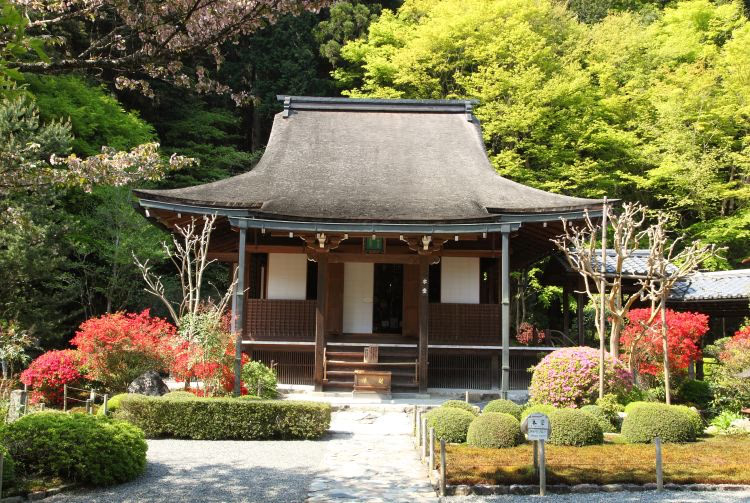
Map: GSI Japan Jakkō-in is an operating convent temple in the northern Kyoto village of Ōhara, remembered above all as the retreat of Taira no Tokuko, or Kenreimon-in, after the Taira defeat in 1185. Its historical power does not come from an intact twelfth-century compound. The site joins a long-lived tradition of female religious residence, the literary afterlife of The Tale of the Heike, a garden read through that text, and a modern reconstruction created after a devastating 2000 fire.
Kenreimon-in Tokuko's Retreat after the Taira Defeat
Attraction
Taira no Tokuko, already known by the imperial title Kenreimon-in, took Buddhist vows after surviving the Taira catastrophe at Dan-no-ura. Kyoto's official interpretation places her at Jakkō-in from 1185, praying for Emperor Antoku and the dead of her house. The association turned a small convent in Ōhara into a principal landscape of Taira remembrance. No residential room from her lifetime survives. What the precinct preserves is a durable institutional and narrative attachment between one woman's religious life, dynastic loss, and the community that continued to maintain her memory.
Current visibility
A marked hermitage tradition and the temple precinct are visible, but no authenticated twelfth-century residence of Tokuko survives.
The Ōhara Imperial Visit as Literary Memory
Attraction
The famous Ōhara Imperial Visit describes the retired emperor Go-Shirakawa meeting Kenreimon-in amid an austere mountain retreat in 1186. The episode became the emotional closing movement of The Tale of the Heike and later Noh performance. Jakkō-in should therefore be read as a place where literature organized historical memory, not as a stage set proving every narrative detail. The surviving terrain—the enclosed valley, approach, water, and vegetation—helps explain why the text could contrast former court splendor with religious seclusion, while the exact dialogue and miraculous signs remain literary narration.
Current visibility
The valley setting and memorialized precinct can be experienced; the imperial visit is interpreted through literature and tradition rather than surviving event fabric.
The Fire-Damaged Medieval Jizō in Protected Storage
Attraction
Jakkō-in's former principal Jizō remains a major work even though it is not the figure normally seen in the hall. National heritage documentation dates the image to the middle or later thirteenth century and records small Jizō figures and other deposits associated with its interior. After the fire, conservators stabilized the charred sculpture, and the temple placed it in a fire-resistant storehouse. This survival changes the story from simple replacement to layered custody: an injured original is conserved as evidence, while a modern carving performs the public liturgical role in reconstructed space.
Current visibility
The damaged important cultural property is kept in protected storage and should not be assumed to be on routine public view.
A Garden Read through Loss, Not Unchanged Survival
Attraction
The pond, stones, trees, and mountain backdrop beside the hall are repeatedly linked to descriptions of Kenreimon-in's retreat. Their value is interpretive rather than archaeological proof that every feature has remained fixed since 1186. Fire, rebuilding, horticultural care, and centuries of temple use have all shaped the present garden. The strongest reading treats it as a maintained memorial landscape: water and vegetation give physical form to a literary language of impermanence, while the reconstructed hall demonstrates that continuity here depends on deliberate renewal rather than the untouched preservation of a single historical moment.
Current visibility
The maintained garden is visible with temple admission; it is a living and reconstructed memorial landscape, not an unchanged twelfth-century garden.