Read the article below. Interactive reading tools are available when scripts load.
Quick
Matsuo Bashō was born in 1644 in the Iga region, in or near the castle town now called Iga Ueno. His family used a surname and belonged to the local order from which service to warrior houses could be drawn, yet surviving descriptions do not fit neatly into a modern choice between farmer and samurai, the hereditary warrior class. The neighborhood itself mixed cultivated land, town households, and lower-ranking warrior residences. Osaka's account calls the household agricultural, while Iga's describes a mixed service neighborhood; its rights and connections do not fit one modern social label. [4][5][15]
His father, Matsuo Yozaemon, died in 1656. His brother Hanzaemon inherited the family home, leaving the younger son's future open to service elsewhere. The household's connections gave Bashō entry into a lordly circle where poetry could become part of his work. They do not establish the later stories of a childhood already devoted to wandering or solitude.
By 1662 Bashō served Tōdō Yoshitada, a member of Iga's ruling family who wrote as Sengin. They practiced haikai, comic and colloquial linked poetry whose opening verse was the hokku. The work brought Bashō into the network of Kyoto poet and classical teacher Kitamura Kigin. Linking a verse to another person's contribution required both invention and attention to shared conventions.
The mature Bashō style had not yet appeared. Early writing participated in the fashionable wit and verbal play of its moment. Yoshitada died in 1666 aged twenty-five by inclusive contemporary reckoning. The death removed Bashō's immediate patron and literary companion, but it did not send him directly to Edo; several years separate the loss from the move usually dated around 1672. His exact duties and the intimacy of the relationship remain only partly recoverable. What can be said is that service gave him entry into a literary network, and the patron's death broke the local arrangement that had supported it.
In 1672 Bashō dedicated Kai Ōi, a judged collection of competing verses, at Ueno Tenmangū, a shrine in Iga. He established himself in Edo, the Tokugawa warrior government's capital, around this time, though chronologies allow a later or staged move. Its audience and publishers gave a provincial writer a larger field of work.
Bashō used the name Tōsei by the mid-1670s and became a haikai master in Edo by 1677. He judged submissions, guided linked sequences and maintained pupils' confidence through gatherings and print. Tokyo Metropolitan Library records a tradition of assistance with Tōdō-house Kanda waterworks in 1677, not a documented independent engineering career.
In 1680 he left the routine of metropolitan mastership for a hut in Fukagawa. The quieter base altered his daily work without ending the relationships that supplied it. The opening verse, or hokku, still belonged to linked composition; the modern independent genre called haiku became established much later.
In 1680 Bashō moved from central Edo to Fukagawa, on the eastern side of the Sumida waterways. A disciple gave him a banana plant whose broad leaves became associated with the hut and with the name Bashō. The name by which posterity knows him thus emerged from a place, a living gift, and a social relationship rather than from an official title. Boats and messengers kept the dwelling connected to Edo, and friends and pupils helped supply it.
The fire of 1682 destroyed the hut. Bashō took refuge with supporter Takayama Biji in Kai, now Yamanashi, and disciples helped rebuild his home in 1683. His mother died in Iga that same year. The record establishes these losses more firmly than every burned paper or his private grief.
He accepted another home before the major journeys that followed, continuing to move between a base and stays with patrons. Later memorial places preserve the hut's association, not an intact room of 1680. Kōtō's account places the site's disappearance between the late Tokugawa period and the Meiji period beginning in 1868.
In 1684 Bashō left Edo on the journey later represented in Nozarashi Kikō. He traveled west along established roads, returned to Iga, visited sites including Ise, and joined poets in Nagoya. The trip involved family memorial obligations, religious and literary places, physical risk, and the renewal of regional relationships. At Nagoya, Bashō and local participants produced linked work associated with Fuyu no Hi. Winter Days brought his developing manner into work made by several poets, combining ordinary detail with playful literary association.
The journey continued into 1685 and the account circulated in manuscripts. Its first full publication came in 1698, after his death. The book selects encounters for literary effect rather than preserving every day's movements; travel had become a means of revising composition and extending relationships beyond Edo.
In 1686 Bashō composed the old-pond verse, focusing on a frog's splash rather than elaborate verbal display. The next year he visited Kashima, a shrine east of Edo, before beginning another westward journey. The route represented in Oi no Kobumi passed through Iga and Ise toward Yoshino, Nara, Suma and Akashi, combining familiar poetic sites with visits and work among local circles.
Kawai Otsushū arranged and published the travel materials in 1709, more than twenty years after the journey and after Bashō's death. The surviving work preserves his writing within a later editorial arrangement. Repeated travel had become central to his practice, but the printed order is not an untouched day-by-day record.
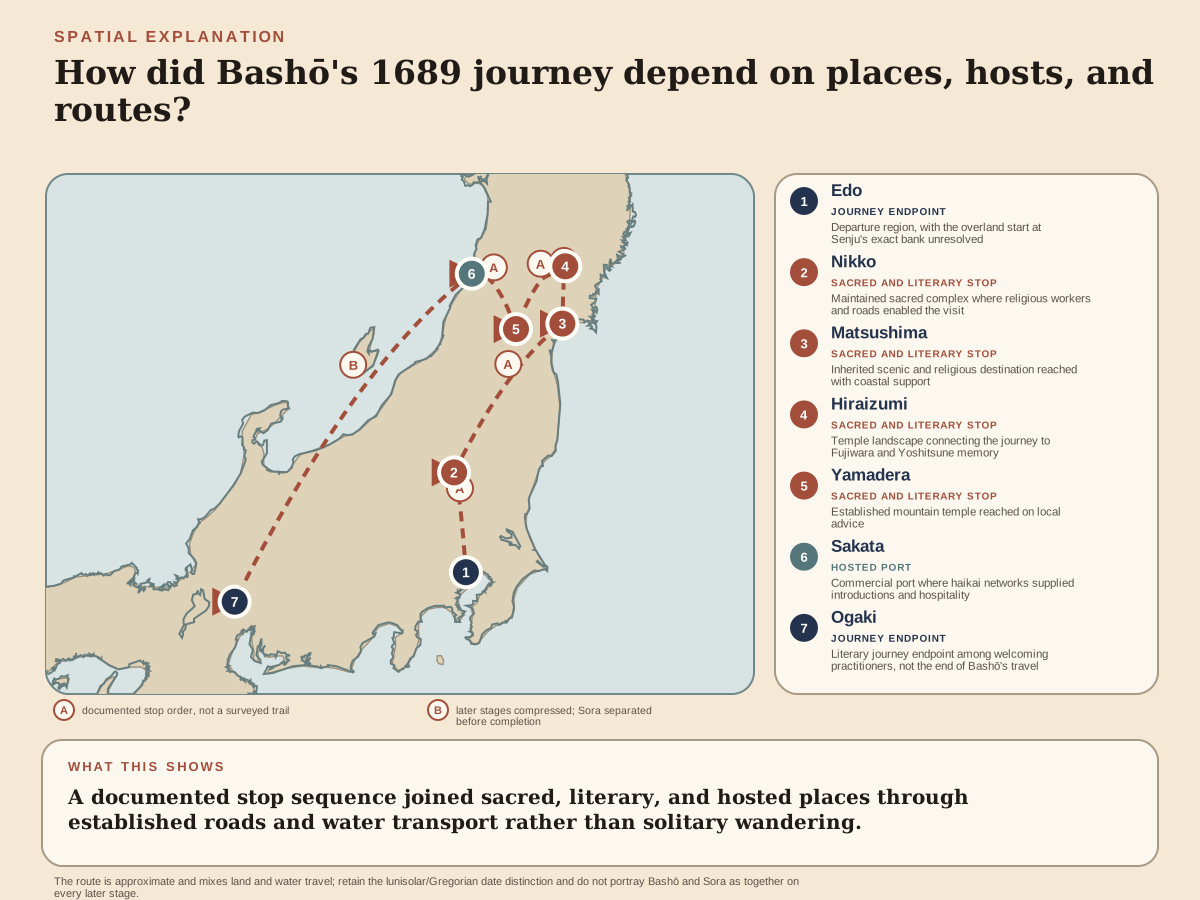
On the twenty-seventh day of the third month of 1689 in the Japanese lunisolar calendar, corresponding to 16 May Gregorian, Bashō and his pupil and travel companion Kawai Sora left Fukagawa by boat and continued from Senju toward northern Honshū. The precise bank at Senju associated with departure remains disputed. The journey lasted about five months before reaching Ōgaki and is commonly estimated at roughly 2,400 kilometers, including land and water stages.
The route followed religious places and earlier poetry, including the twelfth-century monk-poet Saigyō's legacy. Travel depended on hosts and introductions as well as land and water transport. Adachi's museum gives 16 May for the departure and an Ōgaki library answer 17 May; both preserve the traditional third-month twenty-seventh day.
Bashō and Sora reached Nikkō, a sacred mountain complex north of Edo, on the first day of the fourth month in the Japanese calendar, not Gregorian April 1. Tōshōgū, the shrine of Tokugawa founder Ieyasu, stood within an older religious landscape joining Buddhist practice to worship of kami, sacred beings associated with places and lineages. Bashō's opening verse joins reverence to green leaves, young leaves and sunlight, also the meaning of Nikkō's name.
Ōgaki City's account reads the poem as respect for the shrine and Tokugawa authority. Its public reverence is visible, but it does not establish agreement with every policy or prove hidden opposition. Clergy, craftspeople and local hosts maintained the complex the travelers entered.
Bashō and Sora reached Matsushima, a bay of islands near Sendai already celebrated in poetry. Its grouping with Amanohashidate and Miyajima as three outstanding views had roots in Tokugawa scholar Hayashi Gahō's 1643 work, although scenic rankings varied. At Hiraizumi, on the thirteenth day of the fifth month in the traditional calendar, they encountered memories of the Ōshū Fujiwara ruling house, destroyed in 1189, and the warrior Minamoto no Yoshitsune, who died in its protection.
Chūsonji remained an active Buddhist temple, and Sendai lord Date Tsunamura had supported a Yoshitsune hall in 1683. The summer-grass poem condenses warriors' vanished ambitions in this still-maintained landscape. The familiar verse repeating Matsushima's name is not Bashō's. Scenic chronologies themselves vary: one cites the three-view comparison in 1643, another lists it under 1714; the earlier notice prevents treating the grouping as wholly post-Bashō.
On the twenty-seventh day of the fifth month, 13 July 1689 Gregorian, Bashō and Sora visited Risshakuji, commonly called Yamadera, after local advice drew them south. Yamagata City's explanation contrasts an early image of the mountain temple and cicada sound clinging to rock with the finished poem's stillness and sound penetrating rock. The change makes the act of revision visible.
Later interpretations differ. Yamadera's museum favors the nii-nii cicada identification without calling it certain; scholar Minami Yōko's 2024 lecture instead stresses old rocks and inherited Chinese poetic imagery, without requiring a sound at that exact moment. This is a named alternative, not a new academic consensus. The 1748 and 1853 verse monuments belong to later commemoration.
After Yamadera, Bashō and Sora moved through the Dewa mountain region and into Shōnai. They reached Sakata on the thirteenth day of the sixth month in the contemporary calendar. There, physician and haikai practitioner Itō Fugyoku and other local people provided hospitality and connections. Hosts arranged boats, gatherings and care along the route. The travelers continued toward Kisakata and later followed the Japan Sea side through Hokuriku.
Roads, river and coastal transport, horses, lodging, weather, and Sora's declining health affected movement. During the later stages Sora and Bashō separated, so they did not finish every leg together. Bashō reached Ōgaki after roughly five months. Local practitioners welcomed him, and he stayed before leaving by boat toward Kuwana. Arrival ended the expedition later shaped into the book, not Bashō's further travel.
After 1689 Bashō continued traveling and revising. He stayed at Genjūan near Ōtsu in 1690, saw Sarumino, The Monkey's Raincoat, published in 1691 and entered a third Fukagawa hut in 1692. The northern-journey work, Oku no Hosomichi, developed over these years. In 1694 calligrapher Kashiwagi Soryū completed a clean manuscript associated with Bashō's title slip; publication followed after the poet's death.
His later karumi, lightness, turned toward unforced treatment of everyday life: Waseda's account points to soup and sliced fish beneath cherry blossoms in 1690 and the 1694 collection Sumidawara, Charcoal Sack. He continued composing in circles rather than abandoning linked verse.
His pupil Mukai Kyorai inherited Soryū's copy of Oku no Hosomichi, and the 1702 first edition reproduced its appearance while omitting the copyist's afterword. Years of revision and transmission separate the finished book from Sora's practical travel notes; comparison reveals literary shaping without making every difference a lie.
In 1694 Bashō went to Osaka in part to address conflict among disciples. Lodging near the Minami Midō temple, he developed severe illness and died on the twelfth day of the tenth month in the contemporary calendar, aged fifty-one by the inclusive Japanese count. According to his instruction, disciples buried him at Gichūji in Ōtsu, beside the memorial landscape associated with Kiso Yoshinaka, a twelfth-century warrior. They copied texts, organized lineages, disputed interpretation, and elevated Bashō as a supreme master of haikai. Local communities also materialized memory: Yamadera's 1748 and 1853 stones and Hiraizumi's 1769 memorial show reception beyond a single school.
In the Meiji period beginning in 1868, the poet and critic Masaoka Shiki challenged inherited reverence for Bashō and assessed individual poems while helping establish haiku as a modern independent short form. By 1912 the earlier master remained both revered and open to criticism. Editions, memorial places and arguments over style had transformed his living circle into a much wider poetic legacy. Library research distinguishes Shiki's reform from invention of the word haiku: its general use became established in his era, but it did not suddenly appear through him alone.
Classic
Matsuo Bashō was born in 1644 in Iga, the region around present-day Iga City in Mie Prefecture. He was the second son of Matsuo Yozaemon, in a household connected to the lower-ranking service society of the Tōdō lords. Its exact status does not fit a simple modern choice between farmer and samurai, Japan's hereditary warrior class. Iga Ueno and Tsuge preserve competing birthplace associations, while the broader Iga connection is firmer. The family could give a younger son entry into a lordly household without making him a wealthy military heir. [4][5][15]
Iga's castle town mixed lower-ranking warrior households with cultivated plots and commercial work. The Matsuo family's position connected local landholding with service to the Tōdō house, the territorial lords who governed Iga. Osaka City's account calls the household agricultural despite its right to a surname and swords; the Iga account emphasizes its place in a mixed service neighborhood. The opportunities available to a younger son arose from these local connections. [5][15]
His father, Yozaemon, died in 1656, and his brother Hanzaemon inherited the family home. Bashō later returned for family observances and sent his handwritten will to that brother. The records are thinner on his mother's life and on the work of other household members. Those omissions leave much of his childhood unknown; his later poems cannot turn it into a documented resolve to become a traveler.
Service outside the family home offered a younger son a practical route into the ruling household and its literary circle.
By 1662 Bashō was serving Tōdō Yoshitada, a young member of a branch of Iga's ruling house. Yoshitada wrote under the poetic name Sengin. Their difference in rank remained, but linked composition allowed the attendant and his patron to answer one another's contributions. The relationship brought Bashō into a practice with teachers, conventions and an audience, including the circle of Kyoto poet and classical-literature teacher Kitamura Kigin. [4][5]
Haikai was a comic and colloquial branch of renga, collaboratively linked poetry. Its opening verse, the hokku, set a season and a scene for the gathering. Subsequent contributions connected to the preceding verse while shifting its associations. A participant needed to recognize another writer's intention and still leave room for the next response. Bashō learned a social craft with conventions and judgments, not simply the composition of the self-contained poems now called haiku. [6]
Kigin's circle supplied instruction, texts and recognition that could travel beyond Iga. Bashō initially used Munefusa, his personal name, as a poetic name. His early writing participated in the verbal wit of the period; its audience had no reason to measure each verse against the austere master he would later become. Recognition depended on fellow practitioners and teachers as well as his own contributions.
Yoshitada died in 1666, aged twenty-five by the contemporary inclusive count. His death removed Bashō's immediate patron and literary companion. Later accounts stress grief, but the chronology does not support a sudden departure into independent wandering. The Edo move usually placed around 1672 lay several years ahead. Bashō retained his Iga and Kyoto connections while his livelihood became less settled. His movements during the intervening years remain incompletely documented. [4]
The literary skills and affiliations acquired in service remained resources he could use beyond that household.
Edo, the Tokugawa warrior government's capital, offered Bashō a far larger literary audience than Iga. Publishers, booksellers and rival teachers already served a growing city whose townspeople could spend money on poetic gatherings. In 1672 he dedicated Kai Ōi, a collection pairing verses for his judgment, at Ueno Tenmangū, a shrine in his home region. The volume displayed the authority of a judge while giving contributors a place in print. [4]
The exact date of his establishment in Edo is less secure than the collection's date. The Bashō commemorative association's chronology places the move around 1672 and records Kigin's recognition in 1674; other chronologies allow a later or staged move. These contacts need not amount to one documented departure. By 1675 he was using Tōsei as a poetic name, before a banana plant supplied the later name Bashō. [4]
Tokyo Metropolitan Library's account connects him with assistance in Tōdō-house repairs to the Kanda water supply in 1677, explicitly as a tradition. It gives a useful limit to the picture of an aspiring poet freed from practical work. The association does not establish that he designed or commanded the water system. [7]
By 1677 he functioned as a haikai master in Edo. Contributors sent work for evaluation, pupils sought instruction, and hosts arranged sessions. His judgment could bring recognition to another writer, while an active circle sustained his own authority. Pupils with occupations outside literature supplied time, rooms and money; verse-making continued inside the city's service and commercial life. [4][6]
Selection and publication made that authority visible. Printers converted a chosen manuscript into a book, and contributors acquired a wider audience through it. Yet a recognizable manner could become repetitive. In 1680 Bashō left the routine of metropolitan mastership for a hut in Fukagawa. The move changed his daily practice without ending the circle that supplied and visited him. [4][8]
In 1680 Bashō moved from Nihonbashi in central Edo to Fukagawa, east of the Sumida waterways. The district offered distance from the busiest literary gatherings, but canals and river traffic kept it connected to the city. A disciple gave him the banana plant whose broad leaves grew around the dwelling. The circle called it Bashō-an, the banana-plant hut, and the plant supplied the poetic name by which he is remembered. [4][8]
The retreat depended on support. Friends and pupils supplied the home and continued to visit with unfinished writing. Food, fuel and paper still had to reach it, often by boat or messenger. Bashō could reduce the routine of professional teaching while receiving selected company; quieter residence did not mean economic independence.
The great Edo fire of 1682 destroyed Bashō's Fukagawa hut. Like other residents of the wooden city, he lost the shelter on which daily life and work depended. He took refuge with supporter Takayama Biji in Kai, present-day Yamanashi Prefecture. The haikai circle could provide help beyond Edo, turning a literary relationship into lodging and support during displacement. [4]
Rebuilding in 1683 again required the disciples' help. They restored a place in which Bashō could compose, advise and plan journeys. That year his mother died in Iga. The surviving chronology establishes both losses more firmly than the inventory of burned papers or his private grief. No particular lost masterpiece can be inferred merely because it is absent from the surviving corpus. [4]
The restored dwelling is an important part of the sequence: Bashō accepted another home before undertaking the major journeys that followed. Fire intensified the insecurity of a poet's residence; it did not make him permanently homeless. He continued to alternate between a base in Edo and stays within his provincial literary network.
The first hut did not survive as an untouched authorial house. Kōtō's account describes the site passing into a warrior estate and disappearing between the late Tokugawa period and the Meiji period beginning in 1868. Later memorial places preserve an association, not the exact room inhabited in 1680. The several Bashō huts likewise belong to different phases of his life. [8]
In 1684 Bashō left Edo on the westward journey later represented in Nozarashi Kikō, a travel account whose title evokes a body exposed to the elements. He traveled along established routes to his home region, visited Ise's sacred sites and worked among regional poets. His mother's death the year before gave the return to Iga a family purpose as well as a literary one. [2][4]
Risk did not exclude help. Introductions, inns and local hosts made the route possible, and the traveler entered places already used by pilgrims and traders. At Ise, worship and the business of accommodating pilgrims preceded his visit. He encountered a sacred landscape maintained by people whose purposes were not confined to poetry.
Nagoya was a working stop for haikai. Bashō joined local writers in linked sequences gathered as Fuyu no Hi, Winter Days, in 1684. The Kyoto and Edo-trained visitor led a collaborative practice: another writer had to interpret each contribution and carry it forward. The collection became an important example of the developing Bashō manner, not a record of one master supplying every line. [2][3]
His opening in the collection evokes a wind-battered body resembling Chikusai, the comic physician of an earlier tale. Such playful literary association remained within the emerging style. A later division between frivolous early verse and solemn mature verse obscures this continuity. Ordinary experience and inherited literary figures could work together rather than replace one another.
The journey continued through Iga and western cities before his return to Edo in 1685. The account circulated through manuscripts; its first full publication came in Hakusenshū in 1698, after Bashō's death. The surviving prose and verse organize selected encounters rather than every day's movement. Travel had become a way to revise composition and extend the school beyond Edo. [3]
In 1686 Bashō composed the old-pond verse. Journeys resumed the next year: a visit to Kashima's shrine east of Edo was followed by the westward trip later represented in Oi no Kobumi, a travel work assembled from his materials.
The old-pond poem turns on an abrupt event: an old pond, a frog entering, and the sound of water. It uses the familiar poetic subject of the frog but attends to the splash rather than its voice. The short opening gives an ordinary action room to register without an elaborate description of the observer.
Kashima was a separate journey east of Edo, made with Kawai Sora, a pupil and travel companion, and another member of the circle in 1687. The westward route that followed included a return to Iga, worship at Ise and visits toward Yoshino, Nara, Suma and Akashi. Places famous in earlier poetry came with contemporary hosts and religious institutions; Bashō's attention joined inherited scenes to the circumstances of a present visit. [2][4]
The 1688 Iga stay included an invitation from Yoshitada's son Yoshinaga. A verse about cherry blossoms recalls the many things that came to mind there, placing his former household connection within later composition. Travel among patrons could recover personal and literary associations while supplying new gatherings.
Kawai Otsushū later arranged Bashō's materials for the 1709 publication of Oi no Kobumi. Its prose and verse therefore preserve a journey through an editorial sequence published after his death, when he could no longer revise it. This does not erase Bashō's writing; it leaves uncertainty about how completely the published order reproduces his intentions. [2][3]
By 1688, repeated travel and the editing of travel materials were established parts of his work.
On the twenty-seventh day of the third month of 1689 in the Japanese lunisolar calendar, corresponding to 16 May Gregorian, Bashō left Fukagawa with Kawai Sora on the northern journey later shaped into Oku no Hosomichi, The Narrow Road to the Interior. They began by boat toward Senju. Sora shared travel and contacts through most of the route and kept notes that now provide an independent record beside Bashō's literary account. [9][10]
The route used established roads and other transport when terrain required it. Checkpoints and travel permissions still applied to poets, while introductions and religious contacts could help them gain access. Innkeepers and hosts supplied food and shelter. Bashō's reputation made a demanding journey more practicable, without guaranteeing safe passage or good health.
Saigyō, the twelfth-century monk-poet, was an important predecessor whose places and poems Bashō sought. The 1689 journey fell in the five-hundredth memorial year of his death by inclusive commemorative reckoning. That context helps explain the literary horizon without proving a single motive for every destination. Family visits, religious access and relationships with pupils also shaped the route. [10][14][15]
The commonly cited five months and roughly 2,400 kilometers summarize a reconstructed route to Ōgaki, including land and water travel. They are approximate, not measurements from a recorded walking trail. At Senju, the exact bank from which the overland journey began remains unresolved: library reference research allows the northern and southern banks. [9][13]
The conversion of the departure date also varies in institutional explanations. Adachi's museum gives 16 May, used here; an Ōgaki library reference answer gives 17 May. Both retain the traditional third-month twenty-seventh day. The modern discrepancy should not conceal that secure calendar notation.
Bashō's book selected and reordered the journey, while Sora's notes recorded dates and lodging for other purposes. Temple and local records can add further detail. Keeping these accounts distinct makes a demanding, supported expedition more visible than the later picture of an isolated master walking an unchanged path.
On the first day of the fourth month of 1689 in the contemporary calendar, Bashō and Sora reached Nikkō, a sacred mountain complex north of Edo. The date is not Gregorian April 1. Buddhist temples and worship of kami, sacred beings associated with places and lineages, long predated the Tokugawa founder Ieyasu's memorial there. By Bashō's visit, Tōshōgū, Ieyasu's shrine, gave the mountain a powerful dynastic presence. [12]
Bashō and Sora encountered a maintained religious complex, not an uninhabited mountain. Craftspeople and temple or shrine workers kept the buildings and ritual functioning, while roads and lodgings supported visitors. Sora's religious knowledge and notes helped mediate their encounter. The brief literary passage compresses a place whose residents lived with these obligations throughout the year.
In the poem attached to his visit, an exclamation of reverence leads into green leaves, young leaves and sunlight. Nikkō's name itself means sunlight. The brightness of the foliage and the sacred place are brought together in a short opening rather than explained in a political argument. It is a concrete literary response to entering the complex.
Ōgaki City's presentation reads the verse as straightforward respect for Tōshōgū and Tokugawa authority. That public expression is visible, but it does not settle his private judgment of every government policy. Nor does subtle phrasing by itself prove concealed resistance. Ritual decorum and the poem's play on light can be read together without converting the verse into a political declaration. [13]
The religious arrangement also differed from the later institutional separation of Buddhism and Shinto. Bashō entered an interwoven complex whose clergy, buildings and paths mediated the mountain. His visit added one literary layer to a much larger history of worship and memorial government.
Matsushima, an island-filled bay near present-day Sendai, was already famous in poetry and religious travel when Bashō arrived in 1689. Boat crews and local guides made movement through the coast possible. Its grouping with Amanohashidate and Miyajima as three outstanding views had a seventeenth-century history: Hayashi Gahō, a Tokugawa scholar, named the three in 1643, and Kaibara Ekiken used the three-view idea in an account of his 1689 journey. Rankings still varied, so the inherited fame should not be confused with one fixed modern tourist category. [16][17]
Scenic histories do not give one uniform date for that grouping. Amanohashidate's account cites Gahō's 1643 formulation, while Matsushima's chronology lists a three-view notice under 1714. The earlier comparison matters here because it prevents the bay's inherited fame from being treated as a tourist category created only after Bashō. Neither entry makes every seventeenth-century ranking identical to today's.
At Hiraizumi, farther inland, Bashō encountered the memory of the Ōshū Fujiwara, the ruling house whose northern regime ended in 1189, and of Minamoto no Yoshitsune, the warrior who died in its protection that year. The visit on the thirteenth day of the fifth month came about five centuries later. The summer-grass poem sets the remains of warriors' ambition beside growing vegetation, compressing historical loss into a brief image.
Yet the site was not wholly abandoned. Chūsonji continued Buddhist practice, and a hall honoring Yoshitsune had been supported by Date Tsunamura, lord of Sendai, in 1683. Temples and newer memorials carried the past into the landscape Bashō actually saw. The poem's grass does not describe the disappearance of every institution or resident. [18][19]
The familiar comic refrain that simply repeats Matsushima's name is not Bashō's. Its popularity supplies no missing verse for the visit. What his travel writing does show is a movement between inherited scenic fame and memories of political loss, in places whose communities had already been preserving both. [13]
Local advice drew Bashō and Sora south to Risshakuji, the Buddhist mountain temple commonly called Yamadera. They arrived on the twenty-seventh day of the fifth month, 13 July 1689 Gregorian. An established temple, with paths, halls and religious staff, supplied the setting for the famous verse about cicada sound entering rock. [1]
Yamagata City's explanation cites Sora's record for an early form beginning with Yamadera, the mountain temple, and describing cicada voices clinging to rock. The finished form begins with stillness and changes the action to sound penetrating rock. These are brief English renderings of the images, not a claim that the two versions are otherwise different in every word. Naming the site gives way to an atmosphere; the revised verb carries sound inward. [1]
Sora's note preserves an alternative state, making the process of revision visible. It cannot support a story of a perfect line uttered unchanged at the summit. The finished form can intensify stillness through sound without declaring that the whole working temple lacked noise.
Historical disagreement · How should Bashō’s Yamadera cicada poem be read?
Interpretation has not ended with identification of the insect. Literary scholars Saitō Mokichi and Komiya Toyotaka argued for abura and nii-nii cicadas respectively. Yamadera's museum reports that the nii-nii identification became the favored explanation, while retaining uncertainty. In a 2024 Hokkaido University lecture, Minami Yōko instead emphasized the chapter's old rocks and echoes of earlier Chinese poetry: the image need not depend on proving a cicada sounded at that exact moment.
This is a named alternative, not an established replacement for all other readings.
Local monuments raised in 1748 and 1853 later placed the verse within the temple landscape. They record commemoration rather than fix the spot or sound heard in 1689.
After Yamadera the route continued through the Dewa mountains, whose religious practitioners and local guides organized access. Bashō and Sora then entered Shōnai, the region around the port of Sakata. They reached Sakata on the thirteenth day of the sixth month in the contemporary calendar. The port's commerce supported haikai practitioners as well as visiting travelers. [20]
Itō Fugyoku, a physician and haikai poet, hosted Bashō there. His medical and literary connections helped supply introductions and hospitality. Other hosts arranged boats and meetings, while their households supplied food and lodging. Kisakata, farther along the coast, likewise required local knowledge of water and weather rather than a poet's sensitivity alone. [20]
The subsequent Hokuriku stages followed the Japan Sea side of Honshū through towns including Kanazawa and Takaoka. Sora's dates and lodgings help locate the movement; Bashō's account gives it another rhythm. Differences between them are useful traces of selection, not a reason to make either perform the other's task.
Illness changed the companionship. Sora separated from Bashō during the later stages, so the pair did not complete every leg together. Care from hosts and changes of plan belonged to the journey's practical circumstances. The notes establish this break without preserving every word exchanged between the travelers. [13]
Bashō eventually reached Ōgaki among practitioners who welcomed him. He stayed for about two weeks before continuing by boat toward Kuwana. The destination closed the expedition later organized as Oku no Hosomichi, not his movement among pupils and hosts. Even its endpoint opened another journey.
After the northern journey, Bashō continued moving among his circles. In 1690 he stayed at Genjūan, a retreat near Ōtsu; the linked-verse collection Sarumino, The Monkey's Raincoat, appeared in 1691; and in 1692 he entered a third Bashō hut in Fukagawa. These years also allowed repeated work on Oku no Hosomichi. Sora's practical notes recorded lodging and dates, while Bashō arranged prose and verse into a literary sequence that could compress or reorder the route. [3][9]
The collection Sarumino joins composition to this later circle. Edited by disciples Mukai Kyorai and Nozawa Bonchō, it takes its title from Bashō's opening image of a monkey wanting a small raincoat in the first winter shower. An animal's ordinary exposure to weather becomes a gently comic point of recognition. Its inclusion of his Genjūan prose also connects a retreat to the assembled work of fellow practitioners.
His late advocacy of karumi, lightness, favored an apparently unforced handling of familiar life rather than weighty display. Waseda's collection account identifies the 1690 image of soup and sliced fish beneath cherry blossoms as an early example; the 1694 Sumidawara, Charcoal Sack, represents the later tendency. The style remained capable of humor. It did not require abandoning linked verse or the people who gathered to make it.
In 1694 Kashiwagi Soryū, a skilled calligrapher associated with Bashō's circle, made the clean copy of Oku no Hosomichi bearing Bashō's handwritten title slip. Kyorai inherited it, and the 1702 first printed edition closely reproduced its appearance while omitting Soryū's afterword. Authorial revision, a distinct scribal hand and a disciple's publication decisions can be seen in the history of one surviving book. [3][4]
The years between journey and publication are essential to its form. Bashō shaped prose and verse so that a brief encounter could answer earlier poetry or a remembered political past. Sora's practical notes retain a sequence less fully governed by that literary design. Comparing them shows how the book was made; it does not make all departures from a travel log into falsehoods.
In 1694 Bashō went to Osaka partly to mediate tensions among disciples. He lodged near the Minami Midō temple in rooms rented by Hanaya Nizaemon; illness overtook him there, and he died on the twelfth day of the tenth month in the traditional calendar, aged fifty-one by the inclusive Japanese count. Disciples attended him and carried out his wish for burial at Gichūji in Ōtsu, by Lake Biwa. The choice placed his grave beside the memorial of Kiso Yoshinaka, a twelfth-century warrior whose history had long interested him. [3][4][15][21]
The people who attended him preserved accounts of the illness. Takarai Kikaku's 1694 memorial collection Kareobana, Withered Pampas Grass, included a description of his last days and collaborative mourning verse. Kagami Shikō's Oi Nikki followed in 1695 with poems, prose and recollections gathered from different places. The master immediately became the subject of publications shaped by people who had known him.
Those relationships did not produce a single uncontested inheritance. Disciples controlled manuscripts and memories, could claim privileged instruction, and disagreed about authentic style. The honorific haisei, haikai sage, raised Bashō above ordinary teachers. Veneration encouraged preservation, but could make a changing practice appear a fixed doctrine.
Printed editions and memorial places extended the authority beyond the original circle. The 1748 and 1853 Yamadera stones and a Hiraizumi memorial raised in 1769 gave particular poems and visits a place in local identity. A surviving monument dates that act of remembrance, not every detail of the event it commemorates.
In the Meiji period beginning in 1868, the nineteenth-century poet and critic Masaoka Shiki challenged unquestioning reverence and helped reform short verse through the newspaper Nihon, which he joined in 1892. His criticism assessed individual works rather than accepting a master's name as a guarantee. This helped make Bashō's legacy material for debate as well as devotion.
Haiku became the usual name for the independent short-verse genre in Shiki's era. Saitama library research cites Akio Bin's study against the claim that Shiki suddenly invented the word, while a major literary dictionary places its general use in his time. Terminology and practice changed together. By 1912 Bashō's verse had reached a much wider public, but the solitary haiku master of later memory should not erase his work in linked composition. [24][25][26]