HO Guides
Shiki's Matsuyama: Learning to Judge a Poem
A reconstructed childhood room and manuscripts of other people's verses reveal the practical work behind a poet's literary reform.
Quick · About 2 min
The story in five points
A short route through the argument. Follow a point into Classic for its context and sources.
Literary work was shared before fame
Shiki’s childhood magazine gathered friends’ contributions, copied them, and circulated among readers who marked receipt. The reconstructed childhood room recalls a household setting; the booklet preserves work and movement beyond one celebrated writer’s desk.
Read in contextA seasonal phrase had to earn its place
In Matsuyama, Shiki asked poets to substitute other expressions and recite the result. Shared seasonal subjects could yield distinct observations. Selection manuscripts preserved both chosen poems and practical reasons to keep revising, rather than rankings alone.
Read in contextCriticism supplied repeatable operations
His manual treated haiku as art while offering concrete tests: exchange phrases, shorten loose wording, recite, and compare. Its prefatory request from a blind poet also placed learning within communication through other people, rather than unaided visual reading alone.
Read in contextJudgment was not a permanent credential
Shiki rebuked a request to turn selection into displayed recognition. Postal exercises nevertheless retained competition: poems circulated anonymously, then with authors and selectors identified. Their marks let participants compare judgments without treating one success as proof of general poetic worth.
Read in contextPreservation keeps both methods and limits visible
Later illness sometimes prevented Shiki from reading even material that reached him. Manuscripts preserve this uneven participation alongside editing and selection procedures. Reconstructed rooms, memorials, and museum collections bring different periods together without making them one original setting.
Read in context
Opening
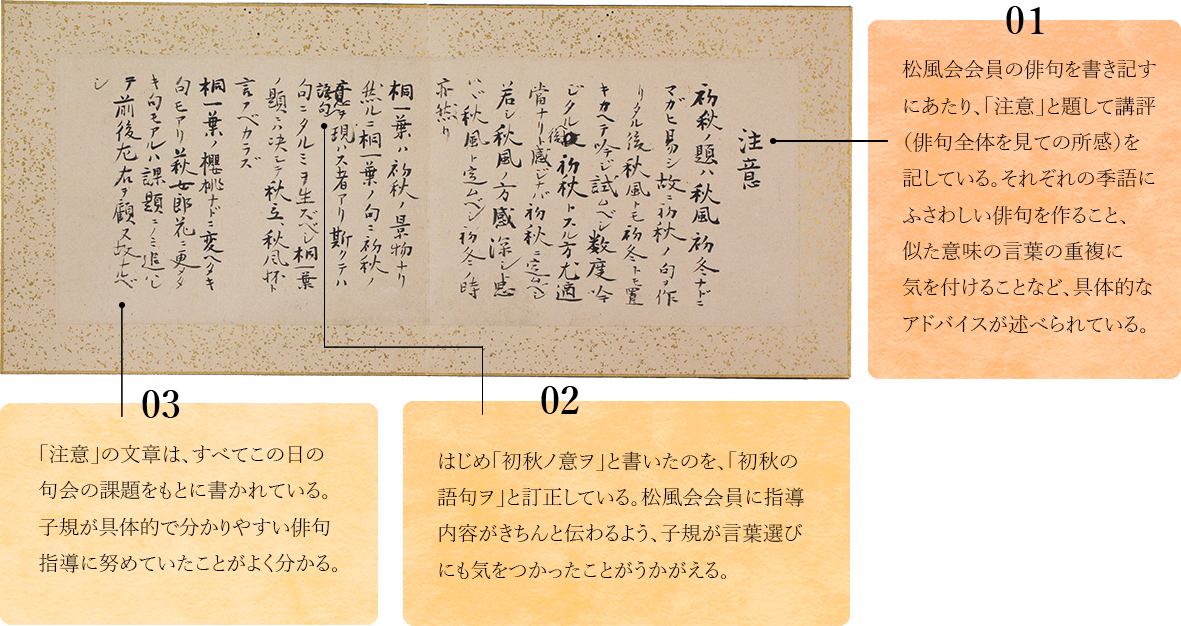
In September 1895, Masaoka Shiki offered his hometown's poets a test. When they wrote about early autumn, they should try replacing that expression with autumn wind, or even early winter, and recite the result. Only after deciding that early autumn really belonged should they settle on it. A seasonal phrase had to contribute something that its possible replacements could not.[1]
The instruction survives in a manuscript selecting thirty poems from a Matsuyama poetry meeting. Shiki supplied comments as well as choices. On one page he revised his own wording while explaining how his pupils should revise theirs. The teacher's text preserves the activity it recommends.
Matsuyama remembers Shiki through two different places: Shiki-dō, a reconstruction of his childhood home within Shōju-ji temple, and the municipal Shiki Memorial Museum in Dōgo Park. The room recalls a young writer's domestic surroundings; the museum's manuscripts disclose what writing and teaching required. Together they allow a more particular question than how a city produced a famous poet. How did people learn to make—and to recognize—a poem that could stand on its own?
1. Before there was a famous author
Shiki was born in Matsuyama in 1867. His family soon moved to a house in Minatomachi, where he remained until leaving for Tokyo as a teenager. The present Shiki-dō is not that house transported intact. It preserves a reconstructed arrangement on the grounds of the family's Buddhist temple, at a different address.[2]
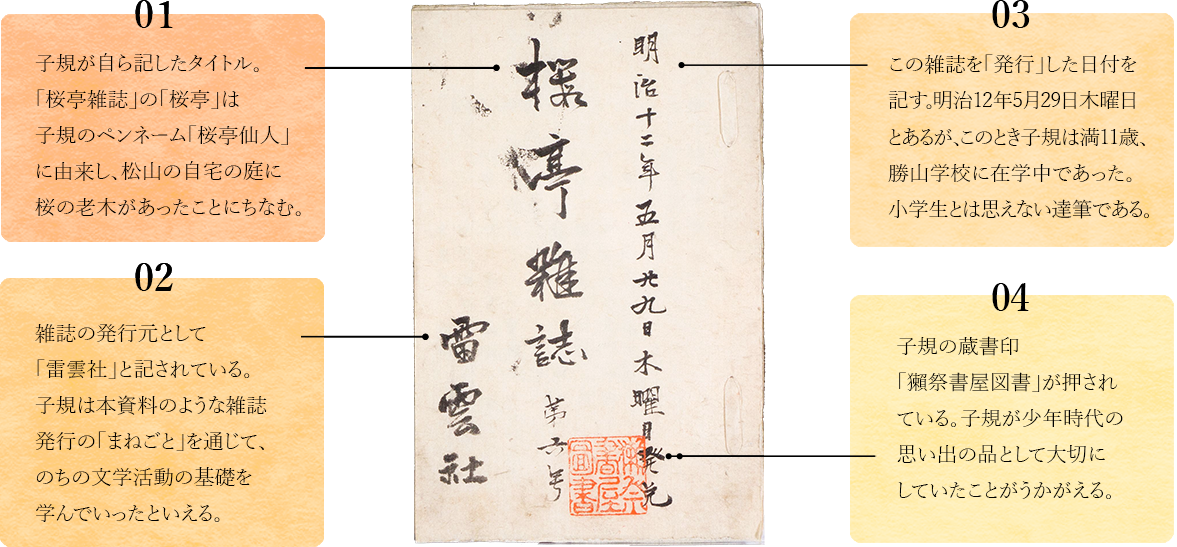
The study setting gives childhood writing an intelligible scale. A manuscript in the municipal museum provides a particular undertaking to set beside it: the sixth number of the Ōtei zasshi, a magazine Shiki edited and copied when he was eleven. Its cover bears the date 29 May 1879 and the name of its publisher, Raiunsha. The impressive publishing apparatus largely consisted of the schoolboy himself.[3]
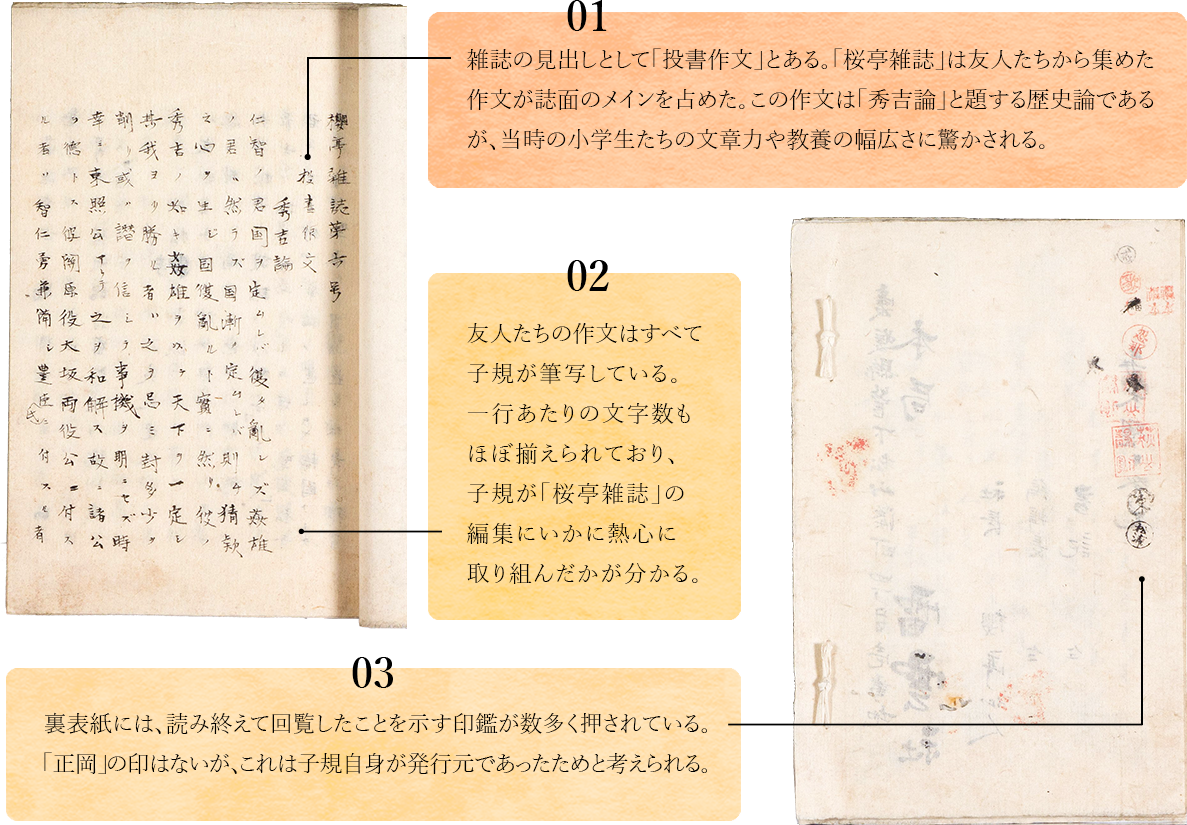
Inside were contributions collected from friends, copied in his hand. The cover and article headings imitate the organization of a periodical, while the back cover carries seals recording its passage among readers. What looks like one author's handwriting is consequently evidence of more than one person's composition. Making the magazine meant gathering contributions, preparing a readable copy and letting it leave the editor's possession.
The title's cherry-tree association also belongs to the remembered home. The museum connects Shiki's youthful pen name, Ōtei Sennin, with an old cherry tree in its garden. This is a closer domestic relationship than a generalized claim that Matsuyama's scenery made him a poet. A feature of the household entered the name under which he arranged other people's writing.
Nothing about the booklet makes his later career inevitable. It does identify activities already present before his mature criticism or prolonged illness: editing, copying and inviting a response. The recreated room helps locate this early work within a household. The surviving booklet preserves its outward movement, from a writer's desk to readers who marked that they had received it.
2. A visit that became a workshop
By the time Shiki returned to Matsuyama in 1895, a local group was already engaged with his approach to haiku. The Shōfūkai had formed the previous year, with schoolteachers among its founders. Shiki came home to recuperate after his journey as a correspondent in the Sino-Japanese War. He stayed at Gudabutsuan, the lodging of his friend Natsume Sōseki, and worked with members of the society.[4]
The September selection records one result. Its five assigned subjects were early autumn, a single falling paulownia leaf, the festival for ancestral spirits, autumn wind and autumn mosquitoes. These were shared starting points. The writers' task was to find something particular within them, rather than merely demonstrate that they knew which season the words denoted.
Shiki's comments address problems produced by those very assignments. Early autumn could become a vague coolness that fitted early winter equally well. Repeating equivalent seasonal information could consume the short poem without advancing it. The correction was therefore not simply an order to describe more. A poet might need to remove a phrase, change its position or choose a different relationship between the few things named.
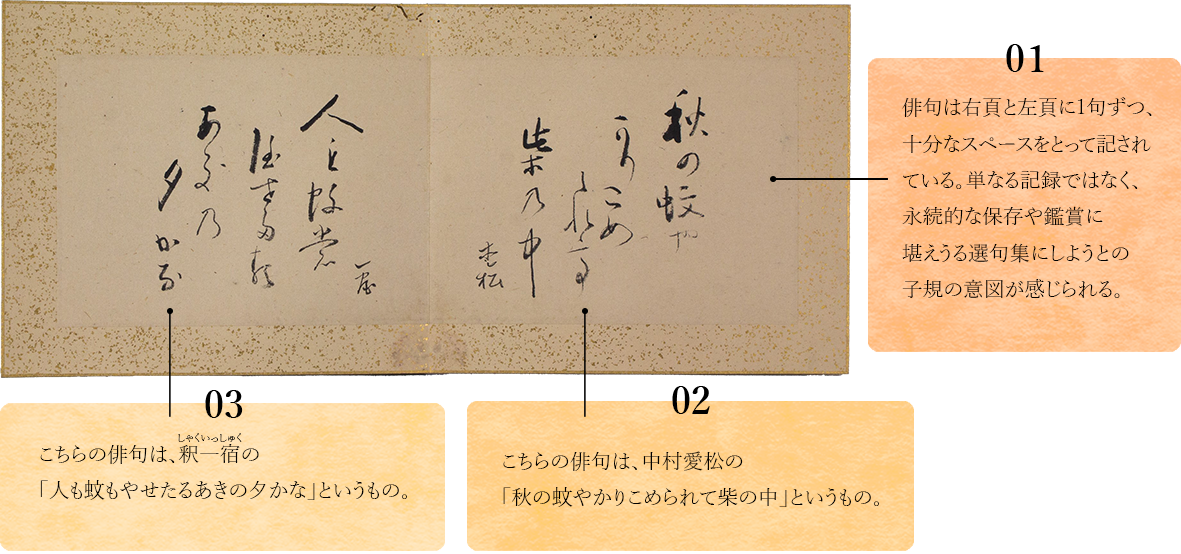
Two selected mosquito poems make the range visible. One, by Nakamura Aishō, places an autumn mosquito driven into the brushwood. Another, by Shaku Isshuku, joins thin people and thin mosquitoes in an autumn evening. The second may be rendered literally: “People and mosquitoes, both grown thin—an autumn evening.”[5]
The first concentrates attention on a displaced insect and its cover. The second discovers a resemblance between human and insect bodies. Their common seasonal subject has not produced interchangeable observations. Nor does the resemblance make the second poem a medical record about its author. Its effect arises from bringing two kinds of frailty into the same brief utterance.
Shiki copied the poems with generous space around them. His selection gives each a separate reading occasion, while his comments explain what he wants the group to reconsider. The manuscript preserves both an outcome and a lesson: some poems have been chosen, but the reasons for examining a poem extend beyond finding its position in the selection.
3. Instructions a reader could try
Shiki's Haikai taiyō, an outline of haiku practice, begins with a request from a blind poet called Kazan. In the preface's account, Kazan visits Shiki's temporary lodging and asks him to write down guidance. Shiki addresses the resulting work to the Shōfūkai members and asks them to pass it to Kazan.[6]
The framing is revealing. The advice is to move through other people, and its intended recipient cannot rely on looking at a page unaided. Recitation, explanation and judgment belong to the work from the start. The preface does not make poetic learning an exclusively visual exercise.
The opening propositions place haiku within literature and literature within the arts. Its familiar five-seven-five sound pattern distinguishes a customary form, but Shiki explicitly admits variations. Elsewhere he denies that age, popularity or social prestige automatically establishes beauty. These are positions he is arguing for, not neutral rules accepted by every poet of his time.
His practical advice brings the argument back to an unfinished line. Writers normally revise while searching for missing words, he observes. They are less inclined to test every expression after they have completed the required length. Completion can make a provisional choice look final. Shiki asks the writer to continue checking whether a phrase can still be exchanged for another.
He illustrates the problem with a verse by Bonchō about nighttime rain falling on accumulated snow. Before the opening is fixed, many phrases seem possible: a town setting, a faint moon, loneliness, a thatched roof. Shiki reports a tradition in which Bashō settles on Shimogyō, a district of Kyoto. The example is presented as a lesson in choosing a setting, rather than an invitation to add whichever attractive phrase remains available.[7]
A second test concerns slackness. Shiki compares a loose line to a poorly tightened musical string. The writer should examine unnecessary words, expressions that could be shorter, and arrangements that force an awkward connection. The work is specific enough to repeat. It gives the learner something to do after being told that a poem is unsatisfactory.
The manual's force lies in this movement between standards and operations. A declaration that haiku belongs among the arts might defend its standing. Substituting, reciting, shortening and comparing made that declaration relevant to the next poem written in Matsuyama.
4. A judgment was not a certificate
Selection created another problem. A poet whose work was chosen could value the distinction for reasons other than learning from it. A manuscript catalogued as Haijin o imashimuru no sho, a warning to haiku poets, records Shiki's response to such a request in 1896.[8]
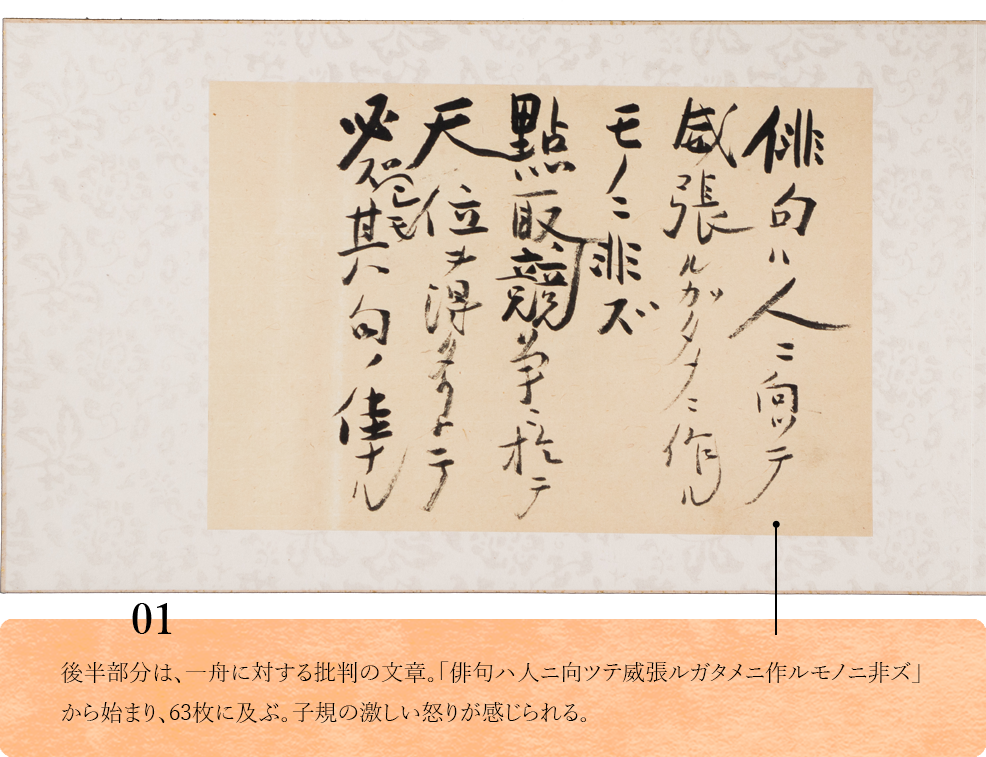
The museum explains the occasion through Yanagihara Kyokudō's later recollection. Isshū, a poet from elsewhere in Iyo, the province around Matsuyama, had received a top selection in the Kainan shinbun's haiku column. Through Kyokudō he repeatedly sought a calligraphic copy from Shiki, the selector. Instead he received a rebuke. His favorable selection had become the subject of a dispute about what that distinction meant.
Shiki's surviving text opens by saying that haiku is not composed in order to show off to other people. Its criticism is directed at turning a favorable selection into a displayed credential. The handwriting makes this an encounter between particular people; the argument reaches beyond Isshū to the relationship between choosing poems and conferring standing upon their authors.
This did not amount to abandoning judgment or competition. Shiki had ranked the Shōfūkai poems, and competitive selection continued in his circle. The objection concerned what happened afterward. An assessment of one poem could be treated as material for further work, or converted into something to exhibit as evidence of its owner's distinction.
The contrast returns us to the thirty-poem manuscript. That book included instructions and examples as well as rankings. It gave the group reasons to keep reading. The requested calligraphy would have done a different job for its recipient. A teacher could agree to select a poem without agreeing to supply every form of recognition that the poet wished to obtain from the selection.
5. Poems without names, then poems with names
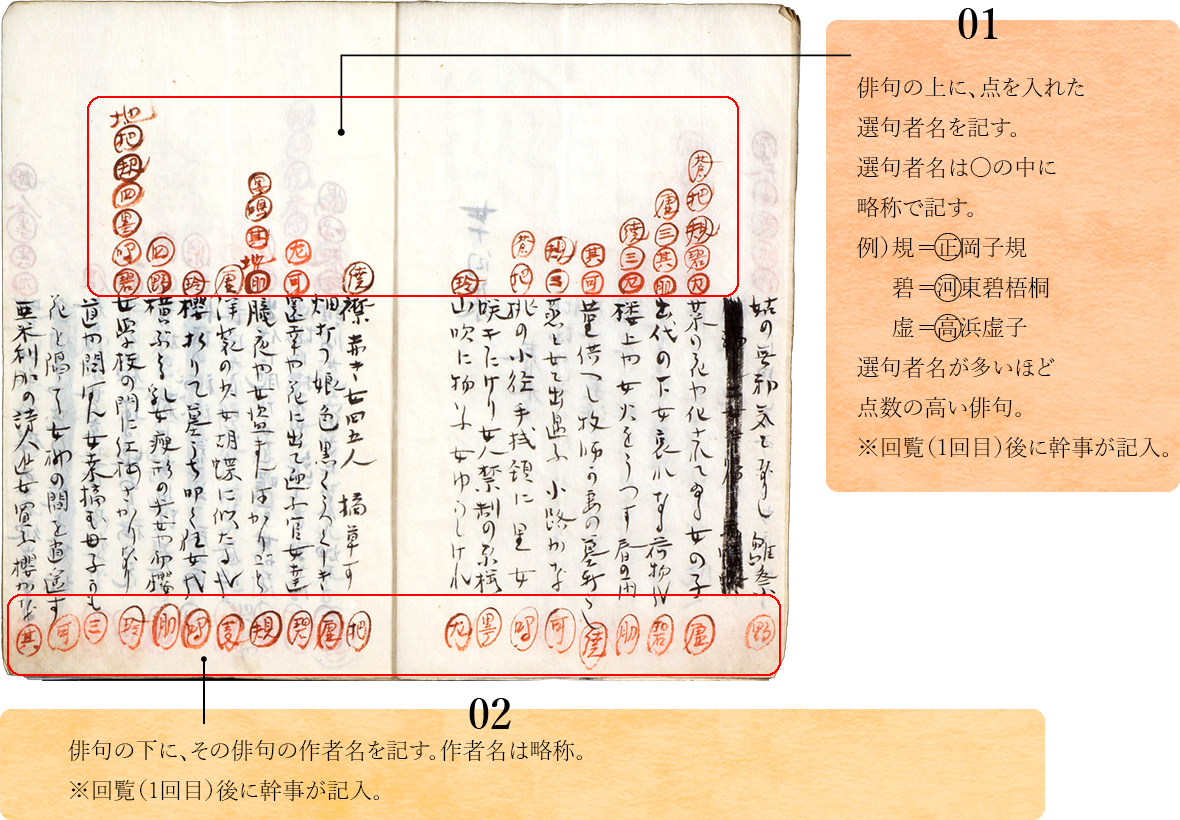
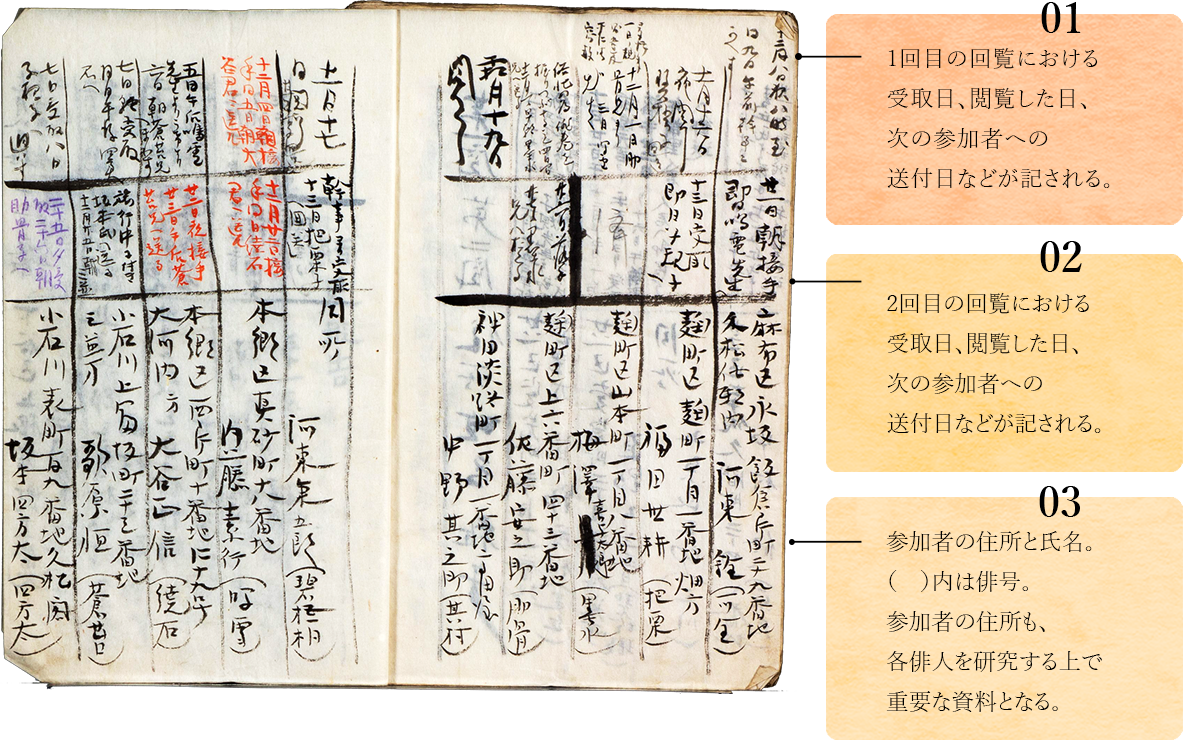
The museum also preserves a series of jikkushū, ten-poem collections, from Shiki's circle. These were records of a postal poetry exercise devised in 1896. Each participant submitted ten poems on a set subject. An organizer copied them anonymously, arranged them by season and sent the booklet around the group. Readers selected poems; after their choices had been assembled, the booklet circulated again with authors and selectors identified.[9]
The two journeys had different purposes. On the first, a reader encountered a poem without its author's name supplied beside it. On the second, the reader could connect the writing with its maker and see who else had selected it. Anonymity was a stage in the exercise, not the permanent erasure of authorship.
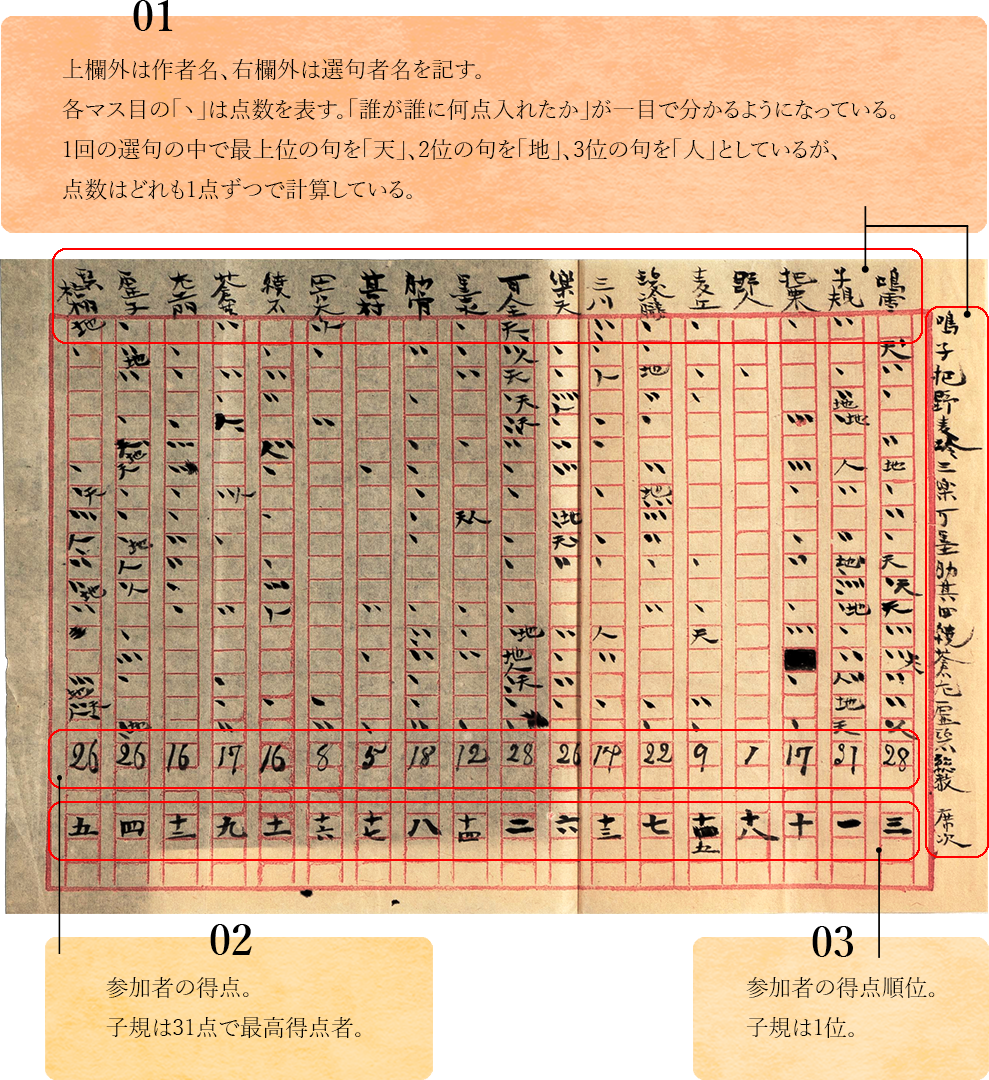
The Onna jikkushū, the collection on the theme of women, preserves the result on its pages. Circled names or abbreviations accumulate above favored verses; authors' names appear below. A separate grid records the selectors' choices against the writers, with totals beneath. The booklet has become a record of reading as well as a collection of things read.[10]
The organizer's work was essential. Someone had to make the anonymous copy, receive the choices, tally them and add the names. A rule required recipients to choose and forward the booklet within twenty-four hours. Delay by one person could prevent everyone farther along the chain from receiving the material. The practical discipline concerned handling a shared object as well as composing a verse.
At the end, the highest-scoring contributor kept the manuscript. The museum explains the survival of much of its group through Shiki's possession of such awarded volumes. That arrangement sits productively beside the warning to Isshū. Competition and possession were permitted; a favorable judgment still did not have to become a general certificate of poetic worth.
The exercise offered something a solitary notebook could not: other people's selections made visible beside one's own. It could reveal agreement without guaranteeing unanimity, and disagreement without removing the poems. The marks preserved a comparison that could be examined again after the immediate contest had ended.
6. The writer did not always have the strength to read
These procedures depended on a living person's capacity to take part. Shiki's later illness sharply restricted that capacity. His final years were spent largely confined at his home in Negishi, Tokyo—not in the childhood room reconstructed at Shiki-dō. The distinction is especially important when a hometown museum places materials from different periods close together.[11]
In the first installment of Byōshō rokushaku, usually translated as The Six-Foot Sickbed, Shiki writes that even the space of his bed has become too large for him. He cannot stretch his legs freely beyond the bedding. Newspapers and magazines remain among the things reaching him, but there are times when pain prevents him from reading even these.[12]
The passage resists a smooth account in which physical confinement automatically releases a larger imaginative world. It records interruptions. A publication may arrive without its reader being able to use it. Literary activity needs both material and an interval in which the person can attend to it.
Yet the same opening insists that he still has things to say. He describes irritation, pleasure and occasional distraction from suffering when he does read. These responses are varied, and he presents them as his own. Neither constant serenity nor unbroken productivity fits the account.
The series appeared in the newspaper Nippon from May to September 1902, ending shortly before his death. Publication brought the writing to readers beyond the sickroom. The earlier manuscripts already show how much such contact involved: papers, readers, intermediaries and repeated acts of judgment. Illness constrained participation in those arrangements. It did not create the need for them, and it does not explain the literary methods on its own.
7. What Matsuyama chose to keep
Kyokudō links the teaching history to its preservation. A school friend of Shiki's, he worked at the Kainan shinbun, published Shiki's criticism there and founded the haiku magazine Hototogisu in Matsuyama in January 1897. His later activity helped turn acquaintance with the living writer into organized remembrance.[13]
Shiki-dō first opened in 1926, using material from the old house and Kyokudō's recollection of its arrangement. Fire destroyed that memorial in 1933, and its replacement was lost in the 1945 air raid. The temple dates the present reconstruction to 1946 and identifies another resource: a recorded plan left by Shiki's sister Ritsu, used alongside Kyokudō's memory.[14]
A room could therefore be reconstructed after its material had been lost because people had retained information about how it was put together. The resulting building embodies their contribution. It recalls Shiki's surroundings through a family's record and a friend's memory, rather than surviving untouched from his childhood.
Nearby, the hair-burial monument established in 1904 performs another task. It gives mourning a focus within the family temple. Its bodily association differs from the room's spatial one and from a manuscript's record of composition. These objects do not need to make the same claim in order to belong together.
The municipal museum, opened in 1981, supplies a separate setting for collecting and reading. Its digital archive can place a youthful magazine, the Shōfūkai selection and the postal collections within reach of one another without implying that they were written in one room. The physical originals also retain things an ordinary printed edition may omit: reader seals, revisions, ample blank space, selection marks and the record of a booklet's circulation.[15]
Through these materials, Matsuyama's literary history becomes a history of learnable actions. Friends submitted writing; an editor copied it; a teacher tested words; poets judged work before seeing its author's name. Later custodians preserved the marks those actions left. Shiki-dō keeps a remembered room available to the imagination. The museum makes it possible to look beyond the famous person at the desk and recover the exacting, shared work that passed across it.
Next topic · HO Guides
Ichi-no-Tani: A Battle Wider Than Its Name
A courier's report, a disputed mountain route and a coast that offered escape recover the different scales of an 1184 defeat.
Continue readingSources and NotesView sourcesHide sources
- [1]
Masaoka Shiki, “松風会九月会稿 抜萃三十章,” 6 September 1895, section “注意”, autograph reproduced by the Matsuyama City Shiki Memorial Museum Digital Archive, catalogue 09. https://shikihaku-digital-archive.jp/shofukai_kugatsukaiko . See the catalogue and reproduced comments page; image: https://shikihaku-digital-archive.jp/wp-content/themes/shikimuseum/image/shofukai_kugatsukaiko_teisai_002.png . The opening paraphrases the written substitution advice, not speech recorded at a meeting. The visible correction from “初秋ノ意” toward “初秋の語句” is identified by the museum's annotation. The complete two-volume manuscript was not independently transcribed.
Return to the reference ↑ - [2]
Matsuyama City, “子規堂 附 埋髪塔,” historical explanation, updated 30 April 2021. https://www.city.matsuyama.ehime.jp/kanko/kankoguide/rekishibunka/bunkazai/ken/sikidou.html . Supports the 1867 birth, Minatomachi childhood residence, move to Tokyo at fifteen by elapsed-age reckoning, temple-site reconstruction, 1926 foundation and 1904 hair monument. The city's traditional counted age of seventeen is not treated as seventeen elapsed years. The temple identifies itself as Shōju-ji / 正宗寺; the childhood address and memorial address are not conflated.
Return to the reference ↑ - [3]
Shiki, “桜亭雑誌 第六号,” 29 May 1879, cover, contributed-writing page and back cover, reproduced in the museum archive, catalogue 07. https://shikihaku-digital-archive.jp/ohtei_zasshi . The catalogue and annotated images: https://shikihaku-digital-archive.jp/wp-content/themes/shikimuseum/image/ohtei_teisai_001.png and https://shikihaku-digital-archive.jp/wp-content/themes/shikimuseum/image/ohtei_teisai_002.png . The date, publisher name, headings and seals are visible; their circulation function and attribution of copying follow the catalogue. The article does not reproduce or endorse the schoolboys' political/historical judgments, infer every reader's response, or claim that a specific page was written at the displayed desk. The garden-tree explanation follows the catalogue, not a surviving botanical identification.
Return to the reference ↑ - [4]
Museum archive, catalogue 09, historical description and five-subject heading, URL in note 1; Matsuyama City, “令和8年度春季特別展『松山子規会創設者・柳原極堂』を開催します,” 9 April 2026, “目的,” paragraphs 2–3. https://www.city.matsuyama.ehime.jp/hodo/202604/kyokudou.html . Used for the 1894 Shōfūkai, schoolteacher involvement, Shiki's 1895 recuperative stay and local instruction. These related municipal accounts are not two independent eyewitness testimonies. The essay gives no precise wartime itinerary, medical causation, claim that all sessions occurred in one room, or current exhibition promise.
Return to the reference ↑ - [5]
Shiki's 1895 selection manuscript, facing poems by Nakamura Aishō / 中村愛松 and Shaku Isshuku / 釈一宿, reproduced image: https://shikihaku-digital-archive.jp/wp-content/themes/shikimuseum/image/shofukai_kugatsukaiko_teisai_003.png . See both manuscript pages and supplied transcriptions. Texts: “秋の蚊やかりこめられて柴の中” and “人も蚊もやせたるあきの夕かな.” The English rendering of the second is this essay's literal translation of the public-domain verse; the first is paraphrased. The comparison of their effects is literary analysis, not a claim about the poets' health or the actual place of composition. Spacious copying is visually observed, not proof of a private intention to create a permanent masterpiece.
Return to the reference ↑ - [6]
Shiki, 『俳諧大要』, preface; “第一 俳句の標準”; “第二 俳句と他の文学.” Public-domain text in Aozora Bunko: https://www.aozora.gr.jp/cards/000305/files/57350_60028.html . See the preface and relevant propositions. Kazan's visit and request remain the author's prefatory account, not independently authenticated dialogue. The argument about artistic standards belongs to Shiki. Five-seven-five refers to Japanese sound units, not a mandatory English syllable scheme. The reading does not claim that all of Shiki's later uses of shasei can be reduced to this manual.
Return to the reference ↑ - [7]
Shiki, 『俳諧大要』, subsection of “第六 修学第二期” beginning “趣向の上に動く動かぬといふ事あり”, through the paragraphs “何といふ語句を置くべきか” and “言語の上にたるむたるまぬといふ事あり,” URL in note 6. See these paragraphs and the adjoining seasonal substitutions. Bonchō's line and the Bashō anecdote are used as examples within Shiki's argument, not independently verified conversations. Aozora's bibliographical card identifies publication in Nippon, 22 October–31 December 1895, and its Iwanami source edition: https://www.aozora.gr.jp/cards/000305/card57350.html . The separate fact of publication in Kainan follows the municipal Kyokudō account; no unverified priority or identical serialization schedule is asserted.
Return to the reference ↑ - [8]
Shiki and others, “俳人ヲ戒ムルノ書,” autumn 1896, museum archive catalogue 02, historical explanation and reproduced opening of the admonition. https://shikihaku-digital-archive.jp/haijin_wo_imashimurunosho . Image: https://shikihaku-digital-archive.jp/wp-content/themes/shikimuseum/image/haijinoimashimurunosho_teisai_003.png . The request and intermediary are supplied through the museum's account of Kyokudō's 『友人子規』, not an independently read complete memoir. The autograph opening supplies Shiki's stated objection. The essay neither adopts the catalogue's inference about his emotional state nor treats every illustrated leaf as certainly in his hand. The contrast between assessment and a displayed credential is this essay's interpretation of the stated dispute.
Return to the reference ↑ - [9]
Museum Digital Archive, “令和6年度資料,” “子規と門人らのユニークな俳句修練を物語る郵便回覧句稿『十句集』,” procedural explanation, stages 1–5 and contents list. https://shikihaku-digital-archive.jp/collection_r6 . Used for the 1896 origin, anonymous seasonal copy, two circulations, twenty-four-hour forwarding rule and final possession by the highest scorer. The rule is not presented as proof of universal compliance or a measured historical postal delivery speed. “Ten poems” is per participant, not the total contents of each book. No claim of guaranteed impartiality is made.
Return to the reference ↑ - [10]
“女十句集,” November 1896, reproduced poem spread, scoring grid and address/handling pages in the archive, URL in note 9. Images: https://shikihaku-digital-archive.jp/wp-content/themes/shikimuseum/image/onnajikkushu_teisai_001.png ; https://shikihaku-digital-archive.jp/wp-content/themes/shikimuseum/image/onnajikkushu_teisai_003.png ; https://shikihaku-digital-archive.jp/wp-content/themes/shikimuseum/image/onnajikkushu_teisai_004.png . Circled selection marks, author indications, grid, totals and handling annotations were visually checked; their procedural interpretation follows the museum. No full retranscription of every poem, address or score is claimed. An erroneous-looking duplicated ranking in one modern image caption is not used.
Return to the reference ↑ - [11]
Matsuyama City Shiki Memorial Museum, Japanese museum pamphlet, p. 2, “病苦をのりこえて,” for the Negishi, Tokyo, setting of the late sickroom. https://shiki-museum.com/file/pamphlet/cata_j.pdf?20250401= . See the corresponding panel; its celebratory interpretation of illness is not adopted. The source is used for location, not an independent retrospective medical diagnosis. Shiki-dō is the childhood reconstruction, and the museum is neither that original childhood house nor the Tokyo residence.
Return to the reference ↑ - [12]
Shiki, 『病牀六尺』, installment 1, 5 May 1902, opening paragraph. https://www.aozora.gr.jp/cards/000305/files/43537_41508.html . See the opening and its immediate continuation in the public-domain Japanese text; only the opening's account of bodily limits, incoming reading and varied reactions is used. It is self-description, not an externally measured functional assessment. Publication dates 5 May–17 September 1902 and death on 19 September 1902 are identified in Aozora's source card: https://www.aozora.gr.jp/cards/000305/card43537.html . Neither the entire series nor the complete newspaper run was read for this essay.
Return to the reference ↑ - [13]
Matsuyama City's 2026 Kyokudō exhibition explanation, “目的,” paragraphs 2–4, URL in note 4. Supports school friendship, Kainan employment, publication of criticism, Hototogisu's January 1897 foundation and later memorial activities. Used as the museum's documented biographical account, without adopting its claims about a single individual's decisive contribution to all later cultural activity. No claim is made that the magazine's subsequent Tokyo history or full circulation has been reconstructed.
Return to the reference ↑ - [14]
Shiki-dō / Shōju-ji, official historical account, “愛媛県の史跡指定,” https://shikido.ehime.jp/ ; municipal heritage description, note 2. These identify the two fires, postwar rebuilding and the respective roles of Ritsu's recorded plan and Kyokudō's recollection. The operator supplies 1946 for the present reconstruction. The complete original plan and reconstruction records were not obtained; faithful reproduction of every original room detail is not independently certified. The 1904 hair monument is described by the city; its commemorative count is not translated as three elapsed years after the 1902 death.
Return to the reference ↑ - [15]
Museum Japanese pamphlet, p. 1, opening paragraph, URL in note 11, dates the museum's opening to April 1981. Matsuyama City, “子規記念博物館,” updated 17 February 2026, section on the digital archive: https://www.city.matsuyama.ehime.jp/shisetsu/bunka/sikihaku/sikihaku_HP.html . Read for institutional collecting and digital preservation/access, not a guarantee of a particular original's current display. The comparison of building memory, object custody and textual procedures is this essay's analysis; it does not assert that every item came directly from Shiki's estate or that Shiki-dō and the municipal museum are one institution.
Return to the reference ↑