HO Guides
Bashō in Fukagawa: The Company a Hermit Kept
Frog poems, departing letters, and a transplanted banana reveal a retreat sustained by relationships—and a writer who sometimes needed to close its gate.
Quick · About 2 min
The story in five points
A short route through the argument. Follow a point into Classic for its context and sources.
Retreat remained part of literary society
Bashō’s Fukagawa prose brings Chinese poets into modest scenes of doors, leaves, rain and a basin. Simplicity was a literary position informed by reading, not evidence that he abandoned learning or a household account demonstrating exact poverty.
Read in contextThe old pond entered a comparison
The frog anthology places Bashō beside Senka in matched pairs with commentary and judgment. Its format is a contest, not linked verse. Publication carried the comparison beyond the hut, documenting presentation without recovering the instant of the poem’s first conception.
Read in contextCompany could enrich or interrupt attention
The snowy-night piece reverses a resolution against visitors when weather makes the narrator desire friends. A later declaration closes the gate against needless talk while acknowledging that his own visits consume others’ time. Withdrawal and exchange required active adjustment.
Read in contextDeparture reorganized existing relationships
A letter thanks Rakugo for paper while describing transfer of the hut. The travel work adds temporary hospitality, farewell companions and Sora’s household assistance. Travel began through familiar connections; the personal letter and composed journey retain different documentary and literary forms.
Read in contextCare sustained the name across absence
Friends divided the banana plant, neighbors protected it during travel, and transplantation accompanied a renewed dwelling. These practical acts helped sustain the hermitage’s identity. Modern gardens and a traditionally associated stone frog commemorate that history without preserving the original house or proving the poem’s pond.
Read in context
Opening
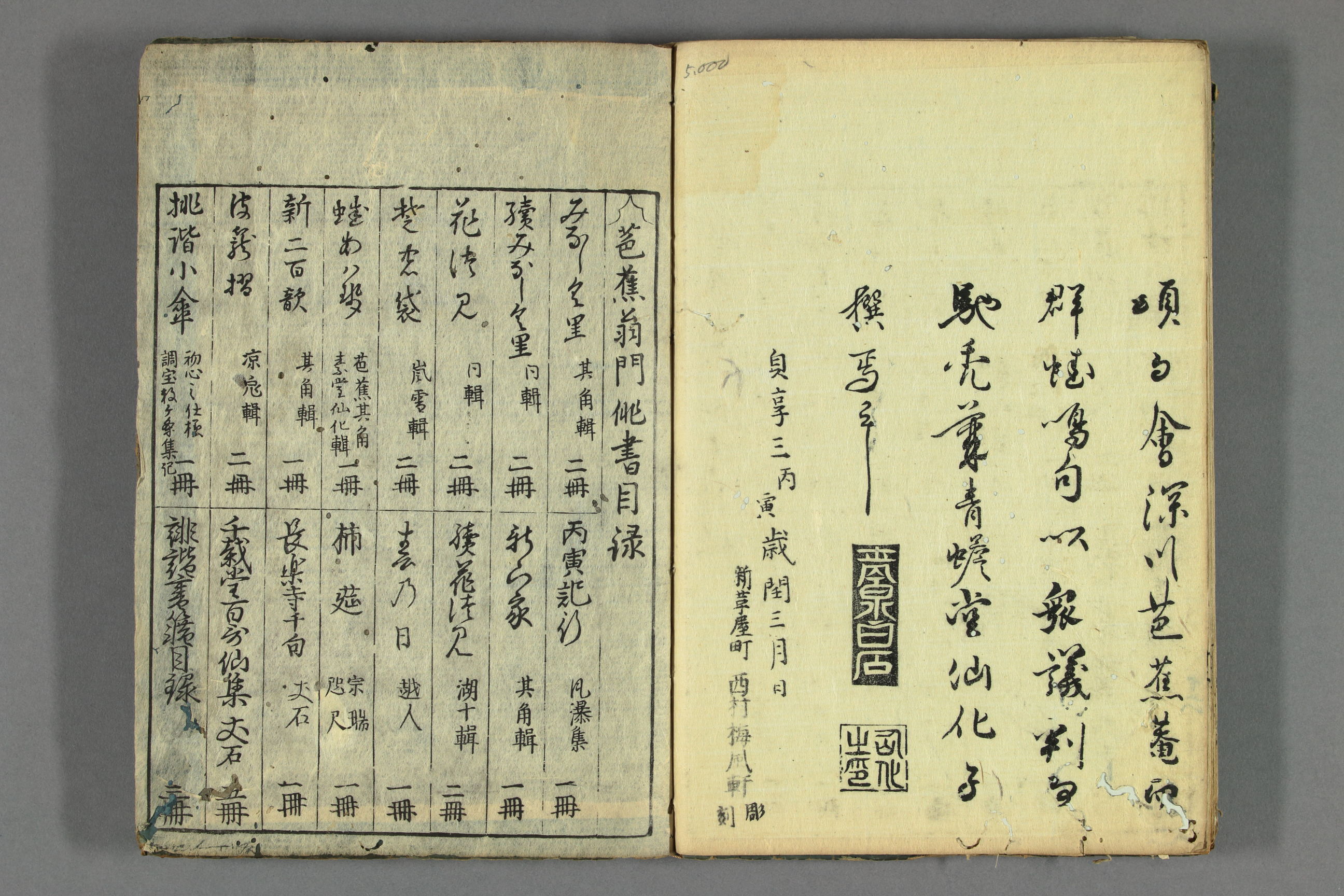
In a little book published in 1686, Bashō’s old pond has a neighboring frog. The famous verse appears in the first pair of a collection devoted to matching poems about frogs. Bashō’s entry stands on the left; a poem by Senka, the collection’s compiler, stands on the right. Commentary follows. The verse often encountered alone—an old pond, a frog jumping in, the sound of water—survives here inside a social arrangement for comparing poems.[1]
The collection, Kawazu awase, is associated with a gathering at Bashō’s Fukagawa hermitage. Its organization gives the place a different character from a cabin in which an isolated genius listened until a masterpiece arrived. Other poets, their competing attempts, and the work of judgment belong to the setting too.[2]
Fukagawa offered Bashō a place of retreat within the waterways of eastern Edo. But retreat did not mean that relations with other people ceased. The dwelling was a place to receive them, write to them, leave things in their care, and sometimes refuse further company. Its literary productivity depended partly on deciding which of these relationships a particular moment required.
1. A quieter address, with books already inside the language
Bashō moved to Fukagawa in 1680. Kōtō City identifies the riverside hermitage as a base for his literary activity and successive journeys.[3] His own short prose piece usually called “The Brushwood Gate” describes the change after years of living in the city. To explain it, he reaches for an older city: Chang’an, the Chinese capital associated with the poet Bai Juyi.
The passage invokes a place of reputation and gain, difficult for someone without money. Then Bashō brings the scale down to his own threshold. Wind gathers leaves by the brushwood door; the accompanying verse connects them with making tea.[4]
This small domestic scene is already full of reading. A writer in Fukagawa could describe his address through a Chinese poet’s language, then give the borrowed urban contrast a local object: leaves collected at a door. Distance from commercial activity was being made into a literary position as well as a change of residence.
The simpler the hut appears, the easier it is to overlook the learning in its description. Plain materials and limited possessions can be represented through a sophisticated inheritance. A reader should not have to imagine that Bashō discarded learning when he left a busier address. His words bring earlier writers into the retreat.
Another piece, “Thoughts in a Thatched Hut,” places his dwelling beside poems about damaged shelter by Du Fu and Su Shi. It ends with the sound of rain in a basin during a storm that batters the banana plant.[5] The modest house becomes a meeting point between immediate sensations and remembered writing. We encounter rain through a poem that knows other poems about rain.
These works are literary self-presentations, not household accounts proving exactly how poor their author was. Their subject is what could be made of a reduced domestic setting. The door, leaves, plant, and basin offer things small enough to attend to closely, while the allusions open that setting to a much larger conversation.
Fukagawa supplied the address from which this conversation could be conducted. Its distance from the city’s busier districts did not place it outside literary society. It gave the writer a way to choose how he would stand in relation to that society.
2. The old pond enters a comparison
The frog collection makes the resulting company visible on the page. Its title, Kawazu awase, means a matching or contest of frog poems. The collection is described as twenty pairs with an additional verse, compiled by Senka and associated with collective judgment at Bashō’s hut.[2] A surviving 1686 edition in Waseda University Library preserves its printed arrangement.
Each matched pair asks for attention to more than one attempt at the subject. The opening page places Bashō and Senka under left and right headings, followed by prose. Later pages continue the paired arrangement, with judgments that sometimes explicitly identify a winning side.[1] The reader is given poems and an activity to perform with them: compare.
For an English reader accustomed to the old-pond verse as a self-contained miniature, this can be surprising. Its shortness does not make its original literary world solitary. A brief poem can be quoted by itself, yet also be offered among other poems and discussed in company.
The collection’s format establishes something quite specific. It is a contest arrangement, not a single long poem to which each participant contributes the next line. Bashō also practiced linked verse, but the frog book works through paired alternatives. The shared subject provides continuity while each entry makes a different attempt.[2]
That arrangement gives the hermitage a practical literary function. Gathering poets around a subject creates occasions for selecting words, hearing another treatment, and distinguishing one effect from another. A teacher’s work can operate through those comparisons rather than through a lecture explaining what every poem must mean.
The printed book then carries the comparison beyond the room. Its colophon names an Edo publisher and dates the edition to 1686. The gathering’s literary product acquired a form that could be handled and read elsewhere.[6] Fukagawa remained part of its origin, while the reader no longer had to be present at the hut to encounter the poems together.
None of this fixes the instant when Bashō first formulated his verse. The anthology supplies a documented setting of presentation, not a transcript of a frog’s movement or the poet’s first thought. It also leaves us free to hear the poem without pretending that all later meanings were settled in the room.
The pond can be quiet within the verse while the verse has an active life among people. In Fukagawa, those two conditions were compatible. The material survives because a small act of attention entered an organized exchange.
3. Snow makes the vow difficult
Bashō’s “Snowy Night in Fukagawa,” dated to the winter of 1686, gives a less orderly account of company. Its narrator has repeatedly resolved not to receive visitors, seek people out, or invite them. Then moonlit nights and snowy mornings make him long for friends.[7]
The little piece turns on that reversal. A scene worth attending to can also be a scene one wishes to share. The desire for quiet does not extinguish the desire for another person’s presence; the weather that enriches the retreat can make solitude less satisfactory.
Bashō describes himself opening the hut’s door to look at the snow, taking up a cup, dipping his brush, and putting it aside. These actions belong to his written scene. Its self-mocking portrait shifts between withdrawal, observation, drinking, and the attempt to write. The hermit has become a troublesome character in his own account.
The humor prevents a neat division between a crowded literary world and a perfectly contented retreat. Company can interrupt attention, yet attention can generate the wish for company. The piece gives that tension a particular setting: a door that can be opened, a winter scene outside, and a writer who cannot make a prior resolution govern every response.
Bashō lets both attitudes stand. Read beside the frog collection, this self-portrait gives the hut two related uses: a place where poetry could be made with others and a place where being without them could itself become something to write about.
4. Leaving began with arrangements at home
Before the journey of 1689 later shaped into Oku no hosomichi—usually translated as The Narrow Road to the Deep North—Bashō wrote to the disciple Rakugo. The letter thanks him for a bundle of paper and describes preparations for departure. Bashō says that he has transferred the hut to another person, a man with a wife and daughter, and includes a verse imagining the change in the household.[8]
The practical transaction and the poem occupy the same letter. The dwelling that had represented a poet’s retreat would acquire another domestic identity. Bashō imagines it as a house for the seasonal display of dolls. The point is the change of inhabitants: his departure makes room for a form of life different from his own.
The letter’s surrounding courtesies are equally important. Paper has arrived through a relationship with another poet; the reply carries news and a verse outward. Even the preparation to leave involves receiving something and acknowledging the giver. The hut’s connection with distant readers was active before the traveler set out.
The opening of Oku no hosomichi reshapes these preparations within a more expansive meditation on travel. It says that Bashō handed his dwelling to another person and moved to the separate residence of his supporter Sanpū. The house-changing verse appears again, followed by a statement that the opening eight stanzas of a linked-verse sequence were left hanging on a hut’s pillar.[9]
The text does not give us a surviving pillar to identify. It gives departure a literary remnant: words left behind as the dwelling’s use changes. The move to Sanpū’s residence also makes clear that relinquishing one home did not mean spending the interval before departure without anybody’s hospitality.
The journey’s opening continues through companions who gather to see him off and a boat passage to Senju. There the travelers leave the boat. Later, the work introduces Sora, Bashō’s traveling companion, as a neighbor who had helped him with the labor of firewood and water.[10]
These details place the road within relationships already attached to Fukagawa. Someone provides temporary accommodation; companions accompany the departure; a neighbor becomes a fellow traveler. The river connects the home district to the outward route. The journey begins by reorganizing familiar connections rather than by erasing them.
The letter and the travel work should retain their different forms. One is a communication sent before departure; the other is a composed literary account. Their treatments of the house overlap, but the travel book makes the episode part of a larger meditation. The same domestic change could do work in both a personal exchange and a text intended to endure beyond that exchange.
5. The plant had to stay somewhere
There was another inhabitant to consider: the banana plant from which the hermitage took its name. In “On Transplanting the Banana,” written in 1692, Bashō recalls how it grew until its leaves crowded the garden and screened the eaves. People used the plant to name the dwelling. Friends and disciples divided its shoots and roots, sending portions to other places.[11]
The plant thus made a relationship capable of growing elsewhere. A shoot carried away did not transfer the whole house or its literary activity. It established another living connection with the place. The prose records propagation as something friends did together, repeated over the years.
Before the northern journey, the plant was moved nearby. Bashō says that he repeatedly asked the neighbors to protect it from frost and wind. In the same work, he describes a new thatched dwelling near the old one and the decision to transplant the banana there.[11]
These are unusually concrete obligations beneath the language of retreat. A plant left behind needed another person’s attention. Returning required a place to put it. The name could persist through changes of dwelling because people cared for the living thing to which it referred.
The prose also resists giving the banana an ordinary account of usefulness. Bashō values its shade and the vulnerability of its leaves to wind and rain. Its appearance enters the work through comparisons and earlier literary associations, while its survival depends on such practical requests as sheltering it from frost.
That combination keeps the plant from becoming a decorative emblem pasted onto the poet’s life. Its growth helped identify the dwelling; its divisions connected friends; its care extended across an absence; its transplantation accompanied a renewed home. The literary name rested on a succession of actions that the poet did not perform alone.
6. Why close the gate?
The relationships that sustained the retreat could also fill it with demands. In “Closing the Gate,” written in 1693, Bashō sets out a declaration of withdrawal. Near its conclusion, he says that visitors bring unnecessary talk, while going out himself can interfere with other people’s work. He makes the written declaration a rule for his own conduct.[12]
The two directions matter. He is not simply blaming the people who come to see a famous poet. His own visits can consume somebody else’s time. A social connection imposes on both sides, even when each participant has reason to value it.
The accompanying verse gives the declaration a physical form: morning glories, a fence, and a gate locked during the day. Instead of leaving retreat as an inward aspiration, the poem places it at a threshold. A person approaching the dwelling would meet a boundary.
Read after the frog anthology, the departing letter, and the banana’s care, the closure does not cancel the hut’s social history. It reveals one of its conditions. A place used for literary exchange also needed occasions when exchange could be limited. Being supported by friends did not make the writer’s availability inexhaustible.
The declaration itself is another piece of writing about that relationship. It gives absence a stated purpose and turns a restriction into a literary act. The gate can be closed without requiring us to imagine that Fukagawa has ceased to belong to a wider world of readers.
7. Two frogs, two kinds of evidence
The modern Fukagawa memorial landscape contains a different frog from the one preserved in the 1686 book. A stone frog found after a typhoon’s storm surge in 1917 became associated with Bashō. In 1921, Tokyo Prefecture designated the locality as the site of his old pond. Bashō Inari Shrine marks the associated area. The memorial museum labels the stone’s connection with the poet as traditional.[13]
That qualification is essential. The object records a history of discovery and commemoration; it does not establish that Bashō owned it or identify the precise pond of the poem. By contrast, the surviving early printed anthology directly establishes how the verse was placed beside another poet’s work. The stone and the book answer different questions.
Kōtō City opened the Bashō Memorial Museum in 1981. A separate branch and observation garden followed in 1995. The main museum’s garden includes a small structure modeled on a hermitage, while the separate riverside garden looks toward the Sumida and Onagi rivers.[13][14] None of these structures is the original house from the poems.
The museum’s collections, library, and rooms for literary activities give the district a new provision for reading and meeting. They are modern arrangements, not an unchanged institution descending from Bashō’s circle. They nevertheless make it possible to approach the old place through something richer than the search for a surviving doorway.
The strongest doorway is in the writing. It admits fellow poets to a comparison, opens toward snow, marks a home being handed over, and finally closes against interruption. Around it move verses, gifts, guests, letters, and a vulnerable plant. Fukagawa’s retreat was productive because it gave these relations a particular setting—and because its inhabitant could sometimes decide that the next necessary act was to be alone.
Next topic · HO Guides
Hokusai’s Sumida: The City Inside the Picture
A timberyard advertises prints, a river journey becomes a private painting, and a lost shrine offering returns through the imperfect evidence of a photograph.
Continue readingSources and NotesView sourcesHide sources
Sources were consulted on 16 September 2026. English renderings and paraphrases of Bashō’s public-domain Japanese texts are the writer’s, not quotations from a modern English translation. Literary first-person scenes are treated as authored representations. Dates supplied by the Japanese texts or their editors are not silently converted from the historical calendar into Gregorian months and days.
- [1]
Senka, compiler, Kawazu / Kawazu awase (可般図), Edo: Nishimura Baifūken, 1686, Waseda University Library, 文庫31 A0062. Catalogue: https://www.wul.waseda.ac.jp/kotenseki/html/bunko31/bunko31_a0062/index.html . Facsimile image index: https://archive.wul.waseda.ac.jp/kosho/bunko31/bunko31_a0062/bunko31_a0062.html . See images p0002–p0005. The first pair labels Bashō left and Senka right; later images show repeated pairs and judging prose. The essay does not declare a winner in the first pair or claim to have transcribed every commentary.
Return to the reference ↑ - [2]
Kindai University Central Library, reference response dated February 11, 2014, updated February 12, hosted by the National Diet Library’s Collaborative Reference Database, record 1000149094. https://crd.ndl.go.jp/reference/entry/index.php?id=1000149094&page=ref_view . The complete response cites dictionary entries for the 1686 anthology, Senka’s role, twenty pairs and one extra poem, and collective judgment at Bashō-an. The cited dictionary volumes were not independently read. Compare the Bashō Memorial Museum’s exhibition explanation “古池の句―芭蕉と蛙―,” https://www.kcf.or.jp/basho/kikaku/detail/?id=159 . These are later bibliographical/curatorial accounts, not transcripts of the gathering; no spontaneous composition scene is reconstructed from them.
Return to the reference ↑ - [3]
Kōtō City, “1680年 松尾芭蕉が深川芭蕉庵に転居,” updated January 19, 2017, title and principal historical paragraph. https://www.city.koto.lg.jp/promotion/kotocity/bashou.html . Used for the relocation year and the Fukagawa base, not for an exact surviving house footprint.
Return to the reference ↑ - [4]
Matsuo Bashō, “柴の戸” (The Brushwood Gate), complete short Japanese prose and accompanying verse, transcribed in Itō Yō’s Bashō Database. https://www2.yamanashi-ken.ac.jp/~itoyo/basho/tanpen/sibanoto.htm . See the primary text and the note identifying its Chinese allusion. The editor’s broader account of Bashō’s motives is not adopted. The text’s presentation of a difficult city and modest threshold is not treated as an audited household budget.
Return to the reference ↑ - [5]
Bashō, “茅舎の感” (Thoughts in a Thatched Hut), 1681, complete primary prose and verse in Itō’s database. https://www2.yamanashi-ken.ac.jp/~itoyo/basho/tanpen/bousya.htm . Used for its explicit Du Fu/Su Shi references and the domestic rain-and-banana setting. Some characters in the hosted text have encoding damage; no argument rests on an unreadable character or on the modern commentary’s reconstruction of the poet’s emotions.
Return to the reference ↑ - [6]
Kawazu awase, Waseda copy, facsimile image p0018, colophon: https://archive.wul.waseda.ac.jp/kosho/bunko31/bunko31_a0062/bunko31_a0062_p0018.jpg . It gives Jōkyō 3, an intercalary third month, and Nishimura Baifūken’s Edo imprint. The article uses 1686 without inventing a Gregorian publication day, print run, readership total, or sales outcome.
Return to the reference ↑ - [7]
Bashō, “深川の雪の夜” (Snowy Night in Fukagawa), dated winter 1686 in Itō’s database; https://www2.yamanashi-ken.ac.jp/~itoyo/basho/tanpen/hukagawa.htm . The narrated actions and wish for companions are used as literary self-representation, not as independently verified weather, a clinical description, or evidence for the writer’s whole personality.
Return to the reference ↑ - [8]
Bashō, letter to Rakugo, dated Genroku 2, third month, twenty-third day (1689), Japanese transcription in Itō’s database. https://www2.yamanashi-ken.ac.jp/~itoyo/basho/letter/rakugo.htm . See the primary text, particularly the thanks for paper and transfer of the hut to a man with wife and daughter. The original autograph was not independently inspected. The editor’s conflicting conjectures about departure-day discrepancies and his identification of the paper’s use are not adopted. “Transferred” does not assert a proven sale price or legal form.
Return to the reference ↑ - [9]
Bashō, Oku no hosomichi, opening section, Japanese text in Itō’s database, https://www2.yamanashi-ken.ac.jp/~itoyo/basho/okunohosomichi/okuno011.htm ; compared with the opening in the Wikisource transcription based on Miyake Kunikichi’s 1911 Shinshaku Oku no hosomichi, https://ja.wikisource.org/wiki/おくのほそ道 . Read the relevant primary paragraphs, not the complete journey for this essay. Textual variants in the house-changing verse are not silently harmonized into a verbatim quotation. The statement about eight stanzas and a pillar is retained without identifying which dwelling’s pillar it was; the editor records that uncertainty.
Return to the reference ↑ - [10]
Oku no hosomichi, departure through Senju and the later introduction of Sora, in the same Wikisource primary text, paragraphs beginning “むづまじきかぎりは” and “曾良は河合氏にして.” https://ja.wikisource.org/wiki/おくのほそ道 . Sora’s household assistance is attributed to Bashō’s account. No exact embarkation structure, reconstructed farewell dialogue, or independent verification of every narrated action is claimed.
Return to the reference ↑ - [11]
Bashō, “芭蕉を移す詞” (On Transplanting the Banana), dated Genroku 5, eighth month (1692), complete primary prose in Itō’s database. https://www2.yamanashi-ken.ac.jp/~itoyo/basho/others/bashoite.htm . Used for the plant naming the dwelling, division among friends, care during travel, and transplantation beside a new hut. The text’s elapsed “five years” is not used because it does not straightforwardly match the chronology; its literary architectural description is not treated as a measured plan. No modern banana plant is identified as a botanically verified descendant.
Return to the reference ↑ - [12]
Bashō, “閉関の説” (Closing the Gate), dated 1693 in Itō’s database; complete primary prose, especially its closing statements about visitors, visiting others, and self-restraint, with the morning-glory verse. https://www2.yamanashi-ken.ac.jp/~itoyo/basho/others/heikan.htm . The modern commentary’s assertions about physical or mental decline are not adopted. The essay interprets the stated regulation of company, not an undocumented motive or a verified continuous period of seclusion.
Return to the reference ↑ - [13]
Bashō Memorial Museum, “常設展示,” entries on the traditionally attributed stone frog, main garden, and observation garden. https://www.kcf.or.jp/basho/josetsu/ . The institution explicitly marks the frog attribution as traditional; its account supplies the 1917 discovery and 1921 designation. Neither designation nor attribution proves that a particular pond generated the verse. The two garden settings and modeled structure are distinguished from original fabric.
Return to the reference ↑ - [14]
Bashō Memorial Museum, “館の概要,” historical and facilities descriptions. https://www.kcf.or.jp/basho/outline/ . See the collection/library/activity-room account and the separate opening entries: main museum in April 1981, branch in January 1995, observation garden in April 1995. These establish modern institutional provision, not unchanged continuity with a seventeenth-century poetry circle or unrestricted present access.
Return to the reference ↑