Read the article below. Interactive reading tools are available when scripts load.
Quick
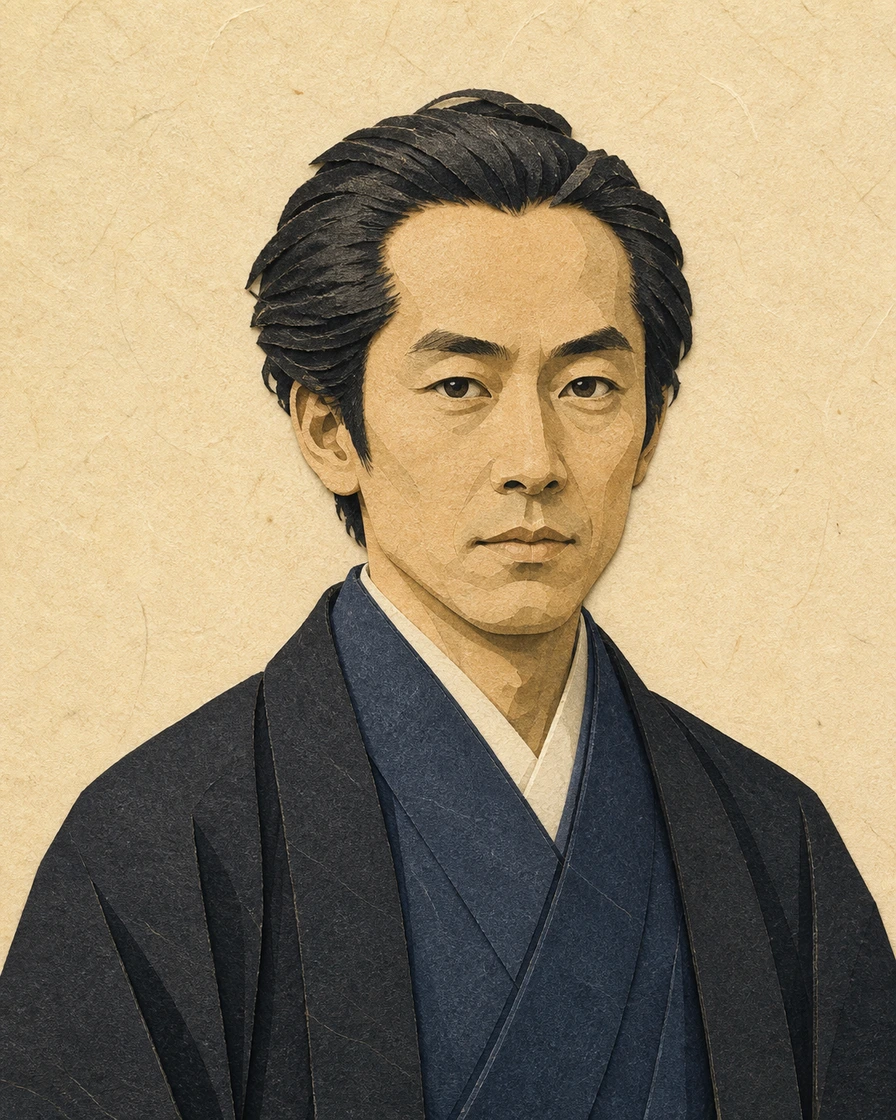
Fukuzawa Yukichi was born on 10 January 1835 at the Nakatsu domain's Osaka storehouse residence. His father, Hyakusuke, served the domain there. After Hyakusuke died, the family returned to Nakatsu.
The Fukuzawa house stood relatively low inside the warrior order. Rank could restrict office and dignity, yet warrior literacy and domain affiliation remained privileges unavailable to most residents.
His mother, siblings, servants, storehouse workers, merchants, carriers, and boat crews belong to the material setting. Osaka's domain warehouse connected rice revenue, credit, transport, and household service.
Later autobiography and commemoration linked Fukuzawa's dislike of hereditary hierarchy to early experience. That is useful retrospective evidence, not a transcript of a boy's mind.
In 1854 Fukuzawa went to Nagasaki to study Dutch. The port was a controlled gateway where interpreters, officials, merchants, physicians, and imported books connected Japanese learners to European knowledge.
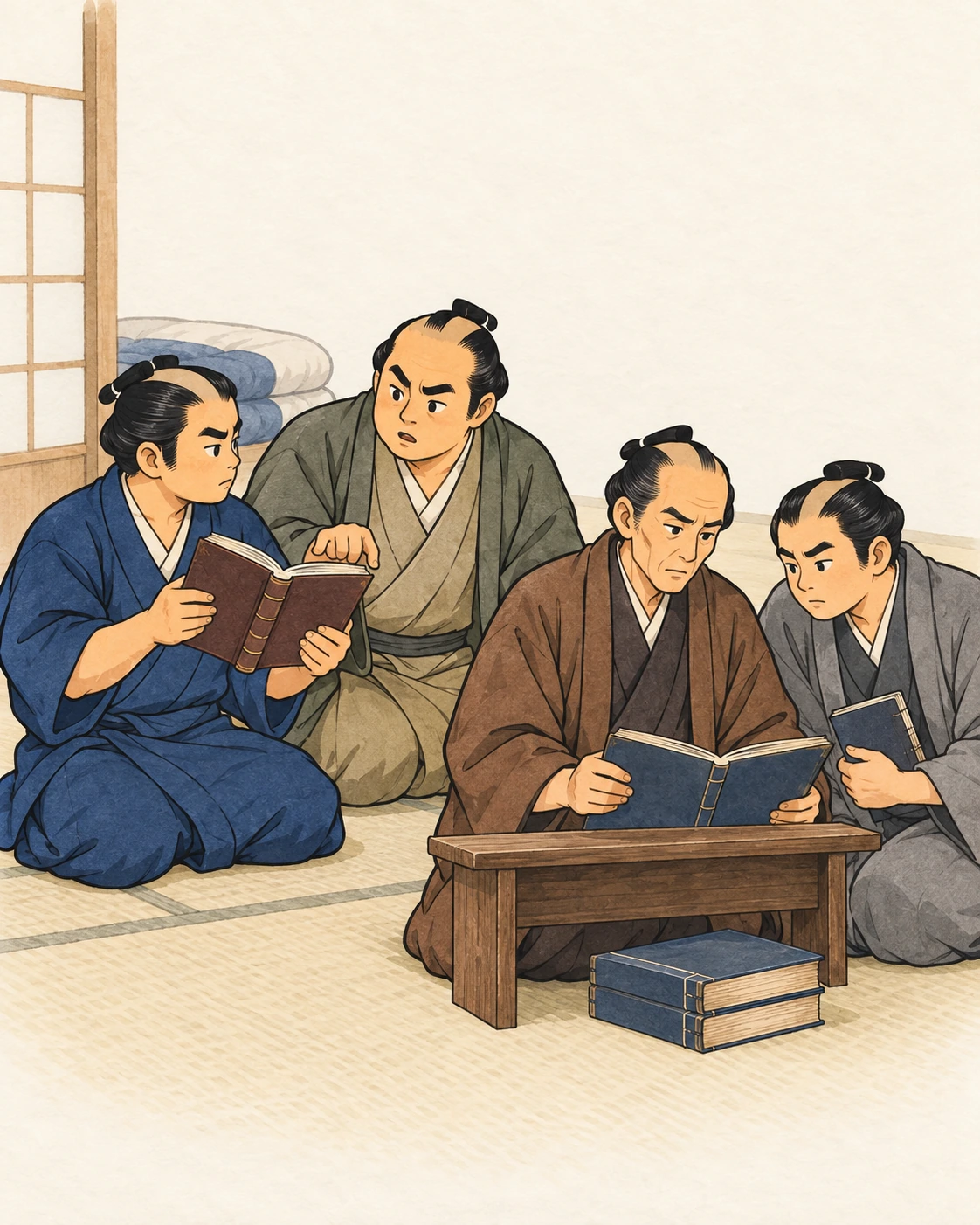
Dutch study required vocabulary, grammar, handwriting, copying, and access to scarce texts. A student depended on teachers, patrons, booksellers, interpreters, and peers. Domain permission and personal rivalry could determine whether he stayed.
The timing mattered. Perry's arrival had intensified demand for foreign information, but Dutch remained useful because generations of translation practice had built Japanese technical vocabulary around it.
Nagasaki did not give Fukuzawa direct, unmediated access to “the West.” It taught him how knowledge moved through controlled institutions—and how access itself created status. He soon sought a stronger learning community in Osaka.
Fukuzawa entered Ogata Kōan's Tekijuku in Osaka in 1855. The school trained students through intensive Dutch reading, medicine, natural knowledge, copying, and peer instruction.
Ogata was central, but his wife Yae, household workers, senior students, patients, book owners, and Osaka suppliers made communal study possible. Students taught one another because no teacher could supervise every line.
Fukuzawa rose to a senior role. That position joined achievement to responsibility: managing study and correcting peers could deepen mastery.
Tekijuku was not a modern university. It issued no standardized degree and joined household, clinic, lodging, and school. Yet its shared discipline made it an effective intellectual infrastructure. It showed Fukuzawa that a private institution could reproduce knowledge beyond one teacher's lifetime.
In 1858 the Nakatsu domain ordered Fukuzawa to Edo to teach Dutch at its Tsukiji Teppōzu residence. The small school had no settled name and initially served a domain-connected educational need.
Its later continuity with Keio is real, but the institution changed. English replaced Dutch as the main language; sites, name, curriculum, teachers, finances, governance, and student population developed across decades.
Fukuzawa brought Tekijuku methods, yet students, colleagues, domain officers, book owners, and household workers made teaching possible. A founder did not create an institution alone.
The 1858 school should therefore be treated as an origin, not today's university in miniature. Its importance lies in a durable learning group that could survive the end of domain government and gradually become a private public institution.
After Yokohama opened, Fukuzawa visited and found that years of Dutch did not let him communicate with many merchants and residents in the new port. English had become the more direct language of trade and diplomacy.
The discovery did not make Dutch useless. It had trained him to learn a European language and had opened technical knowledge. It did reveal that language value follows power, shipping, treaties, publishing, and commercial networks.
Fukuzawa turned toward English through dictionaries, teachers, texts, interpreters, and repeated work. The shift imposed a beginner's dependence on someone already advanced.
Yokohama's multilingual world included Japanese and Chinese merchants, interpreters, sailors, laborers, officials, and several foreign communities. Fukuzawa saw only part of it. The port supplied decisive feedback: scholarship had to change when the institutions using language changed.
In 1860 Fukuzawa crossed the Pacific aboard Kanrin Maru as an attendant to naval official Kimura Yoshitake. The ship accompanied the diplomatic mission but did not carry its principal envoys, who traveled on the United States vessel Powhatan.
Kimura held formal authority; Katsu Kaishū had a central shipboard role; John Brooke and American sailors assisted a Japanese crew affected by difficult seas and illness. Fukuzawa neither commanded the ship nor headed the embassy.
San Francisco exposed him to print, streets, shops, institutions, and social practices. A short official visit gave selected encounters, not complete knowledge of the United States. Slavery, Indigenous dispossession, disenfranchised women, class, and regional conflict limit a simple democracy lesson.
Fukuzawa returned with language materials and observations later used in teaching and writing. Crew, interpreters, hosts, transport, and official access shaped what he could learn.
Fukuzawa joined the 1862 bakufu mission to Europe as a language and information worker. The delegation visited several states, including France, Britain, the Netherlands, Prussia, Russia, and Portugal.
He examined railways, hospitals, schools, armies, parliaments, welfare arrangements, and urban administration. The countries differed in constitutions, religion, class, industry, and government; “the West” did not offer one model.
Official hosts, translators, schedules, documents, and guides selected access. Workers who ran railways and hospitals remained less visible than leaders who explained them.
Fukuzawa became interested in ordinary institutional function: who paid, governed, trained, recorded, and maintained. Learning European systems strengthened a concern for Japanese independence, not simple cultural surrender. Comparison supplied choices but also nineteenth-century rankings that would later distort Asian judgment.
From 1866 Fukuzawa published Conditions in the West and related works explaining foreign institutions in accessible Japanese. The books drew on travel, official materials, foreign publications, language study, and comparison.
In 1867 he traveled to the United States again with a bakufu commission receiving a warship. This was separate from the 1860 voyage and expanded his access to books and information.
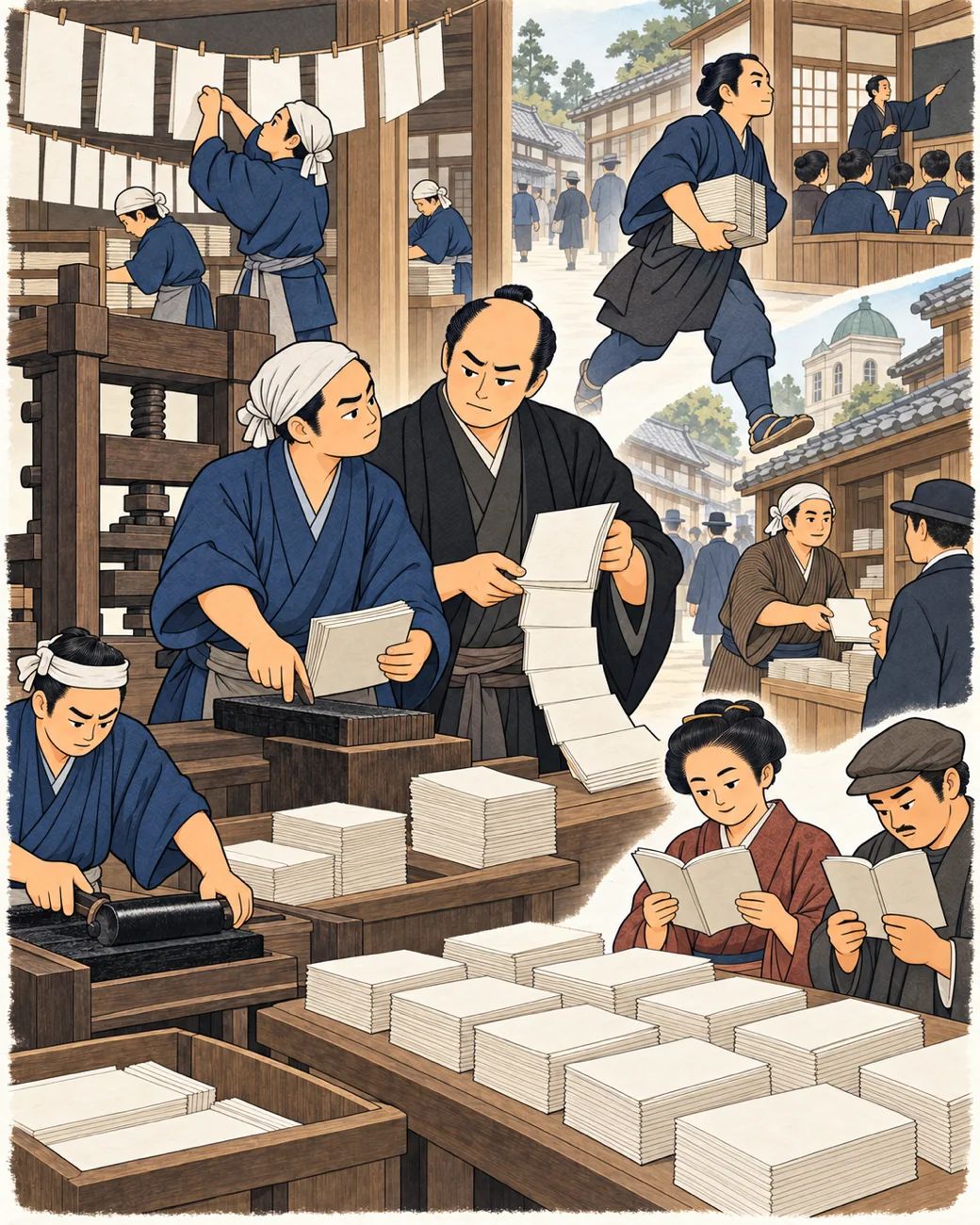
Publishing required colleagues, translators, block cutters or compositors, printers, paper, capital, booksellers, and readers. Accessible prose framed what counted as important; simplification could clarify and distort.
The books reduced dependence on a few returned travelers by making institutional information portable. They also increased Fukuzawa's authority as an interpreter. Knowledge popularization redistributed power without eliminating the author's power to select and rank societies.
In 1868 the school moved to Shiba Shinsenza and adopted the name Keio Gijuku. It moved to Mita in 1871. These stages transformed the 1858 domain school into a larger private institution.
Obata Tokujirō, Koizumi Nobukichi, other teachers, students, administrators, donors, publishers, and families sustained curriculum and finance. Fukuzawa remained the central public figure but not the institution's only worker.
Keio taught languages, economics, history, geography, science, mathematics, and ethics. In 1874 Fukuzawa, Obata, Koizumi, and others organized public-speaking practice.
Autonomy had boundaries. An 1872 report listed all recorded students and staff as male. Tuition, preparation, travel, and class limited entry. A school outside direct state control could widen intellectual organization while reproducing gender and social exclusion.
The first part of An Encouragement of Learning appeared in 1872 and was jointly authored by Fukuzawa and Obata Tokujirō. Its success led to a series of seventeen parts through 1876.
The work rejected natural hereditary superiority and connected practical learning to personal independence. It also connected independent persons to national strength. Equality of standing did not mean equal outcomes without education and effort.
The argument circulated through cheap print, sellers, schools, reading groups, and imitation. Fukuzawa's famous name later obscured Obata and the production network.
Its limits belong beside its force. Meiji society restricted political participation by sex, class, and status; early Keio was male; national independence could become discipline in service of state competition. The celebrated opening is described rather than quoted or closely translated.
Fukuzawa published An Outline of a Theory of Civilization in 1875. Obata Tokujirō reviewed the manuscript and improved its argument, another reminder that a named author's book can contain collaborative intellectual labor.
The work compared social organization, public intelligence, religion, politics, and historical change. Fukuzawa treated civilization as developmental rather than racial destiny and asked how Japan might preserve independence.
Yet nineteenth-century developmental rankings often placed Europe and the United States ahead and turned Asian societies into objects measured by foreign standards. State power, industry, and military capacity could appear as moral advancement.
The book's strength lies in analyzing institutions rather than copying surface customs. Its limit lies in a scale that could make unequal international power look like proof of civilizational worth.
Fukuzawa founded the daily Jiji Shimpō, whose first issue appeared on 1 March 1882. It entered a public sphere shaped by the rights movement, promised 1890 Diet, new parties, censorship, commerce, and expanding literacy.
The paper covered politics, diplomacy, education, business, science, disaster, and daily affairs. Reporters, editors, anonymous writers, compositors, printers, distributors, advertisers, and readers made it an institution.
Fukuzawa wrote and directed much, but attribution requires caution. Most surviving editorial manuscripts are unsigned; some contain several hands. Institutional editorial responsibility is not identical to personal penmanship.
A commercial newspaper could challenge government monopoly over information while depending on sales, advertising, access, and editorial hierarchy. Its claim to independence did not make it neutral. It gave Fukuzawa's circle daily power to frame national and international events.
Fukuzawa and Keio-linked circles engaged Korean reformers including Kim Ok-gyun and Yu Gil-jun. These men pursued Korean projects shaped by their own court, Qing relations, Japanese contacts, and disagreements. They were not Fukuzawa's pupils acting out a Japanese script.
The 1884 Gapsin Coup failed after brief reform control and Qing military intervention. Its violence, elite basis, foreign support, and limited public participation require analysis beyond a simple modernization tragedy.
On 16 March 1885, Jiji Shimpō published an unsigned editorial later called Datsu-A Ron. It has long been attributed to Fukuzawa, but personal authorship and its weight within his thought remain debated.
The later expanded slogan about leaving Asia and entering Europe was not his fixed lifetime motto. Caution over attribution does not erase harsh hierarchy toward Korea and China present across related commentary.
During the Sino-Japanese War, Fukuzawa and Jiji Shimpō supported Japanese national aims and interpreted conflict through civilizational hierarchy. Advocacy for learning and individual independence did not prevent imperial prejudice.
The war occurred in Korea and China and led to Taiwan's transfer without its people's consent. Korean, Qing, and Taiwanese actors cannot be reduced to stages in Japan's progress.
Fukuzawa also criticized male domination in family life and supported women's education. With his wife Kin he raised four sons and five daughters. These positions were significant within Meiji society but remained connected to household roles rather than a complete programme of equal political citizenship.
The contradiction is historical, not a puzzle to remove. A thinker could widen domestic dignity, defend private institutions, and support national coercion abroad. Newspaper organization made those judgments socially consequential.
Fukuzawa suffered serious illness in his final years and died on 3 February 1901. No final thought or deathbed speech is reconstructed.
Kin, their children, Keio teachers and students, Jiji Shimpō staff, publishers, alumni, and readers continued institutions associated with him. Their continuation was not Fukuzawa acting after death.
Early memory emphasized education, independence, plain-language authorship, school, and newspaper. Keio's fiftieth-anniversary culture by 1907 strengthened a founder narrative while colleagues such as Obata and generations of institutional labor could recede.
HO follows reception only through 1912. Later banknote portraits, wartime use, postwar criticism, screen representation, and present national symbolism are excluded. By the boundary, Fukuzawa was already a contested educator and national thinker whose domestic emancipation and Asian hierarchy could not responsibly be separated.
Classic
The Nakatsu domain maintained an Osaka residence because domain rule depended on rice, markets, shipping, accounts, and credit. Fukuzawa's birth there placed his household inside a commercial system even though its legal identity was warrior service.
Hyakusuke's post required literacy and numerical work. His standing was not high, but it gave the family an institutional connection to books and records. “Lower samurai” therefore cannot be translated into “ordinary commoner” without losing real privilege.
After his father's death, the family returned to Nakatsu. Loss could reduce security and narrow a child's future. His mother Jun and older siblings sustained the household; official male biography can make their labor disappear behind the deceased father's influence.
Hereditary rank affected which offices seemed possible, how one addressed superiors, and how much weight learning carried against lineage. A talented lower retainer could experience humiliation from above while remaining above farmers, artisans, and outcast groups in law and custom.
This double position later gave Fukuzawa a powerful subject: independence from inherited subordination. It did not automatically yield universal equality. A person can oppose the barrier that blocks him while noticing other barriers only gradually or incompletely.
Osaka storehouse labor also reveals distributed agency. Domain rice arrived through cultivators and village officials; boat crews and porters moved it; merchants converted it into money and credit; clerks recorded transactions. A warrior employee's education rested on this work.
Fukuzawa's later account of his childhood was composed after decades of public argument. Autobiography selects origins that make a life intelligible. It may faithfully record remembered resentment while organizing scattered experience around the mature author's concerns.
The safest narrative retains both evidence and distance. Early bereavement, low rank, and household learning shaped opportunity. Later Dutch study, travel, teaching, publishing, political conflict, and family experience also formed his ideas.
No child could know the national institutions Fukuzawa would later debate. The bakufu's treaty crisis, Yokohama's English commerce, American and European journeys, Meiji centralization, mass print, and imperial competition had not yet supplied their questions.
Nor did the family rise through individual will alone. Patrons, teachers, domain orders, classmates, printers, readers, and colleagues repeatedly opened routes. “Independence” became an intellectual value through relationships that made independent action possible.
The opening tension is therefore precise. Fukuzawa came from a warrior household whose rank was low enough to expose hierarchy and high enough to grant literacy and domain access. The family suffered loss while receiving support from women and kin whose work public memory often reduces.
His later criticism of inherited status becomes more credible, not less, when it is not treated as prophecy. Thought developed through new problems. The child supplies a social position; the adult must still do the intellectual work.
Nakatsu was not sealed from wider learning. Domain schools, temples, merchants, and travelers moved texts, while access remained graded by family and sex. Fukuzawa's later departure required permission, money, and connections. Mobility was an institutional achievement, not proof that inherited barriers had ceased to matter.
Nagasaki's foreign contact had long been regulated. Trade, residence, interpretation, and movement passed through bakufu offices and hereditary interpreter families. The port opened a channel while carefully limiting it.
Dutch became valuable because books on medicine, astronomy, geography, military technology, and natural knowledge could enter through that channel. Japanese scholars had already spent generations building translation practices. Fukuzawa joined an existing field rather than discovering it.
A beginner faced material barriers. Printed dictionaries were scarce; manuscripts had to be borrowed or copied; unfamiliar alphabet and syntax slowed reading. The ability to see a book did not equal the ability to understand it.
Teachers and advanced students divided sentences, compared meanings, and corrected errors. Interpreters possessed occupational knowledge developed through households and offices. Their labor complicates the idea that a famous learner reached foreign thought without mediation.
Patronage mattered because study cost money and time. Travel, lodging, paper, ink, meals, and books had to be funded. A domain connection could supply access while also imposing obligations and rivalry.
The Perry crisis increased the political value of language. Officials wanted information about weapons, diplomacy, and foreign intentions. Students could convert linguistic skill into employment, but demand also encouraged exaggerated claims and hurried translation.
Dutch was not simply an obsolete language waiting for English. It was a working archive and a bridge to concepts for which Japanese scholarly terms already existed. Later English study would build partly on habits learned through Dutch.
Nagasaki also exposed the inequality of knowledge exchange. Dutch and other Europeans arrived under treaty and trade structures backed by maritime power. Japanese learners selected useful information under pressure from foreign states.
Local actors retained agency. Interpreters negotiated meanings; merchants chose transactions; physicians tested knowledge; officials guarded rules; students pursued careers. “Western knowledge entered Japan” is too passive to describe this work.
Fukuzawa did not remain because one port could not provide everything he needed. Personal relationships and competition affected his position, while Osaka offered Ogata Kōan's larger scholarly community.
The move should not become proof of restless genius alone. Networks have centers and margins. A student can recognize that a different institution offers more books, stronger peers, and a clearer route to mastery.
Nagasaki's lesson was therefore about access as much as language. Knowledge crossed borders through people who controlled texts, permissions, money, and interpretation. Fukuzawa's later mission to make information broadly readable grew from a world where a small number of linguistic intermediaries possessed unusual power.
Foreign learning was politically sensitive. A military or diplomatic translation could attract official attention, and circulation depended on people willing to lend a text. Curiosity operated inside surveillance and domain competition. Later advocacy of open publication challenged an economy in which access could be withdrawn through office or patronage.
Interpreter knowledge was itself cumulative. Families preserved terminology, correspondence practices, and memories of earlier negotiations; visiting students encountered the results without inheriting the whole occupational archive. Fukuzawa's short Nagasaki residence therefore supplied neither complete fluency nor an unfiltered foreign world. It placed him inside a mature Japanese system for controlling, translating, and monetizing contact. Moving onward was a decision between knowledge institutions, not an escape from mediation altogether.
Tekijuku concentrated scarce resources. Ogata Kōan possessed medical experience, Dutch knowledge, books, and reputation. Students traveled because the combination was difficult to find elsewhere.
The institution joined clinic and school. Patients made medicine practical; texts supplied anatomy and theory; observation tested translation. Learning was not separated neatly into today's faculties.
Communal living reduced some costs and intensified work. Students shared rooms, meals, lamps, books, and arguments. Crowding and illness could accompany this arrangement; famous austerity should not be romanticized.
Peer teaching was necessary. Advanced students parsed difficult passages and beginners copied texts. Competition encouraged speed, but correction required cooperation. A mistranslated medical term could have consequences beyond an examination.
Ogata Yae and household labor kept the environment functioning. Food, cleaning, care, accounts, and relations with neighbors rarely occupy the center of intellectual biography, yet scholars cannot study without them.
Osaka's commercial setting mattered. Paper, imported books, instruments, medicine, and credit moved through markets. Merchants were not merely a public awaiting enlightenment; they were part of the infrastructure that supported it.
Fukuzawa's rise to senior student demonstrated mastery recognized inside the community. Leadership was not a modern professorship, and it did not make him co-owner of Ogata's scholarship. It gave practice in organizing learners.
Tekijuku also transmitted an ethic of checking claims against texts and observable results. This did not eliminate error or turn every student into a political liberal. It gave habits useful for comparing institutions later.
The school's limitations are equally important. Access required travel and support; most Japanese people could not enter. Its curriculum was shaped by available Dutch materials. Women performed essential work without ordinary membership in the student hierarchy.
Calling it a university projects later categories backward. It had no national accreditation, modern departments, or degree market. Calling it merely a casual private lesson understates its continuity, rigor, and network.
Students carried its methods into medicine, military work, translation, administration, and education. Their different careers show that an institution produces capacities rather than one ideology.
Fukuzawa later built a school with different subjects and governance, but Tekijuku supplied an institutional example: books become socially powerful when a community can teach new members to use them.
Its deeper lesson concerned independence. Individual judgment required linguistic and factual discipline learned through others. Autonomy was not isolation; it was the ability to test an argument within a network that preserved tools of inquiry.
Clinical responsibility bounded intellectual display. A clever rendering was worthless if it misdescribed a substance or harmed a patient. Practical consequence trained students to separate confidence from verified meaning. Fukuzawa later carried that suspicion toward inherited authority, although political claims could never be tested as cleanly as medical terminology.
Copying also served as examination. A borrowed volume might have to be returned before another student finished it, so accuracy, speed, and legibility became collective obligations. Errors multiplied when copies became sources for further copies. Senior students therefore maintained a small quality-control system: compare passages, expose doubtful words, and leave corrections usable by the next reader. The discipline explains Tekijuku's reach more convincingly than a list of celebrated graduates alone.
Institutional anniversaries need a beginning. The domain order, Edo site, and Fukuzawa's teaching provide a defensible origin in 1858. Continuity of people and organization connects that school to later Keio.
But continuity is not completion. The school operated inside a Nakatsu-domain residence. Its physical space, authority, and initial students depended on a feudal institution that would later disappear.
It did not begin with the name Keio Gijuku. A retrospective label helps modern readers locate the line of descent, but it can make later identity appear present from the first lesson.
The original curriculum centered on Dutch studies. Today's university faculties, degrees, laboratories, and admissions systems did not exist. Even the later shift to English changed what books and teachers were required.
Fukuzawa's role was substantial. He had been recruited because his Tekijuku standing supplied credibility and skill. He selected materials, taught, and connected the Edo group to wider language networks.
Students were not empty recipients. Their questions, progress, fees or support, and subsequent teaching affected survival. Advanced learners could become instructors, making the school less dependent on one person's time.
Domain officials provided permission and space. Book merchants and copyists supplied texts. Servants and household workers sustained rooms and meals. Later accounts that celebrate private independence should remember this public-domain origin.
The school also occupied a changing city. Treaty ports and foreign settlement plans altered land use; political violence affected travel and enrollment. Institutional survival required relocation and negotiation.
An origin story can become a property claim over every later achievement. Keio's future would depend on Obata Tokujirō, Koizumi Nobukichi, teachers, administrators, donors, publishers, students, alumni, and families. Founder status does not absorb them.
The 1858 beginning nevertheless mattered because it established routine. Lessons occurred on schedules; books accumulated; students formed relationships; a reputation attracted more learners. Repetition turned a temporary domain assignment into an organization.
Private education did not initially mean freedom from all authority. The school relied on domain patronage and later operated under national educational regulation. Autonomy was negotiated, funded, and defended.
Its development also had social boundaries. Early access favored men with time, money, sponsorship, and linguistic preparation. The future rhetoric of open practical learning should be compared with who actually entered.
The best description is therefore staged. In 1858 Fukuzawa established a Dutch school within the Nakatsu residence. In later years the community shifted languages, moved, adopted a name, widened curricula, and built more formal divisions. It became Keio through institutional work.
This staging makes the origin more instructive. Modern institutions are not born fully designed. They preserve enough continuity to claim a past while repeatedly changing what that past means.
The domain setting created a future ownership problem: who sustained the school after domain authority vanished? Fukuzawa's answer emerged through colleagues, fees, rules, and a public identity rather than one legal founding instant. Independence required transferring authority from a lord's residence into a continuing association.
That transfer can be measured through ordinary continuities: a returning student, a retained book, a colleague able to teach, and an account that financed the next term. None resembles a dramatic founding ceremony. Together they separate an institution from a temporary appointment. The important 1858 achievement was therefore organizational persistence under fragile conditions, while every later expansion still required its own explanation rather than being credited backward to the first classroom.
Tokugawa foreign learning had developed around Dutch because the regulated Nagasaki relationship made it the most sustained European language channel. Treaty ports altered that geopolitical arrangement.
British and American commercial power increased the everyday usefulness of English. Ships, consuls, merchants, contracts, and imported newspapers made language demand visible. A scholar's prestige could not make a Dutch sentence understood by an English speaker.
The Yokohama experience is often told as a single humiliation followed by heroic self-teaching. The broad transition is strong; exact inner drama comes largely through later narration.
Dutch study remained an asset. It had taught alphabetic literacy, grammar comparison, dictionary use, and tolerance for uncertainty. Some concepts and technical vocabulary were already available through Japanese Dutch scholarship.
English acquisition required material help. Dictionaries had to be obtained; pronunciation needed models; texts required selection; teachers and advanced speakers corrected error. “Self-taught” can describe initiative while hiding infrastructure.
Interpreters at treaty ports occupied a powerful and difficult position. They translated not just words but legal and commercial expectations. Mistakes could affect contracts and diplomacy. Their work made foreign presence operational.
The port was not simply Western. Chinese merchants played important roles; Japanese brokers and officials mediated transactions; sailors and laborers moved goods; residents navigated different currencies and rules. Fukuzawa's linguistic problem was one angle on a larger multilingual economy.
Language hierarchy followed imperial power. English became useful not because it was inherently clearer but because states and firms using it controlled major routes and texts. Choosing English was a rational response to unequal global relations.
That response could widen access to new books while narrowing attention to knowledge produced in dominant languages. Learning the language of power can help a weaker society negotiate; it can also encourage treating that power's categories as universal.
Fukuzawa later made translation and accessible prose central to his public role. Yokohama showed why mediation could not remain a narrow profession: people dependent on a few interpreters had limited ability to judge foreign institutions themselves.
Yet broader language study would still be unequal. Time, tuition, books, and school access favored certain families. Replacing Dutch with English did not democratize knowledge automatically.
The school's shift also required colleagues. Teachers had to learn ahead of students; curricula and book inventories changed; existing Dutch specialists risked loss of status. Institutional adaptation carried human costs and opportunities.
Yokohama therefore represents more than personal flexibility. A world-system change entered the classroom. Fukuzawa's willingness to restart mattered, but merchants, treaties, ships, teachers, dictionaries, and port workers created the evidence to which he responded.
Translation priorities changed with the language. Commercial correspondence, newspapers, political economy, and diplomacy entered beside older Dutch medical and scientific materials. Students did not merely exchange vocabulary; they entered another archive and its imperial assumptions. Curriculum recorded global power moving through a local school.
The transition also tested what could be retained. Dutch-trained readers did not become intellectually empty when English grew dominant; some could compare cognate terms, reuse reference habits, and teach beginners how to approach alphabetic texts. Others faced loss of occupational advantage. A rigorous history treats language change as redistribution among learners and intermediaries, not simply the moment one heroic student chose the future over an obsolete past.
The bakufu mission went to exchange treaty ratifications. Its principal envoys crossed on Powhatan, a United States warship. Kanrin Maru made a related Pacific voyage to San Francisco as an escort and demonstration of Japanese seamanship.
Fukuzawa joined as Kimura Yoshitake's attendant. This gave access without making him a diplomat empowered to negotiate. Kimura, Katsu, officers, interpreters, engineers, sailors, and servants had different duties.
Command terminology is complicated by formal appointment and shipboard function. Reducing the voyage to one famous captain hides Kimura; calling Fukuzawa an envoy inflates observation into state authority.
The crossing tested a crew newly trained in foreign navigation. Weather, seasickness, disease, rigging, engines, charts, food, and watches mattered. John Brooke and American sailors supplied important assistance, preventing a myth of unaided national mastery.
Sailors below celebrated rank made the voyage possible. They handled lines, machinery, cleaning, cooking, and repairs. Attendants supported superiors. Their experiences do not survive equally in public memory.
San Francisco offered striking material differences: urban layout, commercial print, tools, buildings, dress, and organized services. Fukuzawa's eye for ordinary arrangements later helped readers imagine foreign society as a set of institutions rather than wonders.
But official travel selected what could be seen. Hosts arranged visits; language limited conversation; schedules favored public sites; urban encounters did not represent the continent. Visitors could misread practice through ceremony.
The United States in 1860 was approaching civil war. Enslavement remained legal across the South; Indigenous nations faced dispossession; women lacked national voting rights; racial hierarchy shaped citizenship. These conditions prevent “America” from serving as an uncomplicated equality model.
Fukuzawa did not need complete knowledge for the trip to matter. Direct comparison challenged inherited assumptions and supplied books, vocabulary, and questions. Partial observation can be valuable when its partiality remains visible.
Photography, dictionaries, and souvenirs later became memorable, but objects depended on shops, money, makers, and interpreters. They should not replace institutional inquiry with collector anecdotes.
The voyage also altered Japanese knowledge authority. A person who had crossed the Pacific could attract readers and students. Experience became a credential, even when many crew members shared it.
Fukuzawa turned travel into public value through later synthesis. That intellectual labor was his, while the journey remained collective. Distinguishing them permits credit without appropriation.
Kanrin Maru is therefore not a miniature embassy led by future great men. It was one vessel in a diplomatic operation, crewed through international assistance and unequal ranks. Fukuzawa observed from a specific occupational position and returned better equipped to compare institutions.
The crew's achievement and dependence belong together. The crossing proved acquired navigation could operate beyond coastal waters, while Brooke's assistance exposed gaps. Acknowledging help strengthens the voyage as knowledge transfer instead of weakening it into a legend of national self-sufficiency.
The distinction between escort and embassy also changes the evidence Fukuzawa could collect. He observed a shipboard chain of command and a hosted stay in San Francisco, but he did not sit inside every treaty exchange conducted by the principal envoys. His later authority came from interpreting limited access honestly and making comparisons useful. It should not be enlarged by assigning him negotiations, decisions, or nautical responsibility that belonged to other participants.
The mission traveled for bakufu diplomacy and information. Fukuzawa served inside an official hierarchy; he did not choose every destination or interview. His linguistic skill created access while binding him to delegation needs.
European states presented different political structures. Britain combined monarchy and parliament; France had another regime; Prussia's state and army differed; Russia's empire governed vast territories. One label concealed substantial conflict.
Railways drew attention because they joined engineering to timetables, finance, land, stations, maintenance, and law. A train was not merely a machine. It required institutions capable of coordinating strangers repeatedly.
Hospitals likewise joined buildings to medical training, nursing, records, sanitation, budgets, and access. Visitors might see ordered wards without fully understanding who was excluded or how workers were treated.
Parliaments were visible symbols, but procedure mattered more than architecture. Elections, parties, franchise, ministries, and budgets differed. Most European women lacked national votes, and class qualifications or imperial subjects limited representation.
Schools displayed graded curricula and administrative reach. They also reproduced language, religion, class, gender, and state loyalty. “Education” was neither neutral nor identical across borders.
Guides and hosts explained institutions through their own interests. Governments showcased achievements; factories could hide dangerous labor; urban tours missed rural poverty. Translation compressed concepts whose legal meanings did not match Japanese categories.
Fukuzawa's strength was to ask operational questions. A reader in Japan needed to know not only that an institution existed, but how offices, money, and habits kept it working.
Delegates and assistants made separate observations. The mission's later impact cannot be credited to one writer. Diplomats negotiated; interpreters translated; scribes recorded; sailors and transport workers carried them.
Comparison also served national competition. Learning could help Japan revise treaties and resist colonization. Admiration for European capacity therefore reinforced state-building rather than abolishing national interest.
That interest created a later danger. If military and commercial power became the measure of “civilization,” societies under imperial pressure could be blamed for weakness. Comparative analysis could turn hierarchy into apparent science.
In 1862 Fukuzawa did not yet possess his completed theory of civilization. The journey supplied a store of observations and documents later organized through publication and debate.
The trip's value lies in disciplined partiality. Europe became less mysterious and more internally diverse. Yet official access, language, itinerary, and elite attention still bounded knowledge. Fukuzawa could compare institutions without claiming to speak for every person living under them.
The tour also served treaty politics. Bakufu officials sought information while foreign governments assessed Japanese weakness and opportunity. An interpreter's institutional observations were inseparable from negotiation under unequal power. Schools and hospitals inspired admiration while imperial diplomacy threatened Japanese autonomy.
Fiscal questions connected the impressive sites. Railways, armies, schools, and hospitals all required taxation, borrowing, fees, or municipal budgets; without revenue they were displays rather than reproducible systems. Asking who paid also exposed exclusion: a service could appear public while its costs fell unequally or its entrance remained restricted. This attention to maintenance made travel knowledge more transferable, even when the mission lacked time to test official explanations against workers' and residents' experience.
Before mass travel, overseas experience was rare. Official delegates and language specialists could monopolize information. A printed book allowed readers far from ports and ministries to compare claims.
Fukuzawa combined several kinds of evidence. Personal observation supplied concrete detail; official documents supplied structure; foreign books extended beyond visited places; conversations suggested practice. None was sufficient alone.
Travel memory can privilege novelty. Government documents describe formal rules more readily than corruption or exclusion. Foreign authors bring national and class assumptions. Synthesis had to choose among unequal sources.
The 1867 United States journey was his third overseas trip, not a repetition hidden inside the first. He traveled with a commission connected to receiving a warship, gaining another chance to obtain texts and observe commerce.
Publication was collective production. Manuscripts required fair copies; woodblocks or type required skilled labor; paper and ink required supply; booksellers created distribution. Colleagues checked vocabulary and supplied knowledge.
Readers also shaped success. Demand encouraged further editions and topics. A book that ordinary educated readers could use had different influence from a confidential report.
Readable language did not mean access for everyone. Literacy, price, leisure, and schooling still limited audience. Women and poorer households faced distinct barriers. Oral recirculation could widen reach beyond buyers.
Translation created Japanese political vocabulary. A foreign term rarely mapped perfectly onto existing institutions. Choosing a word could imply similarity, hierarchy, or novelty and thereby shape later debate.
Fukuzawa often foregrounded systems that produced national wealth and independence. This made foreign society intelligible as organization rather than costume. It also centered state capacity and competitive survival.
His authorial authority grew because readers could not easily check every source. Popularization opposes expert monopoly while producing a famous new expert. Transparency about sources and uncertainty therefore matters.
The books also entered emerging arguments about publication rights. Reprinting could widen access and deprive authors and publishers of revenue. Fukuzawa's interest in copyright joined intellectual independence to commercial control.
The history concerns what the works did, how they were made, and which limitations they carried—not imitation of their successful style.
By transforming official travel into books, Fukuzawa helped enlarge a public able to discuss schools, parliaments, hospitals, and economies. The public received a framed comparison, not Europe itself. That distinction preserves both the achievement and its power.
Serial publication permitted expansion and correction. Readers could reveal where explanation assumed too much; later volumes could add institutions. Public education differed from a sealed report. “Fukuzawa's West” was a changing series of interventions for changing audiences, not one timeless object.
The sequence from manuscript to edition also fixed some judgments more firmly than travel notes would have. Once cut into blocks, printed, sold, cited, and copied, a simplified comparison could acquire the authority of common knowledge. Revision remained possible, but earlier impressions did not disappear automatically. Popularization therefore demanded two kinds of labor: reducing unfamiliar systems enough for entry and marking where reduction should not be mistaken for a complete description.
The 1868 name marked a new institutional claim. The school no longer appeared merely as a Nakatsu-domain class. “Gijuku” suggested a community maintained by people joined in learning.
Relocation required money, buildings, books, and negotiation. Shiba Shinsenza supplied one stage; the 1871 move to Mita provided a more lasting site. Land is part of intellectual history because rooms determine how many can study.
Fukuzawa's reputation attracted students, but reputation did not teach every class. Obata, Koizumi, and other colleagues prepared lessons, managed learners, translated texts, and preserved routine.
Students paid, studied, taught juniors, and carried the school's name outward. Alumni entered business, journalism, administration, and education. Their later success expanded institutional prestige retrospectively.
Private did not mean untouched by government. Regulations, land, security, and public policy affected operation. Nor did it mean free of markets: tuition, publishing, donations, and employment connected curriculum to economic survival.
Subjects emphasized practical and social knowledge. Economics and political institutions could prepare independent judgment, but they could also train future elites for firms and offices. Education's social effect depended on careers and access.
Public speaking offered a new practice. The 1874 association involved Fukuzawa, Obata, Koizumi, and about a dozen others. A hall, audience, schedule, and rules turned private opinion into accountable performance.
Debate did not create universal public participation. The documented 1872 school report listed hundreds of male students and male staff. Women were not merely few; they were absent from that formal membership record.
Fukuzawa later argued for women's education and criticized aspects of male domination. Those positions should be preserved, but they do not retroactively make early Keio coeducational. Wife Kin and women in associated households supplied labor and family support outside formal teaching lists.
Class also mattered. Students needed prior literacy, travel support, time, and often family resources. Opening enrollment beyond one domain did not eliminate these filters.
Institutional independence could protect criticism from direct ministry control. It could also protect a private leadership's own decisions from public accountability. Autonomy is a relation, not an automatic moral good.
Keio was not yet today's university. The 1890 college division and later legal recognition belonged to subsequent stages. Founder commemoration can make this evolution appear inevitable.
The school's achievement was durable organization. It survived regime change, moved sites, shifted languages, multiplied teachers, and created a public network. Fukuzawa led this process while depending on colleagues and excluded labor.
Keio therefore offers a concrete version of independence: a privately maintained knowledge institution capable of outliving a domain order. Its freedom was significant and incomplete, widening public thought through a community whose actual membership remained structured by gender, money, and preparation.
Public speaking created another authority. Reasoned presentation challenged inherited command, yet access to the platform remained school-controlled. It built an educated elite whose confidence and networks could dominate less-schooled voices even while widening debate.
Financial durability also affected intellectual freedom. Tuition could reduce dependence on one patron while making enrollment depend on family resources; donations could protect expansion while giving wealthy supporters influence. The Mita community did not solve this tension once. It managed it through recurring budgets, teaching assignments, and recruitment. Keio's independence was therefore a maintained institutional practice, vulnerable whenever revenue, regulation, or elite access narrowed the community able to participate.
Bibliography corrects sole authorship immediately. The 1872 first part names Fukuzawa and Obata Tokujirō as joint authors. Later memory attached the series overwhelmingly to Fukuzawa, making collaboration easy to miss.
The first booklet was connected to educational work in Nakatsu. Its audience and practical purpose mattered: abstract claims about standing were joined to reasons ordinary learners should study.
Success produced continuation. Seventeen parts appeared between 1872 and 1876. A series written across years can change emphasis; it should not be flattened into one opening sentence.
The equality argument attacked the assumption that birth alone establishes human worth. Differences visible in society were explained through learning, circumstance, work, and institutions rather than divine hereditary rank.
This was disruptive in a society emerging from formal status orders. Former samurai privilege, commoner subordination, and deference did not vanish with domain abolition. Print gave readers language to contest them.
The argument also emphasized responsibility and self-development. That could empower learners, but it could make structural inequality appear as individual failure. People denied schooling, money, health, or legal standing did not begin from identical conditions.
Personal independence was tied to national independence. A population able to reason and support itself would make Japan less vulnerable to foreign domination. Education thus served both individual dignity and competitive state capacity.
These goals could conflict. A state might demand disciplined sacrifice in the name of independence; an individual might criticize the state. Fukuzawa's work did not permanently solve that tension.
Gender marks a serious boundary. Women performed essential household and educational labor while lacking political rights and ordinary access to Keio's early membership. Fukuzawa's later advocacy for women's learning and fairer family relations mattered, yet remained inside nineteenth-century family assumptions.
Workers and poorer farmers also faced material limits. A booklet could be inexpensive and still require literacy and time. Reading groups, teachers, oral explanation, and borrowed copies widened access beyond individual purchase.
Printers, block cutters, paper suppliers, binders, booksellers, and distributors made the bestseller. Unauthorized reproductions reveal both public appetite and weak control over publishing rights.
Imitation and forgery showed that a successful title became a platform others could appropriate. Fukuzawa's campaign for publication rights joined protection of intellectual labor to ownership and revenue.
The series' accessible style was itself an institutional intervention. Political and moral argument no longer had to remain in elite classical forms. Readers could enter debate without mastering every older scholarly convention.
The responsible assessment holds breadth and boundary together. Fukuzawa and Obata articulated a compelling attack on inherited superiority and a programme of practical learning. They did so within a male-centered, nationalizing society where independence could coexist with exclusion and empire.
The series favored literacy, calculation, economics, and civic judgment over status ornament. That criticism could undervalue literary, religious, artisanal, and local knowledge. “Practical” was a political category shaped by commerce, administration, and an internationally competitive state.
The later parts also prevent an opening-line biography. As the sequence addressed conduct, government, public responsibility, and national affairs, its argument became a curriculum rather than a single maxim. Readers could accept the attack on inherited rank while disputing its prescriptions about effort or nation. Treating all seventeen booklets as one famous sentence removes the very process by which accessible print invited repeated, revisable public reasoning.
Fukuzawa wanted more than a catalogue of railways and parliaments. He asked why institutions develop and how knowledge, habits, government, and material capacity interact.
This comparative ambition was intellectually productive. It prevented clothing or technology from serving as complete explanations. A society's public capacity depended on relationships among people and institutions.
The book was not solitary thought. Fukuzawa acknowledged Obata Tokujirō's careful review and correction. Obata's contribution should remain visible without dissolving Fukuzawa's authorship.
Foreign texts supplied concepts and examples. Translation required selection; Japanese history supplied tests and counterexamples. A theory formed between imported categories and domestic political urgency.
National independence was central. Unequal treaties and imperial expansion made state weakness dangerous. Fukuzawa sought social capacities that would let Japan negotiate without subordination.
This survival problem encouraged ranking. European and American states possessed military, industrial, and diplomatic power. Treating their power as evidence of a higher stage risked turning success into virtue.
The claim that development is historical rather than biological leaves change possible. It can support education and reform rather than fatalism. Yet it still authorizes an observer to place societies on a ladder.
Asian countries then appear as earlier versions of Europe rather than distinct actors with their own debates and institutions. Difference becomes delay. Imperial pressure becomes a test they supposedly failed.
The category of “public intelligence” can widen attention beyond rulers. It can also privilege literate male publics and undervalue oral knowledge, women's work, village governance, or colonized experience.
Religion, custom, and authority receive functional analysis, but comparison can abstract violence. A state called civilized may depend on slavery, colonial extraction, or disenfranchisement.
Japan's own modernization likewise involved conscription, taxation, policing, and empire. Institutional capacity was real; the burdens were not evidence of moral ascent.
Fukuzawa's method encouraged readers to ask how systems work. This remains more rigorous than declaring foreign superiority from spectacle. Historical responsibility requires applying the same skepticism to his criteria.
The book influenced debate because it connected knowledge to national strategy. Readers could see personal learning, political institutions, and international survival as one problem.
That connection later made enlightenment compatible with coercive policy. If national independence is the highest condition for individual development, force against a neighboring society can be justified as security or civilization.
The best reading neither dismisses the work as prejudice nor treats it as neutral science. It is a powerful comparative argument produced inside imperial world inequality. Its questions enlarge analysis; its ladder demands critique.
Fukuzawa treated civilization as collective rather than a ruler's possession. That challenged great-man history. Yet measuring collective intelligence through literacy, state capacity, and wealth let educated elites claim to embody society while marginalized knowledge appeared as delay.
A developmental scale also changes the burden of proof. Once one society is placed “ahead,” its institutions can be presumed explanatory, while societies placed “behind” must defend every difference. Fukuzawa's historical method was strongest when it examined causes and weakest when rank replaced inquiry. The book should therefore be read as both an instrument for institutional questions and an object whose categories reveal the competitive world that produced them.
The first issue appeared amid intense political organization. The 1881 crisis had removed Ōkuma from government; a Diet was promised; Liberal and Progressive parties formed. Newspapers could influence which conflicts readers considered national.
Fukuzawa wanted a platform outside formal party alignment and government office. Institutional independence created room to criticize several sides, but it did not eliminate preference for national strength and order.
A daily paper required regular production. Reporters gathered facts; editors selected and revised; compositors set text; presses ran; distributors moved copies; clerks handled subscriptions; advertisements supplied revenue.
Deadlines changed intellectual work. A book could develop over months; a newspaper judged incomplete events. Correction and uncertainty became daily ethical problems.
Unsigned editorials represented the paper rather than a publicly named individual. This could create a coherent institutional voice and protect contributors. It also makes later personal attribution difficult.
The Fukuzawa Memorial Center notes that many surviving manuscripts lack signatures and some show multiple hands. A famous proprietor's authority can lead editors of collected works to assign texts too confidently.
Fukuzawa undoubtedly wrote many articles and exercised direction. Rejecting automatic attribution does not remove responsibility. A proprietor and intellectual leader bears institutional responsibility for patterns he endorsed even when another writer drafted a sentence.
Editors and disciples also retained agency. They researched, argued, and sometimes developed positions not reducible to their teacher. “Fukuzawa wrote” and “the paper published” must remain separate claims.
The newspaper widened subjects considered public. Business, education, household issues, disasters, and foreign affairs could appear beside cabinet politics. Readers encountered society as interconnected news.
Commercial dependence shaped coverage. Sensation attracted attention; advertisers had interests; access favored officials and elites; urban distribution differed from rural reach. Market publication was not the same as universal public judgment.
Censorship and police law set boundaries. Writers could choose indirect language or anonymous form in response. State repression therefore influenced style as well as content.
Readers interpreted and recirculated articles through conversation and rival papers. They were not passive recipients. Controversy could give an editorial influence far beyond subscribers.
The paper became a vehicle for Fukuzawa's views on empire and Asia, making attribution disputes politically serious. Exact penmanship matters, but a recurring editorial environment matters too.
Jiji Shimpō thus created a new scale of intervention. Fukuzawa moved from occasional book publication to daily framing. The achievement belonged to an organization, and historical accountability must distinguish author, editor, proprietor, institution, and audience.
News networks privileged ministries, merchants, diplomats, and educated correspondents. Telegraph and post accelerated urban information while rural and foreign local voices passed through more intermediaries. Daily publication could look comprehensive while reproducing unequal access.
Attribution should consequently be recorded in layers. A signed manuscript can support personal authorship; an unsigned draft in another hand may support newsroom production; publication under the masthead establishes institutional responsibility; recurring positions may indicate editorial direction without proving who wrote each line. This layered method neither absolves Fukuzawa nor turns every issue into his private speech. It preserves evidence strong enough for criticism without manufacturing certainty that the archive does not provide.
Fukuzawa's Korean engagement began before the famous editorial. Korean reformers traveled, studied, translated, organized, and debated under intense pressure from court factions, Qing influence, Japanese policy, and foreign power.
Kim Ok-gyun sought rapid political change; Yu Gil-jun followed another intellectual and political path. Their contact with Fukuzawa and Keio networks mattered, but “influence” does not transfer ownership of their thought.
Japanese supporters often assumed Korea should repeat Japan's recent transformation. Analogy could generate solidarity and blindness. It made Japanese experience a universal schedule and underestimated Korean institutions and choices.
The Gapsin Coup of December 1884 attempted rapid change through seizure of court power. It lasted only days and collapsed under Qing military intervention. Korean participants and victims bore consequences that Japanese commentary could convert into evidence about civilization.
Calling the coup simply progressive hides its narrow base and violence. Calling it merely foreign conspiracy hides Korean reform agency. Several truths must coexist.
The March 1885 editorial responded within this aftermath. It appeared unsigned in a paper whose editorial production was often collective or institutionally anonymous. Later collections and scholarship attached it to Fukuzawa.
Personal authorship remains disputed because surviving evidence does not yield a simple signed manuscript. The responsible label is an unsigned Jiji Shimpō editorial traditionally attributed to Fukuzawa, not unquestioned recovered personal confession.
Representativeness is separate from authorship. Even if Fukuzawa drafted it, one short editorial does not summarize sixty-six years. Even if another writer drafted it, the paper's leadership and surrounding Fukuzawa commentary still require accountability.
The later phrase commonly expanded as leaving Asia and entering Europe was not his stable slogan. Its repetition after his death shaped national memory more than contemporary citation alone.
Rejecting slogan biography cannot sanitize his thought. Fukuzawa increasingly judged Qing China and Korea through civilizational hierarchy and Japanese security. He supported interventionary reform ideas that denied neighboring peoples equal authority to define change.
Japan itself was not simply “European.” It remained an Asian empire-in-formation borrowing institutions under treaty inequality. The editorial's geography was rhetorical, not a literal departure.
Korean and Chinese responses must not be reduced to failure. Officials, reformers, soldiers, scholars, merchants, farmers, and communities acted under constraints that Japanese observers only partly understood.
Editorial history also shows how institutions create authors. An unsigned text can become a famous man's manifesto because collected works, textbooks, political controversy, and memory need a recognizable name.
The strongest interpretation therefore separates four claims: the date and newspaper are certain; unsigned status is certain; traditional attribution is historically influential; exact penmanship and lifetime representativeness are disputed. Around that uncertainty, Fukuzawa's documented interventionary hierarchy remains open to criticism.
The treaty after the coup made state responsibility concrete through compensation and diplomacy. Qing-Japanese rivalry and Korean sovereignty continued beyond an editorial. Separating those actors prevents Korean political life from becoming an appendix to a Japanese writer's disappointment.
The source problem also has ethical consequences. A disputed byline should never become an excuse to quote an anonymous article as Fukuzawa's private voice, yet institutional anonymity cannot make the article politically ownerless. Researchers must compare manuscripts, publication practice, surrounding editorials, and later collection history. Until that work yields a stronger conclusion, HO preserves both the uncertainty of penmanship and the certainty that Fukuzawa's newspaper circulated the hierarchy.
Independence operated at several scales in Fukuzawa's thought. Individuals should avoid servile dependence; institutions should avoid government domination; Japan should avoid subordination to foreign empires. These goals did not automatically grant equal independence to other states.
By 1894, Korea had become a central object of Japanese and Qing competition. Korean court politics, reform movements, rural rebellion, and foreign pressure created a crisis in which Japan chose war.
Fukuzawa's newspaper supported Japanese aims and used civilization as an explanatory hierarchy. Japan appeared as the more advanced state; Qing China and Korean resistance could be treated as obstacles.
This rhetoric gave war an educational or progressive meaning. It could transform invasion, requisition, occupation, and death into evidence of historical development.
Japanese soldiers and families bore conscription and casualty. That sacrifice does not erase the unequal power imposed on Korean and Chinese communities. Multiple burdens do not cancel one another.
The Shimonoseki settlement transferred Taiwan without Taiwanese consent. Local resistance demonstrated that diplomatic signature was not social acceptance. Taiwanese actors had futures not granted by Japanese victory narratives.
Fukuzawa did not command armies or sign the treaty. His role was public persuasion. Editorial framing helped readers interpret force as legitimate and therefore carried responsibility distinct from state office.
At home, he continued arguments about education, household relations, and women's dignity. His family included wife Kin, four sons, and five daughters. Kin's work and judgment belonged to the household's achievement.
Fukuzawa resisted treating daughters as lesser children and supported women's learning. In a society of male privilege, such positions could alter family practice and public debate.
Yet equality within an educated household did not produce women's national suffrage or ordinary coeducation at early Keio. Family reform could remain paternal and assign different social functions by sex.
The national electorate was itself a tiny tax-qualified male minority. “Individual independence” therefore circulated in a political order where most men and all women lacked national votes.
These limits should not make domestic reform meaningless. Historical change often occurs through partial arguments. They should prevent partial reform from certifying complete liberal identity.
The imperial contradiction was not private hypocrisy alone. Nineteenth-century liberal and civilizational thought often joined rights inside a favored political community to colonial hierarchy outside it. Fukuzawa made a Japanese version of that pattern.
Readers and editors were not forced to accept every claim. Rival papers, Korean and Chinese intellectuals, women activists, and later historians contested the hierarchy. Public argument remained multi-directional.
Fukuzawa's whole-person narrative must preserve both capacities: he helped make education, debate, and family dignity newly discussable; he also helped make Japanese coercion appear civilizational. Independence was powerful precisely because its boundaries mattered.
Refusing government office did not place him outside power. Graduates, businesses, journalists, and officials carried Keio networks into institutions. Influence without appointment could be extensive and less formally accountable. “Private citizen” describes office status, not political insignificance.
War also compressed debate. Reports arrived through military and diplomatic channels, victories accelerated celebration, and censorship limited some criticism. A daily newspaper could convert provisional battlefield information into a moral story before Korean, Chinese, or Taiwanese accounts reached the same readership. The question is not whether Fukuzawa knew every consequence. It is whether his framework encouraged readers to treat Japanese capacity as civilization and other people's resistance as evidence of backwardness.
Medical chronology can establish impairment and death; it cannot recover a final philosophical summary. A neat dying statement would serve biography more than evidence.
Fukuzawa died on 3 February 1901. Death ended his ability to revise an argument, answer a critic, direct a paper, or govern a school. Every later choice belonged to living successors.
Kin and the children experienced family loss and inherited responsibilities. Their work should not be reduced to carrying his legacy. They had relationships and decisions of their own.
Keio's teachers, administrators, students, and alumni maintained classes, finance, buildings, curriculum, and reputation. Institutional continuity demonstrated the success of organization beyond one man.
Jiji Shimpō editors and business staff continued daily publication. Later editorials cannot be attributed to Fukuzawa merely because he founded the paper or trained contributors.
Publishers organized collected texts. Selection, attribution, editing, typography, and marketing shaped what later readers understood as “Fukuzawa.” Unsigned newspaper pieces created special difficulty.
Founder memory favors a coherent message. Education, self-respect, independence, and refusal of office offered useful themes for Keio identity. They could connect students across generations.
Coherence also hides collaboration. Obata's joint authorship and review, faculty labor, Kin's household work, printers, reporters, and readers become supporting characters in a single genius story.
By the 1907 fiftieth-anniversary horizon, institutional commemoration could treat the 1858 domain school as the seed of a mature university. The continuity was real; retrospective inevitability was not.
Political memory also selected. Admirers could emphasize freedom from government. Critics could emphasize harsh views of Korea and China. Neither selection alone represents the full person.
The 1904–05 war and the 1910 annexation of Korea occurred after his death. Fukuzawa did not witness them and cannot be given opinions about their details. His earlier arguments could influence living readers, who remained responsible for how they used them.
Posthumous causation therefore needs discipline. A text may shape later policy without its dead author intending every application. Institutions, states, editors, teachers, and movements mediate influence.
The famous later banknote image lies outside the 1912 historical scope. Importing it would let twentieth-century state selection determine a Meiji biography and would violate the narrative boundary.
What existed by 1912 was already enough: a durable school, newspaper, large printed corpus, family and alumni networks, public admiration, and controversy over Asia. Fukuzawa's status as educator did not erase imperial hierarchy; imperial hierarchy did not erase educational change.
The person ended in 1901. The institutions continued through collective labor, and the debate continued because his most important concepts contained both liberating force and exclusionary boundaries.
Early mourners met different Fukuzawas: teacher, husband, editor, founder, or hierarchical commentator. No ceremony reconciled these relations. Memory is more accurate when it preserves several communities of consequence instead of treating institutional tribute as unanimous national judgment.
The 1912 boundary also prevents later fame from selecting the evidence backward. A twentieth-century portrait, classroom slogan, or state honor may show later reception, but it cannot prove what mourners understood in 1901. Canonical history therefore stops with sources and institutions available before the end of Meiji. Later uses belong to a separate reception layer, where the people choosing and revising Fukuzawa's image become historical actors in their own right.