Read the article below. Interactive reading tools are available when scripts load.
Quick
Fujiwara no Michinaga was born in 966, a son of Fujiwara no Kaneie and Tokihime. He entered the northern Fujiwara house, already powerful through office, land, and marriages connecting daughters to emperors.
He was not its obvious sole future leader. Elder brothers Michitaka and Michikane stood ahead, their children could inherit their networks, and his sister Senshi's position near the throne would later matter.
Household formation involved mothers, nurses, tutors, attendants, estate revenue, and marriage planning. A boy could learn the grammar of rank without knowing which deaths, births, and alliances would reorder it.
Nothing in this privileged but crowded position made his later supremacy inevitable.
Michinaga entered court service in 980. His father's position helped him advance quickly: he entered the senior third rank in 987 and became an acting grand councillor in 991. These were exceptional promotions for a man in his twenties, but his elder brother Michitaka still stood above him and became regent after Kaneie's death.
Michitaka's daughter Teishi entered Emperor Ichijō's household, and his son Korechika acquired a plausible route to family leadership. Senshi, Ichijō's mother and Michinaga's sister, held a different center of influence.
Marriage, residence, office, and client appointment tied these households together while giving each a reason to prefer its own descendants.
By 995 Michinaga held enough rank for a vacancy at the top to matter. He still needed a network capable of surviving inside a family whose existing leader had already placed children near the throne.
In 995 epidemic and serial death transformed the court. Michitaka died; Michikane succeeded to leading authority but died almost immediately. Offices and household expectations that appeared settled became vacant within months.
Senshi supported Michinaga, while Korechika retained rank, Teishi's household connection, and his father's clients. Emperor Ichijō had to choose within a family conflict sharpened by emergency.
Michinaga received the nairan privilege, allowing him to review documents before they reached the emperor, and became minister of the right. In 996 Korechika and his brother Takaie were punished after members of their party shot arrows during a nighttime confrontation involving retired Emperor Kazan. Their fall helped Michinaga become minister of the left.
Disease did not select Michinaga, and the dead did not create a political plan; living actors reorganized power after loss.
Before returning to the sequence of marriages and births, it helps to see how Michinaga's authority actually worked. He became the court's strongest aristocratic figure without normally serving as kanpaku, chief adviser to an adult emperor. His authority worked through the nairan right to review documents, ministerial rank, appointments, the households of Senshi and his daughters, estate income, and clients.
Emperor Ichijō remained a ruler with his own relationships and judgments. Fujiwara no Sanesuke and other officials recorded, cooperated, criticized, or resisted within the same government.
Michinaga's autograph diary preserves calendars, rites, appointments, family events, religion, and administration from inside power. It is a selective working record, not a transparent transcript of every motive.
The later conventional title Midō Kanpakuki should not erase the difference between the diary's name and the offices Michinaga actually held.
Michinaga's daughter Shōshi entered Emperor Ichijō's court in 999 and became chūgū—a title of empress rank—in 1000. Ichijō already had Teishi as an imperial consort of equivalent rank.
The court adjusted titles to sustain two senior consort positions. This served Michinaga's family strategy and weakened the exclusivity of Teishi's household after Korechika's fall.
Shōshi and Teishi each maintained a residence, attendants, cultural life, ritual duties, property relations, and access to the emperor. Those households gave the women roles within a strategy devised by male relatives rather than reducing them to its passive instruments.
Marriage politics aimed toward an imperial son, but fertility, health, affection, household competence, and succession remained uncertain. Institutional innovation created opportunity, not a guaranteed child.
Murasaki Shikibu entered Shōshi's service around 1005–1006, after gaining a reputation as a writer. Her presence strengthened a household already supported by Michinaga's resources and Shōshi's growing authority.
Literature could attract readers, shape prestige, educate a consort, and make a residence socially compelling. It was not merely a campaign message.
Murasaki authored her work. Shōshi and court women read, discussed, copied, circulated, and interpreted texts. Scribes, paper makers, binders, and messengers made literary survival possible.
Michinaga's patronage was consequential, but Murasaki remained the author and Shōshi's women made the household's cultural life together.
In 1007 Michinaga climbed Kinpusen, a major mountain pilgrimage center south of the capital, and deposited copied scripture in a gilt-bronze container. His religious aims included concern that Shōshi had not yet borne a child.
In 1008 Shōshi gave birth to Prince Atsuhira, later Emperor Go-Ichijō. In 1009 she bore Prince Atsunaga, later Emperor Go-Suzaku.
The births transformed Michinaga's political future, but Shōshi bore the bodily danger and became the mother around whom the next generation was organized. Midwives, court women, monks, physicians, nurses, and attendants sustained the event.
A newborn prince was a possibility, not a guaranteed emperor. Survival, recognition, rival heirs, Ichijō's decisions, and later succession politics still stood between birth and throne.
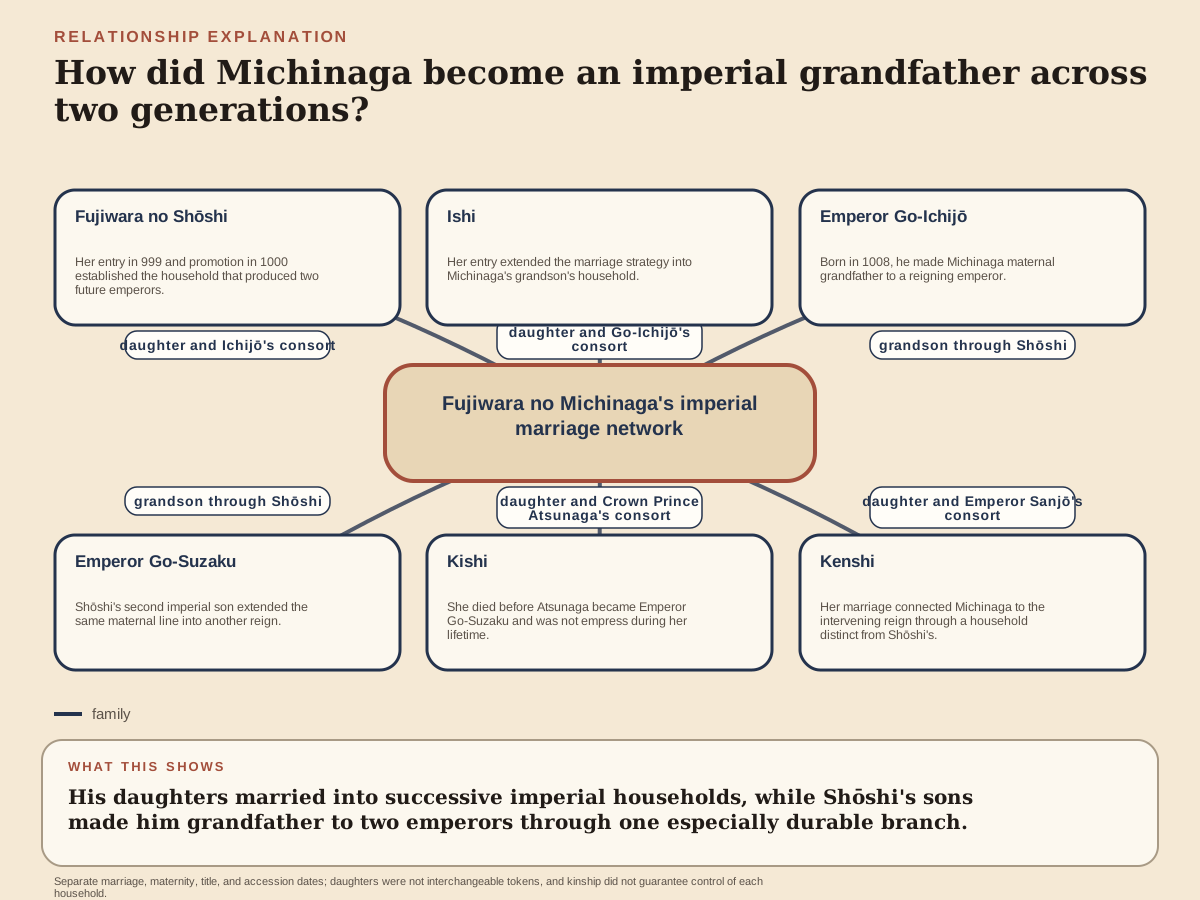
Michinaga placed daughters in the households of successive emperors. Shōshi was connected to Ichijō, Kenshi to Sanjō, and Ishi to the young Go-Ichijō.
Their titles and roles differed across reigns. The later image of three empresses from one father captures unusual marriage density but can falsely make adult women sound like possessions displayed by Michinaga.
The strategy reduced risk by linking his house to several royal transitions. It did not give him sovereignty or eliminate Emperor Sanjō's opposition, each daughter's interests, other consorts, or the uncertainty of children.
By 1018 Ishi's elevation completed an extraordinary pattern. A fourth daughter, Kishi, also entered an imperial household, but she died in 1025 before her husband became Emperor Go-Suzaku. The network was wider—and more fragile—than the familiar image of three simultaneous successes suggests.
At the 1018 celebration of Ishi's elevation, Michinaga composed the poem later associated with a full moon without deficiency.
The poem survives through Fujiwara no Sanesuke's record, not as a passage that can simply be lifted from Michinaga's own diary. The independent witness matters.
The occasion genuinely marked extraordinary success: daughters occupied the highest female ranks around several imperial generations, and Michinaga's grandson reigned.
One ceremonial poem can show public satisfaction and self-presentation. It cannot by itself diagnose permanent arrogance, prove that Michinaga believed power immortal, or turn later change into punishment for a boast. [24]
When the young Go-Ichijō acceded in 1016, Michinaga became regent as the emperor's maternal grandfather. He soon transferred the regency to his son Yorimichi.
Michinaga also briefly held the office of grand minister in 1017. These changes show that the strongest political person did not need to occupy one title continuously.
Regent, kanpaku, and grand minister were not synonyms. They carried different formal relations to a ruler and the court.
Michinaga's central succession problem was now intergenerational: could Yorimichi inherit relationships, documentary access, estates, and trust rather than merely receive an office name?
Around 1019 Michinaga took Buddhist vows. The act belonged to religious preparation, illness, merit, and the reorganization of later life.
Tonsure did not erase his children, estates, clients, residences, or influence. Yorimichi held formal authority, Shōshi remained a powerful imperial mother, and Michinaga continued directing patronage and temple construction.
Elite Buddhist status and worldly power were not mutually exclusive. A vowed aristocrat could transfer some functions while remaining the senior figure of a politically active family.
The records show a change in religious and household status, but do not disclose one private motive for taking vows.
Michinaga began construction of Muryōju-in, later the core of Hōjō-ji, in 1019. The complex grew around a hall with nine images of Amida, the Buddha believed in Pure Land devotion to receive the faithful into his western paradise. Its buildings made that hope materially visible in Kyoto.
The project consumed timber, stone, metal, pigment, textiles, transport, food, land income, and skilled labor. Kyoto records note that stones from the ruined Rajōmon were moved for the work in 1023.
Hōjō-ji displayed religious dedication, family prestige, and the capacity to reorganize urban material. Michinaga supplied patronage and direction; builders, craftspeople, carriers, monks, estate managers, and laborers turned them into a working religious complex during his lifetime.
Michinaga's late Buddhist life did not begin suddenly with illness. His 1007 pilgrimage and scripture deposit had already joined personal devotion to public display. After taking vows, he expanded Amida-centered building and ritual at Hōjō-ji.
These acts pursued religious merit and salvation while sustaining family standing. Scripture, pilgrimage, halls, images, monks, and ceremony gave devotion a material and institutional form.
The conventional year 1052 associated with mappō—the feared decline of Buddhist teaching—came after Michinaga's death. It helps explain later readings of Hōjō-ji, but not a private motive that the evidence cannot recover.
Michinaga died at the calendrical boundary commonly labeled late 1027 in Japanese authorities and early 1028 in converted chronology. The difference reflects dating convention, not two deaths.
Death ended his personal ability to advise, appoint, patronize, write, or arbitrate among descendants. The surviving record does not securely establish a diagnosis or detailed final scene.
Yorimichi inherited the leading regent-house position. Shōshi, Rinshi, other children, grandchildren, clients, monks, and estate managers carried different parts of the family system.
He left a powerful but still personal system. Its continuation depended on his descendants, imperial births, court cooperation, estate administration, and the survival of the institutions he had sponsored.
Yorimichi preserved regent-house power for decades, supported by the relationships Michinaga had concentrated. Shōshi and other family members continued their own political and religious careers.
Hōjō-ji burned in 1058 and was rebuilt under Yorimichi and Morozane before later disasters erased the original complex. Its fate shows both the scale of Michinaga's patronage and the work later generations had to do to preserve it.
The system depended on repeated maternal connection to emperors. When Go-Sanjō acceded in 1068 without a regent-house mother, the family's automatic advantage weakened. Estate policy and later retired-emperor government created further alternatives.
Michinaga's age was a peak, not a modern one-man dictatorship. Emperors, consorts, other nobles, temples, officials, provinces, and estate communities retained agency throughout it.
His autograph diary, other court diaries, literary works and surviving objects make this peak unusually visible, while each source preserves only part of the political world he inhabited.
Classic
Fujiwara no Michinaga was born in 966, a son of Fujiwara no Kaneie and Tokihime. His family belonged to the northern branch of the Fujiwara, whose leaders had accumulated high court office, estates, and marriages with the imperial house. This placed Michinaga close to power from birth. It did not make him the predetermined successor to a single family throne, because no such throne existed.
The household already contained stronger immediate candidates. Michinaga's elder brothers Michitaka and Michikane had seniority and careers of their own, while Michitaka's sons could inherit their father's clients and imperial connections. Michinaga's sister Senshi would also matter: as the mother of Emperor Ichijō, she occupied a place from which access to the sovereign could affect the careers of her brothers and nephews. The phrase “the Fujiwara ruled” conceals these competing households inside the same lineage.
Kaneie's position nevertheless gave his younger son advantages unavailable to almost everyone outside the court aristocracy. Michinaga could be educated for ceremony, literary exchange and administration, introduced to senior officials, and supported by income from family estates. That income linked life in the capital to distant cultivators and estate managers whose production paid for residences, clothing, gifts and ritual. Court rank rested on material support as well as ancestry.
Tokihime and the other women of the household were part of this political formation. Mothers established sibling ties and managed residences; daughters who entered the imperial household could create new centers of patronage and succession. Michinaga's later marriage to Minamoto no Rinshi would add another residence, lineage and group of relationships to his position. These women did not simply carry a plan devised by one man. Their households were among the places where family power was made usable.
Later stories read Michinaga's childhood as preparation for inevitable supremacy. The sequence of his life gives less comfort to that interpretation. The deaths of senior relatives, Emperor Ichijō's decisions, Senshi's support, marriages and the mistakes of rivals would all change the field after Michinaga reached adulthood. Education and family standing prepared him to act when opportunities appeared; they did not allow a child to foresee them.
Michinaga therefore began with privilege and uncertainty at the same time. He stood far ahead of most people in Heian society, but behind several relatives in the contest nearest to him. The next stage of his life is not the rise of “the Fujiwara” as a single unit. It is the story of how one younger son built a position among Fujiwara households that already possessed their own heirs, clients and claims.
Michinaga entered court service in 980. His father's position carried him upward quickly: in 987 he was promoted into the third rank, and in 991 he became gon dainagon, an acting grand councillor. These were exceptional advances for a man still in his twenties, but they did not make him head of the family. His elder brother Michitaka stood above him and, after Kaneie's death in 990, became regent and chief minister.
Michitaka's advantage rested on more than seniority. His daughter Teishi was Emperor Ichijō's consort, and his son Korechika was rising rapidly beside her. Michikane, another elder brother, also had a prior claim. Michinaga therefore spent these years as one well-placed member of a crowded ruling house, not as its obvious heir.
Two women enlarged his own position. His sister Senshi was Ichijō's mother and had direct standing in the imperial household. His wife Minamoto no Rinshi brought a prestigious lineage, a residence, and the children through whom Michinaga would later build imperial marriages of his own. Such households maintained attendants, property, correspondence, ritual, and patronage; they were political bases, not private background.
Office gave Michinaga rank and a place in government. Family ties gave him access that office alone could not supply. Before 995, however, Michitaka's line remained the stronger one. Korechika was not yet a defeated rival, and Michinaga could not know that epidemic disease would remove both of his elder brothers within a few weeks. His achievement in this period was to reach a rank from which an opening could matter.
In 995 epidemic and serial death transformed the court. Michitaka died; Michikane succeeded to leading authority but died almost immediately. Offices and household expectations that appeared settled became vacant within months.
Disease affected bodies across ranks, but the archive gives disproportionate attention to deaths that vacated high office. Michitaka's death removed the leader of a household linked to Teishi and Korechika. It did not erase their network immediately. Michikane's succession appeared to continue brotherly control. His death after an exceptionally brief tenure reopened the question before institutions could stabilize around him. For bereaved households, these were personal losses. For government, they were abrupt changes in document access, appointment authority, residence, and imperial kinship.
Physicians, nurses, monks, onmyō specialists, servants, and burial workers faced the epidemic through different practices and unequal exposure. Michinaga did benefit. Benefit does not establish causation or prove that he foresaw the sequence. He still required support. Senshi's royal-maternal position helped make her brother a plausible holder of responsibilities left open. Calling her a tool would erase a senior woman judging her own household, son, and political future.
Ichijō's choice also mattered. An emperor surrounded by maternal relatives could select among them, even when each option carried pressure. Korechika possessed his father's legacy and his sister Teishi's access. His claim was not irrational or already defeated. The contest involved which documents Michinaga could review, which appointments he influenced, and which rank translated emergency responsibility into lasting precedence. Institutional ambiguity may have served Ichijō by avoiding immediate total commitment. It also prolonged rivalry.
The struggle turned sharply in early 996. Korechika and his brother Takaie went at night against Retired Emperor Kazan after mistaking his visit to a woman's residence for a rival courtship. Members of their party shot arrows; one reportedly struck Kazan's sleeve. The investigation also drew in other charges, including an illicit esoteric rite. Korechika was sent toward Dazaifu as its provisional governor-general and Takaie was demoted to a provincial post. The scandal did not need to have been designed by Michinaga for him to use its consequences.
Teishi remained an imperial consort and cultural patron, but the removal of her brothers weakened the natal household that supported her. Michinaga, meanwhile, gained the nairan privilege in 995, allowing him to inspect documents before they reached the emperor; he became minister of the right that year and minister of the left in 996. A succession crisis had now been converted into offices, documentary access, and precedence.
The epidemic also exposed the biological fragility of marriage politics. A system organized around particular births and lives could change faster than formal planning. This does not make the system irrational. All dynastic orders depend on bodies; early Heian government had fewer impersonal mechanisms to buffer sudden elite loss. Later accounts turn 995 into the year fortune chose Michinaga. The phrase hides the many people for whom the same year meant illness, bereavement, displacement, or fear. Power emerged from that sequence, not from destiny. Michinaga's readiness mattered because an uncontrollable crisis made readiness newly valuable.
The archive's elite focus must also remain visible. Epidemic mortality outside the highest households affected production, service, transport, and local administration, even when names were not recorded. Court vacancy was only one political effect of a broader human disaster whose unequal documentation should not become unequal historical reality.
Michinaga became the court's strongest aristocratic figure without normally serving as kanpaku, the chief adviser to an adult emperor. His authority rested instead on ministerial rank, the nairan right to review documents before imperial inspection, influence over appointments, and the households of his sister and daughters.
Formal titles allocated recognized functions, but early eleventh-century power also depended on controlling movement between institutions. Documentary review let Michinaga see and influence business before or as it reached imperial decision. Information advantage could matter more daily than a grand title. High ministerial rank placed him in appointment, ceremony, precedent, and dispute. Clients expected that proximity to him could change careers. Senshi's status near Ichijō provided another route. Later, daughters' consort households created additional centers joined to Michinaga's residence and resources.
Estate income paid for gifts, rituals, buildings, staff, clothing, and hospitality. Local production became political capacity through managers and transport. Scribes and messengers made access operational. No noble could personally carry every document or monitor every province. Officials such as Sanesuke retained independent standing. Their diaries show a court with observation, criticism, procedural memory, and interests not swallowed by Michinaga. Ichijō also retained agency. Maternal and marital relatives shaped options without automatically dictating every imperial decision.
Michinaga's power was strongest when others anticipated his response. A request could be adjusted before reaching him, making control less visible than a formal veto. This influence required maintenance. Ceremonies, visits, gifts, marriages, conflict mediation, and personnel decisions continually renewed relations. Household staff managed access. Women attendants, clerks, guards, and stewards determined who physically reached a consort or minister. The autograph diary provides extraordinary evidence because Michinaga himself recorded routine and exceptional matters on calendrical sheets.
Corrections, omissions, compressed phrasing, and uneven survival reveal a working document rather than polished memoir. Authorship gives direct proximity but not omniscience. Michinaga did not record every opponent's thought, every worker's burden, or every conversation. The diary also differs from later narrative works that shaped his personality and golden-age image. Each source genre answers different questions. Its conventional title can mislead readers into assuming he was the kanpaku whose diary it must be. Office history requires independent checking.
Michinaga sometimes preferred functional control and family position to an office that might impose expectations or be transferable. Avoiding one permanent title could allow flexible authority across reign stages. It could also make power depend on personal networks that successors had to rebuild. The court was not a modern private company owned by its strongest shareholder. Ministries, ranks, imperial command, religious institutions, and other aristocrats retained defined capacities. Nor was Michinaga merely influential in a vague social sense. Documents, appointments, marriage, estates, and household access supplied concrete mechanisms.
His position was formidable but not equivalent to private ownership of the state. Imperial command, ministerial procedure, religious institutions, and other senior aristocrats retained authority of their own. Fujiwara no Sanesuke, for example, preserved criticism and procedural objections in his diary. Michinaga dominated by making several institutions work together in his favor; he did not abolish them.
Michinaga's daughter Shōshi entered Emperor Ichijō's court in 999 and became chūgū in 1000. Ichijō already had Teishi as an imperial consort of empress rank.
Imperial consorts held rank, residence, attendants, ritual presence, and potential motherhood of heirs. Their households were political institutions. Teishi entered court through Michitaka's family strategy and maintained a cultural world even after her brothers' position weakened. Removing her casually would affect Ichijō, established rank, her children, attendants, and the legitimacy of earlier arrangements. Michinaga wanted Shōshi near the emperor at the highest possible status. A lower place would limit attention, patronage, and the future weight of any child.
The 1000 adjustment used distinct titles to support two empress-level consorts. Legal and ceremonial language made political competition administratively possible. This was not Michinaga owning two women around one emperor. It was a sovereign household reorganized through the interests of several families. Ichijō's personal relations mattered. Later readers often contrast affection for Teishi with political obligation toward Shōshi, but private feeling cannot substitute for full institutional analysis. Shōshi entered very young and developed over decades. Her later authority should not be erased by freezing her as the adolescent daughter introduced by her father.
Rinshi, as Shōshi's mother, helped supply residence, women, materials, and family management. Maternal labor made the consort household credible. Court women served as educators, writers, intermediaries, and managers of access. Their kin connections could strengthen the residence and bring information. Textiles, screens, furnishings, paper, gifts, food, and ceremony required producers whose work displayed household rank. Competition could stimulate cultural patronage, but culture was not only propaganda. Women wrote and read works with meanings beyond Michinaga's immediate succession goal.
The political purpose still mattered. A daughter who bore a future emperor could make her father maternal grandfather and potential regent. Before birth, however, the plan remained exposed to biology. A consort could have daughters, lose pregnancies, die, or have no child. Teishi's own children also affected succession. The later victory of Shōshi's line should not be projected backward into 999. The arrangement changed hierarchy rather than eliminating conflict. Which household received visits, resources, appointments, and symbolic precedence remained contested.
Scribes and ritual officials translated that contest into titles and ceremonies. Small formal distinctions could carry large political consequences. Michinaga's agency lay in mobilizing office and resources to make Shōshi's elevation possible. He did not control every response inside the palace. Shōshi's agency grew through learning, patronage, motherhood, widowhood, and long survival. Her biography intersects Michinaga's without being a subsidiary module. Teishi likewise owns her literary and maternal history. Treating her only as a defeated obstacle reproduces the winner's family tree.
The two-consort system reveals how Heian politics worked: intimate relations became state structure because the identity of future royal mothers shaped government across generations. It also created a durable precedent problem. Once titles had been adjusted to accommodate two senior consorts, later courts could remember the solution when facing new household competition. A maneuver serving Michinaga's immediate interests thus entered institutional memory beyond his control and could be interpreted by people with different family goals.
Murasaki Shikibu entered Shōshi's service around 1005–1006, after gaining a reputation as a writer. Her presence strengthened a household already supported by Michinaga's resources and Shōshi's growing authority.
Writers at court required paper, copying, readers, and a household able to sustain their work. Michinaga's wealth supplied those conditions, and a cultivated circle also strengthened Shōshi's standing with Emperor Ichijō. Murasaki's diary shows the household in operation during the birth celebrations of 1008: attendants worked in shifts, received visitors, and managed ritual and gifts. Political usefulness does not explain every literary choice, and no secure evidence makes Michinaga the sole commissioner of The Tale of Genji.
Murasaki arrived with education, experience, loss, family background, and an already developing authorial identity. Michinaga did not generate those capacities. Shōshi was more than the name over the doorway. She selected attendants, learned, read, managed relations, and matured into a patron with a long independent career. Court women formed audiences for one another. They discussed character, style, behavior, precedent, clothing, religion, and the politics visible through household life. Their reading could reward a writer and also constrain her. Reputation, rivalry, gossip, gendered judgment, and service duties shaped what could circulate.
Scribes and copyists mattered because a text with one material witness remains fragile. Copies made wider reading possible and introduced variation. Paper makers, ink producers, binders, painters, and messengers belonged to literary history even when the author and patron receive the famous names. No secure evidence permits Michinaga to be called sole commissioner of The Tale of Genji. Patronal encouragement and material support are stronger than a modern publishing-contract narrative. Nor should Shōshi's household be treated as a factory organized only to defeat Teishi's memory. Cultural work generated its own value and continued after immediate rivalry changed.
The chronology is also uneven. Parts of Murasaki's writing may precede court service; composition, revision, copying, and circulation did not necessarily occur in one linear block. The diary associated with Murasaki preserves observation of court events and other women but survives through later manuscript transmission. Authorship does not eliminate textual history. Michinaga appears in that record as a living patron and participant, sometimes powerful, ceremonial, intrusive, religious, or socially playful. One writer's portrayal cannot serve as a complete personality diagnosis. It can be compared with his autograph diary and Sanesuke's independent record.
Michinaga did not control every surviving description of his age. The household's cultural prestige supported marriage politics by making Shōshi's court visible, literate, and desirable, yet the work exceeded the patron's plan. Michinaga supplied resources and access; Shōshi shaped the household; Murasaki wrote; other women read and judged; copyists and craftspeople gave the texts material form.
Credit becomes more precise, not smaller. Michinaga helped create a setting in which major literature could thrive, but the literature was made by people who were never extensions of his intention.
In 1007 Michinaga climbed Kinpusen and deposited copied scripture in a gilt-bronze container. His religious aims included concern that Shōshi had not yet borne a child.
Marriage politics seeks a future through another person's body. That fact creates both power and danger. For years after Shōshi entered court, Michinaga could supply rank, literature, rites, and attention but could not produce an heir by command. His 1007 Kinpusen pilgrimage demonstrates religious effort before the result. He copied scripture, commissioned a container, traveled, and deposited the object within a sacred mountain practice. The surviving container and diary corroboration give material depth. Artisans mined, refined, shaped, gilded, inscribed, and transported the object.
Religious intention and political hope were not mutually exclusive. Prayer for Shōshi's child could address family affection, succession, health, merit, and power at once. In 1008 Shōshi entered childbirth surrounded by women attendants, ritual specialists, monks, physicians, and family members. The physical risk was hers. A grandfather-centered account can erase pain, exposure, uncertainty, and the danger faced by mother and infant. The evidence supports roles, ceremonies, records, and outcomes rather than invented bodily interiority.
Murasaki's diary makes the household unusually visible, but it remains one authored and transmitted perspective. Named women within it retain separate lives. Midwives and nurses possessed forms of expertise not captured by high male office. Their work helped turn political expectation into survival. Monks and ritual specialists chanted and performed protection according to contemporary understandings. Modern history need not treat ritual as medical causation to recognize its institutional presence. Atsuhira's birth altered the political calculation because Michinaga could now become maternal grandfather of a possible emperor.
The child still belonged to an imperial household, not to Michinaga as private property. Ichijō, Shōshi, nurses, tutors, and officials would shape his status. Other heirs and consort lines had claims. Mortality made every childhood succession uncertain. Celebrations distributed rank and gifts, announced the household's success, and invited courtiers to recognize a future coalition. Writing and visual culture later preserved these events. Medieval picture scrolls depicting the celebration are later artworks, not eyewitness photographs.
The 1009 birth of Atsunaga reduced family risk by creating another imperial son. It also created a second person with his own future rather than a spare piece in his grandfather's design. Shōshi's authority grew because motherhood altered her position. She was not merely the channel through which Michinaga accessed a grandson. Rinshi became grandmother and senior household organizer. Court women who had served before the birth now belonged to an expanding royal-maternal center. The political result came in 1016 when Atsuhira acceded. Eight years separated birth from throne, and every year required health, education, recognition, and coalition maintenance.
Shōshi owns childbirth and maternal politics; the child owns his life; Michinaga gains a new relationship, not a human possession. The eight-year interval also restores childhood as administration. Nurses, tutors, physicians, guards, ritual officers, and women of Shōshi's residence protected and educated the prince. A political genealogy that jumps from delivery to accession erases the sustained work through which a vulnerable infant became a ruler recognized by the court.
Michinaga placed daughters in the households of successive emperors. Shōshi was connected to Ichijō, Kenshi to Sanjō, and Ishi to the young Go-Ichijō. A fourth daughter, Kishi, entered the household of Crown Prince Atsunaga, the future Emperor Go-Suzaku. She died in 1025, before he came to the throne, so she should not be folded into the convenient claim that Michinaga saw all his daughters become empresses.
One imperial marriage can fail through childlessness, death, lost favor, or an unexpected succession. Multiple ties spread risk across reigns. Shōshi's sons gave Michinaga a powerful maternal-grandfather route. Kenshi's relation to Sanjō addressed the intervening reign and its separate household. Ishi's entry into Go-Ichijō's household extended the pattern into a generation where Michinaga was already the emperor's grandfather. The women did not all hold identical titles at the same moment. Empress, chūgū, empress dowager, and other statuses carried different ritual and household functions.
Compressing them into three empresses loses chronology and institution. It also encourages the language of a father possessing them. Each daughter maintained attendants, property, correspondence, religion, family loyalties, and potential children. Their agency could align with Michinaga without being reducible to obedience. Mothers and maternal kin prepared them for court. Rinshi's role in daughters' households and ceremonial resources must remain visible. Emperors retained agency. Sanjō's relation with Michinaga was marked by disagreement over succession, illness, and the terms of abdication.
Michinaga could pressure through appointments, court attendance, information, and the strength of a waiting successor household. He could not formally declare himself emperor. Other consorts and royal relatives continued to matter. The density of Michinaga's links created advantage, not an empty field. Court women managed access within each residence. A daughter with a high title but weak household service would have less practical influence. Ritual officials translated kinship into rank and ceremony. Titles publicly organized relationships whose private feelings remain only partly recoverable.
The strategy imposed costs on daughters. Their marriages were instruments of family policy and life-defining institutions entered at young ages. Recognizing that constraint does not require inventing either willing enthusiasm or secret resistance for each woman. Children changed the network again. A daughter who became an imperial mother could develop authority extending long after her father's death. Shōshi's exceptionally long career proves the point. Her influence continued through sons, grandchildren, religion, property, and patronage.
The 1018 celebration of Ishi's elevation gave Michinaga reason to perceive completion. Yet the system remained biological and relational. If a later emperor lacked a mother from the dominant line, the entire mechanism would weaken. No number of current titles guaranteed future births. Nor could one family prevent alternative forms of imperial power from developing. Temples, other aristocrats, retired rulers, and provincial resources remained active. The phrase dynastic marriage at its height is therefore accurate only when unpacked. Several daughters, emperors, households, and generations formed the political machine.
Michinaga coordinated and benefited greatly. The machine worked because women lived political lives inside it and because imperial succession still required actors he did not own. This is why the phrase marriage strategy should describe a system without turning it into one man's chessboard. Every marriage joined existing households, created new loyalties, and exposed participants to bodily and ceremonial demands. Strategy shaped entry; lived relationships shaped what the connection later became.
At the 1018 celebration of Ishi's elevation, Michinaga composed the poem later associated with a full moon without deficiency.
Poetry at court was action. It displayed learning, marked occasion, invited response, and made a political relationship memorable. In 1018 Michinaga had unusually strong reason to celebrate. Ishi's elevation joined a pattern already built through Shōshi and Kenshi. His grandson Go-Ichijō occupied the throne. Yorimichi had begun receiving the family machinery. Several generations appeared aligned. The full moon offered an image of completeness intelligible to the audience. It also carried the obvious knowledge that lunar fullness is a phase.
Historical disagreement · A boast of dominion or a celebration of the evening?
The familiar reading makes the full moon a boast that nothing lay beyond Michinaga’s power. Yamamoto Junko rereads the poem through the language of court poetry. In the account of her lecture, “this world” also evokes “this night,” while the moon can evoke his daughters as empresses and the cups passing around the gathering. The emphasis falls on a complete and satisfying occasion rather than a literal claim to own the world. [24]
This interpretation concerns poetic language and the setting of the feast. Neither a boast nor a convivial reading reveals every guest’s private response, and the later decline of the family does not prove that Michinaga secretly foretold it. [24]
Sanesuke recorded the event in his own diary. Its survival gives the celebration a witness outside Michinaga’s control, with distinct judgments and standards. The audience’s public participation remains visible where individual agreement does not.
Poets and musicians supplied cultural form; servers and material workers produced the feast; scribes preserved the record. Ishi should not disappear inside her father's verse. The celebration concerned her rank and imperial household, even if later memory centers Michinaga's expression. Shōshi and Kenshi likewise supplied the kinship structure that made the moment possible. Their lives were not background achievements credited to a father. The poem does provide direct evidence that Michinaga could publicly frame his position as exceptionally complete.
It should not be weakened into meaningless convention merely to avoid a negative judgment. Court convention was the language through which power spoke. But a public utterance is not a full psychological file. Michinaga's diary, religious acts, illnesses, family concerns, and administrative behavior reveal other dimensions. Nor does later Fujiwara decline prove cosmic irony. Political systems change through births, deaths, succession, estates, sovereign strategy, and new institutions. The moon metaphor became famous because later readers knew the peak did not last. That hindsight alters reception.
For contemporaries, the future still contained risk. Go-Ichijō needed to live; daughters' households needed maintenance; Yorimichi needed to govern. The event therefore sits between fact and symbol. The celebration and composition are historical facts; total personality and prophecy are interpretations. Michinaga's satisfaction remains vivid. It becomes historically credible because it is located in one extraordinary night rather than stretched across his entire life. The poem's later textbook fame is itself another event layer. Editors detached it from feast, witness, response, and manuscript context because a brief verse could symbolize an era.
When the young Go-Ichijō acceded in 1016, Michinaga became regent as the emperor's maternal grandfather. He soon transferred the regency to his son Yorimichi.
The 1016 accession fulfilled a long marriage strategy. Go-Ichijō was Michinaga's grandson through Shōshi, making the maternal-grandfather relation institutionally decisive. A young emperor justified regency as a formal mechanism for handling government. Michinaga could occupy that role with unmatched kin standing. Holding it forever would not solve succession inside the Fujiwara house. Yorimichi needed recognized experience before his father's death made transfer urgent. Giving the office to a son while Michinaga remained alive allowed supervision, correction, coalition signaling, and gradual movement of clients.
It also exposed Yorimichi to independent judgment. A successor cannot learn authority if every decision remains invisibly owned by the father. The office of grand minister in 1017 carried supreme rank but did not automatically define daily government. Michinaga's brief tenure illustrates the difference between honor, function, and network. Regent and kanpaku also differ. Regency substitutes for or governs on behalf of a young ruler; kanpaku advises an adult sovereign through a distinct relationship. Using the words interchangeably turns institutional history into a generic prime minister story.
The conventional diary title Midō Kanpakuki adds confusion. It became a familiar label without proving that Michinaga held kanpaku throughout the recorded years. Actual power continued through Shōshi's maternal household, documentary review, appointments, estates, residences, religious patronage, and the expectation that Michinaga could settle disputes. Yorimichi inherited some of these resources by birth and appointment. Others depended on people choosing to redirect loyalty. Sanesuke and senior officials retained expertise that neither father nor son could replace instantly. Institutional continuity required cooperation with men outside their immediate house.
Estate agents and provincial managers supported the material handoff. A regency without revenue and hospitality would be an office lacking its social infrastructure. Women also carried continuity. Shōshi's long authority connected her son, father, brother, and later descendants across changing titles. The transfer could create sibling tension because other sons also had expectations. Family planning had to distribute ranks and careers without producing destructive rivalry. Michinaga's strategy was therefore not retirement. It was controlled duplication: the son acquired office while the father retained enough authority to stabilize him.
This arrangement can look like proof that titles were meaningless. That is too strong. Formal office authenticated action and gave Yorimichi a recognized position. The better conclusion is that office and network multiplied one another. Either alone was weaker than their combination. Later historians call Michinaga the peak of regent-house politics because he connected maternal kinship, formal authority, land, and court culture exceptionally well. He did not create a modern hereditary dictatorship. Imperial command, other nobles, ritual institutions, and the biological future retained space.
The 1016–1018 transfer was successful in the near term. Its limits would appear only across later reigns when the maternal connection could not be reproduced automatically. The handoff also separated retirement from disappearance. Michinaga could let Yorimichi accumulate credit while remaining available as guarantor, a situation that required other officials to judge when consultation became interference. That ambiguity is evidence of transition, not proof that the son's office was empty.
Around 1019 Michinaga took Buddhist vows. The act belonged to religious preparation, illness, merit, and the reorganization of later life.
Modern language often treats ordination as a complete exit from secular identity. Heian aristocratic practice allowed more layered transitions. Tonsure and precepts changed religious status, name, dress, ritual obligation, and the framework through which death was approached. They did not automatically cancel kinship, landholding, residence, or every expectation of advice. Michinaga's sons already held office. His daughters and grandsons occupied imperial relations that no haircut could dissolve.
Shōshi's authority was her own, but her continuing relationship with her father kept information and interests connected. Yorimichi benefited from the appearance of transfer while still operating beside a living family elder whose clients remembered prior patronage. Estate managers continued collecting and litigating. Temple projects required orders, money, land, materials, and supervision. Monks who guided vows became part of an elite household network. Religious specialists could gain patronage while offering ritual expertise and institutional affiliation.
Illness belongs to the context because bodily vulnerability affected timing. It does not authorize a modern diagnosis where evidence is inadequate. Nor does it justify first-person language about symptoms or fear. Religious commitment should not be dismissed as theatrical because political influence continued. People can pursue salvation and family power simultaneously. The opposite reduction is also false. Vows were not merely a cynical costume placed over unchanged politics.
They altered daily practice, patronage priorities, bodily discipline, ritual identity, and the public meaning of late life. Michinaga increasingly directed resources toward Hōjō-ji and Pure Land-centered institutions. These projects converted wealth into both merit and family memory. Conversion never occurred alone. Rinshi, children, monks, attendants, builders, donors, and clients interpreted what the new status required. The household had to decide which audiences Michinaga would still receive and which responsibilities Yorimichi now owned.
Ambiguity could be useful. A retired or vowed elder might influence outcomes without bearing every formal burden. It could also weaken accountability. Officials might not know whether the son's command or the father's preference would prevail. The transition therefore tested the intergenerational system established in 1016. Formal handoff and personal authority had to coexist without becoming rival courts. Michinaga's situation differs from later mature retired-emperor government. He was an aristocratic patriarch, not a former sovereign with a standardized insei apparatus.
His religious identity also differs from complete monastic withdrawal. The category must fit the documented relations rather than an ideal type. The strongest account recognizes sincere, institutionally consequential vows inside continuing power. It neither secularizes religion nor spiritualizes away wealth and kinship. The temporal sequence matters as well. Vows followed the transfer of major office and coincided with new construction, so religious status became part of succession management without being reducible to it. A son could govern while the elder redirected prestige toward salvation, commemoration, and a temple that still strengthened the family name.
Contemporary observers could interpret the same act differently: piety, preparation, withdrawal, display, or family strategy.
Michinaga began construction of Muryōju-in, later the core of Hōjō-ji, in 1019. The complex grew around a nine-Amida hall and other buildings that made Pure Land devotion materially visible in Kyoto.
An office title states rank. A large temple shows how rank could mobilize land, labor, materials, expertise, ritual, and urban space. Construction beginning in 1019 followed Michinaga's vows but should not be reduced to a private retirement chapel. The nine-Amida hall translated Pure Land imagery into architecture. Multiple images and ordered space invited ritual experience beyond a single object. Monks required residence, sustenance, texts, training, and continuing endowment. A dedication ceremony could not maintain the institution for decades.
Architects and master carpenters converted patronal intention into dimensions, joints, roofs, and sequences of work. Timber crews cut and transported material; laborers prepared ground; metalworkers, painters, sculptors, textile workers, and lamp providers filled the structure with ritual capacity. Estate managers redirected income from distant communities. Those communities bore production burdens while rarely appearing in the temple's founder narrative. The movement of Rajōmon stones in 1023 is especially revealing. A decayed symbol of the old southern capital entrance became material for a new aristocratic religious center.
Reuse was practical and political. Michinaga's project could command remnants of public urban monumentality. Transport itself required carts, ropes, animals, road control, workers, and planning. A line in a chronology represents heavy bodily labor. Rinshi, Shōshi, Yorimichi, other family members, and donors contributed to the complex's religious and commemorative life. Calling Hōjō-ji Michinaga's temple identifies patronal initiative without making every element his sole authorship.
The complex embodied family prestige. Visitors could see wealth organized as Buddhist beauty and associate salvation with the household that funded it. Religious sincerity and status display again coexisted. A magnificent hall could be devotional, competitive, commemorative, and economically extractive at once. The 1058 fire ended Michinaga-era fabric after his death. It did not erase the institution immediately. Yorimichi began rebuilding and Morozane continued. Successor labor demonstrates that a founder's program survives through choices by people who can change it.
Repeated disaster and eventual disappearance make authenticity different from Tō-ji or Dazaifu, where major visible institutions remain. The current site marker dates from a much later commemorative project. It points to lost geography rather than reproducing the temple. Absence should not license visual invention. Reconstruction requires documentary and archaeological degrees of certainty. For Michinaga's biography, it shows power moving outward from family and office into an environment meant to outlast his body.
The temple did outlast him institutionally, but not forever or unchanged. Its history belongs to builders, monks, successors, fire, and urban transformation as much as to the named patron. The lost site also imposes an honest visual limit. Plans, textual descriptions, reused materials, and later comparison can support reconstruction at stated confidence levels, but no surviving hall licenses exact color, sound, crowd, or route as if directly observed. Loss remains evidence.
Michinaga's late Buddhist life did not begin suddenly with illness. In 1007 he copied scripture, commissioned an inscribed gilt-bronze container, climbed Kinpusen, and deposited the text.
Fear is plausible in the presence of illness and mortality, but it is analytically too small. Religious practice organized action, institutions, objects, and relationships across decades. The 1007 Kinpusen deposit predates his final years. Michinaga copied scripture and commissioned a container whose inscription records purpose and identity. Autograph diary and surviving object support one another. This rare conjunction limits dependence on later hagiography. The object still depended on metalworkers, engravers, suppliers, guides, carriers, and custodians. Personal copying did not make the entire act solitary.
The difficult pilgrimage placed aristocratic devotion in a mountain environment shaped by religious specialists and routes. Prayer concerning Shōshi's hoped-for child joined family politics to religious merit. The act cannot be sorted into either sincere faith or calculated strategy. Hōjō-ji later expanded this pattern on an urban scale. Amida images, halls, ritual, chanting, light, and architecture gave sensory form to salvation. Monks supplied doctrine and performance. Patrons supplied resources. Artisans made the invisible promise materially apprehensible.
Family members could participate in merit and commemoration while pursuing their own religious aims. Shōshi's later donations demonstrate independent devotion rather than borrowed paternal belief. Estate communities financed part of the magnificence through production and dues, giving salvation architecture an economic geography. Elaborate ritual does not by itself prove either serene confidence or private terror. The surviving record establishes what Michinaga commissioned and did more securely than what he felt at every moment.
Later Pure Land narratives often organize the eleventh century around mappō, the declining age of the Buddhist teaching. The conventional Japanese threshold of 1052 postdates Michinaga. His devotion belonged to existing Amida practice, aristocratic Buddhism, mountain worship, scripture, repentance, merit transfer, and household ritual. Pure Land orientation did not erase other Buddhist relations. Elite patrons could support multiple practices and institutions.
The religious record also complicates the full-moon image. A person who publicly celebrated completion could still invest enormous effort in impermanence and salvation. This does not reveal a hidden true personality that cancels political ambition. Human beings hold power and mortality in the same life. The material sources help prevent psychologizing. A container, copied text, temple, and patronage network document choices even when internal motive remains plural. They also create provenance. Later visitors and museums can study what survives without quoting sacred text or inventing a private prayer.
Michinaga's religious legacy is therefore strongest as practice: resources moved, objects were made, journeys undertaken, monks supported, halls raised, and family memory organized around salvation. Practice also left uneven survivals. The Kinpusen container can be examined materially while chants, gestures, temporary furnishings, and most participants' names are lost.
Michinaga died at the calendrical boundary commonly labeled late 1027 in Japanese authorities and early 1028 in converted chronology. The difference reflects dating convention, not two deaths.
Planned succession reduces disruption but cannot reproduce personal authority exactly. People remember whom they served and reassess loyalty when that person disappears. Yorimichi already held major office and practical experience. This gave the family a stronger transition than a last-minute appointment. He still needed to govern without the elder who could settle disputes, signal preference, and lend prestige to difficult decisions. Shōshi remained a powerful imperial mother with relationships extending beyond her brother's office. Her survival prevented the family from becoming a simple father-to-son institution.
Rinshi and other senior women retained residences, property, religious patronage, and kin connections. Household continuity was gendered and distributed. Other sons could cooperate or compete. Daughters' imperial positions linked the family to separate courts and generations. Estate managers continued revenue and litigation. Monks maintained ritual and Hōjō-ji. Clients sought confirmation from Yorimichi or alternative patrons. Death therefore changed the coordination point. The network remained, but no living actor inherited Michinaga's exact combination of fatherhood, grandfatherhood, experience, and reputation.
The date requires calendrical care. Some Japanese institutional authorities label his life 966–1027, while common converted chronology places death in early 1028. Publishing one date as proof that the other is an error would manufacture a conflict. A concise boundary note preserves both systems. The exact medical cause is less secure than the event. Illness records do not authorize modern retrospective diagnosis without clinical evidence. Terminal ritual has strong later narrative appeal because Pure Land practice emphasizes the last moment. Particular gestures, objects, words, and inner certainty require source-specific support.
A first-person final meditation would imitate religious biography rather than report evidence. Attendants, physicians, monks, and family members who managed the end retain agency. Their roles should not be absorbed into the dead man's plan. The autograph diary stops as a source of continuing observation. Later records belong to other writers with different positions. Hōjō-ji remained physically present, giving the family a ritual center. Its later destruction was not something Michinaga could foresee or interpret.
Yorimichi's long career demonstrates successful transfer. It also reveals that inherited resources cannot guarantee every later imperial mother. Go-Sanjō's eventual accession without a Fujiwara regent-house mother changed structural advantage decades after Michinaga's death. Later retired-emperor government developed another way to coordinate royal authority. It should not be placed inside Michinaga's final intention. Death turns consequence into afterlife without preserving agency. Michinaga remained causal through institutions and relationships already made.
The distinction is essential: a dead founder can have effects, but only living successors decide how those effects are used. Funeral and memorial actions therefore belong to survivors even when they followed plans made earlier. Monks performed, kin attended or directed, workers prepared space, and officials adjusted schedules. A prior instruction can be evidence of living intention; its execution after death remains an event owned by those still able to act. Agency ends at death.
Yorimichi preserved regent-house power for decades, supported by the relationships Michinaga had concentrated. Shōshi and other family members continued their own political and religious careers.
The system solved a specific succession problem by placing Fujiwara daughters near emperors and making their sons central heirs. When a grandson acceded young, the maternal grandfather or uncle possessed a strong claim to regency and education. Yorimichi inherited offices, estates, clients, residences, and the legitimacy of recent success. This allowed long continuity. Shōshi's survival linked imperial generations and gave the family a senior woman whose authority could not be reduced to Yorimichi.
The mechanism remained dependent on births and marriages. A daughter had to enter the right household, bear a son, and see him recognized and survive. No political skill could guarantee that chain every generation. Biological contingency remained constitutional contingency. Go-Sanjō's accession in 1068 exposed the weakness because his maternal relation did not place the regent house in the usual position. He could pursue estate review and sovereign policy with less dependence on the established maternal family.
This did not erase Fujiwara elites. They retained rank, land, culture, marriage, and office while losing a degree of automatic centrality. Later retired emperors developed households and administrative means that offered another center of power. Mature insei was not Michinaga's creation or predicted endpoint. Temples also accumulated wealth and organized force, ritual, learning, and estates. Aristocratic politics never operated in isolation from religious institutions. Estate communities bore the economic underside. Magnificent residences, salons, rituals, and temples relied on production and contested claims across provinces.
Calling the age a dictatorship makes imperial and institutional actors disappear. Calling it mere ceremonial influence understates Michinaga's ability to shape appointments and succession. The useful concept is structural advantage. He connected several systems so effectively that other actors often had to work through relations favorable to him. Culture became part of later golden-age memory. Murasaki, Shōshi's household, diaries, clothing, ritual, and literature were collected under an image of court brilliance. That brilliance was distributed. Women authors and patrons cannot be credited to the regent house as if they were artistic assets.
The autograph diary survived through descendant custody, copying, conservation, cataloguing, and modern recognition. It gives direct evidence and visible correction marks. Other diaries, especially Sanesuke's, prevent a single viewpoint from becoming sovereign. Literary narratives add social and moral interpretation with different evidentiary rules. Hōjō-ji's disappearance warns against equating fame with material survival. A site marker and documents now carry what halls no longer can. Through the Meiji era, scholars, archives, museums, shrine and temple histories, and national narratives continued organizing Michinaga's meaning.
Michinaga's legacy is most rigorous when neither celebrated as omnipotence nor dismissed as luck. He built exceptional advantage from inherited instruments under contingent conditions, and living successors revealed its limits. A peak is a configuration of people, not a single life expanded until it occupies an age.