From Fujiwara Villa to Temple in 1052
Attraction
Fujiwara no Yorimichi converted a villa inherited from his father Michinaga into Byodo-in in 1052. The change linked elite residential landscape to Buddhist patronage at a moment traditionally understood as the beginning of mappo, the declining age of the Dharma. This was not a retreat from politics into private beauty. The regent's family resources, court status and religious hopes shaped a temple capable of representing both salvation and authority. Uji's river, pond and former villa setting matter because Pure Land belief was made spatial. Byodo-in therefore connects the height of Fujiwara marriage politics to the anxiety that worldly order and Buddhist teaching were deteriorating. The same ruling culture that dominated court succession invested in an image of refuge beyond it.
Current visibility
The former villa landscape remains legible through Uji's river, Aji Pond, and the temple setting created after 1052; the visibility claim does not depend on a sculpture group.
Phoenix Hall: An Image of the Pure Land
Attraction
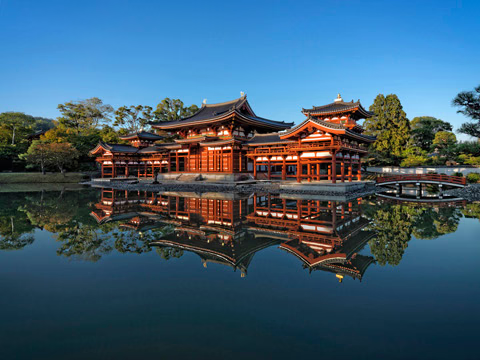
The Amida Hall completed in 1053 is now known as Phoenix Hall. Its central sanctuary, flanking wings and tail corridor extend across an island in Aji Pond, with the building facing east so worshippers approached Amida's western paradise across water. The elegant profile should not obscure function: this is sacred architecture organized around a monumental image by Jocho and an ensemble of worshipping bodhisattvas. Parts of the visible color and roof treatment reflect modern conservation, while the hall preserves exceptional eleventh-century fabric. Interior viewing is controlled and should not be promised without checking current arrangements. From across the pond, read reflection, axial approach and distant hills as a designed religious image rather than merely a famous composition reproduced on a coin.
Current visibility
Phoenix Hall's surviving exterior, central sanctuary, wings, tail corridor, and pond setting can be read from outside; controlled interior viewing must be checked separately.
Hoshokan and the Originals Removed for Protection
Attraction
Hoshokan Museum holds objects removed from vulnerable architectural settings, including the original roof phoenixes, temple bell and many of the cloud-borne bodhisattvas associated with Phoenix Hall. Reproductions now occupy some exterior positions. This division is not a loss of authenticity to conceal; it is the modern conservation history of the ensemble. The museum permits close viewing of casting, carving and surface detail that distance would otherwise hide, while the hall preserves the spatial relationship for which the objects were made. Displays and conservation conditions can change, so interpretation should focus on the transfer between building and museum rather than guarantee every object. Byodo-in survives through both ritual continuity and the deliberate separation of original material from weather and structural risk.
Current visibility
The object or display associated with “Hoshokan and the Originals Removed for Protection” is not guaranteed on every visit to Byōdō-in; check current gallery or special-opening notices, while reading the museum display, the exterior fabric, and the documentary evidence as the stable context.
The 1180 Battle of Uji Inside a Pure Land Landscape
Attraction
Byodo-in also contains a trace of the 1180 Battle of Uji, an opening conflict in the wider Genpei War. Prince Mochihito and Minamoto no Yorimasa opposed Taira power; after defeat, Yorimasa died within the precinct. Ogi-no-shiba and his grave preserve the memorial association, though they do not recreate the battle. This episode prevents the temple from being sealed inside an idealized Fujiwara century. A landscape built to evoke salvation later became a place of armed flight, death and warrior remembrance. The contrast is historically productive: religious sites were embedded in routes, estates and political struggles, not detached from them. Visitors can hold the tranquil pond and the violent event in the same frame without pretending that today's garden appearance reproduces the battlefield of 1180.
Current visibility
“The 1180 Battle of Uji Inside a Pure Land Landscape” can still be read at Byōdō-in through the burial precinct, the memorial, and the pond and water system; the visibility claim concerns that setting, not a past moment preserved intact.