Read the article below. Interactive reading tools are available when scripts load.
Quick
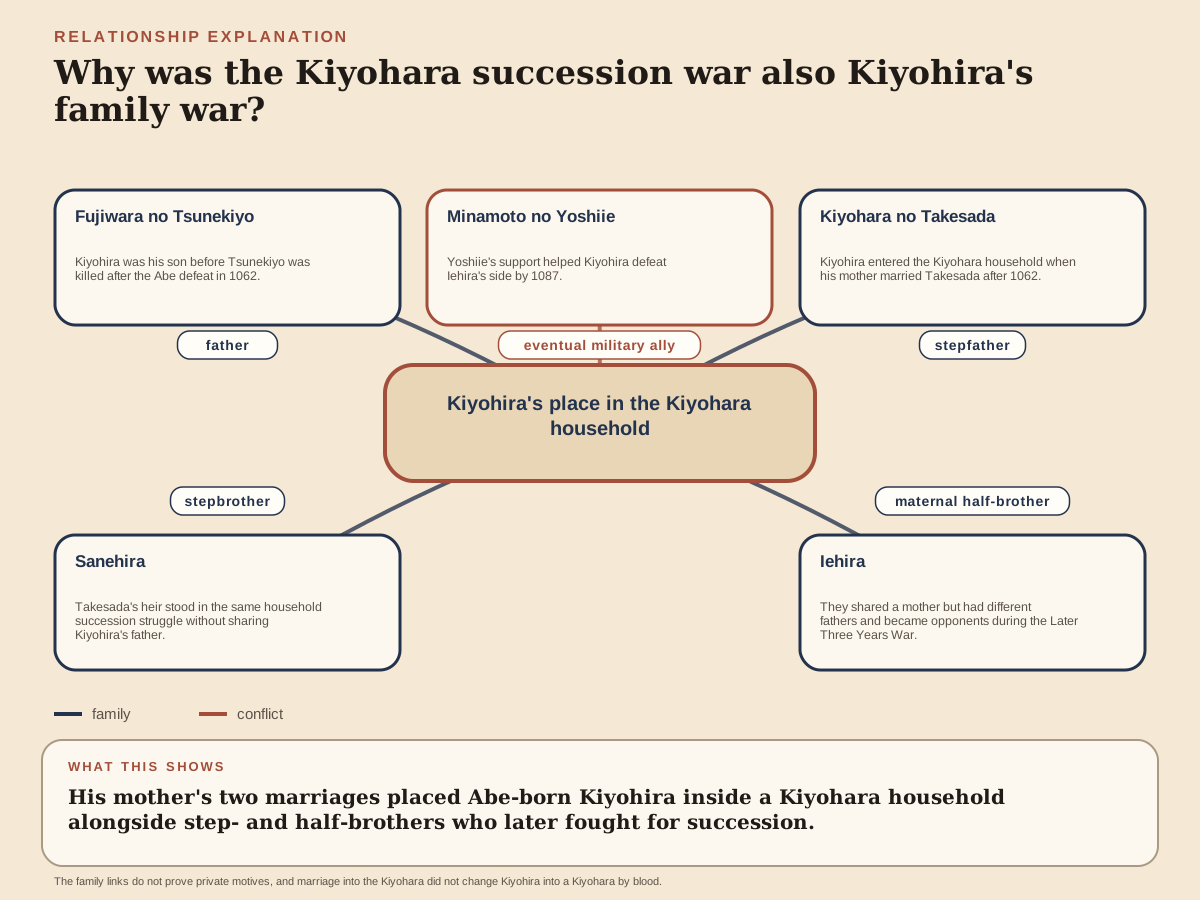
Fujiwara no Kiyohira was born in 1056 in northeastern Japan during the Former Nine Years' War between the Abe family and the provincial governor's forces. His father Tsunekiyo fought beside the Abe; his mother was a daughter of their leader, Yoritoki. After the Abe defeat and Tsunekiyo's execution in 1062, his mother married Kiyohara no Takesada and brought him into the victorious house. The Kiyohara came from Dewa, west of Mutsu, the province covering much of northeastern Honshū, Japan's main island. Kiyohira retained Fujiwara and Abe descent while growing up among the new regional rulers. [1][9]
Takesada's household brought together his older son Sanehira, stepson Kiyohira and Iehira, born of Takesada's marriage to Kiyohira's mother. Disputes over leadership became the Later Three Years' War in 1083. After Sanehira's death, Kiyohira and Iehira remained rivals. Minamoto no Yoshiie, governor of Mutsu, intervened on Kiyohira's side. In 1086 Kiyohira's wife and children were killed amid the fighting. He continued in the winning alliance. His later religious patronage followed a rise achieved through war as well as personal loss. [1][9]
The fall of Kanazawa Stockade in 1087 ended the main war phase. Kiyohira gained the former Abe Six Districts and first governed from Toyota in Esashi. Ōshū City's chronology records his appointment as Mutsu's ōryōshi in 1089, an office associated with policing and military functions. In 1091 he presented two horses to Fujiwara no Morozane, the regent assisting the adult emperor in government from Kyoto. Kiyohira's regional power thus operated alongside provincial offices and court relationships, rather than forming a modern independent country. [1][6]
Kiyohira moved to Hiraizumi around 1095; the local chronology also gives 1099 as an alternative, not a certain latest date. Near the Kitakami River and a north–south route, the settlement connected his household with regional supplies and travel toward Kyoto. Gold made its elite wealth visible, while grain, horses, estate income and exchange sustained daily work. An estate distributed rights to land revenues and protection among managers and patrons. Residences, workshops and temples developed over years; imported ceramics show wider circulation without proving personal control of every trade route. Successors added major monuments later. [1][8]
In 1105 Kiyohira began Chūsonji's great building program, according to local and temple chronologies. Temple tradition assigns an earlier foundation to the monk Ennin; Kiyohira's achievement was the Fujiwara expansion. The opening sanctuary, called Saishōin or Tahōji, drew on the Lotus Sutra, a Buddhist scripture. Clergy shaped worship, while artisans and workers created the structures that his resources supported. The Golden Hall came later, in 1124. A copied canon and repository subsequently extended the patronage beyond buildings. [1]
Around 1117 Kiyohira sponsored a copied Buddhist canon, a collection of scriptures and related religious texts. The scrolls used dark-blue paper with alternating lines of gold and silver script. A surviving volume's 1117 colophon, an inscription recording its copying, and a 1126 appointment draft describing years of work support an extended undertaking. Local chronology dates Chūsonji's sutra repository to 1122. Copyists and clergy made and maintained the collection; later custodians preserved volumes, many of which passed elsewhere. Its endurance depended on work beyond the patron's initial commission. [1][4]
Konjikidō, the Golden Hall, has a ridgepole inscription dating its foundation to 1124 and naming Kiyohira and family patrons. Lacquer, gold leaf and mother-of-pearl inlay required specialist craftspeople. Amida, the Buddha associated with rebirth in the Pure Land, a realm offering release from suffering, stands at its religious center. The hall later housed Kiyohira's remains, those of Motohira and Hidehira, and the head associated with Yasuhira. These successive burials changed its dynastic role after the original commission. Later statue rearrangements also leave some original altar assignments uncertain; not everything visible today belongs to one founding moment. [7][10]
A prayer traditionally linked to Chūsonji's 1126 dedication commemorates war dead beyond the founder's own faction. Its identity is disputed: the traditional Chūsonji reading competes with Nakagawa Shigeo's identification with Mōtsūji, another Hiraizumi temple, and an argument for later fabrication. The original is not preserved; later copies transmit it. Chūsonji continues to present the 1126 attribution, while university research has treated authenticity as an active question. A national scholarly preference is not established here. Its use as evidence of Kiyohira's personal intentions depends on accepting the traditional identification; his documented buildings and manuscripts remain distinct. [2][3][5]
Local chronology records Kiyohira disputing newly established estates with the provincial governor in 1127, without supplying the outcome. The repository appointment of the monk Jizaibō Renkō is dated 1128 in that chronology but 1126 in a transmitted draft; neither securely proves a deathbed instruction. Kiyohira died in 1128, traditionally aged seventy-three, and his remains were placed in Konjikidō. Motohira and Koretsune contested the inheritance in 1129, with further violence around 1130. Motohira continued the dynasty, but its survival should not be mistaken for a smooth succession. [1][4]
Motohira and Hidehira enlarged Hiraizumi after Kiyohira, adding major temples and gardens. The family's political order ended under Yasuhira in 1189. Chūsonji survived, though a 1337 fire destroyed many buildings. Matsuo Bashō's 1689 visit helped frame the place as vanished warrior glory; the Golden Hall gained special protection in 1897. Kiyohira's inclusive commemorator image rests on the dedication prayer's traditional attribution, whose identity remains disputed. His buildings and copied scriptures nevertheless preserve a major patron's achievement, made and maintained by craftspeople, clergy and later generations. [1][2][3][5][7][8]
Classic
Fujiwara no Kiyohira was born in 1056 in northeastern Japan, during the conflict later called the Former Nine Years' War. His father Tsunekiyo was a regional warrior who had married a daughter of Abe no Yoritoki, head of a powerful northern family. The Abe held authority within the imperial administration but resisted the provincial governor's attempts to control them. Tsunekiyo fought on their side. His Fujiwara surname connected him to a prestigious lineage without making his household a branch of Kyoto's ruling aristocracy. [1][9]
The war's conventional name understates its duration: the recognized sequence runs from 1051 to 1062. It concerned authority in Mutsu, the province covering much of northeastern Honshū, Japan's main island. To its west lay Dewa, facing the Sea of Japan. The Kiyohara, a powerful family from Dewa, helped the governor's forces defeat the Abe. In 1062 Tsunekiyo was executed, leaving Kiyohira's mother with a young son and a defeated family's connections. [1]
She subsequently married Kiyohara no Takesada and brought Kiyohira into the victorious house. The child retained his Fujiwara father and Abe maternal descent while growing up under Kiyohara authority. These were overlapping relationships, not successive modern national identities. The northern families had developed through long interaction with court institutions and regional communities; genealogy alone cannot assign Kiyohira a modern ethnic identity. [9]
The household transfer gave him a place among the region's new rulers. It also brought together children with different claims. Takesada's older son Sanehira belonged to an earlier union; Kiyohira entered with his mother; Iehira was born of her marriage to Takesada. Their later struggle would grow within the household that had sheltered Kiyohira after his father's death. [9]
Kiyohira grew to adulthood inside the Kiyohara establishment. He was Tsunekiyo's son and Abe no Yoritoki's maternal grandson, but also Takesada's stepson. That combination supplied relationships through which he could seek followers and territorial claims. It did not make him a permanent outsider incapable of acting within the family. The record says much less about his education or daily upbringing than about the conflict that eventually divided the household. [9]
By 1083 disputes over Kiyohara leadership had become the Later Three Years' War. Sanehira, Kiyohira and Iehira were central rivals; Sanehira's death left the conflict between the two remaining men unresolved. Minamoto no Yoshiie, serving as governor of Mutsu, intervened on Kiyohira's side. His office connected the regional struggle with court authority, while his troops changed the balance between northern contenders. [1]
Kiyohira had interests and followers of his own. Iehira and his ally Kiyohara no Takehira likewise fought to preserve their position. Calling the war Yoshiie's pacification of the north obscures the succession struggle that brought him into it. Control of districts and the people able to mobilize them made this more than a private disagreement among brothers. [1]
In 1086 Kiyohira's wife and children were killed amid the fighting. He lost the household he had formed as an adult, then continued in the alliance that would defeat his rivals. The killing forms part of his earlier experience, but his later religious patronage cannot be traced to this loss alone. Religious commemoration would eventually become central to his reputation, but first he remained a participant in a destructive war. Its final campaign would decide which claimant could turn military survival into regional rule. [1]
Kanazawa Stockade fell in 1087, ending the principal phase of the Later Three Years' War. Kiyohira emerged as the major surviving claimant among its central rivals and gained the former Abe Six Districts. His rise depended on Yoshiie's intervention as well as his own followers and the divisions within the Kiyohara house. The removal of his competitors left him powerful, but did not put every northern district under uniform daily administration. [1]
He first governed from Toyota in Esashi, within Mutsu. The later fame of Hiraizumi can hide these years, as though victory immediately produced a completed Buddhist city. Kiyohira still had to sustain relations with local leaders and the court. His family's strength gave him room to act, while recognized offices supplied a place within the imperial order.
Ōshū City's chronology records his appointment as Mutsu's ōryōshi in 1089, an office associated with policing and military functions. It gave an institutional form to authority established through the war. That relationship continued beyond the province. In 1091 he presented two horses to Fujiwara no Morozane, the regent who assisted the adult emperor in governing from Kyoto. [1][6]
The horses were valuable northern products as well as a gift to a powerful court figure. Their presentation shows a concrete connection between Kiyohira's resources and central elite networks. It does not disclose every private calculation behind the exchange. He could exercise exceptional local power while acknowledging a court patron; distance from Kyoto did not mean political isolation.
Toyota remained his postwar base before the move farther south to Hiraizumi. Office and gift had linked the victor to wider institutions. Relocation would give his household and religious patronage a new center, built over years rather than announced in one act.
Kiyohira moved from Toyota to Hiraizumi near the end of the eleventh century. The local chronology places the move around 1095, with 1099 recorded as an alternative. Hiraizumi lay near the Kitakami River and the north–south route through the Koromo barrier zone, associated with the former Abe frontier. Its position connected the new center with the districts won in war and with travel toward Kyoto. [1]
Relocation was the beginning of an extended investment. A residence and governing personnel required buildings, storage and reliable supplies. River and road access helped bring bulky materials to the settlement. Religious construction would create further demand for specialist work, but Hiraizumi's development also extended beyond temple grounds. [8]
Across these same decades, regional resources sustained the growing center. Gold made its elite wealth conspicuous; grain fed inhabitants and the people working on major projects. Horses linked northern production with military needs and court patronage. Estate income and exchange helped concentrate these different resources in one place. An estate was a holding whose revenues and protective rights could be shared among regional managers, religious institutions and distant aristocratic patrons, rather than simple modern private property.
The visible monuments depended on people outside the ruling household. Cultivators and carriers supplied everyday necessities; craftspeople worked materials that required specialized skills. Excavated imported ceramics reveal wider circulation and elite consumption, although an object found at Hiraizumi cannot establish that Kiyohira personally directed its trade. Nor does the accumulation of wealth at his center prove equal prosperity throughout the surrounding communities. [1]
Residences, workshops and religious institutions developed together. Kiyohira's patronage established the first Fujiwara center, while major temples and gardens associated with his successors came later. The mature Hiraizumi celebrated today grew through those successive contributions, not through a fully realized city present at his arrival. [8]
In 1105, according to local and temple chronologies, Kiyohira began large-scale construction at Chūsonji. The temple preserves a tradition of an earlier foundation by the monk Ennin. Kiyohira's achievement was the great Fujiwara building program, not the first sacred use of an otherwise empty mountain. [1]
Temple records associate the opening phase with a sanctuary called Saishōin or Tahōji. Its worship drew on the Lotus Sutra, a Buddhist scripture whose account of a jeweled treasure tower supplied an image for religious buildings. The exact form of the lost structure is uncertain. What survives most famously today, the Golden Hall, belonged to a later stage of the program and was completed in 1124.
The work brought together patronage and expertise. Kiyohira supplied resources and authority; clergy determined ritual functions, while artisans made structures and objects. Preparing timber or applying lacquer required skills that political command alone could not provide. Workers and the surrounding region supported construction that continued across many years.
A great temple also connected its patron with the Buddhist culture of the court. Worship, care for the dead and protection of the polity could coexist with the public demonstration of regional power. The buildings show the scale of Kiyohira's commitment, without telling us every private intention behind it.
A copied canon and a repository would add another means of sustaining the institution. Scriptures extended the patronage beyond buildings, while their use and preservation required continuing clerical work. The program accumulated through these successive commissions.
Before the Golden Hall was completed, Kiyohira sponsored a major copying project at Chūsonji. The Buddhist canon is a collection of scriptures and related religious texts; individual scriptures are often called sutras. Producing an entire canon demanded far more sustained work than commissioning one ceremonial scroll.
The surviving manuscript tradition provides an unusually tangible connection with this undertaking. A volume of the Flower Garland Sutra has a colophon, an inscription recording the copying, dated to 1117. A Nara National Museum catalogue also cites a repository appointment draft dated 1126 that describes approximately eight years of work. These details anchor an extended project beginning around 1117. [1][4]
The scrolls used dark-blue paper with lines of gold and silver script alternating across the page. Preparing the writing materials and maintaining legible, regular characters required skilled labor. Copyists, paper makers and clergy performed the work that the patron's resources made possible. The use of precious metals made scripture physically valuable while serving religious devotion; its meaning depended on the words and their ritual use as well as their brilliance. [1][4]
Local chronology dates the temple's sutra repository to 1122. Storage brought obligations of custody, access and maintenance. A complete collection could not endure solely through the founder's initial gift; monks and their successors needed the means to preserve and use it. [1][4]
Many surviving volumes later passed into other collections. Their present distribution does not describe an arrangement designed entirely by Kiyohira. The manuscripts nevertheless retain evidence of the work undertaken during his rule, while their survival owes much to later custodians. At Chūsonji, precious materials were becoming scripture and architecture through different kinds of specialist labor. In 1124 that patronage produced the building that would preserve the ruling family's remains.
Konjikidō, the Golden Hall, was completed in 1124. Its ridgepole inscription supplies the date and associates the foundation with Kiyohira and members of his family, including his wife. The compact wooden hall gathers expensive materials and specialized workmanship into a space devoted to Buddhist worship. [10]
Gold leaf covers lacquered surfaces; mother-of-pearl inlay, metal fittings and carved images add detail to the interior. Their combination required craftspeople able to prepare materials and fit them into a durable structure. Kiyohira's patronage made that work possible, but the completed hall also embodies the skills of its makers. [7]
At its religious center stands Amida, the Buddha associated with rebirth in the Pure Land, a realm offering release from suffering. The hall made that hope visible through luminous surfaces and Buddhist images. Its brilliance also displayed the patron's capacity to concentrate regional wealth. Devotion and public authority could inhabit the same building without requiring us to choose only one explanation for it. [7]
After Kiyohira's death, his remains were placed within the hall. Those of Motohira and Hidehira were added later, and the head associated with Yasuhira also came to rest there. These successive interments made the building a dynastic mortuary center across generations. They were decisions made after the original commission, not proof that Kiyohira had controlled every subsequent arrangement. [10]
Even the statues cannot all be assigned confidently to their original positions. National heritage documentation describes later rearrangement and continuing questions about which altar particular images first belonged to. The surviving hall therefore contains different historical layers. Its 1124 foundation is well anchored by the inscription; its later fittings and burials require their own explanations. [10]
The hall became the most recognizable survivor of the Fujiwara building program. Alongside it, a transmitted prayer would give later audiences a powerful account of what the founder's religious undertaking meant.
A dedication prayer traditionally linked to Chūsonji in 1126 has shaped Kiyohira's reputation as a commemorator of the dead on both sides of the northern wars. A dedication prayer explains a religious foundation's purposes and petitions for its benefits. Here, the transmitted text extends Buddhist commemoration beyond the founder's own faction and connects religious patronage with protection of the polity. [2][3][5]
Historical disagreement · What does Kiyohira’s dedication text represent?
Its identity is disputed. The traditional reading identifies the occasion as Chūsonji's dedication. Nakagawa Shigeo proposed that descriptions of buildings, a bridge and a pond fit Mōtsūji, another Hiraizumi temple, instead; the text does not name Chūsonji. Another interpretation regards it as a fabrication of the late Kamakura period, in the early fourteenth century.
These positions affect which institution and historical patron the document can represent, not simply how modern readers judge Kiyohira's character.
The original is not preserved; the surviving versions were transmitted through later copies. Iwate University's 2019 symposium identified authenticity as an active research question. Chūsonji's 2026 exhibition continues to present the 1126 attribution. That is the temple's institutional interpretation, not proof that the dispute has been settled across Japanese scholarship. The competing readings cannot be ranked as a settled Japanese scholarly consensus on this evidence. [2][3][5]
Under the traditional attribution, the prayer gives Kiyohira's religious patronage particular moral complexity. He had lost family members in war, but also fought and gained power through victory. Commemoration beyond faction would address suffering without erasing how his authority had been established. Medieval Buddhist prayer concerned merit and rebirth as well as public order; it was not equivalent to a modern declaration of secular pacifism. [2][3][5]
If the alternative readings are adopted, the document remains important to the history of Hiraizumi's institutions and remembrance, but cannot be used in the same way as direct evidence of Kiyohira's intentions. The buildings and manuscripts establish his patronage independently; the prayer's personal attribution must retain this qualification.
Kiyohira continued to deal with authority beyond Hiraizumi near the end of his life. The municipal chronology records a dispute with the provincial governor in 1127 over newly established estates. The brief entry does not say how the disagreement was resolved. It shows that regional power and provincial administration still met over claims to land and revenue after decades of religious construction.
The temple's continuing operation required its own arrangements. A monk, Jizaibō Renkō, was associated with custody of the sutra repository. Hiraizumi's chronology places his appointment in 1128, while the transmitted appointment draft cited by the Nara museum catalogue bears 1126. That difference matters when the appointment is presented as one of Kiyohira's last acts: neither version securely establishes a deathbed instruction. [1][4]
Kiyohira died in 1128, traditionally aged seventy-three. The cause of his death is not securely established in this account. His remains were placed in Konjikidō, joining the founder's body to a building already central to his patronage. His political and religious institutions survived him, but their continuation depended on heirs and clergy whose decisions were now their own. [1]
In 1129 Motohira and Koretsune contested the inheritance. Further violence followed around 1130. The valuable center had not removed the possibility of another family struggle. Motohira emerged to continue the dynasty, retaining access to Hiraizumi's resources and religious relationships while undertaking patronage beyond his father's achievements. [1]
The copied scriptures and the ruling household thus passed through different forms of succession. Clerical custody could preserve texts while political control remained contested among heirs. Their subsequent survival cannot be read backward as proof that Kiyohira had secured a peaceful transfer. The end of his life separates the founder's actions from the achievements and conflicts of the generations that followed.
After Kiyohira's death, Motohira and then Hidehira enlarged Hiraizumi's political and sacred landscape. Mōtsūji's great development belongs to Motohira; Muryōkōin to Hidehira. The mature center whose wealth has been compared with Kyoto was the product of successive rulers and many makers. Later projects should not be folded into a single founder's achievement. [7][8]
The family's political order ended in 1189 under Yasuhira during Minamoto no Yoritomo's northern campaign. Kiyohira had been dead for more than sixty years. Chūsonji continued as a religious institution, though its relationship with patronage and protection changed. A major fire in 1337 destroyed many halls and treasures. The Golden Hall and surviving manuscripts preserve only part of the earlier complex. [1]
In 1689 Matsuo Bashō, the poet, visited Hiraizumi. His writing made vanished warrior glory central to its literary remembrance. That early-modern response belongs to a different world from Kiyohira's religious commissions. Repair and protection likewise continued through later custodians. In 1897 the Golden Hall was designated a specially protected building, placing its preservation within the new national framework for old shrines and temples. [1]
The founder's peace-making image draws especially on the dedication prayer under its traditional attribution. Its inclusive commemoration is significant in the transmitted text; assigning it personally to Kiyohira remains conditional on the disputed identification. That distinction preserves the value of the tradition without presenting it as an uncontested account of his intentions. [2][3][5]
His securely anchored patronage leaves an important history in its own right: a northern war victor concentrated resources in a regional center, sponsored scriptures and commissioned religious buildings. Craftspeople made those commissions, successors enlarged the landscape and clergy preserved its objects. By the 1912 boundary, much of Kiyohira's world was known through surviving fabric and later remembrance rather than an intact city. [1]