The earlier Former Nine Years War had broken Abe power and elevated the Kiyohara, but victory did not create a stable house. Kiyohira belonged to both defeated Abe and victorious Kiyohara lines. Inheritance and family violence made his identity a political resource and danger.
Conflict within the Kiyohara house drew in Yoshiie after he became governor of Mutsu. Alliances shifted among Kiyohira, Iehira and Takahira. Fighting concentrated around fortified settlements later remembered as Numa Stockade and Kanazawa Stockade, whose exact sites have not been securely identified.
Yoshiie was born in 1039 into the Kawachi branch of the Minamoto, a family of military aristocrats serving the Heian court. He was Yoriyoshi’s eldest son; his mother was a daughter of Taira no Naokata, another warrior official. Such households occupied a middle level of aristocratic society, taking guard posts and provincial appointments while maintaining their own armed followers. Court status and the capacity to bring men into service reinforced one another. Yoriyoshi’s career therefore supplied more than a famous ancestry: it placed Yoshiie within a working connection between officials in Kyoto and armed action in the provinces.
In the conflict later called the Former Nine Years’ War, Yoshiie followed his father into Mutsu, on northern Japan’s Pacific side. The Abe family held strong local positions around the Kitakami basin and resisted the forces sent against it. The war ran from 1051 to 1062, with intervals of accommodation rather than continuous fighting. After Abe no Yoritoki died, his son Sadatō continued the resistance; Yoriyoshi suffered a serious defeat at Kinomi in 1057. Yoshiie fought under his father’s command as their forces confronted a regional power able to sustain resistance over several years.
The decisive shift came when the Kiyohara of Dewa, across the north toward the Japan Sea, joined Yoriyoshi. Their alliance supplied forces the Minamoto had previously lacked. Abe positions fell in 1062, and Sadatō died after the fighting at Kuriyagawa, in the area of present-day Morioka. The Kiyohara emerged with greater regional standing, while the Minamoto received court recognition for their campaign. Yoshiie’s award in 1063 included court rank and the governorship of Dewa. Victory had been converted into advancement through a decision made in Kyoto.
The familiar name Hachiman Tarō was connected in transmitted accounts with Yoshiie’s coming-of-age ceremony at Iwashimizu Hachiman Shrine. The same traditions would surround him with stories of extraordinary courage and generosity, enlarging the reputation acquired in his northern service. His appointment to Dewa followed a shared victory and gave him an office within the region in which the Kiyohara had also advanced. He would spend the following decades moving between provincial responsibilities and the protection of powerful people in the capital. Northern warfare had opened that career; continued employment and patronage would shape its next stages.
Fujiwara no Kiyohira was born in 1056 in northeastern Japan, during the conflict later called the Former Nine Years' War. His father Tsunekiyo was a regional warrior who had married a daughter of Abe no Yoritoki, head of a powerful northern family. The Abe held authority within the imperial administration but resisted the provincial governor's attempts to control them. Tsunekiyo fought on their side. His Fujiwara surname connected him to a prestigious lineage without making his household a branch of Kyoto's ruling aristocracy.
Yoshiie's intervention turned a succession struggle into a prolonged provincial war. The campaigns moved among fortified settlements whose literary fame exceeds archaeological certainty. Kiyohira's survival depended on alliance with the governor after severe losses within his own household.
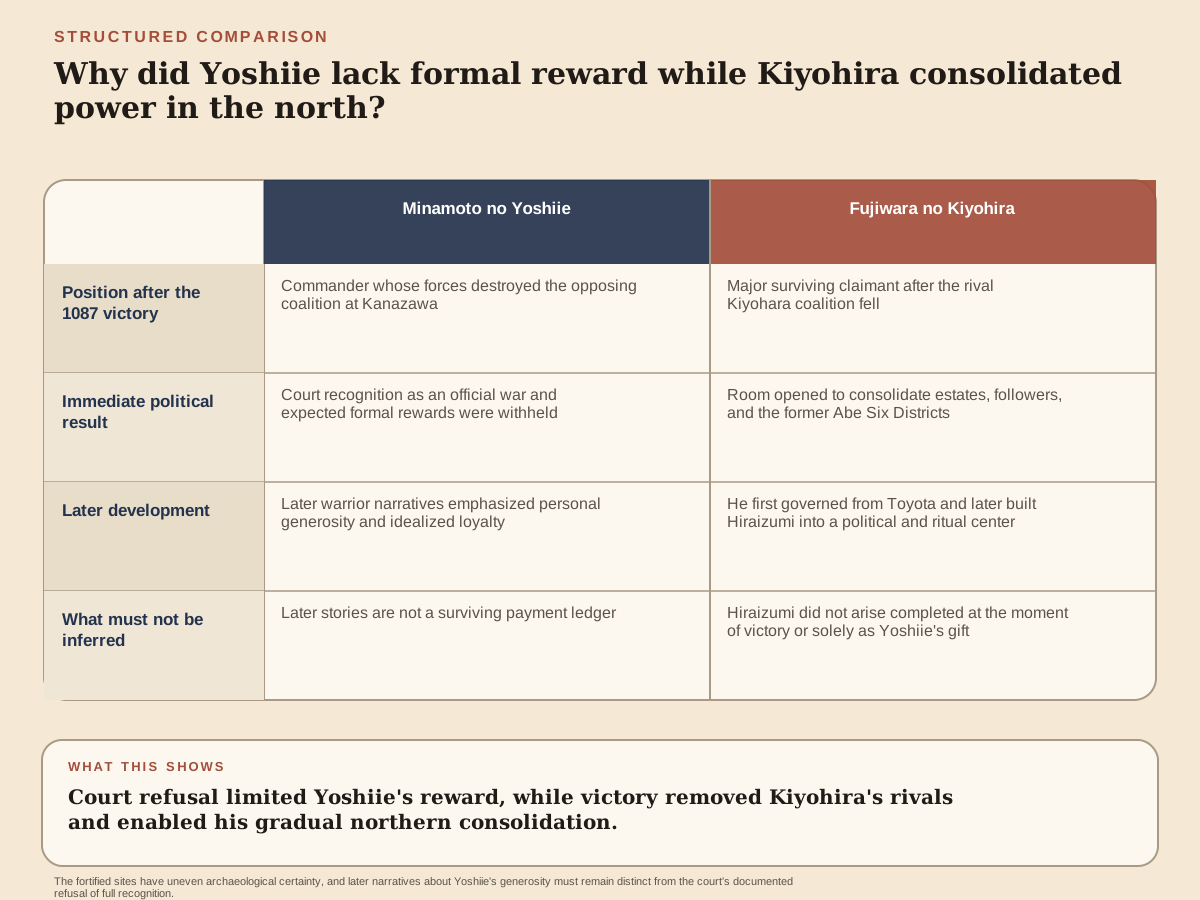
Yoshiie's forces eventually destroyed the opposing coalition at Kanazawa in 1087. The court declined to recognize the campaign fully as an official war and did not provide the rewards Yoshiie expected. Later narratives emphasize his personal generosity to followers, a memory that helped connect the battle to the growth of warrior loyalty.
Kiyohira emerged as the surviving regional leader. He moved his base to Hiraizumi and founded a political and religious center that his descendants expanded. The war's most durable institutional outcome therefore belonged to the northern Fujiwara regime, not only to Yoshiie's reputation.
Yoshiie’s career after 1063 continued through appointments made by the Heian court. Following Dewa, he served in other provinces, including Shimotsuke in eastern Japan, and held guard and police-related posts. A provincial governor served within the court’s territorial administration, exercising authority through an appointment made in Kyoto. His military following could help discharge official duties, while access to appointments depended on relationships in Kyoto. The same man could thus be a provincial official, a protector of an aristocratic household and a commander of his own associates.
The fall of Kanazawa ended the opposing Kiyohara coalition. The court's refusal to treat the fighting as a fully authorized campaign limited formal rewards. Kiyohira, however, gained the room to consolidate estates and followers in the north.
In Kyoto, Yoshiie guarded the Fujiwara regent household and helped maintain urban order. The regents were aristocrats who exercised authority beside the emperor; protection of their household joined military service to a powerful center of patronage. Guarding patrons and enforcing orders kept him engaged in the capital’s political society. In 1079 he was ordered to pursue Minamoto no Shigemune after fighting in Mino. A shared Minamoto name did not prevent one member from enforcing an imperial command against another. The ties that supplied authority for this action crossed the boundaries of the family.
In 1081 Yoshiie went with police officials to Onjōji, a major temple near the capital, to arrest monks. The action belongs to the coercive work through which military aristocrats supported government. An armed household could be called upon when an official order needed men capable of executing it. The arrests carried a government order into a temple through the cooperation of police officials and an armed household. Yoshiie’s standing therefore rested on repeated employment as well as the memory of the Abe war. His connections with court office and aristocratic patrons remained part of the structure of his power.
By 1083 Yoshiie was governor of Mutsu and held the title chinjufu shōgun, a commander associated with the northern military headquarters. That title describes a court military office, distinct from the later position at the head of a shogunal government. The northern provinces were already connected with aristocratic interests in Kyoto through a succession of governors and supervisory officials. Yoshiie entered this field with experience, an armed following and a renowned family name. The Kiyohara, however, possessed regional resources of their own. Their internal division would create opportunities for his intervention without making his official authority unlimited.
Kanazawa Stockade fell in 1087, ending the principal phase of the Later Three Years' War. Kiyohira emerged as the major surviving claimant among its central rivals and gained the former Abe Six Districts. His rise depended on Yoshiie's intervention as well as his own followers and the divisions within the Kiyohara house. The removal of his competitors left him powerful, but did not put every northern district under uniform daily administration.
He first governed from Toyota in Esashi, within Mutsu. The later fame of Hiraizumi can hide these years, as though victory immediately produced a completed Buddhist city. Kiyohira still had to sustain relations with local leaders and the court. His family's strength gave him room to act, while recognized offices supplied a place within the imperial order.
Hiraizumi became the political and ritual center of the Ōshū Fujiwara. Yoshiie's later image as an ideal warrior and Kiyohira's program of memorial construction are related afterlives, but neither should be projected backward as the war's single original purpose.
The war demonstrates the gap between provincial military success and recognition by the court. A governor could mobilize fighters yet fail to have the conflict accepted as public service.
Its aftermath reorganized northern power around Kiyohira and Hiraizumi. Later warrior memory and the material landscape of the Ōshū Fujiwara developed from different parts of the same settlement.
Fujiwara no Kiyohira founded the Hiraizumi polity and temple landscape after generations of northern war. Regional resources, exchange and the political settlement of the Kiyohara conflict allowed him to turn a survivor’s coalition into a dynastic center.
Chūson-ji, the copied canon and Konjikidō expressed a program of Buddhist rule and commemoration, but craftsmen, estates and extracted resources made them possible. His peace-making reputation draws especially on the disputed dedication prayer's traditional attribution; the regional order itself was sustained by power. His successors, not Kiyohira alone, made Hiraizumi a dynasty.