Read the article below. Interactive reading tools are available when scripts load.
Quick
The future Go-Daigo was born Prince Takaharu in 1288, a son of Emperor Go-Uda and Fujiwara Chūshi, later Dantenmon-in. His older half-brother became Emperor Go-Nijō. The imperial house was divided between the Daikakuji and Jimyōin lines, and succession was negotiated among retired emperors, court households, and the Kamakura government rather than passing automatically from father to eldest son. Takaharu was not raised as the uncontested founder of a permanent line. Arrangements made him an eventual candidate while protecting claims belonging to his nephew Prince Kuniyoshi and to the rival branch. [1][2]
Later evidence indicates that his own descendants were not meant to monopolize the throne. This structural insecurity helps explain his adult politics, but it does not give the infant a plan to overthrow Kamakura. His early world was a dense family government in which mothers, retired sovereigns, estates, ritual status, and bakufu (a warrior government headed by a shogun) recognition shaped who could become emperor. [2]
After Go-Nijō died in 1308, Emperor Hanazono of the Jimyōin line reigned and Takaharu became crown prince. Takaharu succeeded him as Go-Daigo in 1318, but his father Go-Uda continued directing court business as a retired sovereign. The succession arrangement also protected Prince Kuniyoshi and the rival Prince Kazuhito, later Kōgon. Go-Daigo cultivated officials and learning while control of the governing household remained with his father. Buddhist rituals, music and calligraphy were part of the court hierarchy through which he could exercise judgment and reward service. [2][3][9][15]
In 1321 Go-Uda transferred governing authority to Go-Daigo with Kamakura's approval. The change ended this phase of cloistered direction and allowed the reigning emperor to organize officials and decisions around his own household. It was a lawful institutional handover before it became an anti-bakufu revolution. Direct rule did not give Go-Daigo a modern centralized state. Court revenue was divided among estates and offices; temples, aristocratic houses, provincial governors, warriors, and Kamakura possessed overlapping jurisdictions. Every appointment or land judgment still required documents, clerks, messengers, compliance, and enforcement. [2][9]
Go-Daigo strengthened government around his household and sought a greater place for his descendants within the succession settlement. His learning and religious patronage supported an active model of kingship. Whether these early changes already formed a plan to overthrow Kamakura remains uncertain; the lawful transfer of authority in 1321 does not itself establish that intention. [2]
In 1324, soon after Go-Uda's death, Kamakura authorities uncovered what they treated as an anti-bakufu conspiracy. Courtiers Hino Suketomo and Hino Toshimoto were investigated. Suketomo was eventually exiled to Sado; Toshimoto was released at this stage. Go-Daigo denied involvement and remained on the throne. The incident is often presented as his first failed overthrow attempt, but the evidence for his precise authorization, timing, and intended operation is not uniform. Government records, court accounts, confessions produced under pressure, and the later war tale Taiheiki do not answer the same questions. [2][8][9]
Kamakura punished an opposition circle without removing the emperor. Go-Daigo retained his household and appointment powers, although his associates faced exile or scrutiny. The incident damaged the network through which he worked but left resources for rebuilding it.
Go-Daigo did not retreat from ambitious politics after 1324. He strengthened a court centered on his officials, religious allies and children born to his consort Ano Renshi during these years. Prince Kuniyoshi's death in 1326 changed the Daikakuji succession field, while the rival Prince Kazuhito remained available to the Jimyōin line. Go-Daigo's son Prince Moriyoshi gained experience within major temple networks; clerics including Monkan and Enkan connected ritual authority to court patronage. Hino Toshimoto again became associated with opposition. Later narratives describe secret journeys, warrior recruitment, divination, and a smoothly coordinated conspiracy. [5][8][9][15]
His patronage also reached particular court households. After the musician Ayanokōji Ariyori died in 1329, Go-Daigo wrote to preserve the family's musical tradition for Ariyori's young son. Opposition developed through similarly personal contacts among courtiers, clerics and regional warriors. The Taiheiki makes their secret preparation look more coordinated than the surviving evidence establishes. By 1331 another exposure would turn these connections into open rebellion. [3][8][9]
In 1331 another investigation forced the conflict into the open. Go-Daigo left Kyoto and established himself at Mount Kasagi, a religious site with defensible terrain. His son Prince Moriyoshi and the warrior Kusunoki Masashige organized resistance elsewhere. Kamakura and Rokuhara forces overwhelmed Kasagi; Go-Daigo was captured, while the Jimyōin prince Kazuhito was enthroned as Emperor Kōgon under bakufu protection. Go-Daigo refused to understand this as a valid end to his reign. Authorities exiled him to Oki in 1332 and punished associates: Hino courtiers and favored clerics faced execution, exile, or confinement in different places. [9]
Accounts differ over the regalia, the sacred objects used to authorize imperial succession, during the flight and capture. The Taiheiki adds dramatic guidance and escape scenes that are less securely established. Kasagi's fall left two competing imperial claims, while Moriyoshi and Masashige continued resistance outside the bakufu's custody. [8][11]
Exiled to Oki, islands in the Sea of Japan, in 1332, Go-Daigo remained cut off from Kyoto while resistance continued on the mainland. Prince Moriyoshi issued appeals, Masashige held mountain fortifications in Kawachi, and Akamatsu Norimura rose in Harima. In 1333 the emperor escaped by sea. Nawa Nagatoshi received him in Hōki, in present-day Tottori Prefecture, and helped establish a base at Mount Senjō. Go-Daigo could again communicate with forces fighting in his name. [9]
A preserved imperial document asks Izumo Taisha, a major shrine in present-day Shimane Prefecture, to send a shrine sword as a substitute for the imperial sacred sword. It shows Go-Daigo issuing a command again, although it does not establish what was delivered. From Senjō he could reconnect separate uprisings and invite defection. He did not personally direct every siege or regional decision. His most powerful contribution was a legitimate alternative around which actors with different interests could coordinate. [11]
The Kamakura bakufu fell in 1333 through converging revolts and defections. Ashikaga Takauji, sent west by the bakufu, changed sides and destroyed its Rokuhara command in Kyoto. Nitta Yoshisada led the assault on Kamakura, ending Hōjō rule. Go-Daigo returned to Kyoto and rewarded the victors. He gave Takauji the character 尊 from his personal name, Takaharu (尊治): Takauji's name changed from 高氏 to 尊氏 in writing, not pronunciation. Land, offices and recognition also had to be distributed among the coalition's commanders. [8][9]
Imperial legitimacy had helped disparate fighters coordinate, but it did not make their contributions identical or their expectations compatible. Saying that Go-Daigo “overthrew the shogunate” is meaningful as political leadership and incomplete as military history. The victory belonged to a coalition whose strongest commanders retained independent households, clients, and regional capacity. [9]
After returning, Go-Daigo constructed what is now called the Kenmu regime. It was not simply the ancient court restored intact. The government revived or reorganized a Records Office, created a Rewards Office and a Miscellaneous Claims Court, maintained a Warrior Office for palace security, and used court, provincial, and former bakufu personnel. It combined imperial commands with governors, shugo (a provincial military governor), estate institutions, and military enforcement. Early insistence that important land rights receive fresh imperial confirmation produced authority and overload. [9][14]
The regime adjusted: the Miscellaneous Claims Court divided work and issued decisions, while broader confirmation rules reduced dependence on a unique personal order for every holding. An Aso family document records a 1333 land claim passing from an imperial order to a Claims Court directive addressed to Higo's provincial offices. It establishes that a decision was sent for enforcement, not that the claimant actually recovered possession. The experiment sought to make the emperor the source of final legitimacy without abolishing warriors from government. Its problem was not that nothing functioned; it was that conflicting rights and wartime promises had to be processed while the coalition was still armed. [4][9]
Kenmu tensions centered on specific rewards, land judgments, offices, and competing military followings. The anonymous Nijō Riverbank Graffiti mocked petitioners, disorder, fashion, and the new regime, offering valuable contemporary criticism but not a neutral opinion survey. Go-Daigo's son Prince Moriyoshi, briefly a senior military figure and opponent of Takauji, was arrested in 1334 with imperial authorization and sent to the custody of Takauji's younger brother, Ashikaga Tadayoshi, in Kamakura. In 1335 Hōjō Tokiyuki seized Kamakura in the Nakasendai Rebellion. During the Ashikaga retreat, Moriyoshi was killed by a custodian; the surviving accounts do not securely establish the precise order behind the killing. [7][9]
Takauji went east, defeated Tokiyuki, remained in Kamakura, and began rewarding followers without waiting for full Kyoto control. Go-Daigo ordered him back and then sent forces associated with Nitta Yoshisada against him. The rupture was not one offended warrior's mood. It concerned who could mobilize the east, judge military service, allocate land, and possess a royal military alternative. [9]
War spread after Go-Daigo and Takauji broke. Court forces associated with Nitta Yoshisada were defeated near Hakone and Takenoshita late in 1335, allowing Takauji to enter Kyoto. Go-Daigo withdrew, but forces including Kusunoki Masashige, Nitta, and Kitabatake Akiie—who had marched from the northeast—drove the Ashikaga west. Takauji rebuilt support in Kyushu after victory at Tatarahama and returned by land and sea. At Minatogawa in 1336, Ashikaga forces defeated Nitta and Kusunoki; Masashige and many followers died. [9]
The Taiheiki turned Masashige's rejected advice and death into a drama of loyalty. Those scenes are less secure than the outcome of the campaign: Takauji retook Kyoto, and Go-Daigo moved to Mount Hiei before entering negotiations. Separate court commands had failed to stop the Ashikaga return by land and sea. [8][9]
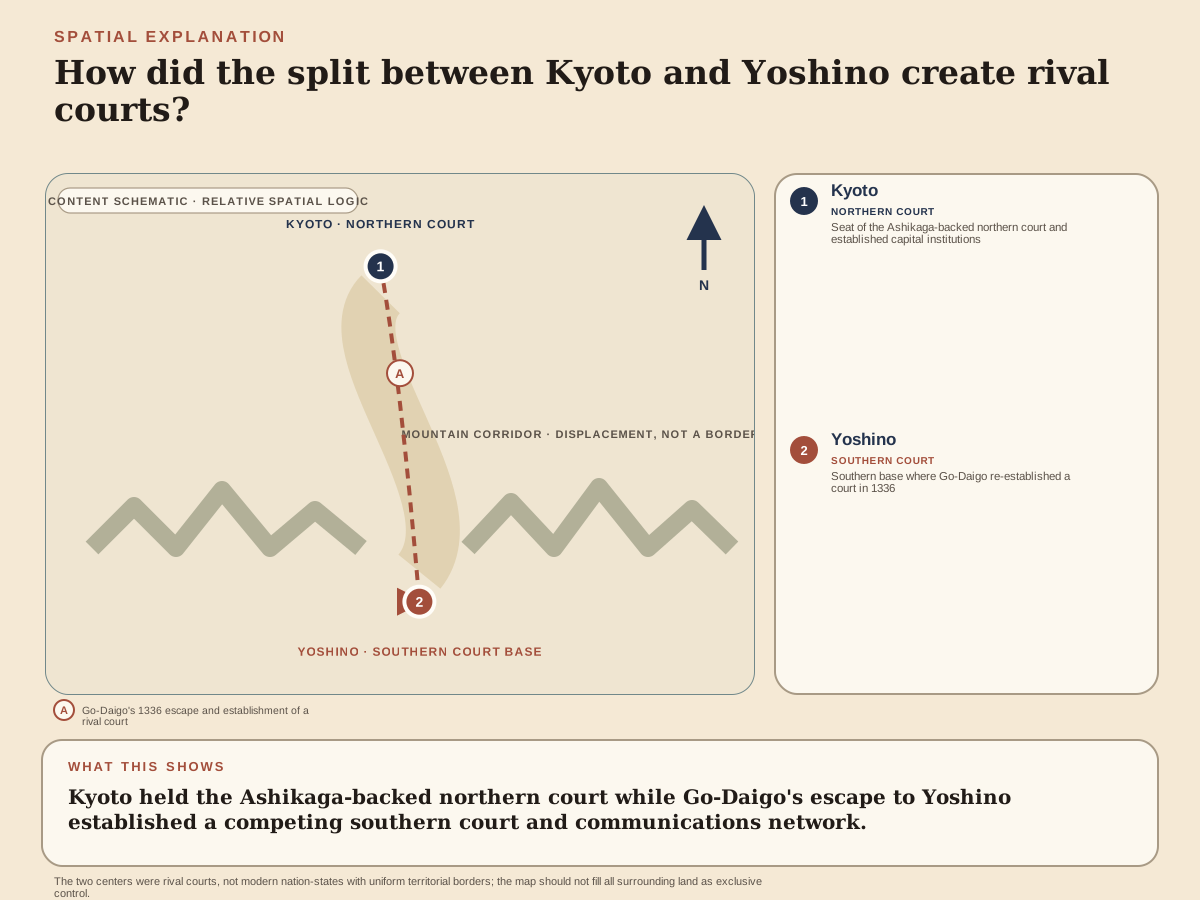
Takauji supported the accession of Emperor Kōmyō in Kyoto while Go-Daigo, after resistance from Mount Hiei, entered a settlement and transferred regalia or objects represented as regalia. He then escaped Kyoto late in 1336 and declared from Yoshino that the items surrendered were not the authentic sacred treasures. Each court now claimed legitimate succession. Yoshino was not an empty refuge. Temples, mountain routes, estates, clerics, courtiers, servants, and regional warriors made a rival court possible. [8][9][11][12]
Go-Daigo first relied on religious lodging associated with Yoshimizu and established his center near Kinpusen, at a site remembered as Kinrinnōji. The Southern and Northern Courts were not modern nation-states with fixed borders. They were competing sovereign institutions whose documents, appointments, era names, regalia claims, and military patrons overlapped across the archipelago. A departure from Kyoto became durable only because a portable court could still appoint, judge, reward, worship, and reproduce an imperial line. [12]
Go-Daigo tried to make the Southern Court distributed. Royal sons and allies connected Yoshino with the northeast, Hokuriku, Kyushu, and other regions. Kitabatake Akiie had governed and mobilized in the northeast with Prince Noriyoshi before marching west; other princes traveled with commanders or religious-military networks. These routes created alternatives to one vulnerable capital. The losses were severe. Akiie died in battle in 1338, and Nitta Yoshisada was killed in Hokuriku the same year; princes and followers also died or were scattered. [9]
In Kyoto, Emperor Kōmyō appointed Takauji shogun in 1338, strengthening a Northern Court–Ashikaga institutional pairing. Yet Yoshino still issued orders and rewards, and local actors continued to choose sides. Southern rule was not a continuous block of territory but a network of courts, princes, commanders, temples, and documentary recognition. Go-Daigo could define objectives and succession; he could not synchronize distant armies or prevent regional leaders from pursuing local survival. [8][9]
Illness overtook Go-Daigo at Yoshino in 1339. He transferred the Southern claim to Prince Noriyoshi, who became Emperor Go-Murakami, and died on the sixteenth day of the eighth lunar month, aged fifty by Western count and fifty-two by traditional reckoning. His designated mausoleum, Tō-no-o at Nyoirinji, remains associated with Yoshino. Temple tradition depicts him dying with sword and scripture, facing or longing toward Kyoto. These images express later devotion and political memory; they are not a medical or eyewitness transcript of his final perception. [1][5][12]
The Southern Court continued under the young Go-Murakami, supported by Ano Renshi, senior courtiers, religious institutions and military allies. Go-Daigo left a rival imperial line with resources to survive, but not peace or secure command over its distant supporters. [5][12]
Go-Daigo's image was contested long after 1339. The Southern Court continued until the 1392 reunification, while the Taiheiki and Kitabatake Chikafusa's dynastic writing gave the conflict powerful moral and legitimacy frameworks. Later scholars and activists alternately portrayed Go-Daigo as rightful restorer, ritual innovator, reckless conspirator, or failed ruler. Meiji state building turned Southern loyalty into public institutions. Minatogawa Shrine honored Kusunoki Masashige; a shrine for Go-Daigo at Yoshino was ordered in 1889 and enshrined him in 1892. [8][10][13]
In 1911 controversy over schoolbooks and the two courts led the Meiji government to recognize the Southern line as legitimate. Official recognition did not change which emperors had actually reigned in Kyoto or erase the divided allegiances of the fourteenth century. The dispute gave Go-Daigo a renewed place in the politics of imperial continuity. [10]
Classic
Prince Takaharu, the future Emperor Go-Daigo, was born in 1288, the second son of Emperor Go-Uda and Fujiwara Chūshi, later known as Dantenmon-in. The imperial family into which he was born was divided. Descendants of Emperor Go-Saga had formed two competing lines, named after the residences Jimyōin and Daikakuji. Takaharu belonged to Daikakuji. A reigning emperor did not necessarily direct court business: a retired sovereign could retain control of appointments, estates and succession. Disputes between the branches also drew in the Kamakura bakufu, the warrior government. Its mediation helped keep succession predictable, but did not establish a perfectly automatic rotation. [1][2]
Settlements were negotiated and revised around particular candidates. Later reconstructions often simplify them into a ten-year rotation, but real arrangements involved reign length, sequence within each branch, and the rights of named descendants. Takaharu was Go-Uda's second son. His older half-brother, Go-Nijō, reigned from 1301 until his death in 1308 and left Prince Kuniyoshi. That nephew's claim meant Takaharu could be positioned as an interim adult without becoming the uncontested source of the next Daikakuji succession. The Jimyōin line also had a waiting candidate. After Go-Nijō died, Emperor Hanazono of that line took the throne. Takaharu's later advance as crown prince belonged to a bargain across lineages, not to universal recognition that he alone deserved rule. [1][2]
An appointment as crown prince could advance Takaharu while leaving his children's prospects insecure. His household depended on estate income and the service of attendants, tutors and clerics. His mother's connections belonged to that practical support, although surviving political narratives tell us much less about Fujiwara Chūshi's activity than about the retired emperors. The bargain concerned more than the prince's own turn on the throne: it determined which household would have income, offices and access in the next generation. [2]
Kamakura's intervention was strongest when the royal branches could not settle their competing claims. It did not amount to choosing every court official or administering palace ceremony. Takaharu could therefore expect to reign, yet still depend on arrangements made by his father, the rival imperial household and the warrior government. [2]
After Go-Nijō died in 1308, Hanazono of the Jimyōin line became emperor and Takaharu became crown prince. Ten years later Takaharu succeeded him, taking the throne as Go-Daigo in 1318. He could issue commands and confer appointments through the court, but Go-Uda continued to direct government from his retired sovereign's household. This arrangement, often called cloistered government, put experienced officials, archives and family strategy under the father rather than the reigning son. Go-Daigo had acquired the throne; the governing network had not yet passed to him. [2][9]
A document might issue in the reigning emperor's name while policy depended on the retired sovereign's household. Officials needed to know which chamber, messenger, and patron could make an order effective. Kamakura remained relevant to succession and to disputes that crossed court-warrior jurisdiction. Its approval of the arrangement constrained Go-Daigo, but it did not turn him into a bakufu employee or make Kyoto administratively passive. Prince Kuniyoshi represented the elder brother's line within Daikakuji interests. Prince Kazuhito represented the Jimyōin future. Go-Daigo's sons could be politically important and still face exclusion from the succession sequence accepted in 1318. Education created another kind of capacity. Go-Daigo studied texts that could support a more active model of kingship, including Chinese political learning interpreted through Japanese court practice. [2][3][9][15]
Religious learning connected the court to powerful institutions. Esoteric Buddhism used initiatory teachings and rituals to seek protection, healing and legitimacy; monastic appointments also gave imperial princes access to temple communities and estates. The monk Monkan would later become prominent in Go-Daigo's circle. Court music and calligraphy offered another means of exercising judgment and rewarding skill. They were part of the hierarchy in which Go-Daigo had been educated, not a separate leisure world outside government. [2][3][15]
In 1318 Go-Daigo possessed the throne's ceremonial and documentary authority while Go-Uda retained the household directing court government. The father's retirement from active rule in 1321 would change that balance. For now, the new emperor had to exercise his influence through an arrangement he had not chosen alone.
In 1321 Go-Uda withdrew from active government and Go-Daigo took over the central direction of court business with Kamakura's approval. The transfer began within the accepted settlement between court and bakufu. Orders still depended on secretaries, precedents and officials able to carry them out. Go-Daigo could confer rank, appoint provincial governors and decide court or estate claims; Kamakura dealt with its own vassals and much warrior justice. Their jurisdictions met on the land, where different institutions could possess different rights in the same estate. [2][9]
Different owners could hold different powers in one estate: a temple might receive its income while a warrior steward handled collection and policing. An imperial judgment needed someone locally able to implement it. Go-Daigo sought a dependable circle of courtiers, including members of the Hino family, who could prepare documents and conduct court business. In the following years his consort Ano Renshi would bear sons, including Noriyoshi in 1328, the future Emperor Go-Murakami. Their claims would make this effort to strengthen his household a succession issue as well. [2][5][9]
Elevating these children changed the prospects of other princes and maternal lines. The death of Prince Kuniyoshi in 1326 would later remove one rival Daikakuji claim, but in 1321 his future still mattered. Go-Daigo's effort to make his descendants eligible challenged a settlement under which he had been a temporary solution. Intellectual models expanded what he considered possible. Chinese classics, histories, and contemporary continental styles offered languages of virtuous sovereign action. Japanese precedents supplied court offices, era names, and ritual memories. The mixture was creative rather than a simple return to one ancient year. Religious policy also belonged to government. Rites addressed illness, weather, childbirth, military danger, and the protection of the realm. Appointing an abbot or favoring a ritual lineage affected estates and factional power as well as belief. [5][9]
The purpose of these early measures remains open to interpretation. Read in the light of the later rebellion, they can look like preparations to overthrow Kamakura. They also fit an effort to strengthen court government and secure his descendants' place without an immediate war. The transfer gave Go-Daigo greater control over appointments and resources, but did not settle the competing imperial claims or bring warrior enforcement under his command. [2]
Go-Uda died in 1324, removing the senior sovereign who had mediated between his son and Kamakura. Within months Rokuhara, the bakufu's Kyoto command, investigated an alleged conspiracy involving Go-Daigo's associates. The courtiers Hino Suketomo and Hino Toshimoto were arrested. Suketomo was eventually exiled to Sado, an island off the Sea of Japan coast; Toshimoto was released. Go-Daigo denied involvement and remained emperor. These unequal outcomes left the central accusation against him unresolved. [2][9]
The emperor's denial left Kamakura with a difficult choice. Deposing him could reopen the succession dispute it had helped contain. The inquiry punished particular courtiers without removing the sovereign they served. That outcome establishes neither his innocence nor the full conspiracy described in later accounts. [9]
The Taiheiki, a war chronicle composed and revised after the events, presents a coherent plot against Kamakura. A recent Japanese interpretation also places an overthrow attempt in 1324: historian Kei Mikawa dates it in a 2023 study to three months after Go-Uda's death. That reading is different from treating all the emperor's activity since 1321 as preparation for war. The surviving investigation still leaves his precise authorization and intended operation uncertain.. [2][8][9]
Remaining on the throne mattered. Go-Daigo retained his household and access to appointments, while associates faced exile or renewed scrutiny. The investigation had damaged his circle without removing the resources through which he could rebuild it.
The years after Shōchū were not empty delay. Go-Daigo retained access to appointments, ranks, ritual patronage, household money, and communication. These resources could turn acquaintances into a political network without producing a visible army at the palace. Dynasty came first. Prince Kuniyoshi's death in 1326 removed the nephew whose claim had limited Go-Daigo's descendants within the Daikakuji line. It did not erase Jimyōin rights or make the emperor's sons universally accepted. Ano Renshi's children formed a new succession project. Prince Noriyoshi could continue the throne; other sons could enter temples, command, or occupy regional positions. Daughters and consorts also linked households, although military narratives give them less space. Go-Daigo's son Prince Moriyoshi demonstrates how religious office could become political infrastructure. Imperial princes placed in great monasteries possessed rank, followers, travel connections, and access to armed temple communities. [5][9][15]
Historical disagreement · How central was Monkan to Go-Daigo’s support?
The clerics Monkan and Enkan connected Go-Daigo with ritual specialists and temple patronage. The importance of Monkan in particular has been debated. In a 2013 study, Japanese historian Tarō Sakaguchi argues that scholarship's emphasis on him obscures a larger source of support: Daikakuji temple, its estates and the emperor's brother, the prince-monk Shōen.
Courtly service could also create loyalties outside that circle. In 1328 the musician Ayanokōji Ariyori taught him secret court songs. After Ariyori died in 1329, an autograph imperial message sought to preserve the tradition for his young son, Atsuari, allowing the transmission of the family's musical writings. The letter shows the emperor attending to a particular household's future as well as to dynastic politics. Hino Toshimoto, meanwhile, again became associated with opposition; his renewed arrest in 1331 establishes his continuing exposure, although the journeys and recruitment scenes attributed to him in later narratives are less securely recoverable. [3][8][9][15]
The warriors whom these contacts reached had land disputes and patrons of their own. Joining the emperor could offer a way to resist Hōjō agents or secure rank and reward; an imperial allegiance did not erase those interests. Kamakura still commanded formidable forces. Its Tokusō—the head of the main Hōjō family line—had a household and private retainers distinct from the bakufu's public offices. Opposition therefore had to win support against a working military government. Temples offered shelter and routes for messages outside the palace, but discovery could expose the courtiers and clerics carrying them.
These institutions had disputes of their own. Enryakuji, the great Buddhist monastery on Mount Hiei northeast of Kyoto, did not simply become the emperor's military department. By 1331 Go-Daigo had assembled royal sons, clerical allies and courtiers with potential regional partners. They could continue resistance outside the palace, but their cooperation was neither uniform nor assured. [5][9]
In 1331 a fresh investigation forced Go-Daigo to leave Kyoto and take refuge at Mount Kasagi, a steep temple site south of the capital. His departure made the conflict an open military challenge. The court split: some attendants accompanied him, while others stayed in Kyoto or sought terms with the bakufu. His son Prince Moriyoshi, who had held monastic office, and the warrior Kusunoki Masashige organized resistance elsewhere. Masashige's base in Kawachi, in what is now Osaka Prefecture, gave the emperor's cause a center beyond the mountain refuge. [9]
Their dispersed capacity meant the movement had several centers before Kasagi fell. Kamakura's response was correspondingly large. Rokuhara supplied proximity and intelligence; warriors arrived from multiple regions; siege required roads, provisions, guards, and assaults. Later war tales magnify numbers and individual feats, so exact totals should not be repeated as neutral statistics. Kasagi's defeat exposed the limit of sacred status in battle. Imperial presence could authorize defenders but could not make walls, food, or manpower unlimited. Go-Daigo fled and was captured after the position collapsed. The Taiheiki gives his flight visionary and dramatic elements, including a dream connected with finding Masashige and episodes of disguise. Such scenes shaped remembrance and may retain geographic memory, but they are not independently witnessed access to supernatural direction or private thought. [8][9][11]
Enthroning Kōgon was more than replacing one person. It activated the Jimyōin succession claim, installed a court able to issue documents and ceremonies, and allowed Kamakura to frame Go-Daigo as a deposed disturber rather than the only sovereign. The regalia—the sacred mirror, sword and jewel associated with imperial succession—mattered because possession could support accession. Accounts differ over which objects Go-Daigo took, surrendered, or later declared inauthentic. Punishment mapped the opposition. Hino Toshimoto and other courtiers, Monkan and Enkan, royal or clerical associates, and regional supporters faced different sentences. Their dispersion carried political information to Sado, remote provinces, temples, and households. Go-Daigo's exile to Oki echoed earlier imperial punishment after the Jōkyū War, but historical analogy did not determine outcome. Maritime custody could remove a leader; it could not reverse local conflicts or make surviving orders meaningless. [8][9][11]
Prince Moriyoshi and Masashige continued to act. Akasaka and later Chihaya demonstrated that small fortified networks could absorb large punitive effort. Other opponents watched for signs that bakufu force was costly or defections survivable. Kamakura won the immediate campaign: Kasagi fell, the emperor was captured, and Kōgon reigned in Kyoto. Yet the operation converted a private succession conflict into visible dual legitimacy and distributed veteran opponents across the country. Defeat therefore changed the rebellion's form. Go-Daigo lost physical freedom; his name became more portable as a warrant for others. The distinction between person, office, regalia, document, and armed network explains why capture did not equal political erasure. [8][9][11]
Go-Daigo was sent into exile on Oki in 1332. These inhabited islands in the Sea of Japan lay far from Kyoto, but remained connected to coastal shipping and religious communities. Officials supervised him, while resistance continued on the mainland. Later traditions identify particular temples and lodgings with his confinement; their histories do not all agree. The practical question for the emperor was how to recover contact with supporters willing to receive him. [9]
Kusunoki Masashige's defense of Akasaka and Chihaya relied on mountain terrain, local supply, fortification, harassment, and the difficulty of sustaining a large besieging force. Popular accounts emphasize clever devices; operational significance lies in time and cost. Akamatsu Norimura's rising in Harima created another regional axis toward Kyoto. His incentives included local power and reward, not an abstract national obedience identical to every other supporter. The bakufu faced simultaneous problems. Large armies away from home consumed food and money; delayed victory weakened authority; mobilized warriors could assess which side might reward them. Go-Daigo's escape required more than personal daring. Custodial failure, household collaboration, coastal knowledge, transport, weather, and a receiving patron formed a chain. [9]
Nawa Nagatoshi provided immediate protection in Hōki. Mount Senjō offered defensible terrain and visibility to nearby networks. Patron and place converted a fugitive into a sovereign issuing commands. The Izumo Taisha document is particularly useful because an autograph or closely identified object anchors action outside the war tale. It orders provision of a shrine sword as a substitute for the imperial sacred sword. Interpretation of sacred substitution requires care, but the request shows material urgency and documentary reach. Go-Daigo still lacked a centrally salaried army. Orders had to persuade warriors that defection was feasible and that future confirmation of land, rank, or reward would be honored. His seal and lineage made promises credible; his previous defeat made them risky. [9][11]
Separate revolts began to form a common crisis because each changed expectations for the others. Chihaya tied down forces; Harima threatened routes; Senjō restored the emperor's presence; court and warrior defectors could imagine Kamakura losing. Later victory made every supporter seem synchronized. In reality, information arrived at different speeds, leaders pursued local enemies, and some joined only when the balance shifted. Coordination emerged through cascading decisions rather than one master timetable. Go-Daigo could return because resistance and local support had survived his confinement. [9]
Go-Daigo's escape altered legitimacy, but the bakufu still possessed armies and institutions. Its destruction required commanders with enough military weight to break major centers rather than merely survive in mountains. Ashikaga Taka-uji came from a prestigious warrior lineage related to the Minamoto tradition and held extensive followers. The bakufu trusted him enough to send him toward Kyoto. That assignment placed a concentrated force near the institution it expected him to defend. Defection was decisive because it converted bakufu resources into an attack on Rokuhara. Motives may include calculation, lineage ambition, accumulated grievance, family networks, religious commitments, and assessment of the changing war. No single private thought is securely recoverable. Rokuhara's fall removed Kamakura's principal Kyoto command and opened the capital. [8][9]
It also endangered officials, records, families, and messengers associated with Hōjō authority. Defeat was administrative as well as battlefield loss. Nitta Yoshisada's campaign struck the other center. His forces crossed the Kantō and attacked Kamakura through difficult approaches. Later accounts give dramatic tidal and divine-intervention scenes; the secure result is that defenders were defeated and the Tokusō/Hōjō leadership destroyed itself or died as the city fell. The two operations were connected by a collapsing political environment, not controlled from one field headquarters. Communication time, local recruitment, road conditions, and separate rivalries prevented minute-by-minute central direction. Kusunoki's prolonged resistance had imposed cost and supplied an example. Prince Moriyoshi circulated legitimacy and mobilized temple-linked forces. Akamatsu pressure shaped western approaches. Nawa turned the escaped emperor into an active commander. [8][9]
Their contributions cannot be ranked solely by who entered the final city. Nor were “the warriors” united against “the court.” Many fighters remained with Kamakura until late; court nobles divided; temples protected different interests. A coalition becomes visible after victory more neatly than it existed during risk. Go-Daigo's return to Kyoto supplied a legal center for the aftermath. He could confirm ranks, redefine treason, restore property, invalidate Kōgon's reign within his own chronology, and issue rewards. These powers were the reason fighters had sought his sanction. The treatment of Kōgon reveals the human cost of constitutional reversal. One man had performed imperial rites under a succession claim recognized by Kamakura and many courtiers. Go-Daigo's victory reclassified that reign without erasing its documents, supporters, or memory. [9]
Go-Daigo rewarded the Ashikaga commander with a character from his own name, Takaharu (尊治). The commander changed the written form of Takauji from 高氏 to 尊氏; the pronunciation remained the same. The gift publicly linked him to the emperor, alongside offices and land rights. Other commanders brought their own claims for recognition. The triumph in 1333 was followed by a rush of petitions in which the court had to decide which service deserved which reward. [9]
The English word “restoration” encourages a picture of rewinding history. Go-Daigo used older names and imperial precedents, but the administrative problem of 1333 was new: absorb the documentary and military consequences of a nationwide bakufu collapse. The Records Office addressed major court and land confirmations. The Rewards Office evaluated military service. The Miscellaneous Claims Court handled the expanding body of estate and property litigation. The Warrior Office organized guards and warrior service near the palace. These were not labels on a chart. Petitioners presented documents; clerks copied and registered them; commissioners compared precedents; decisions went out as specified forms; provincial or military officials were expected to place recipients in possession. An early demand for imperial confirmation asserted that rights flowed from the restored sovereign. [9][14]
Fresh confirmation also threatened holders whose security had rested on bakufu acts and crowded access to palace secretaries. The regime modified its rules and divided the Miscellaneous Claims Court's work by region. A surviving Aso family document makes the route of a decision concrete. An imperial order dated to the second day of the tenth month of 1333 concerned Aso Korenao's boundary claim in Higo, the province corresponding to much of modern Kumamoto Prefecture. On the fourth day of the following month the Claims Court addressed the matter to Higo's military governor and provincial government. The document shows a claim moving from the sovereign to offices expected to enforce it. It does not show whether the claimant actually secured possession. [4][9]
Competing orders could be ignored if the opposing party possessed greater force. Former bakufu personnel were useful because they knew documentary forms, litigants, and regions. Employing them made the regime less like a pure court restoration and more like a recombination of available expertise. Warriors also served inside central institutions. Kusunoki Masashige and other military participants held adjudicative or guard roles. The boundary was not an office of nobles versus an excluded warrior class. Provincial government combined governors appointed from Kyoto with shugo and military networks. Go-Daigo sought a hierarchy in which these agents answered to imperial judgment. Their overlap could create cooperation or rivalry over police and land authority. Temples and shrines were major landholders and political actors. Their petitions involved immunity, boundaries, labor, appointments, and protection. [9][14]
The consequences extended beyond those who received a grant. A new entitlement to estate income changed whom cultivators paid and whose officials could demand labor. Offices deciding rival claims also accumulated their own patrons.
Historical disagreement · How should the Kenmu government be understood?
These tensions help explain the regime's difficulties without assuming it had no administration. Interpretations differ over what that administration represented. Japanese historian Satō Kazuhiko's encyclopedia account emphasizes personal imperial rule, disruptive confirmation requirements and the failure of the coalition. Andrew Goble's 1996 study, Kenmu, instead interprets the regime as an innovative attempt to reorganize power, not an inevitably doomed return to the past.
The dated arguments need not be forced into a single verdict: the regime issued real decisions while failing to secure the continuing obedience of its strongest commanders.
Coalitions divide when promises become decisions. A warrior could claim service at several battles, losses of men and horses, confiscated family land, or a rival's estate. The government needed evidence and a finite asset to award. “Insufficient rewards” is too vague. Some received land, rank, office, court titles, or confirmation. The structural conflict lay in unequal access, overlapping claims, delay, and the difference between an impressive title and enforceable local income. Court rank itself could be valuable to warriors, while aristocrats could hold military or judicial office. The familiar claim that nobles received everything and warriors nothing does not fit the mixed staffing of Kenmu institutions. The Nijō Riverbank Graffiti captures urban ridicule of the regime's petition culture and social flux. [9]
Its long list of absurdities is literary satire written from a position, not a census. Prince Moriyoshi represented an alternative way to organize force around royal command. His temple career, anti-bakufu activity, and appointment as shogun or senior military leader gave him followers and symbolic standing independent of Takauji. That made father and son allies against Kamakura but not identical political actors afterward. Moriyoshi feared Ashikaga ascendancy and is associated with efforts against Takauji. Takauji's household feared a royal commander capable of classifying it as disloyal. Go-Daigo permitted or ordered Moriyoshi's arrest in 1334. The arrest removed a royal commander with an independent following; it does not by itself establish which accusation or political calculation determined the emperor's decision. [7][9]
Moriyoshi was transferred to the custody of Ashikaga Tadayoshi, Takauji's younger brother, in Kamakura. The prince was no longer directly guarded by the emperor's officials. His body became leverage and danger within the Ashikaga eastern headquarters. Hōjō Tokiyuki's 1335 rising shattered that arrangement. Descended from the destroyed Tokusō house, he mobilized supporters, defeated local Ashikaga forces, and took Kamakura. The rebellion shows that 1333 had not eliminated Hōjō constituencies. During the Ashikaga withdrawal, Moriyoshi was killed. Later accounts name Fuchinobe Yoshihiro and dramatize struggle and last words. The death in custody is firm; whether Tadayoshi issued one explicit order in the exact narrated form requires caution. Takauji went east under urgent conditions, apparently without waiting for the authorization he sought. He retook Kamakura and gained direct command over warriors whose lands and lives he had just defended. [7][9]
Rewarding those fighters was militarily rational and constitutionally explosive. If Takauji could confirm service and land from Kamakura, the emperor's claim to final adjudication became optional at the point of greatest armed power. Go-Daigo demanded return and submission. Takauji's delay or refusal allowed each side to interpret the other as the breaker of order. Nitta Yoshisada offered the court another commander and carried his own rivalry with Ashikaga. The rupture thus joined three problems: a reward system under strain, a royal son removed and killed inside Ashikaga custody, and an eastern emergency that let Takauji act as a regional sovereign. Personal mistrust mattered, but it operated through offices, armies, prisoners, and land. Takauji's independent grants gave their recipients a direct interest in defending his authority against an imperial recall. [9]
The campaign began before the famous battle. Nitta Yoshisada's eastern advance met Ashikaga forces around Hakone and Takenoshita and failed. Roads through the mountains, winter movement, defections, and competing warrior ties helped decide access to Kyoto. Takauji's first entry into the capital did not settle the war. Go-Daigo's coalition still possessed commanders and regional depth. Kusunoki and Nitta fought near the center, while Kitabatake Akiie brought forces from the northeast associated with Prince Noriyoshi's regional government. That long march demonstrates the reach and cost of the Kenmu system. Horses, provisions, river crossings, local recruits, and provincial rivalries had to be managed across hundreds of kilometers. Akiie's arrival was not an instantaneous imperial summons. Ashikaga defeat and retreat to Kyushu could have ended Takauji's bid. [9]
It did not because he retained ships, family networks, supporters in western provinces, and the ability to negotiate recognition. Tatarahama gave him a base from which defeat could be narrated as temporary. Kyushu itself was divided. The Kikuchi and other forces that opposed him had local interests and Southern loyalties; Ashikaga supporters had theirs. The campaign was not Kyoto exporting two fixed national parties to passive provinces. Takauji's return used maritime as well as land routes. Fleets moved men and supplies through the Inland Sea, could bypass some land obstacles, and threatened several points. Naval capacity complicates a story centered on one heroic land formation. The court's defenders faced a strategic problem: delay, defend approaches, preserve Kyoto, or withdraw to terrain from which a longer war could continue. [9]
The Taiheiki credits Masashige with a plan to abandon the capital temporarily and divide Takauji from support. Whether the full council dialogue and every recommendation are verbatim is doubtful. War tales explain catastrophe by staging foresight and rejected advice. Other sources offer different emphases on Masashige's relation to Takauji and the court. Minatogawa joined forces under Nitta and Kusunoki but did not erase separate commands. The Ashikaga brothers coordinated a larger returning coalition. Terrain near the coast, river channels, landing, timing, and the possibility of encirclement shaped the defeat. Masashige's death is secure; reported last conversations, suicide numbers, and perfect awareness of inevitable defeat are literary layers. His followers made their own fatal commitments, and their families inherited losses. [8][9]
Go-Daigo bears responsibility for choices made under his authority, although commanders had their own forces and incomplete information. The defeat at Minatogawa destroyed the Kusunoki force and drove Nitta back. Ashikaga armies entered Kyoto, and the emperor sought refuge on Mount Hiei. His court had lost the physical center from which it had tried to govern the reunited coalition. [9]
The settlement after Mount Hiei remains difficult to narrate because each side needed a different legal meaning. Takauji required a recognized sovereign in Kyoto and an end to Go-Daigo's active claim. Go-Daigo needed survival, movement, and a way to deny that submission was final. Emperor Kōmyō's accession activated the Jimyōin line under Ashikaga protection. Retired Emperor Kōgon and court nobles supplied continuity. The Northern Court was not merely Takauji wearing an imperial mask; royal actors had their own lineage claims and household interests. The regalia compressed legitimacy into objects. Transfer could signal abdication and valid succession. Go-Daigo later asserted that what he handed over was not authentic. No modern inspection can recover sacred authenticity independently of the competing traditions and custodial claims. [8][9][11][12]
This creates two kinds of fact. Objects changed hands in a negotiated defeat; rival courts disagreed over what those objects legally and ritually were. Escape from Kyoto required surveillance gaps, guides, horses or litters, clothing, food, and safe houses. Later narrative can make the journey stealthy destiny. Operationally, it depended on people willing to risk punishment after Ashikaga victory. Yoshino offered distance and access. Mountain terrain was defensible, but roads connected it to Yamato, Kawachi, Kii, and religious routes. Isolation and communication existed together. Religious institutions provided more than sanctuary. They possessed buildings, land, armed or laboring communities, ritual legitimacy, storage, scribal skill, and networks of pilgrims and patrons. Kinpusen's sacred landscape could host political authority without becoming a modern capital district. [9][11]
Go-Daigo first relied on religious lodging associated with Yoshimizu-in and the site remembered as Kinrinnōji. Later destruction and changes of religious use altered these places. At the time, local buildings and support allowed the displaced household to resume court business. Southern appointments and orders used an era name and had to reach people who controlled land or troops. In Kyoto, the Northern Court issued its own documents with access to the capital's offices and Ashikaga protection. A recipient's allegiance determined which command could be effective. [8][9][12]
Kyoto gave the Northern Court access to established offices and Ashikaga support but did not make Southern claims disappear from regions where royal princes and allied warriors were active. Calling Yoshino a government in exile helps readers see displacement, yet the analogy has limits. Both courts claimed the same imperial order rather than sovereignty over two territorially bounded countries. A warrior family could change allegiance without crossing a modern international frontier. Go-Daigo's achievement in 1336 was to prevent military defeat from closing the constitutional dispute. Its cost was a dynastic schism in which appointments, confiscations, and loyalties could be valid under one court and treasonous under the other. The displaced household continued to issue appointments and orders, supported by local religious institutions and allied warriors. [9][11]
During his last years, Go-Daigo tried to sustain resistance through royal sons and allied commanders beyond Yoshino. A prince could give a distant force an imperial patron and make appointments credible. Noriyoshi's earlier association with the Kitabatake household in the northeast had helped support Akiie's march west; he later returned closer to the Southern center as the likely heir. Other princes moved toward Hokuriku, Kyushu and eastern supporters. These missions spread the court's reach, but exposed its children to dangerous journeys and sieges. [9]
A storm, hostile port, local feud, or commander's defeat could isolate an imperial node. Kitabatake Akiie combined youth, aristocratic rank, provincial administration, and military leadership. His rapid marches became legendary, but their documented movement reveals taxation, requisition, horses, local recruitment, and exhaustion as well as loyalty. His death in 1338 removed a commander able to link the northeast to the center. Later memorials and admonitions attributed to him criticize the regime; item-level authenticity and textual history matter, even when the criticism fits observable strain. Nitta Yoshisada's death in Hokuriku removed another major house. His coalition had its own clients and regional interests. It did not automatically transfer intact to another Southern commander. Princes Tsunenaga and Takanaga became associated with the Hokuriku struggle and died amid its defeat. [9]
Their deaths show the bodily cost of using dynasty as regional infrastructure. Prince Kaneyoshi's later importance in Kyushu grew from another dispatched royal line. During Go-Daigo's lifetime, the project was still uncertain. A prince sent away was an investment whose outcome the emperor might not live to see. The Ashikaga side was also institutionalizing. Kōmyō's appointment of Takauji as shogun in 1338 supplied an office linking warrior command to Northern imperial authorization. The shogunate did not become complete on one appointment day, but the title clarified a durable center. Southern orders continued to move. Regional archives preserve imperial commands, grants, and reward decisions from Yoshino. Their survival proves activity, while enforcement still depended on the recipient's coalition. [8][9]
Allegiance could be layered. A local warrior might accept one court's title, negotiate with the other's shugo, protect a temple, and switch when a rival threatened. Moral vocabulary in later chronicles often simplifies such decisions into loyalty or treason. The emperor's ability to command diminished with each military death, yet his role as source of alternative legitimacy remained difficult for Takauji to replace. Killing a commander could destroy an army; it did not decide which royal line possessed sacred continuity for every audience. Go-Daigo's distributed strategy thus produced resilience and fragmentation together. Princes and documents kept the Southern claim national, while distance made coordination, supply, and accountability weak. Network survival was real, but it should not be mistaken for effective control of an unbroken realm. [9]
Go-Daigo fell ill at Yoshino in 1339. He transferred the Southern succession to Prince Noriyoshi, Ano Renshi's son, who became Emperor Go-Murakami. Go-Daigo died on the sixteenth day of the eighth month of the traditional calendar. He was fifty in completed years, or fifty-two by the age reckoning then used in Japan. Surviving descriptions do not establish a secure modern diagnosis. Succession gave the court a continuing sovereign while it still faced war with Kyoto. [1][5][12]
The court performed mourning while continuing the war. Nyoirinji and the Tō-no-o mausoleum at Yoshino became central to the custody of Go-Daigo's remains and memory. A tradition holds that his burial faces north toward Kyoto; another depicts him with sword and scripture at death. These images express his remembered military and sacred resolve, rather than establishing the details of his final moments. The present mound and temple grounds also bear the marks of later maintenance. [1][12]
The Yoshino imperial site itself later changed. The temple identified with the palace was suppressed or transformed across later regimes, and modern memorial structures occupy the landscape. A current visitor does not enter an intact 1339 palace. Go-Murakami was young, but the court was not a child acting alone. Ano Renshi, courtiers, Kitabatake Chikafusa and other senior figures, monastic institutions, and military households sustained administration and strategy in different locations. The Northern Court and Ashikaga government had no reason to stop because their principal rival died. They sought submission of the Southern line, regalia, and regional forces. Southern supporters likewise had claims and losses that outlived personal attachment. Go-Daigo had deliberately distributed royal authority among descendants. That strategy created succession capacity even as it produced competing princely interests and dangerous missions. [1][12]
Noriyoshi's accession kept the Southern line in the field. Its supporters held claims, appointments and losses that outlived their attachment to Go-Daigo. The conflict continued for more than half a century after his death, until the settlement of 1392. His successors inherited both the alternative court he had preserved and the difficult task of sustaining it against the government in Kyoto. [5][12]
The first transformation occurred inside the war. Go-Murakami and later Southern sovereigns treated Go-Daigo as founder of an unbroken rightful line. Their documents made his decisions precedent and their own survival proof of continuity. Kitabatake Chikafusa wrote a dynastic argument while serving the Southern cause. The Jinnō Shōtōki offered principles for legitimate succession and sacred history; it is indispensable evidence of partisan political thought, not a neutral court register. The Taiheiki created another memory system. Its circulated and revised war narrative dramatized conspiracies, dreams, commanders, reversals, karmic causes, and loyalty. Go-Daigo could appear bold, sacred, difficult, or poorly advised depending on episode and textual lineage. In 1392 the Southern sovereign Go-Kameyama entered a settlement with the Northern line. [8][10]
Regalia were transferred and Emperor Go-Komatsu continued from the Kyoto court. Promised alternation did not produce a lasting division of succession. The surviving imperial line therefore descended through the court that Southern polemic had contested. Later recognition of Southern legitimacy did not reverse the biological and institutional history by which Northern descendants reigned. Medieval and early modern readers could distinguish effective rule from rightful title in several ways. Buddhist causation, regalia custody, genealogical seniority, treaty, conquest, and moral conduct all supplied arguments. There was no timeless single rule mechanically accepted by everyone. Tokugawa-era historical scholarship, including Mito traditions, elevated loyalty to the sovereign and reassessed Southern actors. Kusunoki Masashige became a model whose obedience and sacrifice could be taught independently of the Kenmu government's administrative record. [8][10]
Restoration activists later found in Go-Daigo an earlier overthrow of warrior government. The analogy connected medieval conflict with opposition to Tokugawa rule, while differences between fourteenth- and nineteenth-century institutions could disappear. The Meiji state materialized memory. Minatogawa Shrine, completed in the early 1870s, made Masashige a public sacred loyalist. Kamakura memorialization elevated Prince Moriyoshi. These sites selected Southern suffering for a new national order. Emperor Meiji ordered a shrine for Go-Daigo at Yoshino in 1889, and enshrinement followed in 1892. The current major buildings include later phases, so their architecture cannot be backdated to the nineteenth-century foundation or the medieval court. The 1911 Southern–Northern legitimacy controversy reached parliament, newspapers, scholarship, and education. Schoolbook wording became politically dangerous because describing “two courts” appeared to some critics to weaken the premise of one unbroken sovereign line. [10][13]
In 1911 the Meiji government adopted Southern legitimacy and revised the official schoolbook treatment of the rival courts. This was a modern political decision about a medieval dispute. It did not undo the Northern emperors' actual reigns or the descent of the continuing imperial line. Go-Daigo's defeat had left a claim that successors, historians and the modern state could put to different uses. [10]