

Skip to content
Chronicle

Search History Omakase

Start typing to search.

    Illustration for Okehazama: Nobunaga Defeats Imagawa Yoshimoto

    1560 | Sengoku period

    Okehazama: Nobunaga Defeats Imagawa Yoshimoto

    桶狭間の戦い

    Choose a reading depth

    Overview

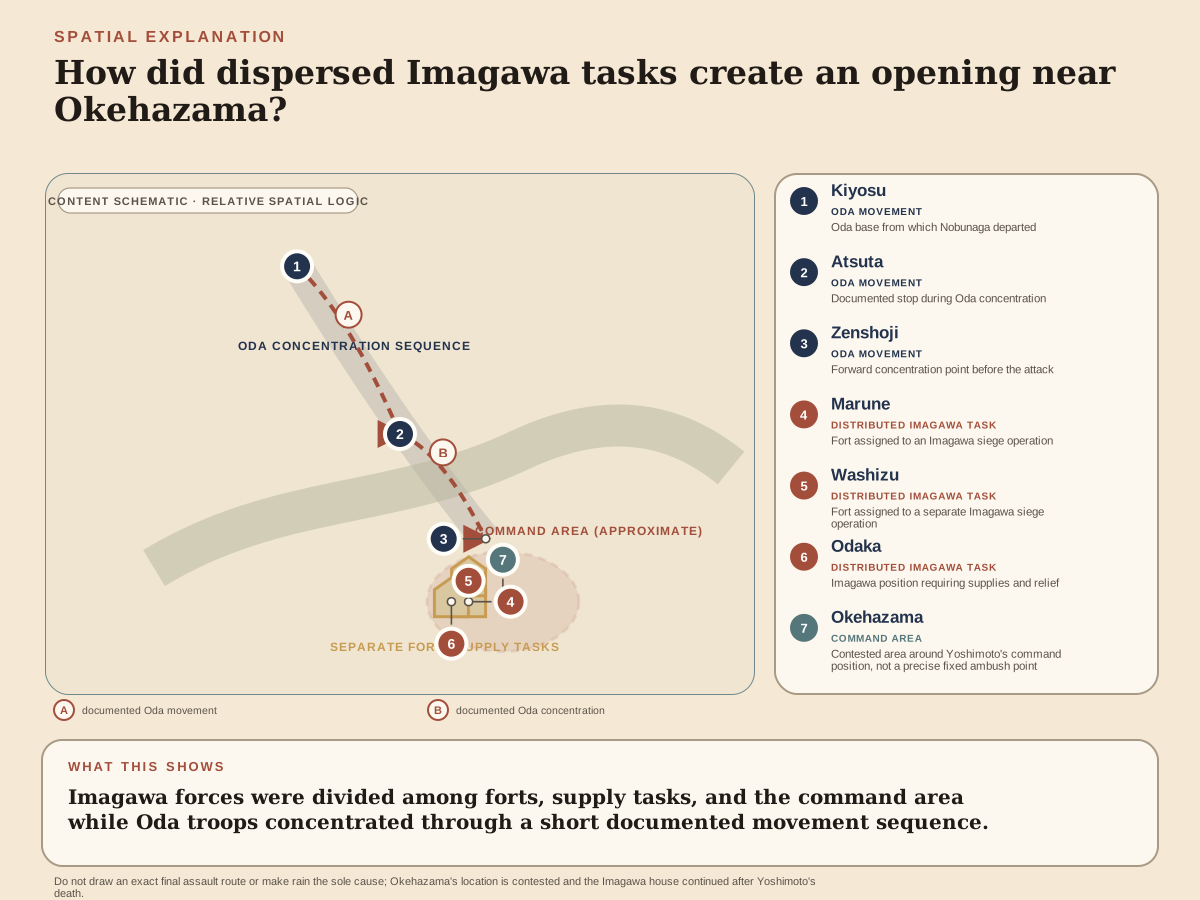
    Imagawa Yoshimoto’s 1560 advance threatened Oda positions in southern Owari. His troops supplied Ōdaka Castle and attacked the nearby Marune and Washizu forts. Matsudaira Motoyasu, later Tokugawa Ieyasu, served on the Imagawa side. The opening operations dispersed forces among several positions.

    Nobunaga moved from Kiyosu through the Atsuta area and his frontier forts. Ōta Gyūichi’s account follows his concentration of troops at Zenshōji and movement through Nakajima before the attack on Yoshimoto’s command group. It records heavy rain followed by the Oda assault and identifies Mōri Shinsuke as the warrior who took Yoshimoto’s head. Its speeches and providential explanation belong to the narrator’s reconstruction.

    Yoshimoto’s death broke the campaign’s command. Imagawa positions were abandoned or surrendered, and Motoyasu returned to Okazaki. He subsequently developed greater independence and allied with Nobunaga in 1562. The Imagawa house survived under Yoshimoto’s son Ujizane, while Nobunaga still had to secure his position and conquer Mino.

    Estimates of the armies and reconstructions of the approach differ. Rain is present in Gyūichi’s narrative, but a complete route concealed by the storm is not established by it. The victory secured Nobunaga against the immediate invasion and altered the Owari–Mikawa balance; Yoshimoto’s distant objectives remain less certain than those results.

    Read Okehazama: Nobunaga Defeats Imagawa Yoshimoto

    Read the article below. Interactive reading tools are available when scripts load.

    Quick

    Okehazama: Nobunaga Defeats Imagawa Yoshimoto

    Imagawa Yoshimoto’s 1560 advance threatened Oda positions in southern Owari. His troops supplied Ōdaka Castle and attacked the nearby Marune and Washizu forts. Matsudaira Motoyasu, later Tokugawa Ieyasu, served on the Imagawa side. The opening operations dispersed forces among several positions.

    Nobunaga moved from Kiyosu through the Atsuta area and his frontier forts. Ōta Gyūichi’s account follows his concentration of troops at Zenshōji and movement through Nakajima before the attack on Yoshimoto’s command group. It records heavy rain followed by the Oda assault and identifies Mōri Shinsuke as the warrior who took Yoshimoto’s head. Its speeches and providential explanation belong to the narrator’s reconstruction.

    Yoshimoto’s death broke the campaign’s command. Imagawa positions were abandoned or surrendered, and Motoyasu returned to Okazaki. He subsequently developed greater independence and allied with Nobunaga in 1562. The Imagawa house survived under Yoshimoto’s son Ujizane, while Nobunaga still had to secure his position and conquer Mino.

    Estimates of the armies and reconstructions of the approach differ. Rain is present in Gyūichi’s narrative, but a complete route concealed by the storm is not established by it. The victory secured Nobunaga against the immediate invasion and altered the Owari–Mikawa balance; Yoshimoto’s distant objectives remain less certain than those results.

    Imagawa Yoshimoto (1519–1560) was a son of Ujichika, lord of Suruga and Tōtōmi, covering much of present-day Shizuoka. The Imagawa were related to the Ashikaga family that headed the Muromachi shogunate, Japan’s military government centered in Kyoto. Ujichika had strengthened territorial government through assessment and a legal code. Yoshimoto’s mother Jukeini came from the court family of Nakamikado. After Ujichika’s death she had conducted affairs during the youth of Yoshimoto’s elder brother Ujiteru, issuing documents under her own seal. The household’s governing authority therefore included the work of a widow as well as the succession of its male heads.

    Classic

    Conditions behind Okehazama: Nobunaga Defeats Imagawa Yoshimoto

    Imagawa Yoshimoto’s 1560 advance threatened Oda positions in southern Owari. His troops supplied Ōdaka Castle and attacked the nearby Marune and Washizu forts. Matsudaira Motoyasu, later Tokugawa Ieyasu, served on the Imagawa side. The opening operations dispersed forces among several positions.

    Imagawa Yoshimoto (1519–1560) was a son of Ujichika, lord of Suruga and Tōtōmi, covering much of present-day Shizuoka. The Imagawa were related to the Ashikaga family that headed the Muromachi shogunate, Japan’s military government centered in Kyoto. Ujichika had strengthened territorial government through assessment and a legal code. Yoshimoto’s mother Jukeini came from the court family of Nakamikado. After Ujichika’s death she had conducted affairs during the youth of Yoshimoto’s elder brother Ujiteru, issuing documents under her own seal. The household’s governing authority therefore included the work of a widow as well as the succession of its male heads.

    As a young son, Yoshimoto was trained for Buddhist life at a temple in the Fuji area. He used the name Baigaku Shōhō and also trained in Kyoto. The monk Taigen Sessai, who had connections with Kyoto religious institutions, became an important figure in his education and later service. When Ujiteru died in 1536, another brother, Genkō Etan, contested the succession. Yoshimoto defeated him and returned to secular life as head of the Imagawa. A succession struggle had turned his religious formation toward the responsibilities of ruling a military house.

    Sessai’s position crossed the religious and political relationships on which the house depended. He served as abbot of Rinzai-ji while assisting Yoshimoto in government, military affairs and diplomacy. His access to Kyoto was part of that contribution. Yoshimoto also inherited established warrior households and the territorial arrangements of his father and elder brother. He would extend their policies while making new decisions about the neighboring Takeda and Hōjō houses. Those decisions soon brought both an advantageous marriage and a dangerous war.

    Okehazama: Nobunaga Defeats Imagawa Yoshimoto in motion

    Nobunaga moved from Kiyosu through the Atsuta area and his frontier forts. Ōta Gyūichi’s account follows his concentration of troops at Zenshōji and movement through Nakajima before the attack on Yoshimoto’s command group. It records heavy rain followed by the Oda assault and identifies Mōri Shinsuke as the warrior who took Yoshimoto’s head. Its speeches and providential explanation belong to the narrator’s reconstruction.

    Yoshimoto’s death broke the campaign’s command. Imagawa positions were abandoned or surrendered, and Motoyasu returned to Okazaki. He subsequently developed greater independence and allied with Nobunaga in 1562. The Imagawa house survived under Yoshimoto’s son Ujizane, while Nobunaga still had to secure his position and conquer Mino.

    Evidence and interpretation · A detour or an attack from the front?

    The General Staff’s nineteenth-century reconstruction made a concealed detour central to Nobunaga’s victory. Fujimoto Masayuki instead read Gyūichi’s account as an advance eastward from Nakajima followed by an attack from the front. Mizuno Seishirō’s discussion sets out the difference: the location of Yoshimoto’s position and the direction implied by the narrative matter, not merely the presence of rain.

    These are competing reconstructions of the approach, not two directly observed routes. Rain in Gyūichi’s narrative does not by itself establish a complete concealed march, and estimates of army size are a separate problem.

    The victory secured Nobunaga against the immediate invasion and altered the Owari–Mikawa balance; Yoshimoto’s distant objectives remain less certain than those results.

    The immediate settlement

    Yoshimoto’s marriage in 1537 joined him to Takeda Nobutora’s family in Kai, to the north of Suruga. Marrying Nobutora’s daughter established a direct family tie between the two ruling houses. The Imagawa had previously maintained an alliance with the Hōjō, whose territories lay east of Suruga. The new Takeda connection upset that arrangement and brought invasion under Hōjō Ujitsuna. Yoshimoto lost the territory east of the Fuji River, a significant part of the province that formed his house’s center. The marriage provided an ally while exposing another frontier to war.

    The museum’s account of the Katō conflict describes unrest among followers as well as the Hōjō invasion. Yoshimoto urged supporters to remain united and cooperated with powers opposed to the Hōjō. The prefectural library’s Fuji family catalogue preserves a more particular trace of such relationships. It summarizes a Yoshimoto letter praising Fuji Miyawaka’s service in fighting at Koizumi, tentatively assigned to 1537. A separate charter of 1537 grants Miyawaka land-related offices in Suruga. The Fuji were hereditary priests of the Asama shrine and also local warrior lords. Religious office, military service and territorial rights could be held within the same household.

    Yoshimoto regained eastern Suruga in 1545 after renewed fighting with the Hōjō. Recovering the territory restored control over the part of his central province lost in the earlier invasion. The settlement did not prevent future negotiation among the Imagawa, Takeda and Hōjō houses. Their later alliance developed from a region in which they had already fought, allied and changed partners. Yoshimoto’s government also had to regulate the land and service obligations through which local households remained connected to him. Expansion westward would increase that work.

    The event's longer afterlife

    The Imagawa Kana Mokuroku combined Ujichika’s territorial code of 1526 with Yoshimoto’s additions of 1553. The earlier code addressed land boundaries, sale and lending, marriage restrictions and the control of private fighting. Yoshimoto’s twenty-one additions regulated service relationships, succession to holdings, privileged jurisdictions and litigation. Its assertion of the house’s own power gave a legal form to authority exercised without relying simply on orders from the shogunate in Kyoto. Historian Katsumata Shizuo emphasizes the code’s control of retainers and the requirement that their disputes come under Imagawa judgment. The regulations concerned concrete relationships among people who possessed land, claims and followers.

    Historian Shimizu Katsuyuki cautions against treating these territorial codes as evidence of a government already enforcing order everywhere. He points to earlier precedents for rules such as punishment of both parties to a quarrel and to the importance of complaints by the parties themselves. A prohibition on private revenge could coexist with violence that had not been brought before the ruler. The code’s claim to jurisdiction was significant, but its text alone cannot measure enforcement across every village. The provisions show the problems his house sought to judge and the authority it claimed when judging them.

    Sources and notes

    1. 信長公記:桶狭間・入京・槇島・長篠・大坂 · Ōta Gyūichi, Machida manuscript edition published by Hokiyama Kageo, 1881, public domain
    2. 今川義元 — signed biographies and reference chronology · 久保田昌希 (Kubota Masaki); 加藤益幹 (Katō Masumiki); reference editors
    3. 今川仮名目録 · 勝俣鎮夫 (Katsumata Shizuo); 久保田昌希 (Kubota Masaki); reference editors
    4. 分国法の真実 · 清水克行 (Shimizu Katsuyuki), Meiji University
    5. 今川義元~偉大なる駿河の太守~ · Shizuoka City Museum of History
    6. 企画展「今川義元~偉大なる駿河の太守~」報道資料・企画書 · Shizuoka City Museum of History
    7. 駿府の今川氏 · Shizuoka City
    8. 富士山関係資料デジタルライブラリー(富士家文書) · Shizuoka Prefectural Central Library
    9. 桶狭間の戦い — 徳川家康:将軍家蔵書からみるその生涯 · National Archives of Japan
    10. 今川仮名目録 — 黒川1-D-139 · Meiji University Museum
    11. 静岡市文化財保存活用地域計画 — 今川氏と都の公家の交流 · Shizuoka City cultural-property office
    12. 元服と婚姻 — 徳川家康:将軍家蔵書からみるその生涯 · National Archives of Japan
    13. Mizuno Seishirō, 研究史と通説1 (2022, updated2023) · Mizuno Seishirō, 研究史と通説1 (2022, updated2023)

    About these sources

    Reading preferences

    Text size
    Glossary intensity

    Choose how much explanation appears as you read.

    Saved on this device. All terms remain available in the glossary.

    Browse the glossary →
    History Omakase

    Opening reading…