Read the article below. Interactive reading tools are available when scripts load.
Classic
The rival courts had developed from Go-Daigo’s departure for Yoshino in 1336. Each imperial line attracted warriors and confirmed claims to offices and land. Court division supplied a political affiliation for struggles within the warrior government as well as a dispute over succession.
By the late fourteenth century, the Southern side’s position had narrowed. Yoshimitsu had consolidated control in Kyoto and confronted powerful provincial military houses. Defeat of the Yamana in 1391 strengthened his ability to coordinate a settlement.
Ōuchi Yoshihiro governed Izumi and Kii, adjoining important Southern networks. He helped conduct preliminary negotiations. Yoshimitsu’s influence and Yoshihiro’s provincial position provided channels through which proposals could reach Go-Kameyama.
The Southern emperor possessed the regalia and a continuing dynastic claim. Bringing those objects into the Kyoto succession offered something military dominance alone had not secured. Terms recognizing the departing line were therefore part of negotiation.
Yoshihiro's mediation joined provincial military authority to a dynastic negotiation. As governor of Izumi and Kii, he held offices in areas adjoining Southern supporters; as a commander who had served in Yoshimitsu's victory over the Yamana, he also had a place in the shogun's military order. Those connections supplied a route between Yoshimitsu and Go-Kameyama. The Southern line was weaker, but its regalia and continued claim to succession still made its agreement politically valuable.
The proposals addressed recognition and income together. Ending a reigning court raised the question of how its emperor and descendants would be treated. The reported revenue provisions likewise concerned the economic support of an imperial line after its move. A settlement needed a route for transmitting such expectations between Yoshino and Kyoto, then an actual journey and transfer. It could not be accomplished merely by defeating one provincial army.
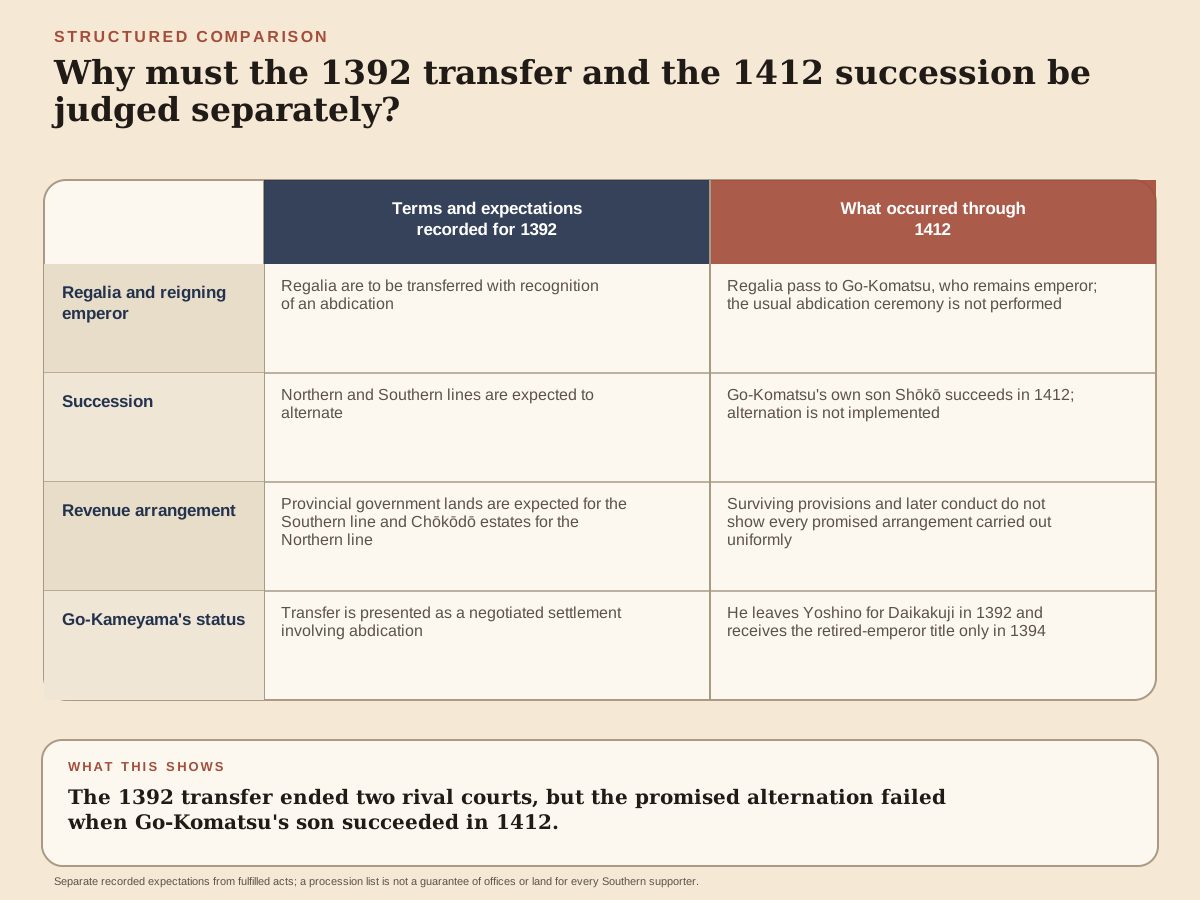
Historical accounts describe three connected provisions: transfer of the regalia with recognition of abdication, alternation of the imperial lines, and arrangements for the Southern line’s provincial revenues alongside holdings of the Northern line. A letter copy in the Konoe collection records these expectations: provincial government lands for the Southern line and the Chōkōdō estate group for the Northern line.
The texts and subsequent conduct do not establish that every party accepted or carried out those provisions in the same way. In particular, the recognition of an abdication expected by Southern supporters was not equivalent to simply recovering objects for the existing Kyoto emperor. The usual abdication ceremony was not performed, according to the municipal history’s account.
In 1392’s intercalary tenth month, Go-Kameyama traveled to Kyoto and entered Daikakuji. A procession list records seventeen courtiers and forty accompanying warriors, including members of the Kusunoki group. The modest recorded retinue gives a concrete view of the court that was moving.
The regalia were transferred to Go-Komatsu. He remained emperor in Kyoto, and Go-Kameyama ceased to reign from Yoshino. The two courts’ parallel operation ended through this movement and transfer.
Go-Kameyama’s association with Daikakuji connected the settlement to the temple’s earlier history with the Daikakuji imperial line. The temple’s present halls have later rebuilding histories; a room displayed today cannot establish every step of the 1392 ceremony.
Yoshimitsu brokered and coordinated the settlement. The imperial participants still performed the transfer and held the titles. The government’s military predominance enabled negotiation, but the shogun did not personally inherit the imperial throne.
The returning procession, known through a surviving list, made the change visible. It counted seven warriors from the Kusunoki group among the forty-man escort, alongside men associated with Izumi and Yamato. The list does not securely identify every warrior or establish that a particular Kusunoki successor led them. It nevertheless records people and regional connections accompanying the emperor, rather than only a symbolic transfer between two names.
Go-Kameyama's arrival at Daikakuji and delivery of the regalia accomplished the central transition. The reported succession and income arrangements concerned what would happen afterwards. Keeping these stages separate explains why a transfer could be completed even as its meaning remained contested. Go-Komatsu continued to occupy the throne; the Southern emperor's departure did not initiate a new Northern reign or give Yoshimitsu an imperial title.
Kyoto had one reigning emperor after the transfer. Go-Komatsu continued the Northern line. Go-Kameyama received the title of retired emperor in 1394, two years after the transfer. A rival court no longer offered immediate appointments under its own reigning emperor.
Southern supporters nevertheless retained their households and claims. Changing the recognized imperial center did not automatically settle possession of each estate or place every former official in a Kyoto office. The procession records people moving; they are not a register of guaranteed new appointments.
Alternation was not put into practice. Go-Kameyama departed Daikakuji for Yoshino in 1410 amid dissatisfaction with the settlement’s fulfillment. In 1412, Go-Komatsu passed the throne to his own son, Shōkō. Go-Kameyama returned to Kyoto in 1416.
The difference between the accomplished transfer and the unfulfilled succession arrangement endured. The settlement removed the active Southern imperial government, while preserving a grievance that dynastic descendants and supporters could invoke.
The settlement therefore changed the position of an emperor before resolving the position of every supporter. Courtiers in the recorded procession moved with Go-Kameyama, and warriors provided an escort, but their names do not amount to a list of offices or land guaranteed by the Kyoto government. The revenue provision was an expectation about the imperial line's support; it did not itself establish that every household's former income was restored.
Regional resistance also survived. After Go-Kameyama's departure in 1410, Kitabatake Mitsumasa in Ise raised forces in support of Southern restoration. In southern Kawachi, a Kusunoki group seized and held a castle in 1437 before military forces overcame it. A court diary cited by the municipal history records the report of victory reaching the government in August. The brief entry does not disclose the commander's personal name or justify reconstructing a large, unified Later Southern army. It does show that incorporation was still being pursued through force decades after the regalia transfer.
Alternating succession, regional possession and recognition of former adherents thus followed different courses. There was one reigning emperor in Kyoto, yet Go-Kameyama could return to Yoshino, regional warriors could invoke the Southern claim, and the next succession could disappoint the departing line. The agreement ended the parallel imperial governments without closing those further contests.
The settlement strengthened Yoshimitsu’s position between court and military government. Opponents could no longer join an existing Southern court in the way that earlier Ashikaga factions had done. The mediator Ōuchi Yoshihiro’s 1399 rebellion nevertheless shows that ending court division did not eliminate conflict among military houses.
Later Southern claimants sought to reverse aspects of the result. In 1443, a group including Hino Arimitsu attacked the Kyoto palace and took the sword and jewel. Subsequent fighting killed leaders of the attack, but recovery of the missing jewel remained a later political objective.
Its 1458 recovery helped surviving Akamatsu retainers restore their house’s standing and obtain provincial office for Masanori. Regalia could still be linked to service and reward long after the 1392 transfer.
Later remembrance also attached the Southern court to buildings and sacred places. Daikakuji preserves this association through a temple reconstructed in later periods. The settlement’s institutional result, the later struggles over its promises and the surviving places of memory have distinct chronologies.
The 1443 theft and 1458 recovery show a further change in the use of the regalia. Objects delivered to secure the 1392 settlement were later taken from the palace by another armed group. Recovering the jewel then provided service for which the Akamatsu house could be rewarded with provincial office. A symbol of imperial succession remained involved in military competition and the rebuilding of a warrior house.
The sources also preserve different kinds of evidence. The Konoe letter copy sets out reported terms; the procession list records a retinue. Dated diaries cited for later Kusunoki incidents record particular reports, not a complete account of Southern restoration. Meitokuki is a war tale about the 1391 Yamana rebellion, useful for the settlement's military background rather than a diary of the 1392 transfer. These records cannot be treated as interchangeable witnesses to one uncontested agreement.
Modern official teaching gave the dynastic dispute another history. In 1911, controversy over school-history wording passed from newspaper argument to parliamentary questions. The Education Ministry stopped use of the disputed teachers' reference book, and textbook deliberations adopted the term 'Yoshino Court' in place of 'Northern and Southern Courts'. Surviving correspondence also reports ministerial instructions against presenting the two courts as parallel legitimate lines. This later educational treatment favored Southern legitimacy even though the succession following 1392 had remained with the Northern line. It records a modern judgment about the past, rather than the shared understanding of the medieval negotiators.