Read the article below. Interactive reading tools are available when scripts load.
Quick
Yoshinobu had returned governing authority in November 1867, but his house retained lands, forces and officials. A council under imperial authority might still include him. Restoration leaders instead sought a government that would end Tokugawa leadership.
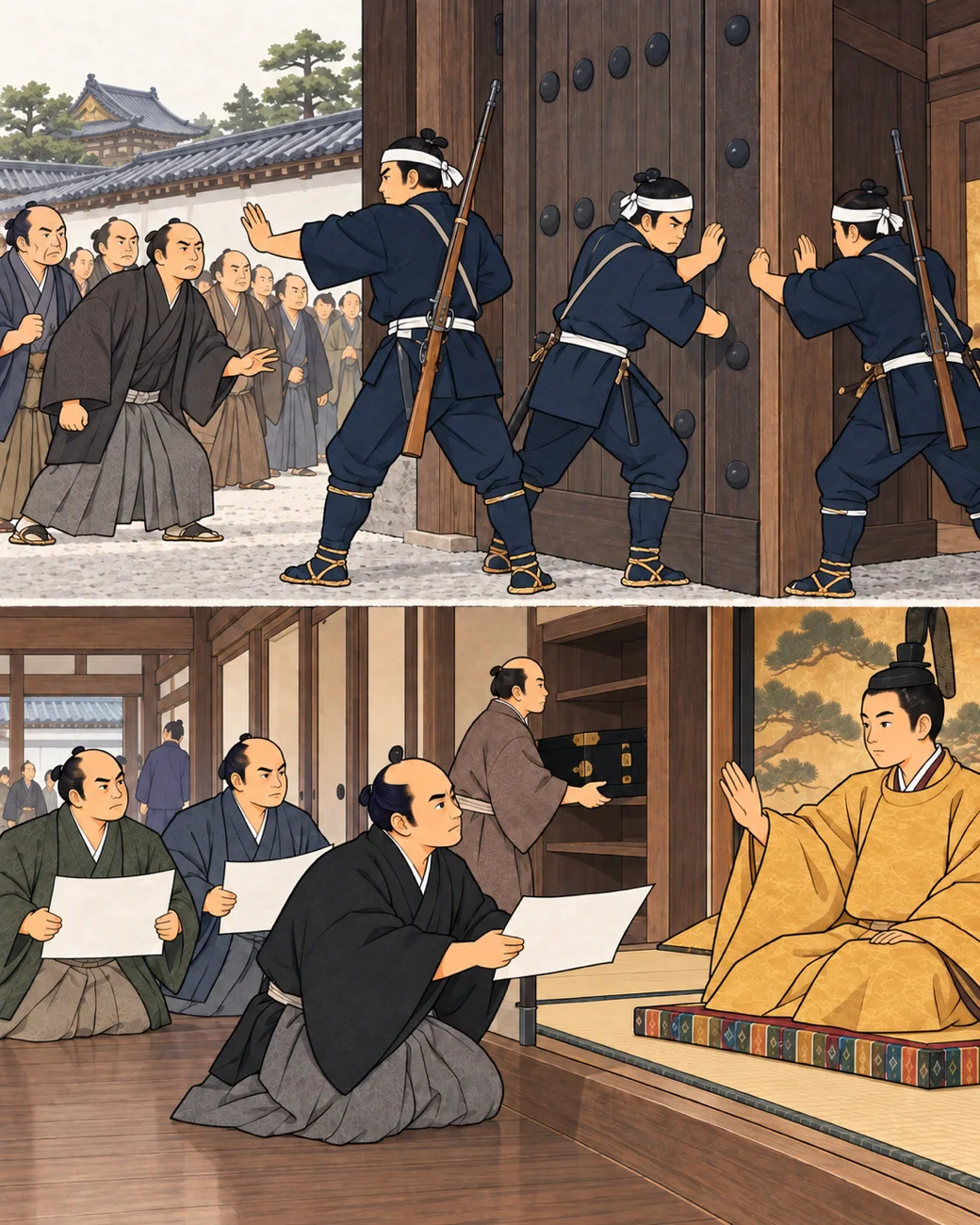
On January 3, 1868—the ninth day of the twelfth month of 1867 in the Japanese calendar—coalition troops restricted access to the Kyoto palace. Iwakura Tomomi and participating leaders secured imperial approval for a restoration proclamation. Control of the palace determined who could take part in these proceedings.
The proclamation accepted Yoshinobu’s return of authority and resignation as shogun. It abolished the shogunate and the regent and chief-adviser offices, replacing them provisionally with sōsai, gijō and san’yo: president, senior councillors and junior councillors. Prince Arisugawa Taruhito became president. An appeal to Emperor Jinmu’s founding accompanied a call for deliberation across inherited court and warrior ranks.
That evening, a council in the Kogosho discussed Yoshinobu’s remaining position without him present. Yamauchi Yōdō favored including him; Iwakura and Ōkubo Toshimichi pressed for relinquishment of his court office and lands. Asano Nagakoto took part in mediating the demand. Abolishing the shogunal office and securing the Tokugawa house’s resources were separate problems.
Yoshinobu withdrew to Osaka, where negotiation continued alongside military preparation. A letter from Satsuma’s Kawakami Hirokane described him as obedient but his followers as difficult to calm. The coalition also differed over patrol responsibilities. The proclamation supplied new offices and a claim to government; it had not settled command of the forces outside the palace. Fighting at Toba and Fushimi later in January tested that claim.
Classic
Returning governing authority had left the next government’s membership open. Yoshinobu possessed the Tokugawa house’s lands and forces, while bakufu officials continued practical business. An assembly of lords could give him a substantial place under imperial authority.
Tosa’s Yamauchi Yōdō favored that route. Iwakura Tomomi and leaders working with Satsuma sought a restoration arrangement that would displace Tokugawa leadership. Agreement that the court should govern did not settle who would advise it or command resources.
The palace was both the emperor’s residence and the place where imperial decisions were issued. Restricting entry could determine which officers and lords participated in the announcement. Military guards therefore mattered to the council’s composition as well as to security.
Yoshinobu’s resignation request also remained distinct from the return of authority. A proclamation could formally settle inherited offices, but transferring the house’s resources required further demands and compliance. The coalition faced both tasks in January.
The rival arrangements differed in sequence as well as personnel. A lords' council could first admit Yoshinobu and use the Tokugawa house's administrative capacity. The restoration coalition instead sought to define the new government before deciding his place in it. Both appealed to imperial authority, but the second route made control of access to the court especially consequential. Neither plan supplied, by itself, the personnel and revenue needed for nationwide government.
Aki's position also resists a simple division between two camps. Asano had supported a military undertaking with Satsuma and Chōshū, while his domain also urged Yoshinobu to return authority. His participation in the subsequent mediation belonged to this history of pursuing more than one route through the crisis.
On January 3, coalition troops secured the palace and restricted access. The date belongs to 1868 in the Gregorian calendar, although the Japanese calendar still dated it to the twelfth month of 1867. The announcement followed the coalition’s control of the meeting place.
Iwakura and participating leaders obtained imperial approval for the restoration proclamation. It accepted both the earlier return of governing authority and Yoshinobu’s resignation as shogun. These were matters decided in the emperor’s name, rather than a transfer completed by the guards alone.
The document abolished the shogunate and the sesshō regency and kanpaku, the senior imperial advisory office. It provisionally established three offices: sōsai (president), gijō (senior councillors) and san’yo (junior councillors). Its appeal to Jinmu’s founding accompanied a requirement for deliberation without the old separation of court and warrior ranks; it did not provide a complete ancient administrative system to revive.
Prince Arisugawa Taruhito occupied the presidency. Ōkubo served as a junior councillor. The new titles assigned places in a governing body, allowing proposals to be submitted within an imperial structure while its wider administration was still being formed.
At the evening Kogosho council, Yamauchi Yōdō argued for Yoshinobu’s participation. Iwakura and Ōkubo supported demands that Yoshinobu relinquish his court office and lands. Asano Nagakoto mediated. The council thus moved from ending an office to reducing the resources and standing of its former holder.
Yoshinobu subsequently moved to Osaka. Kawakami Hirokane’s correspondence reported his obedience alongside unrest among his followers. Other correspondence described reluctance by Tosa and Aki to undertake patrol duties. Neither the Tokugawa side nor the coalition acted as a group with a single settled response.
Yamauchi's objection concerned the terms of public deliberation: a former shogun with major resources should take part before the new body settled his position. Iwakura and Ōkubo's demand reversed that sequence, requiring the relinquishment of office and land. Asano's mediation helped produce the demand, but a council decision did not specify an already completed survey and transfer of every Tokugawa estate.
The proclamation also described how rank should operate within the provisional government. Its appeal to Jinmu's founding accompanied deliberation across former court and warrior distinctions. This authorized a new body of officers; it did not erase differences in domain power or install an ancient ministry system. Guarding the palace, securing imperial approval and assigning offices were connected stages, each requiring participants to act.
The proclamation replaced the old national governing offices with a provisional imperial body. Its acceptance of Yoshinobu’s resignation formally ended the shogunal appointment. The court now issued government decisions through officers bearing the new titles.
The land demand was not itself a completed transfer of Tokugawa estates. Yoshinobu’s forces and resources remained available outside the palace. The council had declared what it required, with implementation still dependent on negotiation or force.
Yoshinobu’s move to Osaka left him able to communicate and consult with supporters. Kawakami’s report distinguished his obedience from agitation among followers. Differences within the coalition over patrols further complicate an account in which two unified sides immediately chose war.
The unresolved military balance became a direct test later in January at Toba and Fushimi. The restoration proclamation supplied authority for the new government’s actions, but its control beyond the palace had to be established in the fighting and settlements that followed.
The new structure was provisional precisely where its language sounded final. Abolition ended the recognized offices; it did not automatically redirect every military order, tax payment or official communication. Yoshinobu's withdrawal left resources outside the new body's immediate command, while disagreements over patrols showed limits within the coalition itself. A government could be announced before its supporters had agreed on all the work of governing.
This is also why restoration did not mean the recovery of a fixed old constitution. Nineteenth-century courtiers and domain officers occupied newly constituted posts. Ancient founding language gave their acts imperial authority, while the practical assignments and competing claims belonged to the current crisis. The decisive change in offices coexisted with an unresolved distribution of power.
The three provisional offices created a channel for proposals in the emperor’s name. Their work extended beyond abolishing the bakufu: officers had to decide where the emperor and government would operate and how they would conduct affairs outside Kyoto.
After Toba and Fushimi, Ōkubo submitted an Osaka capital proposal to Arisugawa Taruhito. He argued for a monarch who would travel and attend to the people, and for Osaka’s advantages in diplomacy and military affairs. This was a proposal within the new government, not an accomplished relocation.
The capital proposal was not adopted, although an imperial visit to Osaka followed in spring 1868. The distinction between proposal and action matters: the restoration government developed its practices through further decisions, rather than acquiring a complete program from the January proclamation.
The proclamation’s call to cross inherited court and warrior ranks widened the terms of elite deliberation. It did not establish elections or equal participation for inhabitants of the domains. Their relationship to the new government would depend on later administrative and military measures.
Ōkubo's capital proposal makes the ensuing work concrete. He argued that separation between the court and people should be reduced and that the monarch should travel, while Osaka offered advantages for diplomacy and military affairs. Submission to the new president turned these views into a proposal the provisional government had to consider. Rejection and the later visit were different decisions, not evidence that the entire program had been accepted.
Imperial authority and coalition action must therefore be read together. The young emperor's approval mattered, and courtiers and domain leaders supplied the guards, proposals and officers through which government operated. Neither a sovereign acting alone nor a permanently united faction describes that distribution. The proclamation created an authoritative center without establishing elected representation or settled limits on the center's future powers.