Read the article below. Interactive reading tools are available when scripts load.
Quick
Hōjō Tokimasa was born in 1138 and belonged to a warrior household based in Izu, the peninsula southwest of present-day Tokyo. The Hōjō served within the provincial administration, where local standing and armed relationships could support official duties. Minamoto no Yoritomo was living in exile in Izu when Tokimasa’s daughter Masako became his wife. That marriage connected Tokimasa’s household with a displaced member of a prominent military family. When Yoritomo rose against the Taira in 1180, Tokimasa joined him with his sons. The connection now required military commitment, and the first campaign would bring both defeat and a family death. [1][2][3]
In 1180 Yoritomo’s forces lost at Ishibashiyama, in Sagami, west of the later Kamakura base. Tokimasa’s son Munetoki was killed in the aftermath, while Tokimasa and Yoshitoki escaped toward Awa across the sea. Yoritomo then sent Tokimasa to the inland province of Kai to seek support from Takeda Nobuyoshi and other Minamoto warriors. Those allies joined the coalition that defeated the Taira expedition at Fujikawa. Tokimasa subsequently remained around the Kamakura government rather than taking part in the western expeditions that destroyed the Taira. His part in the regime’s foundation included recruiting, survival and service at its base. [1][3]
In 1185 Tokimasa went to Kyoto as Yoritomo’s representative after the conflict with Yoshitsune. He obtained court permission for arrangements connecting the pursuit of fugitives with warrior supervision and the collection of resources in the provinces. These negotiations are conventionally associated with the recognition of military governors and estate stewards. The initial powers and their geographical scope remain matters of historical debate. Grain demands and interference in local administration brought opposition; in 1186 Tokimasa relinquished claims to offices over seven provinces. He also transferred responsibility for Kyoto security to a successor and returned to Kamakura. The government’s reach developed through negotiation and adjustment. [1][2][6][7]
Back in the east, Tokimasa supported Ganjōju-in in Izu, the Hōjō’s home region. The temple preserves sculptures by Unkei whose internal inscription tablets date their making to 1186; its foundation account also associates Tokimasa’s patronage with Yoritomo’s northern campaign in 1189. Religious patronage gave the family a lasting presence beside its political service. After Yoritomo died in 1199, his son Yoriie succeeded to leadership. Tokimasa joined thirteen senior retainers who handled litigation, limiting Yoriie’s personal decisions. He received court rank and the title governor of Tōtōmi in 1200. The succession would bring his household into conflict with Yoriie’s Hiki relatives. [4][1][3][2]
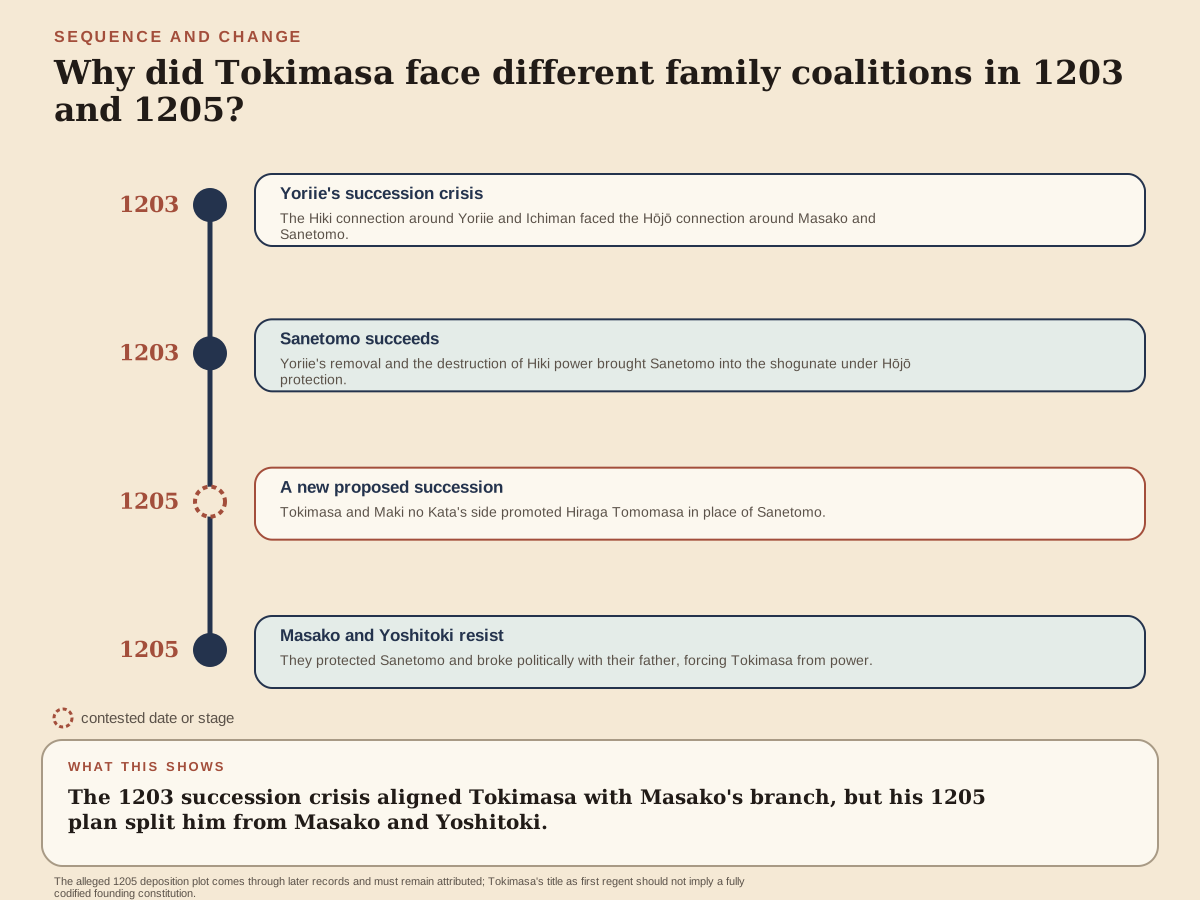
In 1203 the illness of Yoriie intensified rivalry over his authority and inheritance. Hiki Yoshikazu was connected to Yoriie’s wife and son, while Tokimasa’s household supported the younger Minamoto brother Sanetomo. Tokimasa killed Yoshikazu and destroyed the Hiki family; Yoriie’s son Ichiman also died in the conflict. Yoriie was removed and Sanetomo installed as shogun, the formally appointed head of the warrior regime. Tokimasa then directed affairs through the Mandokoro administrative office alongside Ōe no Hiromoto. He is conventionally counted as the first Hōjō regent from this point. Family predominance had grown through the elimination of relatives and rivals inside the ruler’s household. [1][2][3]
In 1205 a quarrel in Kyoto involving Hiraga Tomomasa, Tokimasa’s son-in-law by Maki no Kata, led to accusations against the Hatakeyama household. The regime’s forces killed Hatakeyama Shigetada and his son despite opposition within Tokimasa’s own family. Accounts then attribute to Tokimasa and Maki an attempt to remove Sanetomo and make Tomomasa shogun. Masako and Yoshitoki protected Sanetomo at Yoshitoki’s residence, breaking the attempt. Tokimasa was forced out, took Buddhist vows and retired to Izu; Tomomasa was killed in Kyoto. Tokimasa died in 1215. His children continued Hōjō leadership after ending his personal rule. [5][2][1]
Classic
Tokimasa’s life began in 1138 in a household associated with Hōjō in Izu, the peninsula southwest of the later Kamakura base. The name Hōjō identified a locality as well as the family that would become famous. Its members belonged to the provincial official community, conducting local affairs within a territorial administration whose senior appointments came from outside the province. A warrior household in this position joined service, local connections and the ability to assemble armed men. Tokimasa entered the rising of 1180 with a base from which to act, although his earlier life is much less fully recorded than the events that followed. [1][2]
Yoritomo was a Minamoto exile living in Izu. Tokimasa’s daughter Masako married him there. Reference biographies connect Tokimasa with oversight of the exile, but the politically consequential fact is that the relationship became one of marriage and support. Through Masako, the Hōjō became relatives of the household around which Yoritomo would assemble followers. The arrangement joined the exile’s family name to people with connections in the province where he lived. [2][1]
In 1180 Yoritomo raised forces against the Taira, and Tokimasa helped attack Yamaki Kanetaka, the deputy of Izu’s governor. The target belonged to the local official order in which the Hōjō had operated. The rising consequently carried the household beyond its existing service relationships into armed opposition. Tokimasa’s sons Munetoki and Yoshitoki joined the undertaking. Fatherhood and marriage supplied participants and connections; they also placed several members of the same household at risk in one campaign. [1][2][3]
The position later held by Hōjō regents was still decades away. At the beginning of the rising, Tokimasa was supporting a son-in-law who needed sufficient forces and allies to survive. The Hōjō’s resources formed one part of that undertaking rather than a government already secure in its authority. Success would require connections beyond Izu, and the next battle demonstrated the cost of proceeding before a stronger coalition had gathered. The household’s place in Japanese history grew out of this exposed commitment, followed by the work of recovery after defeat. [3][1]
The rising of 1180 soon met a force it could not overcome at Ishibashiyama in Sagami. Yoritomo’s defeat scattered his supporters and made escape an immediate necessity. Tokimasa’s elder son Munetoki was killed after the battle, while his younger son Yoshitoki survived. Tokimasa and Yoshitoki escaped by sea toward Awa, on the opposite side of the bay. The political connection formed through Masako’s marriage had now cost the household a son. The coalition’s later growth would proceed with that loss already part of its history. [1][3]
Yoritomo sent Tokimasa into Kai, an inland province west of the Kantō plain, to approach Takeda Nobuyoshi and associated warriors. These men had their own local positions and belonged to Minamoto networks distinct from Yoritomo’s immediate household. Tokimasa’s assignment was to connect their armed strength with the force being rebuilt around Yoritomo. He returned with allies from Kai and Shinano. The recruitment enlarged the field of action available after Ishibashiyama: the Hōjō family’s initial commitment had become a contribution to an alliance extending across several provinces. [1][3]
At Fujikawa in Suruga, the strengthened coalition forced the Taira expedition led by Koremori to retreat. The result joined the actions of newly recruited allies with those of Yoritomo’s other supporters. Tokimasa’s place in the account rests on bringing forces into that combination. The victory helped secure Yoritomo’s growing position in the east, where Kamakura became his governing base. Subsequent western campaigns against the Taira were conducted by other commanders; Tokimasa stayed near the regime’s center. The work required to sustain a rising continued through different participants after its immediate battlefield recovery. [1][3]
By 1185 the Taira had been defeated, and Yoritomo’s government faced a struggle with his own brother Yoshitsune. Tokimasa had gained experience inside the household and coalition directing affairs from Kamakura. His usefulness could now be expressed through a delegation to Kyoto, where the court’s authorization remained necessary to claims made across provincial and estate boundaries. Recruiting warriors and negotiating with the court involved different resources, but both required acting on behalf of Yoritomo. The man who had helped restore a defeated army would next carry its government’s demands into the capital. [1][2][7][3]
Tokimasa’s delegation to Kyoto in 1185 followed the confrontation between Yoritomo and Yoshitsune. The pursuit of Yoshitsune and his ally Yukiie supplied the immediate purpose for demands on the court. Acting for Yoritomo, Tokimasa sought authorization to organize warriors and draw on resources beyond Kamakura’s eastern base. The court and the retired sovereign Go-Shirakawa possessed authority over an order already divided among provincial administrations and estates held by powerful houses and temples. Permission consequently mattered wherever military action pressed upon rights and revenues claimed within that order. [1][2][6][7]
Historical disagreement · Was there a separate province-wide stewardship?
In the province-wide stewardship reconstruction, the kuni jitō supervised land and collected military grain across estates and public lands. This made pursuit a means of extending Kamakura’s administrative reach. Local officials and armed men could be drawn into the organization; the disputed authority concerned supplies as well as policing.
Santa Takeshige’s 1991 study disputes the separate office. He locates the grain and confiscated-land powers in the pursuit commission, and reads the “seven-province stewardships” as estate and district stewardships within seven provinces, rather than seven province-wide offices.
The dispute changes which institution exercised the powers and the territory those powers covered. Court authorization in 1185 should not be treated as proof that every later shugo and jitō function already existed in its mature form. [6][7]
The grain demands and interference in provincial affairs generated local confusion and opposition. In 1186 Tokimasa offered to relinquish the offices or claims he held over seven provinces and continue with pursuit responsibilities. Yoritomo stopped the broad collection of military grain, and further measures restrained warriors’ interference outside protected categories of confiscated land. Permission obtained in Kyoto had therefore led into disputes about its exercise. Landholders and provincial authorities did not simply disappear beneath a new military command. The retreat from the broadest claims helped shape an arrangement in which pursuit, policing and estate management could develop through different offices. [6][7]
Tokimasa also undertook Kyoto security and negotiations with the court as Yoritomo’s representative. In 1186 he entrusted those duties to Ichijō Yoshiyasu and returned to Kamakura. The episode had enlarged the standing of the government he served while exposing the limits of its initial demands. Later summaries describe 1185 as the recognition of shugo, military governors, and jitō, stewards associated with land management and dues. The actual delegation belongs to a longer institutional development whose early powers were contested and revised. Tokimasa returned east with experience of government at the point where military resources and established jurisdictions met. [1][6][7]
Evidence boundary · Two dates in the temple’s early history
Tokimasa’s government service carried him to Kamakura and Kyoto, while Ganjōju-in expressed household standing in Izu. The temple’s sculptures include an Amida Buddha and attendant protective figures attributed to Unkei. Inscription tablets inside the works date their production to 1186. The temple’s own foundation narrative places emphasis on 1189, linking Tokimasa’s support to prayers for Yoritomo’s campaign against the northern Fujiwara.
These markers identify different aspects of the temple’s early history: the making of the surviving sculptures and the campaign association in the institutional account. [1][4]
Ganjōju-in became a Hōjō family temple, with construction continuing under Yoshitoki and Yasutoki after Tokimasa. Yoshitoki added a hall commemorating his dead father, while later buildings enlarged the precinct. After Tokimasa’s death, court recognition followed in 1222. The successive works connected prayer, family memory and resources committed to a religious institution. The patron’s role extended beyond donating one object: later relatives maintained a setting in which the family’s standing could be commemorated. The surviving sculptures and the institutional memory thus lead back to Tokimasa while also showing contributions made after his death. [4]
Yoritomo died in 1199, and his son Yoriie succeeded as head of the Kamakura regime. Tokimasa was related to the new ruler through Masako, Yoriie’s mother. The Hiki household possessed another connection through Yoriie’s wife and child. Tokimasa and Yoshitoki joined thirteen senior retainers who handled litigation in place of Yoriie’s unrestricted personal adjudication. The arrangement drew experienced households into decisions, including Hiki Yoshikazu himself. It contained competing interests within the same governing circle rather than removing rivalry from the succession. [1][3]
In 1200 Tokimasa received court rank and the title governor of Tōtōmi. The award added aristocratic distinction to his place among the government’s senior warriors. It did not settle the balance between Yoriie’s leadership and the households gathered around him. The Hōjō and Hiki drew strength from different connections to the ruler and the next generation. When Yoriie became gravely ill in 1203, those connections would become claims upon the division of his authority and inheritance. Tokimasa’s established resources—kinship, senior service and governing office—would now be used in a succession struggle with a violent outcome. [2][1]
Yoriie’s grave illness in 1203 made the succession an immediate governing problem. Authority over the regime and rights associated with its landholding connections could be divided among members of the Minamoto household. Tokimasa took a leading part in arranging that division, provoking Hiki Yoshikazu. The Hiki interest lay in Yoriie’s wife and their son Ichiman; the Hōjō connection also reached Yoriie’s younger brother, Sanetomo. A disagreement about the ruler’s inheritance therefore crossed several households linked by marriage and parentage. The claimants were operating within a government whose founding leader had died only four years earlier. [1]
Tokimasa killed Hiki Yoshikazu, and forces destroyed the Hiki household. Ichiman, Yoriie’s son, died in the conflict. The destruction removed a group with intimate connections to the ruling Minamoto family as well as its own warrior following. It also reduced the field of succession by eliminating people around whom a competing inheritance could have gathered. Yoriie was deposed, and his younger brother Sanetomo became shogun. For the Hōjō, the result joined a favored ruler’s installation to the destruction of the relatives whose position had depended on the former ruler. [1][2]
After Sanetomo’s installation, Tokimasa became a head of the Mandokoro, the administrative office, together with Ōe no Hiromoto. This position gave his predominance a place within the government’s work rather than relying solely on kinship. The regime continued to have a shogun appointed through a court title, while Tokimasa exercised executive direction beneath him. Later lists count him as the first shikken, usually translated as regent, for 1203–1205. The office and its powers would continue to develop under successors; the conventional first-regent label identifies Tokimasa’s position within that development. Hiromoto’s participation also reminds us that administrative leadership involved experienced officials alongside the ruling warrior household. [2][3]
Yoriie was confined at Shūzenji, a Buddhist temple in Izu. Iida Yukiko’s biographical account records that his request to be joined by close attendants was refused. In 1204 he was killed there; Seno Seiichirō attributes the killing to Hōjō agents. Sanetomo’s appointment and his elder brother’s death were separate stages in the consolidation of the new government. Tokimasa’s ascendancy continued while Masako’s displaced son remained confined and then was killed. [10]
The Hiki victory strengthened Tokimasa, but its means left the government’s leadership tied to violence within the shogunal family. Masako was mother to Yoriie and Sanetomo, and Yoshitoki possessed a following and offices of his own. Tokimasa’s later marriage to Maki no Kata introduced further children and a son-in-law whose interests could diverge from theirs. Dominance over a succession did not make all these relatives share one interest in the ruler who had been installed. The question would become acute in 1205, when Tokimasa’s direction again destroyed a powerful warrior household and then threatened Sanetomo’s position. [1][5]
Evidence boundary · The charge against the Hatakeyama
The crisis of 1205 followed a quarrel at a Kyoto gathering between Hiraga Tomomasa and a son of Hatakeyama Shigetada. Tomomasa had married a daughter of Tokimasa and Maki no Kata and held responsibilities in Kyoto. He brought accusations against the Hatakeyama to Maki, connecting a dispute in the capital with relatives directing affairs at Kamakura. Tokimasa’s forces destroyed Shigetada and his son.
The reported accusations should be distinguished from proof of rebellion: the destruction was a political and military action against a prominent household. Relatives including Yoshitoki and Tokifusa are described as having opposed the attack before it went ahead. [5][1][2]
Accounts of the Maki Incident then describe an attempt by Tokimasa and Maki to replace Sanetomo with Tomomasa. Masako and Yoshitoki secured Sanetomo before the plan could succeed, moving him from Tokimasa’s residence to Yoshitoki’s. Protecting the ruler’s person changed the means available to the opposing relatives. Tokimasa had exercised authority under Sanetomo; his children could now sustain the same shogun while rejecting their father’s proposed replacement. The conflict divided the Hōjō household along the relationships that different marriages had created. Political control depended on people and places that could be separated from the senior father’s command. [5][1]
Tokimasa took Buddhist vows and was sent back to Izu, while Yoshitoki assumed the leading position in government. Tomomasa was attacked and died in Kyoto. The defeat thus removed both the senior sponsor at Kamakura and the proposed alternative ruler in the capital. Maki is said to have accompanied Tokimasa into retirement, though her later life also included religious activity in Kyoto. The family connections that had made the plan possible continued in altered circumstances after its failure. Tokimasa’s removal preserved Hōjō predominance while transferring its direction to the relatives who had resisted him. [1][5]
Tokimasa lived another decade and died in Izu in 1215. His years away from government are less fully described than the succession struggles that ended his rule. Ganjōju-in remained a setting for his family’s commemoration, and Yoshitoki built a hall for his deceased father. Maki later arranged a thirteenth-year memorial observance for him in Kyoto. Religious memory could continue across a political rupture that had divided husband, wife and children. Tokimasa left neither the last word on Hōjō government nor an undivided inheritance of personal authority. His surviving family directed the regime, while the temples and memorial observances kept a place for a father whose rule that family had ended. [2][1][4][5]