Map: GSI Japan Dōtonbori is best known today for illuminated signs and restaurants, but its durable historical identity began with a canal and a deliberately concentrated theater district. Kabuki, puppet jōruri, mechanical spectacle, cinema, revue, and modern commercial entertainment occupied the same narrow urban corridor in succession. The surviving canal, documented theater sites, and Osaka Shōchikuza make that transformation legible even though none of the Edo-period playhouse buildings remains.
The Canal That Organized an Entertainment District
Attraction
The Dōtonbori River is not merely scenery beside the district: it is the piece of urban infrastructure that made the theater quarter possible. The canal project began in the early seventeenth century, and in 1626 officials permitted a nearby theater district to move to its banks. Playhouses, teahouses, restaurants, and boat access then reinforced one another. The waterway and the narrow streets beside it still reveal the compressed geography of a commercial culture built around paying audiences, even though the original wooden venues have disappeared.
Current visibility
The canal and adjoining streets remain visible public urban space; the present waterfront is modernized and should not be read as an intact Edo-period streetscape.
The Five Playhouses on the Southern Bank
Attraction
The Goza, or Five Playhouses, gave Dōtonbori a hierarchy rather than a random collection of stages. Naka-za and Kado-za were prestigious kabuki houses; the theater later called Benten-za grew from Takeda's celebrated mechanical spectacles; Takemoto-za and Toyotake-za competed in puppet jōruri. Their former sites explain how different genres shared one commercial district while cultivating distinct audiences and reputations. None of the five Edo-period buildings survives, so the historical object is now their documented alignment along the canal, not any modern façade occupying a former address.
Current visibility
The playhouse buildings are lost. Their history is encountered through documented sites, markers, and the canal-side alignment.
Takemoto-za, Gidayū, and Chikamatsu's Puppet Drama
Attraction
A marker identifies the site of Takemoto-za, opened by Takemoto Gidayū in 1684 for narrated puppet drama. Chikamatsu Monzaemon became closely associated with the house, and The Love Suicides at Sonezaki premiered there in 1703. That achievement depended on a company and a venue: narrator, musicians, puppeteers, playwright, management, and repeat audiences turned written drama into a commercial performing art. The marker is therefore more than a memorial to one author. It locates the institutional setting in which Osaka's urban public helped establish works that outlived the theater itself.
Current visibility
The original theater is destroyed; a site marker identifies the location in the modern district.
A District Read Through Lost Sites, Not Replica Buildings
Attraction
Dōtonbori's theater history requires disciplined looking because commercial redevelopment repeatedly replaced the structures that made the district famous. Addresses and markers for Naka-za, Kado-za, Takemoto-za, Toyotake-za, and Benten-za preserve a spatial record, but modern shops and entertainment buildings are not replicas of the old playhouses. Reading several sites together reveals the scale of the former cluster and prevents one surviving modern theater from being mistaken for the whole story. The absence is itself historical evidence of fire risk, changing property values, new media, and commercial reinvention.
Current visibility
Only locations and commemorative traces remain for the Edo-period houses; present buildings have separate histories.
Cinema and the End of the Old Playhouse System
Attraction
In the twentieth century, moving pictures changed both the repertoire and the economics of Dōtonbori. Some playhouses converted to cinemas; others inserted films between live productions, and the old five-house system gradually collapsed. Naka-za, the last of the famous group to continue as a theater, gave its final performance in 1999. This was not a simple replacement of tradition by modernity. The same district absorbed a new reproducible medium, while kabuki, comedy, and other live forms reorganized around different buildings and companies. Dōtonbori thus records how mass entertainment changes institutions without abandoning place.
Current visibility
The historical transformation is legible through former sites and surviving modern venues; the closed playhouses themselves are not visitable.
Osaka Shōchikuza and the Visible Twentieth-Century Layer
Attraction
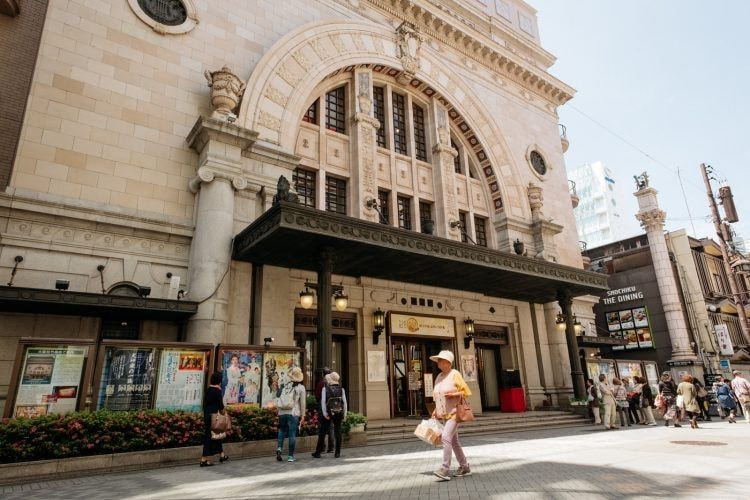
Osaka Shōchikuza supplies the district's clearest surviving theater façade, but it belongs to a later chapter. Opened in 1923 as a Western-style theater for film and revue, it subsequently served as a cinema and later became a principal venue for kabuki and other stage productions. A 1990s rebuilding retained the characteristic street façade while creating a modern performance building behind it. Its large arch therefore does not preserve an Edo playhouse; it shows how a new entertainment company deliberately inserted modern architecture into a district whose theatrical prestige was already centuries old.
Current visibility
The retained street façade is publicly visible. Auditorium access depends on current performances and venue arrangements.