Read the article below. Interactive reading tools are available when scripts load.
Quick
Born in 1653 as Sugimori Nobumori, Chikamatsu was the second son of a samurai family in Echizen, now Fukui Prefecture. His father Nobuyoshi served the Matsudaira houses of Fukui and Yoshie; his mother came from a physician’s family. Nobuyoshi later left service and became a rōnin, a warrior without a current lord. The household moved to Kyoto in the 1660s. [2][10]
Fukui city is the conventional birthplace. A 2018 study by Miyoshi argued instead for Yoshie, now in Sabae, using administrative letters and retainer records. This is an inference, not a letter directly locating the father at the birth. The precise birthplace remains disputed. The family’s move changed the work and patrons available to the young Nobumori.
In Kyoto, Nobumori served court-noble households, although the sequence of patrons is uncertain. A verse appeared in the haikai collection Takaragura in 1671. Haikai was a shared poetic practice using linked verses and allusion.
He became associated with the jōruri chanter Uji Kaga-no-jō in the 1670s. Jōruri joined musical narration to stories, often performed with puppets. Its printed shōhon contained the full play text, but a chanter’s voice gave the words their pace. Classical and warrior stories moved between literary circles and commercial stages. Nobumori was learning to write for that performed exchange; attribution of some early unsigned works remains uncertain.
Nobumori wrote Yotsugi Soga in 1683. Takemoto Gidayū used the work at Takemoto-za’s opening in Osaka in 1684, and Shusse Kagekiyo followed in 1685. The printed Sasaki Senjin, also known as Sasaki Ōkagami, displayed the author’s name Chikamatsu Monzaemon in 1686. Theater commentary soon recorded both objections and acceptance.
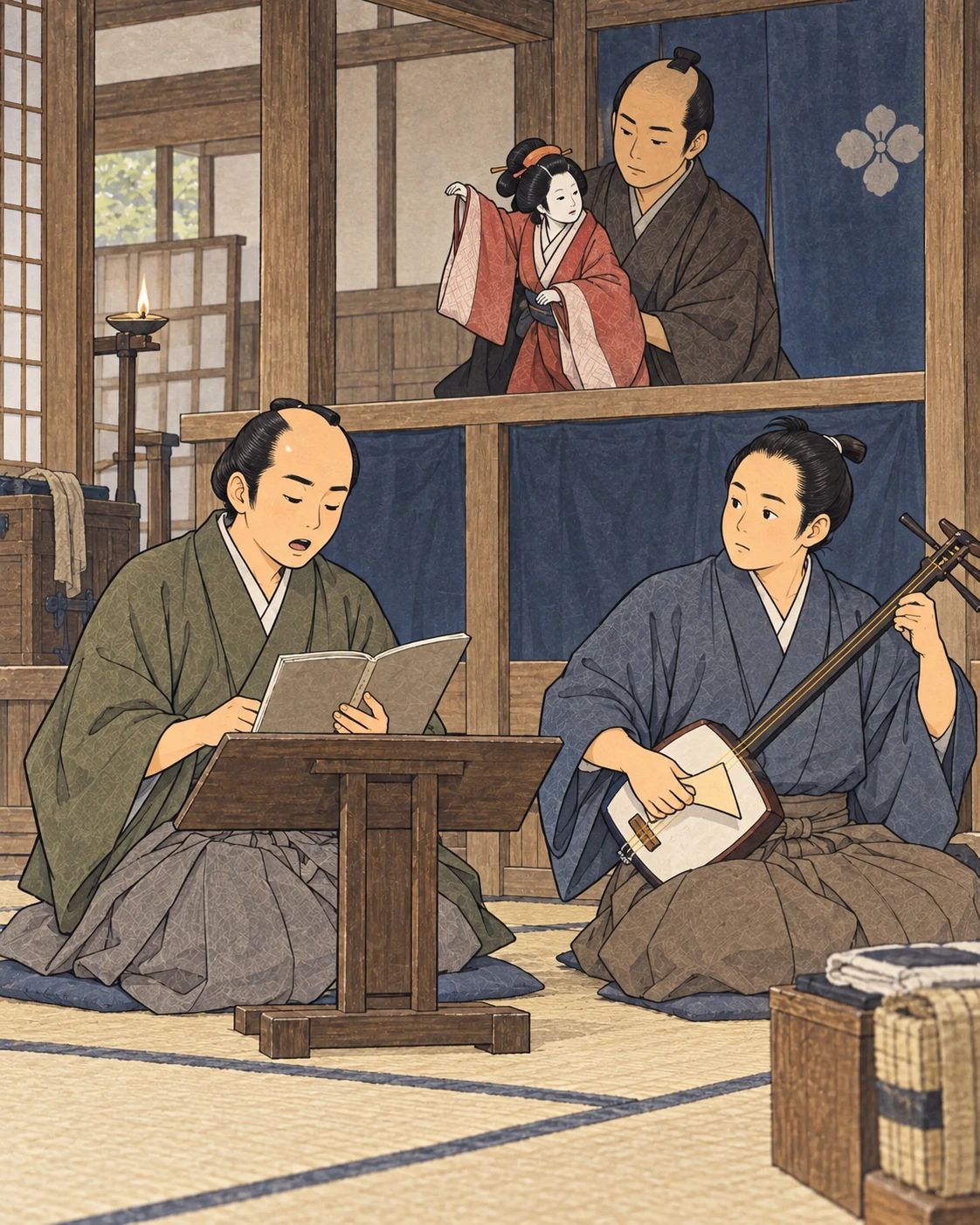
The signature identified a writer within a shared performance. A tayū, the principal narrator, voiced the characters; a shamisen player accompanied him on a three-stringed plucked instrument; puppeteers supplied movement. Leading puppets normally had one operator. The three-person system came in 1734, after Chikamatsu’s death. Bunraku is a later name for the tradition; his own stage was ningyō jōruri, narrated puppet theater.
In the 1690s Chikamatsu also wrote kabuki, theater performed by human actors, for Sakata Tōjūrō I. The actor worked in Kamigata, the Kyoto–Osaka region, and was celebrated for wagoto, a softer style suited to refined or vulnerable lovers.
A diary records discussion of a new play with Chikamatsu in 1698. In the 1699 Keisei Hotoke no Hara, a young lord’s disguise as a townsman links household succession to a courtesan love story. The role offered Tōjūrō room for his particular acting.
Chikamatsu’s closer commitment to Takemoto-za around 1705 did not simply follow Tōjūrō’s disappearance. Performance chronologies record the actor through 1708; he died in 1709. Chikamatsu’s work in the two forms overlapped.
Chikamatsu’s jidaimono were plays set in historical or legendary worlds. A recognized world, or sekai, let spectators bring knowledge of the Soga revenge or Kagekiyo’s warrior story to a new plot. Relationships and events could then be changed for performance.
Tokugawa Japan’s warrior government, the shogunate, also regulated theaters and publishing. Older settings and changed names could reduce the risk of staging a sensitive subject. They do not identify a hidden current ruler in every play, and there is no evidence of one central censor reading every line. Managers weighed the attraction of a recognizable story against possible local intervention. The plays belong to the commercial theater of Chikamatsu’s time, even when their characters come from an earlier one.
Takemoto Gidayū founded Takemoto-za in Osaka’s Dōtonbori theater district in 1684. His forceful narration, called gidayū-bushi, worked with musicians such as Takezawa Gon’emon and puppeteers such as Tatsumatsu Hachirōbei.
Financial difficulty made the success of Sonezaki Shinjū in 1703 especially important. Takeda Izumo became theater manager, while Gidayū concentrated on narration. Chikamatsu’s first work as resident playwright is dated to 1705; his move from Kyoto to Osaka followed in spring 1706. Attachment and relocation were different stages.
Toyotake-za’s first venture failed in 1703, but it reopened nearby in 1707. Rivalry for performers and audiences made continuing repertory essential. Chikamatsu gained a regular base while becoming more dependent on the fortunes of one house.
Tokubei and Ōhatsu died at Sonezaki in 1703. Takemoto-za staged The Love Suicides at Sonezaki one month later, using dates in Japan’s lunisolar calendar.
In the drama, Tokubei must repay a marriage advance. Kuheji denies owing him the money and has him beaten. Ōhatsu hides Tokubei beneath a veranda, where he hears her defend him. They then agree to die and leave together. This sequence is a play’s explanation, not the historical couple’s recorded conversation.
The success strengthened contemporary domestic drama, or sewamono, at the puppet theater. Giri, social obligation, and ninjō, human feeling, describe pressures within particular relationships. Ōhatsu’s courtesan contract and Tokubei’s employment imposed different constraints; their agreement onstage cannot establish equal freedom in life.
Premiered in 1711, The Courier for Hell drew on an embezzlement incident around 1709. Chūbēi, adopted heir of a courier house, has already misused fifty ryō, a gold-based monetary unit. His friend Hachiemon tries to stop further damage, but Chūbēi hears the warning as humiliation.
He breaks the seal on three hundred ryō entrusted for a warrior-house delivery and uses it to redeem the courtesan Umegawa. His access to customer money has become a breach of the trust sustaining his household.
Later adaptations in 1773 and 1796 changed Hachiemon’s role and gave the fugitives a flight through snow; Chikamatsu’s version uses rain. Those changes belong to the play’s later life, not its original incident or text.
After Gidayū’s death in 1714, the young narrator Masadayū helped carry Takemoto-za forward. The Battles of Coxinga, premiered in 1715, reportedly ran for seventeen months.
The play transforms Zheng Chenggong, a Ming loyalist with Chinese and Japanese parentage, into Watonai. Ming and Qing were the Chinese dynasties whose conflict supplied its historical background. The drama invents a fantastic restoration story.
Watonai’s half-sister Kinshōjo sacrifices herself when her husband Kanki refuses an alliance that would look like yielding to her family. Her blood signals the crisis and permits the alliance. This is theatrical invention, not Zheng’s biography. Masadayū’s narration and the company’s puppetry made the distant struggle a durable attraction; the long run does not prove that the writer alone saved the theater.
Takemoto-za premiered The Woman-Killer and the Hell of Oil in 1721, drawing on a recent murder whose particulars remain uncertain.
Yohei, expelled from his oil-merchant household, needs money for a debt. His parents leave help with O-Kichi, a married woman in another oil shop. He asks her for more, then attacks her when she refuses. As oil spills, she tries to escape and he kills her to take the money.
O-Kichi is a victim with her own household, not Yohei’s destined lover. The difficult puppet action does not erase her resistance. No continuing early run is documented, but that absence does not prove categorical rejection. The play’s later prominence came through recovery and adaptation.
Restrictions recorded for 1722 already addressed illustrated publications and kabuki as well as paired deaths and punishment. A further notice in the second month of 1723 renewed controls on naming and dramatizing love suicides.
In a 2024 study, Urushizawa associates an Edo adaptation of Sonezaki Shinjū in 1719 with later paired deaths there. She also traces differing regional responses: Edo performances declined, while related plays continued in Osaka in 1724. This interpretation does not prove that one Chikamatsu play caused a particular death.
After his last domestic play in 1722, Chikamatsu helped prepare work by manager Takeda Izumo and Matsuda Wakichi, later Bunkōdō. His own historical Kanhasshū Tsunagi-uma appeared in early 1724. The company still needed repertory and successors.
A fire displaced Chikamatsu in 1724; he died later that year in Tenma, Osaka. His recorded Japanese date, Kyōhō 9’s eleventh-month twenty-second day, is January 6, 1725 in the Gregorian convention. The year difference is calendrical.
Hōmyōji in Osaka and Kōsaiji in Amagasaki preserve different family and commemorative connections. Printed texts and later adaptations carried a large, unevenly attributed repertory beyond its first companies.
Late-Meiji kabuki revived The Woman-Killer and the Hell of Oil. In 1909 Tsubouchi Shōyō compared Chikamatsu with Shakespeare and Ibsen, helping place him in national literary history. By 1912 his reputation depended on later choices of editions and performances as well as on his original work.
Classic
Chikamatsu Monzaemon was born in 1653 as Sugimori Nobumori, the second son of a samurai family in Echizen, now Fukui Prefecture on Japan’s Sea of Japan coast. His father, Nobuyoshi, served the Matsudaira houses of Fukui and Yoshie. His mother came from a physician’s family. Nobumori grew up within the connections and expectations of warrior service, before his father left that service and the household moved to Kyoto. [2][10]
Historical disagreement · Where in Echizen was Chikamatsu born?
The birthplace within Echizen is less certain. The conventional Fukui-city account places the family near its lord; Sabae presents a Yoshie alternative. In a 2018 study, Miyoshi argued that the Yoshie administration was operating before the lord’s arrival and inferred that Nobuyoshi was already serving there. The argument combines letters about that administration with identification of a retainer in family records.
No letter directly says where Nobumori’s father stood at the birth. The disagreement concerns the inference from those records, not whether the future playwright came from Echizen. These sources do not establish a clear present Japanese scholarly consensus on the town. [1][2][10]
Nobuyoshi’s departure made him a rōnin, a warrior without a current lord. A stipend and an assured position were no longer available on the same terms, although literacy, acquaintances and samurai descent remained family resources. Accounts place the move to Kyoto at different points in the 1660s. Their common outline is a young Nobumori entering a city where another household’s service might offer the family a way forward.
Kyoto was the imperial capital and a center of publishing and performance. Court-noble houses employed attendants; poets circulated verses; commercial theaters drew on stories familiar from older literature. Nobumori would work across these settings. His eventual interest in shopkeepers and courtesans did not come from being born a merchant’s son, and the loss of his father’s office was no simple emancipation. It changed the occupations through which he could earn a place.
In Kyoto, Nobumori served court-noble households. Later accounts name Ichijō Ekan among his patrons, but the order and duration of these employments remain uncertain. Service brought him into a culture of classical stories and poetic exchange. In 1671 one of his verses appeared in Takaragura, a haikai collection that also included contributions from his family. Haikai was a collaborative poetic practice, often playful, in which writers answered one another through linked verses and allusion. [2][10]
During the 1670s he became associated with Uji Kaga-no-jō, a leading jōruri chanter. Jōruri joined musical narration to a story; on the puppet stage, the narrator supplied both description and the characters’ speech. Nobumori was learning to reach spectators through another person’s voice. A printed shōhon, a book containing the full play text, could preserve the words, but the chanter decided how those words unfolded in the theater. [20][24]
The transition drew on connected worlds rather than a sudden rejection of court culture. Warrior legends and older tales already circulated in literature and performance. Their names could carry an audience into a scene with little explanation. A writer still had to give the chanter a sequence that could be sustained aloud and leave room for music and puppet movement.
Early authorship is harder to establish than later signed work. Titles associated with Uji Kaga-no-jō do not automatically identify the person who wrote them. Some attributions to Nobumori are probable rather than certain. The securely recognizable theatrical career emerges in the 1680s; the preceding service and poetry help explain his preparation without supplying a complete account of how he learned his trade. By then he had moved from attendance in a noble household toward writing that another professional could perform for a paying public.
In 1683 Nobumori wrote Yotsugi Soga for Uji Kaga-no-jō. The play returned to the familiar world of the Soga brothers’ revenge and its aftermath. Takemoto Gidayū used it when opening Takemoto-za in Osaka in 1684. A year later, Chikamatsu’s Shusse Kagekiyo, about a defeated warrior, helped establish Gidayū’s reputation. The writer now had work carried by a new company as well as by an established chanter. [20][24]
In 1686 the printed text of Sasaki Senjin, also known as Sasaki Ōkagami, displayed the name Chikamatsu Monzaemon as author. That is the first surviving signed example usually identified in his career. A signature was not yet routine. A 1687 book of theater commentary recorded both objection to the practice and acceptance of it as a writer’s commitment to the stage. The dispute shows that visible authorship was becoming a claim a theater audience could recognize. [10][24]
The work remained shared. The tayū, or principal narrator, voiced every character as well as the narration. A shamisen player accompanied him on a three-stringed plucked instrument, shaping pauses and movement. Puppeteers gave the narrated people bodies. During Chikamatsu’s career an important puppet was normally handled by one operator; the three-person arrangement familiar today was introduced at Takemoto-za in 1734, after his death. [11][17][25]
That earlier division of labor matters when imagining a scene. One voice could pass rapidly from an accusation to a frightened reply, while an operator held or changed a pose. Chikamatsu supplied language and action for that arrangement. His name gave successive texts a recognizable continuity, but neither print nor a signature preserved the whole performance. The modern name Bunraku became attached to the puppet-theater tradition later. Here, ningyō jōruri means the narrated puppet theater for which he actually wrote.
While developing his puppet-theater work, Chikamatsu also wrote for kabuki, performed by human actors. From the 1690s his plays were closely associated with Sakata Tōjūrō I, a celebrated Kyoto actor. Their collaboration belonged to Kamigata, the Kyoto–Osaka region, during the Genroku era of 1688–1704. Tōjūrō was known for wagoto, a softer acting style that made an elegant or vulnerable lover compelling onstage.
The relationship was practical and ongoing. The actor Kaneko Kichizaemon’s diary, quoted by the Hyōgo Prefectural Museum, records discussion of a new play with Chikamatsu in 1698. The entry places the dramatist in company with working actors rather than alone above them. A role had to suit the person who would speak it and the expectations spectators brought to that performer.
In Keisei Hotoke no Hara, first staged in 1699, a young lord appears in a townsman’s disguise and falls in love with a courtesan. The household’s succession troubles and the lover’s altered appearance gave Tōjūrō room to display both refinement and vulnerability. Chikamatsu could make rank and money act through the same character instead of explaining them in separate arguments.
An actor’s voice and body carried such a role together. In puppet theater, narration and movement were divided between performers, so the same kind of scene required a different arrangement. Chikamatsu worked in both forms for years, and surviving catalogs include more than thirty kabuki plays associated with him. The number does not recover every revision made during rehearsal.
Historical disagreement · Did Tōjūrō’s retirement send Chikamatsu to the puppets?
Tōjūrō’s later career also complicates a familiar explanation of Chikamatsu’s turn toward Takemoto-za. Some accounts describe an early retirement as the decisive cause, but performance chronologies record appearances through 1708; he died in 1709. Chikamatsu’s closer attachment to the puppet company around 1705 overlapped that late acting career.
The change was a gradual concentration of work, not the discovery of puppets after a human actor abruptly disappeared. [19][22]
Much of Chikamatsu’s repertory was jidaimono: drama set in a historical or legendary world. The Soga revenge stories and Kagekiyo’s warrior legend already offered recognizable characters. A dramatist could bring a new conflict into such a world, or sekai, without recounting every event that earlier stories had established. [20][24]
These plays freely rearranged inherited material. Relationships, motives and the order of events could change to give a scene a clear confrontation. A long struggle might become a dispute within one household. Audiences were watching a new treatment of a known world, not a documentary reconstruction. This helps explain how Chikamatsu could use history to examine loyalty while inventing the actions through which that loyalty was tested. [20][22]
Tokugawa rule also affected what theaters could show. The shogunate was Japan’s warrior government, and licensed urban playhouses answered to local officials as well as to customers. Direct treatment of ruling houses or recent scandals could carry risks. Older settings and altered names gave companies room to approach sensitive questions at a distance. [15][16][20][22]
An old setting, however, does not identify one concealed contemporary target. Such settings were useful conventions even without a particular political allusion. Nor is there evidence of one central censor reading every Chikamatsu line before performance. A manager’s judgment, a local order or a publisher’s caution could shape what reached the public. Assigning every change to government intervention would erase the writer’s and performers’ own theatrical decisions.
The commercial attraction worked in the other direction. A recent incident was something spectators might already be discussing, and a company could draw customers by staging it quickly. Familiar history and topical domestic drama offered different ways to secure attention. Both passed through a company that had to judge whether a subject could be performed, whether people would attend, and whether official intervention might interrupt the run. The more specific love-suicide restrictions came near the end of Chikamatsu’s career. [23][25]
Takemoto Gidayū founded Takemoto-za in 1684 in Dōtonbori, Osaka’s canal-side theater district. Playhouses shared the area with teahouses and food businesses serving spectators. A permanent venue could cultivate a returning audience, but its expenses continued when seats went unsold. Gidayū’s powerful narration became a central attraction and gave its name to gidayū-bushi, the style of musical storytelling associated with his lineage. [21][24][25]
Other specialists shaped the company’s work. Takezawa Gon’emon developed shamisen playing suited to that narration; Tatsumatsu Hachirōbei brought leading puppet roles to life. They had reputations of their own. Chikamatsu’s scenes gave these performers opportunities, and the performers made the scenes worth returning to hear and see. [8][25]
In the early 1700s Takemoto-za faced serious financial difficulty. The 1703 success of the domestic play Sonezaki Shinjū helped it through the crisis. Takeda Izumo became its theater manager, taking responsibility for the business while Gidayū concentrated on performance. The company was strengthening its arrangements around a successful repertory rather than relying on literary fame to pay its bills. [12][25]
The Japan Arts Council places Chikamatsu’s first work as resident playwright in 1705. Amagasaki’s municipal account dates his move from Kyoto to Osaka to spring 1706. These describe different stages of attachment: supplying plays to one house more consistently and living nearer to it. They need not be competing dates for one contractual event.
Competition remained close. Toyotake Wakadayū, who had trained under Gidayū, first launched Toyotake-za in 1703. After that venture failed, the theater reopened nearby in 1707. The companies competed for performers as well as customers. Chikamatsu’s resident position gave Takemoto-za a continuing source of new work, while tying his livelihood more closely to its fortunes. It could call on him for a large history play or a quickly recognizable domestic story; the house needed both the performers and the audience to make either choice succeed. [21]
In 1703 Tokubei and Ōhatsu died together at Sonezaki in Osaka. The recorded date was the seventh day of the fourth month in Japan’s lunisolar calendar. Takemoto-za presented Chikamatsu’s Sonezaki Shinjū, or The Love Suicides at Sonezaki, on the seventh day of the following month. Its speed depended on a public already aware of the incident; Chikamatsu supplied the connected story through which a theater could understand it. [23]
In the play, Tokubei rejects a marriage arranged by his employer and must return the advance. He has lent the money to Kuheji, who denies the debt, calls the acknowledgment a forgery and has him publicly beaten. Ōhatsu, a courtesan, later hides Tokubei beneath a veranda. He hears Kuheji repeat the accusation while she defends him. Their agreement to die emerges from this scene before they leave for Sonezaki.
Those conversations and decisions belong to the drama, not a transcript left by the dead couple. The distinction is particularly important for Ōhatsu. Her occupation was governed by payment and contractual constraints; the play’s agreement between the lovers cannot establish equal freedom or identical motives in the historical deaths. [25]
Gidayū narrated the work, and Hachirōbei operated Ōhatsu’s puppet. The Japan Arts Council describes the unusually visible appearance of these performers in its opening passage. The company drew spectators with a recent story and a performance that made the people in it responsive and memorable. The success helped establish sewamono, plays of contemporary domestic life, as a major part of Chikamatsu’s puppet repertory. [23][25]
The often-used terms giri and ninjō mean socially acknowledged obligation and human feeling. Here, the pressure is concrete: an employer’s marriage arrangement, a friend’s debt and a courtesan’s dependence on a licensed house cannot all be resolved by declaring loyalty to a lover. These terms describe competing relationships in the play, not a timeless Japanese national psychology. Sewamono made such relationships recognizable through exceptional crises. Its tragedies do not show how frequently ordinary Osaka households failed; most people managed conflicting obligations without becoming the subjects of plays. [4][5][26]
Takemoto-za premiered Meido no Hikyaku, or The Courier for Hell, in 1711. It drew on an embezzlement incident around 1709. Chikamatsu placed the crisis inside a courier house, where carrying remittances depended on customers trusting a business with money that its agents could handle but did not own. [4]
Chūbēi is the adopted heir of the Kameya house. He has already misused fifty ryō intended for his friend Hachiemon; a ryō was a gold-based monetary unit. At a teahouse, Hachiemon tries to stop further trouble by exposing what has happened. Chūbēi hears the warning as humiliation. He breaks the seal on three hundred ryō entrusted for delivery to a warrior household and presents the money as his own. [4][5][26]
He uses it to redeem Umegawa, a courtesan, from her contractual bondage. The redemption does not restore his standing. A customer’s remittance has gone into a transaction from which it cannot be simply recovered. Umegawa warns him and shares the resulting danger, although she did not initiate the breach. [4][5][26]
Adoption makes the offense more than a stranger’s theft from a business. Chūbēi’s place as heir depends on keeping the house viable. Its credit gives him access to the money he spends. Breaking the seal makes the failure of that trust visible in a single gesture, and his claim to own the funds attempts to cover it with the authority of the household.
The familiar later stage versions are not identical to this 1711 work. Adaptations in 1773 and 1796 changed Hachiemon’s function and placed the fugitives in snow. Chikamatsu’s flight takes place in rain. A spectator encountering the later version therefore sees decisions made by subsequent theater makers as well as a story descending from Chikamatsu. [4]
Chūbēi has tried to keep both his intimate attachment and his standing as heir by spending funds entrusted to the house. Umegawa’s redemption leaves them dependent on money whose disappearance will expose him. The fugitives carry the consequences of the seal-breaking with them beyond the teahouse.
Gidayū died in 1714, leaving Takemoto-za without the narrator who had defined its sound. His young successor Masadayū needed to win an audience of his own. In the eleventh month of 1715 the company premiered Kokusenya Kassen, or The Battles of Coxinga. Its reported seventeen-month run helped establish continuity under the new voice, with Hachirōbei also carrying principal puppet action. [9]
The historical starting point was Zheng Chenggong, known in European languages as Coxinga. With a Chinese father and a Japanese mother, he fought for the Ming against the Qing, the dynasty that displaced it in China. Chikamatsu turned this background into the adventures of Watonai, a hero whose family ties lead him from Japan into an imagined struggle to restore the Ming. [6]
In the drama, Watonai seeks the help of the general Kanki. Kanki’s wife Kinshōjo is Watonai’s half-sister, but the general refuses an alliance that could look like yielding to a woman’s family influence. Kinshōjo wounds herself, and her blood reddens a stream that signals what has happened to those outside. Her sacrifice allows the alliance to proceed. A dynastic struggle has become a household decision with a visible, irreversible cost.
This episode is Chikamatsu’s plot, not a documented act in Zheng Chenggong’s life. The China of the play combines continental references with Japanese theatrical convention. Family recognition and a woman’s sacrifice make a distant political contest intelligible onstage. They also let a puppet company give that contest a dramatic scale far larger than the city in which it performed.
Masadayū’s narration of the Kanki scene was an important part of the success. The Japan Arts Council also reports a letter in which Chikamatsu objected to the spread of Coxinga-themed helmets, banners and fans. The work’s popularity had reached objects outside the theater.
The sustained production gave Masadayū repeated opportunities to establish his place in the house. A new narrator and a master puppeteer carried the fantastic historical world that Chikamatsu had supplied. The company continued attracting spectators after the death of its defining founder.
In 1721 Takemoto-za staged Onna Goroshi Abura no Jigoku, or The Woman-Killer and the Hell of Oil. Its premiere was on the fifteenth day of the seventh month in the Japanese calendar. The National Theatre connects it to a murder roughly two months earlier, while leaving the incident’s exact particulars uncertain. [13]
Yohei is a son of an oil-merchant household who repeatedly abuses the trust of his relatives. He lies to obtain money and is expelled from the house. His parents nevertheless leave money for him with O-Kichi, a married woman in another oil shop who has treated him affectionately. Their attempt to help does not cover his urgent debt. [4][5][26]
Yohei asks O-Kichi for a loan. When she refuses, he attacks her to take the shop’s money. Oil spills as she tries to escape; the struggle and killing become physically unstable. This is not a frustrated romance between destined lovers. O-Kichi has a household and a livelihood of her own, and Yohei turns a request for help into violence against her.
The stage gives the material a particular force. Narration and shamisen accompaniment carry the action while puppet movement makes the slipping bodies visible. In Chikamatsu’s period one operator normally controlled each leading puppet. The scene demanded an effective coordination of those skills, but its victim remains more than an opportunity to admire a difficult performance.
Modern interest in Yohei’s darkness can overshadow that distinction. Chikamatsu gives him actions whose consequences can be followed without supplying a modern psychiatric diagnosis. O-Kichi’s refusal and resistance belong to the story; treating her only as the means of revealing a complicated man would repeat the imbalance that makes the killing so disturbing.
No continuing run is documented after the original production. That leaves the early reception uncertain rather than proving that the audience rejected the play. Its later prominence depended on recovery and adaptation, considered in the final chapter. [13]
Love-suicide stories had become attractive theater subjects by the end of Chikamatsu’s career. The authorities also feared that celebrated paired deaths encouraged imitation. Measures recorded for 1722 addressed punishment and the treatment of bodies, but already restricted illustrated publications and kabuki representation. The sequence cannot be reduced to punishment in 1722 followed by the first media ban in 1723. [15][16]
A further notice in the second month of 1723 restricted the naming and dramatization of these deaths. Renewed orders sought to prevent a private tragedy from becoming an attractive public story. Their effect depended on what local authorities and theaters did next. [16]
The impact was uneven. In her 2024 study of Edo love-suicide drama, Urushizawa associates an adaptation of Sonezaki Shinjū in 1719 with a subsequent increase in paired deaths there. She also traces a decline in Edo performances after the restrictions while love-suicide plays were still appearing in Osaka in 1724. Her interpretation allows a relationship between representation and imitation without assuming that every city responded at once. [15][16]
Official fear alone cannot prove that one Chikamatsu play caused a particular death. Continued incidents after the bans also show that performance was not the only source of pressure. The surviving record supports a sharper distinction between possible theatrical influence, government efforts to suppress it, and the differing histories of individual productions. [15][16]
Chikamatsu’s last domestic play, Shinjū Yoi Gōshin, appeared in 1722. The Japan Arts Council describes him then helping prepare scripts by Takeda Izumo and Matsuda Wakichi, later known as Bunkōdō. Izumo was the theater manager introduced earlier, now contributing to its writing as well as its business. Chikamatsu was passing experience to people who would keep the house supplied with repertory.
He returned with Kanhasshū Tsunagi-uma, a large historical play first staged in the first month of 1724. The restrictions narrowed one profitable subject, but the company still needed drama and trained writers. His final period included both his own new work and assistance to the people who would outlive him. [3][13]
The Osaka fire of the third month of 1724 left Chikamatsu burned out of his home. The Hyōgo museum’s account places him afterward in temporary accommodation in Tenma. He died on the twenty-second day of the eleventh month of Kyōhō 9. Japanese chronologies record that as 1724; the Gregorian conversion used in biographies is January 6, 1725. The two years reflect calendar conventions, not rival accounts of two deaths. [3][7]
Hōmyōji in Osaka and Kōsaiji in Amagasaki preserve different family and commemorative connections. Hōmyōji was associated with his wife’s ancestral grave; Chikamatsu had helped Kōsaiji’s restoration and held a memorial for his mother there. These roles explain why remembrance could attach to more than one temple without requiring a claim that each held the same bodily remains.
Printed shōhon kept texts available when a production no longer occupied the stage. Performers transmitted scenes, later writers revised plots and kabuki companies adapted puppet plays for human actors. A familiar title could therefore survive through a substantially altered version. The rain and snow in The Courier for Hell are a concrete example of that changing inheritance. [4][24]
Catalogs count the repertory differently because unsigned work, collaboration and uncertain attribution do not have one obvious boundary. They preserve the outline of a large career across jōruri and kabuki, even where the authorship of an individual text remains uncertain. [4][24]
During the late Meiji period, kabuki adaptation returned The Woman-Killer and the Hell of Oil to prominence. Recovery depended on preserved texts and on later performers choosing a neglected work. Its modern standing cannot be read backward as the reception of its 1721 premiere. [3][13]
In a 1909 essay, Tsubouchi Shōyō compared Chikamatsu with Shakespeare and Ibsen. Such comparison placed Japanese drama in an international literary conversation and helped make the playwright a national author. The label “Japanese Shakespeare” also concealed differences between the human-actor companies of England and Chikamatsu’s narrated puppet stage. By the end of the Meiji period in 1912, his reputation rested on scholarship and renewed performance as well as the plays he had supplied two centuries earlier. [14]